

Jewish Education Methods Parents Shouldn't Miss
 |
Description
Book Introduction
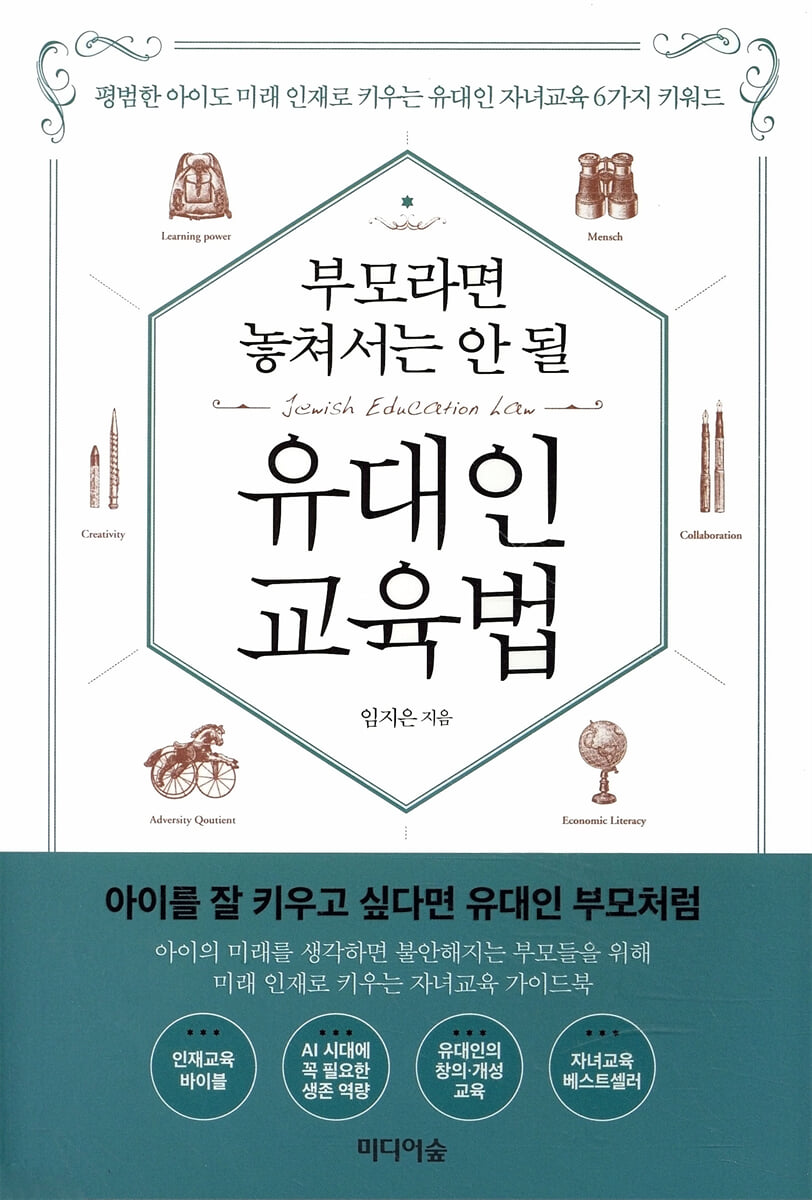
“The education I received was of no help.” “How should we raise our children who will live in the future?” Jewish Parenting Methods Suggested by a "Daechi-dong Kid" Who Became a Mother The author was a 'Daechi-dong kid' who spent his school days moving from one academy to another in Daechi-dong, known as the number one private education district. When I was a student at Daewon Foreign Language High School, I would study on my own until 10 PM and then head to the academy in Daechi-dong. I was always sleep-deprived because I had to go to school at the crack of dawn, and exercise was like a luxury. During class, I wrote down what the teacher said verbatim and memorized it without thinking. I studied meaninglessly without even thinking about what my dream was. It was a lack of strategy. Much later I realized that instead of going to school, I should have been getting enough sleep, exercising regularly, and laughing and sharing my feelings with my friends. "Daechi-dong Kid," who is now a mother, says: He said that the education he received was nothing more or less than a tool to get hired. After going out into society, I painfully felt the limitations of studying by learning faster than others, memorizing, taking tests, and then forgetting again and again. He raised his voice, saying that he had to enjoy learning itself, not be afraid of failure, take on challenges, and develop the strength to solve problems on his own. I assert that I must cultivate the mental strength to truly celebrate the accomplishments of others and the mental fortitude to maintain optimism and a sense of humor even in adversity. |
- You can preview some of the book's contents.
Preview
index
Future Competency 1.
A child who enjoys studying
-Attitude toward Jewish studies
.
Enhance Metacognition with Havruta, a Speaking Study Method
.
Build your thinking muscles with "Havruta" discussions.
.
The more you read out loud, the more your brain enjoys it.
.
The habit of reading books in childhood lasts a lifetime.
[Box] Building Reading Habits in Your Child
.
The Hidden Secret to Jewish Success: Writing
.
A good story to share with your child The greatest asset is the knowledge in your head.
.
Start by teaching them the joy of learning.
Future Competency 2.
Not 'doing better than others' but 'doing differently'
-Jewish creativity and individuality education
.
Be 'unique', not 'best'
.
Why Travel Is Important
.
Happiness and opportunity come from people.
[A Good Story to Share with Your Child] What Made Peter Drucker, the Father of Modern Management
.
Reading, art, and play are essential for a child's imagination.
.
Creating talent through play
.
If you're afraid to ask questions, you won't learn well.
.
Let them draw their own future.
Future Competency 3.
Essential skills in the AI era
-Jewish character education
.
Jews raise their children as 'mensch'
[Box] General MacArthur's "Prayer for Children"
.
Never compare brothers
[A good story to share with children] True life
.
A child gains the strength to survive at the dinner table.
.
Our family's Sabbath
Future Competency 4.
How to be comfortable with anyone
-Jewish communication training
.
Make friends carefully, but make them deeply.
[A good story to share with children] Two friends
.
Jewish parenting methods
[Box] A Jewish Mother's Prayer When Her Child Misbehaves
.
Developing identity and social skills
.
Instilling national pride through history education
Why we need to learn various foreign languages in the AI era
Future Competency 5.
Adversity makes a child stronger
-Jewish adversity education
.
A sense of humor is a weapon in life.
[A Good Story to Share with Your Child] Einstein's Humor
.
When I open my eyes in the morning, I start by being grateful.
[A Good Story to Share with Children] Rabbi Akiva's "Gratitude"
.
It teaches us the strength to get back up again through failure.
.
An era where people with high adversity quotients succeed
Future Competency 6.
Raise my child's financial intelligence
-Jewish economic education
.
The sooner you start studying money, the better.
.
It gives you the experience of making money in your daily life.
.
The rich are not born, they are raised.
.
If you want to be rich, give first.
[Good Stories to Share with Children] Wealth, Family, and Good Deeds
.
Teach the foundation of all relationships: trust.
.
Why do Jewish parents give watches as gifts?
A child who enjoys studying
-Attitude toward Jewish studies
.
Enhance Metacognition with Havruta, a Speaking Study Method
.
Build your thinking muscles with "Havruta" discussions.
.
The more you read out loud, the more your brain enjoys it.
.
The habit of reading books in childhood lasts a lifetime.
[Box] Building Reading Habits in Your Child
.
The Hidden Secret to Jewish Success: Writing
.
A good story to share with your child The greatest asset is the knowledge in your head.
.
Start by teaching them the joy of learning.
Future Competency 2.
Not 'doing better than others' but 'doing differently'
-Jewish creativity and individuality education
.
Be 'unique', not 'best'
.
Why Travel Is Important
.
Happiness and opportunity come from people.
[A Good Story to Share with Your Child] What Made Peter Drucker, the Father of Modern Management
.
Reading, art, and play are essential for a child's imagination.
.
Creating talent through play
.
If you're afraid to ask questions, you won't learn well.
.
Let them draw their own future.
Future Competency 3.
Essential skills in the AI era
-Jewish character education
.
Jews raise their children as 'mensch'
[Box] General MacArthur's "Prayer for Children"
.
Never compare brothers
[A good story to share with children] True life
.
A child gains the strength to survive at the dinner table.
.
Our family's Sabbath
Future Competency 4.
How to be comfortable with anyone
-Jewish communication training
.
Make friends carefully, but make them deeply.
[A good story to share with children] Two friends
.
Jewish parenting methods
[Box] A Jewish Mother's Prayer When Her Child Misbehaves
.
Developing identity and social skills
.
Instilling national pride through history education
Why we need to learn various foreign languages in the AI era
Future Competency 5.
Adversity makes a child stronger
-Jewish adversity education
.
A sense of humor is a weapon in life.
[A Good Story to Share with Your Child] Einstein's Humor
.
When I open my eyes in the morning, I start by being grateful.
[A Good Story to Share with Children] Rabbi Akiva's "Gratitude"
.
It teaches us the strength to get back up again through failure.
.
An era where people with high adversity quotients succeed
Future Competency 6.
Raise my child's financial intelligence
-Jewish economic education
.
The sooner you start studying money, the better.
.
It gives you the experience of making money in your daily life.
.
The rich are not born, they are raised.
.
If you want to be rich, give first.
[Good Stories to Share with Children] Wealth, Family, and Good Deeds
.
Teach the foundation of all relationships: trust.
.
Why do Jewish parents give watches as gifts?
Detailed image

Into the book
** Through Havruta, we do not simply receive knowledge.
Learn how to acquire knowledge.
It's about building the muscles of thought.
It is often said that Jews are not born smart, but rather are educated to be smart.
It is about practicing thinking consistently from a young age.
For Jews who have been reading the Torah since the age of three, Havruta is not a special learning method.
For those who always ask questions and enjoy discussion and debate, Havruta is a way of life that has permeated their lives.
** Jews do not accept anything without asking 'why?'
Because I don't think there is a set answer.
We look at one issue from multiple angles.
They value their own opinions so much that it is said that when three Jews get together, four opinions will emerge.
I think that a child who accepts things without criticism cannot learn well.
Because you don't develop the power of thinking.
** Havruta is not focused on getting the right answer to a question.
Find your own answer, different from others.
Creativity comes from thinking differently from others.
There is a saying in the Talmud:
“When people look at the world head-on, we see it three-dimensionally.” Jews develop three-dimensional thinking skills by looking at a single passage from the Talmud from various angles and repeating endless questions and answers.
** We asked 1,600 people in their 40s who graduated from Harvard, the world's most prestigious university, "What is the most important thing in your current job?"
Surprisingly, more than 90% of graduates answered 'writing'.
When asked, "What do you need to work on more in the future?", the answer "I need to work on writing better" was given nearly three times more often than other answers.
In fact, there are research results that show that writing skills are closely related to income.
** For Jews, writing is life.
There is only a difference between those who write well and those who write poorly.
The fact that one in nine Jews is a writer attests to this.
Jews develop their power of thought by reading, speaking, and writing.
This is the background for Jews to demonstrate their influence in various fields, including academia, journalism, literature, and law.
** If you have 'something' that is different from others, you can achieve a unique position.
'Best' can be one person, but 'unique' can be anyone.
In this way, Jews raise all 100 people to be number 1.
This is how Jews cultivate talent without leaving a single one behind.
** They say that every child is born a genius.
Whether or not you can identify a child's special talent is what separates them from the geniuses.
Just as circles, triangles, and squares are different shapes, so are children.
When parents discover their child's individuality, the child develops his or her potential to the fullest.
Instead of comparing a circle-shaped child to a triangle or square child, let's acknowledge and trust the circle-shaped characteristics.
** A Jew who believes that no standards of the world are his own follows only his own standards.
Because of that, it has become a habit to come up with new things through the fusion of other things.
Through travel, they ask themselves questions, answer them, and develop the power to create ‘differently.’
** The time when a child can really have fun and develop his or her imagination is around the age of ten.
This is similar to saying that the imagination and creativity that a child will have throughout his or her life are created through play around the age of ten.
Going from one academy to another during this period is like trading a lifetime of imagination and creativity for a few pieces of knowledge like English or math.
** The Jewish concept of 'day' is different from the general concept.
Normally, a day means the time from morning to evening, but Jews consider the day to be the opposite, beginning at sunset.
Because I think it's much better to start dark and end bright than to start bright and end dark.
This way of thinking is an example of Jewish optimism.
** Not being afraid of failure is the number one priority of entrepreneurship.
The Israeli government promises failed entrepreneurs more incubation programs and funding than they would for their first venture.
In fact, Tel Aviv, the capital of Israel, produces 1,000 startups every year.
Of these, 2% succeed, but the Israeli government sets aside funds to support the remaining 98% of entrepreneurs who fail.
Plus, it provides 20% more additional support than before the failure.
The government bears full responsibility for the failure.
Israel does not factor startup performance into civil servant performance evaluations, and does not hold startups accountable for lack of success.
** From a young age, children should be taught to take care of their own affairs and gain experience earning money through large and small tasks.
Wealthy families that have inherited wealth for generations do not simply pass down money to their children.
He personally demonstrates the lifestyle habits of the rich from A to Z and teaches them to his children.
We need to reflect on whether we are raising our children to be 'fools' who do nothing but study.
Learn how to acquire knowledge.
It's about building the muscles of thought.
It is often said that Jews are not born smart, but rather are educated to be smart.
It is about practicing thinking consistently from a young age.
For Jews who have been reading the Torah since the age of three, Havruta is not a special learning method.
For those who always ask questions and enjoy discussion and debate, Havruta is a way of life that has permeated their lives.
** Jews do not accept anything without asking 'why?'
Because I don't think there is a set answer.
We look at one issue from multiple angles.
They value their own opinions so much that it is said that when three Jews get together, four opinions will emerge.
I think that a child who accepts things without criticism cannot learn well.
Because you don't develop the power of thinking.
** Havruta is not focused on getting the right answer to a question.
Find your own answer, different from others.
Creativity comes from thinking differently from others.
There is a saying in the Talmud:
“When people look at the world head-on, we see it three-dimensionally.” Jews develop three-dimensional thinking skills by looking at a single passage from the Talmud from various angles and repeating endless questions and answers.
** We asked 1,600 people in their 40s who graduated from Harvard, the world's most prestigious university, "What is the most important thing in your current job?"
Surprisingly, more than 90% of graduates answered 'writing'.
When asked, "What do you need to work on more in the future?", the answer "I need to work on writing better" was given nearly three times more often than other answers.
In fact, there are research results that show that writing skills are closely related to income.
** For Jews, writing is life.
There is only a difference between those who write well and those who write poorly.
The fact that one in nine Jews is a writer attests to this.
Jews develop their power of thought by reading, speaking, and writing.
This is the background for Jews to demonstrate their influence in various fields, including academia, journalism, literature, and law.
** If you have 'something' that is different from others, you can achieve a unique position.
'Best' can be one person, but 'unique' can be anyone.
In this way, Jews raise all 100 people to be number 1.
This is how Jews cultivate talent without leaving a single one behind.
** They say that every child is born a genius.
Whether or not you can identify a child's special talent is what separates them from the geniuses.
Just as circles, triangles, and squares are different shapes, so are children.
When parents discover their child's individuality, the child develops his or her potential to the fullest.
Instead of comparing a circle-shaped child to a triangle or square child, let's acknowledge and trust the circle-shaped characteristics.
** A Jew who believes that no standards of the world are his own follows only his own standards.
Because of that, it has become a habit to come up with new things through the fusion of other things.
Through travel, they ask themselves questions, answer them, and develop the power to create ‘differently.’
** The time when a child can really have fun and develop his or her imagination is around the age of ten.
This is similar to saying that the imagination and creativity that a child will have throughout his or her life are created through play around the age of ten.
Going from one academy to another during this period is like trading a lifetime of imagination and creativity for a few pieces of knowledge like English or math.
** The Jewish concept of 'day' is different from the general concept.
Normally, a day means the time from morning to evening, but Jews consider the day to be the opposite, beginning at sunset.
Because I think it's much better to start dark and end bright than to start bright and end dark.
This way of thinking is an example of Jewish optimism.
** Not being afraid of failure is the number one priority of entrepreneurship.
The Israeli government promises failed entrepreneurs more incubation programs and funding than they would for their first venture.
In fact, Tel Aviv, the capital of Israel, produces 1,000 startups every year.
Of these, 2% succeed, but the Israeli government sets aside funds to support the remaining 98% of entrepreneurs who fail.
Plus, it provides 20% more additional support than before the failure.
The government bears full responsibility for the failure.
Israel does not factor startup performance into civil servant performance evaluations, and does not hold startups accountable for lack of success.
** From a young age, children should be taught to take care of their own affairs and gain experience earning money through large and small tasks.
Wealthy families that have inherited wealth for generations do not simply pass down money to their children.
He personally demonstrates the lifestyle habits of the rich from A to Z and teaches them to his children.
We need to reflect on whether we are raising our children to be 'fools' who do nothing but study.
--- From the text
Publisher's Review
Jews, who make up 0.2% of the world's population, form the world's strongest talent pool.
Their long-standing "talent education bible" that will remain relevant into the future.
Einstein, Freud, Marx, Rothschild, Rockefeller, George Soros, Mark Zuckerberg… There are countless Jews in world history who need no modifiers before their names.
The 'Jewish power' that left a great mark on human history is still ongoing.
There must be a reason why such great people who can change the future of humanity are often produced from ethnic minorities.
If so, isn't it natural that we should look into and study Jewish child education methods to find solutions to the educational crisis in our society?
Israel is a 'startup nation' where 80-90% of university graduates start their own businesses.
They are not bound by any existing doctrine, authority, or order, but rather raise questions, ask endless questions, and take nothing for granted.
The theory of relativity, the Communist Manifesto, and Facebook were all possible thanks to this kind of creativity.
By nurturing the individuality of each child, we raise 100 out of 100 children to become the best in their respective fields, without a single one falling behind.
To nurture talents who can overcome the uncertain information revolution era
The answer lies in Jewish education!
The days of accepting advanced countries' technology and making a living are over.
Now is the time to cultivate the power to create something new.
The future of our children, and indeed the future of our country, depends on education.
Israel and our country, which have only human resources on a small piece of land, have much in common.
It would be a shame to say that this country is second to none in the world in terms of its enthusiasm for education.
Overseas, our people are sometimes referred to as the ‘second Jews.’
However, the teaching methods and results are incomparably different.
Jewish people, who enjoy lifelong learning, cultivate creativity, problem-solving skills, and insight through extensive reading and diverse experiences.
Jews are not born smart, they are made smart.
'Jewish power' appears set to grow stronger.
Our education must also change.
This book contains the deep secrets of Jewish education, a method that has spanned thousands of years and has led to a future.
The author emphasizes his desire to widely share the Jewish method of nurturing talent, the "Bible of Talent Education," which forms the world's strongest talent pool with only 0.2% of the world's population.
Raising even ordinary children into future talents
Six Key Words for Jewish Child Education
The first future competency the author emphasizes is a child who enjoys studying.
By utilizing Havruta, which has already been widely introduced in Korea, we teach you how to develop a study habit that you enjoy on your own rather than studying by force.
And we introduce the competencies essential for talents in future society, including creative and individual education that can help you become a "unique" talent rather than just a "best," character education essential in the AI era, communication education for sociality, adversity education that can help you overcome hardships, and economic education that is the basis for becoming wealthy.
Each book contains touching stories that can be shared with children for each skill level, making it even more interesting to read.
Even today, countless children are still forced to compete for college entrance exams, losing sleep at night.
Parents are just saddened by this reality.
But how helpful will a uniform, entrance exam-focused curriculum truly be in the era to come? Parents are skeptical, but the reality is that finding alternatives is difficult.
This book will instill in parents who are struggling with how to raise their children a firm belief that will not be shaken by any change.
The effectiveness of this educational method is clearly demonstrated by the Jews who are already changing the world and rewriting history.
Their long-standing "talent education bible" that will remain relevant into the future.
Einstein, Freud, Marx, Rothschild, Rockefeller, George Soros, Mark Zuckerberg… There are countless Jews in world history who need no modifiers before their names.
The 'Jewish power' that left a great mark on human history is still ongoing.
There must be a reason why such great people who can change the future of humanity are often produced from ethnic minorities.
If so, isn't it natural that we should look into and study Jewish child education methods to find solutions to the educational crisis in our society?
Israel is a 'startup nation' where 80-90% of university graduates start their own businesses.
They are not bound by any existing doctrine, authority, or order, but rather raise questions, ask endless questions, and take nothing for granted.
The theory of relativity, the Communist Manifesto, and Facebook were all possible thanks to this kind of creativity.
By nurturing the individuality of each child, we raise 100 out of 100 children to become the best in their respective fields, without a single one falling behind.
To nurture talents who can overcome the uncertain information revolution era
The answer lies in Jewish education!
The days of accepting advanced countries' technology and making a living are over.
Now is the time to cultivate the power to create something new.
The future of our children, and indeed the future of our country, depends on education.
Israel and our country, which have only human resources on a small piece of land, have much in common.
It would be a shame to say that this country is second to none in the world in terms of its enthusiasm for education.
Overseas, our people are sometimes referred to as the ‘second Jews.’
However, the teaching methods and results are incomparably different.
Jewish people, who enjoy lifelong learning, cultivate creativity, problem-solving skills, and insight through extensive reading and diverse experiences.
Jews are not born smart, they are made smart.
'Jewish power' appears set to grow stronger.
Our education must also change.
This book contains the deep secrets of Jewish education, a method that has spanned thousands of years and has led to a future.
The author emphasizes his desire to widely share the Jewish method of nurturing talent, the "Bible of Talent Education," which forms the world's strongest talent pool with only 0.2% of the world's population.
Raising even ordinary children into future talents
Six Key Words for Jewish Child Education
The first future competency the author emphasizes is a child who enjoys studying.
By utilizing Havruta, which has already been widely introduced in Korea, we teach you how to develop a study habit that you enjoy on your own rather than studying by force.
And we introduce the competencies essential for talents in future society, including creative and individual education that can help you become a "unique" talent rather than just a "best," character education essential in the AI era, communication education for sociality, adversity education that can help you overcome hardships, and economic education that is the basis for becoming wealthy.
Each book contains touching stories that can be shared with children for each skill level, making it even more interesting to read.
Even today, countless children are still forced to compete for college entrance exams, losing sleep at night.
Parents are just saddened by this reality.
But how helpful will a uniform, entrance exam-focused curriculum truly be in the era to come? Parents are skeptical, but the reality is that finding alternatives is difficult.
This book will instill in parents who are struggling with how to raise their children a firm belief that will not be shaken by any change.
The effectiveness of this educational method is clearly demonstrated by the Jews who are already changing the world and rewriting history.
GOODS SPECIFICS
- Date of issue: April 10, 2020
- Page count, weight, size: 256 pages | 460g | 153*225*16mm
- ISBN13: 9791158740665
- ISBN10: 1158740662
You may also like
카테고리
korean


korean

![GQ KOREA Mark (Monthly): December [2025]](http://librairie.coreenne.fr/cdn/shop/files/8ef265dbbfbf186523ed75ba7319009d.jpg?v=1765340328&width=3840)


