

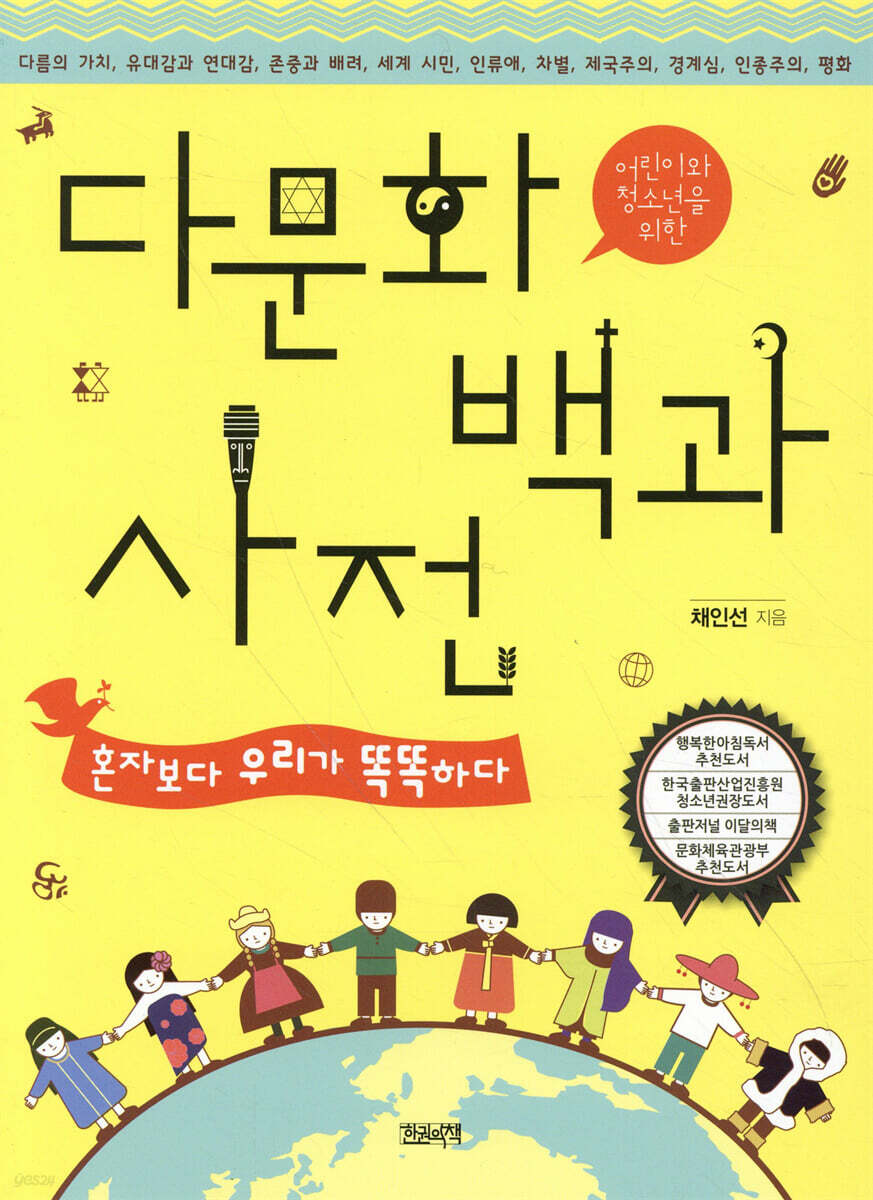
Multicultural Encyclopedia
 |
Description
Book Introduction
Multiculturalism, a precious value for a society where we live together
A person cannot live alone.
And everyone has their own unique culture.
The starting point of this book is these two sentences that seem so obvious.
In the near future, 50 million people make up our society called the Republic of Korea, and in the distant future, 7 billion different people come together to form the global village.
The myriad of diverse places is becoming increasingly geographically close.
The world we live in is moving towards an organic global village where we will inevitably fall behind if we insist on remaining a closed and isolated society.
This book is a children's and youth cultural book that seeks new ways of harmony through the concept of 'multiculturalism' and seriously explores multiculturalism in general.
It clearly covers the overall content that we need to know and share about multiculturalism, including the world historical background of the beginning of multiculturalism, the philosophical background that recognizes difference and otherness, the sociological background surrounding racial discrimination and imperialism, and the psychological background of vigilance, respect, and consideration.
A person cannot live alone.
And everyone has their own unique culture.
The starting point of this book is these two sentences that seem so obvious.
In the near future, 50 million people make up our society called the Republic of Korea, and in the distant future, 7 billion different people come together to form the global village.
The myriad of diverse places is becoming increasingly geographically close.
The world we live in is moving towards an organic global village where we will inevitably fall behind if we insist on remaining a closed and isolated society.
This book is a children's and youth cultural book that seeks new ways of harmony through the concept of 'multiculturalism' and seriously explores multiculturalism in general.
It clearly covers the overall content that we need to know and share about multiculturalism, including the world historical background of the beginning of multiculturalism, the philosophical background that recognizes difference and otherness, the sociological background surrounding racial discrimination and imperialism, and the psychological background of vigilance, respect, and consideration.
- You can preview some of the book's contents.
Preview
index
Chapter 1 - Opening the Door to a Multicultural Encyclopedia
(Multiculturalism, cultural encounters, unfamiliarity and familiarity)
Chapter 2 - Multiculturalism and Population Migration
(migration, nomadism, agriculture, class, war, slavery, cultural exchange, imperialism, colonies, Africa and the Americas, immigration, refugees and exile)
Migration and wandering are long-standing human habits / Agriculture and war / Population movements on the Korean Peninsula
Population Movements in the West / Migration and Settlement
Chapter 3 - Multiculturalism Trapped in Race
(Vigilantism, xenophobia, racism, pacifism, genocide of indigenous peoples, Indian wars, African slavery, white supremacy, imperialism, colonization, comfort women, the Kwantung Massacre, the Nanking Massacre, the Jewish massacre, ethnic cleansing, humanity, anti-racist movements)
Vigilance / Xenophobia and Racism / America's Anger / Africa's Tears
Asia's Nightmare / What Imperialist Nations Must Pay / Why They Can't Be Forgiven
Hitler's Holocaust / The Never-ending Tragedy / Those Who Called for a World Without Discrimination
Chapter 4 - The Illusion of Race, the Illusion of a Single Ethnicity
(race, ethnicity, color, racial discrimination, nationality, citizen, single ethnicity)
Skin Color and Race / Homo sapiens sapiens / Liberation from Race
Nation, People, Citizens / The Illusion of a Single Nation
Chapter 5 - Understanding and Valuing Differences
(Value of difference, genes, uniqueness, relationships, universal standards, solidarity and solidarity, mutual respect and consideration, greetings and hospitality)
Everyone is different / The beginning of a relationship is recognition / Culture and universal ethical standards /
Opportunity to encounter new cultures / Solidarity and connection / Mutual respect and consideration / Greetings and hospitality
Chapter 6 - Multiculturalism in Korea
(Multicultural families, immigrant women, international marriages, immigrant workers, violations of personal dignity, illegal immigrants, nationality, status system, North Korean immigrants, division and unification)
Racism within us / Multicultural families and immigrant women / Migrant workers / Illegal immigrants and stateless children
Slavery in Historical Dramas and Beyond / North Korean Immigrants / The Problem of Unification
Chapter 7 - Living Together
(Multicultural society, multicultural second generation, socially disadvantaged, global citizen, humanity, right action and everyone action)
The Ins and Outs of Multiculturalism / How to Get Along / For a Beautiful Country Where Cultures Are Enjoyed
(Multiculturalism, cultural encounters, unfamiliarity and familiarity)
Chapter 2 - Multiculturalism and Population Migration
(migration, nomadism, agriculture, class, war, slavery, cultural exchange, imperialism, colonies, Africa and the Americas, immigration, refugees and exile)
Migration and wandering are long-standing human habits / Agriculture and war / Population movements on the Korean Peninsula
Population Movements in the West / Migration and Settlement
Chapter 3 - Multiculturalism Trapped in Race
(Vigilantism, xenophobia, racism, pacifism, genocide of indigenous peoples, Indian wars, African slavery, white supremacy, imperialism, colonization, comfort women, the Kwantung Massacre, the Nanking Massacre, the Jewish massacre, ethnic cleansing, humanity, anti-racist movements)
Vigilance / Xenophobia and Racism / America's Anger / Africa's Tears
Asia's Nightmare / What Imperialist Nations Must Pay / Why They Can't Be Forgiven
Hitler's Holocaust / The Never-ending Tragedy / Those Who Called for a World Without Discrimination
Chapter 4 - The Illusion of Race, the Illusion of a Single Ethnicity
(race, ethnicity, color, racial discrimination, nationality, citizen, single ethnicity)
Skin Color and Race / Homo sapiens sapiens / Liberation from Race
Nation, People, Citizens / The Illusion of a Single Nation
Chapter 5 - Understanding and Valuing Differences
(Value of difference, genes, uniqueness, relationships, universal standards, solidarity and solidarity, mutual respect and consideration, greetings and hospitality)
Everyone is different / The beginning of a relationship is recognition / Culture and universal ethical standards /
Opportunity to encounter new cultures / Solidarity and connection / Mutual respect and consideration / Greetings and hospitality
Chapter 6 - Multiculturalism in Korea
(Multicultural families, immigrant women, international marriages, immigrant workers, violations of personal dignity, illegal immigrants, nationality, status system, North Korean immigrants, division and unification)
Racism within us / Multicultural families and immigrant women / Migrant workers / Illegal immigrants and stateless children
Slavery in Historical Dramas and Beyond / North Korean Immigrants / The Problem of Unification
Chapter 7 - Living Together
(Multicultural society, multicultural second generation, socially disadvantaged, global citizen, humanity, right action and everyone action)
The Ins and Outs of Multiculturalism / How to Get Along / For a Beautiful Country Where Cultures Are Enjoyed
Publisher's Review
Why a 'Multicultural Encyclopedia'?
The society our children will live in is a multicultural society!
This book is a children's and youth cultural textbook that seriously explores multiculturalism in general.
It clearly covers the overall content that we need to know and share about multiculturalism, including the world historical background of the beginning of multiculturalism, the philosophical background that recognizes difference and otherness, the sociological background surrounding racial discrimination and imperialism, and the psychological background of vigilance, respect, and consideration.
Our society has already entered a multicultural society.
Even without relying on media statistics, the number of foreign workers, multicultural families, and second-generation multicultural children has grown to a level that is having a significant impact on our society, and this number is expected to continue to increase in the future.
These social changes are a natural process that cannot be reversed or rejected, and they require open minds and brotherhood from people all over the world.
There will be hope for our society when we embrace diverse cultures, coexist, care for each other, and create values for living together in harmony.
Multiculturalism is not a problem for a specific person, but a problem for all of us.
Understanding multiculturalism is valuable for our future.
Different cultures, but the same people
If we divide people by skin color, we are all yellow.
Now is the time to raise the flag of multiculturalism.
-Cultures are different, but people are the same.
“We are so focused on our differences in appearance and culture that we forget that we are all the same.
You and I are the same.
We are the same people.
Everything else is different.
If we remember this every moment, discrimination, injustice, bullying, and exclusion can disappear like melting snow.”
-If you divide by skin color, all Earthlings are yellow.
"If you were to put all the pigments representing the complexions of Earth's people on a palette, would you be able to tell everyone where white ends and black ends? If you insist on categorizing people by skin color, then all Earthlings are yellow.
“There are only ‘light yellow people’ and ‘dark yellow people.’”
It is time to raise the flag of multiculturalism for a society where we live together.
“We must not remain silent in the face of injustice, unfairness, and social corruption. Instead, we must take action to the extent possible.
If we know but do not put it into practice, there is no hope for humanity.
First you have to know, then you have to practice.
If you've learned something from this book, now is the time to put it into practice.”
A full-fledged children's and youth nonfiction book dealing with 'multiculturalism'
Multiculturalism is not our neighbors' problem that we need to help, it is our own problem!
In line with the growing social interest in multiculturalism, dozens of children's and young adult books on the subject are already available in bookstores.
However, most of the children's books are emotionally focused on the plight of multicultural second-generation children who have not yet adapted to society, or books that focus on knowledge and information about various cultures around the world.
Of course, these are necessary books that are suited to the eye level and sensitivity of children living in a multicultural society, but it is also a reality that leaves a sense of regret that multiculturalism is sometimes perceived not as an individual's problem, but as a problem of a specific person in difficulty, or as a story about the weak in a fairy tale.
Now is the time for a deeper understanding and interest in multiculturalism.
Because multiculturalism is now a problem for all of us.
I hope this book will be a genuine starting point, offering hope for understanding our reality, accepting our neighbors, and creating a more colorful future.
“If we neglect our understanding of multiculturalism, our children may end up living in an unlucky country.
You might be sad that you were born in an unlucky country.
How heartbreaking it must be for our parents' generation to have to watch that.
If we want to create a country that is always lucky, we must first examine what kind of thoughts the people around us have before examining what kind of culture they come from.
If we think like this, we can change the world.
Just having hope and making an effort is the beginning of change.
I hope this book will be read by those who are working hard.” - From the author’s note
The society our children will live in is a multicultural society!
This book is a children's and youth cultural textbook that seriously explores multiculturalism in general.
It clearly covers the overall content that we need to know and share about multiculturalism, including the world historical background of the beginning of multiculturalism, the philosophical background that recognizes difference and otherness, the sociological background surrounding racial discrimination and imperialism, and the psychological background of vigilance, respect, and consideration.
Our society has already entered a multicultural society.
Even without relying on media statistics, the number of foreign workers, multicultural families, and second-generation multicultural children has grown to a level that is having a significant impact on our society, and this number is expected to continue to increase in the future.
These social changes are a natural process that cannot be reversed or rejected, and they require open minds and brotherhood from people all over the world.
There will be hope for our society when we embrace diverse cultures, coexist, care for each other, and create values for living together in harmony.
Multiculturalism is not a problem for a specific person, but a problem for all of us.
Understanding multiculturalism is valuable for our future.
Different cultures, but the same people
If we divide people by skin color, we are all yellow.
Now is the time to raise the flag of multiculturalism.
-Cultures are different, but people are the same.
“We are so focused on our differences in appearance and culture that we forget that we are all the same.
You and I are the same.
We are the same people.
Everything else is different.
If we remember this every moment, discrimination, injustice, bullying, and exclusion can disappear like melting snow.”
-If you divide by skin color, all Earthlings are yellow.
"If you were to put all the pigments representing the complexions of Earth's people on a palette, would you be able to tell everyone where white ends and black ends? If you insist on categorizing people by skin color, then all Earthlings are yellow.
“There are only ‘light yellow people’ and ‘dark yellow people.’”
It is time to raise the flag of multiculturalism for a society where we live together.
“We must not remain silent in the face of injustice, unfairness, and social corruption. Instead, we must take action to the extent possible.
If we know but do not put it into practice, there is no hope for humanity.
First you have to know, then you have to practice.
If you've learned something from this book, now is the time to put it into practice.”
A full-fledged children's and youth nonfiction book dealing with 'multiculturalism'
Multiculturalism is not our neighbors' problem that we need to help, it is our own problem!
In line with the growing social interest in multiculturalism, dozens of children's and young adult books on the subject are already available in bookstores.
However, most of the children's books are emotionally focused on the plight of multicultural second-generation children who have not yet adapted to society, or books that focus on knowledge and information about various cultures around the world.
Of course, these are necessary books that are suited to the eye level and sensitivity of children living in a multicultural society, but it is also a reality that leaves a sense of regret that multiculturalism is sometimes perceived not as an individual's problem, but as a problem of a specific person in difficulty, or as a story about the weak in a fairy tale.
Now is the time for a deeper understanding and interest in multiculturalism.
Because multiculturalism is now a problem for all of us.
I hope this book will be a genuine starting point, offering hope for understanding our reality, accepting our neighbors, and creating a more colorful future.
“If we neglect our understanding of multiculturalism, our children may end up living in an unlucky country.
You might be sad that you were born in an unlucky country.
How heartbreaking it must be for our parents' generation to have to watch that.
If we want to create a country that is always lucky, we must first examine what kind of thoughts the people around us have before examining what kind of culture they come from.
If we think like this, we can change the world.
Just having hope and making an effort is the beginning of change.
I hope this book will be read by those who are working hard.” - From the author’s note
GOODS SPECIFICS
- Date of publication: October 23, 2012
- Page count, weight, size: 160 pages | 438g | 170*230*20mm
- ISBN13: 9788996877745
- ISBN10: 8996877743
You may also like
카테고리
korean


korean

![GQ KOREA Mark (Monthly): December [2025]](http://librairie.coreenne.fr/cdn/shop/files/8ef265dbbfbf186523ed75ba7319009d.jpg?v=1765340328&width=3840)


