

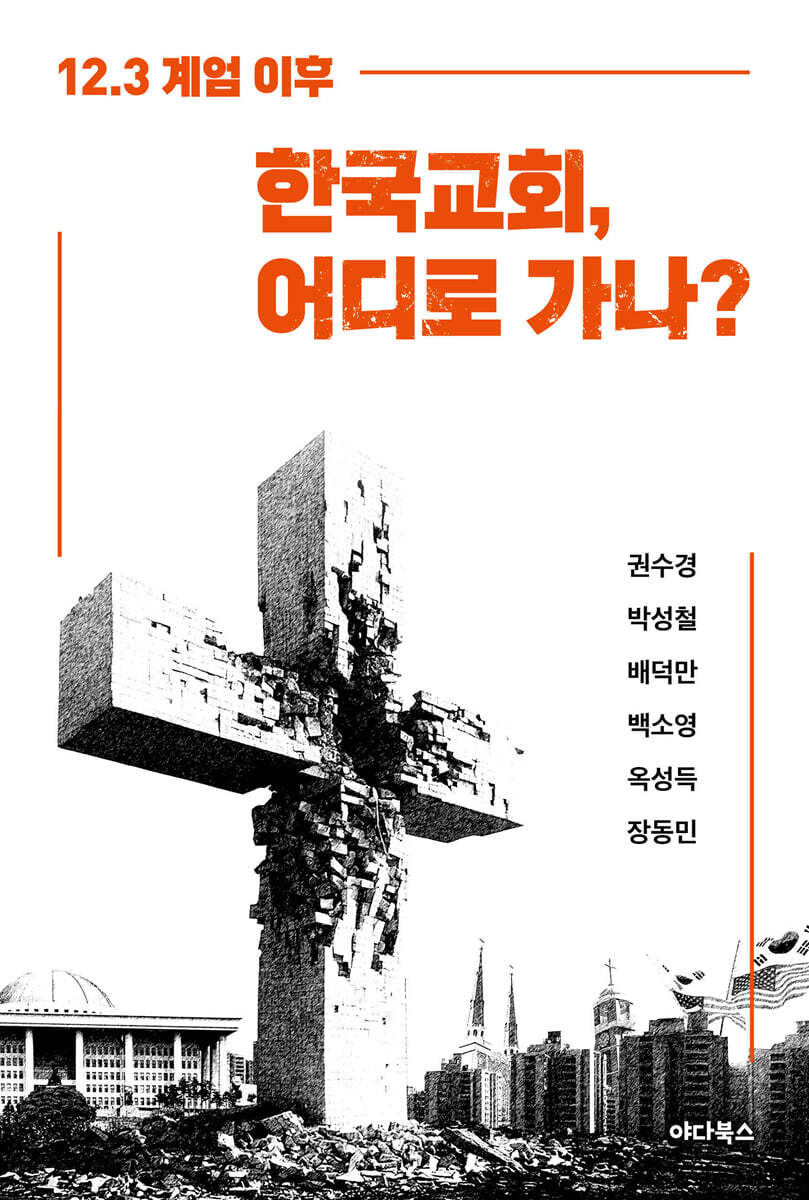
Where is the Korean church headed?
 |
Description
Book Introduction
Now that the church has become a source of worry rather than a source of hope for the world,
We must ask again about the Gospel and the way of the cross!”
On December 3, 2024, following the so-called "12.3 Illegal Martial Law Incident," Korean society experienced great shock and division.
And in the middle of it all was the Korean church.
The Korean church's attitude of justifying violence in the name of faith and shouting hatred and exclusion in the language of the gospel has left us all perplexed.
Of course, it could be said that this is only a very small part of the Korean church.
But it is also undeniable that most churches have remained silent on some of them.
This book looks back at the Korean church in this very situation, asking, "Where should we begin again, and where should we go?" and is a response to this question offered by six theologians and pastors.
We must ask again about the Gospel and the way of the cross!”
On December 3, 2024, following the so-called "12.3 Illegal Martial Law Incident," Korean society experienced great shock and division.
And in the middle of it all was the Korean church.
The Korean church's attitude of justifying violence in the name of faith and shouting hatred and exclusion in the language of the gospel has left us all perplexed.
Of course, it could be said that this is only a very small part of the Korean church.
But it is also undeniable that most churches have remained silent on some of them.
This book looks back at the Korean church in this very situation, asking, "Where should we begin again, and where should we go?" and is a response to this question offered by six theologians and pastors.
- You can preview some of the book's contents.
Preview
index
Preface: From Personality and Daily Life
The terrain is 7 as the world and existence change.
Idolatry in Korean churches
: Power, Wealth, and Ideology _ Kwon Soo-kyung 13
Trump, Fundamentalism, and the Korean Church _ Baek Deok-man 55
A History of Fundamentalist and Liberal Theology
: The Light and Shadow of the Korean Church _Ok Seong-deuk 93
The Problem of the Korean Church and the Christian Far Right
: Towards Deauthorization and New Solidarity _ Park Seong-cheol 139
Criticism of the Korean Church's "Women's Manual" _ Baek So-young 179
Reconstructing the Public Spirituality of the Korean Church _Jang Dong-min 229
Note 278
The terrain is 7 as the world and existence change.
Idolatry in Korean churches
: Power, Wealth, and Ideology _ Kwon Soo-kyung 13
Trump, Fundamentalism, and the Korean Church _ Baek Deok-man 55
A History of Fundamentalist and Liberal Theology
: The Light and Shadow of the Korean Church _Ok Seong-deuk 93
The Problem of the Korean Church and the Christian Far Right
: Towards Deauthorization and New Solidarity _ Park Seong-cheol 139
Criticism of the Korean Church's "Women's Manual" _ Baek So-young 179
Reconstructing the Public Spirituality of the Korean Church _Jang Dong-min 229
Note 278
Detailed image
Into the book
We must keep this in mind when we talk about 'church reform or renewal' today.
When we think about the relationship between the Kingdom of God and the Church as taught by Jesus Christ, and the Church as the mystery of the last days as spoken of in the Book of Ephesians, the Church is connected to the world and all that exists.
The church is the social group that manifests itself as the phenomenal center of Christian faith.
The church is always associated with the 'ends of the earth', 'all things in heaven and on earth', and 'all nations'.
In today's context, it is related to everything in human life, including politics, economics, law, education, and culture, as well as the global environment.
There is no situation of existence in which theology and faith are not involved.
--- p.8-9
Just as Abraham became a stranger, but his hometown was not Ur of the Chaldeans but heaven (Hebrews 11:15-16), it is clear that our church history has fallen, but we cannot look back to the early history to find the ideal from which we can recover.
Where in the earthly church could such a place exist? Even in the truly beautiful first love, human greed and various idols were intertwined.
The first love we must restore is not the starting point of our distorted history, but the Bible, which allows us to see that history correctly.
If we look at it that way, returning to Jehovah is the only true restoration.
--- p.20
The church must embrace the principles of the Bible and exert a positive influence on the world.
The church must first set an example of a life of sharing and living together, and must also strive to create a system in the world where people share with one another rather than monopolize everything.
But the Korean church is not qualified to do such a thing in the first place.
Because the church is more capitalistic than the world, and the church shows a greater gap between the rich and the poor than the world.
The size of the church, the scale of the business, the difference in the salaries of the pastors, the severance pay… it’s really indescribable.
In a capitalist church, the rich have the power.
So when the government of the world makes a policy to equalize, the church criticizes it as a communist policy.
It seems like the church and the world have been turned upside down.
I'm not sure if what we believe is really the gospel of Jesus Christ.
--- p.39
I think this is the limitation of a church that has served idols from the beginning.
At first, it served power, and with it, ideology.
After that, he served power, money, and ideology comprehensively.
Without making any effort to recognize, acknowledge, repent, and turn away from such idolatry, we have developed and utilized diverse and profound training programs with only a clear religious overtone. How can spiritual maturity be achieved in such a limited setting, and how can we cultivate believers who resemble Christ in their daily lives?
--- p.50-51
David P. Gersh
Gushee) criticized that evangelical politics hit rock bottom the moment white evangelicals in the United States voted overwhelmingly for Trump in the 2016 presidential election.
At the same time, he pointed out that the era of post-evangelicalism had begun in earnest as many young evangelicals, disappointed by this appearance, abandoned their faith.
According to his observations, evangelicals tend to look to Republican administrations to serve their own interests, and Republicans look to the large group of white evangelicals for help in solidarity.
As a result, being a (white) evangelical now means being a Republican.
… This kind of corruption and degeneration of evangelicalism is diagnosed as the main reason why many evangelicals, including Gersh himself, are abandoning the evangelical faith.
--- p.78-79
Theology is the product of the encounter between the gospel (Christ) and the context (culture).
The theological work of reinterpreting and practicing the history of the gospel's indigenization and cultural transformation in the Korean context and the theological history of organizing it from a historical perspective go hand in hand.
History helps us not to get lost in presentism.
While there is a wide theological spectrum between the far right and the far left, the crisis is amplified when extremes dominate the church.
Theology changes, and the concepts of conservatism, liberalism, and progressivism are not fixed.
--- p.95-96
In conclusion, fundamentalism played an important role in the history of Korean Protestantism, but its limitations were also clear.
Although fundamentalism has tried to maintain doctrinal purity, there have been many aspects that have been distorted or altered by the times and political ideologies.
Especially since the 1990s, the political participation of the so-called progressives and conservatives has been the main cause of the loss of the church's growth momentum and the deepening of division and conflict.
For the Korean church to experience a revival in the future, it needs not only doctrinal purity but also theological reflection that restores the love, inclusion, and social responsibility that are the essence of the gospel, without being mired in politics.
--- p.137
Of course, those who actively sympathize with political extremism and display antisocial behavior are clearly a minority.
But the reason why antisocial behavior by a minority is possible is because there is passive consent from the majority who silently accept it.
The core of the phenomenon of men in their 20s is not that "all men in their 20s are far-right," but rather that there are many who passively agree with far-right arguments, and that a small number of people who engage in anti-social behavior are expanding their influence based on this.
--- p.151
“Just come out before you get crushed and suffocated!” The voices of young church women are loud as they shout.
right.
If you feel like you're going to die, run away first.
Take a breath and live for yourself.
Because if you have life, you will have the strength to change and start again.
But just like a person who has been holding their breath for over half a century because a surgical gauze was stuck in their lungs, the Korean church has been such a long-standing love-hate relationship with me that I can never escape it.
So, I cry out without giving up the faint hope that the Korean church can start again.
If you hope the phrase "after December 3rd" will bring about a sense of renewal, and thus a renewal of the Korean church, then let the voices that have been unheard (or not heard) within the church be heard first! Start from there.
--- p.227
Conservatives who have lost their spirituality protect their vested interests rather than upholding values, and progressives who have lost their spirituality for self-reflection fall into a sense of moral superiority and try to teach others, only to provoke public resentment and anger.
If Christians are to provide spiritual nourishment to the democratic republic, our spirituality must transcend ideology and system.
When spirituality and system become closely linked, they degenerate into blind energy and self-destruct.
But today, Christianity has lost its true spirituality and degenerated into Christian tribalism by colluding with conservatives and even the far right.
Obsessed with the delusion of establishing a 'Kingdom of God' in the manner of the 'Crusades', they set up false enemies outside the church and mobilize power and violence.
When we think about the relationship between the Kingdom of God and the Church as taught by Jesus Christ, and the Church as the mystery of the last days as spoken of in the Book of Ephesians, the Church is connected to the world and all that exists.
The church is the social group that manifests itself as the phenomenal center of Christian faith.
The church is always associated with the 'ends of the earth', 'all things in heaven and on earth', and 'all nations'.
In today's context, it is related to everything in human life, including politics, economics, law, education, and culture, as well as the global environment.
There is no situation of existence in which theology and faith are not involved.
--- p.8-9
Just as Abraham became a stranger, but his hometown was not Ur of the Chaldeans but heaven (Hebrews 11:15-16), it is clear that our church history has fallen, but we cannot look back to the early history to find the ideal from which we can recover.
Where in the earthly church could such a place exist? Even in the truly beautiful first love, human greed and various idols were intertwined.
The first love we must restore is not the starting point of our distorted history, but the Bible, which allows us to see that history correctly.
If we look at it that way, returning to Jehovah is the only true restoration.
--- p.20
The church must embrace the principles of the Bible and exert a positive influence on the world.
The church must first set an example of a life of sharing and living together, and must also strive to create a system in the world where people share with one another rather than monopolize everything.
But the Korean church is not qualified to do such a thing in the first place.
Because the church is more capitalistic than the world, and the church shows a greater gap between the rich and the poor than the world.
The size of the church, the scale of the business, the difference in the salaries of the pastors, the severance pay… it’s really indescribable.
In a capitalist church, the rich have the power.
So when the government of the world makes a policy to equalize, the church criticizes it as a communist policy.
It seems like the church and the world have been turned upside down.
I'm not sure if what we believe is really the gospel of Jesus Christ.
--- p.39
I think this is the limitation of a church that has served idols from the beginning.
At first, it served power, and with it, ideology.
After that, he served power, money, and ideology comprehensively.
Without making any effort to recognize, acknowledge, repent, and turn away from such idolatry, we have developed and utilized diverse and profound training programs with only a clear religious overtone. How can spiritual maturity be achieved in such a limited setting, and how can we cultivate believers who resemble Christ in their daily lives?
--- p.50-51
David P. Gersh
Gushee) criticized that evangelical politics hit rock bottom the moment white evangelicals in the United States voted overwhelmingly for Trump in the 2016 presidential election.
At the same time, he pointed out that the era of post-evangelicalism had begun in earnest as many young evangelicals, disappointed by this appearance, abandoned their faith.
According to his observations, evangelicals tend to look to Republican administrations to serve their own interests, and Republicans look to the large group of white evangelicals for help in solidarity.
As a result, being a (white) evangelical now means being a Republican.
… This kind of corruption and degeneration of evangelicalism is diagnosed as the main reason why many evangelicals, including Gersh himself, are abandoning the evangelical faith.
--- p.78-79
Theology is the product of the encounter between the gospel (Christ) and the context (culture).
The theological work of reinterpreting and practicing the history of the gospel's indigenization and cultural transformation in the Korean context and the theological history of organizing it from a historical perspective go hand in hand.
History helps us not to get lost in presentism.
While there is a wide theological spectrum between the far right and the far left, the crisis is amplified when extremes dominate the church.
Theology changes, and the concepts of conservatism, liberalism, and progressivism are not fixed.
--- p.95-96
In conclusion, fundamentalism played an important role in the history of Korean Protestantism, but its limitations were also clear.
Although fundamentalism has tried to maintain doctrinal purity, there have been many aspects that have been distorted or altered by the times and political ideologies.
Especially since the 1990s, the political participation of the so-called progressives and conservatives has been the main cause of the loss of the church's growth momentum and the deepening of division and conflict.
For the Korean church to experience a revival in the future, it needs not only doctrinal purity but also theological reflection that restores the love, inclusion, and social responsibility that are the essence of the gospel, without being mired in politics.
--- p.137
Of course, those who actively sympathize with political extremism and display antisocial behavior are clearly a minority.
But the reason why antisocial behavior by a minority is possible is because there is passive consent from the majority who silently accept it.
The core of the phenomenon of men in their 20s is not that "all men in their 20s are far-right," but rather that there are many who passively agree with far-right arguments, and that a small number of people who engage in anti-social behavior are expanding their influence based on this.
--- p.151
“Just come out before you get crushed and suffocated!” The voices of young church women are loud as they shout.
right.
If you feel like you're going to die, run away first.
Take a breath and live for yourself.
Because if you have life, you will have the strength to change and start again.
But just like a person who has been holding their breath for over half a century because a surgical gauze was stuck in their lungs, the Korean church has been such a long-standing love-hate relationship with me that I can never escape it.
So, I cry out without giving up the faint hope that the Korean church can start again.
If you hope the phrase "after December 3rd" will bring about a sense of renewal, and thus a renewal of the Korean church, then let the voices that have been unheard (or not heard) within the church be heard first! Start from there.
--- p.227
Conservatives who have lost their spirituality protect their vested interests rather than upholding values, and progressives who have lost their spirituality for self-reflection fall into a sense of moral superiority and try to teach others, only to provoke public resentment and anger.
If Christians are to provide spiritual nourishment to the democratic republic, our spirituality must transcend ideology and system.
When spirituality and system become closely linked, they degenerate into blind energy and self-destruct.
But today, Christianity has lost its true spirituality and degenerated into Christian tribalism by colluding with conservatives and even the far right.
Obsessed with the delusion of establishing a 'Kingdom of God' in the manner of the 'Crusades', they set up false enemies outside the church and mobilize power and violence.
--- p.271
Publisher's Review
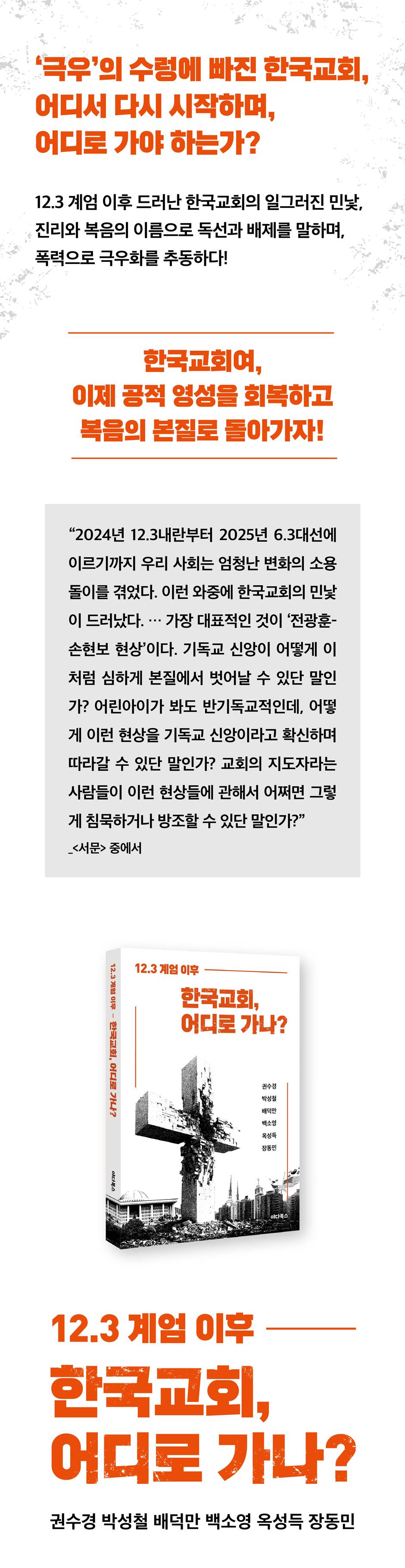
The Korean church, mired in the swamp of the "extreme right," where should it begin again and where should it go?
December 3rd: The distorted face of the Korean church revealed after martial law: speaking of self-righteousness and exclusion in the name of truth and the gospel, and driving extreme right-wing extremism with violence!
Korean Church, let us now restore public spirituality and return to the essence of the gospel!
Kwon Soo-kyung criticized the Korean church for its three idols: power, wealth, and ideology, which distorted faith and led to the loss of the gospel.
Baek Deok-man's collusion with American Trumpism and far-right evangelicalism, which served as the background and driving force behind the extreme right-wing movement of the Korean church,
Park Seong-cheol discusses the problems of far-right Christianity in the context of post-modern fascism and the need for new transversal solidarity and resistance.
Baek So-young advocates for the dismantling and overcoming of the patriarchal authoritarianism and women-exclusion structure deeply rooted in the Korean church.
Ok Seong-deuk reveals the limitations of fundamentalist theology and political participation in the conflict between fundamentalism and liberalism.
Jang Dong-min deals with the transformation of the church from private spirituality to public spirituality.
This book is not simply a critique of the Korean church.
Rather, it is a cry of love that urges reflection and practice, saying that the Korean church must also begin a new, "eventual" change in the face of the important "eventual" change in Korean society after the "December 3 martial law."
The church should not be a source of worry for the world, but should be the world's hope as salt and light.
Any reader who loves the Korean church will pause for a moment before the cry of this book.
And that pause will be a new starting point for the Korean church.
From the 'Preface'
Currently, the social trust in the Korean church is at rock bottom.
Some say that it doesn't matter what the world thinks of you, and that you shouldn't worry about things like social trust.
What matters is how God sees it.
So, does this mean that the current state of the Korean church is truly admirable and healthy in God's eyes, yet society misunderstands, misinterprets, and criticizes the church? If you hold this view, you're a victim of the social confirmation bias of far-right fundamentalism.
Religious identity and social connection are both essential to Christianity.
The two are inseparable.
There are two sides to the same coin.
"syncopation"
From the December 3rd Civil War in 2024 to the June 3rd presidential election in 2025, our society experienced a whirlwind of tremendous change.
In the midst of this, the true face of the Korean church was revealed.
Long before COVID-19, or rather, throughout the hundreds of years of Korean church history, inconvenient problems that had been unresolved and simply passed down have all been brought to light.
The most representative example is the ‘Jeon Gwang-hoon-Son Hyeon-bo phenomenon.’
How can the Christian faith deviate so drastically from its essence? Even a child can see how this is anti-Christian, so how can anyone follow this phenomenon with such conviction that it's Christian faith? How can those who call themselves church leaders remain so silent or even abet these phenomena?
December 3rd: The distorted face of the Korean church revealed after martial law: speaking of self-righteousness and exclusion in the name of truth and the gospel, and driving extreme right-wing extremism with violence!
Korean Church, let us now restore public spirituality and return to the essence of the gospel!
Kwon Soo-kyung criticized the Korean church for its three idols: power, wealth, and ideology, which distorted faith and led to the loss of the gospel.
Baek Deok-man's collusion with American Trumpism and far-right evangelicalism, which served as the background and driving force behind the extreme right-wing movement of the Korean church,
Park Seong-cheol discusses the problems of far-right Christianity in the context of post-modern fascism and the need for new transversal solidarity and resistance.
Baek So-young advocates for the dismantling and overcoming of the patriarchal authoritarianism and women-exclusion structure deeply rooted in the Korean church.
Ok Seong-deuk reveals the limitations of fundamentalist theology and political participation in the conflict between fundamentalism and liberalism.
Jang Dong-min deals with the transformation of the church from private spirituality to public spirituality.
This book is not simply a critique of the Korean church.
Rather, it is a cry of love that urges reflection and practice, saying that the Korean church must also begin a new, "eventual" change in the face of the important "eventual" change in Korean society after the "December 3 martial law."
The church should not be a source of worry for the world, but should be the world's hope as salt and light.
Any reader who loves the Korean church will pause for a moment before the cry of this book.
And that pause will be a new starting point for the Korean church.
From the 'Preface'
Currently, the social trust in the Korean church is at rock bottom.
Some say that it doesn't matter what the world thinks of you, and that you shouldn't worry about things like social trust.
What matters is how God sees it.
So, does this mean that the current state of the Korean church is truly admirable and healthy in God's eyes, yet society misunderstands, misinterprets, and criticizes the church? If you hold this view, you're a victim of the social confirmation bias of far-right fundamentalism.
Religious identity and social connection are both essential to Christianity.
The two are inseparable.
There are two sides to the same coin.
"syncopation"
From the December 3rd Civil War in 2024 to the June 3rd presidential election in 2025, our society experienced a whirlwind of tremendous change.
In the midst of this, the true face of the Korean church was revealed.
Long before COVID-19, or rather, throughout the hundreds of years of Korean church history, inconvenient problems that had been unresolved and simply passed down have all been brought to light.
The most representative example is the ‘Jeon Gwang-hoon-Son Hyeon-bo phenomenon.’
How can the Christian faith deviate so drastically from its essence? Even a child can see how this is anti-Christian, so how can anyone follow this phenomenon with such conviction that it's Christian faith? How can those who call themselves church leaders remain so silent or even abet these phenomena?
GOODS SPECIFICS
- Date of issue: November 20, 2025
- Page count, weight, size: 288 pages | 145*215*20mm
- ISBN13: 9791199536104
- ISBN10: 1199536105
You may also like
카테고리
korean


korean

![GQ KOREA Mark (Monthly): December [2025]](http://librairie.coreenne.fr/cdn/shop/files/8ef265dbbfbf186523ed75ba7319009d.jpg?v=1765340328&width=3840)


