

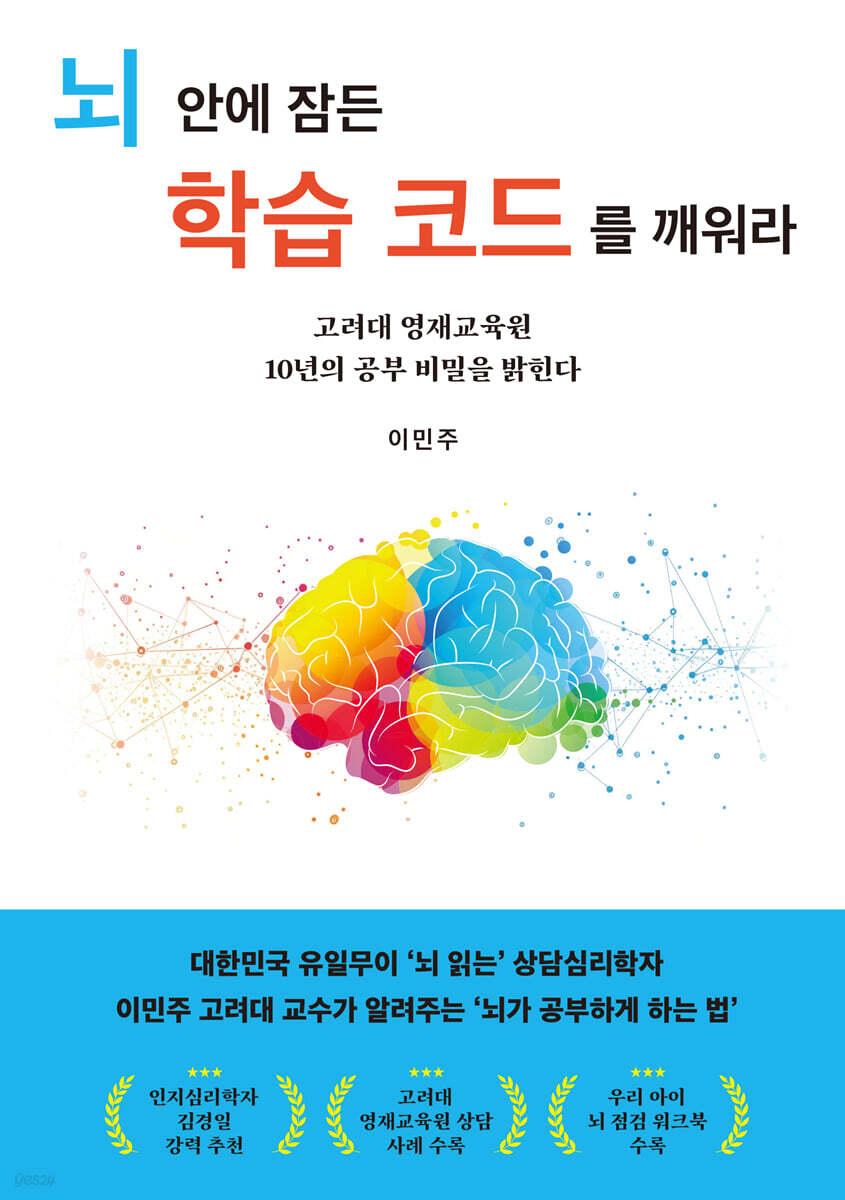
Awaken the learning code dormant in your brain.
 |
Description
Book Introduction
“I clearly memorized it, so why do I keep forgetting it?” “I make plans, but why can’t I put them into action?” “Why is my child so unfocused?” Many parents wonder this as they watch their children.
And I still blame my lack of willpower for not being able to study.
But according to Professor Lee Min-joo of Korea University, studying is actually done by the brain.
Professor Lee Min-joo's first popular book, "Awaken the Learning Codes Sleeping in Your Brain," is the culmination of 20 years of research combining neuroscience, counseling psychology, and education.
The author made his discovery by analyzing approximately 1,300 brain scans of students he met at prestigious universities and gifted education centers.
That means that 10,000 children have 10,000 unique learning codes.
Even an ordinary child can change if he or she designs his or her studies in a way that suits his or her brain.
《Awaken the Learning Code Sleeping in Your Brain》 perfectly covers the principles and practices of brain science study methods.
Along with real-life counseling cases, such as game addiction and test anxiety, we also provide six workbooks and checklists that can be used at home.
Professor Kim Kyung-il, one of Korea's leading cognitive psychologists, praised this book, saying, "It is a truly useful guidebook."
And I still blame my lack of willpower for not being able to study.
But according to Professor Lee Min-joo of Korea University, studying is actually done by the brain.
Professor Lee Min-joo's first popular book, "Awaken the Learning Codes Sleeping in Your Brain," is the culmination of 20 years of research combining neuroscience, counseling psychology, and education.
The author made his discovery by analyzing approximately 1,300 brain scans of students he met at prestigious universities and gifted education centers.
That means that 10,000 children have 10,000 unique learning codes.
Even an ordinary child can change if he or she designs his or her studies in a way that suits his or her brain.
《Awaken the Learning Code Sleeping in Your Brain》 perfectly covers the principles and practices of brain science study methods.
Along with real-life counseling cases, such as game addiction and test anxiety, we also provide six workbooks and checklists that can be used at home.
Professor Kim Kyung-il, one of Korea's leading cognitive psychologists, praised this book, saying, "It is a truly useful guidebook."
- You can preview some of the book's contents.
Preview
index
Prologue | Our Children's Learning Transformed Through Brain Science
Chapter 1.
The Secret of Learning Code Revealed by Brain Science
1.
A parent's brain is a child's universe.
The saying "it's the parents' fault" is wrong.
The Light and Shadow of the World's Highest Educational Fever
Understanding the brain reveals the path to educating children.
2.
Studying is done by the brain
Real study begins with understanding the 'brain'
10,000 people have 10,000 learning codes
Design learning that makes your brain learn
3.
Why do I keep forgetting things even though I clearly memorized them?: The Memory Brain
Memory is not the storage of information, but a combination of emotions and context.
The kid who used to just do random things has changed.
The best memory training with parents
4.
Studying is controlled by the brain's brakes: The self-regulating brain
All About Self-Regulation Originating in the Frontal Lobe
A well-developed 'brain brake' provides a solid support throughout life.
4 Activities to Build Self-Regulation While Playing with Your Family
5.
The prefrontal cortex becomes active only when emotions are stable: the emotional brain
Emotions are the number one priority in the brain.
Why You Need to Create an Emotional Safe Zone
Handling Emotions: Children Learn by Following Adults
5 Activities to Help You Regulate Your Emotions
6.
Concentration: The Magic of a Focused Brain
3 Characteristics of Concentration Parents Should Pay Attention to
In this digital age of overflowing stimulation, protecting your child's focus is crucial.
How to control the use of digital devices at home
5 Activities to Improve Your Focus in Everyday Life
7.
A child's brain is growing every day: The Growing Brain
Brain Plasticity: The Key to Amazing Growth and Change
How to Unleash Your Child's Brain Potential
How can we speak to help our children's brain development?
There is a separate, effective form of feedback that helps brain development.
Parental Attitudes Necessary for a Child's Brain Development Journey
8.
Parents are the best brain designers: The Brain in Learning Design
Design principles for learning spaces that encourage immersion in study
The Miracle of a 21-Day Space Experiment with the Whole Family
Checklist for Creating a Home Conducive to Studying
9.
Small Repetitions Make Big Changes: The Brain of Habit
Small habits accumulate and lead to identity change.
The brain remembers routines better than repetition.
Things to keep in mind when creating habits
A very small practice that changes bad habits 180 degrees
How to Create a Child's Learning and Lifestyle Routine
10.
The power to start is the starting point of all change: the brain of execution.
The executive functions of the frontal lobe move the child.
Three-day resolutions are not a personality problem, but a system problem.
Ways to Increase Your Execution Power in Life
Chapter 2.
A new study guide drawn with brain science
11.
Children who sleep well, eat well, and play well also study well.
Sleep, the magical time when the brain repairs itself
The moment you start exercising, your brain wakes up.
The secret to consistent exercise lies in being together.
Exercises for children studying by time and learning purpose
Manage your 'second brain' chapter
Choose foods that are not toxic to your brain.
Body and mind are one, so health comes first.
12.
“Why on earth do I have to study?”
The inside story of a prestigious university student who hated studying.
Beyond the report card, see your child's effort and sincerity.
13.
There is no child who is not good at studying.
What does pre-learning cost a child in life?
A common thread among children at gifted education centers: a positive learning code.
Each child has his or her own season of blooming.
14.
A turning point in life created by the power of the brain
Barbara Arrowsmith Young knew the words but not the meaning of the sentences.
Robert Jergen, the ADHD "Little Monster" who even gave up on school.
Hope given by those who made the impossible possible
A New Neuroscience Paradigm for Studying
15.
I'm not saying you have to accept it unconditionally.
What Happens When You Accept Your Child's Anger
Chapter 3.
Counseling Archives from a Brain-Reading Counseling Psychologist
16.
Growth Change Method for Everyday Life Problems
CASE 1.
Transform from a game addict to a culinary aspirant!
CASE 2.
Escape from 100-point stress and regain your health.
CASE 3.
I had a dream and wanted to study.
17.
Growth and Change Method for Learning Problems
CASE 1.
Change how you use your brain to improve your learning efficiency and grades.
CASE 2.
Controlling your emotions will boost your concentration.
CASE 3.
Overcoming the barrier to listening with visual learning
CASE 4.
A top elementary school student's first-year middle school slump: overcome it with a daily routine!
CASE 5.
Overcome test anxiety by calming your mind and brain.
Epilogue | It's Never Too Late
Appendix | Workbook and Practice Checklist
Brain Health Checklist
Brain-Based Learning Environment Checklist
Brain-Based Learning Type Diagnostic Checklist
Daily Routine Checklist
Weekly Growth Record
Monthly Growth Record
Chapter 1.
The Secret of Learning Code Revealed by Brain Science
1.
A parent's brain is a child's universe.
The saying "it's the parents' fault" is wrong.
The Light and Shadow of the World's Highest Educational Fever
Understanding the brain reveals the path to educating children.
2.
Studying is done by the brain
Real study begins with understanding the 'brain'
10,000 people have 10,000 learning codes
Design learning that makes your brain learn
3.
Why do I keep forgetting things even though I clearly memorized them?: The Memory Brain
Memory is not the storage of information, but a combination of emotions and context.
The kid who used to just do random things has changed.
The best memory training with parents
4.
Studying is controlled by the brain's brakes: The self-regulating brain
All About Self-Regulation Originating in the Frontal Lobe
A well-developed 'brain brake' provides a solid support throughout life.
4 Activities to Build Self-Regulation While Playing with Your Family
5.
The prefrontal cortex becomes active only when emotions are stable: the emotional brain
Emotions are the number one priority in the brain.
Why You Need to Create an Emotional Safe Zone
Handling Emotions: Children Learn by Following Adults
5 Activities to Help You Regulate Your Emotions
6.
Concentration: The Magic of a Focused Brain
3 Characteristics of Concentration Parents Should Pay Attention to
In this digital age of overflowing stimulation, protecting your child's focus is crucial.
How to control the use of digital devices at home
5 Activities to Improve Your Focus in Everyday Life
7.
A child's brain is growing every day: The Growing Brain
Brain Plasticity: The Key to Amazing Growth and Change
How to Unleash Your Child's Brain Potential
How can we speak to help our children's brain development?
There is a separate, effective form of feedback that helps brain development.
Parental Attitudes Necessary for a Child's Brain Development Journey
8.
Parents are the best brain designers: The Brain in Learning Design
Design principles for learning spaces that encourage immersion in study
The Miracle of a 21-Day Space Experiment with the Whole Family
Checklist for Creating a Home Conducive to Studying
9.
Small Repetitions Make Big Changes: The Brain of Habit
Small habits accumulate and lead to identity change.
The brain remembers routines better than repetition.
Things to keep in mind when creating habits
A very small practice that changes bad habits 180 degrees
How to Create a Child's Learning and Lifestyle Routine
10.
The power to start is the starting point of all change: the brain of execution.
The executive functions of the frontal lobe move the child.
Three-day resolutions are not a personality problem, but a system problem.
Ways to Increase Your Execution Power in Life
Chapter 2.
A new study guide drawn with brain science
11.
Children who sleep well, eat well, and play well also study well.
Sleep, the magical time when the brain repairs itself
The moment you start exercising, your brain wakes up.
The secret to consistent exercise lies in being together.
Exercises for children studying by time and learning purpose
Manage your 'second brain' chapter
Choose foods that are not toxic to your brain.
Body and mind are one, so health comes first.
12.
“Why on earth do I have to study?”
The inside story of a prestigious university student who hated studying.
Beyond the report card, see your child's effort and sincerity.
13.
There is no child who is not good at studying.
What does pre-learning cost a child in life?
A common thread among children at gifted education centers: a positive learning code.
Each child has his or her own season of blooming.
14.
A turning point in life created by the power of the brain
Barbara Arrowsmith Young knew the words but not the meaning of the sentences.
Robert Jergen, the ADHD "Little Monster" who even gave up on school.
Hope given by those who made the impossible possible
A New Neuroscience Paradigm for Studying
15.
I'm not saying you have to accept it unconditionally.
What Happens When You Accept Your Child's Anger
Chapter 3.
Counseling Archives from a Brain-Reading Counseling Psychologist
16.
Growth Change Method for Everyday Life Problems
CASE 1.
Transform from a game addict to a culinary aspirant!
CASE 2.
Escape from 100-point stress and regain your health.
CASE 3.
I had a dream and wanted to study.
17.
Growth and Change Method for Learning Problems
CASE 1.
Change how you use your brain to improve your learning efficiency and grades.
CASE 2.
Controlling your emotions will boost your concentration.
CASE 3.
Overcoming the barrier to listening with visual learning
CASE 4.
A top elementary school student's first-year middle school slump: overcome it with a daily routine!
CASE 5.
Overcome test anxiety by calming your mind and brain.
Epilogue | It's Never Too Late
Appendix | Workbook and Practice Checklist
Brain Health Checklist
Brain-Based Learning Environment Checklist
Brain-Based Learning Type Diagnostic Checklist
Daily Routine Checklist
Weekly Growth Record
Monthly Growth Record
Detailed image
.jpg)
Into the book
When parents know about brain science, their children's studies will change.
The difference is quite astonishing.
Not only that, but the child's mind also becomes stronger.
In fact, the changes in children who received counseling based on brain science are surprisingly clear.
A child is like a tree; even if it does not grow well, if it receives proper education and care tailored to its characteristics, it will eventually begin to regain its vibrant vitality.
--- p.17
In our society, where standards are high, efficiency is valued, and competition is fierce, knowing your brain and using it properly can lead to a healthier and happier life, and even less suffering and pain.
Whether it's studying, working, succeeding, competing, whatever it is I want to do.
And when you know your brain, you understand your strengths and weaknesses, as well as your personality and characteristics.
You can find the study method, career path, and even job that suits you.
The more I know about my brain, the more I know about myself.
Most of the important things in life—our identity, our characteristics, our lifestyle, our relationships, our direction, our personality—are ultimately created by our brain.
--- p.25
Studying is something the brain does, and the brain is a biological system.
Humans develop at different rates, respond to stimuli, and have different processing preferences, which in turn leads to differences in learning styles and, in turn, differences in outcomes.
Therefore, guiding learning without knowing the state of a child's brain is like walking down the street with your eyes closed.
Before blaming your child's distraction and poor academic performance on your child, you must first understand the state of your child's brain.
--- p.31
If there are 10,000 children, there are 10,000 different learning codes.
Just as each child's face has its own unique and delicate features, each child's learning code also has its own unique patterns and rhythms.
Knowing your child's learning code means understanding their unique learning language and designing the most effective learning environment for them.
The learning code is an integrated system that encompasses all brain activity and behavioral patterns that emerge when an individual learns.
Each child has different preferences for information processing and study methods, and the factors that trigger their interests and curiosity are also different.
The situations that motivate us and the factors that elicit motivation also vary greatly from person to person.
Brain characteristics, behavioral traits, habit patterns, cognitive characteristics, environmental factors, previous experiences of success and failure, and even beliefs about learning all combine to form each child's own learning code.
--- p.34
The power of habit doesn't appear immediately.
Just as bamboo grows only 3 meters in 5 years and then grows to 30 meters in 6 weeks, habits also show explosive growth at some point.
In a word, it can be called a compound interest effect.
As self-improvement expert James Clear notes in his book, The Power of Tiny Habits, improving just 1 percent each day will result in a 37-fold improvement in a year.
Conversely, if it gets worse by 1 percent every day, after a year it will be close to zero.
The same goes for a child's learning habits.
A 10-minute daily review habit will completely change your learning code after a year.
--- p.113
I often ask parents this question during counseling sessions.
"How much sleep did you get? How many hours did you move around today? And what did you eat and when?" Many parents are taken aback by these questions.
Some people ask what the relationship is between studying, sleeping, exercising, and eating.
But brain science speaks clearly.
Studying is something the brain does, and the brain's condition is determined by sleep, exercise, and food.
No matter how good the learning method is, if the basic conditions of the brain are not met, the child's learning code will not be properly activated.
--- p.147
It's strangely empowering when parents recognize the precious heart and sincerity with which their children tried to do something that even their children had forgotten.
I want to try it.
Then the change will begin on its own.
Just being aware is where things begin.
When you understand the truth, even a grown man will shed tears, and behavior that seemed unchangeable will begin to change.
Because when someone knows my sincerity, it lets me know that I have the strength to do this.
--- p.160
Children who have had prior learning will obviously know more formulas and concepts.
But why do children who haven't had prior learning shine more in some situations? Observing both sides revealed some interesting differences.
Children who had prior learning tended to approach problems with questions like, "What type of problem is this? What formula should I use?"
On the other hand, children who hadn't done any prior learning approached the problem with the mindset of, "What do you want me to find in this problem? How can I solve it?"
Both had their own advantages.
Children who had prior training were faster and more accurate.
Children who had not received prior learning were flexible, creative, and had a problem-solving-oriented learning code.
--- p.174
Data from the brain field clearly shows that:
This means that accepting and stabilizing emotions first, and then educating and correcting them, is an effective disciplinary method that is in line with the brain's operating principles.
Acceptance is not permission.
Acceptance is a prerequisite for effective education.
When parents maintain discipline, children naturally develop self-control, develop rational judgment, and acquire the ability to make socially mature choices.
During this process, the child's learning code is also gradually optimized.
This is the wise way of discipline that brain science shows us.
The difference is quite astonishing.
Not only that, but the child's mind also becomes stronger.
In fact, the changes in children who received counseling based on brain science are surprisingly clear.
A child is like a tree; even if it does not grow well, if it receives proper education and care tailored to its characteristics, it will eventually begin to regain its vibrant vitality.
--- p.17
In our society, where standards are high, efficiency is valued, and competition is fierce, knowing your brain and using it properly can lead to a healthier and happier life, and even less suffering and pain.
Whether it's studying, working, succeeding, competing, whatever it is I want to do.
And when you know your brain, you understand your strengths and weaknesses, as well as your personality and characteristics.
You can find the study method, career path, and even job that suits you.
The more I know about my brain, the more I know about myself.
Most of the important things in life—our identity, our characteristics, our lifestyle, our relationships, our direction, our personality—are ultimately created by our brain.
--- p.25
Studying is something the brain does, and the brain is a biological system.
Humans develop at different rates, respond to stimuli, and have different processing preferences, which in turn leads to differences in learning styles and, in turn, differences in outcomes.
Therefore, guiding learning without knowing the state of a child's brain is like walking down the street with your eyes closed.
Before blaming your child's distraction and poor academic performance on your child, you must first understand the state of your child's brain.
--- p.31
If there are 10,000 children, there are 10,000 different learning codes.
Just as each child's face has its own unique and delicate features, each child's learning code also has its own unique patterns and rhythms.
Knowing your child's learning code means understanding their unique learning language and designing the most effective learning environment for them.
The learning code is an integrated system that encompasses all brain activity and behavioral patterns that emerge when an individual learns.
Each child has different preferences for information processing and study methods, and the factors that trigger their interests and curiosity are also different.
The situations that motivate us and the factors that elicit motivation also vary greatly from person to person.
Brain characteristics, behavioral traits, habit patterns, cognitive characteristics, environmental factors, previous experiences of success and failure, and even beliefs about learning all combine to form each child's own learning code.
--- p.34
The power of habit doesn't appear immediately.
Just as bamboo grows only 3 meters in 5 years and then grows to 30 meters in 6 weeks, habits also show explosive growth at some point.
In a word, it can be called a compound interest effect.
As self-improvement expert James Clear notes in his book, The Power of Tiny Habits, improving just 1 percent each day will result in a 37-fold improvement in a year.
Conversely, if it gets worse by 1 percent every day, after a year it will be close to zero.
The same goes for a child's learning habits.
A 10-minute daily review habit will completely change your learning code after a year.
--- p.113
I often ask parents this question during counseling sessions.
"How much sleep did you get? How many hours did you move around today? And what did you eat and when?" Many parents are taken aback by these questions.
Some people ask what the relationship is between studying, sleeping, exercising, and eating.
But brain science speaks clearly.
Studying is something the brain does, and the brain's condition is determined by sleep, exercise, and food.
No matter how good the learning method is, if the basic conditions of the brain are not met, the child's learning code will not be properly activated.
--- p.147
It's strangely empowering when parents recognize the precious heart and sincerity with which their children tried to do something that even their children had forgotten.
I want to try it.
Then the change will begin on its own.
Just being aware is where things begin.
When you understand the truth, even a grown man will shed tears, and behavior that seemed unchangeable will begin to change.
Because when someone knows my sincerity, it lets me know that I have the strength to do this.
--- p.160
Children who have had prior learning will obviously know more formulas and concepts.
But why do children who haven't had prior learning shine more in some situations? Observing both sides revealed some interesting differences.
Children who had prior learning tended to approach problems with questions like, "What type of problem is this? What formula should I use?"
On the other hand, children who hadn't done any prior learning approached the problem with the mindset of, "What do you want me to find in this problem? How can I solve it?"
Both had their own advantages.
Children who had prior training were faster and more accurate.
Children who had not received prior learning were flexible, creative, and had a problem-solving-oriented learning code.
--- p.174
Data from the brain field clearly shows that:
This means that accepting and stabilizing emotions first, and then educating and correcting them, is an effective disciplinary method that is in line with the brain's operating principles.
Acceptance is not permission.
Acceptance is a prerequisite for effective education.
When parents maintain discipline, children naturally develop self-control, develop rational judgment, and acquire the ability to make socially mature choices.
During this process, the child's learning code is also gradually optimized.
This is the wise way of discipline that brain science shows us.
--- p.198
Publisher's Review
“Do you still look at your child’s report card and blame it on ‘lack of will’?
Now let your brain study.”
Professor Lee Min-joo of Korea University covers everything from counseling psychology to brain imaging analysis and gifted education.
Insights from a 20-year journey of integration!
Many parents feel frustrated when they look at their children's report cards.
I clearly memorized it, but I keep forgetting it, I only make plans but can't put them into practice, and I can't concentrate well.
Then, we often diagnose the cause of the problem as 'the child's lack of will and perseverance' or 'the child's personality', but this will never lead to a real solution.
In fact, studying is done by the brain.
According to Professor Lee Min-joo of Korea University, who published “Awaken the Learning Code Sleeping in Your Brain,” studying is a sophisticated design task that involves understanding and utilizing the brain’s operating principles.
Ten thousand children have ten thousand unique learning codes, and only when learning is designed in a way that suits each individual's brain can real learning begin.
In this book, the author demonstrates, through real-life examples and scientific evidence, how parents' understanding of brain science can significantly impact their children's academic performance. The author is Korea's only counseling psychologist who can "read the brain."
He received a master's degree in brain science from Seoul National University, a master's degree in counseling psychology, and a doctorate in education from Korea University. He also served as a brain imaging researcher at Samsung Medical Center and a senior researcher at Korea University's Gifted Education Center.
In short, he is an expert with a unique career spanning neuroscience, counseling psychology, and education.
In particular, the author has worked as a senior researcher at the Korea University Gifted Education Center for nearly 10 years, conducting and analyzing approximately 1,300 neuropsychological tests on students from KAIST, Seoul National University, Korea University, and the Korea Science Academy.
Using scientific diagnostic tools such as the Wechsler Intelligence Scale, the Kaufman Intelligence Scale for Children, the Raven Intelligence Scale, and fMRI brain function tests, the author precisely identified the child's brain characteristics and provided customized learning coaching based on these findings. After 20 years of this comprehensive journey, the author has published his first popular book, "Awaken the Learning Code Sleeping in Your Brain."
This book is not just a theory, but a condensation of practical wisdom proven in actual counseling settings.
“How did that ordinary kid become a genius at studying?”
Discovered through over 1,300 research and analysis data and numerous consultations and coaching sessions
The key to a reversal is the 'learning code' based on our child's brain characteristics!
The highlight of "Awaken the Learning Code Sleeping in Your Brain" is the 'brain science study method' that is sure to work.
Parents who have been wondering, “Why can’t my child do it?” will be amazed after learning about this study method and say, “Ah, so that’s how it works!”
The structure and content of this book are clear.
It consists of three chapters and an appendix, of which Chapters 1 and 2 each deal with the principles and methods of studying brain science.
· Chapter 1.
The Secrets of Learning Code Revealed by Neuroscience: A Focus on the Principles and Learning Code of Neuroscience Study Methods
· Chapter 2.
A New Study Guide with Brain Science: How to Study Using Brain Science Study Methods
· Chapter 3.
Counseling Archives from a Brain-Reading Counseling Psychologist: Real-Life Cases of Solving Learning Problems Using Brain Science Study Methods
· Appendix.
Workbook and Practice Checklist: A Practical Toolkit for Diagnosing Your Child at Home
Chapter 1, “The Secret of Learning Code Revealed by Brain Science,” introduces the “learning code,” the principle of brain science study methods.
Learning code is the unique learning style of each child's brain, and learning is best when designed to suit that brain's preferences.
Therefore, it is important to understand the characteristics of the brain, and the author provides an interesting explanation of eight characteristics of the brain, including memory, self-regulation, emotion, concentration, plasticity, learning design, habits, and execution ability.
This will help parents understand why their child is having trouble studying.
You will learn that the reason you keep forgetting things even though you clearly memorized them is not because you studied less, but because you lack the connection between emotions and context. You will also learn that the reason you can't make plans and execute them is not because you lack willpower, but because your frontal lobe is not yet mature. You will also learn that the reason you can play games for hours but can't study for even 10 minutes is because emotions are the brain's number one priority.
This way, parents no longer have to nag their children.
Instead, you can become a wise helper who understands and waits for the characteristics of the child's brain.
The moment parents change their question from “Why isn’t this working?” to “How can I help?” a new path opens up for their children’s education.
Chapter 2, “A New Study Guide with Brain Science,” provides answers to the question parents are most curious about: “How?”
The author explains how to study according to the child's learning code and achieve better results based on the characteristics of the brain.
In addition, it provides knowledge and meaningful stories that help parents view their children from the perspective of brain development rather than report cards.
We learn that the basic conditions of sleep, exercise, and food determine the brain's condition, and that no matter how special a study method you use and how long you study, if these basic conditions are broken, the brain will not study.
You'll also learn how to see your child's effort and sincerity beyond the report card, and how pre-learning can actually take away the joy and curiosity of learning.
By prioritizing 'raising a healthy brain', you can shake off anxiety and impatience, and become a parent who believes in your child's growth and walks alongside them.
A brain science study method that 'reduces parental anxiety and enhances children's abilities'!
Real-life cases selected from the counseling archives of learning psychology experts who read the brain.
Professor Lee Min-joo created four checklists for things to do at home!
"Now, awaken your child's dormant 'true study skills'."
Chapter 3, which follows the principles and methods of the brain science study method, contains actual cases of applying the brain science study method.
And the appendix contains a workbook and checklist created by the author.
Chapter 3, "Counseling Archives of a Brain-Reading Counseling Psychologist," covers typical concerns such as game addiction, stress over getting a perfect score, test anxiety, lack of motivation to study, the middle school slump, low grades compared to the effort put in, and excessively slow learning speed.
As if observing the author's consultation, you can take a detailed look at the process of precisely identifying the child's brain characteristics through scientific diagnosis such as the Wechsler Intelligence Scale and then applying a customized growth change method.
After solving problems in a way that is just right for the child, the more advanced real-life cases provide concrete guidance to families who are struggling to find a way out of their child's problems.
Finally, the appendix provides two workbooks and four checklists created by the author.
This is a practical tool that parents and children can use to diagnose, practice, and record growth together, such as a brain-based learning type diagnosis checklist and a daily routine checklist.
This book will not be something you just read, but a practical workbook you can open and use every day.
Professor Kim Kyung-il, a cognitive psychologist, gave high praise to “Awaken the Learning Code Sleeping in Your Brain,” which is equipped with everything from knowledge and information to a practical workbook, saying, “An expert who has been in this field for over 20 years has now presented us with a truly useful guidebook,” and “As a cognitive psychologist, it is full of content that makes me nod and express my great admiration.”
Are you ready to awaken the true learning potential dormant within your child's brain? For parents everywhere, this book offers both scientific solutions and hope for the frustrating challenges of parenting.
"Awaken the Learning Code Sleeping in Your Brain" will go beyond simply being a "book to read"; it will become a "book to practice" and a "book that creates change" at home.
Now let your brain study.”
Professor Lee Min-joo of Korea University covers everything from counseling psychology to brain imaging analysis and gifted education.
Insights from a 20-year journey of integration!
Many parents feel frustrated when they look at their children's report cards.
I clearly memorized it, but I keep forgetting it, I only make plans but can't put them into practice, and I can't concentrate well.
Then, we often diagnose the cause of the problem as 'the child's lack of will and perseverance' or 'the child's personality', but this will never lead to a real solution.
In fact, studying is done by the brain.
According to Professor Lee Min-joo of Korea University, who published “Awaken the Learning Code Sleeping in Your Brain,” studying is a sophisticated design task that involves understanding and utilizing the brain’s operating principles.
Ten thousand children have ten thousand unique learning codes, and only when learning is designed in a way that suits each individual's brain can real learning begin.
In this book, the author demonstrates, through real-life examples and scientific evidence, how parents' understanding of brain science can significantly impact their children's academic performance. The author is Korea's only counseling psychologist who can "read the brain."
He received a master's degree in brain science from Seoul National University, a master's degree in counseling psychology, and a doctorate in education from Korea University. He also served as a brain imaging researcher at Samsung Medical Center and a senior researcher at Korea University's Gifted Education Center.
In short, he is an expert with a unique career spanning neuroscience, counseling psychology, and education.
In particular, the author has worked as a senior researcher at the Korea University Gifted Education Center for nearly 10 years, conducting and analyzing approximately 1,300 neuropsychological tests on students from KAIST, Seoul National University, Korea University, and the Korea Science Academy.
Using scientific diagnostic tools such as the Wechsler Intelligence Scale, the Kaufman Intelligence Scale for Children, the Raven Intelligence Scale, and fMRI brain function tests, the author precisely identified the child's brain characteristics and provided customized learning coaching based on these findings. After 20 years of this comprehensive journey, the author has published his first popular book, "Awaken the Learning Code Sleeping in Your Brain."
This book is not just a theory, but a condensation of practical wisdom proven in actual counseling settings.
“How did that ordinary kid become a genius at studying?”
Discovered through over 1,300 research and analysis data and numerous consultations and coaching sessions
The key to a reversal is the 'learning code' based on our child's brain characteristics!
The highlight of "Awaken the Learning Code Sleeping in Your Brain" is the 'brain science study method' that is sure to work.
Parents who have been wondering, “Why can’t my child do it?” will be amazed after learning about this study method and say, “Ah, so that’s how it works!”
The structure and content of this book are clear.
It consists of three chapters and an appendix, of which Chapters 1 and 2 each deal with the principles and methods of studying brain science.
· Chapter 1.
The Secrets of Learning Code Revealed by Neuroscience: A Focus on the Principles and Learning Code of Neuroscience Study Methods
· Chapter 2.
A New Study Guide with Brain Science: How to Study Using Brain Science Study Methods
· Chapter 3.
Counseling Archives from a Brain-Reading Counseling Psychologist: Real-Life Cases of Solving Learning Problems Using Brain Science Study Methods
· Appendix.
Workbook and Practice Checklist: A Practical Toolkit for Diagnosing Your Child at Home
Chapter 1, “The Secret of Learning Code Revealed by Brain Science,” introduces the “learning code,” the principle of brain science study methods.
Learning code is the unique learning style of each child's brain, and learning is best when designed to suit that brain's preferences.
Therefore, it is important to understand the characteristics of the brain, and the author provides an interesting explanation of eight characteristics of the brain, including memory, self-regulation, emotion, concentration, plasticity, learning design, habits, and execution ability.
This will help parents understand why their child is having trouble studying.
You will learn that the reason you keep forgetting things even though you clearly memorized them is not because you studied less, but because you lack the connection between emotions and context. You will also learn that the reason you can't make plans and execute them is not because you lack willpower, but because your frontal lobe is not yet mature. You will also learn that the reason you can play games for hours but can't study for even 10 minutes is because emotions are the brain's number one priority.
This way, parents no longer have to nag their children.
Instead, you can become a wise helper who understands and waits for the characteristics of the child's brain.
The moment parents change their question from “Why isn’t this working?” to “How can I help?” a new path opens up for their children’s education.
Chapter 2, “A New Study Guide with Brain Science,” provides answers to the question parents are most curious about: “How?”
The author explains how to study according to the child's learning code and achieve better results based on the characteristics of the brain.
In addition, it provides knowledge and meaningful stories that help parents view their children from the perspective of brain development rather than report cards.
We learn that the basic conditions of sleep, exercise, and food determine the brain's condition, and that no matter how special a study method you use and how long you study, if these basic conditions are broken, the brain will not study.
You'll also learn how to see your child's effort and sincerity beyond the report card, and how pre-learning can actually take away the joy and curiosity of learning.
By prioritizing 'raising a healthy brain', you can shake off anxiety and impatience, and become a parent who believes in your child's growth and walks alongside them.
A brain science study method that 'reduces parental anxiety and enhances children's abilities'!
Real-life cases selected from the counseling archives of learning psychology experts who read the brain.
Professor Lee Min-joo created four checklists for things to do at home!
"Now, awaken your child's dormant 'true study skills'."
Chapter 3, which follows the principles and methods of the brain science study method, contains actual cases of applying the brain science study method.
And the appendix contains a workbook and checklist created by the author.
Chapter 3, "Counseling Archives of a Brain-Reading Counseling Psychologist," covers typical concerns such as game addiction, stress over getting a perfect score, test anxiety, lack of motivation to study, the middle school slump, low grades compared to the effort put in, and excessively slow learning speed.
As if observing the author's consultation, you can take a detailed look at the process of precisely identifying the child's brain characteristics through scientific diagnosis such as the Wechsler Intelligence Scale and then applying a customized growth change method.
After solving problems in a way that is just right for the child, the more advanced real-life cases provide concrete guidance to families who are struggling to find a way out of their child's problems.
Finally, the appendix provides two workbooks and four checklists created by the author.
This is a practical tool that parents and children can use to diagnose, practice, and record growth together, such as a brain-based learning type diagnosis checklist and a daily routine checklist.
This book will not be something you just read, but a practical workbook you can open and use every day.
Professor Kim Kyung-il, a cognitive psychologist, gave high praise to “Awaken the Learning Code Sleeping in Your Brain,” which is equipped with everything from knowledge and information to a practical workbook, saying, “An expert who has been in this field for over 20 years has now presented us with a truly useful guidebook,” and “As a cognitive psychologist, it is full of content that makes me nod and express my great admiration.”
Are you ready to awaken the true learning potential dormant within your child's brain? For parents everywhere, this book offers both scientific solutions and hope for the frustrating challenges of parenting.
"Awaken the Learning Code Sleeping in Your Brain" will go beyond simply being a "book to read"; it will become a "book to practice" and a "book that creates change" at home.
GOODS SPECIFICS
- Date of issue: December 1, 2025
- Page count, weight, size: 288 pages | 148*210*20mm
- ISBN13: 9791191505566
- ISBN10: 1191505561
You may also like
카테고리
korean


korean

![GQ KOREA Mark (Monthly): December [2025]](http://librairie.coreenne.fr/cdn/shop/files/8ef265dbbfbf186523ed75ba7319009d.jpg?v=1765340328&width=3840)


