

Hyomyung Naming
 |
Description
Book Introduction
The delightful and clear fortune telling of a scholar recognized by 50,000 subscribers
A profound understanding of fortune telling, fortune telling, and naming methods, based on over 30 years of study of Chinese characters and classical Chinese literature.
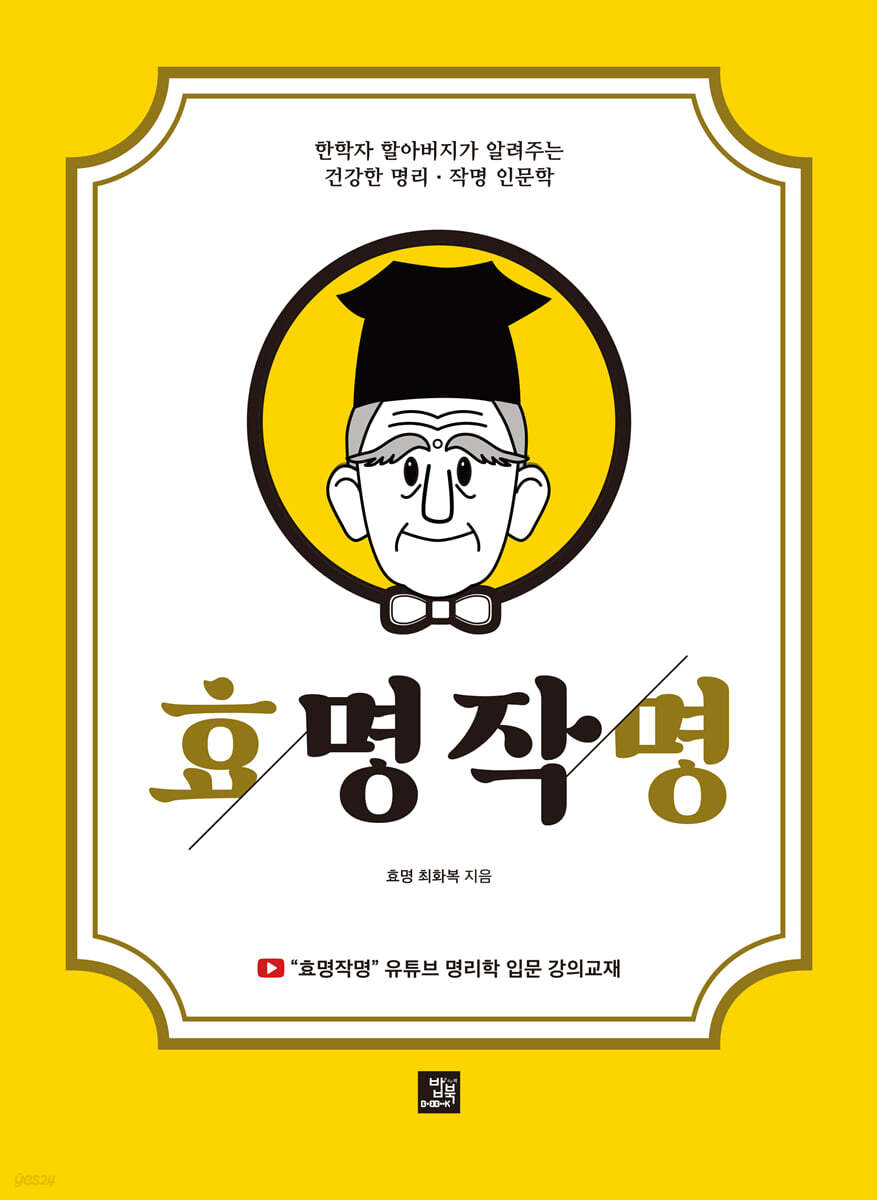
This is an introductory textbook on fortune telling by Hyomyeong Choi Hwa-bok, known as the grandfather of scholars of Chinese classics, who gives famous lectures through the YouTube channel 'Hyomyeongjakmyeong'.
The book covers the basics of fortune telling, from the 10 Heavenly Stems, 12 Earthly Branches, the Jijanggan and Six Relatives, to the origins of characters and the Five Elements, fortune telling and health, the theory of divine use, destiny and reason, and the theory of position, and presents 68 lectures, including special lectures, in easy-to-understand text and tables.
The author believes that the flower of fortune telling and fortune-telling comes to fruition through naming.
That is how much importance naming plays in fortune telling.
Accordingly, the author named the channel 'Hyo-Myeong-Jakmyeong' while giving lectures on fortune telling.
Above all, the author's lectures add a depth that cannot be found in other fortune-telling lectures, as he has studied Chinese characters and classical Chinese literature for over 30 years.
Subscribers who have attended the author's lectures nod their heads in agreement with the clear lectures and are amazed, as if they have discovered a world of fortune telling they have never encountered before.
This book organizes and explains lectures that have already been verified by over 50,000 subscribers in an easier way, so that anyone can easily learn and master fortune telling and naming.
A profound understanding of fortune telling, fortune telling, and naming methods, based on over 30 years of study of Chinese characters and classical Chinese literature.
This is an introductory textbook on fortune telling by Hyomyeong Choi Hwa-bok, known as the grandfather of scholars of Chinese classics, who gives famous lectures through the YouTube channel 'Hyomyeongjakmyeong'.
The book covers the basics of fortune telling, from the 10 Heavenly Stems, 12 Earthly Branches, the Jijanggan and Six Relatives, to the origins of characters and the Five Elements, fortune telling and health, the theory of divine use, destiny and reason, and the theory of position, and presents 68 lectures, including special lectures, in easy-to-understand text and tables.
The author believes that the flower of fortune telling and fortune-telling comes to fruition through naming.
That is how much importance naming plays in fortune telling.
Accordingly, the author named the channel 'Hyo-Myeong-Jakmyeong' while giving lectures on fortune telling.
Above all, the author's lectures add a depth that cannot be found in other fortune-telling lectures, as he has studied Chinese characters and classical Chinese literature for over 30 years.
Subscribers who have attended the author's lectures nod their heads in agreement with the clear lectures and are amazed, as if they have discovered a world of fortune telling they have never encountered before.
This book organizes and explains lectures that have already been verified by over 50,000 subscribers in an easier way, so that anyone can easily learn and master fortune telling and naming.
- You can preview some of the book's contents.
Preview
index
Author's Note/Recommendation 1, 2/Autobiography
Unit 1, 10 Heavenly Stems
Lesson 1: Introduction to the Basics / Lesson 2: The evolution of Chinese characters and Gap-mok (甲木) and Eulmok (乙木) / Lesson 3: Byeong-hwa (丙火) and Jeong-hwa (丁火) and Mu-to (戊土) and Gi-to (己土) / Lesson 4: Gyeong-geum (庚金) and Sin-geum (辛金) / Lesson 5: Im-su (壬水) and Gye-su (癸水)
Unit 2, 12 Earthly Branches
Lesson 6: The Earthly Branches of Spring and Summer / Lesson 7: The Earthly Branches of Fall and Winter / Lesson 8: Understanding the Pillar Order of the Heavenly Stems and Earthly Branches / Lesson 9: The Mutual Generation and Mutual Inhibition of the Five Elements / Lesson 10: The 28 Constellations and the Heavenly Stem Combinations
Open lecture 1.
Just knowing this will make fortune telling easier/Public Lecture 2.
What's My Fortune? - Real-Life Fortune Analysis
Unit 3: The Jijanggan (branch stems) and the six relatives
Lesson 11 Basic principles of square combination and three combinations / Lesson 12 My true heart - Jijanggan / Lesson 13 Calculating the number of Jijanggan days, very easily / Lesson 14 The formation process of the six relatives / Lesson 15 Six relatives viewed as mutual generation and mutual inhibition / Lesson 16 Six relatives are for reference only / Key summary 1.
Yin-Yang and the Five Elements, Heavenly Stems and Earthly Branches, Harmony and Clash/Key Summary 2.
Samhap and Banhap, Jiji Yukhap, Jiji Chong, Ji Jang Gan
Unit 4: Chinese Character Origin and Five Elements, Cold, Warm, Dry, and Wet
Lesson 17: The Five Elements of Resources 1.
Ga-eul-mok/18th lecture, Resource Five Elements 2.
Bing Ding Fire/Lesson 19: Resource Five Elements 3.
戊己土(1)/20th lecture: Jo-hu-han-nan-jo-sip (cold, warm, dry, wet)/21st lecture: Resources Five Elements 3.
戊己土(2)/22nd lecture, resource five elements 4.
Geng Xin Metal/23rd lecture, Resource Five Elements 5.
Im-Gye-Su, the origin of the theory of life (1) / Lesson 24: The origin of the theory of life (2) / Lesson 25: The origin of the theory of life (3) / Lesson 26: Interpreting the four pillars of destiny through the theory of life
Unit 5: The Five Elements: The Rise and Fall of Strength and Weakness, Hunminjeongeum Haeryebon
Lesson 27: What if there is too much wood in the four pillars? / Lesson 28: What if there is too much fire in the four pillars? / Lesson 29: What if there is too much earth in the four pillars? / Lesson 30: What if there is too much gold in the four pillars? / Lesson 31: What if there is too much water in the four pillars? / Lesson 32: Creating your own guardian deity with the three beats of name, nickname, and douin / Lesson 33: The truth about the five elements of sound - the difference between Haeryebon and Unhaebon / Lesson 34: The two gears of the four pillars and a good name
Unit 6: Four Pillars of Destiny and Health
Lesson 35: Liver, Heart, Spleen, and Lungs/Lesson 36: Liver, Gallbladder - Eul-mok, Gap-mok/Lesson 37: Heart, Small Intestine - Ding-hwa, Bing-hwa (1)/Lesson 38: Four Pillars + Heart Pillar/Lesson 39: Nature is the macrocosm, the human body is the microcosm (1)/Lesson 40: Nature is the macrocosm, the human body is the microcosm (2)/Lesson 41: Heart, Triple Cho - Ding-hwa, Bing-hwa (2)/Lesson 42: Practical Four Pillars Analysis - Heart Disease/Lesson 43: Spleen, Stomach - Ji-to, Mu-to/Lesson 44: Practical Four Pillars Analysis - Stomach Disease/Lesson 45: Lungs, Large Intestine - Sin-geum, Geng-geum/Lesson 46: Practical Four Pillars Analysis - Lungs, Large Intestine Disease/Lesson 47: Kidneys, Bladder - Gwi-su, Im-su/Lesson 48: Practical Four Pillars Analysis - Kidneys, Bladder
Unit 7: Theory of Use of God
Lesson 49: The importance of regulating the weather (Jo-hu) / Lesson 50: About Jo-hu Yong-shin and Eok-bu Yong-shin / Lesson 51: The god of water disease and the god of earth medicine / Lesson 52: About Tong-gwan Yong-shin / Lesson 53: How to use Tong-gwan Yong-shin in naming / Lesson 54: The relationship between the four pillars and names / Lesson 55: The theory of cold, warmth, dryness, and moisture (1) / Lesson 56: The theory of cold, warmth, dryness, and moisture (2) / Lesson 57: The roots of the heavenly stems, how to see the commuting / Lesson 58: The disease and weakness of the four pillars, very easily seen / Lesson 59: The theory of illness and weakness, practical four pillars / Lesson 60: The theory of neutralization through the Doctrine of the Mean / Lesson 61: The theory of the head (Gaedu-ron) and the god of false use
Unit 8: Fate and Reason
Lecture 62: Special Lecture on Fortune-telling 1.
Factorization of fate and reason (1)/Lecture 63: Special lecture on fate and reason 2.
Factorization of Fate and Reason (2)
Unit 9: Theory of Positions
Lesson 64: What is my position? Understanding the position of the state/Lesson 65: Understanding the external position very easily/Lesson 66: Understanding the final position very easily
Editorial review
Unit 1, 10 Heavenly Stems
Lesson 1: Introduction to the Basics / Lesson 2: The evolution of Chinese characters and Gap-mok (甲木) and Eulmok (乙木) / Lesson 3: Byeong-hwa (丙火) and Jeong-hwa (丁火) and Mu-to (戊土) and Gi-to (己土) / Lesson 4: Gyeong-geum (庚金) and Sin-geum (辛金) / Lesson 5: Im-su (壬水) and Gye-su (癸水)
Unit 2, 12 Earthly Branches
Lesson 6: The Earthly Branches of Spring and Summer / Lesson 7: The Earthly Branches of Fall and Winter / Lesson 8: Understanding the Pillar Order of the Heavenly Stems and Earthly Branches / Lesson 9: The Mutual Generation and Mutual Inhibition of the Five Elements / Lesson 10: The 28 Constellations and the Heavenly Stem Combinations
Open lecture 1.
Just knowing this will make fortune telling easier/Public Lecture 2.
What's My Fortune? - Real-Life Fortune Analysis
Unit 3: The Jijanggan (branch stems) and the six relatives
Lesson 11 Basic principles of square combination and three combinations / Lesson 12 My true heart - Jijanggan / Lesson 13 Calculating the number of Jijanggan days, very easily / Lesson 14 The formation process of the six relatives / Lesson 15 Six relatives viewed as mutual generation and mutual inhibition / Lesson 16 Six relatives are for reference only / Key summary 1.
Yin-Yang and the Five Elements, Heavenly Stems and Earthly Branches, Harmony and Clash/Key Summary 2.
Samhap and Banhap, Jiji Yukhap, Jiji Chong, Ji Jang Gan
Unit 4: Chinese Character Origin and Five Elements, Cold, Warm, Dry, and Wet
Lesson 17: The Five Elements of Resources 1.
Ga-eul-mok/18th lecture, Resource Five Elements 2.
Bing Ding Fire/Lesson 19: Resource Five Elements 3.
戊己土(1)/20th lecture: Jo-hu-han-nan-jo-sip (cold, warm, dry, wet)/21st lecture: Resources Five Elements 3.
戊己土(2)/22nd lecture, resource five elements 4.
Geng Xin Metal/23rd lecture, Resource Five Elements 5.
Im-Gye-Su, the origin of the theory of life (1) / Lesson 24: The origin of the theory of life (2) / Lesson 25: The origin of the theory of life (3) / Lesson 26: Interpreting the four pillars of destiny through the theory of life
Unit 5: The Five Elements: The Rise and Fall of Strength and Weakness, Hunminjeongeum Haeryebon
Lesson 27: What if there is too much wood in the four pillars? / Lesson 28: What if there is too much fire in the four pillars? / Lesson 29: What if there is too much earth in the four pillars? / Lesson 30: What if there is too much gold in the four pillars? / Lesson 31: What if there is too much water in the four pillars? / Lesson 32: Creating your own guardian deity with the three beats of name, nickname, and douin / Lesson 33: The truth about the five elements of sound - the difference between Haeryebon and Unhaebon / Lesson 34: The two gears of the four pillars and a good name
Unit 6: Four Pillars of Destiny and Health
Lesson 35: Liver, Heart, Spleen, and Lungs/Lesson 36: Liver, Gallbladder - Eul-mok, Gap-mok/Lesson 37: Heart, Small Intestine - Ding-hwa, Bing-hwa (1)/Lesson 38: Four Pillars + Heart Pillar/Lesson 39: Nature is the macrocosm, the human body is the microcosm (1)/Lesson 40: Nature is the macrocosm, the human body is the microcosm (2)/Lesson 41: Heart, Triple Cho - Ding-hwa, Bing-hwa (2)/Lesson 42: Practical Four Pillars Analysis - Heart Disease/Lesson 43: Spleen, Stomach - Ji-to, Mu-to/Lesson 44: Practical Four Pillars Analysis - Stomach Disease/Lesson 45: Lungs, Large Intestine - Sin-geum, Geng-geum/Lesson 46: Practical Four Pillars Analysis - Lungs, Large Intestine Disease/Lesson 47: Kidneys, Bladder - Gwi-su, Im-su/Lesson 48: Practical Four Pillars Analysis - Kidneys, Bladder
Unit 7: Theory of Use of God
Lesson 49: The importance of regulating the weather (Jo-hu) / Lesson 50: About Jo-hu Yong-shin and Eok-bu Yong-shin / Lesson 51: The god of water disease and the god of earth medicine / Lesson 52: About Tong-gwan Yong-shin / Lesson 53: How to use Tong-gwan Yong-shin in naming / Lesson 54: The relationship between the four pillars and names / Lesson 55: The theory of cold, warmth, dryness, and moisture (1) / Lesson 56: The theory of cold, warmth, dryness, and moisture (2) / Lesson 57: The roots of the heavenly stems, how to see the commuting / Lesson 58: The disease and weakness of the four pillars, very easily seen / Lesson 59: The theory of illness and weakness, practical four pillars / Lesson 60: The theory of neutralization through the Doctrine of the Mean / Lesson 61: The theory of the head (Gaedu-ron) and the god of false use
Unit 8: Fate and Reason
Lecture 62: Special Lecture on Fortune-telling 1.
Factorization of fate and reason (1)/Lecture 63: Special lecture on fate and reason 2.
Factorization of Fate and Reason (2)
Unit 9: Theory of Positions
Lesson 64: What is my position? Understanding the position of the state/Lesson 65: Understanding the external position very easily/Lesson 66: Understanding the final position very easily
Editorial review
Detailed image

Publisher's Review
The art of gaining wisdom and creating a positive fortune
The foundation of Eastern thought is yin-yang and the five elements.
However, since this is a study of wisdom rather than knowledge, it is difficult to understand unlike other fields of study.
The author believes that there are many disciplines that seek wisdom, but among them, fortune telling is the best.
This is also the reason why the author has continuously studied fortune telling and has tried to introduce it to many people through lectures.
The author also asserts that fortune telling is a discipline that allows me, as the master of my mind, to help myself have a wise mind and a healthy body.
In doing so, he emphasizes that the most important thing in fortune telling is the correct naming based on the Chinese character origin and the five elements and the Hunminjeongeum Haeryebon.
This is because when the name is created in harmony with such principles, it can lead the fortune of one's destiny with positive power.
The author, who teaches fortune telling and naming with this philosophy, published this book with his heart and sincerity.
May the path to study that lays the foundation for fortune telling, fortune telling, and naming open up.
All learning must serve as a guide for people to be meaningful.
The same goes for fortune telling.
The author, who knows this, approaches fortune telling as a discipline rather than a skill.
This book also approaches the world of fortune telling and naming from an academic perspective, in line with that intention.
This is because we believe that this approach will wash away some of the negative evaluations of fortune telling and lead to a more future-oriented and positive development of fortune telling.
The author, who studies and lectures on fortune telling, says that this book is also an extension of that, and explains the book as follows:
“A name is the shortest spell in the world.
A good name is like holding a powerful guardian angel in your arms for life.
Every time my name is called, positive energy gathers.
It is the mysterious power of Chinese characters.
I hope that through this textbook, you will be able to open the right path to study, laying the foundation for killing two birds with one stone: fortune telling, fortune telling, and Chinese character naming.”
The foundation of Eastern thought is yin-yang and the five elements.
However, since this is a study of wisdom rather than knowledge, it is difficult to understand unlike other fields of study.
The author believes that there are many disciplines that seek wisdom, but among them, fortune telling is the best.
This is also the reason why the author has continuously studied fortune telling and has tried to introduce it to many people through lectures.
The author also asserts that fortune telling is a discipline that allows me, as the master of my mind, to help myself have a wise mind and a healthy body.
In doing so, he emphasizes that the most important thing in fortune telling is the correct naming based on the Chinese character origin and the five elements and the Hunminjeongeum Haeryebon.
This is because when the name is created in harmony with such principles, it can lead the fortune of one's destiny with positive power.
The author, who teaches fortune telling and naming with this philosophy, published this book with his heart and sincerity.
May the path to study that lays the foundation for fortune telling, fortune telling, and naming open up.
All learning must serve as a guide for people to be meaningful.
The same goes for fortune telling.
The author, who knows this, approaches fortune telling as a discipline rather than a skill.
This book also approaches the world of fortune telling and naming from an academic perspective, in line with that intention.
This is because we believe that this approach will wash away some of the negative evaluations of fortune telling and lead to a more future-oriented and positive development of fortune telling.
The author, who studies and lectures on fortune telling, says that this book is also an extension of that, and explains the book as follows:
“A name is the shortest spell in the world.
A good name is like holding a powerful guardian angel in your arms for life.
Every time my name is called, positive energy gathers.
It is the mysterious power of Chinese characters.
I hope that through this textbook, you will be able to open the right path to study, laying the foundation for killing two birds with one stone: fortune telling, fortune telling, and Chinese character naming.”
GOODS SPECIFICS
- Date of issue: May 15, 2023
- Page count, weight, size: 312 pages | 188*257*30mm
- ISBN13: 9791158588977
- ISBN10: 1158588976
You may also like
카테고리
korean


korean

![GQ KOREA Mark (Monthly): December [2025]](http://librairie.coreenne.fr/cdn/shop/files/8ef265dbbfbf186523ed75ba7319009d.jpg?v=1765340328&width=3840)


