

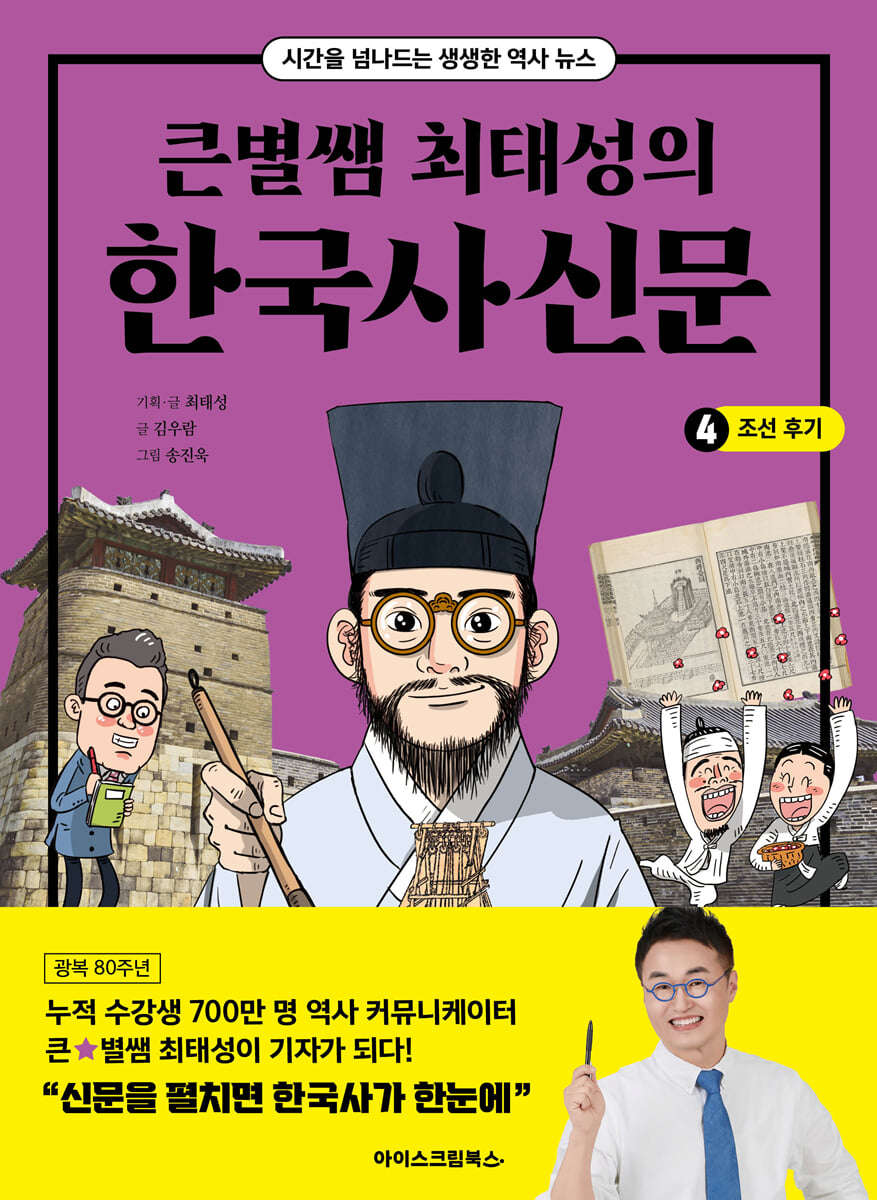
Big Star Teacher Choi Tae-seong's Korean History Newspaper 4: Late Joseon Dynasty
 |
Description
Book Introduction
The latest work by Choi Tae-seong, Korea's top Korean history instructor and history communicator, chosen by 7 million students!
Enjoy reading and learning at the same time through short, intensely written newspaper articles!
80th anniversary of liberation, a new door to Korean history opens for elementary school students!
A Korean history series has been published that allows you to experience the crucial events and scenes in our history as vividly as if they were happening in the present, using the format of a 'newspaper article' and the voice of Big Star, a 'journalist'.
This book, which takes advantage of author Taeseong Choi's strengths in storytelling, allows children to understand the history they need to know more easily and accurately through vivid delivery.
The "Big Star Teacher Choi Tae-seong's Korean History Newspaper" series is a series of historical education books designed to help young readers read the difficult and rigid history of Korea as "interesting articles." It uses the newspaper format to vividly convey major historical events and figures.
Unlike conventional narrative history books, "Big Star Teacher Choi Tae-seong's Korean History Newspaper" unfolds in a short, impactful article style, giving you the vivid feeling of traveling to the scene of an incident in a time machine and reporting directly.
By reconstructing the events of the time into a virtual front-page article, children can spark their imagination and curiosity, and easily understand the complex historical context.
This series is divided into volumes by era, allowing readers to see the flow of Korean history from prehistoric times to modern times at a glance. Each volume contains news articles, interviews, and advertisements appropriately placed by topic.
In particular, readers will have the special experience of organizing their own thoughts through column articles containing the perspectives of reporter Daebyeol Kim on looking at and interpreting history.
For elementary school children who are new to history, this book will be the perfect must-read, not only for textbook-linked learning but also for developing historical thinking and literacy skills.
The '④ Late Joseon Dynasty' section contains the history from the Imjin War, when King Gwanghaegun overcame the ruins of war, to the reformist politics of Heungseon Daewongun.
The stories of representative figures of the late Joseon Dynasty, such as Heo Jun, who wrote the Donguibogam, Lady Jang Hui-bin, known as King Sukjong's wife, and Jeong Yak-yong, who left behind numerous writings while in exile, are vividly told through interviews with reporter Daebyeol.
Additionally, the column articles delve into various issues, including King Jeongjo's construction of Hwaseong Fortress in Suwon and the suffering of the people under the rule of powerful factions, through the eyes of reporter Daebyeol.
In addition, you can enjoy interesting works such as the construction of the Baekdu Mountain boundary monument and the Jin-gyeong landscape paintings left by Gyeomjae Jeong Seon, presented in a modern advertising format.
Enjoy reading and learning at the same time through short, intensely written newspaper articles!
80th anniversary of liberation, a new door to Korean history opens for elementary school students!
A Korean history series has been published that allows you to experience the crucial events and scenes in our history as vividly as if they were happening in the present, using the format of a 'newspaper article' and the voice of Big Star, a 'journalist'.
This book, which takes advantage of author Taeseong Choi's strengths in storytelling, allows children to understand the history they need to know more easily and accurately through vivid delivery.
The "Big Star Teacher Choi Tae-seong's Korean History Newspaper" series is a series of historical education books designed to help young readers read the difficult and rigid history of Korea as "interesting articles." It uses the newspaper format to vividly convey major historical events and figures.
Unlike conventional narrative history books, "Big Star Teacher Choi Tae-seong's Korean History Newspaper" unfolds in a short, impactful article style, giving you the vivid feeling of traveling to the scene of an incident in a time machine and reporting directly.
By reconstructing the events of the time into a virtual front-page article, children can spark their imagination and curiosity, and easily understand the complex historical context.
This series is divided into volumes by era, allowing readers to see the flow of Korean history from prehistoric times to modern times at a glance. Each volume contains news articles, interviews, and advertisements appropriately placed by topic.
In particular, readers will have the special experience of organizing their own thoughts through column articles containing the perspectives of reporter Daebyeol Kim on looking at and interpreting history.
For elementary school children who are new to history, this book will be the perfect must-read, not only for textbook-linked learning but also for developing historical thinking and literacy skills.
The '④ Late Joseon Dynasty' section contains the history from the Imjin War, when King Gwanghaegun overcame the ruins of war, to the reformist politics of Heungseon Daewongun.
The stories of representative figures of the late Joseon Dynasty, such as Heo Jun, who wrote the Donguibogam, Lady Jang Hui-bin, known as King Sukjong's wife, and Jeong Yak-yong, who left behind numerous writings while in exile, are vividly told through interviews with reporter Daebyeol.
Additionally, the column articles delve into various issues, including King Jeongjo's construction of Hwaseong Fortress in Suwon and the suffering of the people under the rule of powerful factions, through the eyes of reporter Daebyeol.
In addition, you can enjoy interesting works such as the construction of the Baekdu Mountain boundary monument and the Jin-gyeong landscape paintings left by Gyeomjae Jeong Seon, presented in a modern advertising format.
- You can preview some of the book's contents.
Preview
index
The Late Joseon Dynasty | King Gwanghaegun, Striving to Heal the Wounds of War
King Gwanghaegun, who won the hearts of the people, ascended to the throne as the 15th king of Joseon.
Meet King Gwanghaegun, who pursued neutral diplomacy
Gyeonggi Province's pilot implementation of the Daedong Law will reduce the burden of public taxes.
Meet Heo Jun, author of Donguibogam
The meaning of history as seen through Gwanghaegun
The Late Joseon Dynasty | Joseon Faces Trials from Two Wars
The regime changed through the Injo Restoration
The Byeongjahoran and its aftermath
Choi Myung-gil vs. Kim Sang-heon: Peace or Resistance?
The outbreak of the Byeongja Horan, King Injo flees to Namhansanseong Fortress
Injo kneels before the Qing emperor
Crown Prince Sohyeon's Death Spreads Conspiracy Theories
What kind of Joseon did Crown Prince Sohyeon dream of?
The Late Joseon Dynasty: Part 3 | Joseon Efforts to Reorganize the Nation After War
The Byeonbyeonsa, the highest political body
Joseon Tongsinsa received a warm welcome in Japan.
One year or nine months? Another Yesong is happening.
Meet Kim Yuk, the man of the Great Law
King Hyojong's Northern Expedition, which could not be realized
Late Joseon Dynasty, Volume 4 | King Sukjong strengthens royal authority through his policy of returning to the country.
Meeting King Sukjong's wife, Lady Jang Hui-bin
King Sukjong dreams of strengthening royal authority through three repatriations.
Notice of the construction of the Baekdu Mountain boundary monument
Was King Sukjong really a king who was swayed by women?
Late Joseon Dynasty, Chapter 5 | King Yeongjo quells political strife with Tangpyeong policies
King Yeongjo erects the Tangpyeong Monument at Sungkyunkwan
Implementation of the Equalization Act to ease the burden on the people
A new work by Jeong Seon, the master of true-view landscape painting, is unveiled!
Crown Prince Sado imprisoned in a back room: the greatest tragedy in Joseon history.
Late Joseon Dynasty, No. 6 | King Jeongjo Leads Joseon's Revival
Jeongjo's Ascension to the Throne: Will an Era of Reform Begin?
Kyujanggak stands tall as a center for nurturing talent.
Meeting the Gyujanggak's censor, a concubine of illegitimate birth
Implementation of the New Sea Trade Act, reduction of privileges for merchants in the city
A glance at the Jeongjo Hwaseong Royal Tomb Trail
Meet Kim Man-deok, who saved the people of Jeju.
King Jeongjo's dream contained in Suwon Hwaseong Fortress
Late Joseon Dynasty, No. 7 | Agricultural Development Brings Change
Nationwide expansion of rice planting techniques, increasing agricultural production
Expanding the cultivation of new varieties and changing dining culture
Expanding commercial crop cultivation and revitalizing the rural economy
Commercial Development Transforms Joseon's Economic Structure
We are recruiting for the Deokdae
The shaky class system in the late Joseon Dynasty
Joseon's economy blossoms from the ruins of war.
Chapter 8: Late Joseon Dynasty | Western learning spreads and Silhak develops
Western learning spread among intellectuals
Intellectuals who set out to reform reality through Silhak
The rise of female scholars and the popularity of boudoir literature
Meeting Jeong Yak-yong at Yeoyudang
Jeong Yak-yong, a name that has left its mark on history
Late Joseon Dynasty: The 9th Period | A Commoner Culture Develops, Centered on the People
The educational boom among the common people: the popularization of private school education.
The rise of genre painting, the lives of the common people captured in the canvas
The popularity of Korean novels that have permeated public life
The folk painting market opens
Pansori and mask dance gain immense popularity
Culture reflects the times
Late Joseon Dynasty: Episode 10 | The People's Anger Explodes
King Sunjo proclaims the liberation of public slaves
The Andong Kim clan's monopoly on power leads to a path of factional politics.
Unidentified wall painting containing public sentiment discovered
Hong Gyeong-rae's Rebellion, suppressed by government troops
Meet the people suffering under the power of the powerful
Peasant uprisings that began in Jinju spread throughout Joseon.
Why Joseon had to collapse
No. 11: Late Joseon Dynasty | The Idea of Equality Captivates the Hearts of the People
The spread of Catholicism and the promotion of equality
Qing literati and scholars vied with each other to praise the "Sehando"
Donghak, Capturing the Hearts of the People
Meet Kim Jeong-ho, the Gosanja who completed the Daedongyeojido.
Why were prophecies popular in the late Joseon Dynasty?
Late Joseon Dynasty | Prince Heungseon Daewongun: Implementing Reform Policies
Heungseon Daewongun takes power, wielding the sword of reform.
Meet Heungseon Daewongun, Joseon's Last Reformer
Attempt to restore royal authority through the reconstruction of Gyeongbokgung Palace
Will the sudden implementation of the Hopoje system destroy the privileges of the yangban class?
Was Heungseon Daewongun's reform policy the right one?
King Gwanghaegun, who won the hearts of the people, ascended to the throne as the 15th king of Joseon.
Meet King Gwanghaegun, who pursued neutral diplomacy
Gyeonggi Province's pilot implementation of the Daedong Law will reduce the burden of public taxes.
Meet Heo Jun, author of Donguibogam
The meaning of history as seen through Gwanghaegun
The Late Joseon Dynasty | Joseon Faces Trials from Two Wars
The regime changed through the Injo Restoration
The Byeongjahoran and its aftermath
Choi Myung-gil vs. Kim Sang-heon: Peace or Resistance?
The outbreak of the Byeongja Horan, King Injo flees to Namhansanseong Fortress
Injo kneels before the Qing emperor
Crown Prince Sohyeon's Death Spreads Conspiracy Theories
What kind of Joseon did Crown Prince Sohyeon dream of?
The Late Joseon Dynasty: Part 3 | Joseon Efforts to Reorganize the Nation After War
The Byeonbyeonsa, the highest political body
Joseon Tongsinsa received a warm welcome in Japan.
One year or nine months? Another Yesong is happening.
Meet Kim Yuk, the man of the Great Law
King Hyojong's Northern Expedition, which could not be realized
Late Joseon Dynasty, Volume 4 | King Sukjong strengthens royal authority through his policy of returning to the country.
Meeting King Sukjong's wife, Lady Jang Hui-bin
King Sukjong dreams of strengthening royal authority through three repatriations.
Notice of the construction of the Baekdu Mountain boundary monument
Was King Sukjong really a king who was swayed by women?
Late Joseon Dynasty, Chapter 5 | King Yeongjo quells political strife with Tangpyeong policies
King Yeongjo erects the Tangpyeong Monument at Sungkyunkwan
Implementation of the Equalization Act to ease the burden on the people
A new work by Jeong Seon, the master of true-view landscape painting, is unveiled!
Crown Prince Sado imprisoned in a back room: the greatest tragedy in Joseon history.
Late Joseon Dynasty, No. 6 | King Jeongjo Leads Joseon's Revival
Jeongjo's Ascension to the Throne: Will an Era of Reform Begin?
Kyujanggak stands tall as a center for nurturing talent.
Meeting the Gyujanggak's censor, a concubine of illegitimate birth
Implementation of the New Sea Trade Act, reduction of privileges for merchants in the city
A glance at the Jeongjo Hwaseong Royal Tomb Trail
Meet Kim Man-deok, who saved the people of Jeju.
King Jeongjo's dream contained in Suwon Hwaseong Fortress
Late Joseon Dynasty, No. 7 | Agricultural Development Brings Change
Nationwide expansion of rice planting techniques, increasing agricultural production
Expanding the cultivation of new varieties and changing dining culture
Expanding commercial crop cultivation and revitalizing the rural economy
Commercial Development Transforms Joseon's Economic Structure
We are recruiting for the Deokdae
The shaky class system in the late Joseon Dynasty
Joseon's economy blossoms from the ruins of war.
Chapter 8: Late Joseon Dynasty | Western learning spreads and Silhak develops
Western learning spread among intellectuals
Intellectuals who set out to reform reality through Silhak
The rise of female scholars and the popularity of boudoir literature
Meeting Jeong Yak-yong at Yeoyudang
Jeong Yak-yong, a name that has left its mark on history
Late Joseon Dynasty: The 9th Period | A Commoner Culture Develops, Centered on the People
The educational boom among the common people: the popularization of private school education.
The rise of genre painting, the lives of the common people captured in the canvas
The popularity of Korean novels that have permeated public life
The folk painting market opens
Pansori and mask dance gain immense popularity
Culture reflects the times
Late Joseon Dynasty: Episode 10 | The People's Anger Explodes
King Sunjo proclaims the liberation of public slaves
The Andong Kim clan's monopoly on power leads to a path of factional politics.
Unidentified wall painting containing public sentiment discovered
Hong Gyeong-rae's Rebellion, suppressed by government troops
Meet the people suffering under the power of the powerful
Peasant uprisings that began in Jinju spread throughout Joseon.
Why Joseon had to collapse
No. 11: Late Joseon Dynasty | The Idea of Equality Captivates the Hearts of the People
The spread of Catholicism and the promotion of equality
Qing literati and scholars vied with each other to praise the "Sehando"
Donghak, Capturing the Hearts of the People
Meet Kim Jeong-ho, the Gosanja who completed the Daedongyeojido.
Why were prophecies popular in the late Joseon Dynasty?
Late Joseon Dynasty | Prince Heungseon Daewongun: Implementing Reform Policies
Heungseon Daewongun takes power, wielding the sword of reform.
Meet Heungseon Daewongun, Joseon's Last Reformer
Attempt to restore royal authority through the reconstruction of Gyeongbokgung Palace
Will the sudden implementation of the Hopoje system destroy the privileges of the yangban class?
Was Heungseon Daewongun's reform policy the right one?
Detailed image

Publisher's Review
“History newspaper delivery~!” If you read it with interest, Korean history will stick in your head!
Big Star Teacher Choi Tae-seong publishes a new concept history book for children.
A Korean history newspaper presented to commemorate the 80th anniversary of liberation
Reading Korean history in newspapers gives me more power to think.
Convey information concisely and clearly, and include diverse perspectives.
This book takes advantage of the newspaper's strengths, conveying the essence of the events in an accessible manner while also raising questions about each topic and encouraging readers to interpret it for themselves.
Young readers can develop historical thinking skills by connecting the past to the present, rather than simply viewing it as "the past."
A history book to read, see, and think about
This book conveys historical events from various angles through a colorful article format, just like an actual newspaper.
1.
Front Page Headline: Presents the core keywords of the day's topic as a title, helping readers get a preview of what will be covered in this chapter.
2.
Big Star Article: A concise news article structured according to the six principles (when, where, who, what, why, and how).
Helps children quickly understand key facts and summarize the development and context of events at a glance.
3.
Big Star Interview: An imaginary interview where you meet historical figures in person and hear their stories.
By vividly conveying the characters' thoughts and emotions, it goes beyond simple information delivery and enables character-centered empathetic learning.
4.
Big Star Column: This is a commentary corner where reporter Big Star provides his own commentary.
It conveys historical significance, background, and connections to the present day in an easy and in-depth manner, using explanations tailored to children's level.
5.
Big Star Advertisement: A fictional advertisement satirically depicting the situation at the time.
It stimulates historical imagination by expressing the times and culture in a playful way, and even provides background knowledge.
6.
Chronological Appendix: Includes a chronological table to help you organize what you've learned in the context of the times.
If you keep it on your desk, it will be effective in understanding the flow of Korean history and the causal relationships between events.
A historical newspaper with witty illustrations and vivid photographs
Witty illustrations help bring historical scenes to life and make complex content visually accessible.
Additionally, various visual materials such as actual artifacts, photographs, and maps are included, adding a sense of historical presence and realism that is difficult to convey through text alone.
History is a window to the future.
『Big Star Teacher Choi Tae-seong's Korean History Newspaper』 is not a simple introduction to history.
It is a living book designed to help children understand history not just as “things of the past,” but as “stories connected to the present.”
Within the clear framework of the newspaper format, children learn, feel, think, and develop a historical attitude that allows them to ask questions.
As we celebrate the 80th anniversary of liberation, this book will be a special gift, helping our children develop a broader perspective and deeper thinking through history.
Big Star Teacher Choi Tae-seong publishes a new concept history book for children.
A Korean history newspaper presented to commemorate the 80th anniversary of liberation
Reading Korean history in newspapers gives me more power to think.
Convey information concisely and clearly, and include diverse perspectives.
This book takes advantage of the newspaper's strengths, conveying the essence of the events in an accessible manner while also raising questions about each topic and encouraging readers to interpret it for themselves.
Young readers can develop historical thinking skills by connecting the past to the present, rather than simply viewing it as "the past."
A history book to read, see, and think about
This book conveys historical events from various angles through a colorful article format, just like an actual newspaper.
1.
Front Page Headline: Presents the core keywords of the day's topic as a title, helping readers get a preview of what will be covered in this chapter.
2.
Big Star Article: A concise news article structured according to the six principles (when, where, who, what, why, and how).
Helps children quickly understand key facts and summarize the development and context of events at a glance.
3.
Big Star Interview: An imaginary interview where you meet historical figures in person and hear their stories.
By vividly conveying the characters' thoughts and emotions, it goes beyond simple information delivery and enables character-centered empathetic learning.
4.
Big Star Column: This is a commentary corner where reporter Big Star provides his own commentary.
It conveys historical significance, background, and connections to the present day in an easy and in-depth manner, using explanations tailored to children's level.
5.
Big Star Advertisement: A fictional advertisement satirically depicting the situation at the time.
It stimulates historical imagination by expressing the times and culture in a playful way, and even provides background knowledge.
6.
Chronological Appendix: Includes a chronological table to help you organize what you've learned in the context of the times.
If you keep it on your desk, it will be effective in understanding the flow of Korean history and the causal relationships between events.
A historical newspaper with witty illustrations and vivid photographs
Witty illustrations help bring historical scenes to life and make complex content visually accessible.
Additionally, various visual materials such as actual artifacts, photographs, and maps are included, adding a sense of historical presence and realism that is difficult to convey through text alone.
History is a window to the future.
『Big Star Teacher Choi Tae-seong's Korean History Newspaper』 is not a simple introduction to history.
It is a living book designed to help children understand history not just as “things of the past,” but as “stories connected to the present.”
Within the clear framework of the newspaper format, children learn, feel, think, and develop a historical attitude that allows them to ask questions.
As we celebrate the 80th anniversary of liberation, this book will be a special gift, helping our children develop a broader perspective and deeper thinking through history.
GOODS SPECIFICS
- Date of issue: October 20, 2025
- Page count, weight, size: 172 pages | 188*257*20mm
- ISBN13: 9791161087740
- ISBN10: 1161087745
- KC Certification: Certification Type: Conformity Confirmation
You may also like
카테고리
korean


korean

![GQ KOREA Mark (Monthly): December [2025]](http://librairie.coreenne.fr/cdn/shop/files/8ef265dbbfbf186523ed75ba7319009d.jpg?v=1765340328&width=3840)


