

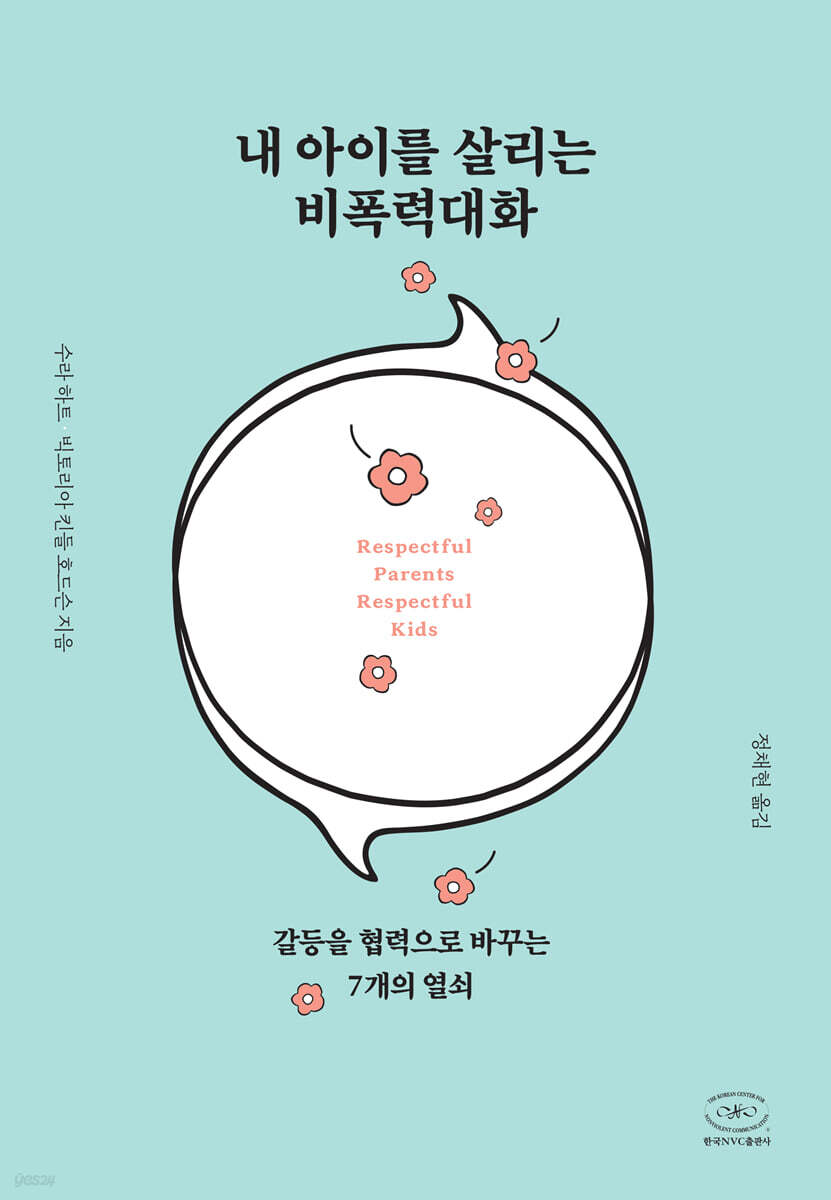
Nonviolent Communication to Save My Child
 |
Description
Book Introduction
This is a practical guide for all parents who want more cooperation, respect, trust, and harmony in their families, offering specific and useful tools.
Based on the principles of Nonviolent Communication (NVC) developed by Marshall Rosenberg, it presents seven keys and various family activities to transform conflict into cooperation, and guides specific methods to create a family culture of respect and cooperation.
The authors, who have studied communication and relationship skills that improve the quality of parent-child relationships beyond discipline-centered parenting, present a new paradigm based on their experiences as teachers and parents that moves beyond the traditional discipline-centered, controlling parenting role and fosters a mutually respectful relationship with children.
Amidst the various stressors faced by modern families, such as time shortage, information overload, and competitive environments, a key goal is to create a safe and trusting space (a “no-fault zone”) where the needs of both parents and children are respected.
In particular, the authors emphasize that the needs of both parents and children are equally important.
Collaboration is a two-way street, a process of creating rules and solving problems together, rather than commanding and obeying.
Parental self-respect and self-care are important at this time, as parents who care for their own needs set a healthier example for their children.
Based on the principles of Nonviolent Communication (NVC) developed by Marshall Rosenberg, it presents seven keys and various family activities to transform conflict into cooperation, and guides specific methods to create a family culture of respect and cooperation.
The authors, who have studied communication and relationship skills that improve the quality of parent-child relationships beyond discipline-centered parenting, present a new paradigm based on their experiences as teachers and parents that moves beyond the traditional discipline-centered, controlling parenting role and fosters a mutually respectful relationship with children.
Amidst the various stressors faced by modern families, such as time shortage, information overload, and competitive environments, a key goal is to create a safe and trusting space (a “no-fault zone”) where the needs of both parents and children are respected.
In particular, the authors emphasize that the needs of both parents and children are equally important.
Collaboration is a two-way street, a process of creating rules and solving problems together, rather than commanding and obeying.
Parental self-respect and self-care are important at this time, as parents who care for their own needs set a healthier example for their children.
- You can preview some of the book's contents.
Preview
index
Table and Family Activity List
Why I wrote this book
People who helped with this book
Foreword by Marshall Rosenberg
ingress
PART 01 Foundation for Respect and Cooperation
Chapter 1: Respect and Cooperation
Chapter 2 Self-Respect
Chapter 3 What Makes ‘Cooperation’ Miss ‘Togetherness’?
PART 02 7 Keys to Collaboration
Key 1: Parenting with Purpose
Key 2: See the desire behind every action.
Key 3: Create Safety, Trust, and Belonging
Key 4: Encourage Giving
Key 5: Speak with Respect
Key 6: Learn Together as You Live
Key 7: Make Your Home a No-Fault Zone
PART 03 Family Activities and Stories from the No-Fault Zone
Chapter 1 Family Activities
Topic: Giraffe Culture and Jackal Culture
Topic: Family Reunion
Topic: Practices that Enrich Your Life
Topic: Peaceful Conflict Resolution
Topic: Giraffe and Jackal Play
Chapter 2: Stories from the No-Fault Zone
References
Parenting Resources
Recommended Reading
Why I wrote this book
People who helped with this book
Foreword by Marshall Rosenberg
ingress
PART 01 Foundation for Respect and Cooperation
Chapter 1: Respect and Cooperation
Chapter 2 Self-Respect
Chapter 3 What Makes ‘Cooperation’ Miss ‘Togetherness’?
PART 02 7 Keys to Collaboration
Key 1: Parenting with Purpose
Key 2: See the desire behind every action.
Key 3: Create Safety, Trust, and Belonging
Key 4: Encourage Giving
Key 5: Speak with Respect
Key 6: Learn Together as You Live
Key 7: Make Your Home a No-Fault Zone
PART 03 Family Activities and Stories from the No-Fault Zone
Chapter 1 Family Activities
Topic: Giraffe Culture and Jackal Culture
Topic: Family Reunion
Topic: Practices that Enrich Your Life
Topic: Peaceful Conflict Resolution
Topic: Giraffe and Jackal Play
Chapter 2: Stories from the No-Fault Zone
References
Parenting Resources
Recommended Reading
Into the book
Our hope in writing this book is to help you make your own choices about how to parent, based on the values you hold most dear.
We also support you in choosing what you most want to give your children.
--- p.15
Practicing Nonviolent Communication transforms the dichotomous thinking, enemy-like thinking, and fear-driven thinking that are the source of both internal and external conflict into a respectful and loving awareness of the life-enriching human needs that lie at the core of all action.
--- p.28
The core meaning of the word 'respect' is 'to see'.
But what do we see? We believe that "respecting" another person means seeing what they're experiencing, especially their current feelings and needs, with a respectful heart.
--- p.44
As with all child behavior, there is a human need underlying every action.
Whether you are conscious of them or not.
By reminding yourself to remember this, you'll move beyond self-judgment and into self-empathy, fueled by positive energy and the motivation to develop new habits.
--- p.63
Children learn most from observing their parents' behavior.
When you take actions that align with your purpose—actions that get you where you want to go—your child will learn the most about what choices to make to get where he or she wants to go by observing that ability in you.
--- p.92
Every moment of every day, your child is doing his or her best to meet his or her needs.
It's the same desire you have.
When we understand behavior this way, our habit of judging our children's behavior naturally shifts to respectful understanding and compassion.
--- p.112
Recognizing that every behavior is an attempt to satisfy a need can help you understand why children behave the way they do and allow you to adopt a needs-centered approach to parenting.
Parents who focus on needs in this way can help their children learn to take greater responsibility for meeting their own needs.
We also support you in choosing what you most want to give your children.
--- p.15
Practicing Nonviolent Communication transforms the dichotomous thinking, enemy-like thinking, and fear-driven thinking that are the source of both internal and external conflict into a respectful and loving awareness of the life-enriching human needs that lie at the core of all action.
--- p.28
The core meaning of the word 'respect' is 'to see'.
But what do we see? We believe that "respecting" another person means seeing what they're experiencing, especially their current feelings and needs, with a respectful heart.
--- p.44
As with all child behavior, there is a human need underlying every action.
Whether you are conscious of them or not.
By reminding yourself to remember this, you'll move beyond self-judgment and into self-empathy, fueled by positive energy and the motivation to develop new habits.
--- p.63
Children learn most from observing their parents' behavior.
When you take actions that align with your purpose—actions that get you where you want to go—your child will learn the most about what choices to make to get where he or she wants to go by observing that ability in you.
--- p.92
Every moment of every day, your child is doing his or her best to meet his or her needs.
It's the same desire you have.
When we understand behavior this way, our habit of judging our children's behavior naturally shifts to respectful understanding and compassion.
--- p.112
Recognizing that every behavior is an attempt to satisfy a need can help you understand why children behave the way they do and allow you to adopt a needs-centered approach to parenting.
Parents who focus on needs in this way can help their children learn to take greater responsibility for meeting their own needs.
--- p.120
Publisher's Review
7 Keys to Transforming Conflict into Cooperation
The seven keys that make up Part 2 of this book are focused on gradually developing parents' ability to make their home a "no-fault zone"—a place where everyone's needs are valued equally and everyone does their best to meet those needs instead of scolding, rewarding, or punishing.
Key 1: 'Parenting with Purpose' Helps you align your deepest reasons for being a parent with your deepest desires for your children.
Parents who have a clear understanding of their role, including the meaning and purpose of their own lives, can provide stability, security, and safety to their children, guide them in finding their own North Star, and help them meet their most pressing needs.
Key 2: "Look at the desires behind every action." Why do children behave in certain ways? This article demystifies this mystery and introduces parenting strategies focused on their needs.
Every moment of every day, children do their best to satisfy their needs.
It's the same desire that parents have.
When we understand behavior this way, our habit of judging our children's behavior can naturally change into respectful understanding and compassion.
Key 3: 'Creating Safety, Trust, and Belonging' Citing scientific research, it confirms that physical and emotional safety play a crucial role in a child's development and shows how to provide it.
It emphasizes that the needs for safety, trust, and belonging are met first by the family, then by the peer group at school, other members of the community, and eventually by peers and the larger world.
Key 4: Encourage Giving: We invite you to recognize and gratefully receive the gifts your children give you, and to encourage a flow of giving and receiving.
In some ways, children lead their parents' lives just as much as their parents lead their children's lives.
According to the authors, children come into their parents' lives as a source of inspiration and reminder of how vibrant and fascinating life can be.
Key 5: Speak Respectfully: This guides you through nonviolent communication, showing you how to transform all criticism and condemnation into expressions that respect your needs.
While words can fuel conflict, they also have the power to foster respect, understanding, and cooperation.
Instead of judging, criticizing, condemning, and forcing, we introduce and practice words that continually focus on desires with respect.
Key 6: 'Let's learn together as we live' I encourage you to explore, research, and create together with your child, confident that there are many ways to do things and many solutions to meet their needs.
Learning 'together' as we live is based on the idea that parents and children can be great partners in planning, making decisions, and solving problems that affect the child's daily life.
Key 7: 'Make Your Home a No-Fault Zone' shows the true roots of conflict and the paths parents can take to transform conflict situations into heartfelt connections.
By transforming your home into a no-fault zone, the authors are confident that conflicts can be reduced by up to 90 percent.
The Persian philosopher and poet Rumi described such a place as “the field beyond right and wrong.”
How to Use This Book
Nonviolent communication is more than just a communication technique; it is a practical tool for fostering a culture of trust, self-esteem, and cooperation within the family.
The book emphasizes the importance of parents first recognizing and respecting their own needs and feelings, along with the message that when parents change, their children will change as well.
We guide you to transform conflict from a power struggle or a matter of control into an opportunity for growth through understanding and cooperation with each other's needs.
This book is very useful for parents struggling with conflicts and communication issues with their children, as well as teachers and counselors considering the practice of nonviolent communication in schools and counseling settings.
The seven keys that make up Part 2 of this book are focused on gradually developing parents' ability to make their home a "no-fault zone"—a place where everyone's needs are valued equally and everyone does their best to meet those needs instead of scolding, rewarding, or punishing.
Key 1: 'Parenting with Purpose' Helps you align your deepest reasons for being a parent with your deepest desires for your children.
Parents who have a clear understanding of their role, including the meaning and purpose of their own lives, can provide stability, security, and safety to their children, guide them in finding their own North Star, and help them meet their most pressing needs.
Key 2: "Look at the desires behind every action." Why do children behave in certain ways? This article demystifies this mystery and introduces parenting strategies focused on their needs.
Every moment of every day, children do their best to satisfy their needs.
It's the same desire that parents have.
When we understand behavior this way, our habit of judging our children's behavior can naturally change into respectful understanding and compassion.
Key 3: 'Creating Safety, Trust, and Belonging' Citing scientific research, it confirms that physical and emotional safety play a crucial role in a child's development and shows how to provide it.
It emphasizes that the needs for safety, trust, and belonging are met first by the family, then by the peer group at school, other members of the community, and eventually by peers and the larger world.
Key 4: Encourage Giving: We invite you to recognize and gratefully receive the gifts your children give you, and to encourage a flow of giving and receiving.
In some ways, children lead their parents' lives just as much as their parents lead their children's lives.
According to the authors, children come into their parents' lives as a source of inspiration and reminder of how vibrant and fascinating life can be.
Key 5: Speak Respectfully: This guides you through nonviolent communication, showing you how to transform all criticism and condemnation into expressions that respect your needs.
While words can fuel conflict, they also have the power to foster respect, understanding, and cooperation.
Instead of judging, criticizing, condemning, and forcing, we introduce and practice words that continually focus on desires with respect.
Key 6: 'Let's learn together as we live' I encourage you to explore, research, and create together with your child, confident that there are many ways to do things and many solutions to meet their needs.
Learning 'together' as we live is based on the idea that parents and children can be great partners in planning, making decisions, and solving problems that affect the child's daily life.
Key 7: 'Make Your Home a No-Fault Zone' shows the true roots of conflict and the paths parents can take to transform conflict situations into heartfelt connections.
By transforming your home into a no-fault zone, the authors are confident that conflicts can be reduced by up to 90 percent.
The Persian philosopher and poet Rumi described such a place as “the field beyond right and wrong.”
How to Use This Book
Nonviolent communication is more than just a communication technique; it is a practical tool for fostering a culture of trust, self-esteem, and cooperation within the family.
The book emphasizes the importance of parents first recognizing and respecting their own needs and feelings, along with the message that when parents change, their children will change as well.
We guide you to transform conflict from a power struggle or a matter of control into an opportunity for growth through understanding and cooperation with each other's needs.
This book is very useful for parents struggling with conflicts and communication issues with their children, as well as teachers and counselors considering the practice of nonviolent communication in schools and counseling settings.
GOODS SPECIFICS
- Date of issue: June 24, 2025
- Page count, weight, size: 312 pages | 452g | 148*215*20mm
- ISBN13: 9791185121628
- ISBN10: 1185121625
You may also like
카테고리
korean


korean

![GQ KOREA Mark (Monthly): December [2025]](http://librairie.coreenne.fr/cdn/shop/files/8ef265dbbfbf186523ed75ba7319009d.jpg?v=1765340328&width=3840)


