

Studying what you want to do
 |
Description
Book Introduction
Choi Jae-cheon's Study, which captivated 100,000 readers
Finally back to children's growth fairy tales!
A small research lab inside the 'Let's Play Fun Park'
Could meeting the director there make the difficult study more fun?
A small research lab on the path leading to the forest in the 'Let's Play Fun Park'.
The twelve-year-old protagonist, Oh Jeong-woo, meets a baker who studies insects and discovers the fun and meaning of studying.
The story of Jung-woo, a fifth grader who wants to become an architecture YouTuber, Geon-i who always says, "You don't even know that," So-ri who was once a crybaby but has become popular, Jung-woo's older brother Su-woo who is good at studying but doesn't want to go to medical school, and their mother who desperately wants Su-woo to go to medical school unfolds in an exciting way under the theme of "studying."
Can we find the reason and direction for studying?
Based on the International Baccalaureate exam-tested book, 『Choi Jae-cheon's Study』, a steady seller chosen by readers, bookstores, and publishers, the original children's story 『Studying I Want to Do』 has been published by Kim Young-sa.
Why should we study so hard? Few adults offer an answer that children can nod along to.
This book does not focus on studying for grades, but rather depicts the process of studying to survive in a changing world, leading to deep reflection on questions ranging from "what is studying?" to "how should we study?"
It serves as a compass to help children find what they want to do and live happy and fun lives.
Finally back to children's growth fairy tales!
A small research lab inside the 'Let's Play Fun Park'
Could meeting the director there make the difficult study more fun?
A small research lab on the path leading to the forest in the 'Let's Play Fun Park'.
The twelve-year-old protagonist, Oh Jeong-woo, meets a baker who studies insects and discovers the fun and meaning of studying.
The story of Jung-woo, a fifth grader who wants to become an architecture YouTuber, Geon-i who always says, "You don't even know that," So-ri who was once a crybaby but has become popular, Jung-woo's older brother Su-woo who is good at studying but doesn't want to go to medical school, and their mother who desperately wants Su-woo to go to medical school unfolds in an exciting way under the theme of "studying."
Can we find the reason and direction for studying?
Based on the International Baccalaureate exam-tested book, 『Choi Jae-cheon's Study』, a steady seller chosen by readers, bookstores, and publishers, the original children's story 『Studying I Want to Do』 has been published by Kim Young-sa.
Why should we study so hard? Few adults offer an answer that children can nod along to.
This book does not focus on studying for grades, but rather depicts the process of studying to survive in a changing world, leading to deep reflection on questions ranging from "what is studying?" to "how should we study?"
It serves as a compass to help children find what they want to do and live happy and fun lives.
- You can preview some of the book's contents.
Preview
index
introduction
Chapter 1.
○○ Research Institute
Chapter 2.
Director
Chapter 3.
Things I want to do
Chapter 4.
Don't try too hard to memorize it
Chapter 5.
My brother ran away from home
Chapter 6.
Real study
Chapter 7.
Write a letter
Chapter 8.
library
Chapter 9.
Deliberation
Chapter 10.
Gyeongju tour
Chapter 11.
Like a chimpanzee
Chapter 12.
Geon-i's secret
Chapter 13.
Each other
Chapter 14.
Find what you like
Epilogue
Chapter 1.
○○ Research Institute
Chapter 2.
Director
Chapter 3.
Things I want to do
Chapter 4.
Don't try too hard to memorize it
Chapter 5.
My brother ran away from home
Chapter 6.
Real study
Chapter 7.
Write a letter
Chapter 8.
library
Chapter 9.
Deliberation
Chapter 10.
Gyeongju tour
Chapter 11.
Like a chimpanzee
Chapter 12.
Geon-i's secret
Chapter 13.
Each other
Chapter 14.
Find what you like
Epilogue
Into the book
When you let them study what they want to study, they feel motivated and can do better.
--- p.48
They say school or academy grades aren't everything.
There are things that cannot be expressed in points.
Everyone has something they are good at and potential.
They say that potential comes out only when you keep trying and challenging yourself.
If there's something I find interesting or something I want to do, I just give it a try.
Having fun and challenging yourself, that's real studying.
--- p.28
Writing is about expressing your thoughts.
If you express your thoughts well, other people may be moved.
Writing isn't about finding the right answer based on other people's thoughts or what you've learned, like taking a test.
You just need to organize your thoughts well.
It's strange, but when you write like that, you start to realize what you're thinking and get to know yourself.
If you look deep into your thoughts, you will also find out what you want to do.
--- pp.67-68
It's okay to make mistakes.
Speak confidently.
They say there is no one who does not make mistakes in life.
Making mistakes is also a part of learning.
If you're so afraid of making mistakes that you don't even start, nothing will happen.
They say that nothing happening is not a good thing.
If you keep challenging yourself, you will make mistakes.
Making mistakes like that makes you a stronger person.
--- p.84
Let's start by promising in advance that we won't criticize or get angry even if we have different opinions.
If you think deeply about the problem, organize it, and talk about it, you will find an answer.
It is important not to get angry at each other and to respect each other's opinions and thoughts without criticizing them.
--- p.91
You often hear people say, "Don't study, do something else." When you try out different things, your perspective on the world expands.
I hope everyone can go through that process to get to know themselves.
Everyone has something they're good at and something they like, but there are many cases where they don't know which direction their antennae are pointing.
I hope you find out which way your antennae are pointing.
--- p.107
There are many different types of people living together in the world.
There are people who are good at drawing or music, even though they are bad at Korean, English, and math.
Some people have the ability to entertain others, and some are good at cooking.
A diverse group of people come together to fill in each other's shortcomings and learn from each other, leading the world.
When I look at it, it seems like Jeong-woo, So-ri, and Geon-i are that kind of existence to each other?
--- p.135
When you decide to go down a certain path, you worry about whether it is the right path to take or not.
What if, in that case, it turns out it's not the path I wanted to take? What if it's too rough and I give up halfway? Instead of worrying, if you want to go, just go for it.
You have to go there to know what the road is like.
--- p.48
They say school or academy grades aren't everything.
There are things that cannot be expressed in points.
Everyone has something they are good at and potential.
They say that potential comes out only when you keep trying and challenging yourself.
If there's something I find interesting or something I want to do, I just give it a try.
Having fun and challenging yourself, that's real studying.
--- p.28
Writing is about expressing your thoughts.
If you express your thoughts well, other people may be moved.
Writing isn't about finding the right answer based on other people's thoughts or what you've learned, like taking a test.
You just need to organize your thoughts well.
It's strange, but when you write like that, you start to realize what you're thinking and get to know yourself.
If you look deep into your thoughts, you will also find out what you want to do.
--- pp.67-68
It's okay to make mistakes.
Speak confidently.
They say there is no one who does not make mistakes in life.
Making mistakes is also a part of learning.
If you're so afraid of making mistakes that you don't even start, nothing will happen.
They say that nothing happening is not a good thing.
If you keep challenging yourself, you will make mistakes.
Making mistakes like that makes you a stronger person.
--- p.84
Let's start by promising in advance that we won't criticize or get angry even if we have different opinions.
If you think deeply about the problem, organize it, and talk about it, you will find an answer.
It is important not to get angry at each other and to respect each other's opinions and thoughts without criticizing them.
--- p.91
You often hear people say, "Don't study, do something else." When you try out different things, your perspective on the world expands.
I hope everyone can go through that process to get to know themselves.
Everyone has something they're good at and something they like, but there are many cases where they don't know which direction their antennae are pointing.
I hope you find out which way your antennae are pointing.
--- p.107
There are many different types of people living together in the world.
There are people who are good at drawing or music, even though they are bad at Korean, English, and math.
Some people have the ability to entertain others, and some are good at cooking.
A diverse group of people come together to fill in each other's shortcomings and learn from each other, leading the world.
When I look at it, it seems like Jeong-woo, So-ri, and Geon-i are that kind of existence to each other?
--- p.135
When you decide to go down a certain path, you worry about whether it is the right path to take or not.
What if, in that case, it turns out it's not the path I wanted to take? What if it's too rough and I give up halfway? Instead of worrying, if you want to go, just go for it.
You have to go there to know what the road is like.
--- pp.141-142
Publisher's Review
“In the end, when you know, you fall in love.”
Why should we study? How should we study?
A coming-of-age story depicting a rewarding journey of discovering the fun and meaning of studying.
Here, in the 'Let's Play Park', also known as the 'Forest in the City', there is a research center made of wood.
There, an unidentified owner bakes bread and studies bugs.
Twelve-year-olds Jeong-woo, Geon-i, and So-ri go back and forth to the institute, share their worries, discover the joy of studying, and resolve their conflicts.
They grow into healthy and confident children who are not swayed by their parents' expectations and pressure, but find their own desires.
The book "Studying I Want to Do," which guides us from "Studying = Exams" to "Studying = Life," has been published by Kim Young Publishing.
The title of the book, which omits the subject, makes us ponder whether children are doing the 'studying that their mothers, fathers, and teachers want them to do.'
It makes us reflect on whether our society has given children the opportunity to think about what they want to study.
I ask whether true study is not studying that helps both children and adults successfully overcome the threshold of growth in life, rather than studying for grades.
Let's go into the book.
The main character, Jeong-woo, wants to become a YouTuber who introduces architecture.
To visit architectural sites from around the world, one must be able to communicate, but Jeong-woo despairs that his dream will be impossible because he is not good at English.
When Jeong-woo confides his worries, the director responds.
“You have to try to find out whether something is possible or impossible,” he says, and “If you keep trying, your potential will come out.” He encourages people to try and doesn’t give up hope out of the blue.
Jeong-woo's friend Geon-i is good at studying and acts like he's a smart guy, but he becomes discouraged after failing the academy level exam.
He asserts that “studying without memorizing is not studying” and emphasizes that “the important things must be memorized, even if it means forcing oneself to do so.”
After hearing Geon-i's argument, the director breaks the stereotype about studying by saying, "If you have interest and curiosity, it's okay to start by learning the parts you like, even if you don't know everything from the beginning."
“If you study with interest, there will come a time when you will memorize it naturally.”
In this way, the owner of the book expands the perspective on the studies that children have been learning.
“There’s no such thing as pointless.” “Don’t try too hard to memorize.” “If you try this path and that path, you’ll find out which path you like.” “It’s okay to make mistakes.
“Speak confidently.” “It is important not to get angry at each other and to respect each other’s opinions and thoughts without criticizing them.” By giving these words of encouragement, they provide the driving force for children to study bigger and broader subjects.
"Studying What You Want to Do" conveys the message that "children grow when they are helped to do what they want to do and find what they like, rather than studying based on test scores."
It breaks the equation that 'studying is a test and a competition for college entrance exams' and gives insight that 'studying is something you do to live well', and breaks the prejudice that 'mistakes are failure and falling behind' and makes children realize again that 'mistakes are challenges and experiences', thereby instilling pride in children.
Children's book author Park Hyun-sook chose a story she wanted to tell children in "Choi Jae-cheon's Study" and created a surprising "realistic fairy tale."
He created a captivating narrative that comforts and encourages children trapped in the reality of endless competition, helping them find their own path.
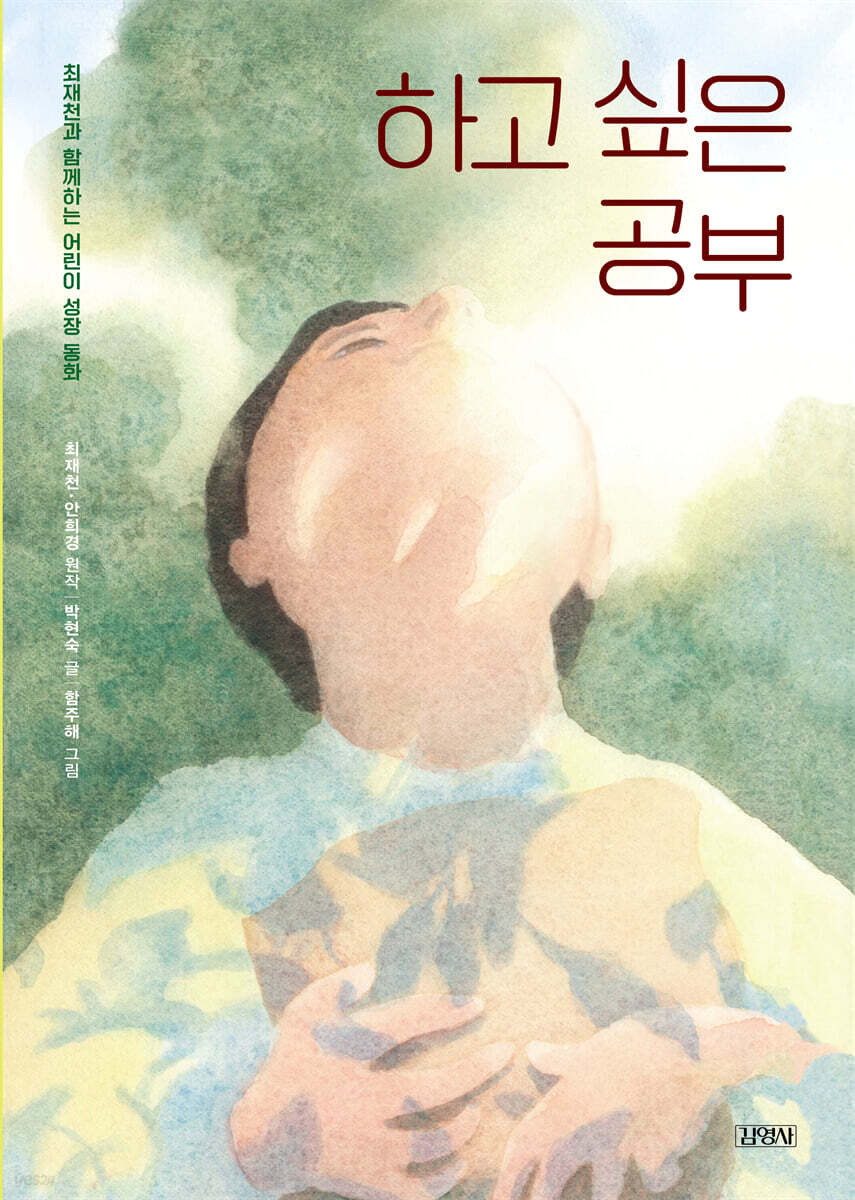
Artist Ham Ju-hae's clear and warm watercolors enhance the emotions of the story and evoke empathy.
“I’ve never felt so proud in my twelve-year life.” This is what Jeong-woo thought after translating it into English himself.
“I want to find out what I like too.” This is what Geon said after talking with the manager.
“It’s not that I don’t like studying.
“You don’t want to go to medical school.” This is the rebuttal that Su-woo, Jeong-woo’s older brother, gave to his mother, who was urging him to go to medical school.
Parents may feel a pang of sadness at these thoughts and words.
Is it not the parents who choose and decide their children's future?
When you open the first chapter of this book and when you close the last, your thoughts about studying will completely change.
“Of course, mathematical formulas never change.
Korean grammar doesn't change either.
The English words don't change either.
But shouldn't the obsession with getting one or ten more points while attending school change? Rather than studying for grades that make you cry and laugh, we need to study for the purpose of living well in a changing world.
(…) Why do you think you study?” If you want someone to pinpoint how to improve your grades, close this book.
If you want to learn how to live well, open this book and read it.
“As you gain a lot of experience, you will discover what you like, what you are good at, and what you want to do.
You often hear people say, "Don't study, do something else." When you try out different things, your perspective on the world expands.
I hope everyone can go through that process to get to know themselves.
Everyone has something they're good at and something they like, but there are many cases where they don't know which direction their antennae are pointing.
I hope you will find the direction your antennae are pointing in.” Through “Studying What You Want to Do,” I hope that children and adults alike will not be bound by the report cards prescribed by our society, but will search, search, and read to find “their own path” rather than insisting on “a single path.”
Why should we study? How should we study?
A coming-of-age story depicting a rewarding journey of discovering the fun and meaning of studying.
Here, in the 'Let's Play Park', also known as the 'Forest in the City', there is a research center made of wood.
There, an unidentified owner bakes bread and studies bugs.
Twelve-year-olds Jeong-woo, Geon-i, and So-ri go back and forth to the institute, share their worries, discover the joy of studying, and resolve their conflicts.
They grow into healthy and confident children who are not swayed by their parents' expectations and pressure, but find their own desires.
The book "Studying I Want to Do," which guides us from "Studying = Exams" to "Studying = Life," has been published by Kim Young Publishing.
The title of the book, which omits the subject, makes us ponder whether children are doing the 'studying that their mothers, fathers, and teachers want them to do.'
It makes us reflect on whether our society has given children the opportunity to think about what they want to study.
I ask whether true study is not studying that helps both children and adults successfully overcome the threshold of growth in life, rather than studying for grades.
Let's go into the book.
The main character, Jeong-woo, wants to become a YouTuber who introduces architecture.
To visit architectural sites from around the world, one must be able to communicate, but Jeong-woo despairs that his dream will be impossible because he is not good at English.
When Jeong-woo confides his worries, the director responds.
“You have to try to find out whether something is possible or impossible,” he says, and “If you keep trying, your potential will come out.” He encourages people to try and doesn’t give up hope out of the blue.
Jeong-woo's friend Geon-i is good at studying and acts like he's a smart guy, but he becomes discouraged after failing the academy level exam.
He asserts that “studying without memorizing is not studying” and emphasizes that “the important things must be memorized, even if it means forcing oneself to do so.”
After hearing Geon-i's argument, the director breaks the stereotype about studying by saying, "If you have interest and curiosity, it's okay to start by learning the parts you like, even if you don't know everything from the beginning."
“If you study with interest, there will come a time when you will memorize it naturally.”
In this way, the owner of the book expands the perspective on the studies that children have been learning.
“There’s no such thing as pointless.” “Don’t try too hard to memorize.” “If you try this path and that path, you’ll find out which path you like.” “It’s okay to make mistakes.
“Speak confidently.” “It is important not to get angry at each other and to respect each other’s opinions and thoughts without criticizing them.” By giving these words of encouragement, they provide the driving force for children to study bigger and broader subjects.
"Studying What You Want to Do" conveys the message that "children grow when they are helped to do what they want to do and find what they like, rather than studying based on test scores."
It breaks the equation that 'studying is a test and a competition for college entrance exams' and gives insight that 'studying is something you do to live well', and breaks the prejudice that 'mistakes are failure and falling behind' and makes children realize again that 'mistakes are challenges and experiences', thereby instilling pride in children.
Children's book author Park Hyun-sook chose a story she wanted to tell children in "Choi Jae-cheon's Study" and created a surprising "realistic fairy tale."
He created a captivating narrative that comforts and encourages children trapped in the reality of endless competition, helping them find their own path.
Artist Ham Ju-hae's clear and warm watercolors enhance the emotions of the story and evoke empathy.
“I’ve never felt so proud in my twelve-year life.” This is what Jeong-woo thought after translating it into English himself.
“I want to find out what I like too.” This is what Geon said after talking with the manager.
“It’s not that I don’t like studying.
“You don’t want to go to medical school.” This is the rebuttal that Su-woo, Jeong-woo’s older brother, gave to his mother, who was urging him to go to medical school.
Parents may feel a pang of sadness at these thoughts and words.
Is it not the parents who choose and decide their children's future?
When you open the first chapter of this book and when you close the last, your thoughts about studying will completely change.
“Of course, mathematical formulas never change.
Korean grammar doesn't change either.
The English words don't change either.
But shouldn't the obsession with getting one or ten more points while attending school change? Rather than studying for grades that make you cry and laugh, we need to study for the purpose of living well in a changing world.
(…) Why do you think you study?” If you want someone to pinpoint how to improve your grades, close this book.
If you want to learn how to live well, open this book and read it.
“As you gain a lot of experience, you will discover what you like, what you are good at, and what you want to do.
You often hear people say, "Don't study, do something else." When you try out different things, your perspective on the world expands.
I hope everyone can go through that process to get to know themselves.
Everyone has something they're good at and something they like, but there are many cases where they don't know which direction their antennae are pointing.
I hope you will find the direction your antennae are pointing in.” Through “Studying What You Want to Do,” I hope that children and adults alike will not be bound by the report cards prescribed by our society, but will search, search, and read to find “their own path” rather than insisting on “a single path.”
GOODS SPECIFICS
- Date of issue: February 25, 2025
- Format: Hardcover book binding method guide
- Page count, weight, size: 152 pages | 358g | 153*220*15mm
- ISBN13: 9791173320835
- KC Certification: Certification Type: Conformity Confirmation
You may also like
카테고리
korean


korean

![GQ KOREA Mark (Monthly): December [2025]](http://librairie.coreenne.fr/cdn/shop/files/8ef265dbbfbf186523ed75ba7319009d.jpg?v=1765340328&width=3840)


