

Swift Programming
 |
Description
Book Introduction
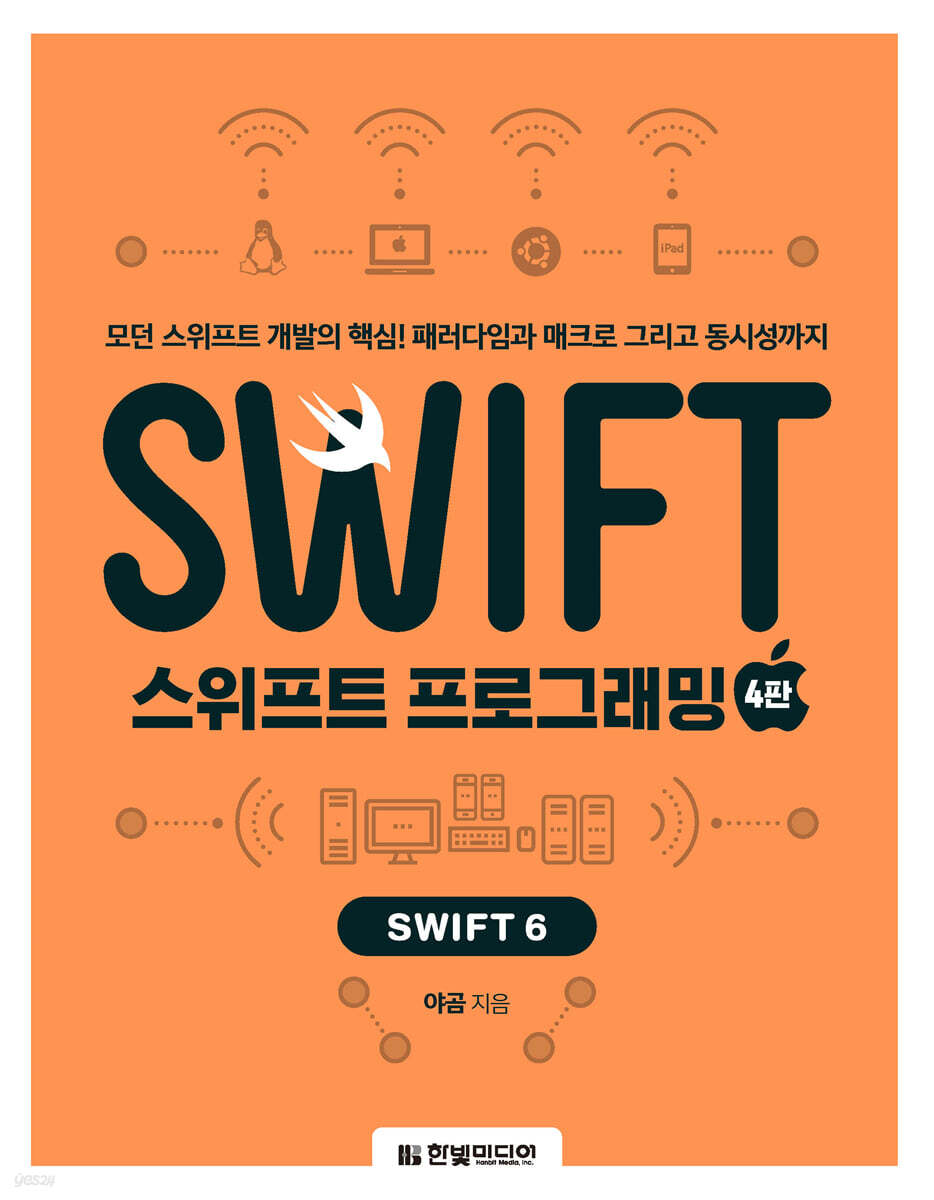
『Swift Programming』 Completely Revised 4th Edition!
A single volume that captures the modern programming philosophy pursued by Swift 6.
This book is a Swift textbook that delves deeply into the Swift language.
This revised edition, which perfectly reflects the 'Swift 6 version', helps you understand the paradigm flow that starts from basic grammar and progresses to object-oriented, functional, and protocol-oriented design at a glance, and naturally learn the philosophy and practical application of Swift.
You can learn and apply the latest features such as safe asynchronous and parallel processing through concurrency, macro-based automation of repetitive tasks, and actors, non-copy types, and package access levels to your actual code.
Experience the full potential of Swift 6 firsthand with this book and improve both safety and productivity.
A single volume that captures the modern programming philosophy pursued by Swift 6.
This book is a Swift textbook that delves deeply into the Swift language.
This revised edition, which perfectly reflects the 'Swift 6 version', helps you understand the paradigm flow that starts from basic grammar and progresses to object-oriented, functional, and protocol-oriented design at a glance, and naturally learn the philosophy and practical application of Swift.
You can learn and apply the latest features such as safe asynchronous and parallel processing through concurrency, macro-based automation of repetitive tasks, and actors, non-copy types, and package access levels to your actual code.
Experience the full potential of Swift 6 firsthand with this book and improve both safety and productivity.
- You can preview some of the book's contents.
Preview
index
[ PART I ] Swift Basics
CHAPTER 1 Swift
__1.1 History of Swift
__1.2 Swift's language features
__1.3 Swift execution environment
CHAPTER 2 Getting Started with Swift
__2.1 Basic Naming Conventions
__2.2 Console log
__2.3 Notes
__2.4 Variables and Constants
CHAPTER 3 Data Type Basics
__3.1 Int and UInt
__3.2 Bool
__3.3 Float and Double
__3.4 Character
__3.5 String
__3.6 Any, AnyObject, and nil
CHAPTER 4 Advanced Data Types
__4.1 Data type assurance
__4.2 Type Alias
__4.3 Tuple
__4.4 Collection type
__4.5 Enumeration
CHAPTER 5 Operators
__5.1 Types of operators
__5.2 Operator Precedence and Associativity
__5.3 User-defined operators
CHAPTER 6 FLOW CONTROL
__6.1 Conditional statements
__6.2 Loops
__6.3 Syntax Name Table
CHAPTER 7 FUNCTIONS
__7.1 Functions and Methods
__7.2 Function definition and calling
__7.3 Nested functions
__7.4 Non-terminating functions
__7.5 Functions that can ignore return values
CHAPTER 8 OPTIONAL
__8.1 Using optionals
__8.2 Optional Extraction
[ PART II ] Object-Oriented Programming and Swift
CHAPTER 9 STRUCTURES AND CLASSES
__9.1 Structure
__9.2 class
__9.3 Difference between structures and classes
__9.4 Selecting and using structures and classes
CHAPTER 10 PROPERTIES AND METHODS
__10.1 Properties
__10.2 Method
CHAPTER 11 Instance Creation and Destruction
__11.1 Instance Creation
__11.2 Instance Destruction
CHAPTER 12 ACCESS CONTROL
__12.1 What is access control?
__12.2 Access level
__12.3 Access Control Implementation
__12.4 Access Control Implementation Notes
__12.5 private and fileprivate
__12.6 Read-only implementation
[ PART III ] Functional Programming and Swift
CHAPTER 13 Closure
__13.1 Basic Closures
__13.2 Trailing closures
__13.3 Simplifying Closure Expressions
__13.4 Get value
__13.5 Closures are reference types
__13.6 Escape Closure
__13.7 Automatic closure
CHAPTER 14: OPTIONAL CHAINING AND EARLY EXIT
__14.1 Optional Chaining
__14.2 Quick Exit
CHAPTER 15 Map, Filter, and Reduce
__15.1 Map
__15.2 Filter
__15.3 Reduce
__15.4 Using Map, Filter, and Reduce
CHAPTER 16 Monads
__16.1 Context
__16.2 Function Object
__16.3 Monad
[ PART IV ] Expansion
CHAPTER 17 Subscripts
__17.1 Subscript Syntax
__17.2 Subscript Implementation
__17.3 Multiple Subscripts
__17.4 Type Subscript
CHAPTER 18 Inheritance
__18.1 Class Inheritance
__18.2 Redefinition
__18.3 Class Initializers - Inheritance and Overriding
CHAPTER 19 Typecasting
__19.1 Type conversion in existing languages and type conversion in Swift
__19.2 Swift Type Casting
__19.3 Data Type Check
__19.4 Downcasting
__19.5 Type casting of Any and AnyObject
CHAPTER 20 PROTOCOL
__20.1 What is a protocol?
__20.2 Protocol Adoption
__20.3 Protocol Requirements
__20.4 Protocol inheritance and class-specific protocols
__20.5 Protocol Combination and Protocol Compliance Verification
__20.6 Optional Requirements of the Protocol
__20.7 Protocol as an Existential Type
__20.8 Protocol for Delegation
CHAPTER 21 EXTENSIONS
__21.1 What is an extension?
__21.2 Extension Grammar
__21.3 Features that can be added with extensions
CHAPTER 22 GENERICS
__22.1 Generic functions
__22.2 Generic Types
__22.3 Generic Type Extension
__22.4 Type Constraints
__22.5 Associated types of protocols
__22.6 Generic Subscripts
__22.7 Parameter Bundle
CHAPTER 23 Protocol-Oriented Programming
__23.1 Initial implementation of the protocol
__23.2 Implementing Map, Filter, and Reduce Directly
__23.3 Basic type extension
[ PART V ] Swift Advanced
CHAPTER 24 Type Overlapping
__24.1 Nested data types
CHAPTER 25 Patterns
__25.1 Wildcard Patterns
__25.2 Identifier Patterns
__25.3 Value Binding Pattern
__25.4 Tuple Pattern
__25.5 Enumeration Case Pattern
__25.6 Optional Pattern
__25.7 Typecasting Pattern
__25.8 Expression Patterns
CHAPTER 26 WHERE CLAUSE
__26.1 Utilizing the where clause
CHAPTER 27 ARC
__27.1 What is ARC?
__27.2 Strong Reference
__27.3 Weak references
__27.4 Non-owned reference
__27.5 Unowned Optional Reference
__27.6 Unowned References and Implicit Extraction of Optional Properties
__27.7 Strong Reference Cycle in Closure
CHAPTER 28 ERROR HANDLING
__28.1 Error handling
__28.2 Expression of errors
__28.3 Error Catching and Handling
__28.4 Specifying error types
CHAPTER 29 Memory Safety
__29.1 Understanding Memory Access Conflicts
__29.2 Memory access conflicts in input/output parameters
__29.3 Conflict in self access inside method
__29.4 Crash while accessing property
CHAPTER 30 Omnidirectional Types and Boxed Protocol Types
__30.1 Unclear type
__30.2 Box-type protocol type
CHAPTER 31 RESULTS CONSTRUCTOR
CHAPTER 32 Concurrency
__32.1 task
__32.2 Defining and calling asynchronous functions
__32.3 Parallel calls to asynchronous functions
__32.4 Working Group
__32.5 Cancellation of task
__32.6 Unstructured Concurrency
__32.7 Actor
__32.8 Transmittable types
__32.9 Uncopied type
CHAPTER 33 MACROS
__33.1 Standalone Macros
__33.2 Attachment Macro
supplement
__A.
Swift's main protocols
__B.
Swift's main functions
__C.
Swift's reserved words
__D.
Debugging identifier
__E.
Compiler control constructs
__F.
Check availability conditions
__G.
attribute
__H.
Type aliases and compatible types
__I.
Useful types to know
CHAPTER 1 Swift
__1.1 History of Swift
__1.2 Swift's language features
__1.3 Swift execution environment
CHAPTER 2 Getting Started with Swift
__2.1 Basic Naming Conventions
__2.2 Console log
__2.3 Notes
__2.4 Variables and Constants
CHAPTER 3 Data Type Basics
__3.1 Int and UInt
__3.2 Bool
__3.3 Float and Double
__3.4 Character
__3.5 String
__3.6 Any, AnyObject, and nil
CHAPTER 4 Advanced Data Types
__4.1 Data type assurance
__4.2 Type Alias
__4.3 Tuple
__4.4 Collection type
__4.5 Enumeration
CHAPTER 5 Operators
__5.1 Types of operators
__5.2 Operator Precedence and Associativity
__5.3 User-defined operators
CHAPTER 6 FLOW CONTROL
__6.1 Conditional statements
__6.2 Loops
__6.3 Syntax Name Table
CHAPTER 7 FUNCTIONS
__7.1 Functions and Methods
__7.2 Function definition and calling
__7.3 Nested functions
__7.4 Non-terminating functions
__7.5 Functions that can ignore return values
CHAPTER 8 OPTIONAL
__8.1 Using optionals
__8.2 Optional Extraction
[ PART II ] Object-Oriented Programming and Swift
CHAPTER 9 STRUCTURES AND CLASSES
__9.1 Structure
__9.2 class
__9.3 Difference between structures and classes
__9.4 Selecting and using structures and classes
CHAPTER 10 PROPERTIES AND METHODS
__10.1 Properties
__10.2 Method
CHAPTER 11 Instance Creation and Destruction
__11.1 Instance Creation
__11.2 Instance Destruction
CHAPTER 12 ACCESS CONTROL
__12.1 What is access control?
__12.2 Access level
__12.3 Access Control Implementation
__12.4 Access Control Implementation Notes
__12.5 private and fileprivate
__12.6 Read-only implementation
[ PART III ] Functional Programming and Swift
CHAPTER 13 Closure
__13.1 Basic Closures
__13.2 Trailing closures
__13.3 Simplifying Closure Expressions
__13.4 Get value
__13.5 Closures are reference types
__13.6 Escape Closure
__13.7 Automatic closure
CHAPTER 14: OPTIONAL CHAINING AND EARLY EXIT
__14.1 Optional Chaining
__14.2 Quick Exit
CHAPTER 15 Map, Filter, and Reduce
__15.1 Map
__15.2 Filter
__15.3 Reduce
__15.4 Using Map, Filter, and Reduce
CHAPTER 16 Monads
__16.1 Context
__16.2 Function Object
__16.3 Monad
[ PART IV ] Expansion
CHAPTER 17 Subscripts
__17.1 Subscript Syntax
__17.2 Subscript Implementation
__17.3 Multiple Subscripts
__17.4 Type Subscript
CHAPTER 18 Inheritance
__18.1 Class Inheritance
__18.2 Redefinition
__18.3 Class Initializers - Inheritance and Overriding
CHAPTER 19 Typecasting
__19.1 Type conversion in existing languages and type conversion in Swift
__19.2 Swift Type Casting
__19.3 Data Type Check
__19.4 Downcasting
__19.5 Type casting of Any and AnyObject
CHAPTER 20 PROTOCOL
__20.1 What is a protocol?
__20.2 Protocol Adoption
__20.3 Protocol Requirements
__20.4 Protocol inheritance and class-specific protocols
__20.5 Protocol Combination and Protocol Compliance Verification
__20.6 Optional Requirements of the Protocol
__20.7 Protocol as an Existential Type
__20.8 Protocol for Delegation
CHAPTER 21 EXTENSIONS
__21.1 What is an extension?
__21.2 Extension Grammar
__21.3 Features that can be added with extensions
CHAPTER 22 GENERICS
__22.1 Generic functions
__22.2 Generic Types
__22.3 Generic Type Extension
__22.4 Type Constraints
__22.5 Associated types of protocols
__22.6 Generic Subscripts
__22.7 Parameter Bundle
CHAPTER 23 Protocol-Oriented Programming
__23.1 Initial implementation of the protocol
__23.2 Implementing Map, Filter, and Reduce Directly
__23.3 Basic type extension
[ PART V ] Swift Advanced
CHAPTER 24 Type Overlapping
__24.1 Nested data types
CHAPTER 25 Patterns
__25.1 Wildcard Patterns
__25.2 Identifier Patterns
__25.3 Value Binding Pattern
__25.4 Tuple Pattern
__25.5 Enumeration Case Pattern
__25.6 Optional Pattern
__25.7 Typecasting Pattern
__25.8 Expression Patterns
CHAPTER 26 WHERE CLAUSE
__26.1 Utilizing the where clause
CHAPTER 27 ARC
__27.1 What is ARC?
__27.2 Strong Reference
__27.3 Weak references
__27.4 Non-owned reference
__27.5 Unowned Optional Reference
__27.6 Unowned References and Implicit Extraction of Optional Properties
__27.7 Strong Reference Cycle in Closure
CHAPTER 28 ERROR HANDLING
__28.1 Error handling
__28.2 Expression of errors
__28.3 Error Catching and Handling
__28.4 Specifying error types
CHAPTER 29 Memory Safety
__29.1 Understanding Memory Access Conflicts
__29.2 Memory access conflicts in input/output parameters
__29.3 Conflict in self access inside method
__29.4 Crash while accessing property
CHAPTER 30 Omnidirectional Types and Boxed Protocol Types
__30.1 Unclear type
__30.2 Box-type protocol type
CHAPTER 31 RESULTS CONSTRUCTOR
CHAPTER 32 Concurrency
__32.1 task
__32.2 Defining and calling asynchronous functions
__32.3 Parallel calls to asynchronous functions
__32.4 Working Group
__32.5 Cancellation of task
__32.6 Unstructured Concurrency
__32.7 Actor
__32.8 Transmittable types
__32.9 Uncopied type
CHAPTER 33 MACROS
__33.1 Standalone Macros
__33.2 Attachment Macro
supplement
__A.
Swift's main protocols
__B.
Swift's main functions
__C.
Swift's reserved words
__D.
Debugging identifier
__E.
Compiler control constructs
__F.
Check availability conditions
__G.
attribute
__H.
Type aliases and compatible types
__I.
Useful types to know
Detailed image
.jpg)
Publisher's Review
The only guide focused on the Swift language.
From the latest Swift 6 features to usage patterns, master pure Swift!
Swift is now expanding beyond iOS and macOS to include servers, embedded systems, and cross-platforms.
As its use expands, a deep understanding of the language's essence and philosophy becomes necessary to develop it with consistent principles even when the execution environment changes.
This book fully achieves its goal of "understanding Swift in depth" by focusing on the language itself rather than an app tutorial.
If you are looking for a book that covers the pure Swift language and wants to learn Swift's usage patterns and the paradigms it presents, this one book is enough.
This book fully reflects Swift 6, released in September 2024, and explains the latest features such as concurrency, safety, and macros with abundant examples.
While starting from a beginner's perspective, it also covers practical concepts that are helpful in the field, such as memory management and pattern matching, so it can be used as a reference not only for beginners but also for developers using Swift.
If you want to calmly understand Swift's declarative and clear philosophy and improve code quality with its latest features, this book will be the best guide.
★ Content composition
| Part 1 Swift Basics |
This book covers the essential fundamental concepts necessary to understand Swift, including the history of Swift, language features, basic types, operators, flow control, functions, and optionals, thereby laying the foundation for learning Swift.
We'll also take a look at an overview of Xcode, the IDE for writing and running Swift code.
| Part 2 Object-Oriented Programming and Swift |
The core of object-oriented programming is dissected using Swift syntax, including structures and classes, properties and methods, instance creation and destruction, and access control.
Learn object-oriented programming design, essential for creating applications that run on platforms such as iOS, macOS, tvOS, and watchOS, through examples.
| Part 3 Functional Programming and Swift |
Learn functional thinking in Swift through concepts such as closures, optional chaining, early termination, and monads.
It presents a method to increase readability and parallelism by adding functional programming to object-oriented programming.
| Part 4 Expansion |
Master techniques for extending types vertically and horizontally by focusing on subscripting, inheritance, typecasting, protocols, extensions, and generics.
Maximize reusability and flexibility through protocol-oriented design.
| Part 5 Swift Advanced |
Learn about features and syntax that will help you use Swift more powerfully and usefully.
It covers pattern matching, ARC, error handling, and memory safety, helping you write stable code.
Take productivity and performance to the next level with the latest Swift 6 features, including type nesting, concurrency, and macros.
★ Major updates in the 4th edition
- Fully updated to Swift 6
- Reflects UI and new features based on Xcode 16
- New chapter on Concurrency included
- New chapter on Macro included
- New chapter included on Result Builder
From the latest Swift 6 features to usage patterns, master pure Swift!
Swift is now expanding beyond iOS and macOS to include servers, embedded systems, and cross-platforms.
As its use expands, a deep understanding of the language's essence and philosophy becomes necessary to develop it with consistent principles even when the execution environment changes.
This book fully achieves its goal of "understanding Swift in depth" by focusing on the language itself rather than an app tutorial.
If you are looking for a book that covers the pure Swift language and wants to learn Swift's usage patterns and the paradigms it presents, this one book is enough.
This book fully reflects Swift 6, released in September 2024, and explains the latest features such as concurrency, safety, and macros with abundant examples.
While starting from a beginner's perspective, it also covers practical concepts that are helpful in the field, such as memory management and pattern matching, so it can be used as a reference not only for beginners but also for developers using Swift.
If you want to calmly understand Swift's declarative and clear philosophy and improve code quality with its latest features, this book will be the best guide.
★ Content composition
| Part 1 Swift Basics |
This book covers the essential fundamental concepts necessary to understand Swift, including the history of Swift, language features, basic types, operators, flow control, functions, and optionals, thereby laying the foundation for learning Swift.
We'll also take a look at an overview of Xcode, the IDE for writing and running Swift code.
| Part 2 Object-Oriented Programming and Swift |
The core of object-oriented programming is dissected using Swift syntax, including structures and classes, properties and methods, instance creation and destruction, and access control.
Learn object-oriented programming design, essential for creating applications that run on platforms such as iOS, macOS, tvOS, and watchOS, through examples.
| Part 3 Functional Programming and Swift |
Learn functional thinking in Swift through concepts such as closures, optional chaining, early termination, and monads.
It presents a method to increase readability and parallelism by adding functional programming to object-oriented programming.
| Part 4 Expansion |
Master techniques for extending types vertically and horizontally by focusing on subscripting, inheritance, typecasting, protocols, extensions, and generics.
Maximize reusability and flexibility through protocol-oriented design.
| Part 5 Swift Advanced |
Learn about features and syntax that will help you use Swift more powerfully and usefully.
It covers pattern matching, ARC, error handling, and memory safety, helping you write stable code.
Take productivity and performance to the next level with the latest Swift 6 features, including type nesting, concurrency, and macros.
★ Major updates in the 4th edition
- Fully updated to Swift 6
- Reflects UI and new features based on Xcode 16
- New chapter on Concurrency included
- New chapter on Macro included
- New chapter included on Result Builder
GOODS SPECIFICS
- Date of issue: May 30, 2025
- Page count, weight, size: 672 pages | 183*235*24mm
- ISBN13: 9791169213905
- ISBN10: 1169213901
You may also like
카테고리
korean


korean

![GQ KOREA Mark (Monthly): December [2025]](http://librairie.coreenne.fr/cdn/shop/files/8ef265dbbfbf186523ed75ba7319009d.jpg?v=1765340328&width=3840)


