

Einstein's Cosmic Religion and Buddhism
 |
Description
Book Introduction
Relativity, quantum mechanics, and Buddhism!
Modern physics has never been this detailed before.
There was no book that incorporated Buddhism.
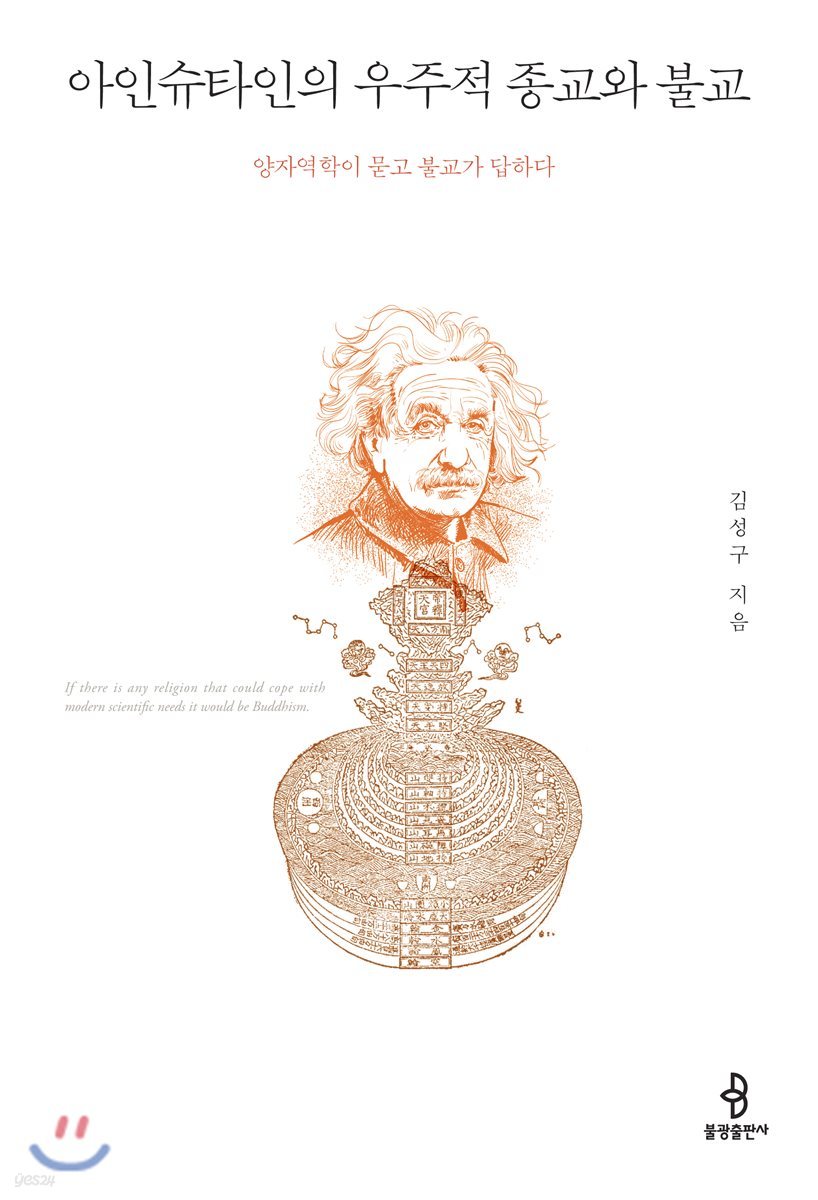
“If there is a religion that meets the demands of modern science, it will be Buddhism.” These are the words of Albert Einstein, the greatest physicist of the 20th century.
Einstein, the genius physicist who discovered that even time, which was thought to be absolute, flows differently depending on conditions, likened religion and science to the two wheels of a cart.
He also said that for religion to be paired with science like a pair of wheels, it must be scientifically proven and be able to inspire scientists and artists.
Einstein called this inspiring religion 'cosmic religion'.
Cosmic religion is a religion based on 'cosmic religious feeling', which refers to 'the feeling of realizing an inexplicable truth'.
It is also a feeling of realizing wrong desires and vanity and feeling the mystery and grandeur of order that appears in both the spiritual and material aspects.
Einstein chose Buddhism as the religion closest to the universal religion he spoke of.
This is because there are many similarities between the worldview that modern physics seeks to elucidate and the teachings of Buddhism, and they provide deep inspiration to physicists.
"Einstein's Cosmic Religion and Buddhism" is a book that verifies Einstein's claims while exploring the intersection between cutting-edge modern physics and Buddhism.
The author of this book, Professor Emeritus Kim Seong-gu of the Department of Physics at Ewha Womans University, thoroughly analyzed why Buddhism cannot but be a cosmic religion, based on his extensive knowledge of physics and Buddhist doctrine.
It explains the theory of relativity and quantum mechanics, which are at the forefront of physics, and examines physics theories through the Buddhist ideas of dependent origination, emptiness, and one mind.
Covering a wide range of topics, from classical to modern physics, to an introduction to Buddhist doctrine, this book will instantly change your preconceived notions about religion and science.
The author, who holds a PhD in physics and has long been immersed in Buddhist studies, offers us new intellectual inspiration through his profound insight.
Modern physics has never been this detailed before.
There was no book that incorporated Buddhism.
“If there is a religion that meets the demands of modern science, it will be Buddhism.” These are the words of Albert Einstein, the greatest physicist of the 20th century.
Einstein, the genius physicist who discovered that even time, which was thought to be absolute, flows differently depending on conditions, likened religion and science to the two wheels of a cart.
He also said that for religion to be paired with science like a pair of wheels, it must be scientifically proven and be able to inspire scientists and artists.
Einstein called this inspiring religion 'cosmic religion'.
Cosmic religion is a religion based on 'cosmic religious feeling', which refers to 'the feeling of realizing an inexplicable truth'.
It is also a feeling of realizing wrong desires and vanity and feeling the mystery and grandeur of order that appears in both the spiritual and material aspects.
Einstein chose Buddhism as the religion closest to the universal religion he spoke of.
This is because there are many similarities between the worldview that modern physics seeks to elucidate and the teachings of Buddhism, and they provide deep inspiration to physicists.
"Einstein's Cosmic Religion and Buddhism" is a book that verifies Einstein's claims while exploring the intersection between cutting-edge modern physics and Buddhism.
The author of this book, Professor Emeritus Kim Seong-gu of the Department of Physics at Ewha Womans University, thoroughly analyzed why Buddhism cannot but be a cosmic religion, based on his extensive knowledge of physics and Buddhist doctrine.
It explains the theory of relativity and quantum mechanics, which are at the forefront of physics, and examines physics theories through the Buddhist ideas of dependent origination, emptiness, and one mind.
Covering a wide range of topics, from classical to modern physics, to an introduction to Buddhist doctrine, this book will instantly change your preconceived notions about religion and science.
The author, who holds a PhD in physics and has long been immersed in Buddhist studies, offers us new intellectual inspiration through his profound insight.
- You can preview some of the book's contents.
Preview
index
1 Is Buddhism the Religion of the Future?
1) Matrix and float
2) Anatta and reincarnation
3) Shinhaehaengjeung and Gyejeonghye
4) Changes in Buddhist thought and terminology over time
2 Einstein's Cosmic Religion
1) Non-letter letters outside the country
2) Gödel's incompleteness theorem
3) Characteristics of Buddhism and Science
3 Mind and Life
1) Buddha's personality
2) Modern life
3) Meaning and quality of life
4) Heart: The Last Shincheonji
5) Power of the mind
4 Acting Methods
1) Overview of the acting method
2) Scientific considerations of interdependence
3) Causality and worldview
4) The Dharma Realm Dependent Origination
5 Quantum Mechanics and the Middle Way Principle
1) Buddha and Parmenides
2) Particle-wave duality
3) Wave function
4) Uncertainty principle and complementarity principle
5) Copenhagen interpretation
6) Buddhist significance of quantum mechanics
6 The Problem of Reality and the Observer's Consciousness
1) The problem of reality
2) The world of everyday experience
3) Observer's consciousness
7 Madhyamaka: The Middle Way and the Middle Path
1) Bodhisattva thought
2) Moderation: The principle of peace and inclusion
3) Samjege and Wonyongsamje
8 The Noble Eightfold Path: The Middle Path
1) Hye: Right view, right thought
2) The following: Jeong-eo, Jeong-eop, Jeong-myeong
3) Jeong: Jeongjeongjin, Jeongnyeom, Jeongjeong
9 True Future Religions
1) The Age of Meditation
2) Additional notes
References
Search
1) Matrix and float
2) Anatta and reincarnation
3) Shinhaehaengjeung and Gyejeonghye
4) Changes in Buddhist thought and terminology over time
2 Einstein's Cosmic Religion
1) Non-letter letters outside the country
2) Gödel's incompleteness theorem
3) Characteristics of Buddhism and Science
3 Mind and Life
1) Buddha's personality
2) Modern life
3) Meaning and quality of life
4) Heart: The Last Shincheonji
5) Power of the mind
4 Acting Methods
1) Overview of the acting method
2) Scientific considerations of interdependence
3) Causality and worldview
4) The Dharma Realm Dependent Origination
5 Quantum Mechanics and the Middle Way Principle
1) Buddha and Parmenides
2) Particle-wave duality
3) Wave function
4) Uncertainty principle and complementarity principle
5) Copenhagen interpretation
6) Buddhist significance of quantum mechanics
6 The Problem of Reality and the Observer's Consciousness
1) The problem of reality
2) The world of everyday experience
3) Observer's consciousness
7 Madhyamaka: The Middle Way and the Middle Path
1) Bodhisattva thought
2) Moderation: The principle of peace and inclusion
3) Samjege and Wonyongsamje
8 The Noble Eightfold Path: The Middle Path
1) Hye: Right view, right thought
2) The following: Jeong-eo, Jeong-eop, Jeong-myeong
3) Jeong: Jeongjeongjin, Jeongnyeom, Jeongjeong
9 True Future Religions
1) The Age of Meditation
2) Additional notes
References
Search
Into the book
It is not the case that the shape of space-time or the distribution of matter is determined first and then the other is determined accordingly.
The shape of space-time and the distribution of matter together determine each other.
The two are interdependent.
If we interpret this from a Buddhist perspective, it becomes the law of dependent origination.
The core concept of Buddhist doctrine, dependent origination, states that all things are interdependent, that no thing can exist independently of other things, and that it only has meaning through its relationship with other things.
--- p.9
From the perspective of modern physics, it is more natural to view the world as event-centered.
The incident may seem like a one-time thing, but it isn't.
This is like the waves in the sea never ending.
A wave in the ocean is a momentary event, but this event is not a one-time event.
The wave that occurs in one moment is caused by the wave that occurred in the previous moment, and the wave in this moment becomes the cause of the wave that will occur in the next moment.
--- p.27
Because of the words anitya (impermanence), anatta (no-self), and emptiness (emptiness), many people misunderstand Buddhism as nihilism or pessimism.
However, in Buddhism, when we talk about anatta and emptiness, we are only referring to the fact that nothing in the world has substance, and this does not mean that there is nothing in the world.
The word entity can refer to something that exists independently of other things, or it can mean an individual property that maintains identity.
--- p.29
Physicist Albert Einstein (1879-1955) compared religion and science to the two wheels of a cart.
He believed that the search for truth was not through rational thought but through religious feeling, and that human reason was to organize the truth thus found in a way that humans could understand.
Einstein believed that the religion of the future would have to have scientifically supported doctrines and be able to inspire scientists and artists, and he called the religion of the future that met these conditions a cosmic religion.
--- p.63
Duality means that one thing has properties that are logically incompatible.
The pair 'youth-old' is logically the same as the pair 'life-death' and is no different from the pair 'on-off' of an electric switch.
--- p.69
Just as the artistry of Nam June Paik's video art cannot be understood by scientists and engineers simply by analyzing the operating principles of their devices, we cannot properly represent the true nature of things in the world by simply representing them with symbols or letters and logically connecting these symbols or letters to explain them.
If we acknowledge this fact, we can understand to some extent why Zen Buddhism says, “By directly facing the mind, one can see one’s nature and become a Buddha.”
And it will also help us understand why Einstein said that religion and science are like two wheels of a cart in the search for truth.
--- p.73
A simpler explanation of Gödel's incompleteness theorem is as follows.
Let's assume that humans have a knowledge system that is free of contradictions.
And let's assume that people use well-defined words and grammar without any ambiguity.
Even if people use this knowledge system and language, Gödel's first incompleteness theorem means that there will inevitably be problems within this knowledge system that cannot be judged as right or wrong by human rational thinking [discernment] alone.
And what the second incompleteness theorem says is that to confirm that what is judged by the discerning mind is correct, greater wisdom is needed, and what this greater wisdom judges must also require greater wisdom.
However, since we cannot continue to progress indefinitely like this, we can never know whether the knowledge system that humans possess is perfect or not.
--- pp.77-78
If there were no common ground between Buddhism and science, it would be impossible or meaningless to illuminate Buddhism scientifically.
Also, if there were only commonalities between the two and no differences, then one of them would not be needed.
--- p.79
Physicists also have difficulty understanding quantum phenomena.
That's why Bohr said, "Anyone who isn't shocked by quantum theory when they first hear it doesn't understand it," and Einstein said to his students after lecturing on quantum mechanics, "If you understood what I said, I didn't speak correctly," and Feynman said, "It's not wrong to say that no one understands quantum mechanics."
--- pp.173-174
Particles have mass and make up the matter around us.
And in classical mechanics, particles are objective entities that exist independently of observers.
In contrast, a wave is a name that refers to the phenomenon of a medium made of particles vibrating.
Good examples of particle-wave relationships include the relationships between water and water waves, and air and sound waves.
Water waves are a phenomenon in which a medium such as water vibrates, and sound is a phenomenon in which an object such as air, water, or a solid vibrates.
--- p.179
Quantum mechanics has achieved remarkable success as a physical theory.
In particular, relativistic quantum mechanics is said to be the most perfect theory of nature created by humans, as it explains physical phenomena in the microscopic world so well.
To put it in terms of the sophistication of the theory, when the distance between the moon and the Earth is predicted by the theory and measured experimentally, the difference between the predicted value and the experimental value is only a few centimeters, which is how accurately the theory describes the physical phenomenon.
--- p.231
There are many religions and ethical and moral codes in the world, but if there is one that is in harmony with scientific truth and does not conflict at all, it is the Buddhist law of dependent origination.
The law of acting is a universal truth realized by Buddha through right samadhi, and can be said to be a science in itself.
The shape of space-time and the distribution of matter together determine each other.
The two are interdependent.
If we interpret this from a Buddhist perspective, it becomes the law of dependent origination.
The core concept of Buddhist doctrine, dependent origination, states that all things are interdependent, that no thing can exist independently of other things, and that it only has meaning through its relationship with other things.
--- p.9
From the perspective of modern physics, it is more natural to view the world as event-centered.
The incident may seem like a one-time thing, but it isn't.
This is like the waves in the sea never ending.
A wave in the ocean is a momentary event, but this event is not a one-time event.
The wave that occurs in one moment is caused by the wave that occurred in the previous moment, and the wave in this moment becomes the cause of the wave that will occur in the next moment.
--- p.27
Because of the words anitya (impermanence), anatta (no-self), and emptiness (emptiness), many people misunderstand Buddhism as nihilism or pessimism.
However, in Buddhism, when we talk about anatta and emptiness, we are only referring to the fact that nothing in the world has substance, and this does not mean that there is nothing in the world.
The word entity can refer to something that exists independently of other things, or it can mean an individual property that maintains identity.
--- p.29
Physicist Albert Einstein (1879-1955) compared religion and science to the two wheels of a cart.
He believed that the search for truth was not through rational thought but through religious feeling, and that human reason was to organize the truth thus found in a way that humans could understand.
Einstein believed that the religion of the future would have to have scientifically supported doctrines and be able to inspire scientists and artists, and he called the religion of the future that met these conditions a cosmic religion.
--- p.63
Duality means that one thing has properties that are logically incompatible.
The pair 'youth-old' is logically the same as the pair 'life-death' and is no different from the pair 'on-off' of an electric switch.
--- p.69
Just as the artistry of Nam June Paik's video art cannot be understood by scientists and engineers simply by analyzing the operating principles of their devices, we cannot properly represent the true nature of things in the world by simply representing them with symbols or letters and logically connecting these symbols or letters to explain them.
If we acknowledge this fact, we can understand to some extent why Zen Buddhism says, “By directly facing the mind, one can see one’s nature and become a Buddha.”
And it will also help us understand why Einstein said that religion and science are like two wheels of a cart in the search for truth.
--- p.73
A simpler explanation of Gödel's incompleteness theorem is as follows.
Let's assume that humans have a knowledge system that is free of contradictions.
And let's assume that people use well-defined words and grammar without any ambiguity.
Even if people use this knowledge system and language, Gödel's first incompleteness theorem means that there will inevitably be problems within this knowledge system that cannot be judged as right or wrong by human rational thinking [discernment] alone.
And what the second incompleteness theorem says is that to confirm that what is judged by the discerning mind is correct, greater wisdom is needed, and what this greater wisdom judges must also require greater wisdom.
However, since we cannot continue to progress indefinitely like this, we can never know whether the knowledge system that humans possess is perfect or not.
--- pp.77-78
If there were no common ground between Buddhism and science, it would be impossible or meaningless to illuminate Buddhism scientifically.
Also, if there were only commonalities between the two and no differences, then one of them would not be needed.
--- p.79
Physicists also have difficulty understanding quantum phenomena.
That's why Bohr said, "Anyone who isn't shocked by quantum theory when they first hear it doesn't understand it," and Einstein said to his students after lecturing on quantum mechanics, "If you understood what I said, I didn't speak correctly," and Feynman said, "It's not wrong to say that no one understands quantum mechanics."
--- pp.173-174
Particles have mass and make up the matter around us.
And in classical mechanics, particles are objective entities that exist independently of observers.
In contrast, a wave is a name that refers to the phenomenon of a medium made of particles vibrating.
Good examples of particle-wave relationships include the relationships between water and water waves, and air and sound waves.
Water waves are a phenomenon in which a medium such as water vibrates, and sound is a phenomenon in which an object such as air, water, or a solid vibrates.
--- p.179
Quantum mechanics has achieved remarkable success as a physical theory.
In particular, relativistic quantum mechanics is said to be the most perfect theory of nature created by humans, as it explains physical phenomena in the microscopic world so well.
To put it in terms of the sophistication of the theory, when the distance between the moon and the Earth is predicted by the theory and measured experimentally, the difference between the predicted value and the experimental value is only a few centimeters, which is how accurately the theory describes the physical phenomenon.
--- p.231
There are many religions and ethical and moral codes in the world, but if there is one that is in harmony with scientific truth and does not conflict at all, it is the Buddhist law of dependent origination.
The law of acting is a universal truth realized by Buddha through right samadhi, and can be said to be a science in itself.
--- p.379
Publisher's Review
Quantum mechanics, born from breaking the mold of classical physics, seeks guidance from Buddhism.
Unraveling modern physics, which cannot be interpreted in the world of discrimination, through Buddhism
The history of physics can be broadly divided into classical physics centered around Newton and modern physics, which deals with the theory of relativity and quantum mechanics that emerged after the 20th century.
In the world of classical physics, scientific knowledge had the character of an unchanging truth.
The natural laws discovered by humans allowed us to predict the movements of celestial bodies and control energy, which became the driving force behind the Industrial Revolution.
Therefore, once the laws of physics are discovered, they are like immutable truths that explain this world.
However, in the 20th century, with the establishment of the theory of relativity and quantum mechanics, which overturned the laws of classical physics, science was redefined as 'the most rational collection of knowledge that can explain the current situation.'
As the laws that were believed to be true collapsed due to the discovery of a new world outside the framework of classical physics, scientific knowledge was redefined as having 'mutability' that can change at any time as long as it can explain things most rationally and efficiently.
The person who opened the door to this change was Einstein.
This is because Einstein's research opened up a new world of physics that even Newton did not know about by proving that light, previously thought to be a wave, also had particle properties.
A particle is a very small, independent unit of matter.
But waves are not independent entities.
A medium is needed for waves to be created, and this can be easily understood by thinking of the relationship between water and waves.
That is, water is the medium and waves are the waves.
However, it was discovered that light has wave properties and at the same time is a particle.
The theory established based on this phenomenon is quantum mechanics.
Quantum mechanics is a field that studies phenomena occurring in the microscopic world of particles, and is one of the most difficult physical worlds to understand where extremes coexist simultaneously.
It is like an unknown world where life and death, youth and old age, existence and non-existence are intertwined.
But surprisingly, this has many similarities with the Buddhist idea of ‘dependent origination’ and ‘emptiness.’
The law of dependent origination is the Buddha's teaching that 'everything in the world is interdependent and constantly changing, and there is no fixed, unchanging entity with substance.'
In Buddhism, this ‘non-existence of all things’ is called emptiness.
It's surprising that cutting-edge physics theories share similar thinking with Buddhist teachings that originated over 2,500 years ago.
This is why many Western physicists, including Einstein, became interested in Buddhism.
The author, Dr. Kim Seong-gu, says that this is precisely the proof that Buddhism is the universal religion that Einstein spoke of.
This is because Buddhist principles of dependent origination and emptiness can provide deep inspiration to physicists in untangling the knots of quantum mechanics, which are blocked by many difficult problems.
Buddhism is certainly of great help in understanding the 'non-existence of things'.
Quantum mechanics is the physics of emptiness and the middle way.
Buddhism as a true religion of the future
The shock physicists received when they discovered that light is both a particle with substance and a wave with no substance was truly tremendous.
It felt like I was encountering a substance that existed but did not exist.
However, Buddhism has been teaching us for over 2,500 years that extremes such as existence-nonexistence, life-death are nothing more than the result of human discrimination based on foolishness.
The teaching that everything is changeable, impermanent, and without substance is the most important core of Buddhism.
This part is in line with the concept of the microscopic world studied by quantum mechanics.
So, through this book, the author argues that quantum mechanics is the physics of Buddhism's emptiness and middle way.
This is because the concepts used in quantum mechanics to describe the appearance of the material world are very similar to the concepts used in Buddhism to explain the appearance of ordinary objects.
Quantum mechanics scientifically revealed the microscopic world where both extremes exist simultaneously.
To explain it in difficult scientific terms, it is the world of the ‘uncertainty principle’ and the world of ‘duality.’
Scientists also call this phenomenon a 'ghost'.
This is consistent with the Buddhist teaching of emptiness, which states that all things have no substance.
What's interesting is that these illusory microscopic worlds come together to form the macroscopic world we perceive.
But most people are obsessed with things and distinguish between what is yours and what is mine without knowing this fact.
The author presents the theory of quantum mechanics and guides readers to properly understand the world of 'illusion' that we believe in.
Through this, we can see how well the Buddhist concepts of dependent origination and emptiness and the quantum mechanics of modern physics are in harmony.
In this way, Einstein's Cosmic Religion and Buddhism reveals that Buddhism and modern physics are two wheels of harmony, and proves that Buddhism cannot help but be a cosmic religion and a religion of the future.
Unraveling modern physics, which cannot be interpreted in the world of discrimination, through Buddhism
The history of physics can be broadly divided into classical physics centered around Newton and modern physics, which deals with the theory of relativity and quantum mechanics that emerged after the 20th century.
In the world of classical physics, scientific knowledge had the character of an unchanging truth.
The natural laws discovered by humans allowed us to predict the movements of celestial bodies and control energy, which became the driving force behind the Industrial Revolution.
Therefore, once the laws of physics are discovered, they are like immutable truths that explain this world.
However, in the 20th century, with the establishment of the theory of relativity and quantum mechanics, which overturned the laws of classical physics, science was redefined as 'the most rational collection of knowledge that can explain the current situation.'
As the laws that were believed to be true collapsed due to the discovery of a new world outside the framework of classical physics, scientific knowledge was redefined as having 'mutability' that can change at any time as long as it can explain things most rationally and efficiently.
The person who opened the door to this change was Einstein.
This is because Einstein's research opened up a new world of physics that even Newton did not know about by proving that light, previously thought to be a wave, also had particle properties.
A particle is a very small, independent unit of matter.
But waves are not independent entities.
A medium is needed for waves to be created, and this can be easily understood by thinking of the relationship between water and waves.
That is, water is the medium and waves are the waves.
However, it was discovered that light has wave properties and at the same time is a particle.
The theory established based on this phenomenon is quantum mechanics.
Quantum mechanics is a field that studies phenomena occurring in the microscopic world of particles, and is one of the most difficult physical worlds to understand where extremes coexist simultaneously.
It is like an unknown world where life and death, youth and old age, existence and non-existence are intertwined.
But surprisingly, this has many similarities with the Buddhist idea of ‘dependent origination’ and ‘emptiness.’
The law of dependent origination is the Buddha's teaching that 'everything in the world is interdependent and constantly changing, and there is no fixed, unchanging entity with substance.'
In Buddhism, this ‘non-existence of all things’ is called emptiness.
It's surprising that cutting-edge physics theories share similar thinking with Buddhist teachings that originated over 2,500 years ago.
This is why many Western physicists, including Einstein, became interested in Buddhism.
The author, Dr. Kim Seong-gu, says that this is precisely the proof that Buddhism is the universal religion that Einstein spoke of.
This is because Buddhist principles of dependent origination and emptiness can provide deep inspiration to physicists in untangling the knots of quantum mechanics, which are blocked by many difficult problems.
Buddhism is certainly of great help in understanding the 'non-existence of things'.
Quantum mechanics is the physics of emptiness and the middle way.
Buddhism as a true religion of the future
The shock physicists received when they discovered that light is both a particle with substance and a wave with no substance was truly tremendous.
It felt like I was encountering a substance that existed but did not exist.
However, Buddhism has been teaching us for over 2,500 years that extremes such as existence-nonexistence, life-death are nothing more than the result of human discrimination based on foolishness.
The teaching that everything is changeable, impermanent, and without substance is the most important core of Buddhism.
This part is in line with the concept of the microscopic world studied by quantum mechanics.
So, through this book, the author argues that quantum mechanics is the physics of Buddhism's emptiness and middle way.
This is because the concepts used in quantum mechanics to describe the appearance of the material world are very similar to the concepts used in Buddhism to explain the appearance of ordinary objects.
Quantum mechanics scientifically revealed the microscopic world where both extremes exist simultaneously.
To explain it in difficult scientific terms, it is the world of the ‘uncertainty principle’ and the world of ‘duality.’
Scientists also call this phenomenon a 'ghost'.
This is consistent with the Buddhist teaching of emptiness, which states that all things have no substance.
What's interesting is that these illusory microscopic worlds come together to form the macroscopic world we perceive.
But most people are obsessed with things and distinguish between what is yours and what is mine without knowing this fact.
The author presents the theory of quantum mechanics and guides readers to properly understand the world of 'illusion' that we believe in.
Through this, we can see how well the Buddhist concepts of dependent origination and emptiness and the quantum mechanics of modern physics are in harmony.
In this way, Einstein's Cosmic Religion and Buddhism reveals that Buddhism and modern physics are two wheels of harmony, and proves that Buddhism cannot help but be a cosmic religion and a religion of the future.
GOODS SPECIFICS
- Date of issue: April 2, 2018
- Page count, weight, size: 408 pages | 600g | 152*225*27mm
- ISBN13: 9788974793937
- ISBN10: 8974793938
You may also like
카테고리
korean


korean

![GQ KOREA Mark (Monthly): December [2025]](http://librairie.coreenne.fr/cdn/shop/files/8ef265dbbfbf186523ed75ba7319009d.jpg?v=1765340328&width=3840)


