

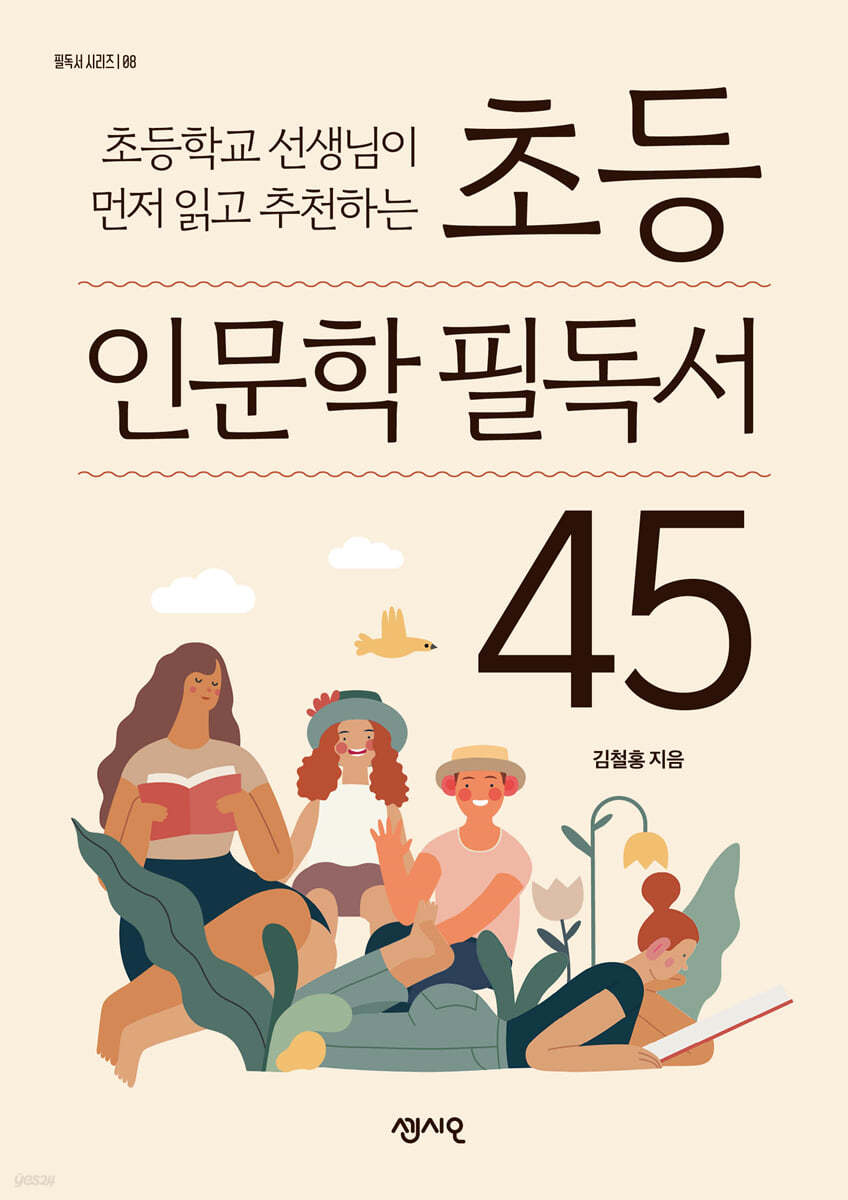
45 Essential Readings for Elementary Humanities Students
 |
Description
Book Introduction
A current elementary school teacher reads and recommends it first.
45 must-read books in the humanities in one volume
A book has been published that contains 45 must-read humanities books that elementary school children must read at least once.
This book is a selection of 45 masterpieces in the humanities, including literature, philosophy, history, science, art, society, and economics, and explains the core content of the books in a way that is suitable for children.
The author is a teacher with 22 years of experience teaching children's philosophy, reading and writing, and discussion classes.
The author says that the question he receives most frequently from parents during his time as an elementary school teacher is how to raise children who excel in school.
There is only one answer to this question.
The author says that it is reading humanities books.
This is because a child's grades are correlated with his or her language ability, that is, his or her ability to understand written text.
Elementary education experts also agree that reading books can help children develop vocabulary, literacy, imagination, problem-solving skills, creativity, and writing skills.
However, reading just any book doesn't work.
It should be a book that has been proven to be valuable over time, a book that contains a process of deep thought, a book that expands one's thinking by asking the question, "Why?"
Here's why you should read masterpieces in the humanities.
Parents also know that humanities books are good.
However, it is difficult to decide which book to read first among the vast number of humanities books, and there is no time to read dozens of books.
The book that solves these problems is 『45 Essential Readings for Elementary Humanities』.
This is because, among the numerous humanities books, we have carefully selected 45 famous works that are related to the elementary school curriculum and have topics that children will find interesting, and compiled them into one volume.
The book contains must-read books for elementary school children in the fields of literature, philosophy, science, history, society, and art, such as “The Giving Tree,” “Animal Farm,” “What is Justice for Teens?” “The Origin of Species for Children,” “Sapiens for Teens,” and “Who Moved My Cheese?”
Reading humanities books is the answer to raising children with the inner strength to study on their own.
Even 5 or 10 minutes a day is fine.
Let's try to develop the habit of reading humanities books for just one month.
You will be able to feel the change in your child's study habits.
45 must-read books in the humanities in one volume
A book has been published that contains 45 must-read humanities books that elementary school children must read at least once.
This book is a selection of 45 masterpieces in the humanities, including literature, philosophy, history, science, art, society, and economics, and explains the core content of the books in a way that is suitable for children.
The author is a teacher with 22 years of experience teaching children's philosophy, reading and writing, and discussion classes.
The author says that the question he receives most frequently from parents during his time as an elementary school teacher is how to raise children who excel in school.
There is only one answer to this question.
The author says that it is reading humanities books.
This is because a child's grades are correlated with his or her language ability, that is, his or her ability to understand written text.
Elementary education experts also agree that reading books can help children develop vocabulary, literacy, imagination, problem-solving skills, creativity, and writing skills.
However, reading just any book doesn't work.
It should be a book that has been proven to be valuable over time, a book that contains a process of deep thought, a book that expands one's thinking by asking the question, "Why?"
Here's why you should read masterpieces in the humanities.
Parents also know that humanities books are good.
However, it is difficult to decide which book to read first among the vast number of humanities books, and there is no time to read dozens of books.
The book that solves these problems is 『45 Essential Readings for Elementary Humanities』.
This is because, among the numerous humanities books, we have carefully selected 45 famous works that are related to the elementary school curriculum and have topics that children will find interesting, and compiled them into one volume.
The book contains must-read books for elementary school children in the fields of literature, philosophy, science, history, society, and art, such as “The Giving Tree,” “Animal Farm,” “What is Justice for Teens?” “The Origin of Species for Children,” “Sapiens for Teens,” and “Who Moved My Cheese?”
Reading humanities books is the answer to raising children with the inner strength to study on their own.
Even 5 or 10 minutes a day is fine.
Let's try to develop the habit of reading humanities books for just one month.
You will be able to feel the change in your child's study habits.
- You can preview some of the book's contents.
Preview
index
Seomun: A selection of excellent books that will deepen and strengthen children's understanding.
Part 1.
literature
book1 The Giving Tree
About the great love that always embraces me in that place
book2 The Book-Eating Fox
The Fox Man's Amazing Reading Method That Will Make Your Heart Grow
book3 The Little Prince
Finding my own beautiful star that shines without purpose
book4 《Jonathan Livingston Seagull》
Where in the high sky are my wings flying?
book5 My Name is Pippi Longstocking
A lovable tomboy who surprised the world and adults
book6 "Hope for the Flowers"
That beautiful butterfly is right inside us
book7 《The Long Night》
The story of 'us' overcoming the long, fearful night
book8 Animal Farm
The Strange Story of a Revolution on Animal Farm
book9 Our Twisted Hero
When the sweet monster reaches out
Part 2.
philosophy
book10 《Children's Philosophy: Learning Opposites》
For different people to live together
book11 《42 Colors of the Heart》
How many emotional colors do I have?
book12 The Philosopher's Club
Deepening thoughts following the question that follows the tail
book13 "Maybe, Maybe Not"
How to think for yourself? Just remember this!
book14 What is freedom?
The freedom to be anything, the weight of freedom
book15 《Olmangjolmang Philosophy Classroom》
30 Questions to Grow Your Worldview
book16 The World's Easiest Philosophy Book
Would you like to take a quick dive into the mysterious world of philosophy?
book17 《Philosophers' Words》
A word from the great philosophers who interpreted and expressed our world.
book18 《Philosophy Class: Finding My Rights》
What are my rights? How do I protect them?
book19 Stories of 18 Eastern Philosophers
The world of Eastern philosophy, which contemplates the principles of the mind and the world.
book20 What is Justice for Teenagers?
How should I live to live correctly?
Part 3.
science
book21 "Really, Really Fun Science Picture Books"
From ancient fossils to the distant universe, fascinating scientific stories come together.
book22 "Extinct for an Unjust Reason"
The sad and fascinating stories of animals we can no longer see.
book23 The Origin of Species for Children
A great book that changed the course of humanity
book24 What do scientists do all day?
Scientists working for a better world
book25 What happens when the temperature rises by 1 degree?
The story the sweating earth tells us
book26 《Inventions Pang Pang》
How were the amazing inventions that changed history born?
book27 "We Live Together for a Reason"
Meet the microorganisms that have lived with the Earth for 4.5 billion years.
book28 "What should we do? Plastic keeps coming back!"
How to live safely in a world full of plastic?
book29 "Dream Blueprint of Robot Doctor Dennis Hong"
The robot doctor who made imagination a reality
book30 "Fun AI Stories"
Imagine a world where anything is possible with AI.
Part 4.
history
book31 Sapiens for Teens
How did humanity come into being and continue to evolve endlessly?
book32 《100 Things Elementary School Students Should Know About World History》
Amazing stories from around the world, from ancient times to the present day.
book33 "Aha! So there was such a person back then."
Let's take a look at the lives and achievements of the people who moved our country.
book34 UNESCO-selected Korean World Heritage Sites
Our precious culture recognized by the world
book35 《True Records of World History》
Special historical moments that become common knowledge once you know them.
book36 "Great Geography: A Glimpse into World History"
If you want to know how the world works, remember geography.
Part 5.
Society and Arts
book37 "A Child Chased by Time, A Child Who Creates Time"
My most powerful weapon: how to use time wisely
book38 Who Moved My Cheese?
What if one day the cheese warehouse suddenly becomes empty?
book39 《Failure Guide》
Stories of failure and mistakes are as great as stories of success.
book40 "Will Understanding Economics Really Make You Rich?"
From Mom's Wallet to National Policy, Here's What You Need to Know About Economics
book41 "Warm Finance that Changes the World"
Meet the good finance that helps, encourages, and saves people.
book42 "Small but Sure Actions That Change Tomorrow"
A better world, starting here and now
book43 "The World Hidden in Colors"
Various colors symbolizing 'country', 'us', and 'me'
book44 《Art History in One Word》
From Da Vinci to Picasso, a brief overview of the flow of art history.
book45 "Great Bookworms Who Changed the World"
Great people who overcame limitations and achieved their dreams through books.
Part 1.
literature
book1 The Giving Tree
About the great love that always embraces me in that place
book2 The Book-Eating Fox
The Fox Man's Amazing Reading Method That Will Make Your Heart Grow
book3 The Little Prince
Finding my own beautiful star that shines without purpose
book4 《Jonathan Livingston Seagull》
Where in the high sky are my wings flying?
book5 My Name is Pippi Longstocking
A lovable tomboy who surprised the world and adults
book6 "Hope for the Flowers"
That beautiful butterfly is right inside us
book7 《The Long Night》
The story of 'us' overcoming the long, fearful night
book8 Animal Farm
The Strange Story of a Revolution on Animal Farm
book9 Our Twisted Hero
When the sweet monster reaches out
Part 2.
philosophy
book10 《Children's Philosophy: Learning Opposites》
For different people to live together
book11 《42 Colors of the Heart》
How many emotional colors do I have?
book12 The Philosopher's Club
Deepening thoughts following the question that follows the tail
book13 "Maybe, Maybe Not"
How to think for yourself? Just remember this!
book14 What is freedom?
The freedom to be anything, the weight of freedom
book15 《Olmangjolmang Philosophy Classroom》
30 Questions to Grow Your Worldview
book16 The World's Easiest Philosophy Book
Would you like to take a quick dive into the mysterious world of philosophy?
book17 《Philosophers' Words》
A word from the great philosophers who interpreted and expressed our world.
book18 《Philosophy Class: Finding My Rights》
What are my rights? How do I protect them?
book19 Stories of 18 Eastern Philosophers
The world of Eastern philosophy, which contemplates the principles of the mind and the world.
book20 What is Justice for Teenagers?
How should I live to live correctly?
Part 3.
science
book21 "Really, Really Fun Science Picture Books"
From ancient fossils to the distant universe, fascinating scientific stories come together.
book22 "Extinct for an Unjust Reason"
The sad and fascinating stories of animals we can no longer see.
book23 The Origin of Species for Children
A great book that changed the course of humanity
book24 What do scientists do all day?
Scientists working for a better world
book25 What happens when the temperature rises by 1 degree?
The story the sweating earth tells us
book26 《Inventions Pang Pang》
How were the amazing inventions that changed history born?
book27 "We Live Together for a Reason"
Meet the microorganisms that have lived with the Earth for 4.5 billion years.
book28 "What should we do? Plastic keeps coming back!"
How to live safely in a world full of plastic?
book29 "Dream Blueprint of Robot Doctor Dennis Hong"
The robot doctor who made imagination a reality
book30 "Fun AI Stories"
Imagine a world where anything is possible with AI.
Part 4.
history
book31 Sapiens for Teens
How did humanity come into being and continue to evolve endlessly?
book32 《100 Things Elementary School Students Should Know About World History》
Amazing stories from around the world, from ancient times to the present day.
book33 "Aha! So there was such a person back then."
Let's take a look at the lives and achievements of the people who moved our country.
book34 UNESCO-selected Korean World Heritage Sites
Our precious culture recognized by the world
book35 《True Records of World History》
Special historical moments that become common knowledge once you know them.
book36 "Great Geography: A Glimpse into World History"
If you want to know how the world works, remember geography.
Part 5.
Society and Arts
book37 "A Child Chased by Time, A Child Who Creates Time"
My most powerful weapon: how to use time wisely
book38 Who Moved My Cheese?
What if one day the cheese warehouse suddenly becomes empty?
book39 《Failure Guide》
Stories of failure and mistakes are as great as stories of success.
book40 "Will Understanding Economics Really Make You Rich?"
From Mom's Wallet to National Policy, Here's What You Need to Know About Economics
book41 "Warm Finance that Changes the World"
Meet the good finance that helps, encourages, and saves people.
book42 "Small but Sure Actions That Change Tomorrow"
A better world, starting here and now
book43 "The World Hidden in Colors"
Various colors symbolizing 'country', 'us', and 'me'
book44 《Art History in One Word》
From Da Vinci to Picasso, a brief overview of the flow of art history.
book45 "Great Bookworms Who Changed the World"
Great people who overcame limitations and achieved their dreams through books.
Detailed image

Into the book
As children grow older, the subjects they learn become more complex, and they begin to view the world with a more mature and critical perspective.
When what I know doesn't match the reality I experience with my own eyes, I want to intervene and resolve the issue.
As the children say, a fair game is one where the rabbit and the turtle run on land and in water at the same time.
We need to read Aesop's fables in this way, twisting them in different ways, recomposing them as if we were the author, and completely deconstructing the content of the book to read it from a different perspective.
This is called critical reading.
Critical reading is a question of 'how do I see the world?'
---p.5
I created this book to provide elementary school students, whose critical thinking is just beginning to blossom, with an encounter with the important and great "humanities."
The philosopher Descartes said, “Reading a good book is like talking with the finest men of past centuries.”
I hope that these stories will serve as valuable nourishment for the countless moments of trial and error that children will experience in their future lives, and for the times of growth that will follow.
---p.6
Dear friends, the last part of The Little Prince is beautiful but sad.
From now on, the stars in the night sky will no longer be meaningless stars to airplane pilots, but will become the 'Little Prince's Stars'.
Because what's important is what you can't see with your eyes.
So, isn't that why the little prince said he longed to see the sunset whenever he felt sad? In broad daylight, everything in existence is clearly visible.
But what you see isn't everything.
When the sunset faded and dusk fell, wasn't it only then that the little prince began to see the precious things?
---p.34
You guys, I don't see any sadness in Pippi, who lives alone without her parents.
Rather, it is so cheerful and confident that it bewilders the readers.
And finally, I ask:
That's a question not only for Tommy and Annika, but also for you, the reader.
“I will travel the world, explore, and sometimes go on reckless adventures.
What are you guys going to do?
---p.49
In my 4th grade Korean language class, I asked, “Do you think you are free?”
“You have to go to school, and after school you have to go to an academy.
We have no freedom.
“Where is freedom when you hear nagging every day to do this and that?”
“Children, then can we say that adults are free?”
"yes.
We are still young and we have to listen to adults, but adults do whatever they want.
“In the end, only the strong are free.”
Listening to the children's complaints, you can see that the concept of 'freedom' is not easy.
When what I know doesn't match the reality I experience with my own eyes, I want to intervene and resolve the issue.
As the children say, a fair game is one where the rabbit and the turtle run on land and in water at the same time.
We need to read Aesop's fables in this way, twisting them in different ways, recomposing them as if we were the author, and completely deconstructing the content of the book to read it from a different perspective.
This is called critical reading.
Critical reading is a question of 'how do I see the world?'
---p.5
I created this book to provide elementary school students, whose critical thinking is just beginning to blossom, with an encounter with the important and great "humanities."
The philosopher Descartes said, “Reading a good book is like talking with the finest men of past centuries.”
I hope that these stories will serve as valuable nourishment for the countless moments of trial and error that children will experience in their future lives, and for the times of growth that will follow.
---p.6
Dear friends, the last part of The Little Prince is beautiful but sad.
From now on, the stars in the night sky will no longer be meaningless stars to airplane pilots, but will become the 'Little Prince's Stars'.
Because what's important is what you can't see with your eyes.
So, isn't that why the little prince said he longed to see the sunset whenever he felt sad? In broad daylight, everything in existence is clearly visible.
But what you see isn't everything.
When the sunset faded and dusk fell, wasn't it only then that the little prince began to see the precious things?
---p.34
You guys, I don't see any sadness in Pippi, who lives alone without her parents.
Rather, it is so cheerful and confident that it bewilders the readers.
And finally, I ask:
That's a question not only for Tommy and Annika, but also for you, the reader.
“I will travel the world, explore, and sometimes go on reckless adventures.
What are you guys going to do?
---p.49
In my 4th grade Korean language class, I asked, “Do you think you are free?”
“You have to go to school, and after school you have to go to an academy.
We have no freedom.
“Where is freedom when you hear nagging every day to do this and that?”
“Children, then can we say that adults are free?”
"yes.
We are still young and we have to listen to adults, but adults do whatever they want.
“In the end, only the strong are free.”
Listening to the children's complaints, you can see that the concept of 'freedom' is not easy.
---p.111
Publisher's Review
Why 90% of Elementary School Excellence Students Fail in Middle and High School
Why do our children need humanities during elementary school, when their thinking is developing?
As a teacher for many years, the question I consistently receive from parents, whether 20 years ago or now, is, "How can I raise my child to be a good student?"
In response to this, the author states that one thing that must be done during elementary school to study well is none other than reading, and that is quality reading through valuable humanities books.
Children who focus on studying fragmented subjects and repeat advanced and in-depth learning can achieve good grades in elementary school.
However, if children fail to develop their reading and comprehension skills in a timely manner, they will inevitably fall behind children who have built a foundation of language skills through quality reading when they reach middle or high school.
In reality, it is not uncommon for children who were said to be as smart as anyone else to not be able to understand the textbook texts when they reach higher grades.
Humanities are the best textbooks to fill that gap.
The reason for reading humanities books is not simply to acquire fragmentary knowledge.
Through the humanities, children develop the ability to consider information flowing in from outside sources with unfamiliar perspectives and to delve into and add to their own thoughts.
In the process, vocabulary, comprehension, literacy, problem-solving, and writing skills are developed evenly.
From literature to art
45 essential elementary humanities books in one volume
The author of this book is a current elementary school teacher who has been teaching various children's philosophy, reading and writing, and discussion classes for 22 years.
Among books related to the elementary school curriculum, we have selected essential humanities books from various fields that can stimulate children's thinking from their perspective.
In addition to literature books that ponder the “true meaning of love and dreams” such as “The Giving Tree,” “The Little Prince,” and “Hope for the Flowers,” and philosophy books that lead readers to think for themselves by encountering the ideas and concepts of Eastern and Western philosophers such as “The Easiest Philosophy Book in the World” and “What is Justice for Teenagers?”, it also includes books from history, science, society, economics, and art, covering a wide range of topics from the role of our society to ethics in the age of artificial intelligence.
I recommend this book to parents who are having trouble deciding which books to give their children among the vast number of humanities books on the vast field.
You will be able to build a solid foundation for language skills and studies that must be developed in elementary school.
Moreover, using this book as a stepping stone, children will be able to develop the power to learn and interpret on their own, to express their thoughts and feelings, and to respond to the world.
It's like being in the classroom with the teacher
Easy and enjoyable humanities classes
The unique feature of this book is that it does not simply introduce the book's content and message, but rather links it to classes for each subject taught in elementary school classrooms, confirming the content covered in actual classes and guiding students to expand their learning.
When explaining the book "The Giving Tree," I introduce the content of the discussion I had with the children during class time about "Is the love of a tree true love?", and when dealing with the book "We Live Together for a Reason," I add an episode about growing cherry tomatoes in the 4th grade classroom.
The book is filled with hilarious situations that occur in an elementary school classroom, the children's quirky questions, and their quirky yet creative answers.
As you follow the explanations given with affection, as if you were telling a story to children sitting in front of you, you will naturally participate in the humanities classroom within the book.
For elementary school children who are intimidated by authors with difficult names and who feel that humanities books are distant and otherworldly, this book will serve as an easy and enjoyable guide to the humanities.
Why do our children need humanities during elementary school, when their thinking is developing?
As a teacher for many years, the question I consistently receive from parents, whether 20 years ago or now, is, "How can I raise my child to be a good student?"
In response to this, the author states that one thing that must be done during elementary school to study well is none other than reading, and that is quality reading through valuable humanities books.
Children who focus on studying fragmented subjects and repeat advanced and in-depth learning can achieve good grades in elementary school.
However, if children fail to develop their reading and comprehension skills in a timely manner, they will inevitably fall behind children who have built a foundation of language skills through quality reading when they reach middle or high school.
In reality, it is not uncommon for children who were said to be as smart as anyone else to not be able to understand the textbook texts when they reach higher grades.
Humanities are the best textbooks to fill that gap.
The reason for reading humanities books is not simply to acquire fragmentary knowledge.
Through the humanities, children develop the ability to consider information flowing in from outside sources with unfamiliar perspectives and to delve into and add to their own thoughts.
In the process, vocabulary, comprehension, literacy, problem-solving, and writing skills are developed evenly.
From literature to art
45 essential elementary humanities books in one volume
The author of this book is a current elementary school teacher who has been teaching various children's philosophy, reading and writing, and discussion classes for 22 years.
Among books related to the elementary school curriculum, we have selected essential humanities books from various fields that can stimulate children's thinking from their perspective.
In addition to literature books that ponder the “true meaning of love and dreams” such as “The Giving Tree,” “The Little Prince,” and “Hope for the Flowers,” and philosophy books that lead readers to think for themselves by encountering the ideas and concepts of Eastern and Western philosophers such as “The Easiest Philosophy Book in the World” and “What is Justice for Teenagers?”, it also includes books from history, science, society, economics, and art, covering a wide range of topics from the role of our society to ethics in the age of artificial intelligence.
I recommend this book to parents who are having trouble deciding which books to give their children among the vast number of humanities books on the vast field.
You will be able to build a solid foundation for language skills and studies that must be developed in elementary school.
Moreover, using this book as a stepping stone, children will be able to develop the power to learn and interpret on their own, to express their thoughts and feelings, and to respond to the world.
It's like being in the classroom with the teacher
Easy and enjoyable humanities classes
The unique feature of this book is that it does not simply introduce the book's content and message, but rather links it to classes for each subject taught in elementary school classrooms, confirming the content covered in actual classes and guiding students to expand their learning.
When explaining the book "The Giving Tree," I introduce the content of the discussion I had with the children during class time about "Is the love of a tree true love?", and when dealing with the book "We Live Together for a Reason," I add an episode about growing cherry tomatoes in the 4th grade classroom.
The book is filled with hilarious situations that occur in an elementary school classroom, the children's quirky questions, and their quirky yet creative answers.
As you follow the explanations given with affection, as if you were telling a story to children sitting in front of you, you will naturally participate in the humanities classroom within the book.
For elementary school children who are intimidated by authors with difficult names and who feel that humanities books are distant and otherworldly, this book will serve as an easy and enjoyable guide to the humanities.
GOODS SPECIFICS
- Date of issue: June 15, 2023
- Page count, weight, size: 362 pages | 604g | 152*215*22mm
- ISBN13: 9791166571060
- ISBN10: 1166571068
You may also like
카테고리
korean


korean

![GQ KOREA Mark (Monthly): December [2025]](http://librairie.coreenne.fr/cdn/shop/files/8ef265dbbfbf186523ed75ba7319009d.jpg?v=1765340328&width=3840)


