

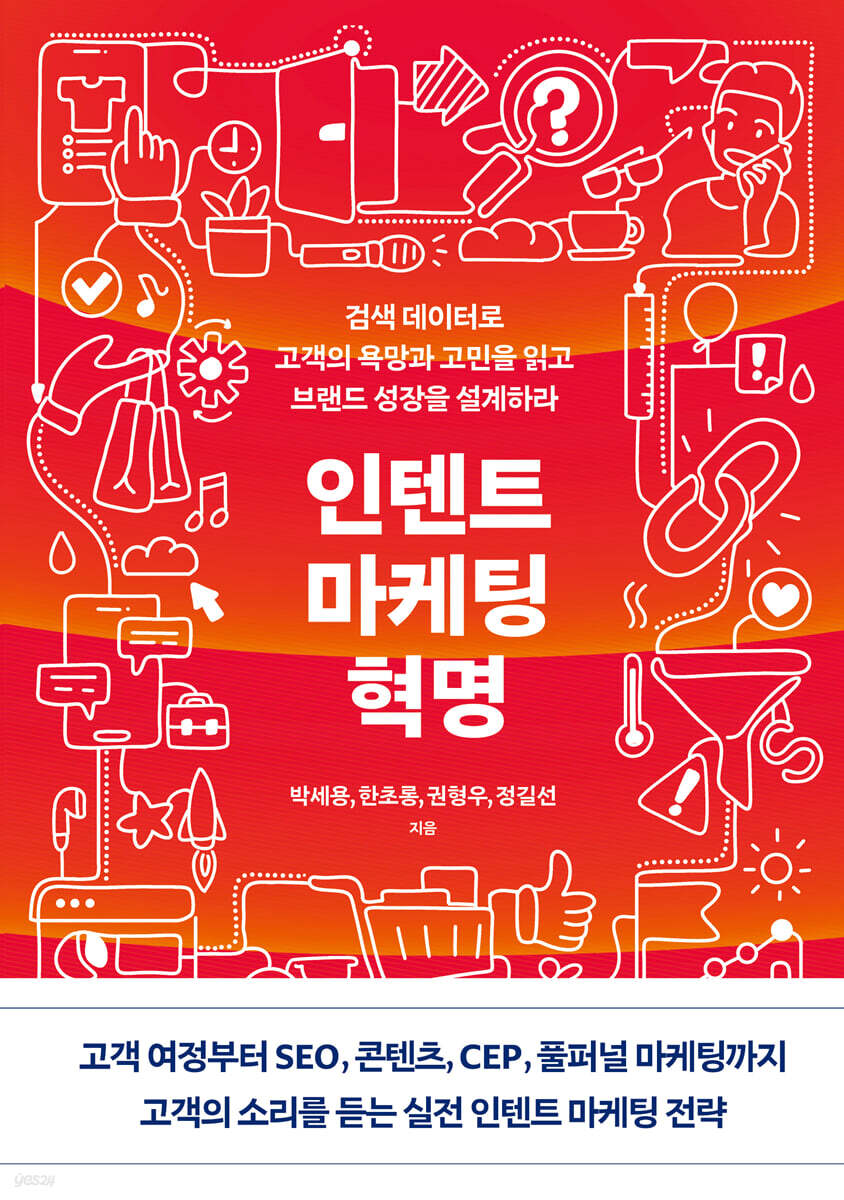
The Intent Marketing Revolution
 |
Description
Book Introduction
Customer intent is the starting point of a new brand growth strategy!
Read your customer journey from search data and translate it into brand strategy!
What are the hidden concerns and needs of customers discovered through search data, and what are the answers for brand growth?
This is a "practical intent marketing strategy" that listens to the voice of the customer, from the customer journey to SEO (search engine optimization), content, CEP (category entry point) analysis, and full-funnel marketing.
Put it into practice now
| Who should read this |
Marketers who want to find new growth engines for their brands
Researchers who follow market trends to find new market opportunities
· Brand managers who want to design customer journeys based on data
· Advertising practitioners who want to implement content and SEO under an integrated strategy
· Management that considers marketing that goes beyond short-term performance and achieves sustainable growth
Read your customer journey from search data and translate it into brand strategy!
What are the hidden concerns and needs of customers discovered through search data, and what are the answers for brand growth?
This is a "practical intent marketing strategy" that listens to the voice of the customer, from the customer journey to SEO (search engine optimization), content, CEP (category entry point) analysis, and full-funnel marketing.
Put it into practice now
| Who should read this |
Marketers who want to find new growth engines for their brands
Researchers who follow market trends to find new market opportunities
· Brand managers who want to design customer journeys based on data
· Advertising practitioners who want to implement content and SEO under an integrated strategy
· Management that considers marketing that goes beyond short-term performance and achieves sustainable growth
- You can preview some of the book's contents.
Preview
index
Part 1: Understanding Intent Marketing
Rewriting Marketing Strategies with Search Data
Chapter 1: The Art of Reading Consumer Minds
_The Beginning of Intent Marketing
1.1 What is Intent Marketing?
1.2 Real needs read from search data
1.3 The Impact of Intent Marketing on Business
1.4 Synergy between Branding and Intent Marketing
1.5 The Birth of Intent Marketing: A Shift in the Marketing Paradigm
1.6 Summary
__Key Points
Chapter 2: How to Uncover Hidden Intents in the Customer Journey
_Search-Based Customer Journey Mapping Strategy
2.1 How the Customer Journey Changes Marketing
__2.1.1 Insights from Customer Journey Mapping
__2.1.2 Strategic Use of Customer Journey Maps and Considerations
2.2 Customer journey map drawn with search data
__2.2.1 Customer Journey Map Using Search Data Mapping
__2.2.2 Customer Journey Mapping Using Traditional Research Methods
__2.2.3 Customer Journey Map Template Example
2.3 Marketing Insights through Intent Mapping
__2.3.1 Identifying consumer interest topics at each stage of the customer journey
__2.3.2 Identifying buying factors that influence consumer purchasing decisions
__2.3.3 Understanding unaided brand awareness at each stage of the customer journey
__2.3.4 Understanding consumer perception, positioning, and customer interest topics by brand
__2.3.5 Identifying consumer complaints about products
__2.3.6 Understanding the competitive landscape between brands in the customer journey
__2.3.7 Determining the potential market size of new products
__2.3.8 Identifying Key Media Touchpoints at Each Customer Journey Stage
2.4 Industry-Specific Customer Journey Intent Map Case Studies
__2.4.1 Imported automobile sector
__2.4.2 Insurance sector
__2.4.3 Men's cosmetics sector
__2.4.4 Global Electric Vehicle Sector
__2.4.5 Content IP field
__2.4.6 TOEIC test areas
2.5 Summary
__Key Points
Chapter 3: Intent Marketing Framework
_Designing customer touchpoints through funnels and media
3.1 Connect your marketing funnel, sales funnel, and customer intent.
__3.1.1 Marketing Funnel vs. Sales Funnel
__3.1.2 Triple media as customer touchpoints within the sales funnel
__3.1.3 Effects of Linking Marketing Funnels and Sales Funnels
3.2 Triple Media as a Point of Contact between Intent and Content
3.3 A full-funnel media strategy that integrates all stages of the customer journey.
__3.3.1 Initial Exploration Phase
__3.3.2 Information search phase
__3.3.3 Experience Exploration Stage
__3.3.4 Purchase Confirmation Step
__3.3.5 Post-purchase steps
3.4 The Future of Customer Journey Design Beyond the Funnel
__3.4.1 Limitations and Criticisms of the Funnel Model
__3.4.2 An Integrated Approach to Network Models and Funnel Models
__3.4.3 Looking Ahead: The Funnel Is Evolving
3.5 Summary
__Key Points
Chapter 4: Finding Brand Growth Opportunities with Intent Data
_Category Entry Point Strategy
4.1 Problems Hindering Brand Growth: Why Existing Strategies Lose Customers
__4.1.1 Limitations of Existing Branding Approaches
__4.1.2 Absence of data-driven approach and its consequences
__4.1.3 How Intent Marketing Transforms Brand Strategy
4.2 Category Entry Points: Strategies for Capturing Purchase Situations
__4.2.1 The Role of CEP in the Consumer Purchase Journey
__4.2.2 Limitations of CEP Discovery Based on Surveys
__4.2.3 CEP Discovery Based on Search Data and Its Advantages
__4.2.4 CEP Analysis Method Using Listening Mind Cluster Finder
4.3 How Global Brands Dominate CEP
__4.3.1 Sneakers Case
__4.3.2 KitKat Case
__4.3.3 Coca-Cola Case
4.4 How to design the moment when your brand is chosen
__4.4.1 How can brands delve into consumers' CEP?
__4.4.2 Strengthening CEP through brand campaigns
4.5 Roadmap for Establishing a CEP Strategy Based on Search Data
__4.5.1 Consumer Search Sequence Data Collection and Analysis
__4.5.2 Deriving CEP candidates through keyword clustering
__4.5.3 Competitor Analysis by CEP
__4.5.4 Identifying Opportunity Areas and Prioritizing CEPs
__4.5.5 Establishing and Executing a CEP-Based Brand Strategy
__4.5.6 Continuous data-driven improvement and enhancement
4.6 Summary
__Key Points
Part 2: Implementing Intent Marketing
_Building brand touchpoints and enhancing exposure
Chapter 5: Consumer Intent Targeting
_Building strategic content assets
5.1 Targeting Consumer Intent with Content
5.2 6-Step Process for Building Content Assets
__5.2.1 Topic and Keyword Selection
__5.2.2 Selecting a response channel
__5.2.3 Summary
__5.2.4 Format Summary
__5.2.5 Using target keywords and related keywords
__5.2.6 Link Utilization
5.3 Content Strategy by Page Type: What to Put on Which Page
__5.3.1 Blog Page
__5.3.2 Customer Support Page
__5.3.3 Product List Page (PLP)
__5.3.4 Product Detail Page (PDP)
__5.3.5 Event Page
__5.3.6 PR Content Page
5.4 Real-World Examples of Intent-Based Content Strategy
__5.4.1 Informational Content: Blogs
__5.4.2 Transactional Content: Product Detail Page
__5.4.3 Content Silos
5.5 A strategy where the brand itself becomes the media.
__5.5.1 A website is not just a company profile.
__5.5.2 Advice for Building Branded Media
5.6 Intent Data-Driven Content Strategy for B2B Products
__5.6.1 The Need for Content Strategy in B2B Marketing
__5.6.2 Developing a Content Strategy in B2B Marketing
__5.6.3 The Effectiveness of Content Strategy in B2B Marketing
5.7 Content Asset Building Strategy Using AI
__5.7.1 Things to Consider When Creating Content Using AI
__5.7.2 Search Engine Evaluation of Content Using Artificial Intelligence
5.8 Summary
__Key Points
Chapter 6: SEO Implementation Strategies for Brand Growth
If you can't see it, it doesn't exist.
6.1 SEO Strategy for Each Customer Journey Stage
__6.1.1 Initial Exploration
__6.1.2 Information seeking and experience seeking stages
__6.1.3 Purchase Confirmation Step
__6.1.4 Post-purchase steps
6.2 An SEO Framework for Designing Customer-Brand Connections
__6.2.1 Customer Intention Analysis
__6.2.2 Intent Mapping and Content Planning
__6.2.3 Technical SEO Settings
__6.2.4 Performance Measurement and Feedback Repeat
6.3 Intent-Based Onsite/Offsite SEO Strategy
__6.3.1 On-Site SEO: Optimizing Your Website to Improve Customer Experience
__6.3.2 Offsite SEO: Strengthening the Connection Between Your Brand and Customers
6.4 The Strategic Value of SEO Centered on Customer Intent
__6.4.1 Simple Inflow vs. Relationship Building: Performance Differences Based on SEO Perspective
__6.4.2 The Power of Consumer Intention-Driven Content
__6.4.3 The first impression that makes people choose a brand: 'Search experience'
__6.4.4 The end of search-based experience boils down to 'trust'
6.5 Key SEO Elements for Intent Marketing
__6.5.1 Understanding Search Engines
__6.5.2 Understanding SEO Elements
6.6 SEO Implementation Strategies by Site Type
__6.6.1 Common Website SEO Elements
__6.6.2 Manufacturer's Site
__6.6.3 E-commerce site
__6.6.4 Global Site
__6.6.5 Content Site
__6.6.6 Community Site
__6.6.7 Platform Site
6.7 Summary
__Key Points
Part 3: Validating Intent Marketing
_Practical examples of using listening mind to prove search data
Chapter 7: Intent Marketing Analysis Strategies Learned in the Field
_Reading Consumers' Minds with Search Data
7.1 Beauty Skincare: Consumers Express Their Concerns in Keywords
__7.1.1 Real Interests in the Beauty Market as Seen Through Search Data
__7.1.2 Skin concerns and search keywords that vary by age group
__7.1.3 Discover opportunities in keywords with rapidly increasing search volume
__7.1.4 Search data is not just market research.
Interview: Trends Should Be Read with Data, Not Guessing - Samsung C&T Fashion Research Team
7.2 Health Functional Foods: The Moment of Brand Discovery Revealed by Search Flow
__7.2.1 When are brands searched and how are they compared?
__7.2.2 Job theory-based persona created from search data
__7.2.3 Customer journeys that change over time
7.3 Hair Loss: A Sensitive Concern, Searching First
__7.3.1 Hair Loss Market: Needs Understood Through Search Data
__7.3.2 Customer questions and messaging strategies that change step by step
__7.3.3 Flow content according to the customer journey
Interview: Search Data: The Language of Understanding Customers and the Basis of Persuasion - DXE Data Consulting Team
7.4 Pets: The Market Opportunity Discovered in "My Dog Won't Eat"
__7.4.1 Grouping customer questions reveals needs
__7.4.2 CEP strategy starts from the ‘situation’, not the product
7.5 Fluid: Follow search data to see new customers.
__7.5.1 Hidden Demand of Unseen Customers Discovered by Search
__7.5.2 Creating a Data-Driven Target Expansion Strategy
7.6 Summary
Interview: Search is a voluntary consumer survey - Chong Kun Dang Health & Fitness Food Marketing Team
__Key Points
Rewriting Marketing Strategies with Search Data
Chapter 1: The Art of Reading Consumer Minds
_The Beginning of Intent Marketing
1.1 What is Intent Marketing?
1.2 Real needs read from search data
1.3 The Impact of Intent Marketing on Business
1.4 Synergy between Branding and Intent Marketing
1.5 The Birth of Intent Marketing: A Shift in the Marketing Paradigm
1.6 Summary
__Key Points
Chapter 2: How to Uncover Hidden Intents in the Customer Journey
_Search-Based Customer Journey Mapping Strategy
2.1 How the Customer Journey Changes Marketing
__2.1.1 Insights from Customer Journey Mapping
__2.1.2 Strategic Use of Customer Journey Maps and Considerations
2.2 Customer journey map drawn with search data
__2.2.1 Customer Journey Map Using Search Data Mapping
__2.2.2 Customer Journey Mapping Using Traditional Research Methods
__2.2.3 Customer Journey Map Template Example
2.3 Marketing Insights through Intent Mapping
__2.3.1 Identifying consumer interest topics at each stage of the customer journey
__2.3.2 Identifying buying factors that influence consumer purchasing decisions
__2.3.3 Understanding unaided brand awareness at each stage of the customer journey
__2.3.4 Understanding consumer perception, positioning, and customer interest topics by brand
__2.3.5 Identifying consumer complaints about products
__2.3.6 Understanding the competitive landscape between brands in the customer journey
__2.3.7 Determining the potential market size of new products
__2.3.8 Identifying Key Media Touchpoints at Each Customer Journey Stage
2.4 Industry-Specific Customer Journey Intent Map Case Studies
__2.4.1 Imported automobile sector
__2.4.2 Insurance sector
__2.4.3 Men's cosmetics sector
__2.4.4 Global Electric Vehicle Sector
__2.4.5 Content IP field
__2.4.6 TOEIC test areas
2.5 Summary
__Key Points
Chapter 3: Intent Marketing Framework
_Designing customer touchpoints through funnels and media
3.1 Connect your marketing funnel, sales funnel, and customer intent.
__3.1.1 Marketing Funnel vs. Sales Funnel
__3.1.2 Triple media as customer touchpoints within the sales funnel
__3.1.3 Effects of Linking Marketing Funnels and Sales Funnels
3.2 Triple Media as a Point of Contact between Intent and Content
3.3 A full-funnel media strategy that integrates all stages of the customer journey.
__3.3.1 Initial Exploration Phase
__3.3.2 Information search phase
__3.3.3 Experience Exploration Stage
__3.3.4 Purchase Confirmation Step
__3.3.5 Post-purchase steps
3.4 The Future of Customer Journey Design Beyond the Funnel
__3.4.1 Limitations and Criticisms of the Funnel Model
__3.4.2 An Integrated Approach to Network Models and Funnel Models
__3.4.3 Looking Ahead: The Funnel Is Evolving
3.5 Summary
__Key Points
Chapter 4: Finding Brand Growth Opportunities with Intent Data
_Category Entry Point Strategy
4.1 Problems Hindering Brand Growth: Why Existing Strategies Lose Customers
__4.1.1 Limitations of Existing Branding Approaches
__4.1.2 Absence of data-driven approach and its consequences
__4.1.3 How Intent Marketing Transforms Brand Strategy
4.2 Category Entry Points: Strategies for Capturing Purchase Situations
__4.2.1 The Role of CEP in the Consumer Purchase Journey
__4.2.2 Limitations of CEP Discovery Based on Surveys
__4.2.3 CEP Discovery Based on Search Data and Its Advantages
__4.2.4 CEP Analysis Method Using Listening Mind Cluster Finder
4.3 How Global Brands Dominate CEP
__4.3.1 Sneakers Case
__4.3.2 KitKat Case
__4.3.3 Coca-Cola Case
4.4 How to design the moment when your brand is chosen
__4.4.1 How can brands delve into consumers' CEP?
__4.4.2 Strengthening CEP through brand campaigns
4.5 Roadmap for Establishing a CEP Strategy Based on Search Data
__4.5.1 Consumer Search Sequence Data Collection and Analysis
__4.5.2 Deriving CEP candidates through keyword clustering
__4.5.3 Competitor Analysis by CEP
__4.5.4 Identifying Opportunity Areas and Prioritizing CEPs
__4.5.5 Establishing and Executing a CEP-Based Brand Strategy
__4.5.6 Continuous data-driven improvement and enhancement
4.6 Summary
__Key Points
Part 2: Implementing Intent Marketing
_Building brand touchpoints and enhancing exposure
Chapter 5: Consumer Intent Targeting
_Building strategic content assets
5.1 Targeting Consumer Intent with Content
5.2 6-Step Process for Building Content Assets
__5.2.1 Topic and Keyword Selection
__5.2.2 Selecting a response channel
__5.2.3 Summary
__5.2.4 Format Summary
__5.2.5 Using target keywords and related keywords
__5.2.6 Link Utilization
5.3 Content Strategy by Page Type: What to Put on Which Page
__5.3.1 Blog Page
__5.3.2 Customer Support Page
__5.3.3 Product List Page (PLP)
__5.3.4 Product Detail Page (PDP)
__5.3.5 Event Page
__5.3.6 PR Content Page
5.4 Real-World Examples of Intent-Based Content Strategy
__5.4.1 Informational Content: Blogs
__5.4.2 Transactional Content: Product Detail Page
__5.4.3 Content Silos
5.5 A strategy where the brand itself becomes the media.
__5.5.1 A website is not just a company profile.
__5.5.2 Advice for Building Branded Media
5.6 Intent Data-Driven Content Strategy for B2B Products
__5.6.1 The Need for Content Strategy in B2B Marketing
__5.6.2 Developing a Content Strategy in B2B Marketing
__5.6.3 The Effectiveness of Content Strategy in B2B Marketing
5.7 Content Asset Building Strategy Using AI
__5.7.1 Things to Consider When Creating Content Using AI
__5.7.2 Search Engine Evaluation of Content Using Artificial Intelligence
5.8 Summary
__Key Points
Chapter 6: SEO Implementation Strategies for Brand Growth
If you can't see it, it doesn't exist.
6.1 SEO Strategy for Each Customer Journey Stage
__6.1.1 Initial Exploration
__6.1.2 Information seeking and experience seeking stages
__6.1.3 Purchase Confirmation Step
__6.1.4 Post-purchase steps
6.2 An SEO Framework for Designing Customer-Brand Connections
__6.2.1 Customer Intention Analysis
__6.2.2 Intent Mapping and Content Planning
__6.2.3 Technical SEO Settings
__6.2.4 Performance Measurement and Feedback Repeat
6.3 Intent-Based Onsite/Offsite SEO Strategy
__6.3.1 On-Site SEO: Optimizing Your Website to Improve Customer Experience
__6.3.2 Offsite SEO: Strengthening the Connection Between Your Brand and Customers
6.4 The Strategic Value of SEO Centered on Customer Intent
__6.4.1 Simple Inflow vs. Relationship Building: Performance Differences Based on SEO Perspective
__6.4.2 The Power of Consumer Intention-Driven Content
__6.4.3 The first impression that makes people choose a brand: 'Search experience'
__6.4.4 The end of search-based experience boils down to 'trust'
6.5 Key SEO Elements for Intent Marketing
__6.5.1 Understanding Search Engines
__6.5.2 Understanding SEO Elements
6.6 SEO Implementation Strategies by Site Type
__6.6.1 Common Website SEO Elements
__6.6.2 Manufacturer's Site
__6.6.3 E-commerce site
__6.6.4 Global Site
__6.6.5 Content Site
__6.6.6 Community Site
__6.6.7 Platform Site
6.7 Summary
__Key Points
Part 3: Validating Intent Marketing
_Practical examples of using listening mind to prove search data
Chapter 7: Intent Marketing Analysis Strategies Learned in the Field
_Reading Consumers' Minds with Search Data
7.1 Beauty Skincare: Consumers Express Their Concerns in Keywords
__7.1.1 Real Interests in the Beauty Market as Seen Through Search Data
__7.1.2 Skin concerns and search keywords that vary by age group
__7.1.3 Discover opportunities in keywords with rapidly increasing search volume
__7.1.4 Search data is not just market research.
Interview: Trends Should Be Read with Data, Not Guessing - Samsung C&T Fashion Research Team
7.2 Health Functional Foods: The Moment of Brand Discovery Revealed by Search Flow
__7.2.1 When are brands searched and how are they compared?
__7.2.2 Job theory-based persona created from search data
__7.2.3 Customer journeys that change over time
7.3 Hair Loss: A Sensitive Concern, Searching First
__7.3.1 Hair Loss Market: Needs Understood Through Search Data
__7.3.2 Customer questions and messaging strategies that change step by step
__7.3.3 Flow content according to the customer journey
Interview: Search Data: The Language of Understanding Customers and the Basis of Persuasion - DXE Data Consulting Team
7.4 Pets: The Market Opportunity Discovered in "My Dog Won't Eat"
__7.4.1 Grouping customer questions reveals needs
__7.4.2 CEP strategy starts from the ‘situation’, not the product
7.5 Fluid: Follow search data to see new customers.
__7.5.1 Hidden Demand of Unseen Customers Discovered by Search
__7.5.2 Creating a Data-Driven Target Expansion Strategy
7.6 Summary
Interview: Search is a voluntary consumer survey - Chong Kun Dang Health & Fitness Food Marketing Team
__Key Points
Detailed image

Into the book
"Marketing that understands consumer intent and proactively provides what they want, and marketing that mimics already popular products without understanding consumer intent and increases sales by increasing advertising exposure—these two approaches are completely opposite."
--- p.34
The first reason search data is so attractive is that consumers input their own desires and interests into search engines without worrying about what others think.
--- p.44
Search data reflects consumers' most intimate desires and interests.
… is to enter your inner thoughts, which you don’t tell anyone, into a search bar rather than a diary.
--- p.45
"Only brands that deeply understand consumers' information-seeking processes can capture their attention, earn their trust, and naturally lead them to purchase."
--- p.72
“The customer journey should be understood as a ‘flow of intent’ rather than a chronological funnel structure.”
--- p.84
“The marketing funnel and the sales funnel are not separate, independent processes, but are deeply interconnected through consumer behavior.”
--- p.145
“The funnel never died.
Rather, it is evolving into a richer and more sophisticated form through integration with network models, and this integrated approach will be the key to solving the complex challenges of modern marketing.”
--- p.186
“While traditional brand strategies focus solely on a brand’s unique image or unique selling proposition (USP), CEP focuses on the moments when consumers actually think of a product category.
This is an approach that redefines brand strategy from a consumer perspective, focusing on the question, “When, where, and under what circumstances will consumers think of our brand?”
--- p.194
“When a brand is strongly connected to a specific consumer moment, it becomes more than just a product name; it becomes part of the experience.
Snickers became my friend when I was hungry, Kit Kat became my companion when I was resting, and Coca-Cola became the refreshing drink on a hot day and the joy of eating.”
--- p.216
“CEP is the key link between branding and business growth… Now, we can replace it with CEP discovery based on search data, which is unbiased, comprehensive data.
…we can now execute a consistent strategy, from intent data-driven to full-funnel marketing communications that span the entire customer journey.
This approach can be called branding that listens to the voice of the customer through data.
This will enable continued brand growth in a rapidly changing market environment.”
--- p.234
“Today’s consumers are constantly searching for information and are exposed to a vast amount of content before making a purchase decision.
However, indiscriminate exposure to advertisements or brand-centric messages can actually lead to a loss of trust by increasing consumer fatigue rather than attracting their attention.
So how can we get consumers to discover, trust, and voluntarily purchase our brand? Intent marketing answers this question by creating a connection between brand and consumer by providing the information they need, at the moment they need it, through the most appropriate channel and format.
--- p.238
“No matter how well you create content, if it’s not visible in search results, it’s like it doesn’t exist.
Chapter 6 now covers search engine optimization (SEO) strategies to maximize the performance of intent marketing.
Beyond simple keyword insertion or title setting, we'll explore specific SEO strategies for each stage of the customer journey, what page structure is appropriate depending on informational vs. transactional intent, and how to structure metadata to drive clicks on search results pages.
…an SEO strategy centered on search intent makes your content 'discoverable' and your brand 'rememberable.'
--- p.307
"SEO is no longer simply a technical task; it's evolving into a core tool for understanding customer search behavior and designing touchpoints with your brand throughout the customer journey."
--- p.317
“On-site SEO is directly related to customer experience, including content quality, structure, and speed, while off-site SEO is a medium for building trust and expanding brand awareness.
When these two axes are designed around customer intent, SEO becomes a sustainable marketing strategy that goes beyond simple exposure and connects to brand value.”
--- p.324
“Customers leave questions in the search box, and we need to respond with content that answers those questions.
…you need to understand the context beyond the words entered in the search bar, and understand customers' real concerns, behavioral patterns, and reasons for their choices beyond keywords.”
--- p.380
“Search is the most honest language consumers voluntarily reveal.
The short search term you type on your keyboard at the moment you want to solve a problem on your own, without relying on advertising or campaigns, contains the consumer's situation, context, needs, and concerns.
But real insight comes from understanding not just “what was searched,” but “why did they search that way?” and “what flow led to it.”
--- p.384
“Uncovering the moments when consumers need your product from search data is a key process for uncovering new market opportunities.
…brands that effectively utilize CEPs become a natural part of consumers’ daily lives, making them feel like a part of their lives.
This creates an emotional connection to the brand, leading to an ongoing brand relationship rather than a one-time purchase.”
--- p.34
The first reason search data is so attractive is that consumers input their own desires and interests into search engines without worrying about what others think.
--- p.44
Search data reflects consumers' most intimate desires and interests.
… is to enter your inner thoughts, which you don’t tell anyone, into a search bar rather than a diary.
--- p.45
"Only brands that deeply understand consumers' information-seeking processes can capture their attention, earn their trust, and naturally lead them to purchase."
--- p.72
“The customer journey should be understood as a ‘flow of intent’ rather than a chronological funnel structure.”
--- p.84
“The marketing funnel and the sales funnel are not separate, independent processes, but are deeply interconnected through consumer behavior.”
--- p.145
“The funnel never died.
Rather, it is evolving into a richer and more sophisticated form through integration with network models, and this integrated approach will be the key to solving the complex challenges of modern marketing.”
--- p.186
“While traditional brand strategies focus solely on a brand’s unique image or unique selling proposition (USP), CEP focuses on the moments when consumers actually think of a product category.
This is an approach that redefines brand strategy from a consumer perspective, focusing on the question, “When, where, and under what circumstances will consumers think of our brand?”
--- p.194
“When a brand is strongly connected to a specific consumer moment, it becomes more than just a product name; it becomes part of the experience.
Snickers became my friend when I was hungry, Kit Kat became my companion when I was resting, and Coca-Cola became the refreshing drink on a hot day and the joy of eating.”
--- p.216
“CEP is the key link between branding and business growth… Now, we can replace it with CEP discovery based on search data, which is unbiased, comprehensive data.
…we can now execute a consistent strategy, from intent data-driven to full-funnel marketing communications that span the entire customer journey.
This approach can be called branding that listens to the voice of the customer through data.
This will enable continued brand growth in a rapidly changing market environment.”
--- p.234
“Today’s consumers are constantly searching for information and are exposed to a vast amount of content before making a purchase decision.
However, indiscriminate exposure to advertisements or brand-centric messages can actually lead to a loss of trust by increasing consumer fatigue rather than attracting their attention.
So how can we get consumers to discover, trust, and voluntarily purchase our brand? Intent marketing answers this question by creating a connection between brand and consumer by providing the information they need, at the moment they need it, through the most appropriate channel and format.
--- p.238
“No matter how well you create content, if it’s not visible in search results, it’s like it doesn’t exist.
Chapter 6 now covers search engine optimization (SEO) strategies to maximize the performance of intent marketing.
Beyond simple keyword insertion or title setting, we'll explore specific SEO strategies for each stage of the customer journey, what page structure is appropriate depending on informational vs. transactional intent, and how to structure metadata to drive clicks on search results pages.
…an SEO strategy centered on search intent makes your content 'discoverable' and your brand 'rememberable.'
--- p.307
"SEO is no longer simply a technical task; it's evolving into a core tool for understanding customer search behavior and designing touchpoints with your brand throughout the customer journey."
--- p.317
“On-site SEO is directly related to customer experience, including content quality, structure, and speed, while off-site SEO is a medium for building trust and expanding brand awareness.
When these two axes are designed around customer intent, SEO becomes a sustainable marketing strategy that goes beyond simple exposure and connects to brand value.”
--- p.324
“Customers leave questions in the search box, and we need to respond with content that answers those questions.
…you need to understand the context beyond the words entered in the search bar, and understand customers' real concerns, behavioral patterns, and reasons for their choices beyond keywords.”
--- p.380
“Search is the most honest language consumers voluntarily reveal.
The short search term you type on your keyboard at the moment you want to solve a problem on your own, without relying on advertising or campaigns, contains the consumer's situation, context, needs, and concerns.
But real insight comes from understanding not just “what was searched,” but “why did they search that way?” and “what flow led to it.”
--- p.384
“Uncovering the moments when consumers need your product from search data is a key process for uncovering new market opportunities.
…brands that effectively utilize CEPs become a natural part of consumers’ daily lives, making them feel like a part of their lives.
This creates an emotional connection to the brand, leading to an ongoing brand relationship rather than a one-time purchase.”
--- p.431
Publisher's Review
| What this book covers |
'Search' is the first conversation consumers have with a brand.
This book guides you through strategies that uncover the hidden intent within consumers' search data and help them discover your brand when and how they need it.
Brands must now go beyond simple advertising exposure to provide answers to consumers in the most appropriate way at the moment they want them.
Through intent marketing, guided by this book, you'll discover brand growth opportunities hidden within consumer search data and learn strategies to connect them to sustainable results.
In an era where "information found directly is more trustworthy than brand advertising," customers first choose "brands that understand their problems."
This book explains how to turn the most real-time and honest consumer search data of this very moment into a "map for brand growth."
| Structure of this book |
Part 1: Understanding Intent Marketing
In an era where consumers trust their own research more than brand advertising, marketers must now consider "what to hear" rather than "what to say."
Chapter 1, "The Art of Reading Consumer Minds," examines intent marketing, which redesigns marketing strategies based on the desires and concerns consumers reveal in search engines in today's weakened cookie-based targeting landscape. It also highlights the importance of understanding consumers' intent and connecting brands with the information they need, when they need it.
Consumers act through search in stages, from need recognition to exploration, comparison, and purchase, and this flow is directly reflected in search keywords.
Chapter 2, "Uncovering Hidden Intents in the Customer Journey," explores how to dramatically improve the precision of your marketing strategy by visualizing the entire customer journey like a map by reading the flow of intent contained in search terms.
Chapter 3, "The Intent Marketing Framework," reframes the marketing funnel and sales funnel as a single, connected journey rather than separate, disconnected concepts, and presents a marketing design method centered on consumer intent by appropriately deploying a triple media strategy at each touchpoint.
It demonstrates that funnels are no longer linear structures, but rather organically linked and actionable strategies aligned with customer behavior.
The reason why well-known brands don't translate into sales is because the brand doesn't come to mind at the moment of purchase.
Chapter 4, "Finding Brand Growth Opportunities with Intent Data," delves into category entry points (CEPs), the moments when consumers think of a specific product category when making a purchase.
Learn how to use search data to find the CEP that best suits your brand.
Part 1 was written by author Park Se-yong.
This book systematically explains the philosophy and fundamental structure of intent marketing, as well as the strategic approach based on it, and presents the perspectives and language that marketers need to re-evaluate in the changing digital environment.
Part 2: Implementing Intent Marketing
Chapter 5, "Targeting Consumer Intent," focuses on content strategy and provides practical insights into content design and operation based on actual search intent.
We teach you how to systematically design and operate content according to search intent, including keyword selection, channel selection, format planning, and internal/external link design.
Marketing success depends on how accurately your content answers your consumers' questions.
This chapter was written by Gilseon Jeong, who has been working on search-based content marketing projects for several years, and is packed with practical know-how that can be applied immediately in the field.
Chapter 6, "SEO Implementation Strategies for Brand Growth," goes beyond the technical elements of search engine optimization (SEO) to explore how search, the "customer touchpoint," can be extended to brand trust.
This chapter details on- and off-site SEO strategies, as well as search engine optimization techniques.
Search Engine Optimization (SEO) goes beyond technology to create touchpoints that connect you with your customers.
Search is the space that best reflects consumer intent, so search results should be designed to display the optimal content at each stage of the customer journey.
This chapter demonstrates how search-based marketing builds brand trust, detailing on- and off-site SEO strategies and practical technical elements that strengthen your search engine presence.
Written by Hyungwoo Kwon, who has been leading SEO at Ascent Korea for many years.
Part 3: "Verifying Intent Marketing"
Chapter 7, "Learning Intent Marketing Analysis Strategies from the Field," provides a realistic overview of intent marketing cases across various industries, including beauty, hair loss, health functional foods, pets, and liquid foods.
Data can help you understand what keywords customers use to express their concerns and how their journey unfolds.
Search terms aren't just keywords; they're data reflecting real-world situations and context. Analyzing these trends shows you can capture untapped customers and connect your brand to the moment of purchase.
Industry interviews, especially those that incorporate a listening mindset, provide vivid experiences and insights.
Written by Han Cho-rong, who oversaw domestic and international marketing and sales for Listening Mind.
[Author's Note]
“Customers’ sincerity is recorded in the search.
Opportunity belongs to those who read the flow.
Marketing must now be designed around 'intent' rather than target.
What we need is the ability to read search flows and translate them into strategies.”
This book redefines modern marketing strategy by capturing the essence of search data-driven intent marketing.
Beyond the limitations of traditional advertising and performance marketing, we present a method for developing marketing strategies by analyzing the desires and customer journeys consumers honestly reveal through search with high resolution and clarity.
We also systematically organize methodologies for analyzing consumer intent and applying it to brand strategy, media operations, content planning, and search engine optimization (SEO).
Through search data, we interpret consumer needs and problem-solving processes, and based on this, we provide a marketing framework that goes beyond performance marketing to encompass continuous brand growth and customer relationship building.
The core of this book is analyzing consumer intent and customer journeys using search data, and based on this, optimizing the role of triple media—owned, earned, and paid media—in the marketing and sales funnels.
In particular, we present a long-term growth plan for your brand by combining content asset building strategies with SEO strategies.
This book is structured as a standalone learning unit, allowing each chapter to be utilized by a variety of business professionals, including marketers, brand managers, content planners, SEO specialists, salespeople, data analysts, and executives, according to their individual needs.
This book's greatest strength lies in its approach, which goes beyond theory to provide practical implementation strategies, based on a wealth of real-world business cases and data.
Brands must now go beyond simple advertising exposure to provide answers to consumers in the most appropriate way at the moment they want them.
Through intent marketing, guided by this book, you'll discover brand growth opportunities hidden within consumer search data and learn strategies to connect them to sustainable results.
'Search' is the first conversation consumers have with a brand.
This book guides you through strategies that uncover the hidden intent within consumers' search data and help them discover your brand when and how they need it.
Brands must now go beyond simple advertising exposure to provide answers to consumers in the most appropriate way at the moment they want them.
Through intent marketing, guided by this book, you'll discover brand growth opportunities hidden within consumer search data and learn strategies to connect them to sustainable results.
In an era where "information found directly is more trustworthy than brand advertising," customers first choose "brands that understand their problems."
This book explains how to turn the most real-time and honest consumer search data of this very moment into a "map for brand growth."
| Structure of this book |
Part 1: Understanding Intent Marketing
In an era where consumers trust their own research more than brand advertising, marketers must now consider "what to hear" rather than "what to say."
Chapter 1, "The Art of Reading Consumer Minds," examines intent marketing, which redesigns marketing strategies based on the desires and concerns consumers reveal in search engines in today's weakened cookie-based targeting landscape. It also highlights the importance of understanding consumers' intent and connecting brands with the information they need, when they need it.
Consumers act through search in stages, from need recognition to exploration, comparison, and purchase, and this flow is directly reflected in search keywords.
Chapter 2, "Uncovering Hidden Intents in the Customer Journey," explores how to dramatically improve the precision of your marketing strategy by visualizing the entire customer journey like a map by reading the flow of intent contained in search terms.
Chapter 3, "The Intent Marketing Framework," reframes the marketing funnel and sales funnel as a single, connected journey rather than separate, disconnected concepts, and presents a marketing design method centered on consumer intent by appropriately deploying a triple media strategy at each touchpoint.
It demonstrates that funnels are no longer linear structures, but rather organically linked and actionable strategies aligned with customer behavior.
The reason why well-known brands don't translate into sales is because the brand doesn't come to mind at the moment of purchase.
Chapter 4, "Finding Brand Growth Opportunities with Intent Data," delves into category entry points (CEPs), the moments when consumers think of a specific product category when making a purchase.
Learn how to use search data to find the CEP that best suits your brand.
Part 1 was written by author Park Se-yong.
This book systematically explains the philosophy and fundamental structure of intent marketing, as well as the strategic approach based on it, and presents the perspectives and language that marketers need to re-evaluate in the changing digital environment.
Part 2: Implementing Intent Marketing
Chapter 5, "Targeting Consumer Intent," focuses on content strategy and provides practical insights into content design and operation based on actual search intent.
We teach you how to systematically design and operate content according to search intent, including keyword selection, channel selection, format planning, and internal/external link design.
Marketing success depends on how accurately your content answers your consumers' questions.
This chapter was written by Gilseon Jeong, who has been working on search-based content marketing projects for several years, and is packed with practical know-how that can be applied immediately in the field.
Chapter 6, "SEO Implementation Strategies for Brand Growth," goes beyond the technical elements of search engine optimization (SEO) to explore how search, the "customer touchpoint," can be extended to brand trust.
This chapter details on- and off-site SEO strategies, as well as search engine optimization techniques.
Search Engine Optimization (SEO) goes beyond technology to create touchpoints that connect you with your customers.
Search is the space that best reflects consumer intent, so search results should be designed to display the optimal content at each stage of the customer journey.
This chapter demonstrates how search-based marketing builds brand trust, detailing on- and off-site SEO strategies and practical technical elements that strengthen your search engine presence.
Written by Hyungwoo Kwon, who has been leading SEO at Ascent Korea for many years.
Part 3: "Verifying Intent Marketing"
Chapter 7, "Learning Intent Marketing Analysis Strategies from the Field," provides a realistic overview of intent marketing cases across various industries, including beauty, hair loss, health functional foods, pets, and liquid foods.
Data can help you understand what keywords customers use to express their concerns and how their journey unfolds.
Search terms aren't just keywords; they're data reflecting real-world situations and context. Analyzing these trends shows you can capture untapped customers and connect your brand to the moment of purchase.
Industry interviews, especially those that incorporate a listening mindset, provide vivid experiences and insights.
Written by Han Cho-rong, who oversaw domestic and international marketing and sales for Listening Mind.
[Author's Note]
“Customers’ sincerity is recorded in the search.
Opportunity belongs to those who read the flow.
Marketing must now be designed around 'intent' rather than target.
What we need is the ability to read search flows and translate them into strategies.”
This book redefines modern marketing strategy by capturing the essence of search data-driven intent marketing.
Beyond the limitations of traditional advertising and performance marketing, we present a method for developing marketing strategies by analyzing the desires and customer journeys consumers honestly reveal through search with high resolution and clarity.
We also systematically organize methodologies for analyzing consumer intent and applying it to brand strategy, media operations, content planning, and search engine optimization (SEO).
Through search data, we interpret consumer needs and problem-solving processes, and based on this, we provide a marketing framework that goes beyond performance marketing to encompass continuous brand growth and customer relationship building.
The core of this book is analyzing consumer intent and customer journeys using search data, and based on this, optimizing the role of triple media—owned, earned, and paid media—in the marketing and sales funnels.
In particular, we present a long-term growth plan for your brand by combining content asset building strategies with SEO strategies.
This book is structured as a standalone learning unit, allowing each chapter to be utilized by a variety of business professionals, including marketers, brand managers, content planners, SEO specialists, salespeople, data analysts, and executives, according to their individual needs.
This book's greatest strength lies in its approach, which goes beyond theory to provide practical implementation strategies, based on a wealth of real-world business cases and data.
Brands must now go beyond simple advertising exposure to provide answers to consumers in the most appropriate way at the moment they want them.
Through intent marketing, guided by this book, you'll discover brand growth opportunities hidden within consumer search data and learn strategies to connect them to sustainable results.
GOODS SPECIFICS
- Date of issue: May 13, 2025
- Page count, weight, size: 456 pages | 150*215*22mm
- ISBN13: 9791189909864
- ISBN10: 1189909863
You may also like
카테고리
korean


korean

![GQ KOREA Mark (Monthly): December [2025]](http://librairie.coreenne.fr/cdn/shop/files/8ef265dbbfbf186523ed75ba7319009d.jpg?v=1765340328&width=3840)


