

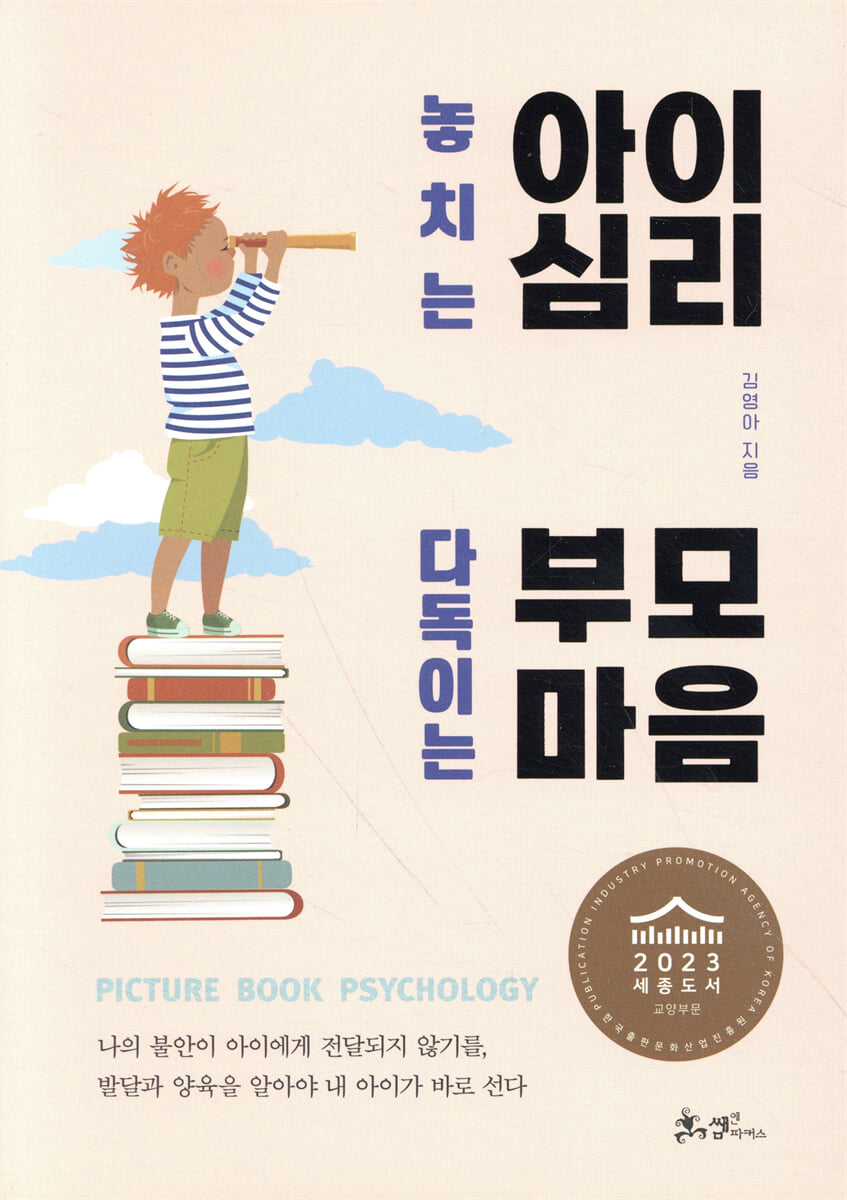
Parents' hearts that comfort children who miss out
 |
Description
Book Introduction
A magical book that soothes parenting anxiety
★ Recommended by Professor Yoo Geon-hee, a pediatrician and adolescent specialist at Samsung Seoul Hospital ★
★ Recommended by Dr. Eunji Kim, a child and adolescent psychiatrist ★
★ Recommended by broadcaster Nam Hee-seok ★
Just as the world is new to a baby, parenting is also new to parents.
Parents grow through countless trials and errors, but ultimately, the most important thing in the parenting process is that children learn by observing their parents' lives.
Because children see how their parents live, how they make friends, how they spend their mornings, and how they spend the rest of their time.
Therefore, the level of emotional stability of parents inevitably determines the quality and direction of their children's lives.
《Parents' Hearts that Read the Psychology of Children Who Miss Out》 is a book that comprehensively covers the major developmental psychology theories that parents must know, including attachment theory, cognitive development theory, and psychosocial development theory.
Based on a broad understanding and specialized knowledge of developmental psychology, the book explains behavioral changes and psychological characteristics according to a child's growth stage in an easy-to-understand manner.
The greatest strength of this book, consisting of six chapters, is that it goes beyond simply introducing theories, and allows parents to look into the source of their anxiety through reading various picture books.
At the end of each chapter, questions are asked to reflect on the emotional history of the caregiver and various parenting methods that can be positively applied in the current family are summarized and introduced.
I hope that you can become a little wiser as a parent through “Parents’ Hearts that Read to Comfort the Psychology of Children That They Miss Out on,” which is strongly recommended by Professor Yoo Geon-hee, a pediatrician at Samsung Seoul Hospital, MC Nam Hee-seok, a broadcaster with 33 years of experience and a father of two, and Director Kim Eun-ji, a pediatric and adolescent psychiatrist.
★ Recommended by Professor Yoo Geon-hee, a pediatrician and adolescent specialist at Samsung Seoul Hospital ★
★ Recommended by Dr. Eunji Kim, a child and adolescent psychiatrist ★
★ Recommended by broadcaster Nam Hee-seok ★
Just as the world is new to a baby, parenting is also new to parents.
Parents grow through countless trials and errors, but ultimately, the most important thing in the parenting process is that children learn by observing their parents' lives.
Because children see how their parents live, how they make friends, how they spend their mornings, and how they spend the rest of their time.
Therefore, the level of emotional stability of parents inevitably determines the quality and direction of their children's lives.
《Parents' Hearts that Read the Psychology of Children Who Miss Out》 is a book that comprehensively covers the major developmental psychology theories that parents must know, including attachment theory, cognitive development theory, and psychosocial development theory.
Based on a broad understanding and specialized knowledge of developmental psychology, the book explains behavioral changes and psychological characteristics according to a child's growth stage in an easy-to-understand manner.
The greatest strength of this book, consisting of six chapters, is that it goes beyond simply introducing theories, and allows parents to look into the source of their anxiety through reading various picture books.
At the end of each chapter, questions are asked to reflect on the emotional history of the caregiver and various parenting methods that can be positively applied in the current family are summarized and introduced.
I hope that you can become a little wiser as a parent through “Parents’ Hearts that Read to Comfort the Psychology of Children That They Miss Out on,” which is strongly recommended by Professor Yoo Geon-hee, a pediatrician at Samsung Seoul Hospital, MC Nam Hee-seok, a broadcaster with 33 years of experience and a father of two, and Director Kim Eun-ji, a pediatric and adolescent psychiatrist.
- You can preview some of the book's contents.
Preview
index
prolog
If we just let go of the idea that 'picture books are only for children'
Chapter 1: Bowlby's Attachment Theory
Before the age of 3, talk about attachment
Chapter 2 Piaget's Theory of Cognitive Development
Understanding development is essential to predicting parenting direction.
Chapter 3: Erikson's Psychosocial Development Theory
Guiding the long and winding river of life
Chapter 4 Bowen _ Emotional Closeness in Family Relationships
My Bloodline Resume
Chapter 5: Satir: Empirical Family Therapy
Communication, a way of fighting for survival
Chapter 6: Klein, Winnicott, and Fairbairn: Object Relations Theory
Who you meet determines your life.
List of picture books introduced / References
Epilogue
I hope that I can look straight at myself and comfort myself.
If we just let go of the idea that 'picture books are only for children'
Chapter 1: Bowlby's Attachment Theory
Before the age of 3, talk about attachment
Chapter 2 Piaget's Theory of Cognitive Development
Understanding development is essential to predicting parenting direction.
Chapter 3: Erikson's Psychosocial Development Theory
Guiding the long and winding river of life
Chapter 4 Bowen _ Emotional Closeness in Family Relationships
My Bloodline Resume
Chapter 5: Satir: Empirical Family Therapy
Communication, a way of fighting for survival
Chapter 6: Klein, Winnicott, and Fairbairn: Object Relations Theory
Who you meet determines your life.
List of picture books introduced / References
Epilogue
I hope that I can look straight at myself and comfort myself.
Detailed image

Into the book
From the moment a child is born, an attachment system is activated that connects them to someone for survival.
When this system is not functioning properly, the child sends constant signals to the attachment figure.
This is a primary strategy.
If the caregiver responds to these signals, the child's attachment system becomes stable, but if the caregiver does not respond, the child uses a secondary strategy.
They either become hyperactive by persistently approaching the attachment figure to get his or her attention, or, conversely, become hyperactive by not expressing their feelings and limiting the caregiver's proximity.
French artist Eric Batut's "The Red Kangaroo" is famous for its captivating illustrations and vibrant colors.
As the title suggests, this book features a kangaroo with a red body.
The white kangaroos murmur as a red kangaroo appears among the group.
“Oh my gosh, my gosh! It’s all red.
“Oh, I’m scared.” Then Mom said, “I’m not scared.
“He just has red fur,” he says, wrapping his arms around Red.
---pp.22-23 From "Chapter 1 Bowlby _ Attachment Theory"
"100 Life Picture Book" shows through pictures the moments in life that people face at each age, from 0 to 100.
The author says that to write this book, he met people of various ages and asked them, “What have you learned in life?”
This means that this book contains the twists and turns of life experienced by many people interviewed by the author, as well as their values, perceptions of life, and problem-solving methods.
(syncopation)
According to Erikson's 'lifelong development' and 'lifelong development', anyone can change and transform as they live.
Because humans are beings that mature without rest from birth until death.
That is precisely why lifelong education scholars cannot discuss Erikson without mentioning him.
---pp.76-78 From “Chapter 3 Erikson’s Psychosocial Development Theory”
If we look around, we see many cases where people are not able to separate themselves from their families in a healthy way, whether they know it or not.
Because even things that seem so obvious are not obvious when it comes to my job.
You should always be able to take a step back and look at yourself and your family objectively.
Sometimes picture books serve as a great tool for that.
Projection is a type of defense mechanism, and among them, family projection refers to transferring anxiety caused by one's own problems or conflicts onto other family members.
When a son or daughter who has been projected onto their mother acts like her husband or son, it is called 'projective identification'.
In other words, projective identification means that the son's behavior is a result of the mother's thoughts.
Undifferentiated parents choose the most infantile and vulnerable of their children as the object of their projections.
Also, the lower the level of self-differentiation in a family, the more severe the projection tendency is.
If parents are undifferentiated, the influence will inevitably be passed on to their children, and this undifferentiation will continue for generations.
The level of anxiety and stress a family experiences determines the quality and direction of its life.
This kind of thing happens all around us.
It happened yesterday, and it's happening today too.
How can we break this chain of anxiety?
---pp.115-116 From “Chapter 4 Bowen _ Emotional Closeness in Family Relationships”
Is our ability to communicate innate, or is it something we acquire later in life? Human communication skills are learned.
Naturally, the place that has the greatest influence is the home.
A child who grows up in a home where abuse and verbal abuse are rampant cannot communicate in the same way as a child who grows up in a home overflowing with intelligence and warmth.
There are scholars who have taken an interest in this very area and argued that communication is dysfunctional and causes errors.
This is Satir, an American social worker and psychotherapist.
He believed that nothing was more important in a person's life than family.
So, Satir's 'empirical family therapy' has a deeper meaning.
When this system is not functioning properly, the child sends constant signals to the attachment figure.
This is a primary strategy.
If the caregiver responds to these signals, the child's attachment system becomes stable, but if the caregiver does not respond, the child uses a secondary strategy.
They either become hyperactive by persistently approaching the attachment figure to get his or her attention, or, conversely, become hyperactive by not expressing their feelings and limiting the caregiver's proximity.
French artist Eric Batut's "The Red Kangaroo" is famous for its captivating illustrations and vibrant colors.
As the title suggests, this book features a kangaroo with a red body.
The white kangaroos murmur as a red kangaroo appears among the group.
“Oh my gosh, my gosh! It’s all red.
“Oh, I’m scared.” Then Mom said, “I’m not scared.
“He just has red fur,” he says, wrapping his arms around Red.
---pp.22-23 From "Chapter 1 Bowlby _ Attachment Theory"
"100 Life Picture Book" shows through pictures the moments in life that people face at each age, from 0 to 100.
The author says that to write this book, he met people of various ages and asked them, “What have you learned in life?”
This means that this book contains the twists and turns of life experienced by many people interviewed by the author, as well as their values, perceptions of life, and problem-solving methods.
(syncopation)
According to Erikson's 'lifelong development' and 'lifelong development', anyone can change and transform as they live.
Because humans are beings that mature without rest from birth until death.
That is precisely why lifelong education scholars cannot discuss Erikson without mentioning him.
---pp.76-78 From “Chapter 3 Erikson’s Psychosocial Development Theory”
If we look around, we see many cases where people are not able to separate themselves from their families in a healthy way, whether they know it or not.
Because even things that seem so obvious are not obvious when it comes to my job.
You should always be able to take a step back and look at yourself and your family objectively.
Sometimes picture books serve as a great tool for that.
Projection is a type of defense mechanism, and among them, family projection refers to transferring anxiety caused by one's own problems or conflicts onto other family members.
When a son or daughter who has been projected onto their mother acts like her husband or son, it is called 'projective identification'.
In other words, projective identification means that the son's behavior is a result of the mother's thoughts.
Undifferentiated parents choose the most infantile and vulnerable of their children as the object of their projections.
Also, the lower the level of self-differentiation in a family, the more severe the projection tendency is.
If parents are undifferentiated, the influence will inevitably be passed on to their children, and this undifferentiation will continue for generations.
The level of anxiety and stress a family experiences determines the quality and direction of its life.
This kind of thing happens all around us.
It happened yesterday, and it's happening today too.
How can we break this chain of anxiety?
---pp.115-116 From “Chapter 4 Bowen _ Emotional Closeness in Family Relationships”
Is our ability to communicate innate, or is it something we acquire later in life? Human communication skills are learned.
Naturally, the place that has the greatest influence is the home.
A child who grows up in a home where abuse and verbal abuse are rampant cannot communicate in the same way as a child who grows up in a home overflowing with intelligence and warmth.
There are scholars who have taken an interest in this very area and argued that communication is dysfunctional and causes errors.
This is Satir, an American social worker and psychotherapist.
He believed that nothing was more important in a person's life than family.
So, Satir's 'empirical family therapy' has a deeper meaning.
---p.136 From “Chapter 5: Cyter _ Empirical Family Therapy”
Publisher's Review
Putting parenting anxiety to rest in one fell swoop
My Child's Psychological Exploration Report
The stages of human development proceed systematically and sequentially.
Although each child develops at different stages and in different ways, the direction of development is already set, so all children go through the same stages of development.
So, providing something that skips the developmental stage a child is facing doesn't really help the child.
Therefore, if you understand your child's cognitive system and schematic level, you can provide your child with what he or she needs most at the most appropriate time.
This book, "The Psychology of Children We Miss Out on, The Heart of Parents We Read," explains various developmental psychology theories that parents must know, divided into six chapters.
It is easy to read and not difficult because it is explained using picture books.
Chapter 1 discusses the importance of a child's secure attachment to the caregivers' early caregiving behavior through Bowlby's attachment theory.
Through picture books such as Caesar's Rules, The Blue Duck, and The Red Kangaroo, we learn about maternal love; through The Cat Who Lived a Million Times, we learn about how attachment relationships change lives; and through books such as The Butcher Mom and I Don't Want to Get Scolded!, we learn about various attachment types.
Chapter 2 examines how humans perceive and learn things through Piaget's theory of cognitive development.
Picture books that clearly show the stages of cognitive development in which children adapt to new environments by changing the basic schematics they already know, such as “Do Cats Know Everything?” and “The Special Yellow Balloon.”
It also talks about the cognitive process of understanding and expanding upon others with different schemata, like the characters in "The Duck and the Owl" or "Boom! Boom! Boom!"
Chapter 3 discusses Erikson's theory of psychosocial development, which states that people form relationships in society, influence each other's development, and continue to grow until death.
Through books such as “100 Life Picture Books” and “My Name is Jagaju,” we examine the meaning of growth and decline, and through books such as “The Story of the Red Crayon,” “The Underground Garden,” and “I Like Grandma’s Wrinkles,” we examine the tasks that must be accomplished at each of the eight stages of development.
Chapter 4 discusses the emotional closeness of family relationships studied by Bowen.
Looking at examples of self-differentiation, family projection, love triangles, multi-generational transmission, and emotional disconnection that appear in books such as “Because of Me,” “The Family Who Went to the Pool,” and “Dad Who Went to the Pool,” it is advised that if parents are unable to manage their own anxiety, their children’s experience will inevitably be low, and this can eliminate various scenarios that serve as the foundation for growth.
Chapter 5 explains Satir's experiential family therapy and discusses the importance of communication among family members.
Through picture books such as “Mr. Bear’s Chair,” “Stripes Appeared,” and “True Champion,” various communication methods are shown and communication methods that can help build a healthy family are introduced.
In Chapter 6, we will learn about object relations theory, which states that your life can change depending on who you meet.
Picture books such as “The Time of the Badger,” “I Speak Like a River,” and “The Child Living in the Wall” make us think about the role of parents in creating positive relationships with others.
Picture books are great teachers
It makes me reflect on myself as an adult.
Picture books can be great teachers for parents.
Because picture books allow me to see my child from a different perspective than usual, and through that, I can gain new values and insights.
Dr. Eunji Kim, a pediatric and adolescent psychiatrist, said the following about picture books.
“In picture books, there are children’s wishes, hopes, fears, and sorrows.
So, when parents share the world of picture books with their children, they can better explore their children's world and understand their own children better.
And in picture books, there are the lives of us adults who were children.
So it also awakens the fears and sadness hidden within the parents.
“It’s a difficult task, but encountering glimpses of my hidden emotions as a child in picture books helps me understand myself, my child, and life better.”
As I read "Parents' Hearts That Read to the Psychology of Children We Miss," which explains developmental psychology theory through picture books, I found myself reflecting on how I, as an adult, have treated children.
A father who accepts a child who stutters as he is, a parent who slowly approaches a child who is alone and holds his hand without forcing him out, a neighbor who finds a solution with the child instead of scolding him, an adult who acknowledges and respects the child as a proper person, etc. Through the figures of mature adults who appear in picture books, we can reflect on our own treatment of children.
Parents must understand the process of development and parenting so that their children can stand upright.
With this book, you will discover a more comfortable and relaxed way of parenting.
My Child's Psychological Exploration Report
The stages of human development proceed systematically and sequentially.
Although each child develops at different stages and in different ways, the direction of development is already set, so all children go through the same stages of development.
So, providing something that skips the developmental stage a child is facing doesn't really help the child.
Therefore, if you understand your child's cognitive system and schematic level, you can provide your child with what he or she needs most at the most appropriate time.
This book, "The Psychology of Children We Miss Out on, The Heart of Parents We Read," explains various developmental psychology theories that parents must know, divided into six chapters.
It is easy to read and not difficult because it is explained using picture books.
Chapter 1 discusses the importance of a child's secure attachment to the caregivers' early caregiving behavior through Bowlby's attachment theory.
Through picture books such as Caesar's Rules, The Blue Duck, and The Red Kangaroo, we learn about maternal love; through The Cat Who Lived a Million Times, we learn about how attachment relationships change lives; and through books such as The Butcher Mom and I Don't Want to Get Scolded!, we learn about various attachment types.
Chapter 2 examines how humans perceive and learn things through Piaget's theory of cognitive development.
Picture books that clearly show the stages of cognitive development in which children adapt to new environments by changing the basic schematics they already know, such as “Do Cats Know Everything?” and “The Special Yellow Balloon.”
It also talks about the cognitive process of understanding and expanding upon others with different schemata, like the characters in "The Duck and the Owl" or "Boom! Boom! Boom!"
Chapter 3 discusses Erikson's theory of psychosocial development, which states that people form relationships in society, influence each other's development, and continue to grow until death.
Through books such as “100 Life Picture Books” and “My Name is Jagaju,” we examine the meaning of growth and decline, and through books such as “The Story of the Red Crayon,” “The Underground Garden,” and “I Like Grandma’s Wrinkles,” we examine the tasks that must be accomplished at each of the eight stages of development.
Chapter 4 discusses the emotional closeness of family relationships studied by Bowen.
Looking at examples of self-differentiation, family projection, love triangles, multi-generational transmission, and emotional disconnection that appear in books such as “Because of Me,” “The Family Who Went to the Pool,” and “Dad Who Went to the Pool,” it is advised that if parents are unable to manage their own anxiety, their children’s experience will inevitably be low, and this can eliminate various scenarios that serve as the foundation for growth.
Chapter 5 explains Satir's experiential family therapy and discusses the importance of communication among family members.
Through picture books such as “Mr. Bear’s Chair,” “Stripes Appeared,” and “True Champion,” various communication methods are shown and communication methods that can help build a healthy family are introduced.
In Chapter 6, we will learn about object relations theory, which states that your life can change depending on who you meet.
Picture books such as “The Time of the Badger,” “I Speak Like a River,” and “The Child Living in the Wall” make us think about the role of parents in creating positive relationships with others.
Picture books are great teachers
It makes me reflect on myself as an adult.
Picture books can be great teachers for parents.
Because picture books allow me to see my child from a different perspective than usual, and through that, I can gain new values and insights.
Dr. Eunji Kim, a pediatric and adolescent psychiatrist, said the following about picture books.
“In picture books, there are children’s wishes, hopes, fears, and sorrows.
So, when parents share the world of picture books with their children, they can better explore their children's world and understand their own children better.
And in picture books, there are the lives of us adults who were children.
So it also awakens the fears and sadness hidden within the parents.
“It’s a difficult task, but encountering glimpses of my hidden emotions as a child in picture books helps me understand myself, my child, and life better.”
As I read "Parents' Hearts That Read to the Psychology of Children We Miss," which explains developmental psychology theory through picture books, I found myself reflecting on how I, as an adult, have treated children.
A father who accepts a child who stutters as he is, a parent who slowly approaches a child who is alone and holds his hand without forcing him out, a neighbor who finds a solution with the child instead of scolding him, an adult who acknowledges and respects the child as a proper person, etc. Through the figures of mature adults who appear in picture books, we can reflect on our own treatment of children.
Parents must understand the process of development and parenting so that their children can stand upright.
With this book, you will discover a more comfortable and relaxed way of parenting.
GOODS SPECIFICS
- Date of issue: April 20, 2023
- Page count, weight, size: 212 pages | 436g | 152*215*16mm
- ISBN13: 9791165347253
- ISBN10: 1165347253
You may also like
카테고리
korean


korean

![GQ KOREA Mark (Monthly): December [2025]](http://librairie.coreenne.fr/cdn/shop/files/8ef265dbbfbf186523ed75ba7319009d.jpg?v=1765340328&width=3840)


