

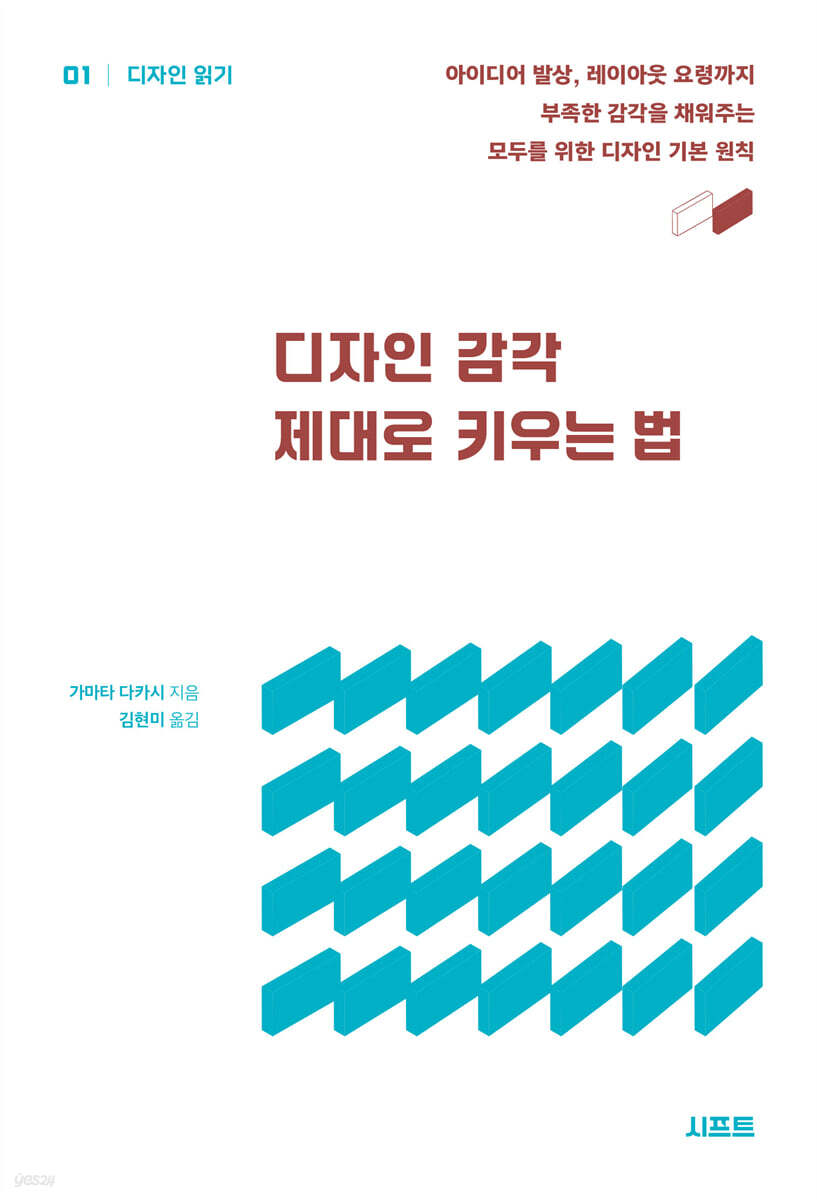
How to properly develop a sense of design
 |
Description
Book Introduction
Is design sense innate?
This book is a design textbook for anyone who has ever felt intimidated by saying, “I have no sense…”
This course systematically helps anyone who wants to develop their senses, from new designers who have not majored in design or are just starting out in the field, to marketers or planners who need to do design even though design is not their main profession.
From how to gather inspiration from the street to the necessity of sketching for creative design, layout, color, fonts, and more, we will guide you through the entire design process, training your head and hands to develop your design sense.
This book is a design textbook for anyone who has ever felt intimidated by saying, “I have no sense…”
This course systematically helps anyone who wants to develop their senses, from new designers who have not majored in design or are just starting out in the field, to marketers or planners who need to do design even though design is not their main profession.
From how to gather inspiration from the street to the necessity of sketching for creative design, layout, color, fonts, and more, we will guide you through the entire design process, training your head and hands to develop your design sense.
- You can preview some of the book's contents.
Preview
index
Part 01 Learning Design from the Street
Turn off your computer and go out into the street / 18
How to Create an Inspiration Notebook / 24
How to Develop Design Skills with Photography / 30
The world is full of color / 38
A concept-finding game you can play on your commute / 46
Font Selection: The Importance of Small Differences / 52
Characteristics of Gothic and Ming fonts / 57
What is a Font? / 62
Creating an Inspiration Note / 69
Part 02 Sketching and Drawing Skills
Are sketching skills necessary for design? / 74
Expressiveness in Drama / 83
How to Increase Expressiveness / 86
Sketching is done with the 'head', not the 'hand'.
/ 92
Seeing Things from a New Perspective (The Upside-Down Method) / 99
7-Minute Design Exercise / 106
A Personal Experience / 113
Beyond the Essence of Sketching / 120
Pencil Sketching Process / 127
Part 03 What is sensible design?
The Key to Sensible Design: 'Basic Principles' / 132
The Three Fundamentals of Color (The Three Elements of Color) / 134
Can we develop our sense of color? / 142
Pasted, spaced / 154
The Importance of Negative Space / 158
Grid and Non-Grid Design / 162
Imagine, "How Would I Design?" and Try It Yourself / 166
What is the Golden Ratio? / 171
The Three Attributes of Color / 180
Part 04 At the design site
How to View Design Objectively / 184
What designers who achieve rapid growth have in common / 193
Readability or Visual Clarity / 197
In addition to Plan A, Plan B is also needed / 206
Idea Generation: The Power of Combination / 213
Growing by Comparing Before and After: For Solo Designers / 221
Explaining the "Reason for Design" / 228
Turn off your computer and go out into the street / 18
How to Create an Inspiration Notebook / 24
How to Develop Design Skills with Photography / 30
The world is full of color / 38
A concept-finding game you can play on your commute / 46
Font Selection: The Importance of Small Differences / 52
Characteristics of Gothic and Ming fonts / 57
What is a Font? / 62
Creating an Inspiration Note / 69
Part 02 Sketching and Drawing Skills
Are sketching skills necessary for design? / 74
Expressiveness in Drama / 83
How to Increase Expressiveness / 86
Sketching is done with the 'head', not the 'hand'.
/ 92
Seeing Things from a New Perspective (The Upside-Down Method) / 99
7-Minute Design Exercise / 106
A Personal Experience / 113
Beyond the Essence of Sketching / 120
Pencil Sketching Process / 127
Part 03 What is sensible design?
The Key to Sensible Design: 'Basic Principles' / 132
The Three Fundamentals of Color (The Three Elements of Color) / 134
Can we develop our sense of color? / 142
Pasted, spaced / 154
The Importance of Negative Space / 158
Grid and Non-Grid Design / 162
Imagine, "How Would I Design?" and Try It Yourself / 166
What is the Golden Ratio? / 171
The Three Attributes of Color / 180
Part 04 At the design site
How to View Design Objectively / 184
What designers who achieve rapid growth have in common / 193
Readability or Visual Clarity / 197
In addition to Plan A, Plan B is also needed / 206
Idea Generation: The Power of Combination / 213
Growing by Comparing Before and After: For Solo Designers / 221
Explaining the "Reason for Design" / 228
Detailed image
Publisher's Review
Develop your senses in everyday life and train yourself to adapt to practical situations.
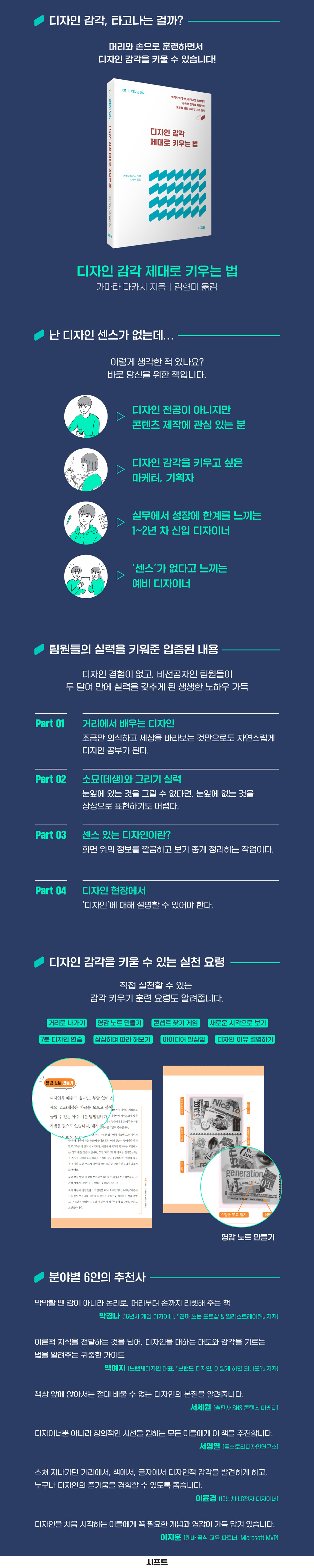
The author of "How to Develop a Proper Design Sense" made various efforts to quickly improve the skills of team members without design experience, and as a result, in just two months, they achieved the skills of a main designer at the company.
This book is full of the know-how of that time.
This book covers a wide range of topics, from how to find inspiration by observing the surroundings, such as street signs, posters, and product packaging, to the necessity of sketching and the basic principles of color and layout, and guides readers to understand the principles and structure of design and train their senses through observation.
It's okay if you lack design sense right now.
The author emphasizes that 'design sense is not something you are born with, but rather an ability that can be developed through training.'
Even if you are not good at drawing or have not received design education, you can learn design systematically.
After reading this book, you will be able to logically answer questions like, "Why did I choose this font?" and "Why is this layout good?"
This is a design textbook that conveys 'design sense' in 'understandable language' to anyone who is learning design for the first time or feels they lack design sense.
What's in this book
ㆍHow to get inspired by the streets: Just by being a little conscious and looking at the world, you can naturally study design.
ㆍThe necessity of sketching: If you cannot draw what is in front of you, it is also difficult to imagine what is not in front of you.
ㆍSenseful design: This is the process of organizing information on the screen neatly and visually.
ㆍLearning from the design field: You must be able to explain ‘design’.
This book is for people like this.
ㆍPeople who are not design majors but are interested in content creation
Marketers and planners who want to develop their design sense
ㆍNew designers in their first or second year of experience who feel limited in their growth in the field
Aspiring designers who feel they lack 'sense'
The author of "How to Develop a Proper Design Sense" made various efforts to quickly improve the skills of team members without design experience, and as a result, in just two months, they achieved the skills of a main designer at the company.
This book is full of the know-how of that time.
This book covers a wide range of topics, from how to find inspiration by observing the surroundings, such as street signs, posters, and product packaging, to the necessity of sketching and the basic principles of color and layout, and guides readers to understand the principles and structure of design and train their senses through observation.
It's okay if you lack design sense right now.
The author emphasizes that 'design sense is not something you are born with, but rather an ability that can be developed through training.'
Even if you are not good at drawing or have not received design education, you can learn design systematically.
After reading this book, you will be able to logically answer questions like, "Why did I choose this font?" and "Why is this layout good?"
This is a design textbook that conveys 'design sense' in 'understandable language' to anyone who is learning design for the first time or feels they lack design sense.
What's in this book
ㆍHow to get inspired by the streets: Just by being a little conscious and looking at the world, you can naturally study design.
ㆍThe necessity of sketching: If you cannot draw what is in front of you, it is also difficult to imagine what is not in front of you.
ㆍSenseful design: This is the process of organizing information on the screen neatly and visually.
ㆍLearning from the design field: You must be able to explain ‘design’.
This book is for people like this.
ㆍPeople who are not design majors but are interested in content creation
Marketers and planners who want to develop their design sense
ㆍNew designers in their first or second year of experience who feel limited in their growth in the field
Aspiring designers who feel they lack 'sense'
GOODS SPECIFICS
- Date of issue: May 12, 2025
- Page count, weight, size: 234 pages | 260g | 128*188*15mm
- ISBN13: 9791198673060
You may also like
카테고리
korean


korean

![GQ KOREA Mark (Monthly): December [2025]](http://librairie.coreenne.fr/cdn/shop/files/8ef265dbbfbf186523ed75ba7319009d.jpg?v=1765340328&width=3840)


