

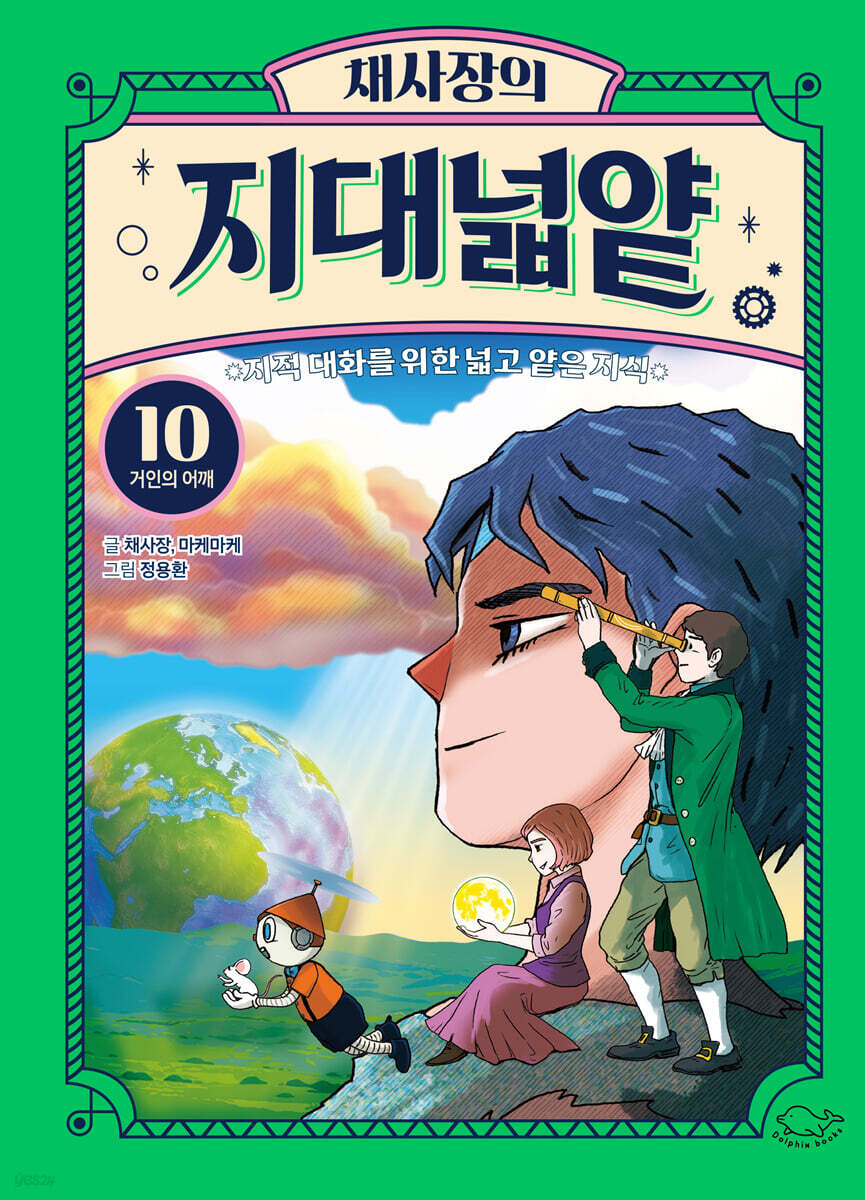
Chae Sa-jang's Wide and Shallow Land 10: Giant's Shoulders
 |
Description
Book Introduction
A special science adventure with President Chae
The intellectual conversation in the field of science begins!
Science, the most trusted candidate for truth for modern people!
The amazing story of scientists who sought the truth unfolds.
“The most popular book in the children's library”
“A book that children read in one sitting and eagerly await the next volume.”
A never-before-seen science story told by author Cha Sa-jang
Are there any children's educational books you can confidently recommend to your loved ones? The "Chae Sa-jang's Wide and Shallow Land" series, released immediately, received rave reviews from parents and children alike, spreading through word of mouth and establishing itself as a must-read for elementary school students.
It is said that it is fun for adults to read, and that children read it repeatedly and acquire the humanities knowledge they need for life.
Culture is not a special and difficult culture, but a pastime enjoyed by all generations.
Language is not the only thing we need to communicate and converse.
It is the common denominator that we humans have experienced together, a broad and shallow knowledge.
This kind of knowledge is our ticket to a joyful and profound conversation.
Many children, parents, and teachers have experienced the joy of conversation through the “Chae Sa-jang’s Wide and Shallow Land” series, and are sharing that joy with everyone.
Through the stories in Volumes 1 through 8 of this series, readers studied the five areas that make up the 'real world': history, economics, politics, society, and ethics.
From Volume 9 onwards, we begin to explore the 'world beyond reality', which is the universal and unchanging truth that we humans have been endlessly searching for.
The first candidate for truth we should explore is science.
How does science view me and the world?
In 『The Great and Shallow Land of the Chae Sa Jang: 10 Giants' Shoulders』, we look back on the history of science.
By examining the flow of science from ancient times to the modern era, we will examine what achievements science has made and which figures have fought against the times and brought science to its current level.
We look forward to a moment when young readers will meet the great giants who laid the foundations of today's knowledge, such as Ptolemy, Copernicus, Galileo, Descartes, and Newton, and dream of amazing discoveries by standing on their shoulders.
The intellectual conversation in the field of science begins!
Science, the most trusted candidate for truth for modern people!
The amazing story of scientists who sought the truth unfolds.
“The most popular book in the children's library”
“A book that children read in one sitting and eagerly await the next volume.”
A never-before-seen science story told by author Cha Sa-jang
Are there any children's educational books you can confidently recommend to your loved ones? The "Chae Sa-jang's Wide and Shallow Land" series, released immediately, received rave reviews from parents and children alike, spreading through word of mouth and establishing itself as a must-read for elementary school students.
It is said that it is fun for adults to read, and that children read it repeatedly and acquire the humanities knowledge they need for life.
Culture is not a special and difficult culture, but a pastime enjoyed by all generations.
Language is not the only thing we need to communicate and converse.
It is the common denominator that we humans have experienced together, a broad and shallow knowledge.
This kind of knowledge is our ticket to a joyful and profound conversation.
Many children, parents, and teachers have experienced the joy of conversation through the “Chae Sa-jang’s Wide and Shallow Land” series, and are sharing that joy with everyone.
Through the stories in Volumes 1 through 8 of this series, readers studied the five areas that make up the 'real world': history, economics, politics, society, and ethics.
From Volume 9 onwards, we begin to explore the 'world beyond reality', which is the universal and unchanging truth that we humans have been endlessly searching for.
The first candidate for truth we should explore is science.
How does science view me and the world?
In 『The Great and Shallow Land of the Chae Sa Jang: 10 Giants' Shoulders』, we look back on the history of science.
By examining the flow of science from ancient times to the modern era, we will examine what achievements science has made and which figures have fought against the times and brought science to its current level.
We look forward to a moment when young readers will meet the great giants who laid the foundations of today's knowledge, such as Ptolemy, Copernicus, Galileo, Descartes, and Newton, and dream of amazing discoveries by standing on their shoulders.
- You can preview some of the book's contents.
Preview
index
Send a prologue signal
1.
What is the center of the universe?
- Ancient science
[Cha Sa-jang's Key Notes] Ptolemy and the Geocentric Theory
[Master's Report] The Library of Alexandria
[Break time] Ptolemy's constellations
2.
A simple and beautiful truth
- Science in the Middle Ages
[Chairman Cha's Key Notes] Occam's Razor
[Master's Report] Copernicus's Heliocentric Theory
[Break time] What kind of planets are there?
3.
A book written in the language of mathematics
- Heliocentrism and its mathematical basis
[Cha Sa-jang's Key Notes] Galileo's Heliocentric Theory
[Master's Report] Galileo Galilei
[Break time] Where is Galileo's house?
4.
Expressing the location of Paris in a formula?
- Algebra and geometry
[Cha Sa-jang's Key Notes] Kepler and Descartes
[Master's Report] René Descartes
[Break time] Stand on the shoulders of giants
5.
We are pulling each other
- From existence to relationship
[Cha Sa-jang's Key Notes] Newton, the Expansion of Physics
[Master's Report] Isaac Newton
[Break time] Crossword puzzle
Epilogue Come Save Me
Final Summary
1.
What is the center of the universe?
- Ancient science
[Cha Sa-jang's Key Notes] Ptolemy and the Geocentric Theory
[Master's Report] The Library of Alexandria
[Break time] Ptolemy's constellations
2.
A simple and beautiful truth
- Science in the Middle Ages
[Chairman Cha's Key Notes] Occam's Razor
[Master's Report] Copernicus's Heliocentric Theory
[Break time] What kind of planets are there?
3.
A book written in the language of mathematics
- Heliocentrism and its mathematical basis
[Cha Sa-jang's Key Notes] Galileo's Heliocentric Theory
[Master's Report] Galileo Galilei
[Break time] Where is Galileo's house?
4.
Expressing the location of Paris in a formula?
- Algebra and geometry
[Cha Sa-jang's Key Notes] Kepler and Descartes
[Master's Report] René Descartes
[Break time] Stand on the shoulders of giants
5.
We are pulling each other
- From existence to relationship
[Cha Sa-jang's Key Notes] Newton, the Expansion of Physics
[Master's Report] Isaac Newton
[Break time] Crossword puzzle
Epilogue Come Save Me
Final Summary
Detailed image
.jpg)
Publisher's Review
In "The Great and Shallow Land of the 10 Giants' Shoulders," the history of science is explored.
By examining the flow of science from ancient times to the modern era, we will examine what achievements science has made and which figures have fought against the times and brought science to its current level.
We look forward to a moment when young readers will meet the great giants who laid the foundations of today's knowledge, such as Ptolemy, Copernicus, Galileo, Descartes, and Newton, and dream of amazing discoveries by standing on their shoulders.
Does the sun revolve around the earth? Does the earth revolve around the sun?
Can the laws of this world be expressed in mathematics?
From geocentrism and heliocentrism, to algebra and geometry, to Newtonian mechanics and universal gravitation!
Even difficult science becomes an exciting journey of knowledge when accompanied by the vast and shallow.
From ancient times to modern times, science has strived to reach the truth without fail.
Since time immemorial, people have been curious about this world.
Ancient natural philosophers discussed the basic elements that make up the world, and Ptolemy systematically organized the geocentric theory, which was the common knowledge at the time that celestial bodies revolved around the Earth.
The geocentric theory was a theory that was accepted without question for over a thousand years because it was a theory that conformed to the human-centered way of thinking that humans were the center of the universe because God created them.
However, since the Middle Ages, a change has occurred in the way we understand the world through the power of faith.
Copernicus argued that the simple and beautifully organized heliocentric theory, rather than the complexly expressed geocentric theory, was the truth, and Galileo supported his argument with empirical observational data and mathematical evidence.
Geometry attempted to express everything in the world, including the movements of the planets, mathematically, and with Descartes, it became possible to express the objects of geometry using algebra.
Newton expanded the interests of existing science and organized the invisible forces between objects into mathematics.
It was a time when superstitions and spirits dominated people's thoughts, but there seemed to be no room for such things to interfere with Newtonian mechanics.
Nature also came to be understood as a giant machine that operates according to certain laws.
The history of scientific progress and the fundamental concepts of science are not special knowledge that only specialists should learn, but rather are general knowledge that all of us living in modern society should know.
Science as a liberal arts discipline goes beyond simply acquiring knowledge and plays an important role in developing scientific thinking and problem-solving skills.
Scientists explore phenomena through observation, experimentation, and analysis, and they are tolerant of the possibility that these theories may be overturned at any time.
Even for those of us who aren't science majors, understanding the fundamental principles of this world and how science works will help us make rational decisions for ourselves and society.
This book helps us understand science, which has been learned through memorization and calculation, in an integrated way through historical context.
The stories of five scientists who have struggled against the times and pursued truth will help us understand and empathize with science, not as isolated knowledge, but as a humanistic experience closely related to human life.
An instant bestseller
Boy's Korea's Best Children's Book Selection
The Best Children's Humanities Books, Proven by Reader Reviews
We live in an age where more learning materials than ever are available through books and media.
Today's children take in a lot of information, but they may not have the time or energy to synthesize that knowledge and digest it into their own thoughts.
What we need more than anything is to connect the flow of knowledge and make it our own.
Speaking 'my thoughts' is not something that can be studied by memorization.
For children who need to understand hidden meanings and contexts and apply them to real life, this book will be an excellent teacher and discussion forum.
As important as knowledge is the power of thinking.
1.
Korea's first full-fledged humanities story comic for children!
By conveying only the core knowledge of humanities and science in an easy and fun way, we can make difficult and complex humanities easier to understand.
It's organized into one easy-to-understand line.
2.
Providing the 'real knowledge' needed to survive in the world.
The meaning of mathematics in science, the expansion of physics through universal gravitation, the absolutist view of truth, etc.
It contains the learning content learned in school, but also provides real knowledge that is not taught in school.
3.
A cultural comic format you've never seen before, 100% worth collecting!
With text and pictures that are different from previous educational cartoons
Rather than providing only fragmentary information, we cultivate the ability to think for oneself and develop a perspective on the world.
4.
Brain-stimulating stories + mind-stimulating knowledge
Through the story of the protagonist Alpha struggling to survive in the world with his whole body,
You can experience a unique reading experience with a story that awakens your mind and knowledge that touches your heart.
5.
A knowledge series that explains everything about the world and life.
The important thing is to see the forest! Helping children broaden their understanding of the world.
It teaches wisdom beyond knowledge, how to live in the future.
How to read this book
1.
If you follow the main character's steps in the story, you can understand the flow of information.
2.
Compare what you know with the new scientific information you've discovered.
3.
Find the key words of science in [Chairman Cha's Key Notes].
4.
Let's connect the knowledge that you are curious about by looking at [Master's Report].
5.
It's more fun to summarize a book briefly in [Final Summary] and discuss it with people around you.
# Appendix [Scientist Quiz]
Meet other scientists through fun quizzes and games.
By examining the flow of science from ancient times to the modern era, we will examine what achievements science has made and which figures have fought against the times and brought science to its current level.
We look forward to a moment when young readers will meet the great giants who laid the foundations of today's knowledge, such as Ptolemy, Copernicus, Galileo, Descartes, and Newton, and dream of amazing discoveries by standing on their shoulders.
Does the sun revolve around the earth? Does the earth revolve around the sun?
Can the laws of this world be expressed in mathematics?
From geocentrism and heliocentrism, to algebra and geometry, to Newtonian mechanics and universal gravitation!
Even difficult science becomes an exciting journey of knowledge when accompanied by the vast and shallow.
From ancient times to modern times, science has strived to reach the truth without fail.
Since time immemorial, people have been curious about this world.
Ancient natural philosophers discussed the basic elements that make up the world, and Ptolemy systematically organized the geocentric theory, which was the common knowledge at the time that celestial bodies revolved around the Earth.
The geocentric theory was a theory that was accepted without question for over a thousand years because it was a theory that conformed to the human-centered way of thinking that humans were the center of the universe because God created them.
However, since the Middle Ages, a change has occurred in the way we understand the world through the power of faith.
Copernicus argued that the simple and beautifully organized heliocentric theory, rather than the complexly expressed geocentric theory, was the truth, and Galileo supported his argument with empirical observational data and mathematical evidence.
Geometry attempted to express everything in the world, including the movements of the planets, mathematically, and with Descartes, it became possible to express the objects of geometry using algebra.
Newton expanded the interests of existing science and organized the invisible forces between objects into mathematics.
It was a time when superstitions and spirits dominated people's thoughts, but there seemed to be no room for such things to interfere with Newtonian mechanics.
Nature also came to be understood as a giant machine that operates according to certain laws.
The history of scientific progress and the fundamental concepts of science are not special knowledge that only specialists should learn, but rather are general knowledge that all of us living in modern society should know.
Science as a liberal arts discipline goes beyond simply acquiring knowledge and plays an important role in developing scientific thinking and problem-solving skills.
Scientists explore phenomena through observation, experimentation, and analysis, and they are tolerant of the possibility that these theories may be overturned at any time.
Even for those of us who aren't science majors, understanding the fundamental principles of this world and how science works will help us make rational decisions for ourselves and society.
This book helps us understand science, which has been learned through memorization and calculation, in an integrated way through historical context.
The stories of five scientists who have struggled against the times and pursued truth will help us understand and empathize with science, not as isolated knowledge, but as a humanistic experience closely related to human life.
An instant bestseller
Boy's Korea's Best Children's Book Selection
The Best Children's Humanities Books, Proven by Reader Reviews
We live in an age where more learning materials than ever are available through books and media.
Today's children take in a lot of information, but they may not have the time or energy to synthesize that knowledge and digest it into their own thoughts.
What we need more than anything is to connect the flow of knowledge and make it our own.
Speaking 'my thoughts' is not something that can be studied by memorization.
For children who need to understand hidden meanings and contexts and apply them to real life, this book will be an excellent teacher and discussion forum.
As important as knowledge is the power of thinking.
1.
Korea's first full-fledged humanities story comic for children!
By conveying only the core knowledge of humanities and science in an easy and fun way, we can make difficult and complex humanities easier to understand.
It's organized into one easy-to-understand line.
2.
Providing the 'real knowledge' needed to survive in the world.
The meaning of mathematics in science, the expansion of physics through universal gravitation, the absolutist view of truth, etc.
It contains the learning content learned in school, but also provides real knowledge that is not taught in school.
3.
A cultural comic format you've never seen before, 100% worth collecting!
With text and pictures that are different from previous educational cartoons
Rather than providing only fragmentary information, we cultivate the ability to think for oneself and develop a perspective on the world.
4.
Brain-stimulating stories + mind-stimulating knowledge
Through the story of the protagonist Alpha struggling to survive in the world with his whole body,
You can experience a unique reading experience with a story that awakens your mind and knowledge that touches your heart.
5.
A knowledge series that explains everything about the world and life.
The important thing is to see the forest! Helping children broaden their understanding of the world.
It teaches wisdom beyond knowledge, how to live in the future.
How to read this book
1.
If you follow the main character's steps in the story, you can understand the flow of information.
2.
Compare what you know with the new scientific information you've discovered.
3.
Find the key words of science in [Chairman Cha's Key Notes].
4.
Let's connect the knowledge that you are curious about by looking at [Master's Report].
5.
It's more fun to summarize a book briefly in [Final Summary] and discuss it with people around you.
# Appendix [Scientist Quiz]
Meet other scientists through fun quizzes and games.
GOODS SPECIFICS
- Date of issue: June 18, 2024
- Page count, weight, size: 160 pages | 460g | 153*210*15mm
- ISBN13: 9791193487037
- ISBN10: 119348703X
- KC Certification: Certification Type: Conformity Confirmation
You may also like
카테고리
korean


korean

![GQ KOREA Mark (Monthly): December [2025]](http://librairie.coreenne.fr/cdn/shop/files/8ef265dbbfbf186523ed75ba7319009d.jpg?v=1765340328&width=3840)


