

Spacing race
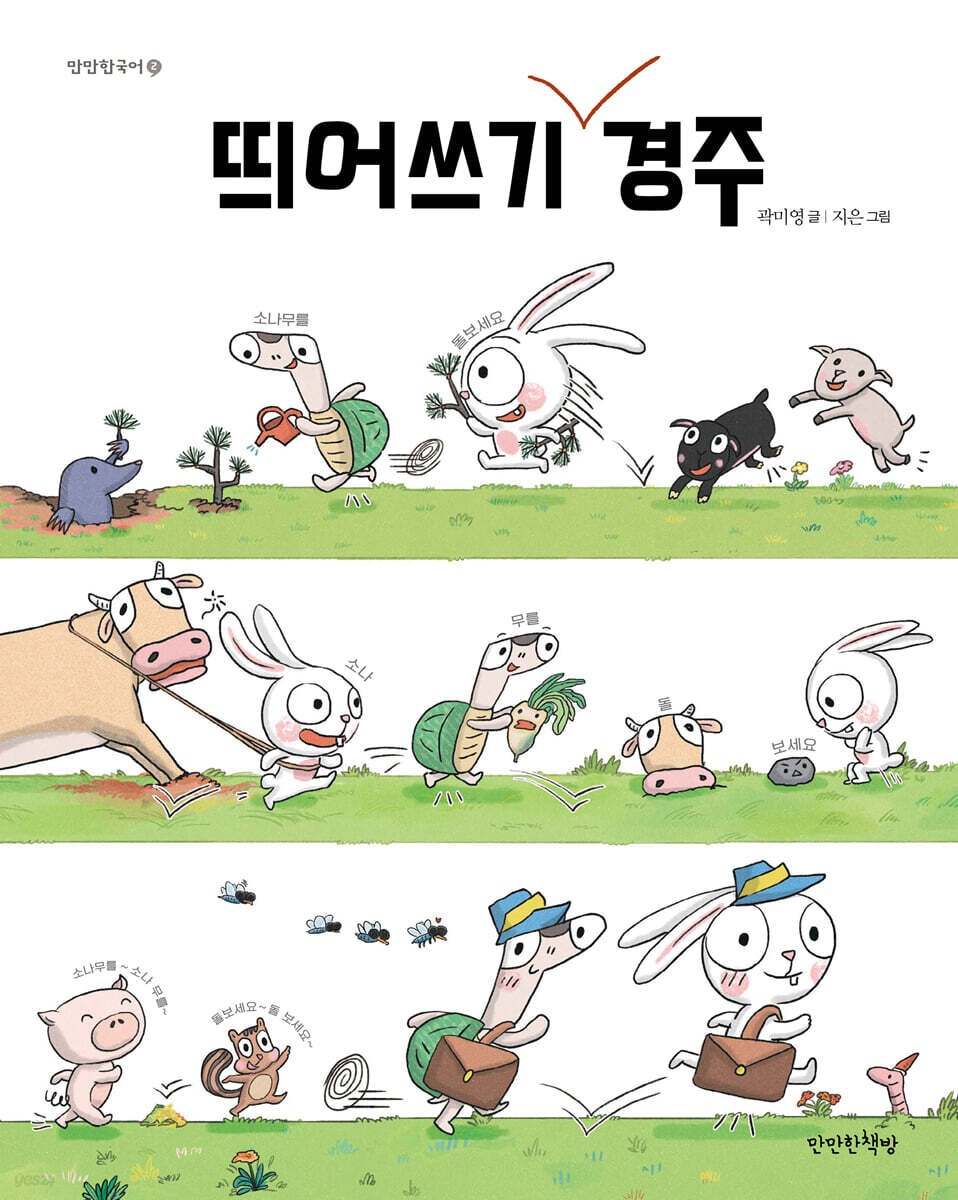 |
Description
Book Introduction
The second book in the "Easy Korean" series
Spacing Race
To be a postman, you need to be quick and persistent.
You need to be good at spacing and reading.
The race between the turtle and the hare begins now!
There are nine gates in total!
Who will be the forest postman?
Author Kwak Mi-young and illustrator Ji Eun, who won the 64th Korea Publishing Culture Award for their book “Balchimgudae,” which solidified the foundation of the Korean language and presented confusing final consonants in an easy and fun way, are back with “Easy Korean Series 2,” “Spacing Race.”
The greatest strength of this book is that it intuitively shows how meaning and situations change depending on spacing through the fairytale-like structure of a space race between a tortoise and a hare.
As you follow the tortoise and the hare through the nine gates of the spacing race, you will immediately forget that spacing is difficult, complicated, and boring.
Without any grammar rules or explanations, the concept of spacing will be ingrained in your head.
Spacing Race
To be a postman, you need to be quick and persistent.
You need to be good at spacing and reading.
The race between the turtle and the hare begins now!
There are nine gates in total!
Who will be the forest postman?
Author Kwak Mi-young and illustrator Ji Eun, who won the 64th Korea Publishing Culture Award for their book “Balchimgudae,” which solidified the foundation of the Korean language and presented confusing final consonants in an easy and fun way, are back with “Easy Korean Series 2,” “Spacing Race.”
The greatest strength of this book is that it intuitively shows how meaning and situations change depending on spacing through the fairytale-like structure of a space race between a tortoise and a hare.
As you follow the tortoise and the hare through the nine gates of the spacing race, you will immediately forget that spacing is difficult, complicated, and boring.
Without any grammar rules or explanations, the concept of spacing will be ingrained in your head.
- You can preview some of the book's contents.
Preview
Detailed image

Publisher's Review
■Do I really need to space them? It's easier if I just write them all together! Or what if I just write them all apart?
But would a world without spaces really be convenient?
The turtle sent a letter wishing, “Please make me bigger and bigger.”
However, the person who received the letter with the messy spacing said, “Oh, make the dot bigger!” and gave the turtle a dot in the middle of its face.
The rabbit sent a letter wishing, “Please make the cucumber ripen quickly.”
However, the person who received the letter with the messy spacing said, “Oh, please let the teeth grow quickly!” and gave the rabbit a tooth as a gift.
The turtle and the rabbit, who unexpectedly got moles and dentures, paid dearly for their mistake in spacing.
It shows that if you write all the words together without spacing or write them all with spaces, the sentences become confusing and the world becomes chaos itself.
But what exactly did the turtle and the rabbit intend to write in their wish letters? Will they be able to overcome the hurdle of spacing and become the postmen they dreamed of?
■ An interesting story unfolds, with meaning changing depending on the spacing!
At the first spaced gate, the turtle and the rabbit receive a letter from the mother goat.
“Four baby goats have disappeared.”
The rabbit read out loud, “Four baby goats have disappeared.”
The turtle read out loud, “Four baby goats are missing.”
With just this sentence, it's hard to tell who read it correctly.
The clue is something added to the letter.
The mother goat wrote in the letter, “Our names are Woori, Marie, Yori, and Jori.
“Please come and find our children,” he added.
Aha! Now we know that the mother goat is looking for her four baby goats, named Uri, Marie, Yori, and Jori.
You can see that it requires literacy to read with spacing depending on the situation, rather than simply teaching spacing with just a sentence.
The turtle, who read the word correctly, brought four baby goats hidden in a bunch of flowers to their mother goat, but the rabbit, who read the word incorrectly, ended up bringing a baby squirrel named 'Marie' to its mother goat.
Could there be another spacing method? As I read further into the story, I find myself imagining words and sentences, not just those suggested by the author, but also by using various spacing and gluing techniques. It's a lot of fun.
In this way, the author shows an intuitive approach to grammar rather than a memorization approach in this book.
While existing spacing textbooks explain the structure of sentences and how to space them in each case, the intuitive method of combining stories allows us to understand that meaning changes depending on spacing.
Spacing that is intuitively understood in combination with pictures is not only easier to understand, but also more memorable, thus enhancing learning effectiveness.
Each sentence presented in this book has been carefully selected to help children learn spacing, a skill that often confuses them.
■9 new spacing gates based on Aesop's fables and traditional fairy tales!
And the hidden final gate that will surprise everyone?
In this book, the author not only clearly teaches children the concept of spacing, but also amplifies the positive functions of fairy tales by flexibly combining children's favorite Aesop fables and traditional fairy tales, such as "The Tale of the Rabbit" and "The Golden Axe and the Silver Axe."
《The Space Race》 is reminiscent of the race in Aesop's fable 《The Tortoise and the Hare》, but it is not obsessed with winning.
As they pass through the spaced gates, the rabbit and the turtle form a friendship, and then they open the final gate that surprises everyone.
Why did the tortoise and the hare want to be postmen? It shows healthy competition, cooperation, and coexistence, leaving a deeply moving impression.
Don't memorize it! Don't get a headache!
With the Easy Korean Series, you can enjoy learning the 'taste of the Korean language' just by reading along!
You say Korean is easier than math or English? Korean is our native language, so we speak and write it naturally from a young age, so it might seem easier than other subjects. However, the truth is, there are many things we don't know and use well.
However, it is not easy to memorize all the grammar rules one by one.
The Easy Korean Series helps you learn the flavor of the Korean language in a fun way by helping you properly understand its unique grammatical characteristics through fun situations.
If 《Consolation Structure》 showed at a glance how the situation changes if a single consonant is wrong, and therefore how important it is to use consonants correctly, rather than memorizing each and every one of the various overlapping consonants, 《Spacing Race》 shows that rich stories are created when you understand the various usage cases of a word and use spacing accordingly.
In addition to final consonants and spacing, we will continue to plan projects that will allow readers to enjoy the flavor of the Korean language by simply reading along to understand the flavor of the Korean language at a glance, including punctuation marks and homonyms.
But would a world without spaces really be convenient?
The turtle sent a letter wishing, “Please make me bigger and bigger.”
However, the person who received the letter with the messy spacing said, “Oh, make the dot bigger!” and gave the turtle a dot in the middle of its face.
The rabbit sent a letter wishing, “Please make the cucumber ripen quickly.”
However, the person who received the letter with the messy spacing said, “Oh, please let the teeth grow quickly!” and gave the rabbit a tooth as a gift.
The turtle and the rabbit, who unexpectedly got moles and dentures, paid dearly for their mistake in spacing.
It shows that if you write all the words together without spacing or write them all with spaces, the sentences become confusing and the world becomes chaos itself.
But what exactly did the turtle and the rabbit intend to write in their wish letters? Will they be able to overcome the hurdle of spacing and become the postmen they dreamed of?
■ An interesting story unfolds, with meaning changing depending on the spacing!
At the first spaced gate, the turtle and the rabbit receive a letter from the mother goat.
“Four baby goats have disappeared.”
The rabbit read out loud, “Four baby goats have disappeared.”
The turtle read out loud, “Four baby goats are missing.”
With just this sentence, it's hard to tell who read it correctly.
The clue is something added to the letter.
The mother goat wrote in the letter, “Our names are Woori, Marie, Yori, and Jori.
“Please come and find our children,” he added.
Aha! Now we know that the mother goat is looking for her four baby goats, named Uri, Marie, Yori, and Jori.
You can see that it requires literacy to read with spacing depending on the situation, rather than simply teaching spacing with just a sentence.
The turtle, who read the word correctly, brought four baby goats hidden in a bunch of flowers to their mother goat, but the rabbit, who read the word incorrectly, ended up bringing a baby squirrel named 'Marie' to its mother goat.
Could there be another spacing method? As I read further into the story, I find myself imagining words and sentences, not just those suggested by the author, but also by using various spacing and gluing techniques. It's a lot of fun.
In this way, the author shows an intuitive approach to grammar rather than a memorization approach in this book.
While existing spacing textbooks explain the structure of sentences and how to space them in each case, the intuitive method of combining stories allows us to understand that meaning changes depending on spacing.
Spacing that is intuitively understood in combination with pictures is not only easier to understand, but also more memorable, thus enhancing learning effectiveness.
Each sentence presented in this book has been carefully selected to help children learn spacing, a skill that often confuses them.
■9 new spacing gates based on Aesop's fables and traditional fairy tales!
And the hidden final gate that will surprise everyone?
In this book, the author not only clearly teaches children the concept of spacing, but also amplifies the positive functions of fairy tales by flexibly combining children's favorite Aesop fables and traditional fairy tales, such as "The Tale of the Rabbit" and "The Golden Axe and the Silver Axe."
《The Space Race》 is reminiscent of the race in Aesop's fable 《The Tortoise and the Hare》, but it is not obsessed with winning.
As they pass through the spaced gates, the rabbit and the turtle form a friendship, and then they open the final gate that surprises everyone.
Why did the tortoise and the hare want to be postmen? It shows healthy competition, cooperation, and coexistence, leaving a deeply moving impression.
Don't memorize it! Don't get a headache!
With the Easy Korean Series, you can enjoy learning the 'taste of the Korean language' just by reading along!
You say Korean is easier than math or English? Korean is our native language, so we speak and write it naturally from a young age, so it might seem easier than other subjects. However, the truth is, there are many things we don't know and use well.
However, it is not easy to memorize all the grammar rules one by one.
The Easy Korean Series helps you learn the flavor of the Korean language in a fun way by helping you properly understand its unique grammatical characteristics through fun situations.
If 《Consolation Structure》 showed at a glance how the situation changes if a single consonant is wrong, and therefore how important it is to use consonants correctly, rather than memorizing each and every one of the various overlapping consonants, 《Spacing Race》 shows that rich stories are created when you understand the various usage cases of a word and use spacing accordingly.
In addition to final consonants and spacing, we will continue to plan projects that will allow readers to enjoy the flavor of the Korean language by simply reading along to understand the flavor of the Korean language at a glance, including punctuation marks and homonyms.
GOODS SPECIFICS
- Date of issue: February 23, 2024
- Page count, weight, size: 80 pages | 400g | 190*242*11mm
- ISBN13: 9791189499648
- ISBN10: 1189499649
- KC Certification: Certification Type: Conformity Confirmation
You may also like
카테고리
korean


korean

![GQ KOREA Mark (Monthly): December [2025]](http://librairie.coreenne.fr/cdn/shop/files/8ef265dbbfbf186523ed75ba7319009d.jpg?v=1765340328&width=3840)


