

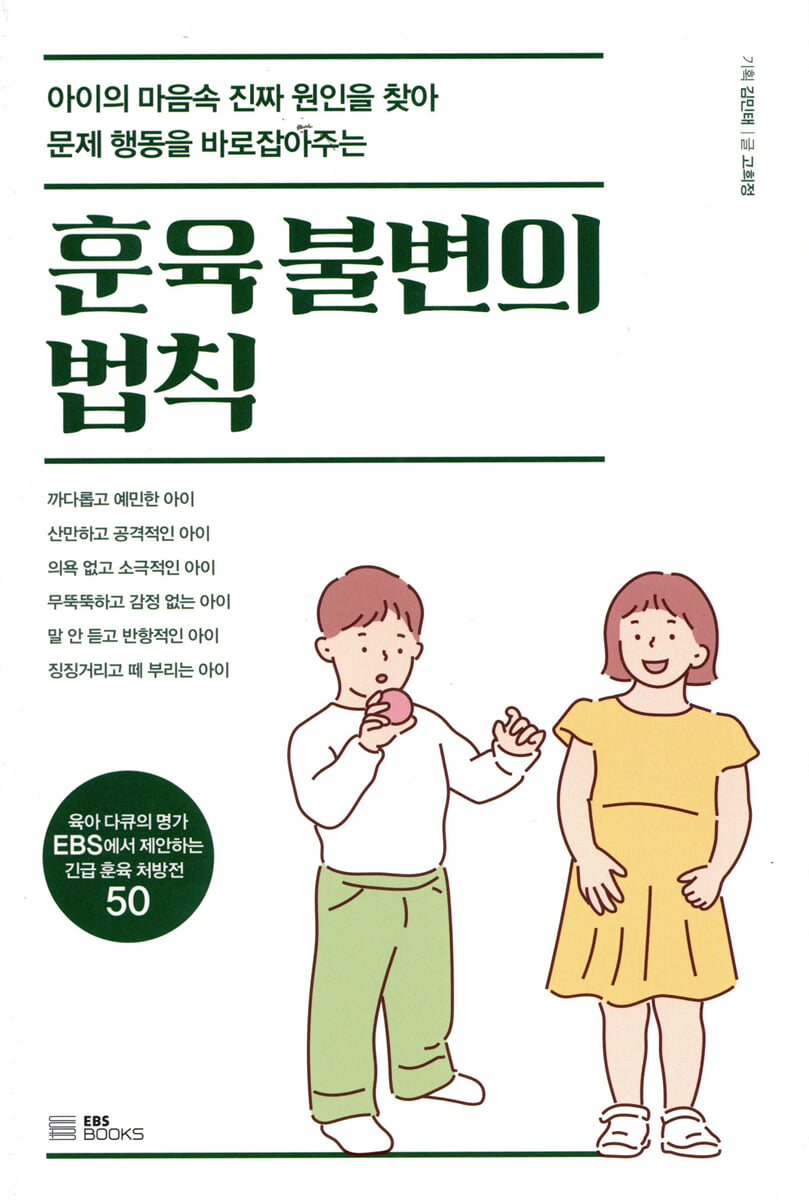
The immutable laws of discipline
 |
Description
Book Introduction
- A word from MD
- Proper discipline alone can solve 99% of parenting concerns! An emergency discipline prescription from EBS, the parenting documentary powerhouse.
The magical law of discipline that instantly changes your mind and thoughts from "Why on earth did he do that?" to "Ah! So that's why he did that!"
We present in detail the most realistic and effective coping methods through 50 common cases encountered in everyday life.
- Health/Hobby MD Kim Hyun-joo
Just by properly disciplining your children, 99% of your parenting concerns can be resolved!
Emergency Discipline Prescription from EBS, the Parenting Documentary Powerhouse
From 'Why on earth did he do that?' to 'Ah! So that's why he did that!'
50 Magical Discipline Rules That Will Change Your Mind and Thoughts in an Instant
Parents' concerns about raising their children are truly varied.
This happens because each child has a different innate temperament.
However, children born with similar temperaments do not all grow up in the same way.
That is the power of parenting.
No matter what anyone says, the most important thing in a parenting environment is ‘discipline.’
In fact, many of the concerns about parenting can be resolved if discipline is done properly.
Additionally, most of the child's problem behaviors are resolved.
As children grow, their sense of self develops and their desires diversify, so they want to do whatever they want. At this time, we must cultivate self-control in children through appropriate discipline so that they can judge and control their own actions according to the time and place.
But discipline is so difficult.
This is because each child has a different innate temperament, different behaviors at each stage of development, and different emotions felt by the child depending on the situation and environment.
However, there are clear principles of discipline and answers to how best to discipline in each situation.
Knowing this will make discipline easier and more effective, and will help you become a wise parent who can help your child grow.
In "The Unchangeable Laws of Discipline," we present the most realistic and effective coping methods in great detail through 50 common examples from everyday life.
10 Rules of Discipline to Develop Emotional Control, 10 Rules of Discipline that Consider Temperament and Development, 10 Rules of Discipline to Enhance Attachment and Self-Esteem, 10 Rules of Discipline for Social Development, and 10 Rules of Discipline to Correct Bad Habits. These rules contain very specific alternatives to understand the various temperamental characteristics of children and correct problem behaviors.
There is no best parenting, but there is definitely a best parenting.
The best parenting method is to first understand the child's temperament and developmental status, examine the parents' parenting attitude, and then decide on a disciplinary method that suits that.
Emergency Discipline Prescription from EBS, the Parenting Documentary Powerhouse
From 'Why on earth did he do that?' to 'Ah! So that's why he did that!'
50 Magical Discipline Rules That Will Change Your Mind and Thoughts in an Instant
Parents' concerns about raising their children are truly varied.
This happens because each child has a different innate temperament.
However, children born with similar temperaments do not all grow up in the same way.
That is the power of parenting.
No matter what anyone says, the most important thing in a parenting environment is ‘discipline.’
In fact, many of the concerns about parenting can be resolved if discipline is done properly.
Additionally, most of the child's problem behaviors are resolved.
As children grow, their sense of self develops and their desires diversify, so they want to do whatever they want. At this time, we must cultivate self-control in children through appropriate discipline so that they can judge and control their own actions according to the time and place.
But discipline is so difficult.
This is because each child has a different innate temperament, different behaviors at each stage of development, and different emotions felt by the child depending on the situation and environment.
However, there are clear principles of discipline and answers to how best to discipline in each situation.
Knowing this will make discipline easier and more effective, and will help you become a wise parent who can help your child grow.
In "The Unchangeable Laws of Discipline," we present the most realistic and effective coping methods in great detail through 50 common examples from everyday life.
10 Rules of Discipline to Develop Emotional Control, 10 Rules of Discipline that Consider Temperament and Development, 10 Rules of Discipline to Enhance Attachment and Self-Esteem, 10 Rules of Discipline for Social Development, and 10 Rules of Discipline to Correct Bad Habits. These rules contain very specific alternatives to understand the various temperamental characteristics of children and correct problem behaviors.
There is no best parenting, but there is definitely a best parenting.
The best parenting method is to first understand the child's temperament and developmental status, examine the parents' parenting attitude, and then decide on a disciplinary method that suits that.
- You can preview some of the book's contents.
Preview
index
Introduction
Chapter 1: The Law of Discipline That Develops Emotional Control
01. Provide appropriate alternatives for children who are throwing tantrums.
02 Teach children who get angry often how to manage their emotions.
03 Teach your child how to express themselves verbally when they cry easily.
04 Aggressive children: Parenting with a balance of permissiveness and restraint
05 For children who are not good at expressing their emotions, teach them emotional words and help them express them.
06 Hyperactive children: Identify behavioral patterns and discipline consistently 48
07 A child who talks back understands the meaning behind words.
08 Whining Child: Clearly Explain What's Allowed and What's Not Allowed
09 For fearful children, accept their emotions and build self-confidence.
10. Help a child who self-harms with sensitivity.
Chapter 2: The Law of Discipline Considering Temperament and Development
01 Train children who are easily distracted systematically and repeatedly.
02 For picky children, make sure they have a regular routine.
03. For slow children, find their strengths, praise them, and wait for them.
04 Gentle Child: Teaching How to Express Yourself
05 Reduces anxiety in shy children
06 Recognize the strengths of introverted children and foster self-direction.
07 Sensitive and irritable children develop sensory integration through play.
08 Teach your child a variety of play styles to avoid risky behavior.
09. Provide a variety of language stimulation to children who are late speakers.
10. Do not scold or rush a child who cannot use the toilet.
Chapter 3: The Law of Discipline That Boosts Attachment and Self-Esteem
01. A child who follows his mother around will experience overcoming this problem step by step.
02 If a child is obsessed with a particular object, expand their interest without scolding them.
03. If a child suddenly exhibits regressive behavior, improve the quality of interaction.
04 A child who ignores his mother shows his mother's competence.
05. If a child says no unconditionally, understand their intentions and respond flexibly.
06 For a child who only wants to be first, praise the process without comparing.
07. Build the experience of success for a child who lacks motivation.
08 Teach your child the importance of process.
09 When a child lies, don't blame them; figure out their hidden intentions.
10. Have a child who steals admit their mistake and be forgiven.
Chapter 4: The Laws of Discipline for Social Development
01 Teach interaction skills to children who have difficulty in peer relationships.
02 Selfish children, practice empathizing with others.
03 For children who are unable to express their own opinions, we provide activities that foster self-expression.
04 Teach specific coping strategies to children who struggle to grasp situations.
05 For children who have difficulty adapting to new environments, gradually introduce new challenges.
06 Follower children develop initiative and autonomy.
07 Teach your inflexible child the art of compromise.
08 Comforting and building self-esteem in bullied children
09 Children who bully their friends develop empathy skills.
10. A child who constantly fights with his or her siblings, please provide sufficient support to meet their needs.
Chapter 5: The Law of Discipline to Correct Bad Habits
01. Engage your child's smartphone addiction with fun activities.
02 A child who bites his nails, read his mind without scolding him.
03. If your child keeps blinking, find the cause of their stress and relieve it.
04 Children who masturbate are encouraged to engage in alternative behaviors.
05. Encourage children who don't eat to be curious about ingredients and food.
06 Children who can't sleep manage their daytime routine well.
07 For children who often lose things, have them do things in order.
08 Children who don't clean up, show their parents how to clean up.
09 A child who is overly neat plays games to relieve tension.
10 Let your persistent child experience the joy of success.
Chapter 1: The Law of Discipline That Develops Emotional Control
01. Provide appropriate alternatives for children who are throwing tantrums.
02 Teach children who get angry often how to manage their emotions.
03 Teach your child how to express themselves verbally when they cry easily.
04 Aggressive children: Parenting with a balance of permissiveness and restraint
05 For children who are not good at expressing their emotions, teach them emotional words and help them express them.
06 Hyperactive children: Identify behavioral patterns and discipline consistently 48
07 A child who talks back understands the meaning behind words.
08 Whining Child: Clearly Explain What's Allowed and What's Not Allowed
09 For fearful children, accept their emotions and build self-confidence.
10. Help a child who self-harms with sensitivity.
Chapter 2: The Law of Discipline Considering Temperament and Development
01 Train children who are easily distracted systematically and repeatedly.
02 For picky children, make sure they have a regular routine.
03. For slow children, find their strengths, praise them, and wait for them.
04 Gentle Child: Teaching How to Express Yourself
05 Reduces anxiety in shy children
06 Recognize the strengths of introverted children and foster self-direction.
07 Sensitive and irritable children develop sensory integration through play.
08 Teach your child a variety of play styles to avoid risky behavior.
09. Provide a variety of language stimulation to children who are late speakers.
10. Do not scold or rush a child who cannot use the toilet.
Chapter 3: The Law of Discipline That Boosts Attachment and Self-Esteem
01. A child who follows his mother around will experience overcoming this problem step by step.
02 If a child is obsessed with a particular object, expand their interest without scolding them.
03. If a child suddenly exhibits regressive behavior, improve the quality of interaction.
04 A child who ignores his mother shows his mother's competence.
05. If a child says no unconditionally, understand their intentions and respond flexibly.
06 For a child who only wants to be first, praise the process without comparing.
07. Build the experience of success for a child who lacks motivation.
08 Teach your child the importance of process.
09 When a child lies, don't blame them; figure out their hidden intentions.
10. Have a child who steals admit their mistake and be forgiven.
Chapter 4: The Laws of Discipline for Social Development
01 Teach interaction skills to children who have difficulty in peer relationships.
02 Selfish children, practice empathizing with others.
03 For children who are unable to express their own opinions, we provide activities that foster self-expression.
04 Teach specific coping strategies to children who struggle to grasp situations.
05 For children who have difficulty adapting to new environments, gradually introduce new challenges.
06 Follower children develop initiative and autonomy.
07 Teach your inflexible child the art of compromise.
08 Comforting and building self-esteem in bullied children
09 Children who bully their friends develop empathy skills.
10. A child who constantly fights with his or her siblings, please provide sufficient support to meet their needs.
Chapter 5: The Law of Discipline to Correct Bad Habits
01. Engage your child's smartphone addiction with fun activities.
02 A child who bites his nails, read his mind without scolding him.
03. If your child keeps blinking, find the cause of their stress and relieve it.
04 Children who masturbate are encouraged to engage in alternative behaviors.
05. Encourage children who don't eat to be curious about ingredients and food.
06 Children who can't sleep manage their daytime routine well.
07 For children who often lose things, have them do things in order.
08 Children who don't clean up, show their parents how to clean up.
09 A child who is overly neat plays games to relieve tension.
10 Let your persistent child experience the joy of success.
Detailed image

Into the book
Even if parents get angry at the thought of their child talking back, they should first control their emotions and not respond in kind.
Children are less able to regulate their emotions than their parents.
So, even if your child speaks rudely or nitpicks, you should try to remain calm and not get upset.
Then, understand the intention behind the child's words and respond accordingly.
You need to figure out whether it's because they're constantly frustrated, whether they don't know how to properly express their feelings, or whether they're asking why they have to do something.
If there are any accumulated complaints, you can talk honestly with your child and meet his or her needs.
If you have misrepresented your feelings, say, “I feel bad.
In that case, it would be better to say, ‘Mom, I feel bad because I fought with my friend at school today.’”
If the child is asking because they are genuinely curious, you can satisfy their curiosity.
It is best to avoid using language that asserts parental authority.
If your child talks back, you may react emotionally, saying, “How can you be so rude! I’m your friend!”
But if you say it like this, 'Oh, right, these are your parents.
There is no child who thinks, 'I have to listen well.'
Rather, it makes them think that parents are just yelling because they have nothing to say, which further weakens their authority.
As adults, our parental authority shines even brighter when we show generosity and embrace our children.
--- p.56, from “A child who talks back understands the intention behind words”
Difficult children are anxious and suspicious, so they perceive bad things more quickly than good things, and often express frustration and anger.
Also, because they are emotionally unstable, they easily become intimidated and fearful when they encounter unfamiliar situations or unfamiliar people.
They have difficulty adapting to change and react strongly to even small changes, which can cause misunderstandings among people.
If parents are not familiar with their child's temperament or if their temperament does not match their own, it is very difficult to understand their child's pickiness.
So, the words, “I really don’t know why he’s doing this” come out naturally.
However, if you get angry and say, “Why are you making such a fuss? You’re driving me crazy,” the child will be deeply hurt.
The child doesn't even know why he is being picky.
Because that's how you're born, you can't help but do that.
So, it is better for a difficult child to have parents who understand and accept his or her characteristics.
Raising a difficult child is difficult, but if you nurture their unique characteristics, their sensitivity can be developed into excellent senses, their emotional volatility can be developed into rich sensitivity, and their clarity of what they want can be developed into their own distinct color.
These are essential skills for creative work.
However, in order to turn a child's pickiness into an advantage, the child's temperament must be well understood and discipline must be provided accordingly.
--- p.86, from “Making Difficult Children Live Regularly”
Infancy and childhood are ages when there are many things one wants to do.
If your child appears lethargic during such times, he or she may be sending the message, "That's scary," "I'm struggling," or "I'm so tired."
Therefore, you need to have a serious conversation with your child to find out the cause.
The only way to solve the problem is to figure out whether it's because they're afraid of doing it, because they're afraid of getting in trouble if the results aren't good, or because they can't find their own motivation.
Scolding or yelling at a child with low self-confidence by saying things like, “Why don’t you do what you want to do?” or “What good will come of doing that?” will only make the child feel more discouraged.
Then, even if something you want to do happens, you may hesitate because you are afraid of being evaluated or compared.
A child who lacks motivation needs words of encouragement more than evaluation.
When a child has the courage to do something, even if it is a small thing, you need to praise and encourage them so that they can take on new challenges.
Of course, we should praise the process, not the result.
It is also important to find something your child is good at and give them lots of experiences of success.
Just because you don't have motivation doesn't mean you're not good at something.
So, let's find out what your child is good at.
If you're not good at anything, it doesn't matter what you like.
Let's try setting small goals for things you are good at or like and practicing achieving them one by one.
If you like playing the piano, you can set a goal, such as playing for 10 minutes a day or mastering a song.
To experience success, you must set the task at a level that your child can handle and in a short amount of time.
--- p.182, from “Building Success Experiences for Unmotivated Children”
Selfishness is human nature.
All humans have selfishness, and selfishness is a means of protecting oneself and also a driving force that enables development.
Children begin to develop self-awareness around the age of two, and from this point on, they begin to show independence and self-centeredness, as well as the desire to do things on their own without parental help.
So it is natural for children to act selfishly during their development.
But humans are also social animals.
Almost all children go to kindergarten when they are 3 or 4 years old, and when they reach school age, they all go to elementary school.
And in order to get along well with others when living in a group, you need to have altruism and try to help others even if it doesn't benefit you.
Fortunately, research by child development scientists shows that even very young children are altruistic.
However, education from parents and society is necessary for altruism to develop into the ability to read and empathize with others, which is a core element of sociality.
So, social skills are not abilities that develop naturally, but rather, they are abilities that parents must demonstrate and teach through words and actions.
It is about experiencing, learning, and solidifying what we learn from our parents in society.
--- p.215, from “Selfish Children: Practice Empathizing with Others”
Siblings are the first family members that children meet after being born into the world, but they are also their first and lifelong rivals.
Because they have to share their parents' love, attention, and time, and share food and toys.
From the first person's perspective, it is a situation where an intruder suddenly appears in a world that was once theirs, and from the second person's perspective, it is a situation where an old-timer has already taken over the world since birth and has all the power.
So, a lot of children's fights start as a battle for their parents' love and attention.
The parents' position is different.
I feel sorry for my eldest child because I couldn't take good care of him because of his younger sibling and made him the eldest too early. I also feel sorry for my second child because I couldn't give him complete love from the beginning.
Because parents are also human, sometimes this feeling of guilt is biased and they give unfair affection.
When a fight breaks out, they either tell you to endure it because you are the older brother or, conversely, tell you to listen to your older brother because you are the younger brother.
The relationship between parents, especially mothers and children, can be said to be a kind of triangle.
If a mother is affectionate with her first child, her second child will become jealous, and if she shows more affection to her second child, her first child will become upset.
So, perhaps, quarrels between siblings are like fate.
--- p.262, from “A child who keeps fighting with his siblings, sufficiently fulfilling their needs”
Children don't value tidying up as much as their parents do.
What you are doing right now and what you want to do right now are your priorities.
Also, because they consider tidying up to be their mother's job, they do not take it for granted that they should clean their own desks, and instead think that they have no choice but to do it because their mother tells them to.
In fact, parents are largely responsible for their children developing bad tidying habits.
Since I've been following my child around and cleaning up after him since he was little, it's become a natural thing.
Organizing also requires systematic thinking and the ability to organize, as well as the ability to understand and distribute space well.
Because organizing is not an easy task, it requires systematic training from a young age.
Mothers may think that all they have to do is put it in its place, so what's so difficult about that? However, it can be difficult for children who have not yet fully developed their thought processes and lack the ability to execute.
That's why more and more experience and training are needed.
If you haven't learned how to organize properly since you were young, you may not know what, where, and how to organize things even when you grow up.
Children are less able to regulate their emotions than their parents.
So, even if your child speaks rudely or nitpicks, you should try to remain calm and not get upset.
Then, understand the intention behind the child's words and respond accordingly.
You need to figure out whether it's because they're constantly frustrated, whether they don't know how to properly express their feelings, or whether they're asking why they have to do something.
If there are any accumulated complaints, you can talk honestly with your child and meet his or her needs.
If you have misrepresented your feelings, say, “I feel bad.
In that case, it would be better to say, ‘Mom, I feel bad because I fought with my friend at school today.’”
If the child is asking because they are genuinely curious, you can satisfy their curiosity.
It is best to avoid using language that asserts parental authority.
If your child talks back, you may react emotionally, saying, “How can you be so rude! I’m your friend!”
But if you say it like this, 'Oh, right, these are your parents.
There is no child who thinks, 'I have to listen well.'
Rather, it makes them think that parents are just yelling because they have nothing to say, which further weakens their authority.
As adults, our parental authority shines even brighter when we show generosity and embrace our children.
--- p.56, from “A child who talks back understands the intention behind words”
Difficult children are anxious and suspicious, so they perceive bad things more quickly than good things, and often express frustration and anger.
Also, because they are emotionally unstable, they easily become intimidated and fearful when they encounter unfamiliar situations or unfamiliar people.
They have difficulty adapting to change and react strongly to even small changes, which can cause misunderstandings among people.
If parents are not familiar with their child's temperament or if their temperament does not match their own, it is very difficult to understand their child's pickiness.
So, the words, “I really don’t know why he’s doing this” come out naturally.
However, if you get angry and say, “Why are you making such a fuss? You’re driving me crazy,” the child will be deeply hurt.
The child doesn't even know why he is being picky.
Because that's how you're born, you can't help but do that.
So, it is better for a difficult child to have parents who understand and accept his or her characteristics.
Raising a difficult child is difficult, but if you nurture their unique characteristics, their sensitivity can be developed into excellent senses, their emotional volatility can be developed into rich sensitivity, and their clarity of what they want can be developed into their own distinct color.
These are essential skills for creative work.
However, in order to turn a child's pickiness into an advantage, the child's temperament must be well understood and discipline must be provided accordingly.
--- p.86, from “Making Difficult Children Live Regularly”
Infancy and childhood are ages when there are many things one wants to do.
If your child appears lethargic during such times, he or she may be sending the message, "That's scary," "I'm struggling," or "I'm so tired."
Therefore, you need to have a serious conversation with your child to find out the cause.
The only way to solve the problem is to figure out whether it's because they're afraid of doing it, because they're afraid of getting in trouble if the results aren't good, or because they can't find their own motivation.
Scolding or yelling at a child with low self-confidence by saying things like, “Why don’t you do what you want to do?” or “What good will come of doing that?” will only make the child feel more discouraged.
Then, even if something you want to do happens, you may hesitate because you are afraid of being evaluated or compared.
A child who lacks motivation needs words of encouragement more than evaluation.
When a child has the courage to do something, even if it is a small thing, you need to praise and encourage them so that they can take on new challenges.
Of course, we should praise the process, not the result.
It is also important to find something your child is good at and give them lots of experiences of success.
Just because you don't have motivation doesn't mean you're not good at something.
So, let's find out what your child is good at.
If you're not good at anything, it doesn't matter what you like.
Let's try setting small goals for things you are good at or like and practicing achieving them one by one.
If you like playing the piano, you can set a goal, such as playing for 10 minutes a day or mastering a song.
To experience success, you must set the task at a level that your child can handle and in a short amount of time.
--- p.182, from “Building Success Experiences for Unmotivated Children”
Selfishness is human nature.
All humans have selfishness, and selfishness is a means of protecting oneself and also a driving force that enables development.
Children begin to develop self-awareness around the age of two, and from this point on, they begin to show independence and self-centeredness, as well as the desire to do things on their own without parental help.
So it is natural for children to act selfishly during their development.
But humans are also social animals.
Almost all children go to kindergarten when they are 3 or 4 years old, and when they reach school age, they all go to elementary school.
And in order to get along well with others when living in a group, you need to have altruism and try to help others even if it doesn't benefit you.
Fortunately, research by child development scientists shows that even very young children are altruistic.
However, education from parents and society is necessary for altruism to develop into the ability to read and empathize with others, which is a core element of sociality.
So, social skills are not abilities that develop naturally, but rather, they are abilities that parents must demonstrate and teach through words and actions.
It is about experiencing, learning, and solidifying what we learn from our parents in society.
--- p.215, from “Selfish Children: Practice Empathizing with Others”
Siblings are the first family members that children meet after being born into the world, but they are also their first and lifelong rivals.
Because they have to share their parents' love, attention, and time, and share food and toys.
From the first person's perspective, it is a situation where an intruder suddenly appears in a world that was once theirs, and from the second person's perspective, it is a situation where an old-timer has already taken over the world since birth and has all the power.
So, a lot of children's fights start as a battle for their parents' love and attention.
The parents' position is different.
I feel sorry for my eldest child because I couldn't take good care of him because of his younger sibling and made him the eldest too early. I also feel sorry for my second child because I couldn't give him complete love from the beginning.
Because parents are also human, sometimes this feeling of guilt is biased and they give unfair affection.
When a fight breaks out, they either tell you to endure it because you are the older brother or, conversely, tell you to listen to your older brother because you are the younger brother.
The relationship between parents, especially mothers and children, can be said to be a kind of triangle.
If a mother is affectionate with her first child, her second child will become jealous, and if she shows more affection to her second child, her first child will become upset.
So, perhaps, quarrels between siblings are like fate.
--- p.262, from “A child who keeps fighting with his siblings, sufficiently fulfilling their needs”
Children don't value tidying up as much as their parents do.
What you are doing right now and what you want to do right now are your priorities.
Also, because they consider tidying up to be their mother's job, they do not take it for granted that they should clean their own desks, and instead think that they have no choice but to do it because their mother tells them to.
In fact, parents are largely responsible for their children developing bad tidying habits.
Since I've been following my child around and cleaning up after him since he was little, it's become a natural thing.
Organizing also requires systematic thinking and the ability to organize, as well as the ability to understand and distribute space well.
Because organizing is not an easy task, it requires systematic training from a young age.
Mothers may think that all they have to do is put it in its place, so what's so difficult about that? However, it can be difficult for children who have not yet fully developed their thought processes and lack the ability to execute.
That's why more and more experience and training are needed.
If you haven't learned how to organize properly since you were young, you may not know what, where, and how to organize things even when you grow up.
--- p.314, from “Children who don’t clean up, show their parents how to clean up”
Publisher's Review
“Who does my child resemble to be so picky and sensitive?”
“I’m upset that my child is being treated as a problem child because he is too aggressive.”
“A child who was once gentle and kind suddenly started rebelling.”
“I’m worried about what my child will become because he has no motivation.”
“I get so annoyed when I hear my child whining.”
Parents' concerns about raising their children are truly varied.
This happens because each child has a different innate temperament.
However, children born with similar temperaments do not all grow up in the same way.
That is the power of parenting.
Some children are born with difficult temperaments, but if they are given the opportunity to overcome their difficult nature little by little in a stable and calm environment where their difficultness is accepted,
On the other hand, some children grow up feeling like they are a different breed, constantly being criticized with questions like, “Why are you so noisy?” and “What are you going to do if you can’t even tolerate this?”
In the former case, the child can overcome his innate temperament and fill in the gaps in his development, but in the latter case, he cannot overcome his innate pickiness and continues to show an inability to empathize with others and behave self-centeredly.
Therefore, a nurturing environment that helps a child grow is very important and urgent.
No matter what anyone says, the most important thing in a parenting environment is ‘discipline.’
In fact, many of the concerns about parenting can be resolved if discipline is done properly.
Additionally, most of the child's problem behaviors are resolved.
As children grow, their sense of self develops and their desires diversify, so they want to do whatever they want. At this time, we must cultivate self-control in children through appropriate discipline so that they can judge and control their own actions according to the time and place.
But discipline is so difficult.
This is because each child has a different innate temperament, different behaviors at each stage of development, and different emotions felt by the child depending on the situation and environment.
But there are clear principles of discipline and answers to how best to discipline in each situation.
Knowing this will make discipline easier and more effective, and will help you become a wise parent who can help your child grow.
If you look into your child's mind, you can see the cause of their problem behavior!
Let's learn through 50 common examples from everyday life.
The Causes of Your Child's Problem Behavior and How to Properly Discipline Them
When disciplining, there are three basic principles to remember:
First, you must understand and empathize with the child's mind.
If you look inside your child's mind rather than focusing on their behavior, you will see why they behave that way.
It must also be possible to act according to established rules.
The biggest reason discipline fails is because it ends with just scolding and preventing misbehavior. However, if we keep in mind that the purpose of discipline is to help children behave according to rules, it must continue to the point where they can control their desires and follow the rules.
The final basic principle of discipline is that all of this must be consistent and continuous.
We need to provide enough time and repeated experiences to help new standards and attitudes become habits.
But in fact, it's not that we don't know these basic principles and thus cannot put them into practice.
This is because many parenting books already explain what to pay attention to when disciplining, and it is also frequently mentioned in parenting programs broadcast on TV.
The problem is that it doesn't work smoothly when faced with the various variables and unexpected situations that arise in daily life.
The fact that each child expresses his or her dissatisfaction through different emotions and behaviors also makes discipline difficult.
To address this concern, this book provides the most realistic and effective coping methods through 50 common examples from everyday life.
10 Rules of Discipline to Develop Emotional Control, 10 Rules of Discipline that Consider Temperament and Development, 10 Rules of Discipline to Enhance Attachment and Self-Esteem, 10 Rules of Discipline for Social Development, and 10 Rules of Discipline to Correct Bad Habits. These rules contain very specific alternatives to understand the various temperamental characteristics of children and correct problem behaviors.
There is no best parenting, but there is definitely a best parenting.
The best parenting method is to first understand the child's temperament and developmental status, examine the parents' parenting attitude, and then decide on a disciplinary method that suits that.
This book aims to help parents examine their own parenting styles and find the discipline methods that best suit their children.
“I’m upset that my child is being treated as a problem child because he is too aggressive.”
“A child who was once gentle and kind suddenly started rebelling.”
“I’m worried about what my child will become because he has no motivation.”
“I get so annoyed when I hear my child whining.”
Parents' concerns about raising their children are truly varied.
This happens because each child has a different innate temperament.
However, children born with similar temperaments do not all grow up in the same way.
That is the power of parenting.
Some children are born with difficult temperaments, but if they are given the opportunity to overcome their difficult nature little by little in a stable and calm environment where their difficultness is accepted,
On the other hand, some children grow up feeling like they are a different breed, constantly being criticized with questions like, “Why are you so noisy?” and “What are you going to do if you can’t even tolerate this?”
In the former case, the child can overcome his innate temperament and fill in the gaps in his development, but in the latter case, he cannot overcome his innate pickiness and continues to show an inability to empathize with others and behave self-centeredly.
Therefore, a nurturing environment that helps a child grow is very important and urgent.
No matter what anyone says, the most important thing in a parenting environment is ‘discipline.’
In fact, many of the concerns about parenting can be resolved if discipline is done properly.
Additionally, most of the child's problem behaviors are resolved.
As children grow, their sense of self develops and their desires diversify, so they want to do whatever they want. At this time, we must cultivate self-control in children through appropriate discipline so that they can judge and control their own actions according to the time and place.
But discipline is so difficult.
This is because each child has a different innate temperament, different behaviors at each stage of development, and different emotions felt by the child depending on the situation and environment.
But there are clear principles of discipline and answers to how best to discipline in each situation.
Knowing this will make discipline easier and more effective, and will help you become a wise parent who can help your child grow.
If you look into your child's mind, you can see the cause of their problem behavior!
Let's learn through 50 common examples from everyday life.
The Causes of Your Child's Problem Behavior and How to Properly Discipline Them
When disciplining, there are three basic principles to remember:
First, you must understand and empathize with the child's mind.
If you look inside your child's mind rather than focusing on their behavior, you will see why they behave that way.
It must also be possible to act according to established rules.
The biggest reason discipline fails is because it ends with just scolding and preventing misbehavior. However, if we keep in mind that the purpose of discipline is to help children behave according to rules, it must continue to the point where they can control their desires and follow the rules.
The final basic principle of discipline is that all of this must be consistent and continuous.
We need to provide enough time and repeated experiences to help new standards and attitudes become habits.
But in fact, it's not that we don't know these basic principles and thus cannot put them into practice.
This is because many parenting books already explain what to pay attention to when disciplining, and it is also frequently mentioned in parenting programs broadcast on TV.
The problem is that it doesn't work smoothly when faced with the various variables and unexpected situations that arise in daily life.
The fact that each child expresses his or her dissatisfaction through different emotions and behaviors also makes discipline difficult.
To address this concern, this book provides the most realistic and effective coping methods through 50 common examples from everyday life.
10 Rules of Discipline to Develop Emotional Control, 10 Rules of Discipline that Consider Temperament and Development, 10 Rules of Discipline to Enhance Attachment and Self-Esteem, 10 Rules of Discipline for Social Development, and 10 Rules of Discipline to Correct Bad Habits. These rules contain very specific alternatives to understand the various temperamental characteristics of children and correct problem behaviors.
There is no best parenting, but there is definitely a best parenting.
The best parenting method is to first understand the child's temperament and developmental status, examine the parents' parenting attitude, and then decide on a disciplinary method that suits that.
This book aims to help parents examine their own parenting styles and find the discipline methods that best suit their children.
GOODS SPECIFICS
- Publication date: February 15, 2021
- Page count, weight, size: 332 pages | 606g | 153*224*21mm
- ISBN13: 9788954757621
- ISBN10: 8954757626
You may also like
카테고리
korean


korean

![GQ KOREA Mark (Monthly): December [2025]](http://librairie.coreenne.fr/cdn/shop/files/8ef265dbbfbf186523ed75ba7319009d.jpg?v=1765340328&width=3840)


