

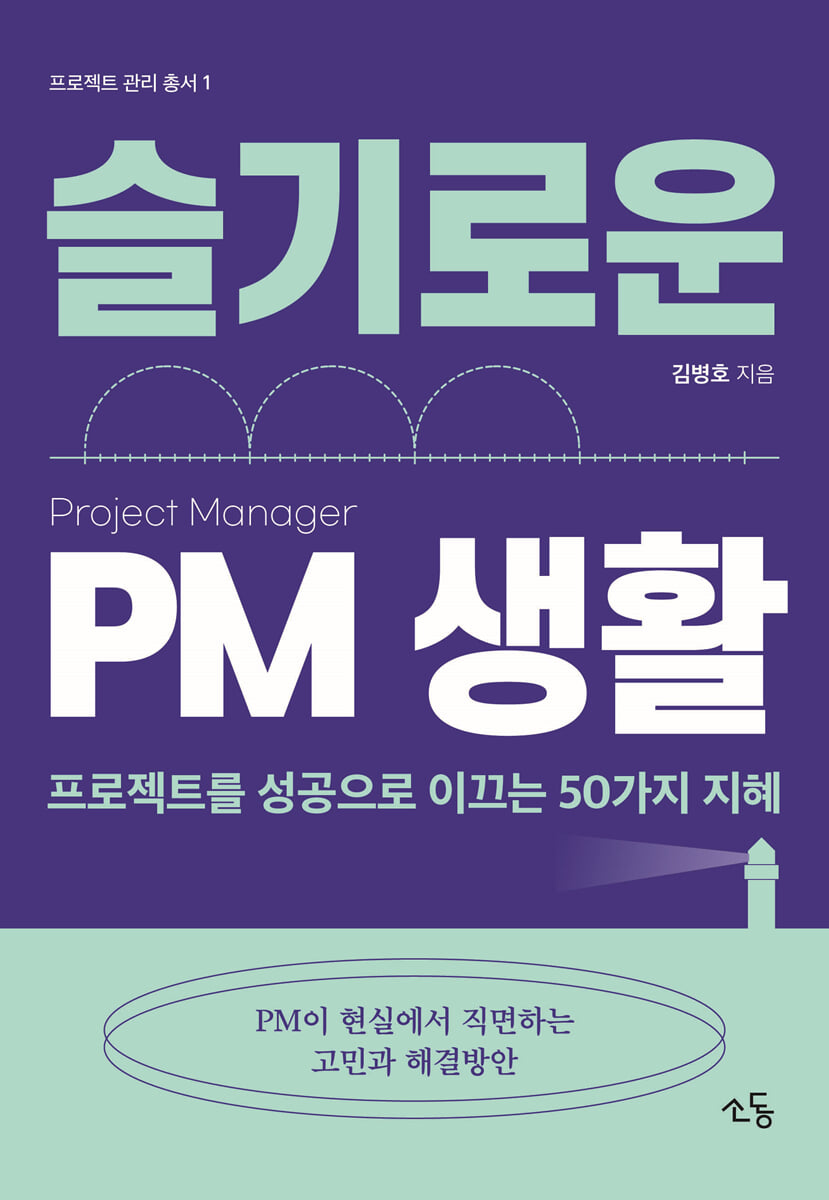
Smart PM Life
 |
Description
Book Introduction
The Secrets of a Wise PM, Drawing on 30 Years of Project Management Experience
Knowledge and wisdom are complementary.
Knowledge allows us to attain wisdom more quickly, and conversely, wisdom allows us to gain a deeper understanding and insight into knowledge.
Knowledge may be limited to mere learning, but wisdom goes beyond that and leads to practice.
Knowledge and wisdom are not separate, but rather they reinforce and develop each other.
Especially in practical fields such as project management, these two factors play an important role.
Most project management books currently on the market focus primarily on knowledge.
"The Wise PM Life" imparts essential "wisdom" in project management, along with knowledge, and offers practical guidance for dealing with various situations encountered in actual project management work.
The author wrote this book based on the experiences and lessons learned from working in various fields related to 'project management' at Samsung SDS for 30 years.
This book contains valuable insights gained through experience.
Knowledge and wisdom are complementary.
Knowledge allows us to attain wisdom more quickly, and conversely, wisdom allows us to gain a deeper understanding and insight into knowledge.
Knowledge may be limited to mere learning, but wisdom goes beyond that and leads to practice.
Knowledge and wisdom are not separate, but rather they reinforce and develop each other.
Especially in practical fields such as project management, these two factors play an important role.
Most project management books currently on the market focus primarily on knowledge.
"The Wise PM Life" imparts essential "wisdom" in project management, along with knowledge, and offers practical guidance for dealing with various situations encountered in actual project management work.
The author wrote this book based on the experiences and lessons learned from working in various fields related to 'project management' at Samsung SDS for 30 years.
This book contains valuable insights gained through experience.
index
Chapter 1: Good Projects, Bad Projects
1 Is your project real or fake?
2 How to avoid dirt spoon projects and participate in gold spoon projects?
3 How to survive a hellish project?
Chapter 2 Project Management to Reduce Waste
4 How do you distinguish between what to do efficiently and what to do effectively?
5 How to avoid the temptation to add features?
6 Is it a wise choice to increase the size of the project?
7 How to minimize waste caused by inefficient processes?
8 Is your project solving the right problem?
9 There is no wrong methodology in the world.
What should you consider when deciding on a methodology?
10 What problems arise when a development organization pursues high uptime?
11 What is the difference between a complex project and a complex project?
12 What are the hidden pitfalls of rapid development?
Chapter 3: Developing a Project Plan Considering Constraints
13 How do project goals and the means to achieve them interact?
14 What should we compromise on: scope, schedule, or budget?
15 How to reduce the gap between achievable and required schedules?
16 What are the results of an optimistic project plan?
Chapter 4 Managing Uncertainty in Estimates
17 What is the difference between an estimate and a promise?
18 How do I properly use project slack schedule?
19 Overestimation or Underestimation: Which is More Dangerous?
20 Did you plan well? Did you execute it well?
Chapter 5: Team Management to Increase Execution Power
21 What steps does project teamwork go through to complete it?
22 How do you define the responsibilities and roles of project team members?
23 What should project managers keep in mind when exercising leadership?
24 How can we apply Theory X (theory of human nature as evil) and Theory Y (theory of human nature as good) to project management?
25 What happens if you don't clearly define the criteria for task completion?
26 Can the 3-point rule of Go-Stop be applied to projects?
27 How to reduce the fear of running?
28 Why do projects need work routines?
29 What should you keep in mind to make the right decision?
Chapter 6: The Essentials of Requirements Management
30 How to define requirements priorities?
31 Why is it difficult to communicate requirements in documents?
32 Why are the requirements changing?
33 How to prevent requirements changes?
34 How to control changes in the requirements of symbiosis?
Chapter 7: Communication Skills to Encourage Stakeholder Cooperation
35 Why is managing key stakeholder requirements important?
36 How to increase the effectiveness of stakeholder persuasion?
37 How to communicate effectively every day?
38 What causes conflicts in projects and how do they resolve them?
39 How do you navigate a conversation that has a critical impact on a project?
Chapter 8 Project Risk Management in Practice
40 What factors cause uncertainty in project outcomes and how can they be managed?
41 What should you keep in mind when managing project risks?
42 What is an effective way to identify project risks?
43 What should you keep in mind when developing and reporting a risk response plan?
44 What should you keep in mind when selecting project performance indicators?
45 Why is it difficult to accurately determine the progress of a project?
46 Why are project schedules often delayed?
47 How to effectively respond to schedule delays?
48 How to recover a lost orbit issue project?
Chapter 9: Project Completion with Pre-Preparation
49 Why is it difficult to end a project?
What should I prepare to ensure a smooth project completion?
Acknowledgements
1 Is your project real or fake?
2 How to avoid dirt spoon projects and participate in gold spoon projects?
3 How to survive a hellish project?
Chapter 2 Project Management to Reduce Waste
4 How do you distinguish between what to do efficiently and what to do effectively?
5 How to avoid the temptation to add features?
6 Is it a wise choice to increase the size of the project?
7 How to minimize waste caused by inefficient processes?
8 Is your project solving the right problem?
9 There is no wrong methodology in the world.
What should you consider when deciding on a methodology?
10 What problems arise when a development organization pursues high uptime?
11 What is the difference between a complex project and a complex project?
12 What are the hidden pitfalls of rapid development?
Chapter 3: Developing a Project Plan Considering Constraints
13 How do project goals and the means to achieve them interact?
14 What should we compromise on: scope, schedule, or budget?
15 How to reduce the gap between achievable and required schedules?
16 What are the results of an optimistic project plan?
Chapter 4 Managing Uncertainty in Estimates
17 What is the difference between an estimate and a promise?
18 How do I properly use project slack schedule?
19 Overestimation or Underestimation: Which is More Dangerous?
20 Did you plan well? Did you execute it well?
Chapter 5: Team Management to Increase Execution Power
21 What steps does project teamwork go through to complete it?
22 How do you define the responsibilities and roles of project team members?
23 What should project managers keep in mind when exercising leadership?
24 How can we apply Theory X (theory of human nature as evil) and Theory Y (theory of human nature as good) to project management?
25 What happens if you don't clearly define the criteria for task completion?
26 Can the 3-point rule of Go-Stop be applied to projects?
27 How to reduce the fear of running?
28 Why do projects need work routines?
29 What should you keep in mind to make the right decision?
Chapter 6: The Essentials of Requirements Management
30 How to define requirements priorities?
31 Why is it difficult to communicate requirements in documents?
32 Why are the requirements changing?
33 How to prevent requirements changes?
34 How to control changes in the requirements of symbiosis?
Chapter 7: Communication Skills to Encourage Stakeholder Cooperation
35 Why is managing key stakeholder requirements important?
36 How to increase the effectiveness of stakeholder persuasion?
37 How to communicate effectively every day?
38 What causes conflicts in projects and how do they resolve them?
39 How do you navigate a conversation that has a critical impact on a project?
Chapter 8 Project Risk Management in Practice
40 What factors cause uncertainty in project outcomes and how can they be managed?
41 What should you keep in mind when managing project risks?
42 What is an effective way to identify project risks?
43 What should you keep in mind when developing and reporting a risk response plan?
44 What should you keep in mind when selecting project performance indicators?
45 Why is it difficult to accurately determine the progress of a project?
46 Why are project schedules often delayed?
47 How to effectively respond to schedule delays?
48 How to recover a lost orbit issue project?
Chapter 9: Project Completion with Pre-Preparation
49 Why is it difficult to end a project?
What should I prepare to ensure a smooth project completion?
Acknowledgements
Detailed image

Publisher's Review
50 Tips for Successful Projects
《Smart PM Life》 poses and answers 50 questions that lead to project success.
This book presents practical answers to the difficult situations that project managers often face in real life, such as when they are assigned to a hellish project, when they are under pressure to reduce the project budget and shorten the delivery time, when the constraints of scope, schedule, budget, and quality conflict with each other in planning, when there is a large gap between the schedule that must be achieved and the achievable schedule, when they want to create a project team with high productivity and execution power, when they have trouble negotiating with stakeholders about requirement changes, when the project is in trouble because they cannot convince stakeholders, when it is difficult to communicate with management about project risks, when the project goes off track and needs to be rewritten, and when inspection or handover for project closure is difficult. It provides specific examples.
Each question is organized independently, so readers can select and read only the parts they are interested in without any problems in understanding.
Project management skills applicable in practice
Because project management is a field of diverse and complex issues, even one question can be answered in multiple ways.
This book presents such diverse perspectives and helps readers think about their own 'right answer.'
Readers can gradually develop their project management skills by pondering the answers to each question and applying them to real-world situations.
The answers provided in "Smart PM Life" are not merely theoretical and abstract, but are useful guidelines for solving practical problems that can be encountered in the field.
This book addresses the complexities of project management from a variety of perspectives, including good projects, bad projects, managing projects to reduce waste, developing project plans that consider constraints, managing uncertainty in estimates, the core of requirements management, communication skills that elicit stakeholder cooperation, project risk management in practice, and preparing for project closure in advance.
It will be of great help in improving readers' project management capabilities by providing practical problem-solving methods that go beyond theory.
Additionally, it helps readers easily understand project management techniques applicable in real-world situations by presenting them in various tables, figures, and graphs.
This book will equip readers with the skills to apply wisdom in the complex field of project management.
Advantages of "Smart PM Life"
Experience-Based Insights: Drawing on the author's 30 years of project management experience, this book provides practical lessons and insights gleaned from the field.
The author offers readers useful solutions based on the difficulties he encountered in various project management situations.
Focused on practical problem solving: Rather than theoretical explanations, the course presents problem solving based on various situations that can be encountered in real-world project management.
Readers will gain practical guidance that can be applied directly to their work through specific examples and solutions.
Providing multiple perspectives: The book presents multiple solutions to each question, giving readers the opportunity to think and choose for themselves.
This helps readers find the best solution for their individual circumstances.
Independent Question Structure: Each chapter of the book is structured around 50 independent questions, allowing readers to select and read only the parts they need.
Suitable for readers who want to find quick solutions to specific problems.
Use visual aids: When explaining complex content, use tables, pictures, graphs, etc. to help readers understand easily.
Through this, theoretical content can also be practically explained.
Strengthening Project Management Capabilities: This book addresses the complex issues of project management from various perspectives, helping readers strengthen their management capabilities.
By presenting techniques and methods that can be applied in real-world situations, readers can improve their practical skills.
"Smart PM Life" provides practical problem-solving solutions that can be applied immediately in the field, greatly helping readers improve their project management skills.
Those who need "Smart PM Life"
Project Manager (PM) who manages projects in his current position
PMP candidates preparing for the Project Management Professional (PMP) certification
Project management professionals who perform other duties related to project management, such as quality management, risk management, and schedule management.
Executives and mid-level managers who understand the strategic importance of project management and want to link it to organizational performance.
General readers interested in project management who wish to build a foundational knowledge of project management.
"The Wise PM Life" focuses on solving practical problems, making it particularly useful for those with project management experience. It is also a must-read for those who wish to strengthen their practical skills through project management cases and experiences in various fields.
《Smart PM Life》 poses and answers 50 questions that lead to project success.
This book presents practical answers to the difficult situations that project managers often face in real life, such as when they are assigned to a hellish project, when they are under pressure to reduce the project budget and shorten the delivery time, when the constraints of scope, schedule, budget, and quality conflict with each other in planning, when there is a large gap between the schedule that must be achieved and the achievable schedule, when they want to create a project team with high productivity and execution power, when they have trouble negotiating with stakeholders about requirement changes, when the project is in trouble because they cannot convince stakeholders, when it is difficult to communicate with management about project risks, when the project goes off track and needs to be rewritten, and when inspection or handover for project closure is difficult. It provides specific examples.
Each question is organized independently, so readers can select and read only the parts they are interested in without any problems in understanding.
Project management skills applicable in practice
Because project management is a field of diverse and complex issues, even one question can be answered in multiple ways.
This book presents such diverse perspectives and helps readers think about their own 'right answer.'
Readers can gradually develop their project management skills by pondering the answers to each question and applying them to real-world situations.
The answers provided in "Smart PM Life" are not merely theoretical and abstract, but are useful guidelines for solving practical problems that can be encountered in the field.
This book addresses the complexities of project management from a variety of perspectives, including good projects, bad projects, managing projects to reduce waste, developing project plans that consider constraints, managing uncertainty in estimates, the core of requirements management, communication skills that elicit stakeholder cooperation, project risk management in practice, and preparing for project closure in advance.
It will be of great help in improving readers' project management capabilities by providing practical problem-solving methods that go beyond theory.
Additionally, it helps readers easily understand project management techniques applicable in real-world situations by presenting them in various tables, figures, and graphs.
This book will equip readers with the skills to apply wisdom in the complex field of project management.
Advantages of "Smart PM Life"
Experience-Based Insights: Drawing on the author's 30 years of project management experience, this book provides practical lessons and insights gleaned from the field.
The author offers readers useful solutions based on the difficulties he encountered in various project management situations.
Focused on practical problem solving: Rather than theoretical explanations, the course presents problem solving based on various situations that can be encountered in real-world project management.
Readers will gain practical guidance that can be applied directly to their work through specific examples and solutions.
Providing multiple perspectives: The book presents multiple solutions to each question, giving readers the opportunity to think and choose for themselves.
This helps readers find the best solution for their individual circumstances.
Independent Question Structure: Each chapter of the book is structured around 50 independent questions, allowing readers to select and read only the parts they need.
Suitable for readers who want to find quick solutions to specific problems.
Use visual aids: When explaining complex content, use tables, pictures, graphs, etc. to help readers understand easily.
Through this, theoretical content can also be practically explained.
Strengthening Project Management Capabilities: This book addresses the complex issues of project management from various perspectives, helping readers strengthen their management capabilities.
By presenting techniques and methods that can be applied in real-world situations, readers can improve their practical skills.
"Smart PM Life" provides practical problem-solving solutions that can be applied immediately in the field, greatly helping readers improve their project management skills.
Those who need "Smart PM Life"
Project Manager (PM) who manages projects in his current position
PMP candidates preparing for the Project Management Professional (PMP) certification
Project management professionals who perform other duties related to project management, such as quality management, risk management, and schedule management.
Executives and mid-level managers who understand the strategic importance of project management and want to link it to organizational performance.
General readers interested in project management who wish to build a foundational knowledge of project management.
"The Wise PM Life" focuses on solving practical problems, making it particularly useful for those with project management experience. It is also a must-read for those who wish to strengthen their practical skills through project management cases and experiences in various fields.
GOODS SPECIFICS
- Date of issue: January 17, 2025
- Page count, weight, size: 432 pages | 152*220*30mm
- ISBN13: 9791193193167
- ISBN10: 1193193168
You may also like
카테고리
korean


korean

![GQ KOREA Mark (Monthly): December [2025]](http://librairie.coreenne.fr/cdn/shop/files/8ef265dbbfbf186523ed75ba7319009d.jpg?v=1765340328&width=3840)


