

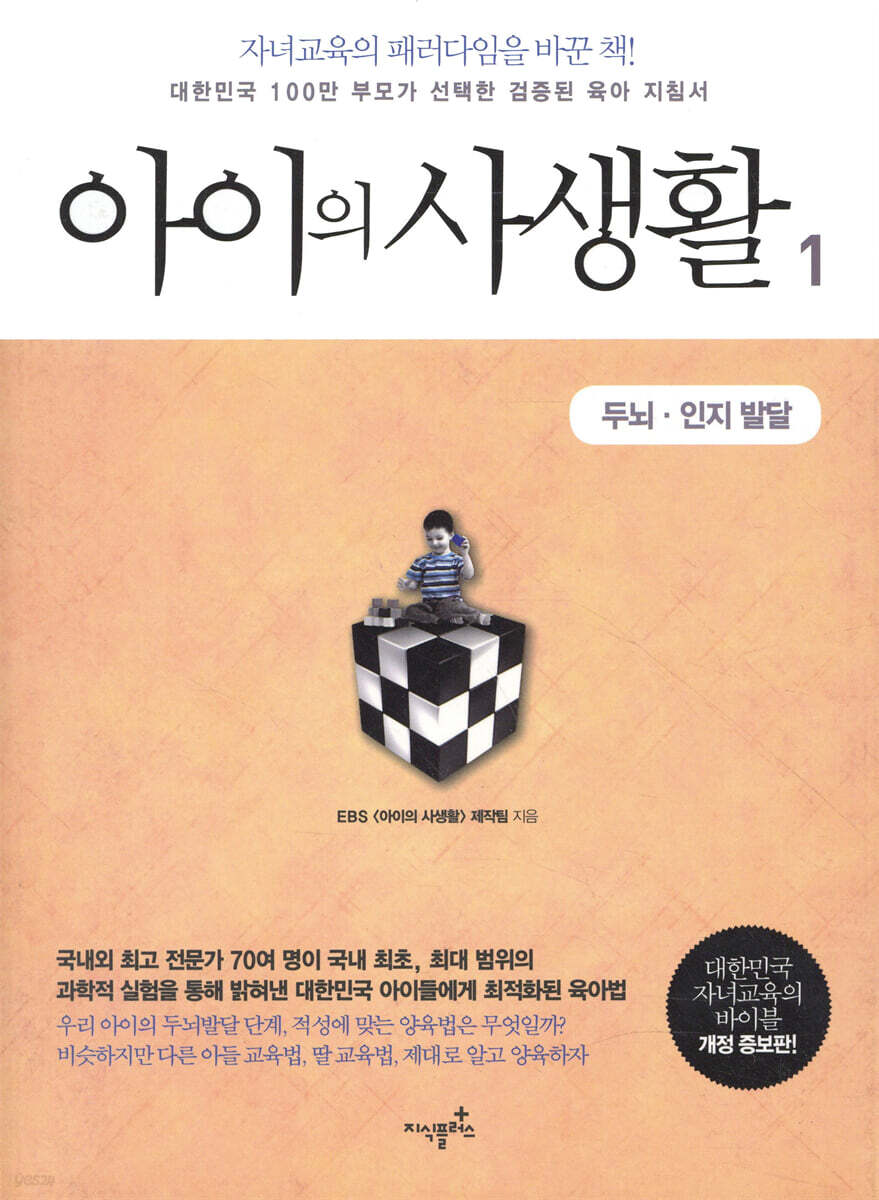
Child's Private Life 1
 |
Description
Book Introduction
Understand my child correctly
A must-read for proper parenting!
The Revised and Expanded Edition of "A Child's Private Life," Which Changed the Paradigm of Child Education in Korea
-You have to know the 'brain' to see your child!
-What parenting method is appropriate for my child's brain development stage and aptitude?
-Suggesting parenting methods suitable for each son and daughter, who are similar but different.
The revised edition of "Children's Private Lives," which brought a revolutionary wind of change to children's education in Korea, has been published.
The documentary [A Child's Private Life], which aired on EBS in 2008 and caused a sensation, not only received enthusiastic support from viewers but also swept various awards and was praised for opening up new horizons for documentaries.
In an age where we are bombarded with fragmented advice and guidelines on parenting in our daily lives and through the media, this book offers a completely different approach and a vivid portrayal of the realities of children.
Based on this comprehensive and scientific documentary about children, "The Private Life of Children" was published, and the book has consistently received rave reviews from parents, teachers, and education experts, solidifying its position as a bestseller for seven years.
In particular, Volume 1, ‘Brain Cognitive Development’, added new content to existing books to enrich the information.
We introduce the stages through which a child's brain develops, the reasons why sons and daughters are different, and parenting methods that bring out each child's unique characteristics in a uniform educational environment, as well as ways to pay attention to your child's brain tendencies and customized educational methods.
Also, based on the theory of multiple intelligences, it teaches you how to find your child's unique strengths and weaknesses, and introduces know-how to develop your child's strengths and lay the foundation for success.
With the advent of the 'artificial intelligence era', there is a lot of talk about children's education.
The realization that the day is not far off when artificial intelligence will catch up with human learning, reasoning, perception, and language abilities is enough to instill anxiety about the future.
However, there are clearly areas of human functioning that cannot be replaced by artificial intelligence, and the secret still lies in the 'brain'.
This is precisely why we need to understand our children's brain development and think more deeply about their aptitude.
Through this book, you will not only learn in depth about the human development process, but also learn what and how to do to help your child fully realize his or her infinite potential and design a more successful and happy life.
This is a principle of happiness and success that remains unchanged even in the age of artificial intelligence.
This book, which encompasses analysis across philosophy, psychology, education, sociology, and science, and delivers a richer emotional impact, not only provides insight into my child and humanity, but also provides solid guidance on "how to raise my child" while preparing for the future.
A must-read for proper parenting!
The Revised and Expanded Edition of "A Child's Private Life," Which Changed the Paradigm of Child Education in Korea
-You have to know the 'brain' to see your child!
-What parenting method is appropriate for my child's brain development stage and aptitude?
-Suggesting parenting methods suitable for each son and daughter, who are similar but different.
The revised edition of "Children's Private Lives," which brought a revolutionary wind of change to children's education in Korea, has been published.
The documentary [A Child's Private Life], which aired on EBS in 2008 and caused a sensation, not only received enthusiastic support from viewers but also swept various awards and was praised for opening up new horizons for documentaries.
In an age where we are bombarded with fragmented advice and guidelines on parenting in our daily lives and through the media, this book offers a completely different approach and a vivid portrayal of the realities of children.
Based on this comprehensive and scientific documentary about children, "The Private Life of Children" was published, and the book has consistently received rave reviews from parents, teachers, and education experts, solidifying its position as a bestseller for seven years.
In particular, Volume 1, ‘Brain Cognitive Development’, added new content to existing books to enrich the information.
We introduce the stages through which a child's brain develops, the reasons why sons and daughters are different, and parenting methods that bring out each child's unique characteristics in a uniform educational environment, as well as ways to pay attention to your child's brain tendencies and customized educational methods.
Also, based on the theory of multiple intelligences, it teaches you how to find your child's unique strengths and weaknesses, and introduces know-how to develop your child's strengths and lay the foundation for success.
With the advent of the 'artificial intelligence era', there is a lot of talk about children's education.
The realization that the day is not far off when artificial intelligence will catch up with human learning, reasoning, perception, and language abilities is enough to instill anxiety about the future.
However, there are clearly areas of human functioning that cannot be replaced by artificial intelligence, and the secret still lies in the 'brain'.
This is precisely why we need to understand our children's brain development and think more deeply about their aptitude.
Through this book, you will not only learn in depth about the human development process, but also learn what and how to do to help your child fully realize his or her infinite potential and design a more successful and happy life.
This is a principle of happiness and success that remains unchanged even in the age of artificial intelligence.
This book, which encompasses analysis across philosophy, psychology, education, sociology, and science, and delivers a richer emotional impact, not only provides insight into my child and humanity, but also provides solid guidance on "how to raise my child" while preparing for the future.
- You can preview some of the book's contents.
Preview
index
Prologue: A Stepping Stone Leading Children to Happiness
PART 1 Men and Women: Their Differences
The difference between you and me is the difference in brain.
What are humans made of?
The one and only precious child in the world
What happens in a child's brain?
The special process by which my child's brain grows
0 years old, the skin is the second brain
1-2 years old, development of motor skills
Ages 3-6, ability to think for oneself
Ages 7-12: Diverse experiences and learning are important.
Puberty: Preparing the Adult Brain
Bonus Page 1 The Structure and Amazing Performance of the Brain
Bonus Page 2 Brain Development Chart by Age at a Glance
Pink Princess and the Superhero
Are the differences between men and women learned or innate?
When does a child begin to recognize their gender?
A woman who remembers faces and locations well
A man who excels in mental rotation and understanding the characteristics of objects.
Male brain vs.
woman's brain
Son's brain, daughter's brain
Why Women Win Arguments
Is parking ability a man's privilege?
A woman who can multitask, a man who can focus on just one thing
A daughter who sympathizes with her mother's pain, a son who is indifferent
Men's systematizing brain, women's empathetic brain
Scientific facts at your fingertips
The relationship between finger length and sex hormones
Men and women, there are exceptions
17 percent secret
Respect my child as he is
Sons and daughters should be raised differently.
Differences between men and women in art class
Boys and girls need different educations.
Why is my son so susceptible to the temptation of games?
Why ADHD is More Prevalent in Boys
Son, wait patiently
A daughter who opens her heart only when her emotions are connected
Daughter, raise her to be a confident leader.
Bonus Page 3: Sons and Daughters: The Best Learning Methods Are Different
PART 2 Multiple Intelligences, Finding Your Own Profile
Infinite possibilities, the child's brain
The brain focuses on specific things
The brain remembers sounds well
The brain loves stories
The brain stores things that feel good
The brain is ready to evolve
Focus on multiple intelligences
Secrets of Successful People
Limitations of IQ tests
The discovery of multiple intelligences: hidden areas of intelligence in the brain
Gardner's theory of multiple intelligences
Make your strengths even more special
Servant Syndrome: Proving Multiple Intelligences
Compensate for your weaknesses with your strengths.
The common denominator among successful people: self-understanding intelligence.
Schools that have adopted the theory of multiple intelligences
How to discover your child's talents and happiness
Why should we find our strengths?
Capture curiosity and build self-esteem
Neither coercion nor abandonment is allowed; children must create their own motivation.
Observe interests and concretize dreams according to developmental stage.
Even geniuses can't beat those who enjoy it.
You can't change your genes, but you can change your environment.
Use your strengths to compensate for your weaknesses.
Existential intelligence and other infinite possibilities
Bonus Page 4 Discovering Your Child's Strengths
Bonus Page 5 Developing Your Child's Strengths
Epilogue: Education is the ignition of thought.
Search
Why is that?
1.
Boys need to eat breakfast to keep their brains sharp.
2.
Girls need rough exercise too
3.
Boys are attracted to violence.
4.
Sons and daughters, even if they are the same age, should be disciplined differently.
5.
Most boys don't do their homework well.
6.
Walking a lot makes you smarter
7.
Museum education broadens children's interests.
8.
The discovery of multiple intelligences occurs at different times for each child.
9.
Child observation diaries replace intelligence profiles.
PART 1 Men and Women: Their Differences
The difference between you and me is the difference in brain.
What are humans made of?
The one and only precious child in the world
What happens in a child's brain?
The special process by which my child's brain grows
0 years old, the skin is the second brain
1-2 years old, development of motor skills
Ages 3-6, ability to think for oneself
Ages 7-12: Diverse experiences and learning are important.
Puberty: Preparing the Adult Brain
Bonus Page 1 The Structure and Amazing Performance of the Brain
Bonus Page 2 Brain Development Chart by Age at a Glance
Pink Princess and the Superhero
Are the differences between men and women learned or innate?
When does a child begin to recognize their gender?
A woman who remembers faces and locations well
A man who excels in mental rotation and understanding the characteristics of objects.
Male brain vs.
woman's brain
Son's brain, daughter's brain
Why Women Win Arguments
Is parking ability a man's privilege?
A woman who can multitask, a man who can focus on just one thing
A daughter who sympathizes with her mother's pain, a son who is indifferent
Men's systematizing brain, women's empathetic brain
Scientific facts at your fingertips
The relationship between finger length and sex hormones
Men and women, there are exceptions
17 percent secret
Respect my child as he is
Sons and daughters should be raised differently.
Differences between men and women in art class
Boys and girls need different educations.
Why is my son so susceptible to the temptation of games?
Why ADHD is More Prevalent in Boys
Son, wait patiently
A daughter who opens her heart only when her emotions are connected
Daughter, raise her to be a confident leader.
Bonus Page 3: Sons and Daughters: The Best Learning Methods Are Different
PART 2 Multiple Intelligences, Finding Your Own Profile
Infinite possibilities, the child's brain
The brain focuses on specific things
The brain remembers sounds well
The brain loves stories
The brain stores things that feel good
The brain is ready to evolve
Focus on multiple intelligences
Secrets of Successful People
Limitations of IQ tests
The discovery of multiple intelligences: hidden areas of intelligence in the brain
Gardner's theory of multiple intelligences
Make your strengths even more special
Servant Syndrome: Proving Multiple Intelligences
Compensate for your weaknesses with your strengths.
The common denominator among successful people: self-understanding intelligence.
Schools that have adopted the theory of multiple intelligences
How to discover your child's talents and happiness
Why should we find our strengths?
Capture curiosity and build self-esteem
Neither coercion nor abandonment is allowed; children must create their own motivation.
Observe interests and concretize dreams according to developmental stage.
Even geniuses can't beat those who enjoy it.
You can't change your genes, but you can change your environment.
Use your strengths to compensate for your weaknesses.
Existential intelligence and other infinite possibilities
Bonus Page 4 Discovering Your Child's Strengths
Bonus Page 5 Developing Your Child's Strengths
Epilogue: Education is the ignition of thought.
Search
Why is that?
1.
Boys need to eat breakfast to keep their brains sharp.
2.
Girls need rough exercise too
3.
Boys are attracted to violence.
4.
Sons and daughters, even if they are the same age, should be disciplined differently.
5.
Most boys don't do their homework well.
6.
Walking a lot makes you smarter
7.
Museum education broadens children's interests.
8.
The discovery of multiple intelligences occurs at different times for each child.
9.
Child observation diaries replace intelligence profiles.
Into the book
We were born as wonderful beings called humans.
But among the 7.1 billion people in the world, there is no one exactly like me.
Although all the newborns lying in the nursery look similar, they are all completely different beings.
A child may resemble his father or his mother.
You may hate vegetables or you may love them.
As they grow older, they may become so averse to reading that they cause their mothers trouble, but they may also enjoy drawing every day without being asked to do so.
My child looks similar to his peers, but is so different.
How does a child become a unique being in the world? How exactly does the formula "one-of-a-kind" come to be? --- p.19
But more than anything, what makes us unique and different from anyone else in the world is our brain.
My brain is one of a kind in the world.
It's different from anyone else's brain.
So there is no one like me in the world.
We can have the same opinions as others, but we cannot have the same thoughts without even a single letter of difference.
You may feel similarly, but you cannot feel the exact same emotion as if you copied it.
You can empathize with someone, but you can't feel completely like them.
That's the difference between you and me.
This difference is not something that someone taught me, but rather something that is caused by my brain, which has been continuously changing since birth.
We are born with differences.
And as we grow up, we meet different people, visit different places, see different things, and learn different things.
All of these experiences we have as we live affect our brain.
How is my child's brain being affected right now? --- p.22-23
At the age of 6 or 7, when awareness of sexuality becomes clear, the brain is the entity that issues commands regarding self-awareness.
Although the brains of men and women are different from the beginning, during this period, the characteristics of the male brain and female brain become stronger.
And in response to these brain changes, boys tend to behave more masculinely, and girls tend to behave more femininely.
The reason why men and women behave differently is because of differences in their brains.
--- p.66
It is thought that the reason girls can use both sides of their brains differently than boys is because the corpus callosum in girls is about 10 percent thicker and wider than in boys.
Because the corpus callosum is wide, the connection between the left and right brain can be close and efficient.
On the other hand, because the corpus callosum of a boy's brain is smaller than that of a girl's, communication between the left and right brain is not smooth.
However, since the emotional brain is in the right brain and the language brain is in the left brain, boys have difficulty expressing their emotions in words.
According to a research team at the University of North Carolina, women's brains use both sides of the brain when understanding spelling.
In contrast, it is said that men's brains mainly use the left brain in this case as well.
Additionally, girls have 11 percent more neurons in the temporal lobe, which controls listening, memory, and speaking, than boys, which also contributes to their superior language skills.
--- p.84
Human intelligence develops in various ways due to social and cultural stimuli.
The same goes for strengths and weaknesses.
If we nurture a child's strengths and reinforce their weaknesses, their brain will develop more balancedly, and based on that, they will be able to produce diverse social and cultural outcomes.
The key to developing a child's weak intelligence by utilizing his or her strong intelligence is the perceptual channel.
However, just as our strengths and intelligences differ, our perceptual channels also differ from person to person.
The intensity of sensitivity to stimuli varies depending on which of the visual, auditory, tactile, kinesthetic, olfactory, and gustatory perceptual channels is developed, and this also serves as another criterion for distinguishing between those who are good at something and those who are not.
What is important to note here is that the abilities of the perceptual channel and the areas in which strengths are shown in multiple intelligences are interrelated.
People with high spatial intelligence have high visual sensitivity, and people with strong verbal intelligence are good at receptive to auditory stimuli.
People with high bodily-kinesthetic intelligence learn external stimuli through their physical senses.
--- p.209
The days of churning out talented people like fish-shaped bread in the same mold are over.
Society now wants people who can produce unique results in each field.
To meet this demand, you must find an area that you enjoy and are passionate about and dedicate yourself to.
There is bound to be a difference between someone who discovered and developed their own strengths early on and someone who grew up under a uniform educational framework.
In an age where creativity, originality, and individuality are the buzzwords, that difference will determine our children's future.
But among the 7.1 billion people in the world, there is no one exactly like me.
Although all the newborns lying in the nursery look similar, they are all completely different beings.
A child may resemble his father or his mother.
You may hate vegetables or you may love them.
As they grow older, they may become so averse to reading that they cause their mothers trouble, but they may also enjoy drawing every day without being asked to do so.
My child looks similar to his peers, but is so different.
How does a child become a unique being in the world? How exactly does the formula "one-of-a-kind" come to be? --- p.19
But more than anything, what makes us unique and different from anyone else in the world is our brain.
My brain is one of a kind in the world.
It's different from anyone else's brain.
So there is no one like me in the world.
We can have the same opinions as others, but we cannot have the same thoughts without even a single letter of difference.
You may feel similarly, but you cannot feel the exact same emotion as if you copied it.
You can empathize with someone, but you can't feel completely like them.
That's the difference between you and me.
This difference is not something that someone taught me, but rather something that is caused by my brain, which has been continuously changing since birth.
We are born with differences.
And as we grow up, we meet different people, visit different places, see different things, and learn different things.
All of these experiences we have as we live affect our brain.
How is my child's brain being affected right now? --- p.22-23
At the age of 6 or 7, when awareness of sexuality becomes clear, the brain is the entity that issues commands regarding self-awareness.
Although the brains of men and women are different from the beginning, during this period, the characteristics of the male brain and female brain become stronger.
And in response to these brain changes, boys tend to behave more masculinely, and girls tend to behave more femininely.
The reason why men and women behave differently is because of differences in their brains.
--- p.66
It is thought that the reason girls can use both sides of their brains differently than boys is because the corpus callosum in girls is about 10 percent thicker and wider than in boys.
Because the corpus callosum is wide, the connection between the left and right brain can be close and efficient.
On the other hand, because the corpus callosum of a boy's brain is smaller than that of a girl's, communication between the left and right brain is not smooth.
However, since the emotional brain is in the right brain and the language brain is in the left brain, boys have difficulty expressing their emotions in words.
According to a research team at the University of North Carolina, women's brains use both sides of the brain when understanding spelling.
In contrast, it is said that men's brains mainly use the left brain in this case as well.
Additionally, girls have 11 percent more neurons in the temporal lobe, which controls listening, memory, and speaking, than boys, which also contributes to their superior language skills.
--- p.84
Human intelligence develops in various ways due to social and cultural stimuli.
The same goes for strengths and weaknesses.
If we nurture a child's strengths and reinforce their weaknesses, their brain will develop more balancedly, and based on that, they will be able to produce diverse social and cultural outcomes.
The key to developing a child's weak intelligence by utilizing his or her strong intelligence is the perceptual channel.
However, just as our strengths and intelligences differ, our perceptual channels also differ from person to person.
The intensity of sensitivity to stimuli varies depending on which of the visual, auditory, tactile, kinesthetic, olfactory, and gustatory perceptual channels is developed, and this also serves as another criterion for distinguishing between those who are good at something and those who are not.
What is important to note here is that the abilities of the perceptual channel and the areas in which strengths are shown in multiple intelligences are interrelated.
People with high spatial intelligence have high visual sensitivity, and people with strong verbal intelligence are good at receptive to auditory stimuli.
People with high bodily-kinesthetic intelligence learn external stimuli through their physical senses.
--- p.209
The days of churning out talented people like fish-shaped bread in the same mold are over.
Society now wants people who can produce unique results in each field.
To meet this demand, you must find an area that you enjoy and are passionate about and dedicate yourself to.
There is bound to be a difference between someone who discovered and developed their own strengths early on and someone who grew up under a uniform educational framework.
In an age where creativity, originality, and individuality are the buzzwords, that difference will determine our children's future.
--- p.243
Publisher's Review
Discovered through the first and largest scientific experiment in Korea
The optimal parenting method for Korean children
The book's greatest strength is its perfect balance of theory and practice.
We extracted scientific data through a long and painstaking process, including a one-year reporting period, surveys of approximately 4,200 people, and experiments with 500 children. We also received advice from approximately 70 leading domestic and international experts, including Howard Gardner, John Manning, Leonard Sachs, and professors at Seoul National University, to enhance its reliability.
The specific experimental scenes and results are enough to reveal the child's true nature, which was previously only vaguely known, and the experts' latest theories help me systematically understand my child.
Moreover, it is noteworthy that the most suitable parenting method for our circumstances was derived from an experiment conducted on children in our country, not from foreign cases.
For example, everyone knows that men and women are different, but no one has ever said that they should be raised differently.
Of course, we must help each gender fully develop their abilities, and it would be unreasonable if they were unable to fully develop their inclinations and talents because of their gender. However, we must not raise and educate different genders from an overly uniform perspective.
The book thoroughly introduces how the sexes differ, what the differences in developmental processes are, what their strengths and weaknesses are, and what methods should be used to properly raise them.
Boys are more active than girls, and also have the characteristic of being unable to hear other sounds when they focus on one thing.
That's why, when raising a boy, you need to make direct eye contact and talk to him.
Also, girls develop fine motor skills, thinking, and language first, while boys develop gross motor skills and behavior first.
Therefore, it would be overly cautious to worry that a five-year-old boy is too late in learning to read and write.
Boys should wait until this area is more developed.
These scientific experimental results and practical guidelines provide clear answers on how to raise my child.
Everything you never knew about your child will be revealed in detail.
The reason parenting and education are difficult is because we don't know our children well.
Many parents say things like, "I don't know why my child is so distracted," "I worry that there's something wrong because he keeps making the same mistakes no matter how many times I tell him," or "Other kids are good at everything, but I don't know why my child is so slow at everything." In fact, these are worries and complaints that stem from a lack of understanding of their children.
Even though I gave birth to my own child, understanding a child is not an easy task.
However, if you understand the proper developmental process and understand your child's individual characteristics, you can understand with a more generous heart why they say and act in certain ways, and you can also find hints on how to help your child grow properly.
A poor understanding is the same as a misunderstanding.
Books will help you overcome misunderstandings and truly understand your child, and this understanding will provide an opportunity to love your child more deeply.
Raising a child with limitless potential, knowing them well
"A Child's Private Life 1" reveals my child's secrets one by one, focusing especially on brain development and cognitive development.
You can learn through specific research results how your child acquires information, internalizes it, and develops it into talent or intelligence.
The book focuses on the ability to discover one's own special talents rather than the intelligence to understand mathematical formulas or English words, and on understanding the true power that leads to happiness and success.
It presents in detail, through scientific storytelling, what children really want and desire to do, what they are good at and bad at, and what aspects of boys and girls are different.
In Chapter 1, 'Men and Women, Their Differences,' we take a detailed look at the developmental processes and differences between men and women, which everyone has known about but have easily overlooked, and suggest how we can further highlight the strengths of both genders and how we can grow into more harmonious human beings.
Additionally, in Chapter 2, Multiple Intelligences, Finding Your Own Profile, we present a method to identify your child's strengths based on the theory of multiple intelligences.
Every child has infinite potential, and depending on the environment provided, that potential can either be realized with abundant success or simply disappear.
You will learn how to help your child succeed and be happy.
This is a must-read for parents who want to help their children's intelligence and talents blossom.
Specific parenting guidelines to help you get closer to your child
We've also included some specific tips that parents might be curious about.
It explains in an easy-to-understand way, with specific examples, how breakfast affects brain development, what kind of exercise is good for boys and girls, what kind of discipline should be given at each age, and when a child's multiple intelligences are discovered. Bonus pages include 'Brain Development Chart by Age', 'The Best Study Method for Sons and Daughters', and 'How to Discover and Develop Strengths'.
This provides practical help so that each reader can personally diagnose their own and their child's personality type and develop a parenting attitude accordingly.
The optimal parenting method for Korean children
The book's greatest strength is its perfect balance of theory and practice.
We extracted scientific data through a long and painstaking process, including a one-year reporting period, surveys of approximately 4,200 people, and experiments with 500 children. We also received advice from approximately 70 leading domestic and international experts, including Howard Gardner, John Manning, Leonard Sachs, and professors at Seoul National University, to enhance its reliability.
The specific experimental scenes and results are enough to reveal the child's true nature, which was previously only vaguely known, and the experts' latest theories help me systematically understand my child.
Moreover, it is noteworthy that the most suitable parenting method for our circumstances was derived from an experiment conducted on children in our country, not from foreign cases.
For example, everyone knows that men and women are different, but no one has ever said that they should be raised differently.
Of course, we must help each gender fully develop their abilities, and it would be unreasonable if they were unable to fully develop their inclinations and talents because of their gender. However, we must not raise and educate different genders from an overly uniform perspective.
The book thoroughly introduces how the sexes differ, what the differences in developmental processes are, what their strengths and weaknesses are, and what methods should be used to properly raise them.
Boys are more active than girls, and also have the characteristic of being unable to hear other sounds when they focus on one thing.
That's why, when raising a boy, you need to make direct eye contact and talk to him.
Also, girls develop fine motor skills, thinking, and language first, while boys develop gross motor skills and behavior first.
Therefore, it would be overly cautious to worry that a five-year-old boy is too late in learning to read and write.
Boys should wait until this area is more developed.
These scientific experimental results and practical guidelines provide clear answers on how to raise my child.
Everything you never knew about your child will be revealed in detail.
The reason parenting and education are difficult is because we don't know our children well.
Many parents say things like, "I don't know why my child is so distracted," "I worry that there's something wrong because he keeps making the same mistakes no matter how many times I tell him," or "Other kids are good at everything, but I don't know why my child is so slow at everything." In fact, these are worries and complaints that stem from a lack of understanding of their children.
Even though I gave birth to my own child, understanding a child is not an easy task.
However, if you understand the proper developmental process and understand your child's individual characteristics, you can understand with a more generous heart why they say and act in certain ways, and you can also find hints on how to help your child grow properly.
A poor understanding is the same as a misunderstanding.
Books will help you overcome misunderstandings and truly understand your child, and this understanding will provide an opportunity to love your child more deeply.
Raising a child with limitless potential, knowing them well
"A Child's Private Life 1" reveals my child's secrets one by one, focusing especially on brain development and cognitive development.
You can learn through specific research results how your child acquires information, internalizes it, and develops it into talent or intelligence.
The book focuses on the ability to discover one's own special talents rather than the intelligence to understand mathematical formulas or English words, and on understanding the true power that leads to happiness and success.
It presents in detail, through scientific storytelling, what children really want and desire to do, what they are good at and bad at, and what aspects of boys and girls are different.
In Chapter 1, 'Men and Women, Their Differences,' we take a detailed look at the developmental processes and differences between men and women, which everyone has known about but have easily overlooked, and suggest how we can further highlight the strengths of both genders and how we can grow into more harmonious human beings.
Additionally, in Chapter 2, Multiple Intelligences, Finding Your Own Profile, we present a method to identify your child's strengths based on the theory of multiple intelligences.
Every child has infinite potential, and depending on the environment provided, that potential can either be realized with abundant success or simply disappear.
You will learn how to help your child succeed and be happy.
This is a must-read for parents who want to help their children's intelligence and talents blossom.
Specific parenting guidelines to help you get closer to your child
We've also included some specific tips that parents might be curious about.
It explains in an easy-to-understand way, with specific examples, how breakfast affects brain development, what kind of exercise is good for boys and girls, what kind of discipline should be given at each age, and when a child's multiple intelligences are discovered. Bonus pages include 'Brain Development Chart by Age', 'The Best Study Method for Sons and Daughters', and 'How to Discover and Develop Strengths'.
This provides practical help so that each reader can personally diagnose their own and their child's personality type and develop a parenting attitude accordingly.
GOODS SPECIFICS
- Date of issue: July 20, 2016
- Page count, weight, size: 288 pages | 487g | 165*225*16mm
- ISBN13: 9791158590963
- ISBN10: 1158590962
You may also like
카테고리
korean


korean

![GQ KOREA Mark (Monthly): December [2025]](http://librairie.coreenne.fr/cdn/shop/files/8ef265dbbfbf186523ed75ba7319009d.jpg?v=1765340328&width=3840)


