

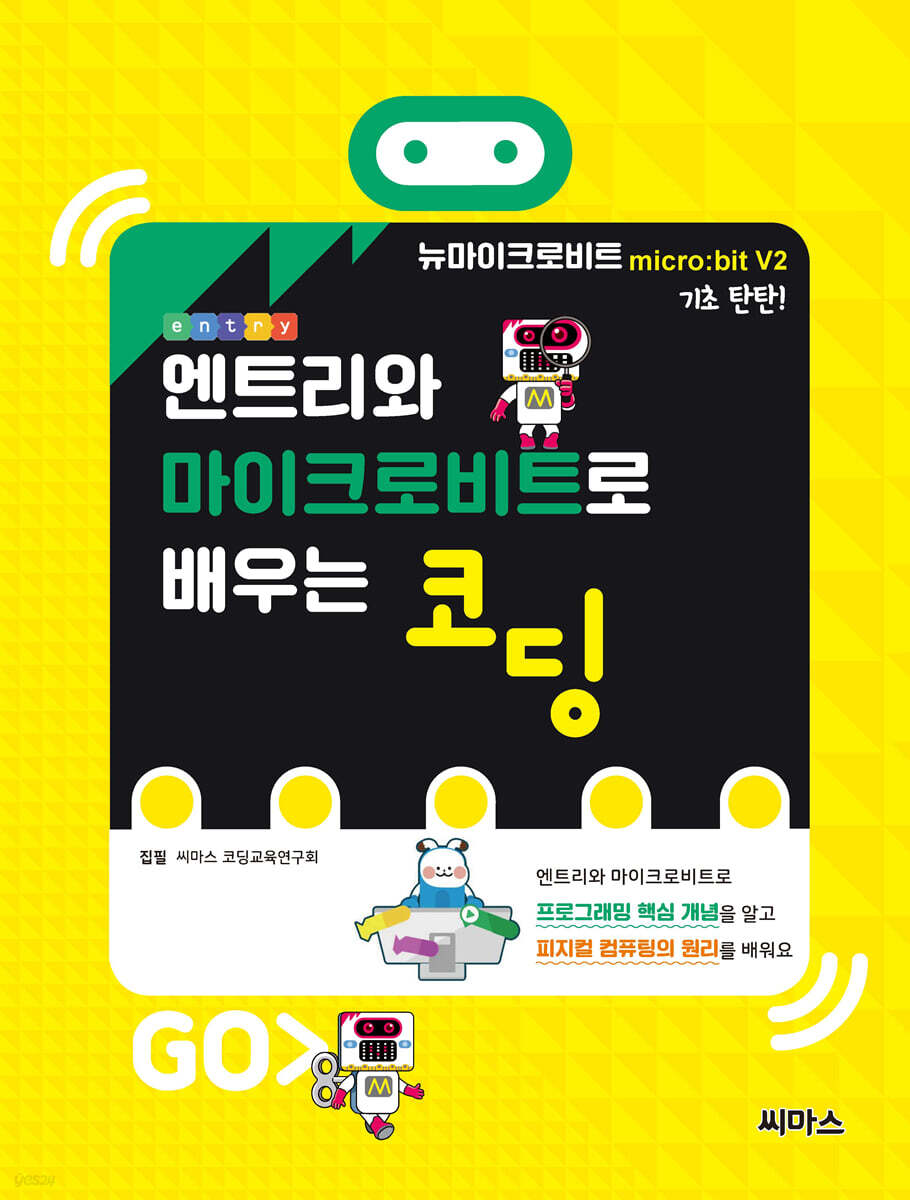
Learning to code with Entry and Micro:bit
 |
Description
Book Introduction
Learn programming through physical computing principles.
This book was written by teachers from the Seemas Coding Education Research Group, which is comprised of teachers who teach computer classes and after-school classes in elementary, middle, and high schools.
It is systematically organized according to the input, processing, and output processes of programming.
It is structured so that you can clearly understand how to solve the problem.
It is structured to lay a solid foundation by presenting topics at a level that is suitable for students.
It is designed to allow students to study programming by solving various tasks using the Micro:bit V2.
The aim was to provide a foundation for creative maker activities through making activities using the design in the appendix.
By experiencing hand recognition AI and facial recognition AI programs, we were able to develop creative thinking by incorporating them into physical computing.
Activities to improve the program or add device-specific features are presented so that it can be used as a supplementary or in-depth activity.
This book was written by teachers from the Seemas Coding Education Research Group, which is comprised of teachers who teach computer classes and after-school classes in elementary, middle, and high schools.
It is systematically organized according to the input, processing, and output processes of programming.
It is structured so that you can clearly understand how to solve the problem.
It is structured to lay a solid foundation by presenting topics at a level that is suitable for students.
It is designed to allow students to study programming by solving various tasks using the Micro:bit V2.
The aim was to provide a foundation for creative maker activities through making activities using the design in the appendix.
By experiencing hand recognition AI and facial recognition AI programs, we were able to develop creative thinking by incorporating them into physical computing.
Activities to improve the program or add device-specific features are presented so that it can be used as a supplementary or in-depth activity.
- You can preview some of the book's contents.
Preview
index
Activity 1: Turn on the light bulb!
Activity 2 I love my family!
Activity 3: Blow up the log cabin!
Activity 4 This is a book I made!
Activity 5: Move around in space!
Activity 6: Save the Earth!
Activity 7 Light up the stage!
Activity 8 I'll invite you to the magic school!
Activity 9: Save the Little Match Girl!
Activity 10 Will spring come to the Frozen Kingdom?
Activity 11 Come here, fish!
Activity 12 I need a rope!
Activity 13 Where is North?
Activity 14 Spin the roulette!
Activity 15 Meow, find the ball!
Activity 16: Is the teddy bear gathering honey?
Activity 17 Calculate the cost of food!
Activity 18 Happy birthday, friend!
Activity 19: Collect the sounds!
Activity 20 Oh my goodness!
Activity 21: Left hand or right hand?
Activity 22 Show me your face!
Activity 23 Fly, Eagle!
Activity 24 Earth Village Friends
Appendix Creation Pattern
Activity 2 I love my family!
Activity 3: Blow up the log cabin!
Activity 4 This is a book I made!
Activity 5: Move around in space!
Activity 6: Save the Earth!
Activity 7 Light up the stage!
Activity 8 I'll invite you to the magic school!
Activity 9: Save the Little Match Girl!
Activity 10 Will spring come to the Frozen Kingdom?
Activity 11 Come here, fish!
Activity 12 I need a rope!
Activity 13 Where is North?
Activity 14 Spin the roulette!
Activity 15 Meow, find the ball!
Activity 16: Is the teddy bear gathering honey?
Activity 17 Calculate the cost of food!
Activity 18 Happy birthday, friend!
Activity 19: Collect the sounds!
Activity 20 Oh my goodness!
Activity 21: Left hand or right hand?
Activity 22 Show me your face!
Activity 23 Fly, Eagle!
Activity 24 Earth Village Friends
Appendix Creation Pattern
Detailed image

Publisher's Review
Learn programming through physical computing principles.
ㆍ Systematically according to the input, processing, and output processes of programming
It has been configured.
ㆍ So that you can clearly understand how to solve the problem
It has been configured.
A total of 24 thematic activities are conducted for each of the entry program's core elements and physical devices.
ㆍBuilding a solid foundation by presenting topics at the students' eye level
It is structured so that it can be easily crushed.
ㆍ It is designed to allow you to study programming by solving various tasks using Micro:bit V2.
We offer fun craft classes using materials appropriate for each activity.
ㆍ We aimed to provide a foundation for creative maker activities through making activities using the design in the appendix.
Let's develop AI skills together.
ㆍ By experiencing hand recognition AI and facial recognition AI programs, we were able to develop creative thinking by incorporating them into physical computing.
Enhance the quality of your lessons with optional activities tailored to your learner's level.
We have provided activities to improve the program or add device-specific features, so that it can be used as a supplementary or enrichment activity.
Special features
ㆍ Systematically organized according to the input, processing, and output processes of programming
ㆍ Includes 24 thematic activities for each core programming element and physical device.
ㆍ Fun crafting classes with materials suitable for each activity
Physical computing using artificial intelligence
ㆍ Includes optional activities that can be used selectively depending on the learner's level and class situation.
ㆍ Systematically according to the input, processing, and output processes of programming
It has been configured.
ㆍ So that you can clearly understand how to solve the problem
It has been configured.
A total of 24 thematic activities are conducted for each of the entry program's core elements and physical devices.
ㆍBuilding a solid foundation by presenting topics at the students' eye level
It is structured so that it can be easily crushed.
ㆍ It is designed to allow you to study programming by solving various tasks using Micro:bit V2.
We offer fun craft classes using materials appropriate for each activity.
ㆍ We aimed to provide a foundation for creative maker activities through making activities using the design in the appendix.
Let's develop AI skills together.
ㆍ By experiencing hand recognition AI and facial recognition AI programs, we were able to develop creative thinking by incorporating them into physical computing.
Enhance the quality of your lessons with optional activities tailored to your learner's level.
We have provided activities to improve the program or add device-specific features, so that it can be used as a supplementary or enrichment activity.
Special features
ㆍ Systematically organized according to the input, processing, and output processes of programming
ㆍ Includes 24 thematic activities for each core programming element and physical device.
ㆍ Fun crafting classes with materials suitable for each activity
Physical computing using artificial intelligence
ㆍ Includes optional activities that can be used selectively depending on the learner's level and class situation.
GOODS SPECIFICS
- Date of issue: October 15, 2024
- Page count, weight, size: 184 pages | 220*290*20mm
- ISBN13: 9791156725459
- ISBN10: 1156725453
You may also like
카테고리
korean


korean

![GQ KOREA Mark (Monthly): December [2025]](http://librairie.coreenne.fr/cdn/shop/files/8ef265dbbfbf186523ed75ba7319009d.jpg?v=1765340328&width=3840)


