

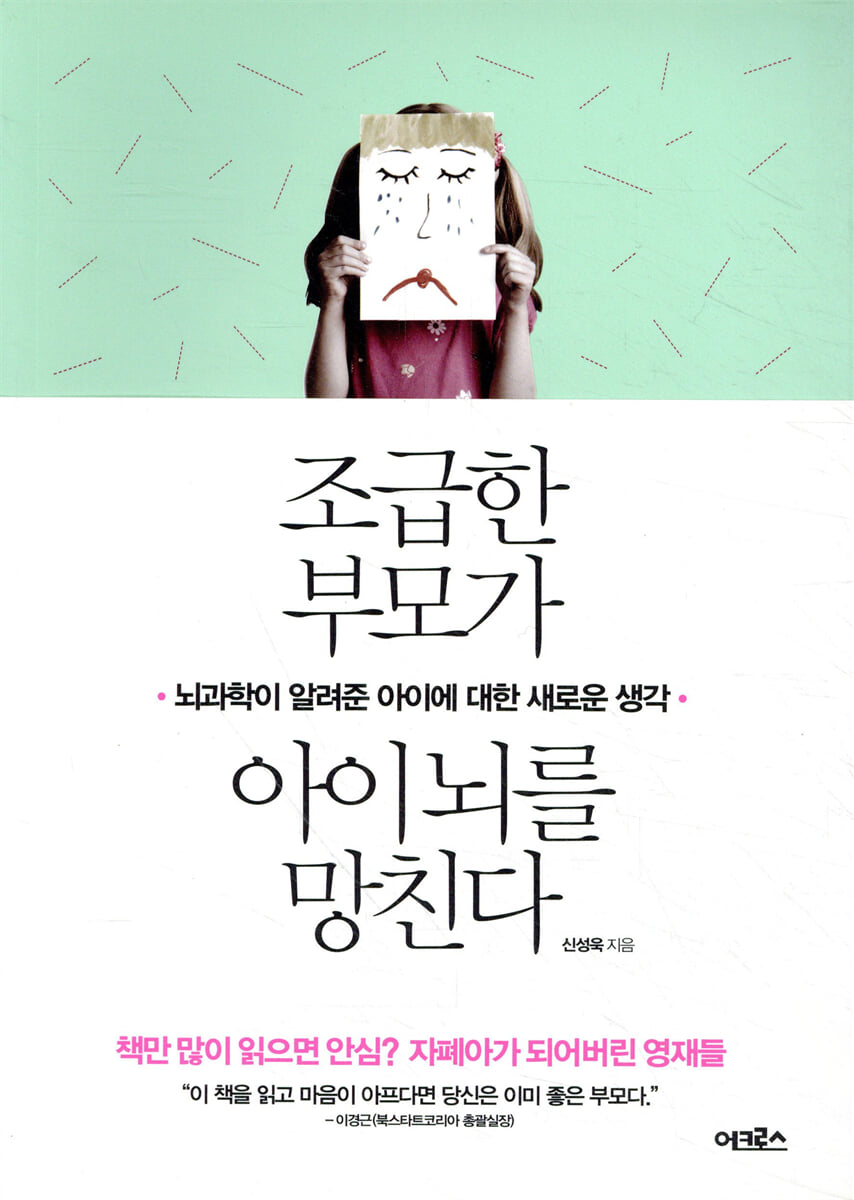
Impatient parents ruin their children's brains.
 |
Description
Book Introduction
[Republic of Korea's Reading Revolution] Producer Shin Sung-wook exposes pseudoscience and misconceptions about the brain that are harming children!
Smart parents who want to ensure their children's healthy growth must know this story about their children's brains.
Children who received early literacy training, or who were reading from six months old, are increasingly being diagnosed with autism or hyperlexia.
When these children's brains are scanned, abnormalities in the limbic system are found.
In other words, the emotional brain is damaged and changes into a reptilian brain.
Parents envy their children who read well and learn letters and numbers early, but their impatience and misunderstanding of developmental processes are only harming their children's brains.
Producer Shin Sung-wook, who produced the KBS special documentary "Korea's Reading Revolution," which detailed the relationship between reading and brain development and sparked significant interest among parents, now exposes misconceptions about children's brains and exposes the pseudo-neuroscientists and educational realities that created these stereotypes. In 2007, the OECD published a list of eight "Brain Myths," including right-brain/left-brain learning methods and the "three-year-old myth."
Despite the remarkable progress made in recent brain science, many parents and educators still rely on outdated assumptions when it comes to raising children.
In particular, our country's hasty cognitive education, combined with incorrect common sense and stereotypes about the brain, is creating a war-like educational reality.
So how should we raise our children? Having given over 400 lectures and met with parents and teachers, the author, drawing on extensive research and investigation, reveals surprising secrets about children revealed by the latest research.
This book is a brain science report that teaches us how to develop the brain healthily by avoiding excessive cognitive education, and is also a child education guide for wise parents who want to raise healthy and intelligent children.
Smart parents who want to ensure their children's healthy growth must know this story about their children's brains.
Children who received early literacy training, or who were reading from six months old, are increasingly being diagnosed with autism or hyperlexia.
When these children's brains are scanned, abnormalities in the limbic system are found.
In other words, the emotional brain is damaged and changes into a reptilian brain.
Parents envy their children who read well and learn letters and numbers early, but their impatience and misunderstanding of developmental processes are only harming their children's brains.
Producer Shin Sung-wook, who produced the KBS special documentary "Korea's Reading Revolution," which detailed the relationship between reading and brain development and sparked significant interest among parents, now exposes misconceptions about children's brains and exposes the pseudo-neuroscientists and educational realities that created these stereotypes. In 2007, the OECD published a list of eight "Brain Myths," including right-brain/left-brain learning methods and the "three-year-old myth."
Despite the remarkable progress made in recent brain science, many parents and educators still rely on outdated assumptions when it comes to raising children.
In particular, our country's hasty cognitive education, combined with incorrect common sense and stereotypes about the brain, is creating a war-like educational reality.
So how should we raise our children? Having given over 400 lectures and met with parents and teachers, the author, drawing on extensive research and investigation, reveals surprising secrets about children revealed by the latest research.
This book is a brain science report that teaches us how to develop the brain healthily by avoiding excessive cognitive education, and is also a child education guide for wise parents who want to raise healthy and intelligent children.
- You can preview some of the book's contents.
Preview
index
PART 1
The Child's Revenge: Is My Child Really Okay?
1.
I thought I was smart, but I have autism!
2.
A Day in the Life of Eunseo, a Three-Year-Old
3.
The Brain of a Psychopath, the Brain of an English Prodigy
4.
The Secret of Our Lost Empathy
5.
That's because he's gifted
6.
The Age of Addiction: Smartphones and the Child's Brain
7.
The child is not a warrior
8.
We are now in a state of emergency.
9.
A violent society of brain-damaged children
PART 2
Myth: What Happened to Children's Brains
10.
Old Myths About the Brain: Ruining Your Child
11.
The origin of the 3rd generation myth
12.
One child, six wallets
13.
Children's brains devoured by the market
14.
Selling the right brain
15.
Who Dominates the Brain Market?
16.
Dr. Jekyll and the Brain and Mr. Hyde's Brain
17.
The competition for specifications begins from fetal age
18.
Misconceptions and Truths about Synapses
PART 3
The Brain Grows as Much as You Believe: How to Approach Children Through Neuroscience
20.
A special being called a human child
21.
Children who get sick from reading only books
22.
The potential of children to become anything
23.
Letters don't register well in a child's brain.
24.
Stress, the natural enemy of children's brains
25.
Magic Power: Play Makes the Brain
26.
Children who play well also have well-developed brains.
27.
English: When Should I Start Teaching It?
PART 4
The Amazing Child: A New Way of Thinking About Children
28.
Are all babies born language geniuses?
29. Does a High IQ Make You Happy?: Discovery of the Theory of Multiple Intelligences
30.
Time to Grow Your Mind: Focus on Your Emotional Brain
31.
The human brain is wider than the sky.
32.
Stare, carve the brain
33.
The brain loves stories
34.
The mind of another being other than mine
Reviews
annotation
The Child's Revenge: Is My Child Really Okay?
1.
I thought I was smart, but I have autism!
2.
A Day in the Life of Eunseo, a Three-Year-Old
3.
The Brain of a Psychopath, the Brain of an English Prodigy
4.
The Secret of Our Lost Empathy
5.
That's because he's gifted
6.
The Age of Addiction: Smartphones and the Child's Brain
7.
The child is not a warrior
8.
We are now in a state of emergency.
9.
A violent society of brain-damaged children
PART 2
Myth: What Happened to Children's Brains
10.
Old Myths About the Brain: Ruining Your Child
11.
The origin of the 3rd generation myth
12.
One child, six wallets
13.
Children's brains devoured by the market
14.
Selling the right brain
15.
Who Dominates the Brain Market?
16.
Dr. Jekyll and the Brain and Mr. Hyde's Brain
17.
The competition for specifications begins from fetal age
18.
Misconceptions and Truths about Synapses
PART 3
The Brain Grows as Much as You Believe: How to Approach Children Through Neuroscience
20.
A special being called a human child
21.
Children who get sick from reading only books
22.
The potential of children to become anything
23.
Letters don't register well in a child's brain.
24.
Stress, the natural enemy of children's brains
25.
Magic Power: Play Makes the Brain
26.
Children who play well also have well-developed brains.
27.
English: When Should I Start Teaching It?
PART 4
The Amazing Child: A New Way of Thinking About Children
28.
Are all babies born language geniuses?
29. Does a High IQ Make You Happy?: Discovery of the Theory of Multiple Intelligences
30.
Time to Grow Your Mind: Focus on Your Emotional Brain
31.
The human brain is wider than the sky.
32.
Stare, carve the brain
33.
The brain loves stories
34.
The mind of another being other than mine
Reviews
annotation
Into the book
“In this book, I point out the tragic reality that threatens the intelligent and healthy growth of children, and challenge the false beliefs that underlie such reality, such as the myth of the giant brain, represented by the myth of the three-year-old.
And I tried to introduce new ideas about children that have been revealed through brain science, which has developed greatly over the past 30 years.” - Preface
“Many parents only notice that their toddlers are good at reading letters and numbers and have a good memory.
And we overlook the fact that the child has poor eye contact, is not very expressive, and does not get along well with peers.
So” (page 61)
“Pavlov, who had been devoting himself to research day and night, was summoned one day to the revolutionary government in the Kremlin.
Lenin, who had listened to the story about Pavlov's dog, said, "It is indeed an interesting story," and requested a report. After reading it, he was deeply moved and said, "This has secured the future of the revolution." (p. 147)
And I tried to introduce new ideas about children that have been revealed through brain science, which has developed greatly over the past 30 years.” - Preface
“Many parents only notice that their toddlers are good at reading letters and numbers and have a good memory.
And we overlook the fact that the child has poor eye contact, is not very expressive, and does not get along well with peers.
So” (page 61)
“Pavlov, who had been devoting himself to research day and night, was summoned one day to the revolutionary government in the Kremlin.
Lenin, who had listened to the story about Pavlov's dog, said, "It is indeed an interesting story," and requested a report. After reading it, he was deeply moved and said, "This has secured the future of the revolution." (p. 147)
--- From the text
Publisher's Review
1.
Don't be complacent if your child only reads books by himself!
Excessive early education and literacy are turning children into psychopaths and autistic children.
Children diagnosed with acquired autism and hyperverbal disorder due to early literacy-based education
An English prodigy whose limbic system, which controls emotions, is damaged
A gifted reader who was diagnosed with autism after following the immersive reading method
Part 1 of this book features a variety of children.
These are ordinary children that can be easily seen around us today, and they are also children who make their parents wonder if they might be gifted children.
These children, who demonstrate a faster language learning ability than their peers, have something in common.
The point is that there is a problem with brain development or signs of a problem have been discovered.
Jinwoo (pseudonym), who never missed first place in an English speaking contest, had severe damage to the emotional brain.
What's going on in children's brains?
In many cases, parents envy their children who learn Korean and numbers on their own without being taught, and even speak English.
So, we overlook the fact that the child has poor eye contact, has few facial expressions, and has difficulty getting along with friends.
It's passed over with something like, 'My child is gifted, so he or she is a little bit different.'
Early education and excessive literacy-centered education like this are pushing children toward acquired autism, pseudo-autism, and autistic tendencies.
Learning stress caused by excessive early education is threatening children's mental health and healthy brain development.
But the real perpetrators of education only say, “Gifted children are originally diagnosed with autism.”
What exactly is the truth? Why are children's emotional brains disappearing? This book contains the scientific truths every adult should know about children's brains devoured by the market, parents forced to hand them smartphones, and teenagers driven to suicide by the war on education.
2.
Brain Misconceptions That Are Harming Our Children?
: The 3-Year-Old Myth, Right-Brain Training, Critical Period Theory, and Misconceptions About the Brain
8 Brain Myths Debunked by the OECD
1) By the age of three, almost everything important in the brain is determined!
2) There is a critical period in learning something!
3) Humans only use 10 percent of their brains throughout their lives!
4) Humans are divided into left-brained and right-brained people!
5) Men and women have different brains!
6) A child's brain can only learn one language at a time!
7) Your brain develops by improving your memory!
8) Your brain learns even while you sleep!
Parents' excessive desire to raise their children well can actually harm them.
This is because many of the common beliefs we have had about the brain have been revised or discarded by recent research.
In 2007, the OECD published a report detailing long-standing neuromyths about the brain to provide accurate information about the brain in member countries and to provide educational guidelines.
This is both a confession from scientists that 'we don't know much about the brain' and a warning that 'scientific results discovered in the laboratory should not be directly applied to the educational field.'
It's just that we're finally starting to understand what we don't know about the human brain.
The first misconception about the brain that comes to mind is the so-called "three-year-old myth," which is the belief that "almost everything related to brain development is determined around the age of three," and has become the theoretical basis for early childhood education.
However, this is a result of ignoring the biological timetable of the brain and only linearly reading the graph of changes in synapse density.
In fact, humans change their brains by strengthening and rearranging synapses throughout their lives.
Educational products that emphasize the right and left brains are also the result of developing past theories into educational programs while ignoring the process of research on the brain.
Misconceptions about the brain confine a child's brain, which has infinite potential, to only one way, blocking its ability to grow like a forest.
This book traces how these misconceptions about the brain arose and how they were commercialized, helping parents make informed decisions.
3.
The Science of Growth for Parents Who Want to Raise Children with Healthy Minds
: Gaze, play and brain development, visual and language formation, stress management, proper reading education and appropriate character learning timing and method
It is dangerous to teach letters to children under 6 years old.
There is good stress and bad stress for children.
How Human Children Learn Language, as Revealed by Dr. Deb Roy
At 42 minutes old, a baby demonstrates human skills by accurately imitating other people's facial expressions.
So how should we view children? This book, spread across parts 3 and 4, presents a new perspective on children informed by brain science.
It is a new way of thinking about the child, based on the infinite potential of the special being called the human child and the latest achievements in brain science.
Humans develop their brains throughout their lives.
Therefore, teaching letters at a time when letters are not ingrained causes fatal stress to the brain.
Education is essentially just one form of help that parents can give to their children.
During this process, human abilities, including intelligence, grow, and this is also a process that follows the biological timeline of brain development.
Am I doing the right thing for my child? Parents constantly ask themselves this question.
This book is not intended to criticize parents.
Maybe we've known this for a long time.
The neuroscientists' expressions, such as '7 billion moons rise in the world every night' and 'the brain is wider than the sky', are things we already feel and know about children.
From the process of visual center and language formation, to play and brain development, to the process of forming relationships through gaze and storytelling, to the process of creating human skills.
The latest brain science research offers brilliant insights into the child brain, offering parents a chance to get closer to their children, alleviating their anxiety and impatience, and enabling new discoveries about their children.
Don't be complacent if your child only reads books by himself!
Excessive early education and literacy are turning children into psychopaths and autistic children.
Children diagnosed with acquired autism and hyperverbal disorder due to early literacy-based education
An English prodigy whose limbic system, which controls emotions, is damaged
A gifted reader who was diagnosed with autism after following the immersive reading method
Part 1 of this book features a variety of children.
These are ordinary children that can be easily seen around us today, and they are also children who make their parents wonder if they might be gifted children.
These children, who demonstrate a faster language learning ability than their peers, have something in common.
The point is that there is a problem with brain development or signs of a problem have been discovered.
Jinwoo (pseudonym), who never missed first place in an English speaking contest, had severe damage to the emotional brain.
What's going on in children's brains?
In many cases, parents envy their children who learn Korean and numbers on their own without being taught, and even speak English.
So, we overlook the fact that the child has poor eye contact, has few facial expressions, and has difficulty getting along with friends.
It's passed over with something like, 'My child is gifted, so he or she is a little bit different.'
Early education and excessive literacy-centered education like this are pushing children toward acquired autism, pseudo-autism, and autistic tendencies.
Learning stress caused by excessive early education is threatening children's mental health and healthy brain development.
But the real perpetrators of education only say, “Gifted children are originally diagnosed with autism.”
What exactly is the truth? Why are children's emotional brains disappearing? This book contains the scientific truths every adult should know about children's brains devoured by the market, parents forced to hand them smartphones, and teenagers driven to suicide by the war on education.
2.
Brain Misconceptions That Are Harming Our Children?
: The 3-Year-Old Myth, Right-Brain Training, Critical Period Theory, and Misconceptions About the Brain
8 Brain Myths Debunked by the OECD
1) By the age of three, almost everything important in the brain is determined!
2) There is a critical period in learning something!
3) Humans only use 10 percent of their brains throughout their lives!
4) Humans are divided into left-brained and right-brained people!
5) Men and women have different brains!
6) A child's brain can only learn one language at a time!
7) Your brain develops by improving your memory!
8) Your brain learns even while you sleep!
Parents' excessive desire to raise their children well can actually harm them.
This is because many of the common beliefs we have had about the brain have been revised or discarded by recent research.
In 2007, the OECD published a report detailing long-standing neuromyths about the brain to provide accurate information about the brain in member countries and to provide educational guidelines.
This is both a confession from scientists that 'we don't know much about the brain' and a warning that 'scientific results discovered in the laboratory should not be directly applied to the educational field.'
It's just that we're finally starting to understand what we don't know about the human brain.
The first misconception about the brain that comes to mind is the so-called "three-year-old myth," which is the belief that "almost everything related to brain development is determined around the age of three," and has become the theoretical basis for early childhood education.
However, this is a result of ignoring the biological timetable of the brain and only linearly reading the graph of changes in synapse density.
In fact, humans change their brains by strengthening and rearranging synapses throughout their lives.
Educational products that emphasize the right and left brains are also the result of developing past theories into educational programs while ignoring the process of research on the brain.
Misconceptions about the brain confine a child's brain, which has infinite potential, to only one way, blocking its ability to grow like a forest.
This book traces how these misconceptions about the brain arose and how they were commercialized, helping parents make informed decisions.
3.
The Science of Growth for Parents Who Want to Raise Children with Healthy Minds
: Gaze, play and brain development, visual and language formation, stress management, proper reading education and appropriate character learning timing and method
It is dangerous to teach letters to children under 6 years old.
There is good stress and bad stress for children.
How Human Children Learn Language, as Revealed by Dr. Deb Roy
At 42 minutes old, a baby demonstrates human skills by accurately imitating other people's facial expressions.
So how should we view children? This book, spread across parts 3 and 4, presents a new perspective on children informed by brain science.
It is a new way of thinking about the child, based on the infinite potential of the special being called the human child and the latest achievements in brain science.
Humans develop their brains throughout their lives.
Therefore, teaching letters at a time when letters are not ingrained causes fatal stress to the brain.
Education is essentially just one form of help that parents can give to their children.
During this process, human abilities, including intelligence, grow, and this is also a process that follows the biological timeline of brain development.
Am I doing the right thing for my child? Parents constantly ask themselves this question.
This book is not intended to criticize parents.
Maybe we've known this for a long time.
The neuroscientists' expressions, such as '7 billion moons rise in the world every night' and 'the brain is wider than the sky', are things we already feel and know about children.
From the process of visual center and language formation, to play and brain development, to the process of forming relationships through gaze and storytelling, to the process of creating human skills.
The latest brain science research offers brilliant insights into the child brain, offering parents a chance to get closer to their children, alleviating their anxiety and impatience, and enabling new discoveries about their children.
GOODS SPECIFICS
- Date of publication: June 24, 2014
- Page count, weight, size: 264 pages | 450g | 150*215*15mm
- ISBN13: 9788997379439
- ISBN10: 8997379437
You may also like
카테고리
korean


korean

![GQ KOREA Mark (Monthly): December [2025]](http://librairie.coreenne.fr/cdn/shop/files/8ef265dbbfbf186523ed75ba7319009d.jpg?v=1765340328&width=3840)


