

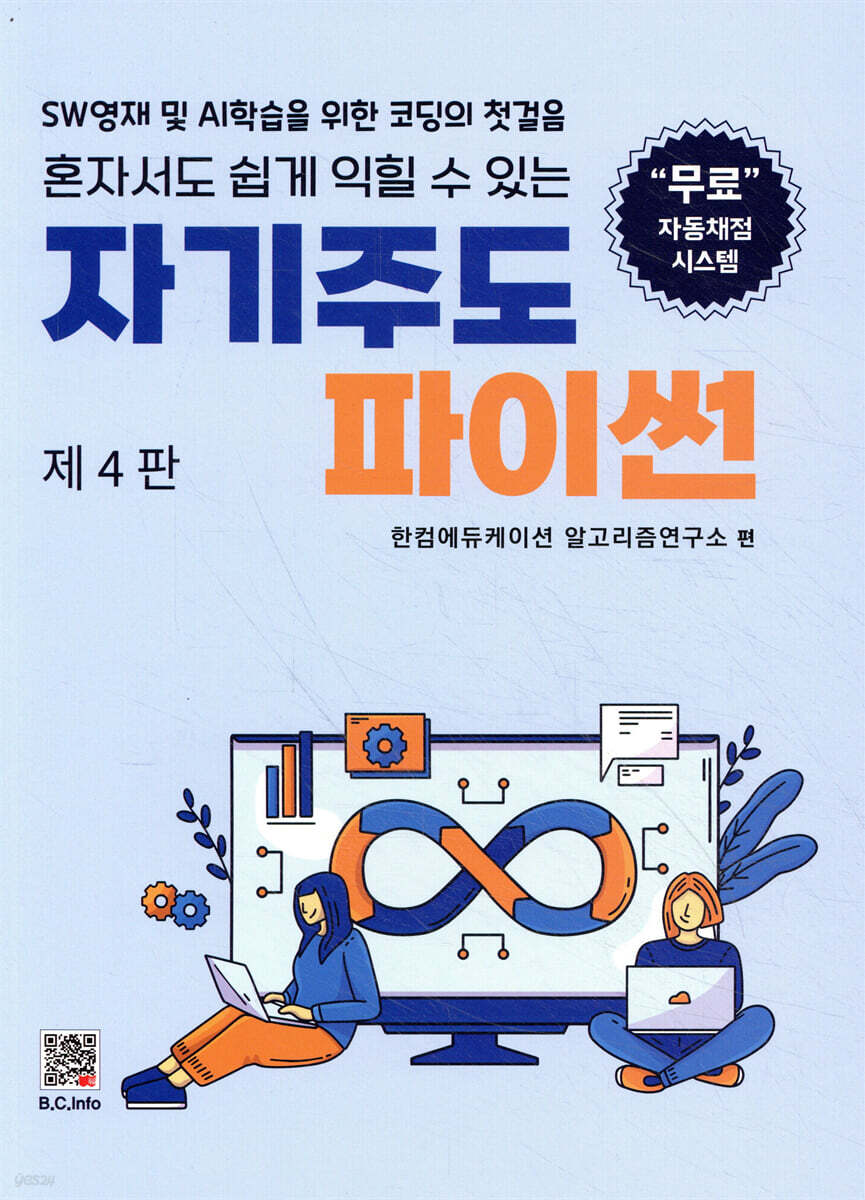
Self-directed Python
 |
Description
Book Introduction
This book is not a grammar book that delves into the various grammars of Python, but rather a practical book that guides anyone to easily approach programming.
Just as Korean students who study English for over 10 years are unable to communicate with foreigners, the reality is that there are surprisingly many students who have mastered all of the difficult grammar of the Python language but are unable to properly solve problems that could be solved with just a basic understanding of grammar.
This book was written with the hope that students who don't get hung up on complex grammar, but simply follow the steps and complete simple tasks, will find themselves becoming programming experts without even realizing it.
Meanwhile, this book was not written simply for the purpose of developing programs using Python's syntax, but was structured to focus on developing problem-solving skills.
This book is written for beginners who are learning Python for the first time.
Of course, this book will also be very useful for students who already have some experience with Python but lack confidence.
This book will also serve as an excellent introductory guide for many students who wish to participate in various competitions, such as the newly established Code Fair, or in the Information Gifted Program.
Just as Korean students who study English for over 10 years are unable to communicate with foreigners, the reality is that there are surprisingly many students who have mastered all of the difficult grammar of the Python language but are unable to properly solve problems that could be solved with just a basic understanding of grammar.
This book was written with the hope that students who don't get hung up on complex grammar, but simply follow the steps and complete simple tasks, will find themselves becoming programming experts without even realizing it.
Meanwhile, this book was not written simply for the purpose of developing programs using Python's syntax, but was structured to focus on developing problem-solving skills.
This book is written for beginners who are learning Python for the first time.
Of course, this book will also be very useful for students who already have some experience with Python but lack confidence.
This book will also serve as an excellent introductory guide for many students who wish to participate in various competitions, such as the newly established Code Fair, or in the Information Gifted Program.
index
Chapter 01 Output
Chapter 02 Variables and Input
Chapter 03 Operators
Chapter 04 Selection Control Statements
Chapter 05 Comments and Debugging
Chapter 06 Iteration Control Statement 1
Chapter 07 Iteration Control Statement 2
Chapter 08 Iteration Control Statement 3
Chapter 09 List 1
Chapter 10 Strings
Chapter 11 List 2
Chapter 12 Other Data Types
Chapter 13 Function 1
Chapter 14 Function 2
Chapter 15 Function 3
Chapter 16 Classes
Chapter 17 File Input/Output
Chapter 02 Variables and Input
Chapter 03 Operators
Chapter 04 Selection Control Statements
Chapter 05 Comments and Debugging
Chapter 06 Iteration Control Statement 1
Chapter 07 Iteration Control Statement 2
Chapter 08 Iteration Control Statement 3
Chapter 09 List 1
Chapter 10 Strings
Chapter 11 List 2
Chapter 12 Other Data Types
Chapter 13 Function 1
Chapter 14 Function 2
Chapter 15 Function 3
Chapter 16 Classes
Chapter 17 File Input/Output
Publisher's Review
It has been over 14 years since I published the book “Self-Directed C Language Programming.”
At first, it didn't receive much attention because its style was completely different from existing programming books, but as interest gradually increased, it has now reached its 11th revised edition.
When the above book was published, I had no idea that Python, a language that had not received much attention, would receive the attention it has today in education and practice.
It seems that this was made possible by its simple and concise grammar, powerful features, and wide compatibility and portability with other languages, compared to any other language.
When I actually tried to teach Python, I ran into the same problem as when I was teaching C.
As with most programming books, it was not easy for elementary and middle school students to learn the language by following along with general textbooks that focused on grammar.
In the end, I published the first edition by adopting the learning style of “Self-Directed C Language Programming” which is structured to develop problem-solving skills by solving problems independently and checking oneself through the grading system of the Jungol website (www.jungol.co.kr), and I achieved considerable results.
In the first edition, rather than taking advantage of Python's features, there was a tendency to write with excessive focus on C syntax, assuming that the Python language would be encountered before learning C.
However, now that Python has established its own domain and is being widely used in actual fields, we felt it was appropriate to revise it to maximize the features of Python, so we undertook a complete overhaul.
This book is not a grammar book that delves into the various grammars of Python, but rather a practical book that guides anyone to easily approach programming.
Just as Korean students who study English for over 10 years are unable to communicate with foreigners, the reality is that there are surprisingly many students who have mastered all of the difficult grammar of the Python language but are unable to properly solve problems that could be solved with just a basic understanding of grammar.
This book was written with the hope that students who don't get hung up on complex grammar, but simply follow the steps and complete simple tasks, will find themselves becoming programming experts without even realizing it.
Meanwhile, this book was not written simply for the purpose of developing programs using Python's syntax, but was structured to focus on developing problem-solving skills.
For example, if you want to sort a sequence of numbers in ascending or descending order without a set order of size, you can do so easily using the built-in function sort() in Python.
However, in this book, before using such sorting functions, we first learn the principles of sorting directly so that we can sufficiently implement them in code.
I hope you won't complain that I wrote unnecessary things when I could have just told you about simple functions.
This book is written for beginners who are learning Python for the first time.
Of course, this book will also be very useful for students who already have some experience with Python but lack confidence.
This book will also serve as an excellent introductory guide for many students who wish to participate in various competitions, such as the newly established Code Fair, or in the Information Gifted Program.
I sincerely hope that this book will serve as a useful guide for anyone who is trying their hand at Python, as it will provide practical programming practice that will help them open their mouths.
At first, it didn't receive much attention because its style was completely different from existing programming books, but as interest gradually increased, it has now reached its 11th revised edition.
When the above book was published, I had no idea that Python, a language that had not received much attention, would receive the attention it has today in education and practice.
It seems that this was made possible by its simple and concise grammar, powerful features, and wide compatibility and portability with other languages, compared to any other language.
When I actually tried to teach Python, I ran into the same problem as when I was teaching C.
As with most programming books, it was not easy for elementary and middle school students to learn the language by following along with general textbooks that focused on grammar.
In the end, I published the first edition by adopting the learning style of “Self-Directed C Language Programming” which is structured to develop problem-solving skills by solving problems independently and checking oneself through the grading system of the Jungol website (www.jungol.co.kr), and I achieved considerable results.
In the first edition, rather than taking advantage of Python's features, there was a tendency to write with excessive focus on C syntax, assuming that the Python language would be encountered before learning C.
However, now that Python has established its own domain and is being widely used in actual fields, we felt it was appropriate to revise it to maximize the features of Python, so we undertook a complete overhaul.
This book is not a grammar book that delves into the various grammars of Python, but rather a practical book that guides anyone to easily approach programming.
Just as Korean students who study English for over 10 years are unable to communicate with foreigners, the reality is that there are surprisingly many students who have mastered all of the difficult grammar of the Python language but are unable to properly solve problems that could be solved with just a basic understanding of grammar.
This book was written with the hope that students who don't get hung up on complex grammar, but simply follow the steps and complete simple tasks, will find themselves becoming programming experts without even realizing it.
Meanwhile, this book was not written simply for the purpose of developing programs using Python's syntax, but was structured to focus on developing problem-solving skills.
For example, if you want to sort a sequence of numbers in ascending or descending order without a set order of size, you can do so easily using the built-in function sort() in Python.
However, in this book, before using such sorting functions, we first learn the principles of sorting directly so that we can sufficiently implement them in code.
I hope you won't complain that I wrote unnecessary things when I could have just told you about simple functions.
This book is written for beginners who are learning Python for the first time.
Of course, this book will also be very useful for students who already have some experience with Python but lack confidence.
This book will also serve as an excellent introductory guide for many students who wish to participate in various competitions, such as the newly established Code Fair, or in the Information Gifted Program.
I sincerely hope that this book will serve as a useful guide for anyone who is trying their hand at Python, as it will provide practical programming practice that will help them open their mouths.
GOODS SPECIFICS
- Date of issue: August 5, 2024
- Page count, weight, size: 326 pages | 188*257*13mm
- ISBN13: 9791166755293
You may also like
카테고리
korean


korean

![GQ KOREA Mark (Monthly): December [2025]](http://librairie.coreenne.fr/cdn/shop/files/8ef265dbbfbf186523ed75ba7319009d.jpg?v=1765340328&width=3840)


