

Science of Iguaticon
 |
Description
Book Introduction
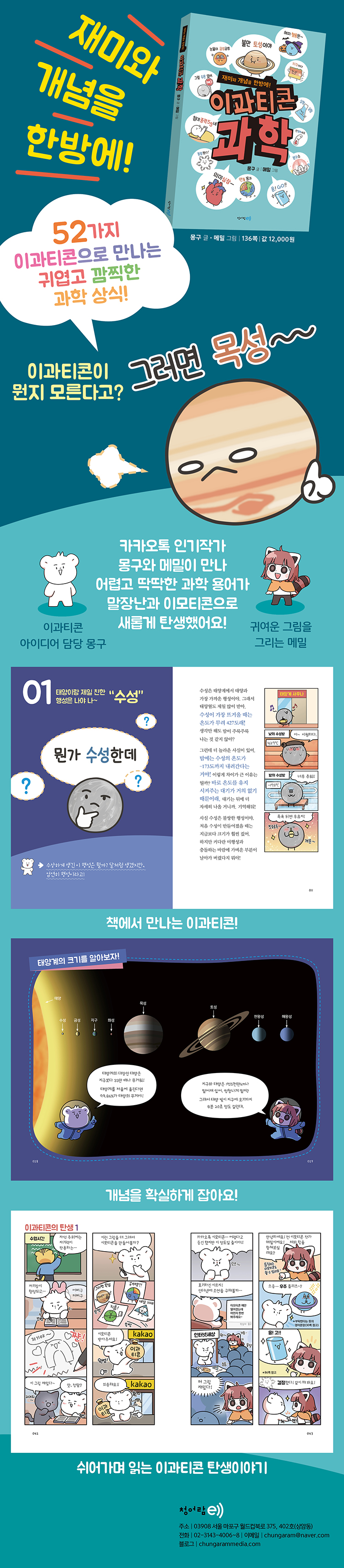
Cute and adorable science facts with 52 science icons!
Emoticons in a book, not on a smartphone?!
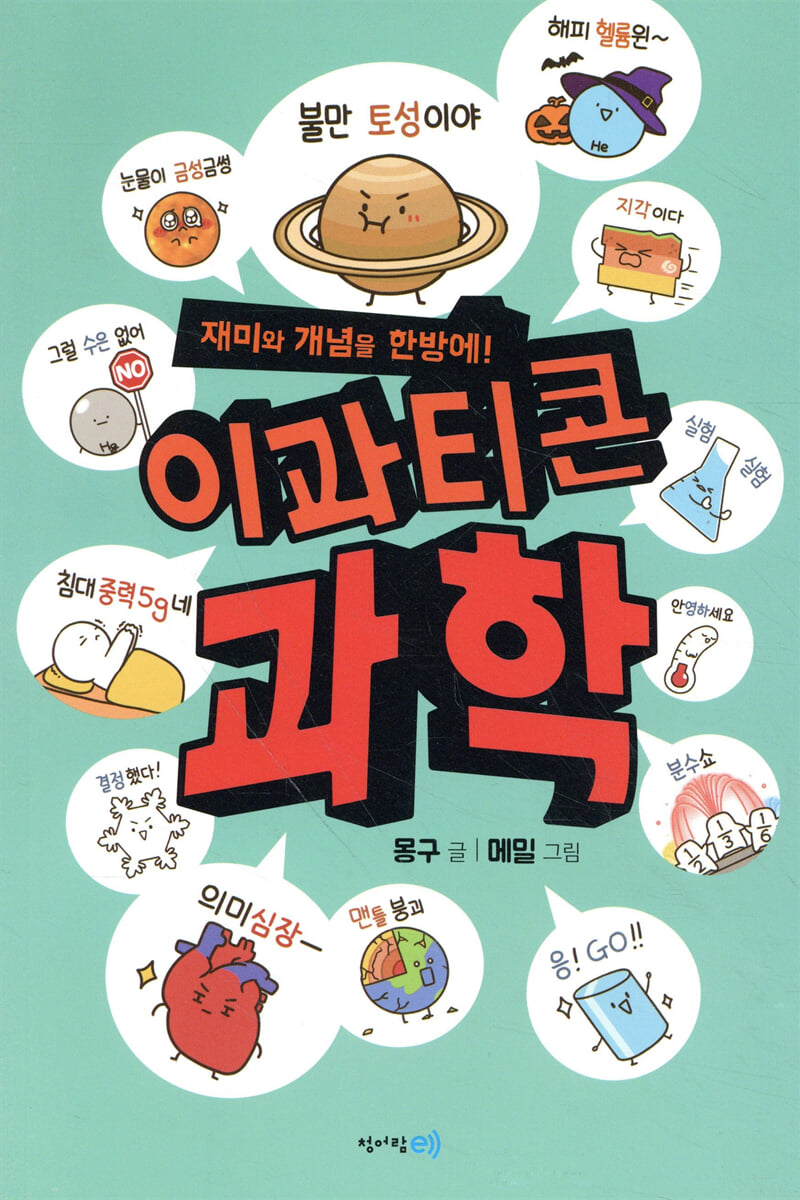
"Science with Ectoicons" is a book that explains scientific terms in a really easy-to-understand way using emoticons and puns.
The 52 science terms appearing in 『Science Science』 were created from scientific terms used in various fields such as space science, earth science, life science, chemistry, experimental tools, and the human body.
To help children in the upper grades of elementary school become interested in science, it intuitively presents difficult scientific terms and helps them understand concepts with humorous four-panel cartoons and illustrations.
This is a delightful science book that not only children but anyone will never forget once they read it.
Emoticons in a book, not on a smartphone?!
"Science with Ectoicons" is a book that explains scientific terms in a really easy-to-understand way using emoticons and puns.
The 52 science terms appearing in 『Science Science』 were created from scientific terms used in various fields such as space science, earth science, life science, chemistry, experimental tools, and the human body.
To help children in the upper grades of elementary school become interested in science, it intuitively presents difficult scientific terms and helps them understand concepts with humorous four-panel cartoons and illustrations.
This is a delightful science book that not only children but anyone will never forget once they read it.
- You can preview some of the book's contents.
Preview
index
Starting the book
01 The planet closest to the sun is me~ “Mercury” / 02 Hello? I am the morning star “Venus” / 03 It’s the only planet with life~ “Earth” / 04 The idol of the planetary system! “Mars” / 05 I am the biggest in the solar system! “Jupiter” / 06 The planet with mysterious rings “Saturn” / 07 Rolling around while lying down “Uranus” / 08 The last runner in the solar system “Neptune” / 09 The cute dwarf planet of the universe! “Dwarf planet” / Let’s find out the size of the solar system! / 10 The mystery beyond Earth “Space” / 11 What is the most famous telescope in the universe? “Hubble Space Telescope” / 12 It’s all thanks to me that there is life! “Sun” / 13 The moon in the night sky is sweet~ “Moon” / 14 I thought it was a superhero! “Comet” / 15 It’s sparkly and beautiful, but not small! "Star" / The Birth of the Iguaticon 1 / 16 The Hard Shell Surrounding the Earth "Crust" / 17 It Moves Depending on the Temperature~ "Mantle" / 18 Are People X-rays, and the Core Seismic Waves? "Nucleus" / 19 The Protective Shield That Protects the Earth! "Atmosphere" / 20 The Force That Pulls the Earth to Me "Gravity" / Let's Learn About Pangaea! / 21 The Smallest Unit That Makes Up the World "Atom" / 22 The Magical Gas That Changes Your Voice "Helium" / 23 I Hate Being Alone "Carbon" / 24 The Beautiful Element That Brightens the City Night "Neon" / 25 Also Called Iron "Iron" / 26 Copper, a Symbol of Power~ "Copper" / 27 The Mysterious but Dangerous Metal "Mercury" / 28 Phosphorus is a Really Attractive Element~ Do You Admit It? "Phosphorus" / 29 Same Element, But Different Weights "Isotopes" / Let's Learn About the Periodic Table! / 30 How Many Apples Are There? How Many Pages of Homework Are There? “Natural Numbers” / 31 Can they come together in pairs? Or not? “Odd or Even” / 32 How many slices should I cut the pizza into? “Fountain” / The Birth of the Science Icon 2 / 33 Why do they disappear whenever they want! Oh my gosh~ “Evaporation” / 34 Let’s stick together because it’s cold “Coagulation” / 35 A beautiful jewel created by nature “Crystal” / 36 The temperature at which water freezes “Below zero” / 37 I hate to imagine a world without experiments, I hate them “Experiments” / 38 I can’t be in the lab without you~ “Beaker” / 39 Liquid comes up when you press your head “Pipette” / 40 Always be careful when using fire! “Alcohol Lamp” / 41 Is cider an acid or a base? “Litmus” / 42 You can filter out dirt “Filter paper” / Interesting anecdotes about scientists: Darwin / 43 Move your body with your thoughts “Cerebrum” / 44 Adjust your pupils according to light “Midbrain” / 45 It makes you taller? In the thalamus! “Thalamus” / Let’s learn about the brain! / 46 The four come together to transport blood “Heart” / 47 What does this mean? “Eardrum” / 48 The precious air passage “Lungs” / 49 Our body’s savvy doctor “Liver” / 50 The final gateway to digestion! “Small intestine” / 51 Large intestine! The last residue has arrived! “Large intestine” / 52 When it meets sperm, it becomes a baby “Egg” / Interesting anecdotes about scientists: Newton / A collection of science icons!
In closing the book
01 The planet closest to the sun is me~ “Mercury” / 02 Hello? I am the morning star “Venus” / 03 It’s the only planet with life~ “Earth” / 04 The idol of the planetary system! “Mars” / 05 I am the biggest in the solar system! “Jupiter” / 06 The planet with mysterious rings “Saturn” / 07 Rolling around while lying down “Uranus” / 08 The last runner in the solar system “Neptune” / 09 The cute dwarf planet of the universe! “Dwarf planet” / Let’s find out the size of the solar system! / 10 The mystery beyond Earth “Space” / 11 What is the most famous telescope in the universe? “Hubble Space Telescope” / 12 It’s all thanks to me that there is life! “Sun” / 13 The moon in the night sky is sweet~ “Moon” / 14 I thought it was a superhero! “Comet” / 15 It’s sparkly and beautiful, but not small! "Star" / The Birth of the Iguaticon 1 / 16 The Hard Shell Surrounding the Earth "Crust" / 17 It Moves Depending on the Temperature~ "Mantle" / 18 Are People X-rays, and the Core Seismic Waves? "Nucleus" / 19 The Protective Shield That Protects the Earth! "Atmosphere" / 20 The Force That Pulls the Earth to Me "Gravity" / Let's Learn About Pangaea! / 21 The Smallest Unit That Makes Up the World "Atom" / 22 The Magical Gas That Changes Your Voice "Helium" / 23 I Hate Being Alone "Carbon" / 24 The Beautiful Element That Brightens the City Night "Neon" / 25 Also Called Iron "Iron" / 26 Copper, a Symbol of Power~ "Copper" / 27 The Mysterious but Dangerous Metal "Mercury" / 28 Phosphorus is a Really Attractive Element~ Do You Admit It? "Phosphorus" / 29 Same Element, But Different Weights "Isotopes" / Let's Learn About the Periodic Table! / 30 How Many Apples Are There? How Many Pages of Homework Are There? “Natural Numbers” / 31 Can they come together in pairs? Or not? “Odd or Even” / 32 How many slices should I cut the pizza into? “Fountain” / The Birth of the Science Icon 2 / 33 Why do they disappear whenever they want! Oh my gosh~ “Evaporation” / 34 Let’s stick together because it’s cold “Coagulation” / 35 A beautiful jewel created by nature “Crystal” / 36 The temperature at which water freezes “Below zero” / 37 I hate to imagine a world without experiments, I hate them “Experiments” / 38 I can’t be in the lab without you~ “Beaker” / 39 Liquid comes up when you press your head “Pipette” / 40 Always be careful when using fire! “Alcohol Lamp” / 41 Is cider an acid or a base? “Litmus” / 42 You can filter out dirt “Filter paper” / Interesting anecdotes about scientists: Darwin / 43 Move your body with your thoughts “Cerebrum” / 44 Adjust your pupils according to light “Midbrain” / 45 It makes you taller? In the thalamus! “Thalamus” / Let’s learn about the brain! / 46 The four come together to transport blood “Heart” / 47 What does this mean? “Eardrum” / 48 The precious air passage “Lungs” / 49 Our body’s savvy doctor “Liver” / 50 The final gateway to digestion! “Small intestine” / 51 Large intestine! The last residue has arrived! “Large intestine” / 52 When it meets sperm, it becomes a baby “Egg” / Interesting anecdotes about scientists: Newton / A collection of science icons!
In closing the book
Detailed image
Publisher's Review
Difficult and rigid scientific terms
Reborn with puns and emoticons!
“How can I get my child interested in science?” is a common title on Mom Cafe.
Perhaps the reason these topics are so frequently posted is because so many children lack interest in science. When we think of "science," the image that often comes to mind is "difficult and rigid."
Compared to the past, the image of science has become much more familiar through events and YouTube videos that convey the joy of science, but that doesn't mean science feels any easier.
There are probably many reasons, but one reason may be that we don't often encounter scientific terms in our daily lives, so the terms themselves are too unfamiliar.
"Science with Science" uses puns and characters to explain unfamiliar scientific terms to children in an intuitive and easy-to-understand way.
For example, 'Jupiter' is expressed as 'Then Jupiter~~', 'carbon' is expressed as 'carbon carbon cow', 'mercury' is expressed as 'That can't be mercury', 'solidification' is expressed as 'Yeah! GO!!', 'sub-zero' is expressed as 'Hello', and various characters appear for each term.
And it helps to understand the concepts by using humorous 4-panel cartoons and illustrations.
Any young reader who reads "Science with Science" will be able to create their own "Science with Science" right away.
If unfamiliar and difficult scientific terms become the subject of play, it will be a great help in cultivating children's interest in science.
Science becomes easy
A different approach!
There are many ways to enjoy science, but what are some things children can immediately apply in their daily lives? Science experiments are a prime example, but even these experiments can be challenging for children to attempt on their own without parents or teachers helping prepare them.
In that sense, 『Science with Science』 is also a fun science activity that children can use right away in their daily lives.
If young readers who read the book create sentences and characters that fit scientific terms through wordplay, they will be able to find fun and excitement in even the most difficult scientific fields.
Additionally, motivation is possible by using the science icon released through KakaoTalk.
In fact, the characters in 『Science with Science』 were created from terms used in various fields such as space science, earth science, life science, chemistry, experimental tools, and the human body.
The eight planets in the solar system are expressed as 'Something's wrong with Mercury', 'Tears are falling on Venus', 'Earth 5', 'Are you angry?', 'Then Jupiter~~', 'I'm dissatisfied with Saturn', 'I'm the hot spring king', 'I love Neptune', and each part of the brain is expressed as 'I don't know the brain well', 'Oh my, late brain', 'Thalamus!', etc.
Young readers will find this book inspiring and create even more ingenious science icons.
The beginning of the science theme
After several failures, I got it!
In fact, the science icon was first released as an emoticon, not a book, and it is a series that has already had 6 installments.
The E-Gwaticon was famous online even before its release. Initially, the author, Monggu, planned the E-Gwaticon alone and applied for it on KakaoTalk, but was rejected.
And while posting the story on an online community, I met the artist, Memil.
Even though the two of them joined forces and failed three more times, they did not give up and kept trying, and were able to successfully launch the product.
Thanks to such a story and ingenious idea, the E-Gwaticon became a bestseller as soon as it was released.
『Science with Ectoicons』 is not a work created simply with emoticons.
The writer, Monggu, is an engineering student who graduated from the Department of Genetic Engineering, and the illustrator, Memil, is an engineering student who graduated from the Department of Electrical Engineering.
The work that melts together the diverse scientific knowledge and experiences of these two people is 『Science of Science』.
And by utilizing the know-how of webtoon and emoticon production, we have captured the core of each term to make it easier and more fun for young readers.
『Science with Science』, which combines fun and concepts, will be a delightful science book that not only children but anyone will never forget once they read it.
Reborn with puns and emoticons!
“How can I get my child interested in science?” is a common title on Mom Cafe.
Perhaps the reason these topics are so frequently posted is because so many children lack interest in science. When we think of "science," the image that often comes to mind is "difficult and rigid."
Compared to the past, the image of science has become much more familiar through events and YouTube videos that convey the joy of science, but that doesn't mean science feels any easier.
There are probably many reasons, but one reason may be that we don't often encounter scientific terms in our daily lives, so the terms themselves are too unfamiliar.
"Science with Science" uses puns and characters to explain unfamiliar scientific terms to children in an intuitive and easy-to-understand way.
For example, 'Jupiter' is expressed as 'Then Jupiter~~', 'carbon' is expressed as 'carbon carbon cow', 'mercury' is expressed as 'That can't be mercury', 'solidification' is expressed as 'Yeah! GO!!', 'sub-zero' is expressed as 'Hello', and various characters appear for each term.
And it helps to understand the concepts by using humorous 4-panel cartoons and illustrations.
Any young reader who reads "Science with Science" will be able to create their own "Science with Science" right away.
If unfamiliar and difficult scientific terms become the subject of play, it will be a great help in cultivating children's interest in science.
Science becomes easy
A different approach!
There are many ways to enjoy science, but what are some things children can immediately apply in their daily lives? Science experiments are a prime example, but even these experiments can be challenging for children to attempt on their own without parents or teachers helping prepare them.
In that sense, 『Science with Science』 is also a fun science activity that children can use right away in their daily lives.
If young readers who read the book create sentences and characters that fit scientific terms through wordplay, they will be able to find fun and excitement in even the most difficult scientific fields.
Additionally, motivation is possible by using the science icon released through KakaoTalk.
In fact, the characters in 『Science with Science』 were created from terms used in various fields such as space science, earth science, life science, chemistry, experimental tools, and the human body.
The eight planets in the solar system are expressed as 'Something's wrong with Mercury', 'Tears are falling on Venus', 'Earth 5', 'Are you angry?', 'Then Jupiter~~', 'I'm dissatisfied with Saturn', 'I'm the hot spring king', 'I love Neptune', and each part of the brain is expressed as 'I don't know the brain well', 'Oh my, late brain', 'Thalamus!', etc.
Young readers will find this book inspiring and create even more ingenious science icons.
The beginning of the science theme
After several failures, I got it!
In fact, the science icon was first released as an emoticon, not a book, and it is a series that has already had 6 installments.
The E-Gwaticon was famous online even before its release. Initially, the author, Monggu, planned the E-Gwaticon alone and applied for it on KakaoTalk, but was rejected.
And while posting the story on an online community, I met the artist, Memil.
Even though the two of them joined forces and failed three more times, they did not give up and kept trying, and were able to successfully launch the product.
Thanks to such a story and ingenious idea, the E-Gwaticon became a bestseller as soon as it was released.
『Science with Ectoicons』 is not a work created simply with emoticons.
The writer, Monggu, is an engineering student who graduated from the Department of Genetic Engineering, and the illustrator, Memil, is an engineering student who graduated from the Department of Electrical Engineering.
The work that melts together the diverse scientific knowledge and experiences of these two people is 『Science of Science』.
And by utilizing the know-how of webtoon and emoticon production, we have captured the core of each term to make it easier and more fun for young readers.
『Science with Science』, which combines fun and concepts, will be a delightful science book that not only children but anyone will never forget once they read it.
GOODS SPECIFICS
- Date of issue: June 18, 2020
- Page count, weight, size: 144 pages | 330g | 150*225*12mm
- ISBN13: 9791158711368
- ISBN10: 1158711360
- KC Certification: Certification Type: Conformity Confirmation
You may also like
카테고리
korean


korean

![GQ KOREA Mark (Monthly): December [2025]](http://librairie.coreenne.fr/cdn/shop/files/8ef265dbbfbf186523ed75ba7319009d.jpg?v=1765340328&width=3840)


