

Math Self-Esteem Class
 |
Description
Book Introduction
"There are no born bluffers!"
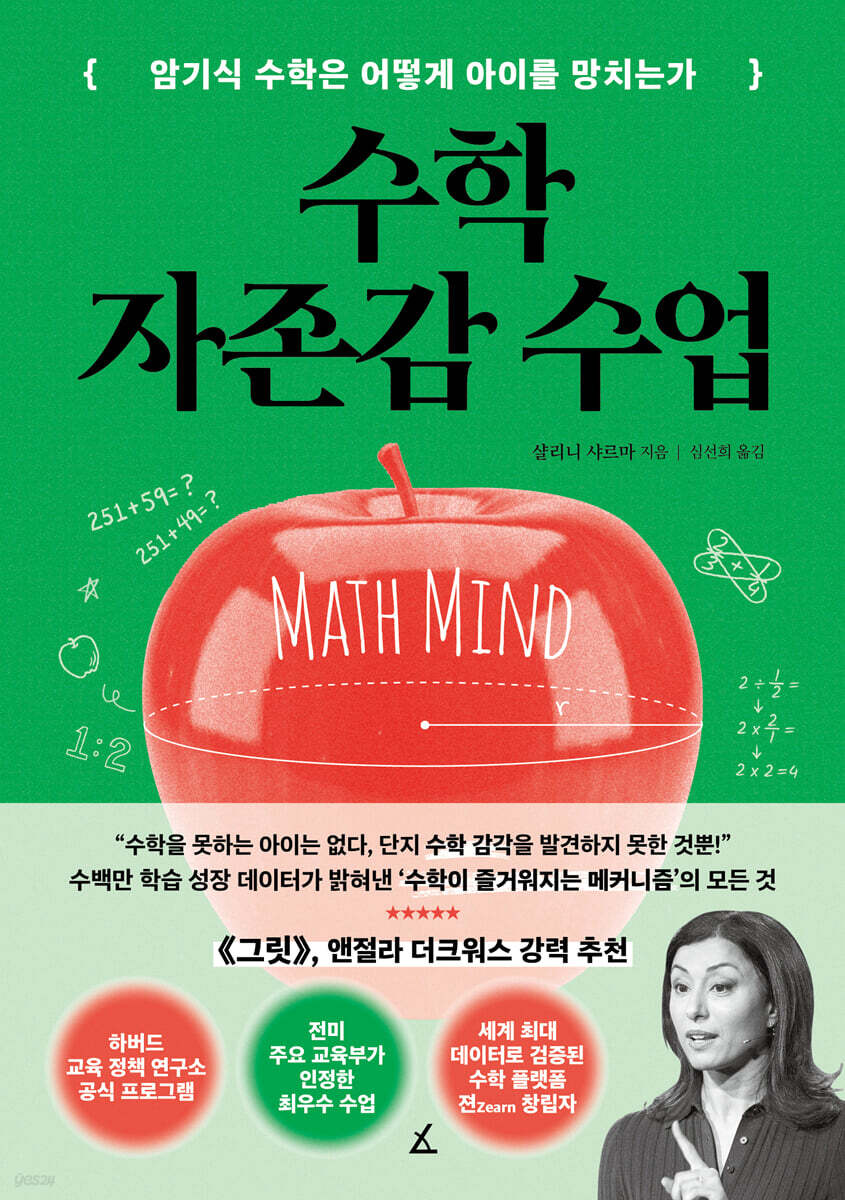
"Math Self-Esteem Lessons," Proven by Millions of Students Worldwide, Released
The first book by Shalini Sharma, founder of Zearn, an educational platform used by one-quarter of American elementary school students.
Highly recommended by world-renowned scholars including Angela Duckworth ("Grit") and Amanda Lipley ("The World's Smartest Kids").
A new book, "Math Self-Esteem Class," has been published, challenging the stereotype that "math brains" are innate.
The author of this book, Shalini Sharma, points out that the existing rote learning and speed-oriented math education causes math phobia in children, and suggests a special educational solution that makes math a fun part of everyday life, like 'reading and writing.'
Author Shalini Sharma is a data analytics expert with degrees from Brown University and Harvard Business School, and an innovative educational activist recognized as a "global expert on mathematics education."
Zearn, the non-profit math education platform he co-founded, is highly regarded in the educational field, with one in four elementary school students in the United States using it, and has even been adopted as an official educational program by the Harvard Education Policy Research Institute.
"Math Self-Esteem Lessons," Proven by Millions of Students Worldwide, Released
The first book by Shalini Sharma, founder of Zearn, an educational platform used by one-quarter of American elementary school students.
Highly recommended by world-renowned scholars including Angela Duckworth ("Grit") and Amanda Lipley ("The World's Smartest Kids").
A new book, "Math Self-Esteem Class," has been published, challenging the stereotype that "math brains" are innate.
The author of this book, Shalini Sharma, points out that the existing rote learning and speed-oriented math education causes math phobia in children, and suggests a special educational solution that makes math a fun part of everyday life, like 'reading and writing.'
Author Shalini Sharma is a data analytics expert with degrees from Brown University and Harvard Business School, and an innovative educational activist recognized as a "global expert on mathematics education."
Zearn, the non-profit math education platform he co-founded, is highly regarded in the educational field, with one in four elementary school students in the United States using it, and has even been adopted as an official educational program by the Harvard Education Policy Research Institute.
- You can preview some of the book's contents.
Preview
index
prolog
In search of lost 'math self-esteem'
Chapter 1 We could all be math geniuses!
Part 1: 'I'm not good at math' is a lie!
Three Illusions That Destroy Math Self-Esteem
Chapter 2: Speed Isn't Everything
Chapter 3: "Tricks" Are Not the Answer
Chapter 4: There is Not 'Just One' Method
'This' comes before the second part score!
Five Ways to Build Unbreakable Math Self-Esteem
Chapter 5: Math is Yours
Chapter 6: Learning the Language of Mathematics through Pictures and Objects
Chapter 7 Making the Problem Easier and Simpler
Chapter 8: Trying Different Methods
Chapter 9: Purposeful Practice
Part 3: A world ruled by numbers!
Is your child's math self-esteem okay?
Chapter 10: The Equation That Determines Our Destiny
Chapter 11: The First Step to Real Learning
Chapter 12: From ‘Classifying’ to ‘Teaching’
Epilogue
For the love of math!
Math skills come from self-esteem.
References
In search of lost 'math self-esteem'
Chapter 1 We could all be math geniuses!
Part 1: 'I'm not good at math' is a lie!
Three Illusions That Destroy Math Self-Esteem
Chapter 2: Speed Isn't Everything
Chapter 3: "Tricks" Are Not the Answer
Chapter 4: There is Not 'Just One' Method
'This' comes before the second part score!
Five Ways to Build Unbreakable Math Self-Esteem
Chapter 5: Math is Yours
Chapter 6: Learning the Language of Mathematics through Pictures and Objects
Chapter 7 Making the Problem Easier and Simpler
Chapter 8: Trying Different Methods
Chapter 9: Purposeful Practice
Part 3: A world ruled by numbers!
Is your child's math self-esteem okay?
Chapter 10: The Equation That Determines Our Destiny
Chapter 11: The First Step to Real Learning
Chapter 12: From ‘Classifying’ to ‘Teaching’
Epilogue
For the love of math!
Math skills come from self-esteem.
References
Detailed image

Into the book
The feeling that 'I can do it too', the thrill of solving a problem in one go, the moment when the numbers fit together perfectly in a proportional relationship, and that moment when you understand y = mx + b by plotting a point on a coordinate plane.
At one point, I felt boundless joy along with an exclamation of “Aha!”
That's how I learned to love math, and at some point, I became a 'kid who was good at math.'
When I entered the math gifted class, I was definitely intimidated by the class atmosphere.
The group in front seemed like they were naturally gifted, and I felt like an outsider who had luckily gotten into their group.
But a single word awakened the potential within me, and that potential became reality through effort.
If you are someone who feels small when faced with math, you have probably experienced the pain I felt during math class.
I guarantee you that back then, you weren't a 'child who was bad at math', but a 'child who was afraid of math'.
--- pp.6-7
Most children are afraid of math.
No, I think mathematics itself rejects itself.
What's more serious is that the current educational system encourages this kind of thinking.
Most classes continue to send the subliminal message, “You’re not born with a math brain.”
They obsess over memorizing multiplication tables, obsess over memorizing formulas, and have 'line races' to see who can shout out the answer the fastest.
It's as if math is taught as a subject to be memorized.
When I see a child struggling, I offer comfort like this.
"are you okay.
Instead, you are very creative.
“Math just doesn’t suit you.”
Wait a minute! Imagine saying this to a student struggling in reading class.
“Some of us are born with a reading gene, but most of us are not.
But there's no need to worry.
“Books will soon become extinct like dinosaurs,” he said.
Doesn't something seem strange?
Recently I thought, “There is no need to teach math.
I often hear people say, “Because we have computers and calculators.”
But no one is saying that we don't need to learn to read just because AI can read books for us.
But why do you think math is different?
--- pp.8-9
In a recent article in The New Yorker, Korean-American journalist and author Jay Caspian Kang asked this question about the reality of math education.
“What do we know about how to teach math to children?”
Then he added:
“Actually, it probably won’t be that much.
Even what we do know is controversial.”1
It's actually surprising to hear this said about mathematics, one of the fundamental subjects of public education.
This is especially true when considering that the level of understanding of fraction concepts learned in elementary school predicts the likelihood of successfully completing algebra courses later on, and that how well one digests algebra in middle and high school has a significant impact on whether one enters and graduates from college.
Could anyone have ever guessed that mathematics could change the trajectory of a person's life like this?
--- pp.17-18
I came across the "bright spots" research method introduced in the book "Switch" by brothers Chip Heath and Dan Heath. This is a method of studying cases of unusual success even in adverse situations, and the case of Vietnam in the 1990s is a representative example.
At the time, malnutrition among children living in rural Vietnam was considered an inevitable result of poor living conditions and poor sanitary conditions.
However, Save the Children broke away from these stereotypes and focused on children who grew up particularly healthy even in the same environment.
As a result, they discovered that their parents used small but effective parenting methods that were different from the typical methods.
For example, they improved the children's nutritional status by feeding them four meals a day instead of two, feeding them directly, and using local ingredients such as shrimp, crab, and sweet potato leaves.
So, aren't there similar "bright spots" in math education? To find these success stories, I sought out and met with teachers who teach low-income children and still achieve top scores on state math tests each year.
Unfortunately, in reality, economic conditions have a significant impact on educational achievement in our society today.
But even within that, there are always exceptions.
I observed those "exceptional" teachers closely and discovered that they used several small but important techniques to effectively boost students' interest in math and their self-esteem.
This was a remarkable effect, similar to the one observed in Vietnam in the 1990s when seafood and sweet potato leaves improved the nutritional status of children.
--- pp.22-23
Mathematics administrators and data scientists scrutinize this accumulated data to answer the question, “What is the most effective way to learn math?”
As a result, we discovered one simple yet powerful fact:
All students will see meaningful learning outcomes if they consistently solve math problems.
What's particularly surprising is that the students who initially scored the lowest actually made the greatest progress.
What does this really mean?
Whatever previously held students back was never a limitation to their learning ability.
What the data from over 14 billion math problem solutions tells us is clear.
The truth is that we all have an innate mathematical instinct, and anyone can develop mathematical thinking skills.
At one point, I felt boundless joy along with an exclamation of “Aha!”
That's how I learned to love math, and at some point, I became a 'kid who was good at math.'
When I entered the math gifted class, I was definitely intimidated by the class atmosphere.
The group in front seemed like they were naturally gifted, and I felt like an outsider who had luckily gotten into their group.
But a single word awakened the potential within me, and that potential became reality through effort.
If you are someone who feels small when faced with math, you have probably experienced the pain I felt during math class.
I guarantee you that back then, you weren't a 'child who was bad at math', but a 'child who was afraid of math'.
--- pp.6-7
Most children are afraid of math.
No, I think mathematics itself rejects itself.
What's more serious is that the current educational system encourages this kind of thinking.
Most classes continue to send the subliminal message, “You’re not born with a math brain.”
They obsess over memorizing multiplication tables, obsess over memorizing formulas, and have 'line races' to see who can shout out the answer the fastest.
It's as if math is taught as a subject to be memorized.
When I see a child struggling, I offer comfort like this.
"are you okay.
Instead, you are very creative.
“Math just doesn’t suit you.”
Wait a minute! Imagine saying this to a student struggling in reading class.
“Some of us are born with a reading gene, but most of us are not.
But there's no need to worry.
“Books will soon become extinct like dinosaurs,” he said.
Doesn't something seem strange?
Recently I thought, “There is no need to teach math.
I often hear people say, “Because we have computers and calculators.”
But no one is saying that we don't need to learn to read just because AI can read books for us.
But why do you think math is different?
--- pp.8-9
In a recent article in The New Yorker, Korean-American journalist and author Jay Caspian Kang asked this question about the reality of math education.
“What do we know about how to teach math to children?”
Then he added:
“Actually, it probably won’t be that much.
Even what we do know is controversial.”1
It's actually surprising to hear this said about mathematics, one of the fundamental subjects of public education.
This is especially true when considering that the level of understanding of fraction concepts learned in elementary school predicts the likelihood of successfully completing algebra courses later on, and that how well one digests algebra in middle and high school has a significant impact on whether one enters and graduates from college.
Could anyone have ever guessed that mathematics could change the trajectory of a person's life like this?
--- pp.17-18
I came across the "bright spots" research method introduced in the book "Switch" by brothers Chip Heath and Dan Heath. This is a method of studying cases of unusual success even in adverse situations, and the case of Vietnam in the 1990s is a representative example.
At the time, malnutrition among children living in rural Vietnam was considered an inevitable result of poor living conditions and poor sanitary conditions.
However, Save the Children broke away from these stereotypes and focused on children who grew up particularly healthy even in the same environment.
As a result, they discovered that their parents used small but effective parenting methods that were different from the typical methods.
For example, they improved the children's nutritional status by feeding them four meals a day instead of two, feeding them directly, and using local ingredients such as shrimp, crab, and sweet potato leaves.
So, aren't there similar "bright spots" in math education? To find these success stories, I sought out and met with teachers who teach low-income children and still achieve top scores on state math tests each year.
Unfortunately, in reality, economic conditions have a significant impact on educational achievement in our society today.
But even within that, there are always exceptions.
I observed those "exceptional" teachers closely and discovered that they used several small but important techniques to effectively boost students' interest in math and their self-esteem.
This was a remarkable effect, similar to the one observed in Vietnam in the 1990s when seafood and sweet potato leaves improved the nutritional status of children.
--- pp.22-23
Mathematics administrators and data scientists scrutinize this accumulated data to answer the question, “What is the most effective way to learn math?”
As a result, we discovered one simple yet powerful fact:
All students will see meaningful learning outcomes if they consistently solve math problems.
What's particularly surprising is that the students who initially scored the lowest actually made the greatest progress.
What does this really mean?
Whatever previously held students back was never a limitation to their learning ability.
What the data from over 14 billion math problem solutions tells us is clear.
The truth is that we all have an innate mathematical instinct, and anyone can develop mathematical thinking skills.
--- p.32
Publisher's Review
“There is no child who is not good at math.
“It’s just something you’re born with, instinctively, like language.”
'Math Self-Esteem Class' explains the 'mechanism that makes math fun' based on the world's largest math learning data accumulated through 'Zearn' and the latest brain science research.
The author asserts that "there is no child who is not good at math," and emphasizes that mathematical ability is something that is innate in everyone, just like language.
In fact, Zearn's data proves that teaching methods that foster "math self-esteem" raise students' math scores by an average of 53 points and help 62% of struggling students improve by at least one level.
Furthermore, this book emphasizes that mathematics is not simply a tool for solving problems, but also a tool for developing important life skills.
Mathematics develops the ability to solve complex problems, think logically, and persevere in difficult situations.
Math also has a surprising similarity to art, making it a creative activity that anyone can enjoy.
The author explains how mathematical principles lead to beautiful patterns and innovative ideas, showing that mathematics is more than just calculations; it is a joyful process of exploration.
“It’s just that the way we learned math was wrong,
“Math skills are proportional to self-esteem.”
Even before its publication, "Math Self-Esteem Class" received praise from world-renowned scholars.
Angela Duckworth, author of Grit, highly recommends this book, saying, “This book will show us that we have known the ‘language of mathematics’ since we were born.”
Amanda Lipley, author of The Smartest Kids in the World, praised the book, saying, “If I had a magic wand, I would make every parent and math teacher in America read this book.” Professor Barbara Oakley, author of The Mind for Math, praised the book, saying, “It is a masterpiece that opens the door to a new future of mathematics education.”
For parents concerned about their children's math education, teachers seeking change in the educational field, and anyone with a vague fear of math, "Math Self-Esteem Class" will offer new hope and concrete guidance.
“It’s just something you’re born with, instinctively, like language.”
'Math Self-Esteem Class' explains the 'mechanism that makes math fun' based on the world's largest math learning data accumulated through 'Zearn' and the latest brain science research.
The author asserts that "there is no child who is not good at math," and emphasizes that mathematical ability is something that is innate in everyone, just like language.
In fact, Zearn's data proves that teaching methods that foster "math self-esteem" raise students' math scores by an average of 53 points and help 62% of struggling students improve by at least one level.
Furthermore, this book emphasizes that mathematics is not simply a tool for solving problems, but also a tool for developing important life skills.
Mathematics develops the ability to solve complex problems, think logically, and persevere in difficult situations.
Math also has a surprising similarity to art, making it a creative activity that anyone can enjoy.
The author explains how mathematical principles lead to beautiful patterns and innovative ideas, showing that mathematics is more than just calculations; it is a joyful process of exploration.
“It’s just that the way we learned math was wrong,
“Math skills are proportional to self-esteem.”
Even before its publication, "Math Self-Esteem Class" received praise from world-renowned scholars.
Angela Duckworth, author of Grit, highly recommends this book, saying, “This book will show us that we have known the ‘language of mathematics’ since we were born.”
Amanda Lipley, author of The Smartest Kids in the World, praised the book, saying, “If I had a magic wand, I would make every parent and math teacher in America read this book.” Professor Barbara Oakley, author of The Mind for Math, praised the book, saying, “It is a masterpiece that opens the door to a new future of mathematics education.”
For parents concerned about their children's math education, teachers seeking change in the educational field, and anyone with a vague fear of math, "Math Self-Esteem Class" will offer new hope and concrete guidance.
GOODS SPECIFICS
- Date of issue: July 25, 2025
- Page count, weight, size: 308 pages | 436g | 148*210*20mm
- ISBN13: 9791194451198
- ISBN10: 1194451195
You may also like
카테고리
korean


korean

![GQ KOREA Mark (Monthly): December [2025]](http://librairie.coreenne.fr/cdn/shop/files/8ef265dbbfbf186523ed75ba7319009d.jpg?v=1765340328&width=3840)


