

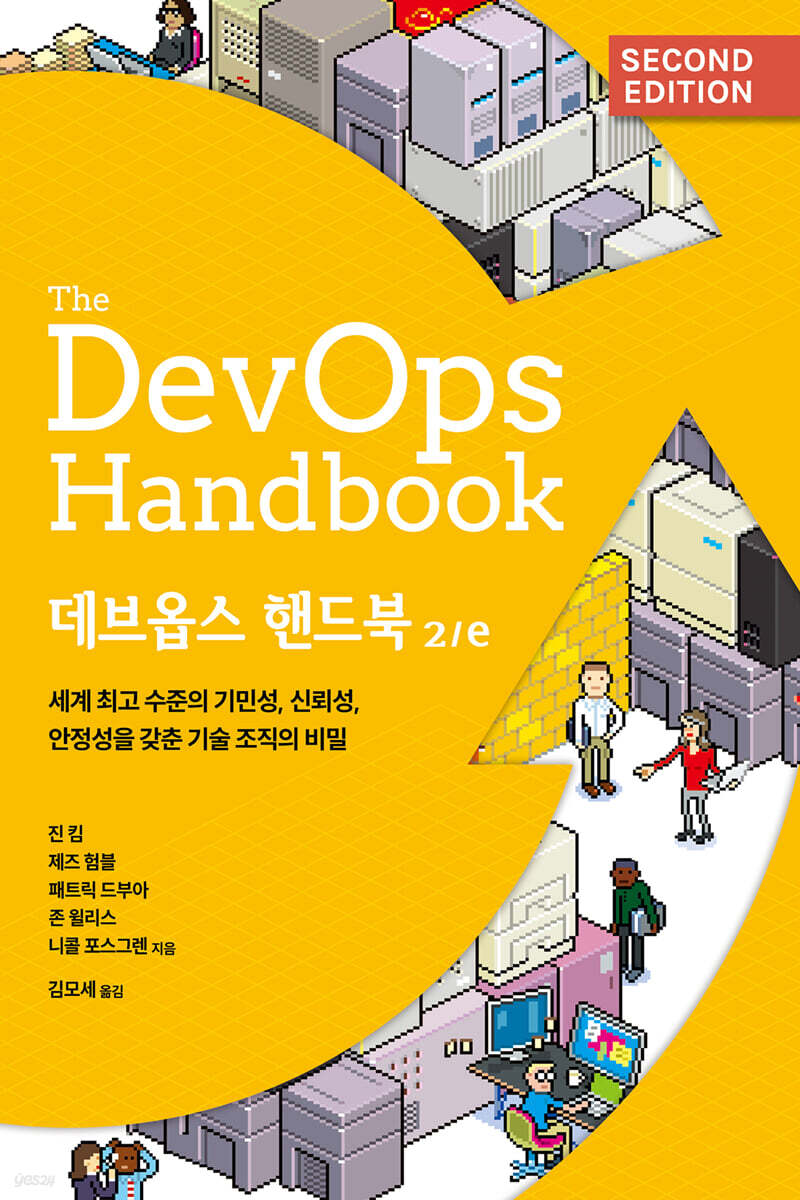
DevOps Handbook 2/e
 |
Description
Book Introduction
DevOps is a compound word of software development and operations, and refers to an environment and culture that continuously and stably develops and operates software through communication, collaboration, and integration between software developers and information technology experts.
Since the publication of the first edition in 2016, the second edition has been refined and supplemented based on the latest research findings, practices, and case studies.
In today's world, where everything has changed since the COVID-19 pandemic in 2020, this book will provide insight into not only the concept of DevOps, but also its modern significance and various concepts and principles that can be applied in actual development.
Since the publication of the first edition in 2016, the second edition has been refined and supplemented based on the latest research findings, practices, and case studies.
In today's world, where everything has changed since the COVID-19 pandemic in 2020, this book will provide insight into not only the concept of DevOps, but also its modern significance and various concepts and principles that can be applied in actual development.
- You can preview some of the book's contents.
Preview
index
Part 1.
Three ways/
Part 1 / Introduction
Chapter 1.
Agile, Continuous Delivery, and the Three Methods
__Manufacturing (Production) Value Stream
__Technology Value Stream
__Three Principles Underpinning DevOps
____Case Study: 2nd Edition Additional Access to Cruising Altitude:
____American Airlines' DevOps Journey (Part 1) (2020)
__conclusion
Chapter 2.
Method 1: Flow Principle
__Visualizing work
__Limit Work in Progress (WIP)
__Reducing the size of batch jobs
__Reduce the number of handoffs
__Continuously check and improve constraints
__Removing pain and waste from the value stream
____Case Study: Managing Flow and Constraints in Healthcare, 2nd Edition (2001)
__conclusion
Chapter 3.
Method Two: The Feedback Principle
__Working safely in complex systems
__Check the problem at the time it occurs
__Accumulating new knowledge through swarming and problem solving
Case Study: Pulling the Andon Code, 2nd Edition (2018)
__Keeping quality activities closer to the source
__Optimizing Downstream Work Centers
__conclusion
Chapter 4.
The Third Method: The Principle of Continuous Learning and Experimentation
__Enabling organizational learning and a safety culture
__Institutionalize daily work improvements
__Transform local discoveries into organization-wide improvements.
__Add resilience patterns to your daily work
__Leaders strengthen a learning culture.
____Case Study: The Bell Labs Story (1925), 2nd Edition
__conclusion
Part 1 / Conclusion
Part 2.
Where to start?
Part 2 / Introduction
Chapter 5.
Select a value stream to start with
__Nordstrom's DevOps Transformation
__Greenfield Service VS.
Brownfield Services
____Case Study: 2nd Edition Supplement Castle Run: Aerial Refueling Systems
______Brownfield Transition (2020)
__Consider both the record system and the participation system.
__Start with the most empathetic and innovative group.
__Scaling DevOps across the entire organization
____Case Study: Scaling DevOps Across Your Business, 2nd Edition Additions:
American Error Lines' DevOps Journey (Part 2) (2020)
____Case Study: HMRC, 2nd Edition (Using Large-Scale PaaS)
______Reviving the Economy from Ruins (2020)
__conclusion
Chapter 6.
Understanding and visualizing work within the value stream and extending it across the organization.
__Nordstrom's Value Stream Mapping Experience
Identifying the team that supports your value stream
__Create a value stream map to understand your work.
__Building a Dedicated Transformation Team
____Case Study: LinkedIn, Operation Inversion (2011)
__Using tools to promote behavior change
__conclusion
Chapter 7.
Organizational and Architecture Design Methods Considering Conway's Law
Conway's Law in Etsy
__Organization's Archetype
Problems with excessive functional orientation (cost optimization)
__Activating a market-oriented team (optimizing for speed)
__Creating functionally oriented tasks
Testing, operations, and security are everyone's daily tasks.
__Make every team member a generalist
__Invest in services and products, not projects.
__Design team boundaries according to Conway's Law
__For developer productivity and safety
____Build a loosely coupled architecture
__Keep your team small (the two-pizza rule)
____Case Study: Target, API Activation (2015)
__conclusion
Chapter 8.
How to integrate daily tasks and operations to achieve optimal results
__Big Fish Games
__Create shared services to improve developer productivity.
__Include operations engineers in your service team.
__Designate an operations contact person for each service team.
__Integrate operations into the development team's regular work activities.
____Case Study: 2nd Edition Supplement Nationwide Building Society,
How to Do ______ Better (2020)
__conclusion
Part 2 / Conclusion
Part 3.
Method 1: Technical Practices for Improving Flow
Part 3 / Introduction
Chapter 9.
Creating the foundation for a deployment pipeline
The Enterprise Data Warehouse Story (2009)
__Development, test, and production environments on demand
Allow ____ to be created
__Create a single repository for the entire system
__Create infrastructure that is easier to rebuild than to repair.
____Case Study: 2nd Edition Additional Containers for $30 Billion
Hotel companies that made ______ profits (2020)
__Development items including execution in a similar production environment
____Revise the definition of 'complete'
__conclusion
Chapter 10.
Enable fast and reliable automated testing.
__Google's Web Server Story (2005)
__Continuously build, test, and integrate your code with your environment.
__Create fast, reliable, and automated verification test suites.
__Find errors in automated tests as early as possible.
__If your deployment pipeline breaks, pull the Andon code.
__conclusion
Chapter 11.
Enable and practice continuous integration.
__HP LaserJet Firmware (2014)
__Small batch development and code in trunk
__What happens when you commit rarely?
__Apply trunk-based development practices
____Case Study: Bazaarvoice, Continuous Integration (2012)
__conclusion
Chapter 12.
Automate and enable low-risk launches.
__Automate the deployment process
____Case Study CSG International, Daily Distribution (2013)
____Case Study: Etsy, Self-Service Developer Deployment and Continuous Delivery (2014)
__Separate release and distribution
____Case Study: Dixons Retail Deploys Blue Green Store Management System (2008)
____Case Study: Facebook Chat, Dark Launch (2008)
__A Study on Continuous Delivery and Continuous Distribution
____Case Study: Creating a Win-Win Relationship Between Development and Operations, 2nd Edition, Additional CSG (2016)
__conclusion
Chapter 13.
Architecture for low-risk releases
__Architecture that improves productivity, testability, and safety
__Architecture Archetypes - Monolith vs.
Microservices
____Case Study: Amazon, Evolutionary Architecture (2002)
__For the safe evolution of enterprise architecture
Use the ____Strangler Application Pattern
____Case Study: The Strangler Pattern in the Blackboard Learn Project (2011)
__conclusion
Part 3 / Conclusion
Part 4.
Method Two: Technical Practices for Feedback
Part 4 / Introduction
Chapter 14.
Generate telemetry that enables problem identification and resolution.
__Etsy's DevOps Transformation
__Build a centralized telemetry infrastructure
__Generate application logging telemetry useful for production.
__Use telemetry to guide troubleshooting
__Enable the generation of production metrics in daily work
__Create your own service to access telemetry and information radiators.
____Case Study: LinkedIn Creates Its Own Service Metrics (2011)
__Identify and address telemetry's shortcomings.
__conclusion
Chapter 15.
Analyze telemetry to better predict problems and achieve your goals.
Telemetry on Netflix (2012)
__Use the mean and standard deviation to detect potential problems.
__Measure and warn of undesirable outcomes
__Problems that arise when telemetry data does not follow a Gaussian distribution
____Case Study: Netflix, Automatic Capacity Scaling (2012)
__Using anomaly detection techniques
____Case Study: Enhanced Anomaly Detection Techniques (2014)
__conclusion
Chapter 16.
Enable feedback so development and operations can safely deploy code.
__Make deployments more secure using telemetry
__Development shares the responsibilities of operations and phaser rotation.
__Let developers follow downstream work
__Initially, let developers manage product services themselves.
____Case Study: Google, Implementation and Handoff Preparation Review (2010)
__conclusion
Chapter 17.
Integrate hypothesis-driven development and A/B testing into your daily work.
Intuit's Hypothesis-Driven Development (2012)
__A Brief History of A/B Testing
Integrating A/B Testing into Functional Testing
__Integrating A/B testing into launch
__Integrating A/B testing into feature planning
____Case Study Yahoo! Answers,
______Doubling Sales Through Rapid Release Cycle Experiments (2010)
__conclusion
Chapter 18.
Create a review and adjustment process to improve the quality of your current work.
__GitHub Peer Review (2011)
__The Risks of the Change Approval Process
Potential risks of 'excessive change control'
____Case Study: 2nd Edition Added Adidas,
From the Six Eyes Principle to Launch (2020)
__Activate coordination and planning for change
__Enable peer review of changes
____Case Study: Google, Code Review (2010)
__Potential risks of performing more manual testing and prohibiting changes
__Enable pair programming to improve all changes.
____Case Study Pivotal Labs, Using Pair Programming
Replacing a Broken Code Review Process (2011)
__Evaluating the effectiveness of the pull request process
__Boldly eliminate bureaucratic procedures
__conclusion
Part 4 / Conclusion
Part 5.
The Third Way: Technical Practices for Continuous Learning and Experimentation
Part 5 / Introduction
Chapter 19.
Activate and instill learning as part of your daily routine.
__AWS US East Region and Netflix (2011)
__Create a fair learning culture
__Plan a retrospective meeting after an incident.
__Make retrospective reviews as widely public as possible.
Reduce your tolerance for accidents to detect the weakest signals of failure.
Redefine failure and encourage calculated risk-taking.
__Instill resilience and learning by instilling production failures.
__Introduce game days to practice failure.
____Case Study: 2nd Edition Additional CSG, Disability as a Powerful Learning Opportunity
______Transition (2021)
__conclusion
Chapter 20.
Transform local discoveries into organization-wide improvements.
__Automate and store organizational knowledge using chat rooms and chatbots.
__GitHub's Hubot
__Automate the standardization process of software to enable reuse.
__Create a single shared source code repository for the entire organization.
__Use automated testing as a documentation and practice community to spread knowledge.
__Systematize non-functional requirements and design operations.
__Design for operations using coded non-functional requirements.
__Create reusable operational user stories as development items
__Ensure that technical choices help achieve the organization's goals.
____Case Study: Etsy Standardizes a New Technology Stack (2010)
____Case Study: 2nd Edition Additional Targets, Crowdsourcing
______Technology Governance (2018)
__conclusion
Chapter 21.
Make time for learning and improvement in your organization.
__Target, 30-Day Challenge (2015)
Pay off technical debt by institutionalizing rituals.
__Let everyone teach and learn
Share your experiences at the __DevOps Conference
____Case Study Nationwide Insurance, Capital One,
______Target's Internal Technology Conference (2014)
__Create a community structure to spread the practice.
__conclusion
Part 5 / Conclusion
Part 6.
Technical practices for integrating information security, change management, and compliance.
Part 6 / Introduction
Chapter 22.
Information security is everyone's daily job.
__Integrate security into your development iteration demos
__Integrate security into defect tracking and postmortems
__Preventive security controls shared with source code repositories and
__Integrate into shared services
__Integrate security into your deployment pipeline
__Ensure the security of your application
____Case Study: Twitter, Static Security Testing (2009)
__Ensure the security of your software supply chain
__Ensure security for the environment
____Case Study 18F, Through Compliance Mercenaries
______Federal Government Compliance Automation
__Integrate information security with production telemetry
____Case Study Etsy, Environmental Measurement (2010)
__Protect your deployment pipeline
____Case Study: Shifting Left in Security, 2nd Edition, Additional Pie Mae (2020)
__conclusion
Chapter 23.
Protecting your deployment pipeline
__Integrate security and compliance into your change approval process.
__Reclassify low-risk changes as standard changes
__What to do when a change is classified as a general change
____Case Study Salesforce.com, Standard Changes
______Automated Infrastructure Change Handling (2012)
Separate duties through code reviews
____Case Study: Etsy, a Lesson in PCI Compliance and Segregation of Duties (2014)
____Case Study: Capital One, "Fearless" (2nd Edition)
______Partnership between Hyangsan Business and Development with 10 releases per day
__Secure documentation and evidence for auditors and compliance officers.
____Case Study: Demonstrating Compliance in a Regulatory Environment (2015)
____Case Study: Production Telemetry for ATM Systems
Depend on ______ (2013)
__conclusion
Part 6 / Conclusion
Now is the Time to Act: Conclusion from the DevOps Handbook
Concluding the 2nd edition
supplement
Three ways/
Part 1 / Introduction
Chapter 1.
Agile, Continuous Delivery, and the Three Methods
__Manufacturing (Production) Value Stream
__Technology Value Stream
__Three Principles Underpinning DevOps
____Case Study: 2nd Edition Additional Access to Cruising Altitude:
____American Airlines' DevOps Journey (Part 1) (2020)
__conclusion
Chapter 2.
Method 1: Flow Principle
__Visualizing work
__Limit Work in Progress (WIP)
__Reducing the size of batch jobs
__Reduce the number of handoffs
__Continuously check and improve constraints
__Removing pain and waste from the value stream
____Case Study: Managing Flow and Constraints in Healthcare, 2nd Edition (2001)
__conclusion
Chapter 3.
Method Two: The Feedback Principle
__Working safely in complex systems
__Check the problem at the time it occurs
__Accumulating new knowledge through swarming and problem solving
Case Study: Pulling the Andon Code, 2nd Edition (2018)
__Keeping quality activities closer to the source
__Optimizing Downstream Work Centers
__conclusion
Chapter 4.
The Third Method: The Principle of Continuous Learning and Experimentation
__Enabling organizational learning and a safety culture
__Institutionalize daily work improvements
__Transform local discoveries into organization-wide improvements.
__Add resilience patterns to your daily work
__Leaders strengthen a learning culture.
____Case Study: The Bell Labs Story (1925), 2nd Edition
__conclusion
Part 1 / Conclusion
Part 2.
Where to start?
Part 2 / Introduction
Chapter 5.
Select a value stream to start with
__Nordstrom's DevOps Transformation
__Greenfield Service VS.
Brownfield Services
____Case Study: 2nd Edition Supplement Castle Run: Aerial Refueling Systems
______Brownfield Transition (2020)
__Consider both the record system and the participation system.
__Start with the most empathetic and innovative group.
__Scaling DevOps across the entire organization
____Case Study: Scaling DevOps Across Your Business, 2nd Edition Additions:
American Error Lines' DevOps Journey (Part 2) (2020)
____Case Study: HMRC, 2nd Edition (Using Large-Scale PaaS)
______Reviving the Economy from Ruins (2020)
__conclusion
Chapter 6.
Understanding and visualizing work within the value stream and extending it across the organization.
__Nordstrom's Value Stream Mapping Experience
Identifying the team that supports your value stream
__Create a value stream map to understand your work.
__Building a Dedicated Transformation Team
____Case Study: LinkedIn, Operation Inversion (2011)
__Using tools to promote behavior change
__conclusion
Chapter 7.
Organizational and Architecture Design Methods Considering Conway's Law
Conway's Law in Etsy
__Organization's Archetype
Problems with excessive functional orientation (cost optimization)
__Activating a market-oriented team (optimizing for speed)
__Creating functionally oriented tasks
Testing, operations, and security are everyone's daily tasks.
__Make every team member a generalist
__Invest in services and products, not projects.
__Design team boundaries according to Conway's Law
__For developer productivity and safety
____Build a loosely coupled architecture
__Keep your team small (the two-pizza rule)
____Case Study: Target, API Activation (2015)
__conclusion
Chapter 8.
How to integrate daily tasks and operations to achieve optimal results
__Big Fish Games
__Create shared services to improve developer productivity.
__Include operations engineers in your service team.
__Designate an operations contact person for each service team.
__Integrate operations into the development team's regular work activities.
____Case Study: 2nd Edition Supplement Nationwide Building Society,
How to Do ______ Better (2020)
__conclusion
Part 2 / Conclusion
Part 3.
Method 1: Technical Practices for Improving Flow
Part 3 / Introduction
Chapter 9.
Creating the foundation for a deployment pipeline
The Enterprise Data Warehouse Story (2009)
__Development, test, and production environments on demand
Allow ____ to be created
__Create a single repository for the entire system
__Create infrastructure that is easier to rebuild than to repair.
____Case Study: 2nd Edition Additional Containers for $30 Billion
Hotel companies that made ______ profits (2020)
__Development items including execution in a similar production environment
____Revise the definition of 'complete'
__conclusion
Chapter 10.
Enable fast and reliable automated testing.
__Google's Web Server Story (2005)
__Continuously build, test, and integrate your code with your environment.
__Create fast, reliable, and automated verification test suites.
__Find errors in automated tests as early as possible.
__If your deployment pipeline breaks, pull the Andon code.
__conclusion
Chapter 11.
Enable and practice continuous integration.
__HP LaserJet Firmware (2014)
__Small batch development and code in trunk
__What happens when you commit rarely?
__Apply trunk-based development practices
____Case Study: Bazaarvoice, Continuous Integration (2012)
__conclusion
Chapter 12.
Automate and enable low-risk launches.
__Automate the deployment process
____Case Study CSG International, Daily Distribution (2013)
____Case Study: Etsy, Self-Service Developer Deployment and Continuous Delivery (2014)
__Separate release and distribution
____Case Study: Dixons Retail Deploys Blue Green Store Management System (2008)
____Case Study: Facebook Chat, Dark Launch (2008)
__A Study on Continuous Delivery and Continuous Distribution
____Case Study: Creating a Win-Win Relationship Between Development and Operations, 2nd Edition, Additional CSG (2016)
__conclusion
Chapter 13.
Architecture for low-risk releases
__Architecture that improves productivity, testability, and safety
__Architecture Archetypes - Monolith vs.
Microservices
____Case Study: Amazon, Evolutionary Architecture (2002)
__For the safe evolution of enterprise architecture
Use the ____Strangler Application Pattern
____Case Study: The Strangler Pattern in the Blackboard Learn Project (2011)
__conclusion
Part 3 / Conclusion
Part 4.
Method Two: Technical Practices for Feedback
Part 4 / Introduction
Chapter 14.
Generate telemetry that enables problem identification and resolution.
__Etsy's DevOps Transformation
__Build a centralized telemetry infrastructure
__Generate application logging telemetry useful for production.
__Use telemetry to guide troubleshooting
__Enable the generation of production metrics in daily work
__Create your own service to access telemetry and information radiators.
____Case Study: LinkedIn Creates Its Own Service Metrics (2011)
__Identify and address telemetry's shortcomings.
__conclusion
Chapter 15.
Analyze telemetry to better predict problems and achieve your goals.
Telemetry on Netflix (2012)
__Use the mean and standard deviation to detect potential problems.
__Measure and warn of undesirable outcomes
__Problems that arise when telemetry data does not follow a Gaussian distribution
____Case Study: Netflix, Automatic Capacity Scaling (2012)
__Using anomaly detection techniques
____Case Study: Enhanced Anomaly Detection Techniques (2014)
__conclusion
Chapter 16.
Enable feedback so development and operations can safely deploy code.
__Make deployments more secure using telemetry
__Development shares the responsibilities of operations and phaser rotation.
__Let developers follow downstream work
__Initially, let developers manage product services themselves.
____Case Study: Google, Implementation and Handoff Preparation Review (2010)
__conclusion
Chapter 17.
Integrate hypothesis-driven development and A/B testing into your daily work.
Intuit's Hypothesis-Driven Development (2012)
__A Brief History of A/B Testing
Integrating A/B Testing into Functional Testing
__Integrating A/B testing into launch
__Integrating A/B testing into feature planning
____Case Study Yahoo! Answers,
______Doubling Sales Through Rapid Release Cycle Experiments (2010)
__conclusion
Chapter 18.
Create a review and adjustment process to improve the quality of your current work.
__GitHub Peer Review (2011)
__The Risks of the Change Approval Process
Potential risks of 'excessive change control'
____Case Study: 2nd Edition Added Adidas,
From the Six Eyes Principle to Launch (2020)
__Activate coordination and planning for change
__Enable peer review of changes
____Case Study: Google, Code Review (2010)
__Potential risks of performing more manual testing and prohibiting changes
__Enable pair programming to improve all changes.
____Case Study Pivotal Labs, Using Pair Programming
Replacing a Broken Code Review Process (2011)
__Evaluating the effectiveness of the pull request process
__Boldly eliminate bureaucratic procedures
__conclusion
Part 4 / Conclusion
Part 5.
The Third Way: Technical Practices for Continuous Learning and Experimentation
Part 5 / Introduction
Chapter 19.
Activate and instill learning as part of your daily routine.
__AWS US East Region and Netflix (2011)
__Create a fair learning culture
__Plan a retrospective meeting after an incident.
__Make retrospective reviews as widely public as possible.
Reduce your tolerance for accidents to detect the weakest signals of failure.
Redefine failure and encourage calculated risk-taking.
__Instill resilience and learning by instilling production failures.
__Introduce game days to practice failure.
____Case Study: 2nd Edition Additional CSG, Disability as a Powerful Learning Opportunity
______Transition (2021)
__conclusion
Chapter 20.
Transform local discoveries into organization-wide improvements.
__Automate and store organizational knowledge using chat rooms and chatbots.
__GitHub's Hubot
__Automate the standardization process of software to enable reuse.
__Create a single shared source code repository for the entire organization.
__Use automated testing as a documentation and practice community to spread knowledge.
__Systematize non-functional requirements and design operations.
__Design for operations using coded non-functional requirements.
__Create reusable operational user stories as development items
__Ensure that technical choices help achieve the organization's goals.
____Case Study: Etsy Standardizes a New Technology Stack (2010)
____Case Study: 2nd Edition Additional Targets, Crowdsourcing
______Technology Governance (2018)
__conclusion
Chapter 21.
Make time for learning and improvement in your organization.
__Target, 30-Day Challenge (2015)
Pay off technical debt by institutionalizing rituals.
__Let everyone teach and learn
Share your experiences at the __DevOps Conference
____Case Study Nationwide Insurance, Capital One,
______Target's Internal Technology Conference (2014)
__Create a community structure to spread the practice.
__conclusion
Part 5 / Conclusion
Part 6.
Technical practices for integrating information security, change management, and compliance.
Part 6 / Introduction
Chapter 22.
Information security is everyone's daily job.
__Integrate security into your development iteration demos
__Integrate security into defect tracking and postmortems
__Preventive security controls shared with source code repositories and
__Integrate into shared services
__Integrate security into your deployment pipeline
__Ensure the security of your application
____Case Study: Twitter, Static Security Testing (2009)
__Ensure the security of your software supply chain
__Ensure security for the environment
____Case Study 18F, Through Compliance Mercenaries
______Federal Government Compliance Automation
__Integrate information security with production telemetry
____Case Study Etsy, Environmental Measurement (2010)
__Protect your deployment pipeline
____Case Study: Shifting Left in Security, 2nd Edition, Additional Pie Mae (2020)
__conclusion
Chapter 23.
Protecting your deployment pipeline
__Integrate security and compliance into your change approval process.
__Reclassify low-risk changes as standard changes
__What to do when a change is classified as a general change
____Case Study Salesforce.com, Standard Changes
______Automated Infrastructure Change Handling (2012)
Separate duties through code reviews
____Case Study: Etsy, a Lesson in PCI Compliance and Segregation of Duties (2014)
____Case Study: Capital One, "Fearless" (2nd Edition)
______Partnership between Hyangsan Business and Development with 10 releases per day
__Secure documentation and evidence for auditors and compliance officers.
____Case Study: Demonstrating Compliance in a Regulatory Environment (2015)
____Case Study: Production Telemetry for ATM Systems
Depend on ______ (2013)
__conclusion
Part 6 / Conclusion
Now is the Time to Act: Conclusion from the DevOps Handbook
Concluding the 2nd edition
supplement
Publisher's Review
◈ Target audience of this book ◈
This book is for all business and marketing leaders involved in technology initiatives, as well as those who perform or influence work across technology value streams (typically project management, development, QA, IT operations, and information security).
Readers of this book are expected to lack extensive knowledge of domains such as DevOps, Agile, ITIL, Lean, and process improvement.
Each topic will be introduced and explained when necessary.
The purpose of this book is to create a working knowledge of the core concepts in each domain, serve as an introductory guide, introduce the language practitioners need to work with colleagues across the entire IT value stream, and create a framework of shared goals.
It will also be valuable to business leaders and stakeholders who increasingly rely on technology organizations to achieve their goals.
Furthermore, it is intended for readers in organizations that have not yet experienced all the challenges described in this book (e.g., long deployment lead times, painful deployments).
They would benefit greatly from understanding DevOps principles, especially those related to shared goals, feedback, and continuous learning.
◈ Structure of this book ◈
Part 1 presents a brief history of DevOps and introduces the foundational theories and core themes gleaned from decades of relevant knowledge.
Next, we explain the upper principles of the 'three ways': continuous learning and experimentation.
Part 2 explains where and how to get started with DevOps, introducing concepts such as value streams, organizational design principles and patterns, organizational adoption patterns, and case studies.
Part 3 explains how to build the foundation of a deployment pipeline to accelerate 'flow'.
Learn how to implement architectures for fast and effective automated testing, continuous integration, continuous delivery, and low-risk releases.
Part 4 discusses how to accelerate and amplify feedback.
We'll discuss how to generate effective production telemetry to discover and resolve issues, enable feedback to better predict issues and achieve goals, enable development and operations to safely deploy changes, integrate A/B testing into daily work, and create review and adjustment processes to improve the quality of work.
In Part 5, we explore how to accelerate 'continuous learning'.
We'll show you how to establish the right culture, apply what your department learns to improve the entire organization, and properly secure time for organizational learning and improvement.
Finally, Part 6 discusses how to properly integrate security compliance into your daily work.
It also discusses the integration of security control precautions into shared source code repositories and services, the integration of security into deployment pipelines, the enhancement of telemetry for more effective detection and recovery, and the achievement of deployment pipeline protection and change management goals.
We hope that systematizing these practices will accelerate the adoption of DevOps practices, increase the success of DevOps initiatives, and reduce the effort required for DevOps transformation.
◈ Author's Note ◈
In 『DevOps Handbook 2/e』, the authors have updated the text to incorporate new research, learnings, and experiences.
You can understand DevOps as well as how DevOps is used in the industry.
Also co-authored by renowned researcher Dr. Nicole Forsgren.
Nicole has been a great help in updating and expanding the book with new research and various indicators to support it.
We also added various case studies.
Each case study demonstrates how DevOps has spread beyond the IT department and into every industry, from the C-suite to the C-suite.
At the end of each case study, we included one or two key takeaways highlighting the most important learnings.
Finally, we added a conclusion to each chapter along with new resources.
It will help you to continue learning.
◈ Translator's Note ◈
When I close my eyes and open them, a different world unfolds before me.
The pace of change, especially in the software field, is faster than in any other field.
Not only development languages, but also processes, development organizations, and development culture are all changing.
The rapid pace of change is further accelerated by the numerous technologies being released daily.
DevOps is a compound word for software development and operation, and it refers to an environment and culture that continuously and stably develops and operates software through communication, collaboration, and integration between software developers and information technology experts.
DevOps, which focuses on a development culture based on continuous and evolving collaboration, is expanding into xOps and its impact is spreading across various areas.
The DevOps Handbook 2/e is an expanded version of the DevOps Handbook published in 2016.
Since the publication of the first edition, the authors have refined and supplemented the content based on the latest research findings, practices, and case studies.
In today's world, where everything has changed since the COVID-19 pandemic in 2020, this book will provide insight into not only the concept of DevOps, but also its modern significance and the various concepts and principles that can be applied in actual development.
This book is for all business and marketing leaders involved in technology initiatives, as well as those who perform or influence work across technology value streams (typically project management, development, QA, IT operations, and information security).
Readers of this book are expected to lack extensive knowledge of domains such as DevOps, Agile, ITIL, Lean, and process improvement.
Each topic will be introduced and explained when necessary.
The purpose of this book is to create a working knowledge of the core concepts in each domain, serve as an introductory guide, introduce the language practitioners need to work with colleagues across the entire IT value stream, and create a framework of shared goals.
It will also be valuable to business leaders and stakeholders who increasingly rely on technology organizations to achieve their goals.
Furthermore, it is intended for readers in organizations that have not yet experienced all the challenges described in this book (e.g., long deployment lead times, painful deployments).
They would benefit greatly from understanding DevOps principles, especially those related to shared goals, feedback, and continuous learning.
◈ Structure of this book ◈
Part 1 presents a brief history of DevOps and introduces the foundational theories and core themes gleaned from decades of relevant knowledge.
Next, we explain the upper principles of the 'three ways': continuous learning and experimentation.
Part 2 explains where and how to get started with DevOps, introducing concepts such as value streams, organizational design principles and patterns, organizational adoption patterns, and case studies.
Part 3 explains how to build the foundation of a deployment pipeline to accelerate 'flow'.
Learn how to implement architectures for fast and effective automated testing, continuous integration, continuous delivery, and low-risk releases.
Part 4 discusses how to accelerate and amplify feedback.
We'll discuss how to generate effective production telemetry to discover and resolve issues, enable feedback to better predict issues and achieve goals, enable development and operations to safely deploy changes, integrate A/B testing into daily work, and create review and adjustment processes to improve the quality of work.
In Part 5, we explore how to accelerate 'continuous learning'.
We'll show you how to establish the right culture, apply what your department learns to improve the entire organization, and properly secure time for organizational learning and improvement.
Finally, Part 6 discusses how to properly integrate security compliance into your daily work.
It also discusses the integration of security control precautions into shared source code repositories and services, the integration of security into deployment pipelines, the enhancement of telemetry for more effective detection and recovery, and the achievement of deployment pipeline protection and change management goals.
We hope that systematizing these practices will accelerate the adoption of DevOps practices, increase the success of DevOps initiatives, and reduce the effort required for DevOps transformation.
◈ Author's Note ◈
In 『DevOps Handbook 2/e』, the authors have updated the text to incorporate new research, learnings, and experiences.
You can understand DevOps as well as how DevOps is used in the industry.
Also co-authored by renowned researcher Dr. Nicole Forsgren.
Nicole has been a great help in updating and expanding the book with new research and various indicators to support it.
We also added various case studies.
Each case study demonstrates how DevOps has spread beyond the IT department and into every industry, from the C-suite to the C-suite.
At the end of each case study, we included one or two key takeaways highlighting the most important learnings.
Finally, we added a conclusion to each chapter along with new resources.
It will help you to continue learning.
◈ Translator's Note ◈
When I close my eyes and open them, a different world unfolds before me.
The pace of change, especially in the software field, is faster than in any other field.
Not only development languages, but also processes, development organizations, and development culture are all changing.
The rapid pace of change is further accelerated by the numerous technologies being released daily.
DevOps is a compound word for software development and operation, and it refers to an environment and culture that continuously and stably develops and operates software through communication, collaboration, and integration between software developers and information technology experts.
DevOps, which focuses on a development culture based on continuous and evolving collaboration, is expanding into xOps and its impact is spreading across various areas.
The DevOps Handbook 2/e is an expanded version of the DevOps Handbook published in 2016.
Since the publication of the first edition, the authors have refined and supplemented the content based on the latest research findings, practices, and case studies.
In today's world, where everything has changed since the COVID-19 pandemic in 2020, this book will provide insight into not only the concept of DevOps, but also its modern significance and the various concepts and principles that can be applied in actual development.
GOODS SPECIFICS
- Date of issue: May 31, 2024
- Page count, weight, size: 628 pages | 152*228*29mm
- ISBN13: 9791161758480
- ISBN10: 1161758488
You may also like
카테고리
korean


korean

![GQ KOREA Mark (Monthly): December [2025]](http://librairie.coreenne.fr/cdn/shop/files/8ef265dbbfbf186523ed75ba7319009d.jpg?v=1765340328&width=3840)


