

Freezing food ingredients is the answer!
 |
Description
Book Introduction
Cooking Recipe Award 2024 in Japan [Cooking Category] Winner!
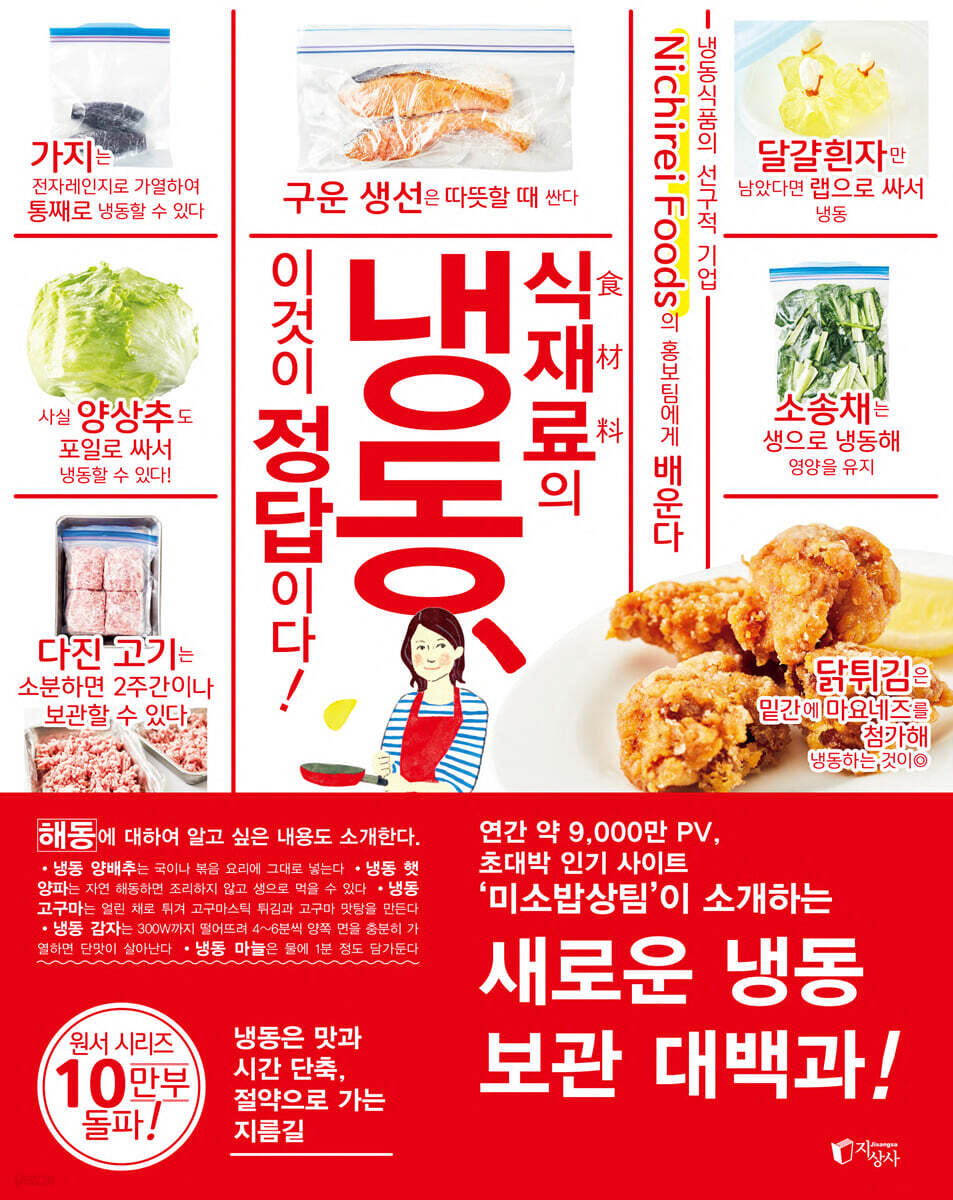
Over 150 ways to freeze food ingredients revealed
The hottest frozen book right now!
Are frozen foods hygienic?
The thawed vegetables are soft and tasteless.
Is this freezing method actually correct?
I'm concerned about the smell and taste of frozen food.
All your questions and concerns about freezer storage are answered.
Everyone takes freezing for granted.
But how many people can confidently say, "I'm using it well!" Resolving your questions and concerns about freezer storage can shorten your everyday cooking time.
We will be able to enjoy our family's precious mealtimes more.
With this in mind, the Nichirei Foods PR team launched the "Smile Table" website.
And the column 'Freezing Ingredients' from 'Smile Table' was collected and included in this book.
It's packed with chefs' advice and recipes on freezing, as well as hints to make cooking more enjoyable.
Consider using 'frozen' ingredients as an important factor in meal preparation.
I hope this will be a good opportunity to create a dining table full of laughter in your home.
Over 150 ways to freeze food ingredients revealed
The hottest frozen book right now!
Are frozen foods hygienic?
The thawed vegetables are soft and tasteless.
Is this freezing method actually correct?
I'm concerned about the smell and taste of frozen food.
All your questions and concerns about freezer storage are answered.
Everyone takes freezing for granted.
But how many people can confidently say, "I'm using it well!" Resolving your questions and concerns about freezer storage can shorten your everyday cooking time.
We will be able to enjoy our family's precious mealtimes more.
With this in mind, the Nichirei Foods PR team launched the "Smile Table" website.
And the column 'Freezing Ingredients' from 'Smile Table' was collected and included in this book.
It's packed with chefs' advice and recipes on freezing, as well as hints to make cooking more enjoyable.
Consider using 'frozen' ingredients as an important factor in meal preparation.
I hope this will be a good opportunity to create a dining table full of laughter in your home.
- You can preview some of the book's contents.
Preview
index
All your questions and concerns about freezer storage answered.
Structure of this book
Don't Make Mistakes Now! The Basic Rules of Freezing
Rules for freezing vegetables
Meat Freezing Storage Rules
Fish Freezing Storage Rules
Chapter 1: Freezing Vegetables and Fruits
Spinach salad
crown daisy / bok choy cabbage
Lettuce/Cabbage/Myeongsuchae
Rapeseed flowers / asparagus green onions
Chives and tomatoes
Eggplant Cucumber / Zucchini
Bell peppers / paprika / chili peppers / okra
Broccoli/cauliflower carrots
Cornmeal / Avocado
Onion radish
Turnip burdock / lotus root
Pumpkin and sweet potato
Potatoes / Taro / Yam / Shiitake mushrooms
Enoki mushrooms / Shiitake mushrooms
Mushrooms / Shiitake mushrooms / Tasty mushrooms
Bean sprouts / kidney beans / green beans / peas
Ginger garlic
Seesaw / Yangha Paddeuknamul (Badinamul) / Yuja
Basil / Coriander / Cilantro
Celery / Parsley Banana
Apple / Pear / Tangerine
Orange Lemon
Persimmon / Kiwi / Grapefruit / Blueberry
Peach / Plum Strawberry / Cherry
Figs / Loquats / Watermelon
Melon / Mango
Chapter 2 Freezing Meat
Chicken breast, chicken tenderloin
Chicken drumstick pork
minced meat liver
Bacon Vienna Sausage
ham
Chapter 3: Freezing Fish
Salmon mackerel
Defense Shirasu
Shrimp Octopus (Boiled Octopus)
Oyster clams
Clam and pollack roe / salmon roe
Raw seaweed / seaweed roe / herring roe
Grilled fish / sashimi
Chapter 4 Freezing of dairy products, eggs, soy products, and fish cakes
Butter cream
Yogurt cheese
Egg white tofu fritters
Biji cylindrical fish cake
Fried fish cake, steamed fish cake / plated fish cake
Konjac / Silk Konjac
Chapter 5 Freezing of Stocks
Rice ball glutinous rice cake
Cookie Bread / Meal Replacement Bread Udon
Somen dumpling skin
Sake lees
Chapter 6: Freezing side dishes and desserts
Fried Chicken Spring Rolls
Fried shrimp tempura
High Rice Stew
Gapao Rice Egg Rice Bowl
Pizza Okonomiyaki (Cabbage Pancakes)
Meatballs with Meat Sauce
Bell Pepper Meatballs Beef and Potato Stew
Gratin cabbage rolls
Soup Potato Salad
Pork soybean paste stew, chicken and vegetable stew
Braised radish greens, braised burdock root, braised gourd
Red bean cake
Donut Castella
Baumkuchen / Raw Chocolate Jam
column
Before you know it, it's full! Freezer storage: This is the answer: Use the top and bottom compartments separately.
How to thaw frozen scallops to keep them plump and tender
Before you know it, it's full! Freezer storage: This is the answer. Small storage tips you can use right away.
Using the microwave! What's the best way to defrost frozen dumplings?
Structure of this book
Don't Make Mistakes Now! The Basic Rules of Freezing
Rules for freezing vegetables
Meat Freezing Storage Rules
Fish Freezing Storage Rules
Chapter 1: Freezing Vegetables and Fruits
Spinach salad
crown daisy / bok choy cabbage
Lettuce/Cabbage/Myeongsuchae
Rapeseed flowers / asparagus green onions
Chives and tomatoes
Eggplant Cucumber / Zucchini
Bell peppers / paprika / chili peppers / okra
Broccoli/cauliflower carrots
Cornmeal / Avocado
Onion radish
Turnip burdock / lotus root
Pumpkin and sweet potato
Potatoes / Taro / Yam / Shiitake mushrooms
Enoki mushrooms / Shiitake mushrooms
Mushrooms / Shiitake mushrooms / Tasty mushrooms
Bean sprouts / kidney beans / green beans / peas
Ginger garlic
Seesaw / Yangha Paddeuknamul (Badinamul) / Yuja
Basil / Coriander / Cilantro
Celery / Parsley Banana
Apple / Pear / Tangerine
Orange Lemon
Persimmon / Kiwi / Grapefruit / Blueberry
Peach / Plum Strawberry / Cherry
Figs / Loquats / Watermelon
Melon / Mango
Chapter 2 Freezing Meat
Chicken breast, chicken tenderloin
Chicken drumstick pork
minced meat liver
Bacon Vienna Sausage
ham
Chapter 3: Freezing Fish
Salmon mackerel
Defense Shirasu
Shrimp Octopus (Boiled Octopus)
Oyster clams
Clam and pollack roe / salmon roe
Raw seaweed / seaweed roe / herring roe
Grilled fish / sashimi
Chapter 4 Freezing of dairy products, eggs, soy products, and fish cakes
Butter cream
Yogurt cheese
Egg white tofu fritters
Biji cylindrical fish cake
Fried fish cake, steamed fish cake / plated fish cake
Konjac / Silk Konjac
Chapter 5 Freezing of Stocks
Rice ball glutinous rice cake
Cookie Bread / Meal Replacement Bread Udon
Somen dumpling skin
Sake lees
Chapter 6: Freezing side dishes and desserts
Fried Chicken Spring Rolls
Fried shrimp tempura
High Rice Stew
Gapao Rice Egg Rice Bowl
Pizza Okonomiyaki (Cabbage Pancakes)
Meatballs with Meat Sauce
Bell Pepper Meatballs Beef and Potato Stew
Gratin cabbage rolls
Soup Potato Salad
Pork soybean paste stew, chicken and vegetable stew
Braised radish greens, braised burdock root, braised gourd
Red bean cake
Donut Castella
Baumkuchen / Raw Chocolate Jam
column
Before you know it, it's full! Freezer storage: This is the answer: Use the top and bottom compartments separately.
How to thaw frozen scallops to keep them plump and tender
Before you know it, it's full! Freezer storage: This is the answer. Small storage tips you can use right away.
Using the microwave! What's the best way to defrost frozen dumplings?
Detailed image

Into the book
When making stir-fries or soups with frozen spinach, heat it while it is still frozen. When making salads or side dishes, thaw it in the refrigerator for about an hour before using.
If you need to thaw it quickly, you can speed up the process by pouring hot water directly over the frozen spinach.
Meanwhile, if you are concerned about the bitter taste, blanch it in hot water for about 1 minute while it is still frozen before using.
Also, if you sprinkle a small amount of seasoned soy sauce on it while it is frozen and let it thaw, you will have a delicious side dish in about 15 minutes.
--- p.13
Cabbage is cut in different ways depending on its intended use.
For stir-fry or stew, wash in water and cut into 3-5cm thick pieces. For soybean paste stew or side dishes, cut into 1cm thick pieces.
Then, wipe off any moisture, place in a freezer ziplock bag, close the opening while removing the air, and store in the freezer.
--- p.18
Wash in water, remove moisture well, and cut off the hard part of the root.
Then, wrap each 100g in plastic wrap and place in a freezer storage bag.
If you heat it enough when cooking, the tough texture will be reduced.
Chop the rapeseed while it is frozen and stir-fry for about 3 minutes if using in a stir-fry dish. If using in a side dish, blanch it in boiling water until it starts to boil.
--- p.19
Tomatoes are frozen without removing the seeds and jelly, as they contain acidity and sweetness.
However, do not use the juice that has accumulated on the cutting board as it may cause frost to form.
If tomatoes are overripe, they will be difficult to cut and will release a lot of moisture, so it is better to ripen them just enough.
Freezing large, un-overlapping tomatoes in a freezer-safe zip-top bag makes it easy to remove just the amount you need.
--- p.22
Cut into cubes, sticks, or whole pieces, then place flat in a freezer zipper bag and freeze.
Cook frozen in soups or pastas.
If you defrost it naturally in the refrigerator (about 4 hours for 50g), you can eat it raw without heating, such as in salads or pickles.
--- p.25
Okra is tricky to properly cook.
However, heating it in a microwave not only preserves the proper texture, but also eliminates the need to heat it after thawing.
Place neatly in a heat-resistant container, cover loosely with plastic wrap, and heat in a microwave (600W) for 40 seconds.
When the heat has cooled, wrap 2-3 in plastic wrap and place in a freezer zipper bag and freeze.
Because it is heated in a microwave, it is convenient to use as is in side dishes or salads.
When cutting with a knife, leave it at room temperature for 1 to 2 minutes.
--- p.27
Chicken breast is best frozen immediately after purchase, as it is perishable.
We recommend freezing chicken breasts with sugar, salt, pepper, and alcohol.
It is a three-in-one solution as it increases storage efficiency, softens the meat, and can also be used as a base.
In particular, don't forget sugar, which increases moisturizing properties.
It can be used in a variety of dishes after thawing, so be sure to freeze it this way even if you don't know what you're going to use it for.
--- p.70
If you divide it into small pieces and wrap it in plastic wrap, it will not spoil easily and will also prevent moisture from escaping.
Divide the minced meat into portions for one-time use and wrap in plastic wrap to prevent exposure to air.
If you make it as flat as possible, it will be easy to defrost and won't take up much space in the refrigerator.
After wrapping, place in a freezer ziplock bag, remove as much air as possible, and close the opening.
Place on a metal tray and quickly freeze in the freezer.
--- p.76
When using for stewing and frying, it is OK to cook it frozen.
When adding to stew, add frozen liver to cold broth and boil while defrosting.
When using in stir-fries, it does not cook well when frozen, so thaw it while seasoning or use it after half-thawing it in the refrigerator.
When defrosting naturally in the refrigerator, chicken liver will be half-thawed in about 4 hours per 100g, and beef or pork liver will be half-thawed in about 2-3 hours.
Don't defrost in the microwave because it will be overcooked.
--- p.79
① Remove moisture from the two pieces of defense.
② Mix 4 thinly sliced ginger, 3 tablespoons of sake, 2 tablespoons of mirin, and 1 1/2 tablespoons of soy sauce in a freezer zipper bag, then add ① and mix well.
Remove the air, close the opening, place on a metal tray and freeze.
It can be stored for 3 to 4 weeks.
If you need to thaw it quickly, you can speed up the process by pouring hot water directly over the frozen spinach.
Meanwhile, if you are concerned about the bitter taste, blanch it in hot water for about 1 minute while it is still frozen before using.
Also, if you sprinkle a small amount of seasoned soy sauce on it while it is frozen and let it thaw, you will have a delicious side dish in about 15 minutes.
--- p.13
Cabbage is cut in different ways depending on its intended use.
For stir-fry or stew, wash in water and cut into 3-5cm thick pieces. For soybean paste stew or side dishes, cut into 1cm thick pieces.
Then, wipe off any moisture, place in a freezer ziplock bag, close the opening while removing the air, and store in the freezer.
--- p.18
Wash in water, remove moisture well, and cut off the hard part of the root.
Then, wrap each 100g in plastic wrap and place in a freezer storage bag.
If you heat it enough when cooking, the tough texture will be reduced.
Chop the rapeseed while it is frozen and stir-fry for about 3 minutes if using in a stir-fry dish. If using in a side dish, blanch it in boiling water until it starts to boil.
--- p.19
Tomatoes are frozen without removing the seeds and jelly, as they contain acidity and sweetness.
However, do not use the juice that has accumulated on the cutting board as it may cause frost to form.
If tomatoes are overripe, they will be difficult to cut and will release a lot of moisture, so it is better to ripen them just enough.
Freezing large, un-overlapping tomatoes in a freezer-safe zip-top bag makes it easy to remove just the amount you need.
--- p.22
Cut into cubes, sticks, or whole pieces, then place flat in a freezer zipper bag and freeze.
Cook frozen in soups or pastas.
If you defrost it naturally in the refrigerator (about 4 hours for 50g), you can eat it raw without heating, such as in salads or pickles.
--- p.25
Okra is tricky to properly cook.
However, heating it in a microwave not only preserves the proper texture, but also eliminates the need to heat it after thawing.
Place neatly in a heat-resistant container, cover loosely with plastic wrap, and heat in a microwave (600W) for 40 seconds.
When the heat has cooled, wrap 2-3 in plastic wrap and place in a freezer zipper bag and freeze.
Because it is heated in a microwave, it is convenient to use as is in side dishes or salads.
When cutting with a knife, leave it at room temperature for 1 to 2 minutes.
--- p.27
Chicken breast is best frozen immediately after purchase, as it is perishable.
We recommend freezing chicken breasts with sugar, salt, pepper, and alcohol.
It is a three-in-one solution as it increases storage efficiency, softens the meat, and can also be used as a base.
In particular, don't forget sugar, which increases moisturizing properties.
It can be used in a variety of dishes after thawing, so be sure to freeze it this way even if you don't know what you're going to use it for.
--- p.70
If you divide it into small pieces and wrap it in plastic wrap, it will not spoil easily and will also prevent moisture from escaping.
Divide the minced meat into portions for one-time use and wrap in plastic wrap to prevent exposure to air.
If you make it as flat as possible, it will be easy to defrost and won't take up much space in the refrigerator.
After wrapping, place in a freezer ziplock bag, remove as much air as possible, and close the opening.
Place on a metal tray and quickly freeze in the freezer.
--- p.76
When using for stewing and frying, it is OK to cook it frozen.
When adding to stew, add frozen liver to cold broth and boil while defrosting.
When using in stir-fries, it does not cook well when frozen, so thaw it while seasoning or use it after half-thawing it in the refrigerator.
When defrosting naturally in the refrigerator, chicken liver will be half-thawed in about 4 hours per 100g, and beef or pork liver will be half-thawed in about 2-3 hours.
Don't defrost in the microwave because it will be overcooked.
--- p.79
① Remove moisture from the two pieces of defense.
② Mix 4 thinly sliced ginger, 3 tablespoons of sake, 2 tablespoons of mirin, and 1 1/2 tablespoons of soy sauce in a freezer zipper bag, then add ① and mix well.
Remove the air, close the opening, place on a metal tray and freeze.
It can be stored for 3 to 4 weeks.
--- p.87
Publisher's Review
No more failures!
Basic principles of frozen storage
Freezing is fine, but we'll introduce the basic principles to follow when freezing vegetables, meat, and fish to solve concerns such as "the taste changes when thawing and it's not tasty" or "it's too much of a hassle to thaw, so it just sleeps like a fossil in the freezer"!
Basically, what is freezing?
It means that the moisture in food freezes.
Freezing is a way to prevent deterioration of food ingredients and products without using preservatives and minimize waste.
However, during the freezing process, moisture turns into ice crystals and destroys the cell walls of the food, so when thawed, the savory components are lost or the texture changes.
That's why freezing tips that can be done at home are important!
To minimize destruction of food cell walls, it is important to freeze rapidly to prevent ice crystals from growing and to prevent drying and oxidation of food ingredients.
It may not be the same as a commercial freezer, but with some home-based tips, anyone can become a freezing expert!
Fish Freezing Storage Rules
The 4 Basics of 'Fish Freezing'
Explains the freezing and thawing methods to maintain taste and freshness, as well as the key points of basic handling.
①Freeze fresh fish within the same day.
Fish is perishable, so to safely freeze it at home, it's important to store fresh fish while it's still fresh.
It is best to process it on the day of purchase.
② Clean the base and wipe off any moisture.
Fish starts to spoil from the inside out, so remove the gills, intestines, and scales before freezing.
Even if you cut it into pieces, wipe off any excess moisture as this can cause a fishy smell.
③Seal tightly with a freezer zipper bag.
Freezing fish by wrapping it only in plastic wrap or placing it in a plastic bag will cause it to dry out and oxidize.
There is also a risk that the smell may transfer to other foods.
Use a freezer ziplock bag to remove all the air and seal tightly.
④ Quick freeze to maintain flavor.
When putting fish in a ziplock bag, pack it as thinly as possible because thick fish does not conduct cold air well.
If your freezer does not have a quick-freeze function, place it on a metal tray.
Rules for freezing vegetables
4 Basics of Vegetable Freezing
Freezing vegetables can easily change their taste and texture.
But just one small trick can make a huge difference in flavor.
① Make the food thin and flat to quickly freeze it efficiently.
Spreading food thinly and freezing it allows it to freeze quickly, which minimizes the destruction of cell walls because ice crystals do not grow large.
It also has the advantage of reducing thawing time and allowing you to take out only the amount you need by hand.
② Place the food on a metal tray or similar and freeze.
You can shorten the freezing time by freezing it on a metal tray with good thermal conductivity, such as aluminum.
After wrapping it in plastic wrap, you can wrap it again in cooking foil.
③ Blocks air to prevent food from drying out.
The inside of the freezer is very dry.
Prevent moisture from evaporating from food by wrapping it in plastic wrap or placing it in a freezer-safe zip-top bag to create as much of a vacuum as possible.
④Remove residual heat and moisture to prevent frost.
Freezing while hot not only causes dew to form and form frost, but also affects the deterioration of other frozen foods.
Since any remaining moisture can cause frost, wipe off any moisture from the vegetables before freezing.
Principles of freezing meat
3 Basics of Meat Freezing
Here are some tips for preventing freezer burn and preserving the flavor of meat for a long time.
① Wipe off any moisture on the surface of the meat.
If frozen while still moist, it can cause frost or a fishy smell, so wipe it thoroughly with a paper towel.
②Place the meat in a freezer zipper bag and seal it while removing the air.
Place the ziplock bag containing the meat on a flat surface and seal it by pressing down with your hand to remove the air and prevent oxidation.
If it is thin, it can be frozen quickly.
③ Make the inside of the freezer flat and freeze it.
If you have a quick-freeze function, use it; if not, place it flat on a metal tray with good thermal conductivity and place it in the freezer.
Basic principles of frozen storage
Freezing is fine, but we'll introduce the basic principles to follow when freezing vegetables, meat, and fish to solve concerns such as "the taste changes when thawing and it's not tasty" or "it's too much of a hassle to thaw, so it just sleeps like a fossil in the freezer"!
Basically, what is freezing?
It means that the moisture in food freezes.
Freezing is a way to prevent deterioration of food ingredients and products without using preservatives and minimize waste.
However, during the freezing process, moisture turns into ice crystals and destroys the cell walls of the food, so when thawed, the savory components are lost or the texture changes.
That's why freezing tips that can be done at home are important!
To minimize destruction of food cell walls, it is important to freeze rapidly to prevent ice crystals from growing and to prevent drying and oxidation of food ingredients.
It may not be the same as a commercial freezer, but with some home-based tips, anyone can become a freezing expert!
Fish Freezing Storage Rules
The 4 Basics of 'Fish Freezing'
Explains the freezing and thawing methods to maintain taste and freshness, as well as the key points of basic handling.
①Freeze fresh fish within the same day.
Fish is perishable, so to safely freeze it at home, it's important to store fresh fish while it's still fresh.
It is best to process it on the day of purchase.
② Clean the base and wipe off any moisture.
Fish starts to spoil from the inside out, so remove the gills, intestines, and scales before freezing.
Even if you cut it into pieces, wipe off any excess moisture as this can cause a fishy smell.
③Seal tightly with a freezer zipper bag.
Freezing fish by wrapping it only in plastic wrap or placing it in a plastic bag will cause it to dry out and oxidize.
There is also a risk that the smell may transfer to other foods.
Use a freezer ziplock bag to remove all the air and seal tightly.
④ Quick freeze to maintain flavor.
When putting fish in a ziplock bag, pack it as thinly as possible because thick fish does not conduct cold air well.
If your freezer does not have a quick-freeze function, place it on a metal tray.
Rules for freezing vegetables
4 Basics of Vegetable Freezing
Freezing vegetables can easily change their taste and texture.
But just one small trick can make a huge difference in flavor.
① Make the food thin and flat to quickly freeze it efficiently.
Spreading food thinly and freezing it allows it to freeze quickly, which minimizes the destruction of cell walls because ice crystals do not grow large.
It also has the advantage of reducing thawing time and allowing you to take out only the amount you need by hand.
② Place the food on a metal tray or similar and freeze.
You can shorten the freezing time by freezing it on a metal tray with good thermal conductivity, such as aluminum.
After wrapping it in plastic wrap, you can wrap it again in cooking foil.
③ Blocks air to prevent food from drying out.
The inside of the freezer is very dry.
Prevent moisture from evaporating from food by wrapping it in plastic wrap or placing it in a freezer-safe zip-top bag to create as much of a vacuum as possible.
④Remove residual heat and moisture to prevent frost.
Freezing while hot not only causes dew to form and form frost, but also affects the deterioration of other frozen foods.
Since any remaining moisture can cause frost, wipe off any moisture from the vegetables before freezing.
Principles of freezing meat
3 Basics of Meat Freezing
Here are some tips for preventing freezer burn and preserving the flavor of meat for a long time.
① Wipe off any moisture on the surface of the meat.
If frozen while still moist, it can cause frost or a fishy smell, so wipe it thoroughly with a paper towel.
②Place the meat in a freezer zipper bag and seal it while removing the air.
Place the ziplock bag containing the meat on a flat surface and seal it by pressing down with your hand to remove the air and prevent oxidation.
If it is thin, it can be frozen quickly.
③ Make the inside of the freezer flat and freeze it.
If you have a quick-freeze function, use it; if not, place it flat on a metal tray with good thermal conductivity and place it in the freezer.
GOODS SPECIFICS
- Date of issue: March 13, 2025
- Page count, weight, size: 160 pages | 448g | 182*230*11mm
- ISBN13: 9788965023401
- ISBN10: 8965023408
You may also like
카테고리
korean


korean

![GQ KOREA Mark (Monthly): December [2025]](http://librairie.coreenne.fr/cdn/shop/files/8ef265dbbfbf186523ed75ba7319009d.jpg?v=1765340328&width=3840)


