

Smoke & Pickles
 |
Description
Book Introduction
- A word from MD
-
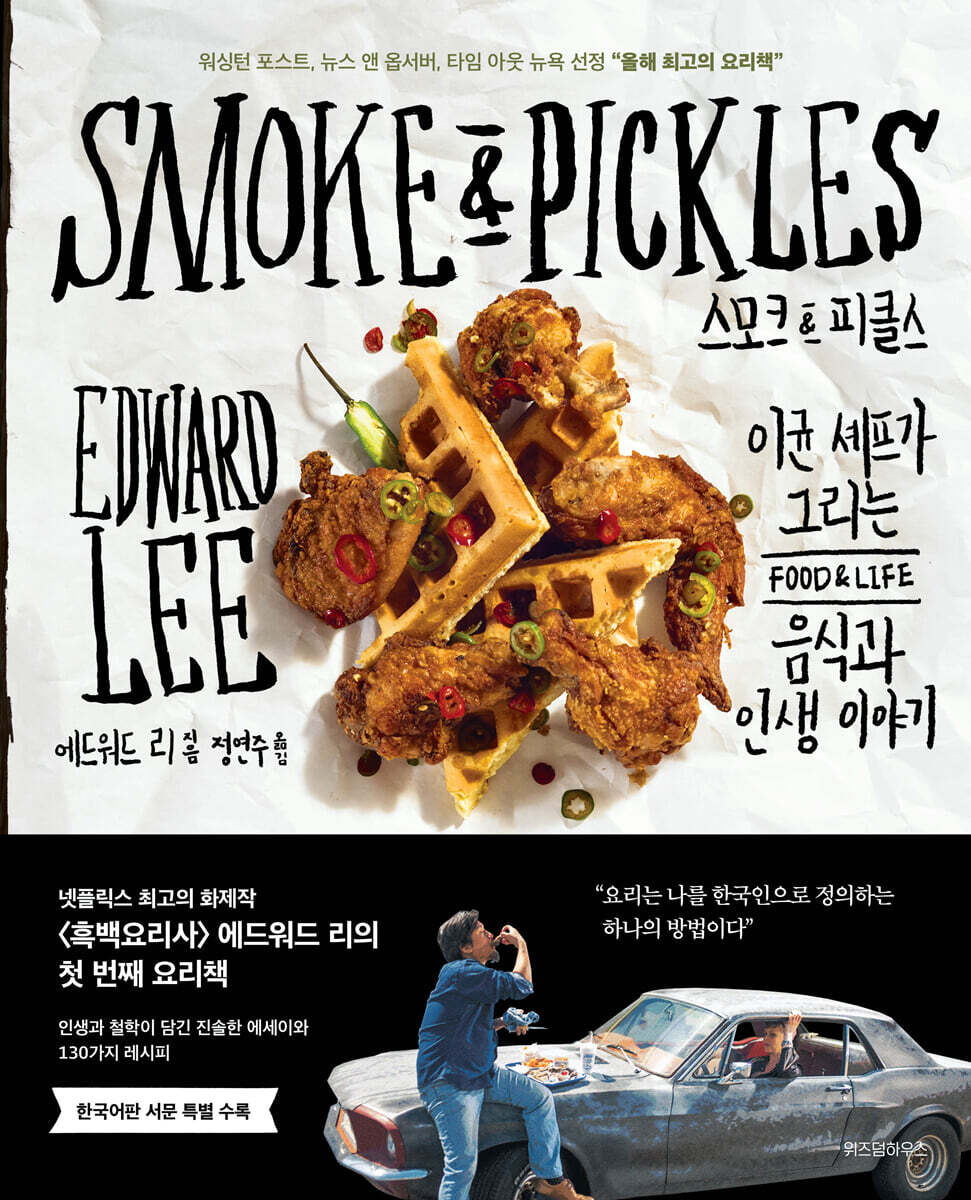
Edward Lee, Chef Lee Gyun's Food and Life StoriesChef Edward Lee, who impressed viewers with his hit Netflix series, has released his first cookbook, which features original and diverse recipes that combine traditional Korean food with Southern American cuisine, along with his personal growth story and deep culinary philosophy.
This is a must-have book for any fan of Edward Lee.
January 10, 2025. Baek Jeong-min, PD of Home Life
“My Korean name is ‘Gyun.’
So this dish was made by Lee Kyun.”
Netflix's most talked-about series [The Black and White Chef] Edward Lee
Chef Lee Gyun's Stories of Food and Life
Named one of the "Best Cookbooks of the Year" by the Washington Post, News & Observer, and Time Out New York.
The first recipe bible, a compilation of the memories and flavors that shaped Edward Lee's culinary world.
“I am Lee Gyun.” Chef Edward Lee, who not only showed the taste and class that a chef can show in the Netflix series [Black and White Chef: Culinary Class Wars] that shook up South Korea in 2024, but also deeply moved people by expressing his identity and life as an immigrant through food.
His first cookbook, Smoke & Pickles, which contains the essence of his unique culinary world that combines American Southern cuisine and traditional Korean food, has finally been officially translated and published in Korea.
Written in essay format with accompanying recipes, this book follows Edward Lee's personal journey of growth and the expansion of his culinary world, introducing him to all the ingredients he can handle at home, from beef, pork, lamb, seafood, pickles, bourbon, and even desserts.
He combines traditional Korean ingredients like kimchi, gochujang, and doenjang with regional flavors like bourbon and the Southern smoking technique to create dishes that embody his life, such as 'Steak Tartare with a 6-Minute Boiled Egg and Strawberry Ketchup,' 'Acorn Pumpkin Dumpling Bone Soup,' 'Curry Pork Pie,' and 'Fried Trout Sandwich.'
His soul food dish, 'Fried Chicken and Waffles', can also be found in this book.
He opens the book with a story and recipe for the 'pot rice' his grandmother used to make for him when he was a child.
This is also the reason why the first recipe in each chapter starts with 'rice bowl'.
For him, 'cooking' is not just the act of preparing food, but a way to explore culture, identity, family, and relationships, as well as a love for his roots and the land he lives on.
In this book, you will discover that the cooking philosophy that impressed us in [The Black and White Chef] is the result of Edward Lee's long-term contemplation and development.
For those curious about Edward Lee's life and culinary world, this is a must-read first book, and it will be a special opportunity to experience Edward Lee's culinary world in your own kitchen through the recipes in the book.
Beyond a simple cookbook that showcases the best flavors and skills discovered by a star chef who has swept prestigious cooking competitions like Iron Chef and Top Chef, let's meet Edward Lee's deeply personal story filled with philosophical reflections and warm memories about the roots of the kitchen.
This book will deeply inspire not only those who love cooking, but also those interested in diverse cultures and identities.
It will also be a fresh challenge for readers who want to explore new possibilities in cuisine that combines two or more cultures, traditional and modern.
So this dish was made by Lee Kyun.”
Netflix's most talked-about series [The Black and White Chef] Edward Lee
Chef Lee Gyun's Stories of Food and Life
Named one of the "Best Cookbooks of the Year" by the Washington Post, News & Observer, and Time Out New York.
The first recipe bible, a compilation of the memories and flavors that shaped Edward Lee's culinary world.
“I am Lee Gyun.” Chef Edward Lee, who not only showed the taste and class that a chef can show in the Netflix series [Black and White Chef: Culinary Class Wars] that shook up South Korea in 2024, but also deeply moved people by expressing his identity and life as an immigrant through food.
His first cookbook, Smoke & Pickles, which contains the essence of his unique culinary world that combines American Southern cuisine and traditional Korean food, has finally been officially translated and published in Korea.
Written in essay format with accompanying recipes, this book follows Edward Lee's personal journey of growth and the expansion of his culinary world, introducing him to all the ingredients he can handle at home, from beef, pork, lamb, seafood, pickles, bourbon, and even desserts.
He combines traditional Korean ingredients like kimchi, gochujang, and doenjang with regional flavors like bourbon and the Southern smoking technique to create dishes that embody his life, such as 'Steak Tartare with a 6-Minute Boiled Egg and Strawberry Ketchup,' 'Acorn Pumpkin Dumpling Bone Soup,' 'Curry Pork Pie,' and 'Fried Trout Sandwich.'
His soul food dish, 'Fried Chicken and Waffles', can also be found in this book.
He opens the book with a story and recipe for the 'pot rice' his grandmother used to make for him when he was a child.
This is also the reason why the first recipe in each chapter starts with 'rice bowl'.
For him, 'cooking' is not just the act of preparing food, but a way to explore culture, identity, family, and relationships, as well as a love for his roots and the land he lives on.
In this book, you will discover that the cooking philosophy that impressed us in [The Black and White Chef] is the result of Edward Lee's long-term contemplation and development.
For those curious about Edward Lee's life and culinary world, this is a must-read first book, and it will be a special opportunity to experience Edward Lee's culinary world in your own kitchen through the recipes in the book.
Beyond a simple cookbook that showcases the best flavors and skills discovered by a star chef who has swept prestigious cooking competitions like Iron Chef and Top Chef, let's meet Edward Lee's deeply personal story filled with philosophical reflections and warm memories about the roots of the kitchen.
This book will deeply inspire not only those who love cooking, but also those interested in diverse cultures and identities.
It will also be a fresh challenge for readers who want to explore new possibilities in cuisine that combines two or more cultures, traditional and modern.
- You can preview some of the book's contents.
Preview
index
To readers who opened this book in Korea
introduction
Introduction: Rice and Remoulade
Sheep and Whistles
Cow and Clover
Birds and Bluegrass
Pigs and slaughterhouses
Seafood and Verification
Married to a Pickle
Vegetables and charity
Bourbon and snacks
Buttermilk and Karaoke
Where to buy
Acknowledgements
INDEX
introduction
Introduction: Rice and Remoulade
Sheep and Whistles
Cow and Clover
Birds and Bluegrass
Pigs and slaughterhouses
Seafood and Verification
Married to a Pickle
Vegetables and charity
Bourbon and snacks
Buttermilk and Karaoke
Where to buy
Acknowledgements
INDEX
Detailed image

Into the book
As I open this book again now, I am filled with great joy and considerable surprise.
I can't believe I'm still relying on the recipes in this post to make dishes that will end up on my menu.
I still can't believe that so many people are cooking from this book and sending me pictures of it online.
It's also the first book I've ever written.
I didn't hire a ghostwriter.
I wanted to tell my story through my own writing.
This is a very special book for me.
This is a book I poured everything I had into.
---From "To the readers who opened this book in Korea"
I moved to Louisville in 2003.
I had to reinvent both my cuisine and my personal identity through the lens of tobacco, bourbon, corn, horse racing, and country ham.
The first time I tasted buttermilk, I thought it was sour and had gone bad, so I threw it away.
It was a surprising discovery to learn that it is used in cooking because of its sour taste.
And it tastes completely different from butter.
As time passed, Louisville, and by extension the American South, accepted me as an adopted child.
It wasn't that surprising.
It was natural.
Rather, what I didn't expect was that I would come full circle and rediscover myself as a child of Korean immigrants.
The loving and rich traditions prevalent in the Southern landscape drew me back to my grandmother's kitchen, where her spicy, garlicky dishes were made.
To me, the soft grits reminded me of porridge, the jerky reminded me of dried squid, and the Chinese pickles reminded me of kimchi.
---From the "Preface"
Deep down in my head, I have this idea that food is a miracle.
Our George Rushi rice cooker quietly and obediently emitted white steam every day.
During the holidays, my grandmother would put red beans and chestnuts in the rice cooker, but other than that, everything else was always the same.
Sometimes, when her trusty rice cooker broke down and the light flickered, my grandmother would cook rice in a heavy pot the traditional way.
But he didn't like that method because he had to keep the pot on the gas stove and watch it.
Since rice sticks to the bottom of the pot and becomes crispy, it is easy to make mistakes because it burns in an instant.
But the rice cooker gives the same result every time.
Just press the button according to the preset settings and come back after 20 minutes.
The results are always perfect and consistent.
---From "Rice and Remoulade"
My relationship with food in my life has evolved into three stages.
First is memory, second is history, and third is material.
Let's take lamb as an example.
My first memory of lamb was eating it with my older sister.
I never ate lamb when I was young.
Lamb is not a common ingredient in Korean cooking, but I find it quite odd because Korean seasonings go so well with lamb.
But if it weren't for my older sister, I wouldn't have even thought about eating lamb.
My older sister was an adventurous person.
---From "The Sheep and the Whistles"
Since I majored in literature, I like to look at things metaphorically.
The beef was just the tip of the iceberg of disappointment I had built up.
I thought everything was going my way, and to some extent, that was true.
But deep down, I knew there was more to life than grilled meats and tequila shots.
The three years I ran the restaurant disappeared in the blink of an eye.
My girlfriend left for Italy.
My new friends were strange people.
And then two planes reduced the Twin Towers to ashes.
I lost a precious friend.
And I lost all the money I had saved.
I needed a break.
---From "The Cow and the Clover"
It's a recipe that took a long time to be passed down from my mother.
Because I didn't write down the exact measurements, every time I asked, they would say something like, 'Put a little of this in, and a little of that in.'
But even without an exact recipe, my mother's ribs always taste the same, so it's always best when my mother makes them herself rather than eating them at a restaurant.
I think that's what mother's cooking tastes like.
---From "Grilled Ribs"
I don't know who first came up with the idea of eating fried chicken and waffles together, but if adding a waffle makes you feel better about eating fried chicken in the morning, I'm all for it.
Next is the Filipino adobo, not the Spanish one.
Vinegar brightens the oily flavor of fried chicken and helps with digestion.
You can increase or decrease the amount of chili pepper depending on how spicy you like it.
It's like soul food to me.
Try the Pumpkin Mac and Cheese (page 218) with a glass of Boulevard Brewing Company's Tank 7 Farmhouse Ale.
And if I ever come to your neighborhood, I hope you'll invite me.
---From "Adobo Fried Chicken and Waffles"
When you move to Louisville, there's one question people ask first.
“Have you tried a Hot Brown?” It’s as if eating a Hot Brown is the starting point of solidifying your identity as a true Louisville native.
Legend has it that the Hot Brown was invented at the Brown Hotel in the 1920s, and the belt size has continued to expand since then.
A true monster sandwich with turkey, bacon, cheese, and gravy all on Texas toast.
Eating an entire hot brown sandwich is a monumental feat, and one that you only need to do once or twice a year.
Here's a hot brown I made my own, still hearty but a little less heavy and just as delicious.
This dish is devilishly filling, so it calls for a spicy bourbon whiskey poured over a few ice cubes in a large rocks glass.
---From "Hot Brown Style Turkey Leg Stew"
I've visited other slaughterhouses in the area, including Bun's Meat Shop, and when I tell people about my experience, I get reactions ranging from curious questions to disgust.
Should a chef be involved in killing animals? Shouldn't the kitchen be my place? I knew I wasn't meant to be in a slaughterhouse.
But then, where should I be? Picking strawberries on a farm? Passing orders in a long line at an expo? Standing in front of a camera, spouting nonsense? Or perhaps writing at my computer, raising a public voice about the usually unnoticed process of a bunch of nameless pigs becoming delicious ingredients.
This is the agricultural practice I am trying.
---From "Pigs and Slaughterhouses"
My [Top Chef] challenge ended with a can of oysters, a lot of fuss, and a little bit of temporary sadness.
But like many chefs before me and after me, I took the bitter pill of failure and moved forward again.
There's a lot of hype about reality cooking shows, and rightly so. These programs have changed the landscape for young chefs building their careers.
I think the days when chefs spent their entire lives in front of the oven door are over.
Chefs now have to worry as much about their public image as they do about their knife skills.
This newfound fame and idolatry naturally gave rise to detractors as well as enthusiastic supporters.
---From "Aquatic Products and Verification"
This is a recipe I pulled out of my memory.
Pickled garlic in soy sauce is a dish my grandmother used to make.
My grandmother pickled garlic in a slightly different way each time.
So I made my own version, adding molasses to the recipe.
I think your grandmother will like it too.
Be warned, this is a very tangy pickle.
But if you're crazy about garlic like me, you'll definitely love it.
---From "Marriage with a Pickle"
I don't like simple potato salads that lose their appeal after a bite or two.
This recipe was created for dinner on a day when you want to eat only vegetables and be healthy, but don't want to eat something too healthy or boring.
I invited Stephen over and he came over with a glass of wine in his hand to try my new potato dish.
He hadn't decided on a name yet, but as soon as he took a bite he exclaimed, "What the heck, this is delicious!"
That's how this potato salad got its name.
---From "What the Crazy Thing Is This" Potato Salad
If it looks like it's going to be a long night, this is one of the cocktails to start with.
Fresh ginger soothes the stomach and opens the sinuses, while bourbon awakens the senses.
But be careful.
It's so delicious that you might end up chugging it down before you even start dinner, and you might not even taste the food at all.
I can't believe I'm still relying on the recipes in this post to make dishes that will end up on my menu.
I still can't believe that so many people are cooking from this book and sending me pictures of it online.
It's also the first book I've ever written.
I didn't hire a ghostwriter.
I wanted to tell my story through my own writing.
This is a very special book for me.
This is a book I poured everything I had into.
---From "To the readers who opened this book in Korea"
I moved to Louisville in 2003.
I had to reinvent both my cuisine and my personal identity through the lens of tobacco, bourbon, corn, horse racing, and country ham.
The first time I tasted buttermilk, I thought it was sour and had gone bad, so I threw it away.
It was a surprising discovery to learn that it is used in cooking because of its sour taste.
And it tastes completely different from butter.
As time passed, Louisville, and by extension the American South, accepted me as an adopted child.
It wasn't that surprising.
It was natural.
Rather, what I didn't expect was that I would come full circle and rediscover myself as a child of Korean immigrants.
The loving and rich traditions prevalent in the Southern landscape drew me back to my grandmother's kitchen, where her spicy, garlicky dishes were made.
To me, the soft grits reminded me of porridge, the jerky reminded me of dried squid, and the Chinese pickles reminded me of kimchi.
---From the "Preface"
Deep down in my head, I have this idea that food is a miracle.
Our George Rushi rice cooker quietly and obediently emitted white steam every day.
During the holidays, my grandmother would put red beans and chestnuts in the rice cooker, but other than that, everything else was always the same.
Sometimes, when her trusty rice cooker broke down and the light flickered, my grandmother would cook rice in a heavy pot the traditional way.
But he didn't like that method because he had to keep the pot on the gas stove and watch it.
Since rice sticks to the bottom of the pot and becomes crispy, it is easy to make mistakes because it burns in an instant.
But the rice cooker gives the same result every time.
Just press the button according to the preset settings and come back after 20 minutes.
The results are always perfect and consistent.
---From "Rice and Remoulade"
My relationship with food in my life has evolved into three stages.
First is memory, second is history, and third is material.
Let's take lamb as an example.
My first memory of lamb was eating it with my older sister.
I never ate lamb when I was young.
Lamb is not a common ingredient in Korean cooking, but I find it quite odd because Korean seasonings go so well with lamb.
But if it weren't for my older sister, I wouldn't have even thought about eating lamb.
My older sister was an adventurous person.
---From "The Sheep and the Whistles"
Since I majored in literature, I like to look at things metaphorically.
The beef was just the tip of the iceberg of disappointment I had built up.
I thought everything was going my way, and to some extent, that was true.
But deep down, I knew there was more to life than grilled meats and tequila shots.
The three years I ran the restaurant disappeared in the blink of an eye.
My girlfriend left for Italy.
My new friends were strange people.
And then two planes reduced the Twin Towers to ashes.
I lost a precious friend.
And I lost all the money I had saved.
I needed a break.
---From "The Cow and the Clover"
It's a recipe that took a long time to be passed down from my mother.
Because I didn't write down the exact measurements, every time I asked, they would say something like, 'Put a little of this in, and a little of that in.'
But even without an exact recipe, my mother's ribs always taste the same, so it's always best when my mother makes them herself rather than eating them at a restaurant.
I think that's what mother's cooking tastes like.
---From "Grilled Ribs"
I don't know who first came up with the idea of eating fried chicken and waffles together, but if adding a waffle makes you feel better about eating fried chicken in the morning, I'm all for it.
Next is the Filipino adobo, not the Spanish one.
Vinegar brightens the oily flavor of fried chicken and helps with digestion.
You can increase or decrease the amount of chili pepper depending on how spicy you like it.
It's like soul food to me.
Try the Pumpkin Mac and Cheese (page 218) with a glass of Boulevard Brewing Company's Tank 7 Farmhouse Ale.
And if I ever come to your neighborhood, I hope you'll invite me.
---From "Adobo Fried Chicken and Waffles"
When you move to Louisville, there's one question people ask first.
“Have you tried a Hot Brown?” It’s as if eating a Hot Brown is the starting point of solidifying your identity as a true Louisville native.
Legend has it that the Hot Brown was invented at the Brown Hotel in the 1920s, and the belt size has continued to expand since then.
A true monster sandwich with turkey, bacon, cheese, and gravy all on Texas toast.
Eating an entire hot brown sandwich is a monumental feat, and one that you only need to do once or twice a year.
Here's a hot brown I made my own, still hearty but a little less heavy and just as delicious.
This dish is devilishly filling, so it calls for a spicy bourbon whiskey poured over a few ice cubes in a large rocks glass.
---From "Hot Brown Style Turkey Leg Stew"
I've visited other slaughterhouses in the area, including Bun's Meat Shop, and when I tell people about my experience, I get reactions ranging from curious questions to disgust.
Should a chef be involved in killing animals? Shouldn't the kitchen be my place? I knew I wasn't meant to be in a slaughterhouse.
But then, where should I be? Picking strawberries on a farm? Passing orders in a long line at an expo? Standing in front of a camera, spouting nonsense? Or perhaps writing at my computer, raising a public voice about the usually unnoticed process of a bunch of nameless pigs becoming delicious ingredients.
This is the agricultural practice I am trying.
---From "Pigs and Slaughterhouses"
My [Top Chef] challenge ended with a can of oysters, a lot of fuss, and a little bit of temporary sadness.
But like many chefs before me and after me, I took the bitter pill of failure and moved forward again.
There's a lot of hype about reality cooking shows, and rightly so. These programs have changed the landscape for young chefs building their careers.
I think the days when chefs spent their entire lives in front of the oven door are over.
Chefs now have to worry as much about their public image as they do about their knife skills.
This newfound fame and idolatry naturally gave rise to detractors as well as enthusiastic supporters.
---From "Aquatic Products and Verification"
This is a recipe I pulled out of my memory.
Pickled garlic in soy sauce is a dish my grandmother used to make.
My grandmother pickled garlic in a slightly different way each time.
So I made my own version, adding molasses to the recipe.
I think your grandmother will like it too.
Be warned, this is a very tangy pickle.
But if you're crazy about garlic like me, you'll definitely love it.
---From "Marriage with a Pickle"
I don't like simple potato salads that lose their appeal after a bite or two.
This recipe was created for dinner on a day when you want to eat only vegetables and be healthy, but don't want to eat something too healthy or boring.
I invited Stephen over and he came over with a glass of wine in his hand to try my new potato dish.
He hadn't decided on a name yet, but as soon as he took a bite he exclaimed, "What the heck, this is delicious!"
That's how this potato salad got its name.
---From "What the Crazy Thing Is This" Potato Salad
If it looks like it's going to be a long night, this is one of the cocktails to start with.
Fresh ginger soothes the stomach and opens the sinuses, while bourbon awakens the senses.
But be careful.
It's so delicious that you might end up chugging it down before you even start dinner, and you might not even taste the food at all.
---From "Kentucky Mule"
Publisher's Review
“What are you cooking?”
This is a question I get asked all the time.
This book is a long answer to that.
Chef Edward Lee's unique culinary style and philosophy,
A deep understanding of food ingredients and memorable stories of loving family, all in one book.
"I cried when I saw the Korean written on the cover."
Edward Lee, Korea's most beloved chef
Lee Gyun's first translated book, with a special preface for Korean readers, is published!
The afterglow of [Black and White Chef: Culinary Class Wars], which became a national issue by ranking first in non-English speaking countries worldwide for three consecutive weeks since its Netflix release, is bringing about a storm of change in various fields.
The restaurant industry is experiencing an unprecedented ticketing war, the advertising industry is also flooding chefs with offers, and in the broadcasting industry, the popular entertainment show [Please Take Care of My Refrigerator] featuring chefs has been revived for a second season.
Books written by chefs also became a hot topic in the publishing world, and among them, Chef Edward Lee's book even recorded the highest sales in the foreign book category.
In 2025, the golden age of star chefs and gastronomy has arrived, his first cookbook, Smoke & Pickles, has been officially published by Wisdom House.
Edward Lee, who was already a star chef in the United States after winning Iron Chef in 2010 and the James Beard Award, often called the Nobel Prize of the culinary world, in 2019, captivated the public's hearts by showing both class and sincerity as a chef in [Black and White Chef] as a White House dinner chef.
Where did his culinary journey begin? Where does the deep-rooted longing for Korea, imbued in every dish, originate? What process shaped him into the Edward Lee he is today? How did his remarkable creativity, patience, and expressiveness come to be honed? "Smoke & Pickles" is a lengthy and thoughtful answer to these questions.
This book also includes a special preface to the Korean edition, which fills two pages with long and profound reflections, the first of its kind to be shared in Korea since [The Black and White Chef].
“For me, food is like a blank canvas.”
From my grandmother's pot rice to my mother's ribs and four-season kimchi recipes.
The taste of traditional Korean food permeates the southern United States of Kentucky through Edward Lee's deep affection.
Each chapter of this book begins with Edward Lee's life story.
He speaks candidly about his love for cooking, the land he stands on, the people he works with, his family, and the joy of food and cooking that brings it all together.
In the first chapter, she recalls memories of her grandmother.
It tells of the Brooklyn kitchen where my grandmother stood and the Zojirushi rice cooker that quietly gave off white steam every day.
The steaming bowl of rice that accompanied every meal of his childhood is his roots and his way of expressing his culinary world.
For that reason, each chapter usually begins with a variety of 'donburi' recipes, such as 'Tomato Yogurt Lamb Donburi', 'Beef Corn Donburi', 'Chicken, Orange Peanut, and Miso Donburi', 'Spicy Pork Donburi', and 'Tuna Avocado Donburi'.
Recipes are introduced that bring rice, the symbol of a simple, everyday meal, to life by adding modern techniques, global flavors, and unique combinations that Edward Lee has learned.
In the recipes he introduces, you can feel traces of familiar Korean food.
The recipe for 'Grilled Ribs' that I learned from watching my mother measure it out, saying 'Put a little of this in, put an appropriate amount of that in', and the 'Sweet Pumpkin Dumpling Bone Soup' that I make when the weather gets cold because I desperately want a warm soup.
In particular, the pickle chapter is very impressive in that it introduces 'four seasons kimchi recipes' for spring, summer, fall, and winter.
“Pickles are a lot like love stories.”
The day I first met my wife's parents, I read a handwritten letter and received my mother-in-law's special sauerkraut.
A diverse range of cultures and people, and touching stories from outside the kitchen that couldn't be fully told on TV.
The principles and philosophy he considers important when cooking are also introduced in this book.
From the weeds on the ground where cows walk, to cheese artisans, ham makers, restaurant owners who go out to sea to fish for their ingredients, fellow chefs who share a love of kimchi, and even the editor who first published his story, stories about the people surrounding cooking and ingredients add to the vividness.
The first meeting with the in-laws, especially in the pickle chapter, is intense.
The special sauerkraut that has been passed down through generations in his mother-in-law's family is a precious food that is not only unknown in terms of recipe and storage materials, but is also not even served on the dinner table. However, the scene where he reads a letter he wrote himself in front of his wife's family for the first time and asks for their permission to marry, and his mother silently gives him six jars of sauerkraut brings a heartwarming laugh.
In addition, you can get a glimpse into his life of accepting the culture of each family and region without prejudice and incorporating it into his cooking, such as the story of him sometimes going to a karaoke room and singing songs while shedding hot tears and reminiscing about his childhood home, or the story of how he dozed off from being so nervous when he first came to Louisville and went duck hunting and got hit in the face by the recoil of the gun he shot while shooting bait, and then laughed together and felt a sense of belonging.
“Cook freely as you wish!”
Sheep, beef, chicken, pork, seafood.
Pickles, kimchi, vegetables, bourbon, snacks, and even desserts!
Over 130 Amazing Recipes with a Pinch of Smoke and Pickles
But above all, this book is a very faithful cooking bible that contains all of Edward Lee's know-how.
Edward Lehman's method for bringing out the best flavor in every ingredient, from lamb, beef, pork, seafood, pickles, vegetables, bourbon, and even snacks and desserts, is explained in a friendly and easy-to-follow manner so that anyone can follow it.
Let's get rid of the prejudice that chef's cooking might be too complicated or difficult.
All recipes are prepared with measurements and quantities that can be made at home, and each recipe is accompanied by witty and accurate instructions and anecdotes so that you can use it for everyday celebrations and gatherings, big and small, and it will make you want to check the ingredients in your fridge right away.
In this book, you can discover the memories and skills he has accumulated from his time running a hot New York restaurant to moving to Kentucky and opening a restaurant.
“The idea of the perfect roast chicken has always haunted me.
Because there was no way to fully cook the thigh meat before the breast meat became dry.
Then I tried this technique in my kitchen.
“The potatoes act as insulation for the breast meat, while the fat from the skins seeps into the potatoes, adding flavor, and keeping the breast meat incredibly moist.” (p. 94) In the recipe for ‘Roast Chicken with Potato Stuffing,’ which he found the optimal method after countless failures, he conveys not only his cooking skills but also the sweat and sense of accomplishment that comes from saying, ‘I finally did it!’
A colorful collection of recipes filled with pickles, fermentations, frying, and smoking are presented with such sophisticated photos and process shots that it's hard to believe this is a book from 2013.
It is now time to taste his sincerity expressed through cooking on our dining table.
This is a question I get asked all the time.
This book is a long answer to that.
Chef Edward Lee's unique culinary style and philosophy,
A deep understanding of food ingredients and memorable stories of loving family, all in one book.
"I cried when I saw the Korean written on the cover."
Edward Lee, Korea's most beloved chef
Lee Gyun's first translated book, with a special preface for Korean readers, is published!
The afterglow of [Black and White Chef: Culinary Class Wars], which became a national issue by ranking first in non-English speaking countries worldwide for three consecutive weeks since its Netflix release, is bringing about a storm of change in various fields.
The restaurant industry is experiencing an unprecedented ticketing war, the advertising industry is also flooding chefs with offers, and in the broadcasting industry, the popular entertainment show [Please Take Care of My Refrigerator] featuring chefs has been revived for a second season.
Books written by chefs also became a hot topic in the publishing world, and among them, Chef Edward Lee's book even recorded the highest sales in the foreign book category.
In 2025, the golden age of star chefs and gastronomy has arrived, his first cookbook, Smoke & Pickles, has been officially published by Wisdom House.
Edward Lee, who was already a star chef in the United States after winning Iron Chef in 2010 and the James Beard Award, often called the Nobel Prize of the culinary world, in 2019, captivated the public's hearts by showing both class and sincerity as a chef in [Black and White Chef] as a White House dinner chef.
Where did his culinary journey begin? Where does the deep-rooted longing for Korea, imbued in every dish, originate? What process shaped him into the Edward Lee he is today? How did his remarkable creativity, patience, and expressiveness come to be honed? "Smoke & Pickles" is a lengthy and thoughtful answer to these questions.
This book also includes a special preface to the Korean edition, which fills two pages with long and profound reflections, the first of its kind to be shared in Korea since [The Black and White Chef].
“For me, food is like a blank canvas.”
From my grandmother's pot rice to my mother's ribs and four-season kimchi recipes.
The taste of traditional Korean food permeates the southern United States of Kentucky through Edward Lee's deep affection.
Each chapter of this book begins with Edward Lee's life story.
He speaks candidly about his love for cooking, the land he stands on, the people he works with, his family, and the joy of food and cooking that brings it all together.
In the first chapter, she recalls memories of her grandmother.
It tells of the Brooklyn kitchen where my grandmother stood and the Zojirushi rice cooker that quietly gave off white steam every day.
The steaming bowl of rice that accompanied every meal of his childhood is his roots and his way of expressing his culinary world.
For that reason, each chapter usually begins with a variety of 'donburi' recipes, such as 'Tomato Yogurt Lamb Donburi', 'Beef Corn Donburi', 'Chicken, Orange Peanut, and Miso Donburi', 'Spicy Pork Donburi', and 'Tuna Avocado Donburi'.
Recipes are introduced that bring rice, the symbol of a simple, everyday meal, to life by adding modern techniques, global flavors, and unique combinations that Edward Lee has learned.
In the recipes he introduces, you can feel traces of familiar Korean food.
The recipe for 'Grilled Ribs' that I learned from watching my mother measure it out, saying 'Put a little of this in, put an appropriate amount of that in', and the 'Sweet Pumpkin Dumpling Bone Soup' that I make when the weather gets cold because I desperately want a warm soup.
In particular, the pickle chapter is very impressive in that it introduces 'four seasons kimchi recipes' for spring, summer, fall, and winter.
“Pickles are a lot like love stories.”
The day I first met my wife's parents, I read a handwritten letter and received my mother-in-law's special sauerkraut.
A diverse range of cultures and people, and touching stories from outside the kitchen that couldn't be fully told on TV.
The principles and philosophy he considers important when cooking are also introduced in this book.
From the weeds on the ground where cows walk, to cheese artisans, ham makers, restaurant owners who go out to sea to fish for their ingredients, fellow chefs who share a love of kimchi, and even the editor who first published his story, stories about the people surrounding cooking and ingredients add to the vividness.
The first meeting with the in-laws, especially in the pickle chapter, is intense.
The special sauerkraut that has been passed down through generations in his mother-in-law's family is a precious food that is not only unknown in terms of recipe and storage materials, but is also not even served on the dinner table. However, the scene where he reads a letter he wrote himself in front of his wife's family for the first time and asks for their permission to marry, and his mother silently gives him six jars of sauerkraut brings a heartwarming laugh.
In addition, you can get a glimpse into his life of accepting the culture of each family and region without prejudice and incorporating it into his cooking, such as the story of him sometimes going to a karaoke room and singing songs while shedding hot tears and reminiscing about his childhood home, or the story of how he dozed off from being so nervous when he first came to Louisville and went duck hunting and got hit in the face by the recoil of the gun he shot while shooting bait, and then laughed together and felt a sense of belonging.
“Cook freely as you wish!”
Sheep, beef, chicken, pork, seafood.
Pickles, kimchi, vegetables, bourbon, snacks, and even desserts!
Over 130 Amazing Recipes with a Pinch of Smoke and Pickles
But above all, this book is a very faithful cooking bible that contains all of Edward Lee's know-how.
Edward Lehman's method for bringing out the best flavor in every ingredient, from lamb, beef, pork, seafood, pickles, vegetables, bourbon, and even snacks and desserts, is explained in a friendly and easy-to-follow manner so that anyone can follow it.
Let's get rid of the prejudice that chef's cooking might be too complicated or difficult.
All recipes are prepared with measurements and quantities that can be made at home, and each recipe is accompanied by witty and accurate instructions and anecdotes so that you can use it for everyday celebrations and gatherings, big and small, and it will make you want to check the ingredients in your fridge right away.
In this book, you can discover the memories and skills he has accumulated from his time running a hot New York restaurant to moving to Kentucky and opening a restaurant.
“The idea of the perfect roast chicken has always haunted me.
Because there was no way to fully cook the thigh meat before the breast meat became dry.
Then I tried this technique in my kitchen.
“The potatoes act as insulation for the breast meat, while the fat from the skins seeps into the potatoes, adding flavor, and keeping the breast meat incredibly moist.” (p. 94) In the recipe for ‘Roast Chicken with Potato Stuffing,’ which he found the optimal method after countless failures, he conveys not only his cooking skills but also the sweat and sense of accomplishment that comes from saying, ‘I finally did it!’
A colorful collection of recipes filled with pickles, fermentations, frying, and smoking are presented with such sophisticated photos and process shots that it's hard to believe this is a book from 2013.
It is now time to taste his sincerity expressed through cooking on our dining table.
GOODS SPECIFICS
- Date of issue: January 8, 2025
- Format: Hardcover book binding method guide
- Page count, weight, size: 308 pages | 1,218g | 205*255*30mm
- ISBN13: 9791171713431
- ISBN10: 1171713436
You may also like
카테고리
korean


korean

![GQ KOREA Mark (Monthly): December [2025]](http://librairie.coreenne.fr/cdn/shop/files/8ef265dbbfbf186523ed75ba7319009d.jpg?v=1765340328&width=3840)


