

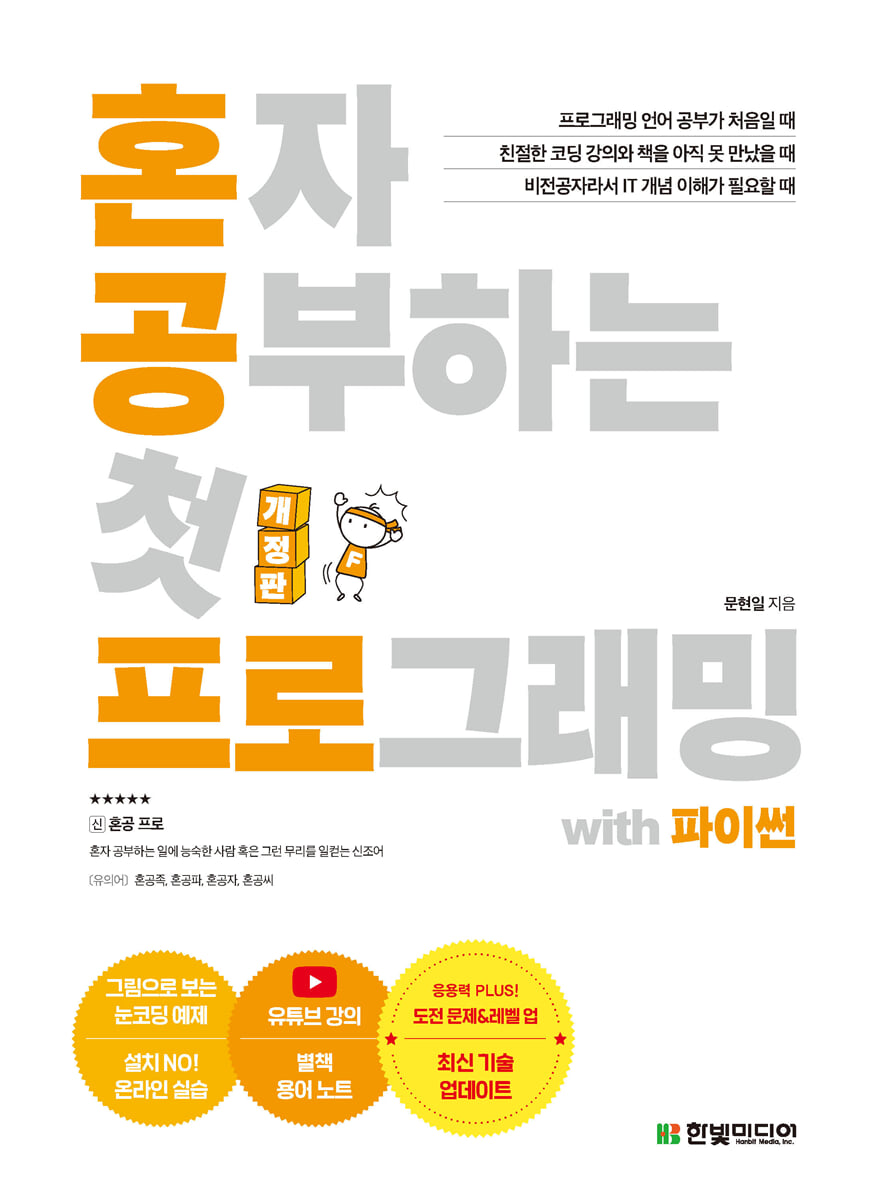
Self-study for the first time with Python
 |
Description
Book Introduction
It's enough to do it alone!
A programming tutorial that teaches you how to use one-on-one tutoring.
"First Programming with Python: Self-Study" provides tailored explanations for complete beginners who don't even know the "P" in "program" through rich visual aids and easy examples.
Before directly entering the code, you can visually observe the process of executing the code through “Learn by Seeing Coding” and try coding online without installing a program through “Hand Coding”.
The revised edition of "Self-study Programming with Python" has been upgraded with more useful content, introducing the latest technologies, including artificial intelligence, tailored to the beginner's level.
"Learn More" introduces how to code using generative AI, allowing you to explore the world of programming in an even more interesting way.
Let's go one step further and practice our application skills by solving examples and challenge problems from "Level Up"!
If you're new to programming! If you haven't yet encountered a helpful coding course or book! If you're a non-major and need to understand IT concepts! Start confidently with this beginner-friendly coding introductory book that covers everything from the ground up.
A programming tutorial that teaches you how to use one-on-one tutoring.
"First Programming with Python: Self-Study" provides tailored explanations for complete beginners who don't even know the "P" in "program" through rich visual aids and easy examples.
Before directly entering the code, you can visually observe the process of executing the code through “Learn by Seeing Coding” and try coding online without installing a program through “Hand Coding”.
The revised edition of "Self-study Programming with Python" has been upgraded with more useful content, introducing the latest technologies, including artificial intelligence, tailored to the beginner's level.
"Learn More" introduces how to code using generative AI, allowing you to explore the world of programming in an even more interesting way.
Let's go one step further and practice our application skills by solving examples and challenge problems from "Level Up"!
If you're new to programming! If you haven't yet encountered a helpful coding course or book! If you're a non-major and need to understand IT concepts! Start confidently with this beginner-friendly coding introductory book that covers everything from the ground up.
- You can preview some of the book's contents.
Preview
index
Chapter 01 First Programming
01-01 Learning Programming
Understanding Programs, Programming, and Coding
Things you need to know to program
Key points summarized in six keywords
Verification problem
01-02 Creating a "Hello, World!" Program
Learn about the "Hello, World!" program
Why Start Programming with Python
What you need to code in Python
How to Practice Python Smartly: Cloud Python Development Environments
[Learn more] How to use the source code
Key points summarized in three keywords
Verification problem
Challenge problem
Chapter 02 Data
02-01 Character data
Understanding Text Data
Representing character data
Knowing escape characters
Character encoding UTF-8
Key points summarized in four keywords
Verification problem
02-02 Character data processing
Understanding Operators
Character data concatenation operator: +
Character data repetition concatenation operator: *
Finding the length of character data
Truncate character data
Character data indexing
[Level Up] Various ways to process text data
Key points summarized in six keywords
Verification problem
Challenge problem
02-03 Numeric data
Characteristics of numeric data processed by computers
How to represent numeric data
Operators for numeric data
Precedence of numeric operators
Pitfalls of Floating Point Number Handling
[Level Up] Various Ways to Process Numeric Data
Key points summarized in 7 keywords
Verification problem
Challenge problem
02-04 Variable
Why Data Needs Names
Names and variables attached to data
How to create and use variables
Key points summarized in three keywords
Verification problem
Chapter 03 Selection
03-01 Understanding the Selection Structure
Choice situations encountered in real life programs
Two essential factors to consider when choosing
Selection structure expressed in a diagram, flowchart
[Learn more] Flowchart for daily life
Key points summarized in three keywords
Verification problem
Challenge problem
03-02 How to code a selection structure in Python
How to code conditional expressions
How to code a selection structure
How to Procrastinate on Writing Code: The Pass Keyword
Key points summarized in six keywords
Verification problem
Challenge problem
Chapter 04 Dataset
04-01 Efficient Data Management 1: Lists
As the amount of data increases, data management becomes more difficult.
How to manage multiple data in one variable: List
[Level Up] Various ways to process lists
Key points summarized in two keywords
Verification problem
Challenge problem
04-02 Efficient Data Management 2: Dictionaries
Disadvantages of lists
How to label and manage data: Dictionaries
Differences between variables, lists, and dictionaries
[Level Up] Various Ways to Process Dictionaries
Key points summarized in two keywords
Verification problem
Challenge problem
Chapter 05 Repetition
05-01 Learn about repetition
The core principle of repetition
Understanding the iterative processing flow
while loop
for loop
The for loop's best friend: range
Controlling the number of repetitions: break
Controlling the number of repetitions: continue
[Level Up] Various ways to utilize range
Key points summarized in 5 keywords
Verification problem
Challenge problem
05-02 Dataset and for loop
Data type
Strings and for loops
Lists and for loops
Dictionaries and for loops
[Level Up] Various Ways to Use the For Loop
Key points summarized in four keywords
Verification problem
Challenge problem
Chapter 06 Functions
06-01 Using Functions
Python built-in functions
Create a function
Using function results
Using function input values
[Level Up] How to get data from users
Key points summarized in six keywords
Verification problem
Challenge problem
06-02 Examples of various functions
Function to check if an integer is odd
A function that outputs a border surrounding the English alphabet.
Function to calculate the sum and average of array elements
Function to convert seconds to hours and minutes
[Learn More] Practice Coding with Generative AI
Key points summarized in two keywords
Verification problem
Challenge problem
Answer and explanation
Search
01-01 Learning Programming
Understanding Programs, Programming, and Coding
Things you need to know to program
Key points summarized in six keywords
Verification problem
01-02 Creating a "Hello, World!" Program
Learn about the "Hello, World!" program
Why Start Programming with Python
What you need to code in Python
How to Practice Python Smartly: Cloud Python Development Environments
[Learn more] How to use the source code
Key points summarized in three keywords
Verification problem
Challenge problem
Chapter 02 Data
02-01 Character data
Understanding Text Data
Representing character data
Knowing escape characters
Character encoding UTF-8
Key points summarized in four keywords
Verification problem
02-02 Character data processing
Understanding Operators
Character data concatenation operator: +
Character data repetition concatenation operator: *
Finding the length of character data
Truncate character data
Character data indexing
[Level Up] Various ways to process text data
Key points summarized in six keywords
Verification problem
Challenge problem
02-03 Numeric data
Characteristics of numeric data processed by computers
How to represent numeric data
Operators for numeric data
Precedence of numeric operators
Pitfalls of Floating Point Number Handling
[Level Up] Various Ways to Process Numeric Data
Key points summarized in 7 keywords
Verification problem
Challenge problem
02-04 Variable
Why Data Needs Names
Names and variables attached to data
How to create and use variables
Key points summarized in three keywords
Verification problem
Chapter 03 Selection
03-01 Understanding the Selection Structure
Choice situations encountered in real life programs
Two essential factors to consider when choosing
Selection structure expressed in a diagram, flowchart
[Learn more] Flowchart for daily life
Key points summarized in three keywords
Verification problem
Challenge problem
03-02 How to code a selection structure in Python
How to code conditional expressions
How to code a selection structure
How to Procrastinate on Writing Code: The Pass Keyword
Key points summarized in six keywords
Verification problem
Challenge problem
Chapter 04 Dataset
04-01 Efficient Data Management 1: Lists
As the amount of data increases, data management becomes more difficult.
How to manage multiple data in one variable: List
[Level Up] Various ways to process lists
Key points summarized in two keywords
Verification problem
Challenge problem
04-02 Efficient Data Management 2: Dictionaries
Disadvantages of lists
How to label and manage data: Dictionaries
Differences between variables, lists, and dictionaries
[Level Up] Various Ways to Process Dictionaries
Key points summarized in two keywords
Verification problem
Challenge problem
Chapter 05 Repetition
05-01 Learn about repetition
The core principle of repetition
Understanding the iterative processing flow
while loop
for loop
The for loop's best friend: range
Controlling the number of repetitions: break
Controlling the number of repetitions: continue
[Level Up] Various ways to utilize range
Key points summarized in 5 keywords
Verification problem
Challenge problem
05-02 Dataset and for loop
Data type
Strings and for loops
Lists and for loops
Dictionaries and for loops
[Level Up] Various Ways to Use the For Loop
Key points summarized in four keywords
Verification problem
Challenge problem
Chapter 06 Functions
06-01 Using Functions
Python built-in functions
Create a function
Using function results
Using function input values
[Level Up] How to get data from users
Key points summarized in six keywords
Verification problem
Challenge problem
06-02 Examples of various functions
Function to check if an integer is odd
A function that outputs a border surrounding the English alphabet.
Function to calculate the sum and average of array elements
Function to convert seconds to hours and minutes
[Learn More] Practice Coding with Generative AI
Key points summarized in two keywords
Verification problem
Challenge problem
Answer and explanation
Search
Detailed image

Publisher's Review
When you first start learning a programming language
When you haven't found a friendly coding course or book yet
When you are not a major and need to understand IT concepts
》 Systematic, repetitive learning by following the 'customized 7-step structure' that even beginners can study on their own!
This book is structured to teach the basics of programming in seven steps so that you can naturally memorize them.
Through “Key Keywords” and “Before You Begin,” we will briefly review the representative concepts of each topic in each section, and through “Speech Bubbles,” “Learning by Watching: Coding,” and “Hand Coding: Trying It Yourself,” we will naturally combine theory and practice.
In the conclusion, we will review what we have learned through [Key Points] and [Confirmation Questions].
The revised book adds steps to improve your skills through [Level Up] and [Challenge Problems], stimulating your motivation to learn.
By following the systematic structure, anyone, even someone new to programming, can learn it all the way through.
》 Two, a sense of coding that you can understand by looking at it with ‘eye coding’ and learn it properly with ‘hand coding’!
"Learning by Seeing" shows the code execution process in pictures, allowing even beginners who are just starting out with programming to understand the theory.
If you understand how the program works through 'Eye Coding', try your hand at simple code of less than 10 lines through 'Hand Coding'.
Anyone can easily learn programming through a hands-on course optimized for absolute beginners who value conceptual understanding and repetitive learning.
》 3. Video lectures to empower 'Honkong' and support for Honkong study sites & open chat with the author!
For beginners who still find it difficult to learn from books alone, we provide videos of lectures directly from the author.
You can also ask the author any questions you may have at any time through the learning site.
The author will answer your questions directly and you can also get technical information about programming.
If you want to interact with the author in real time, join the open chat and ask questions.
We also run a self-study group for readers who want to study alone but lack confidence.
With the Honkong Study Group, you can complete the course without giving up.
▶ Learning site: https://hongong.hanbit.co.kr
▶ Open chat with the author: https://open.kakao.com/o/g5rNEh7d
》 Net, [Honey Glossary] provided that can be viewed easily anytime, anywhere!
We provide a [Honkong Terminology Note] that organizes only the key concepts and terms that you must remember.
The reason why people who are new to programming find it difficult is because of the unfamiliar terminology.
Whenever you have trouble remembering a term or concept, feel free to open the [Honkong Terminology Note].
In addition to the terms presented, you can also add new terms and complete your own glossary, which will be another fun part of the process.
》 Five, NO program installation required! Online training you can do anytime, anywhere, as long as you have internet access!
You can practice anywhere, including on your laptop, mobile phone, or tablet PC, as long as you have an internet connection.
Just access your internet browser and enter the code you learned without going through a cumbersome installation process.
Who is this book for?
》 I am a complete beginner who has read programming language books but had difficulty understanding them due to lack of background knowledge.
》 Non-majors who want to try it out but have no knowledge of programming concepts
》 Non-IT workers who require programming knowledge due to the expansion of their work areas
When you haven't found a friendly coding course or book yet
When you are not a major and need to understand IT concepts
》 Systematic, repetitive learning by following the 'customized 7-step structure' that even beginners can study on their own!
This book is structured to teach the basics of programming in seven steps so that you can naturally memorize them.
Through “Key Keywords” and “Before You Begin,” we will briefly review the representative concepts of each topic in each section, and through “Speech Bubbles,” “Learning by Watching: Coding,” and “Hand Coding: Trying It Yourself,” we will naturally combine theory and practice.
In the conclusion, we will review what we have learned through [Key Points] and [Confirmation Questions].
The revised book adds steps to improve your skills through [Level Up] and [Challenge Problems], stimulating your motivation to learn.
By following the systematic structure, anyone, even someone new to programming, can learn it all the way through.
》 Two, a sense of coding that you can understand by looking at it with ‘eye coding’ and learn it properly with ‘hand coding’!
"Learning by Seeing" shows the code execution process in pictures, allowing even beginners who are just starting out with programming to understand the theory.
If you understand how the program works through 'Eye Coding', try your hand at simple code of less than 10 lines through 'Hand Coding'.
Anyone can easily learn programming through a hands-on course optimized for absolute beginners who value conceptual understanding and repetitive learning.
》 3. Video lectures to empower 'Honkong' and support for Honkong study sites & open chat with the author!
For beginners who still find it difficult to learn from books alone, we provide videos of lectures directly from the author.
You can also ask the author any questions you may have at any time through the learning site.
The author will answer your questions directly and you can also get technical information about programming.
If you want to interact with the author in real time, join the open chat and ask questions.
We also run a self-study group for readers who want to study alone but lack confidence.
With the Honkong Study Group, you can complete the course without giving up.
▶ Learning site: https://hongong.hanbit.co.kr
▶ Open chat with the author: https://open.kakao.com/o/g5rNEh7d
》 Net, [Honey Glossary] provided that can be viewed easily anytime, anywhere!
We provide a [Honkong Terminology Note] that organizes only the key concepts and terms that you must remember.
The reason why people who are new to programming find it difficult is because of the unfamiliar terminology.
Whenever you have trouble remembering a term or concept, feel free to open the [Honkong Terminology Note].
In addition to the terms presented, you can also add new terms and complete your own glossary, which will be another fun part of the process.
》 Five, NO program installation required! Online training you can do anytime, anywhere, as long as you have internet access!
You can practice anywhere, including on your laptop, mobile phone, or tablet PC, as long as you have an internet connection.
Just access your internet browser and enter the code you learned without going through a cumbersome installation process.
Who is this book for?
》 I am a complete beginner who has read programming language books but had difficulty understanding them due to lack of background knowledge.
》 Non-majors who want to try it out but have no knowledge of programming concepts
》 Non-IT workers who require programming knowledge due to the expansion of their work areas
GOODS SPECIFICS
- Date of issue: April 5, 2024
- Page count, weight, size: 424 pages | 188*257*30mm
- ISBN13: 9791169212137
- ISBN10: 1169212131
You may also like
카테고리
korean


korean

![GQ KOREA Mark (Monthly): December [2025]](http://librairie.coreenne.fr/cdn/shop/files/8ef265dbbfbf186523ed75ba7319009d.jpg?v=1765340328&width=3840)


