

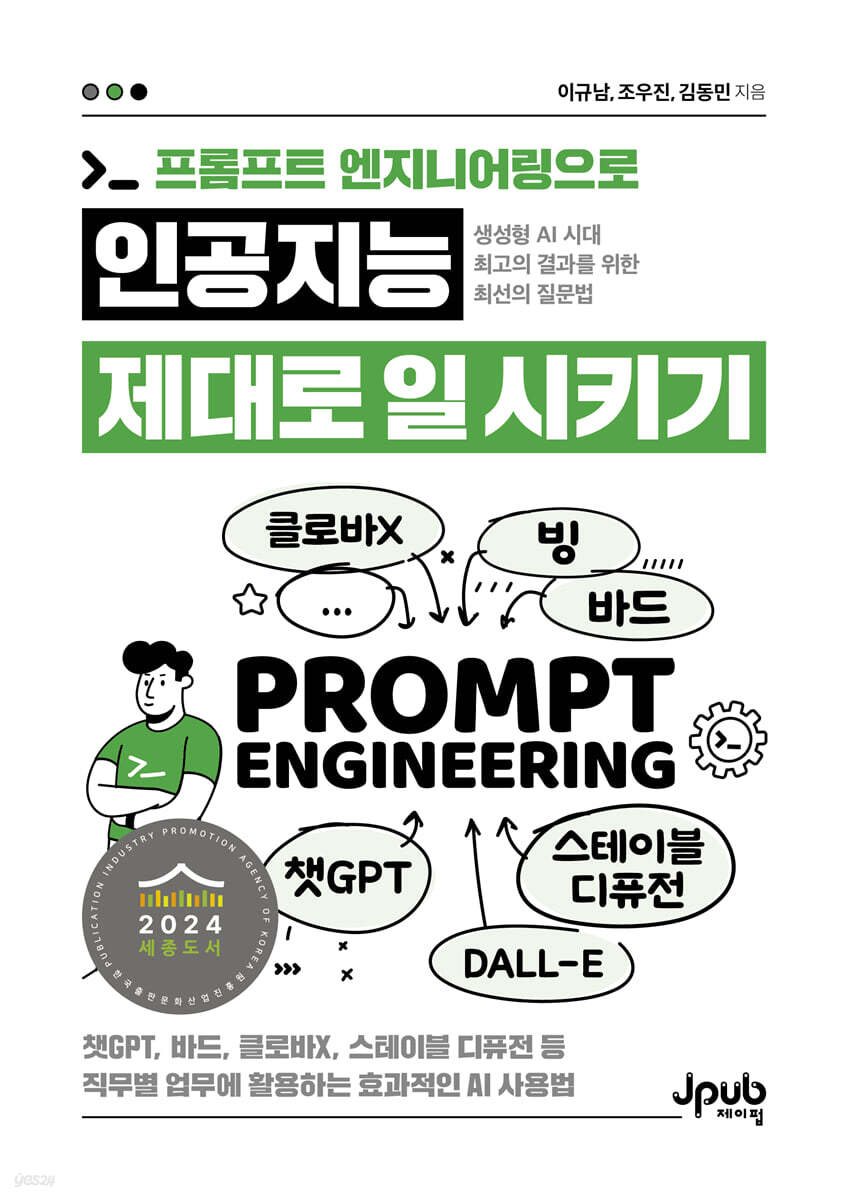
Making AI Work Properly with Prompt Engineering
 |
Description
Book Introduction
Prompt engineering: freely manipulate AI as you speak and as you wish.
Even artificial intelligence that can answer questions immediately can produce completely different results depending on how it is used.
Let's learn about prompt engineering that can be applied to various AI services and explore practical, job-specific AI applications.
In addition to asking questions to effectively use generative AI, you'll also gain insights into how to apply AI to your work and life.
Let's make AI your own by learning 16 prompt engineering techniques from AI experts and harnessing the full potential of AI.
Even artificial intelligence that can answer questions immediately can produce completely different results depending on how it is used.
Let's learn about prompt engineering that can be applied to various AI services and explore practical, job-specific AI applications.
In addition to asking questions to effectively use generative AI, you'll also gain insights into how to apply AI to your work and life.
Let's make AI your own by learning 16 prompt engineering techniques from AI experts and harnessing the full potential of AI.
- You can preview some of the book's contents.
Preview
index
Recommendation viii
Preface xi
How to Use This Book xiv
Chapter 1: Giant Generative AI: Are You Curious?
1.1 Why is artificial intelligence such a hot topic? 003
1.2 Why We Need Super-Giant Generative AI 014
1.3 A favorable situation for applying large-scale generative AI services 018
1.4 Understanding Stakeholders 032
Chapter 2: Prompt Engineering for Non-Majors
2.1 What exactly is prompt engineering? 037
2.2 Basic Step Prompt Engineering 051
__Please tell me more, specify specific conditions
__What is the context? Contextual learning
__Let me know you, clarify the definition
__Father enters the bag, avoiding ambiguity
__Say only one person, remove the process report
__Hyperparameter tuning
__Looking at it from multiple angles, asking repeated questions
__Exclude to get the reverse, exclusion of information
2.3 Advanced Step Prompt Engineering 080
__Answer me better, fine tuning
__Can you do this too? Context-independent, low-shot running
__Can you give me just one example? One-shot learning in context.
Is it possible without examples? Zero-shot learning in context.
__Gives answers and asks questions, chain of thought
__Ego-empowerment, role-playing
Asking until __, a chain of questions
2.4 How to Estimate Costs 103
Chapter 3: Use Cases for Large-Scale Generative AI Services and Prompt Engineering
3.1 Natural Language Generation Artificial Intelligence 109
__OpenAI ChatGPT
__Google Bard
__Naver CLOVA X
__Microsoft BingChat
3.2 Image Generation Artificial Intelligence 170
__OpenAI DALL-E2
__Stable Diffusion
Microsoft Bing Image Creator
3.3 AI for document creation, including presentations 196
__gamma
3.4 Goal-Oriented Artificial Intelligence 210
__AgentGPT
Chapter 4: Prompt Marketplace
4.1 PromptBase 219
4.2 Prompt Hero 220
4.3 Art Hub 221
4.4 Prompt 222
4.5 ChatX 223
4.6 Prompttown 223
Chapter 5: Application Examples by Job
5.1 Strategy 227
5.2 Marketing 245
5.3 Greetings 255
5.4 Development 265
5.5 Legal Affairs 280
Chapter 6: What You Need to Know When Applying Large-Scale Generative AI Services to Practice
6.1 Why Super-Gigantic Generative AI Has Superior Performance 297
6.2 Prerequisites for applying large-scale generative AI services 302
6.3 Problems and Solutions That May Occur When Launching a Large-Scale Generative AI Service 317
6.4 Considerations for Using Super-Large-Scale Generative AI 333
Chapter 7: Change is Opportunity
7.1 How to Seize Opportunity in a Crisis 345
7.2 Things to Discard When Using Artificial Intelligence 346
7.3 Career Change 348
7.4 The Future AI Society 353
Search 357
Preface xi
How to Use This Book xiv
Chapter 1: Giant Generative AI: Are You Curious?
1.1 Why is artificial intelligence such a hot topic? 003
1.2 Why We Need Super-Giant Generative AI 014
1.3 A favorable situation for applying large-scale generative AI services 018
1.4 Understanding Stakeholders 032
Chapter 2: Prompt Engineering for Non-Majors
2.1 What exactly is prompt engineering? 037
2.2 Basic Step Prompt Engineering 051
__Please tell me more, specify specific conditions
__What is the context? Contextual learning
__Let me know you, clarify the definition
__Father enters the bag, avoiding ambiguity
__Say only one person, remove the process report
__Hyperparameter tuning
__Looking at it from multiple angles, asking repeated questions
__Exclude to get the reverse, exclusion of information
2.3 Advanced Step Prompt Engineering 080
__Answer me better, fine tuning
__Can you do this too? Context-independent, low-shot running
__Can you give me just one example? One-shot learning in context.
Is it possible without examples? Zero-shot learning in context.
__Gives answers and asks questions, chain of thought
__Ego-empowerment, role-playing
Asking until __, a chain of questions
2.4 How to Estimate Costs 103
Chapter 3: Use Cases for Large-Scale Generative AI Services and Prompt Engineering
3.1 Natural Language Generation Artificial Intelligence 109
__OpenAI ChatGPT
__Google Bard
__Naver CLOVA X
__Microsoft BingChat
3.2 Image Generation Artificial Intelligence 170
__OpenAI DALL-E2
__Stable Diffusion
Microsoft Bing Image Creator
3.3 AI for document creation, including presentations 196
__gamma
3.4 Goal-Oriented Artificial Intelligence 210
__AgentGPT
Chapter 4: Prompt Marketplace
4.1 PromptBase 219
4.2 Prompt Hero 220
4.3 Art Hub 221
4.4 Prompt 222
4.5 ChatX 223
4.6 Prompttown 223
Chapter 5: Application Examples by Job
5.1 Strategy 227
5.2 Marketing 245
5.3 Greetings 255
5.4 Development 265
5.5 Legal Affairs 280
Chapter 6: What You Need to Know When Applying Large-Scale Generative AI Services to Practice
6.1 Why Super-Gigantic Generative AI Has Superior Performance 297
6.2 Prerequisites for applying large-scale generative AI services 302
6.3 Problems and Solutions That May Occur When Launching a Large-Scale Generative AI Service 317
6.4 Considerations for Using Super-Large-Scale Generative AI 333
Chapter 7: Change is Opportunity
7.1 How to Seize Opportunity in a Crisis 345
7.2 Things to Discard When Using Artificial Intelligence 346
7.3 Career Change 348
7.4 The Future AI Society 353
Search 357
Detailed image

Into the book
Most existing repetitive tasks will be replaced by artificial intelligence.
We will be required to perform higher-level tasks, and there may come a day when competencies different from those demanded in this era will be important.
For example, while the ability to utilize artificial intelligence is not essential for general office workers today, those who cannot utilize artificial intelligence in the future may not be able to work.
There will come a time when we will have to find and do things that artificial intelligence cannot do, and people who are good at doing those things will be in the spotlight.
--- p.10
Since this is a task of adjusting the prompt value to obtain the desired value from artificial intelligence (to improve performance), it does not necessarily have to be text.
This is because artificial intelligence can receive various values, such as structured data, in addition to images and text.
However, most generative artificial intelligence that has recently shown good results provides various types of results, such as text or images, when a value containing text is provided as an initial value.
So I want to discuss mainly text-based prompt engineering.
--- p.40
When a lot of people are talking at the same time, the conversation can't proceed properly.
I don't know what to say because I can't quite understand what the other person is saying.
The same goes for artificial intelligence.
When too much information comes into a prompt at once, it is difficult to respond properly.
Especially when a lot of useless information comes in, the response is affected accordingly.
Therefore, it is important to eliminate useless information and structure the prompt concisely, focusing on key information.
--- p.66~67
When I introduced myself to an employee of an IT company, the words I used changed.
Instead of using familiar examples, use practical examples (customer support, automated response systems, document summarization and summary information extraction, internal knowledge sharing, chatbots, etc.) to appeal to usability and explain what technologies were used to develop it.
Prompt engineering is important because the results vary depending on the role assigned.
--- p.116
OpenAI asked the machine to create synthetic images of turtles and giraffes to show non-existent images.
Then, we created an image that combined the concepts of giraffe and turtle, such as a giraffe with a turtle shell or a turtle with the colors and patterns of a giraffe.
Of course, there's no such thing as a giraffe with a turtle shell, and no turtle with giraffe colors and patterns. DALL-E2 synthesized these two disparate concepts to create a new image.
This suggests that, as discussed earlier, concepts can be combined.
--- p.182
What we wanted was a software assistant that would automatically perform tasks that the user needed to do, using generative artificial intelligence like ChatGPT.
Of course, ChatGPT can also continue the conversation and remembers what was previously discussed to some extent.
However, it does not automatically perform tasks when given a goal.
So we started developing a system that would automatically accomplish the goal, and our AI agent, AutoGPT, started to get results.
So, when you give AutoGPT a goal, it automatically performs the tasks required to produce the desired result.
--- p.211
We can assume that in the future, artificial intelligence will become easier to use and will develop in a way that makes it more natural to encounter it in our lives.
If such a society comes, what should non-experts do? They must become the best leaders who can effectively utilize AI.
To do that, we need to use artificial intelligence extensively and introduce it into our work environment.
So, this book covers the types of super-large-scale generative artificial intelligence, examples of its use, and examples of artificial intelligence use by job.
In other words, we need to use artificial intelligence a lot and get a feel for how and when to use it better.
We will be required to perform higher-level tasks, and there may come a day when competencies different from those demanded in this era will be important.
For example, while the ability to utilize artificial intelligence is not essential for general office workers today, those who cannot utilize artificial intelligence in the future may not be able to work.
There will come a time when we will have to find and do things that artificial intelligence cannot do, and people who are good at doing those things will be in the spotlight.
--- p.10
Since this is a task of adjusting the prompt value to obtain the desired value from artificial intelligence (to improve performance), it does not necessarily have to be text.
This is because artificial intelligence can receive various values, such as structured data, in addition to images and text.
However, most generative artificial intelligence that has recently shown good results provides various types of results, such as text or images, when a value containing text is provided as an initial value.
So I want to discuss mainly text-based prompt engineering.
--- p.40
When a lot of people are talking at the same time, the conversation can't proceed properly.
I don't know what to say because I can't quite understand what the other person is saying.
The same goes for artificial intelligence.
When too much information comes into a prompt at once, it is difficult to respond properly.
Especially when a lot of useless information comes in, the response is affected accordingly.
Therefore, it is important to eliminate useless information and structure the prompt concisely, focusing on key information.
--- p.66~67
When I introduced myself to an employee of an IT company, the words I used changed.
Instead of using familiar examples, use practical examples (customer support, automated response systems, document summarization and summary information extraction, internal knowledge sharing, chatbots, etc.) to appeal to usability and explain what technologies were used to develop it.
Prompt engineering is important because the results vary depending on the role assigned.
--- p.116
OpenAI asked the machine to create synthetic images of turtles and giraffes to show non-existent images.
Then, we created an image that combined the concepts of giraffe and turtle, such as a giraffe with a turtle shell or a turtle with the colors and patterns of a giraffe.
Of course, there's no such thing as a giraffe with a turtle shell, and no turtle with giraffe colors and patterns. DALL-E2 synthesized these two disparate concepts to create a new image.
This suggests that, as discussed earlier, concepts can be combined.
--- p.182
What we wanted was a software assistant that would automatically perform tasks that the user needed to do, using generative artificial intelligence like ChatGPT.
Of course, ChatGPT can also continue the conversation and remembers what was previously discussed to some extent.
However, it does not automatically perform tasks when given a goal.
So we started developing a system that would automatically accomplish the goal, and our AI agent, AutoGPT, started to get results.
So, when you give AutoGPT a goal, it automatically performs the tasks required to produce the desired result.
--- p.211
We can assume that in the future, artificial intelligence will become easier to use and will develop in a way that makes it more natural to encounter it in our lives.
If such a society comes, what should non-experts do? They must become the best leaders who can effectively utilize AI.
To do that, we need to use artificial intelligence extensively and introduce it into our work environment.
So, this book covers the types of super-large-scale generative artificial intelligence, examples of its use, and examples of artificial intelligence use by job.
In other words, we need to use artificial intelligence a lot and get a feel for how and when to use it better.
--- p.345~346
Publisher's Review
Learn prompt engineering and become a leader in the future society.
We live in an era where the use of artificial intelligence is essential.
In the information age, using office programs like Word, Excel, and PowerPoint was a basic skill for office workers, but now we need to know how to use artificial intelligence as if it were our own body.
Especially with the advent of generative AI, which can create anything it says, just by entering a command, AI can handle everything you need, including creating text, images, and documents, as well as coding, shopping, and travel planning.
Even if you just set a goal, artificial intelligence will find a solution and produce results.
This book contains questioning methods for effectively using generative artificial intelligence.
Generative AI needs to ask questions in a way that is easy to understand to efficiently obtain the desired answers, and the process of designing and processing prompts in this way is called 'prompt engineering.'
The authors, who are experts in artificial intelligence, explain 16 prompt engineering techniques, including specifying specific conditions, hyperparameter tuning, and zero-shot learning in context, in an easy-to-understand manner for readers.
We'll explore how to apply each prompt engineering technique to a specific scenario, along with practical examples, along with basic AI principles.
We will directly apply prompt engineering to various AI services, including natural language generation AI such as ChatGPT, Bard, and Clova X, as well as image generation AI such as DALL-E2 and Stable Diffusion, the Gamma AI service that generates presentation materials with commands, and the goal-oriented AgentGPT.
It also suggests how and what AI services can be used by workers in each job, from strategy and marketing to human resources, development, and legal affairs.
When ChatGPT first came out, the salaries of Prompt engineers were in the news.
In the future, the world will be filled with opportunities for those who can effectively utilize generative artificial intelligence.
Understanding what a massive generative AI is and how to apply prompt engineering can help you further enhance your capabilities.
I hope to become a Citizen Prompt engineer who can freely handle artificial intelligence and seize opportunities in this constantly changing environment.
Key Contents
-Introducing 16 Prompt Engineering Techniques
- Examples of AI service applications, including natural language generation, image generation, and document generation.
- How to use AI in various fields, such as strategy, marketing, human resources, development, and legal affairs.
Insights into the AI application environment and future society
We live in an era where the use of artificial intelligence is essential.
In the information age, using office programs like Word, Excel, and PowerPoint was a basic skill for office workers, but now we need to know how to use artificial intelligence as if it were our own body.
Especially with the advent of generative AI, which can create anything it says, just by entering a command, AI can handle everything you need, including creating text, images, and documents, as well as coding, shopping, and travel planning.
Even if you just set a goal, artificial intelligence will find a solution and produce results.
This book contains questioning methods for effectively using generative artificial intelligence.
Generative AI needs to ask questions in a way that is easy to understand to efficiently obtain the desired answers, and the process of designing and processing prompts in this way is called 'prompt engineering.'
The authors, who are experts in artificial intelligence, explain 16 prompt engineering techniques, including specifying specific conditions, hyperparameter tuning, and zero-shot learning in context, in an easy-to-understand manner for readers.
We'll explore how to apply each prompt engineering technique to a specific scenario, along with practical examples, along with basic AI principles.
We will directly apply prompt engineering to various AI services, including natural language generation AI such as ChatGPT, Bard, and Clova X, as well as image generation AI such as DALL-E2 and Stable Diffusion, the Gamma AI service that generates presentation materials with commands, and the goal-oriented AgentGPT.
It also suggests how and what AI services can be used by workers in each job, from strategy and marketing to human resources, development, and legal affairs.
When ChatGPT first came out, the salaries of Prompt engineers were in the news.
In the future, the world will be filled with opportunities for those who can effectively utilize generative artificial intelligence.
Understanding what a massive generative AI is and how to apply prompt engineering can help you further enhance your capabilities.
I hope to become a Citizen Prompt engineer who can freely handle artificial intelligence and seize opportunities in this constantly changing environment.
Key Contents
-Introducing 16 Prompt Engineering Techniques
- Examples of AI service applications, including natural language generation, image generation, and document generation.
- How to use AI in various fields, such as strategy, marketing, human resources, development, and legal affairs.
Insights into the AI application environment and future society
GOODS SPECIFICS
- Date of issue: November 10, 2023
- Page count, weight, size: 380 pages | 152*215*18mm
- ISBN13: 9791192987590
You may also like
카테고리
korean


korean

![GQ KOREA Mark (Monthly): December [2025]](http://librairie.coreenne.fr/cdn/shop/files/8ef265dbbfbf186523ed75ba7319009d.jpg?v=1765340328&width=3840)


