

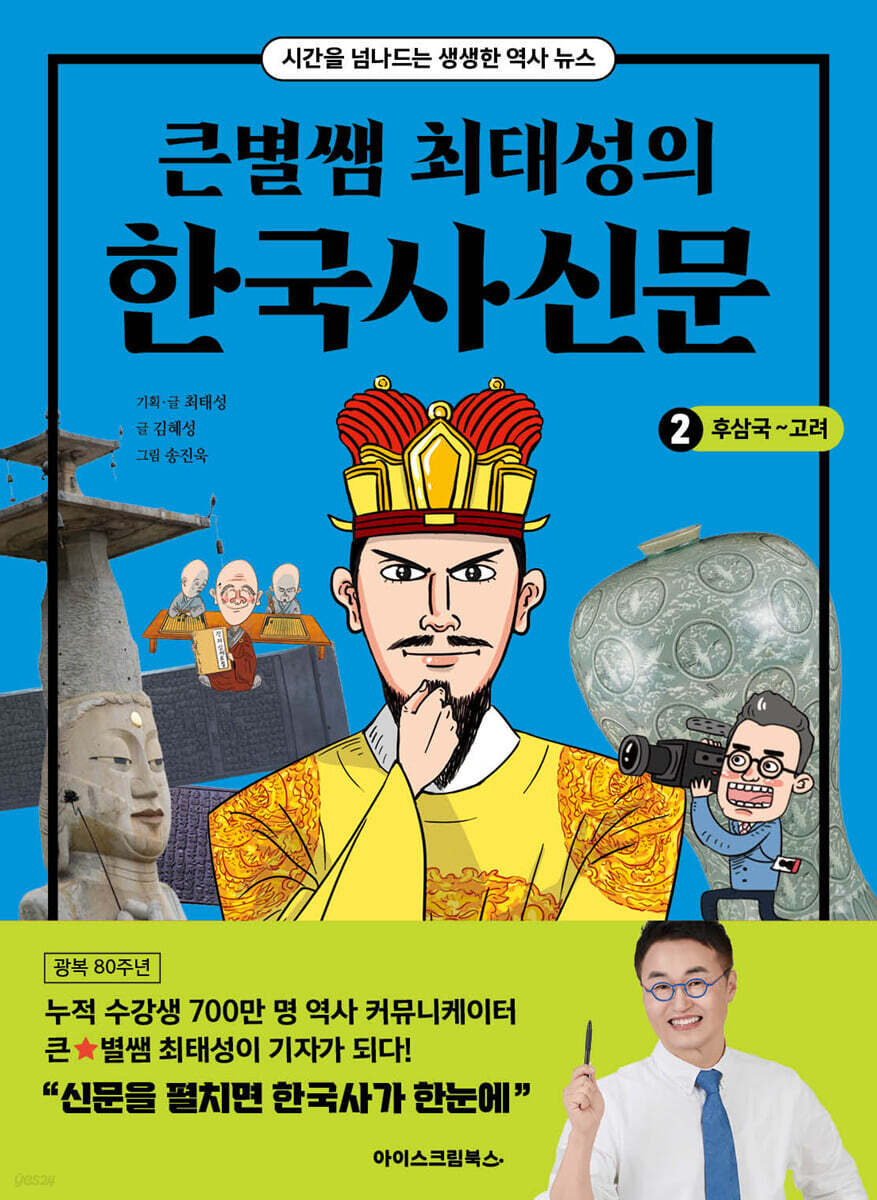
Big Star Teacher Choi Tae-seong's Korean History Newspaper 2: Later Three Kingdoms to Goryeo
 |
Description
Book Introduction
The '② Later Three Kingdoms~Goryeo' section contains the story from the Later Three Kingdoms period that emerged after the fall of Unified Silla to the founding and fall of Goryeo.
Reporter Daebyeol interviews representative figures of the Goryeo Dynasty, including Taejo Wang Geon, King Gongmin, General Gang Gam-chan, and Jeong Mong-ju, and asks them key questions.
Additionally, the column articles examine key issues in Goryeo society, such as the Goryeo gold standard, Manjeok's movement for liberation of social classes, and King Gongmin's reforms, from the perspective of reporter Daebyeol.
In addition, you can easily understand the Tripitaka Koreana and Jikji Simche Yojeol, which were created during the Goryeo Dynasty, by approaching them like interesting advertisements of today.
Reporter Daebyeol interviews representative figures of the Goryeo Dynasty, including Taejo Wang Geon, King Gongmin, General Gang Gam-chan, and Jeong Mong-ju, and asks them key questions.
Additionally, the column articles examine key issues in Goryeo society, such as the Goryeo gold standard, Manjeok's movement for liberation of social classes, and King Gongmin's reforms, from the perspective of reporter Daebyeol.
In addition, you can easily understand the Tripitaka Koreana and Jikji Simche Yojeol, which were created during the Goryeo Dynasty, by approaching them like interesting advertisements of today.
- You can preview some of the book's contents.
Preview
index
The Later Three Kingdoms Period, Part 1 │ The Later Three Kingdoms Period Begins
The emergence of Later Goguryeo and Later Baekje, the beginning of the Later Three Kingdoms period.
Interview: Gung Ye and Gyeon Hwon, who ushered in the Three Kingdoms period, meet in a surprise meeting!
King Taejo Wang Geon of Goryeo unifies the Later Three Kingdoms!
Wang Geon's politics of addition that unified the Later Three Kingdoms
No. 2 Early Goryeo │ Taejo Wang Geon Lays the Foundation of the Nation
The results of Goryeo's northward advance policy are gradually revealed.
The story of King Taejo Wang Geon marrying 29 daughters of powerful families
The will of King Taejo Wang Geon contained in the 10 articles of Hunyo
No. 3 Early Goryeo │ Gwangjong Draws the Sword of Reform
Gwangjong brings reform to Goryeo
What does Gwangjong's reform politics mean to the powerful?
Was Gwangjong a tyrant or a reformist monarch?
Announcement of the 1st Civil Service Examination
No. 4 Early Goryeo │ Completing the Framework of the Goryeo Governing System
Seongjong adopts Choi Seung-ro's 28 articles of state affairs!
Meet King Seongjong, who perfected Goryeo's ruling system.
A rising tourist destination, the stone statue of Maitreya Bodhisattva at Gwanchoksa Temple in Nonsan
King Hyeonjong completes the local government system by dividing the five provinces into two regions!
How should we view the implementation of the Goryeo civil service examination system?
No. 5 Early Goryeo │ Repelling the Khitan Invasion
800,000 Khitan troops invade! The Goryeo government is thrown into turmoil.
Diplomatic Negotiation Skills from the Top Diplomat, Seo Hee
Gang Gam-chan, victory in the Battle of Gwiju thanks to the miracle of the wind!
Learning perseverance from Kang Gam-chan
No. 6 Early Goryeo │ Goryeo Exchanges with Various Countries
Exclusive reveal of the Palgwanhoe site!
Byeokrando Island emerges as an international trading port
The Writing of the 『Goryeo Dogyeong』 from Seo Geung
Look at the open society considerations!
No. 7 Early Goryeo │ The Aristocracy-Centered Society Shakes
Yun Gwan established nine castles in the northeast after conquering the Jurchen.
Lee Ja-gyeom's failed attempt to usurp the throne
Meet the people who suppressed Lee Ja-gyeom's rebellion
The Seogyeong faction strongly pushes for the relocation of the capital to Seogyeong.
The Four Great Powers of Gold, how should we view them?
No. 8 Early Goryeo │ Confucianism Develops
Private education is gaining attention as a shortcut to passing the civil service exam.
King Yejong promotes reform of the national education system.
The Writing of the Samguk Sagi from Kim Bu-sik
Was private education popular even during the Goryeo Dynasty?
No. 9 Late Goryeo Dynasty │ Military officials seize power
The military coup d'état occurred, and continued discrimination led to an explosion of discontent among the military.
Meet Choi Chung-heon, a key figure in the Choi regime
Nobi Manjeok, “Is there a separate seed for the general?”
The significance of Manjeok's movement for liberation of social classes
No. 10 Late Goryeo │ Resisting the Mongol Invasion
Goryeo's inheritance culture as heard from Son Byeon
Goryeo relocates the capital to Ganghwa
Kim Yun-hu shares the secrets of victory in the Battle of Cheoinseong and Chungjuseong.
A ceremony commemorating the completion of the Tripitaka Koreana was held.
Sambyeolcho defeated by Goryeo-Mongol allied forces in Jeju
Wonjong's choice was right
No. 11: Late Goryeo │ Thoughts Develop and New History Books Are Compiled
Jinul launches Buddhist reform movement
Meet Jinul, who led the Buddhist reform and unification movement.
Books that revive the roots of the nation are being published one after another.
Recruiting students for the Feng Shui class
We seek Dangun in times of trouble
No. 12 Late Goryeo │ King Gongmin pursues reformist policies against the Yuan Dynasty.
Yuan's interference in Goryeo's internal affairs is becoming more severe by the day.
Meet Ki-cheol, a leading figure in the powerful family.
What's the latest trend in Korea these days? Mongolian style!
King Gongmin begins full-scale internal reforms
King Gongmin and his wife fled from the Red Turban Rebellion.
Did King Gongmin really fail in his reforms?
No. 13: Late Goryeo │ The Emergence of a New Military Power
Goryeo at a diplomatic crossroads: Ming or Yuan?
Emerging military powers achieve consecutive victories against the Red Turbans and Japanese pirates.
Choi Mu-seon's story of success in gunpowder production
Special Distribution Announcement for the Limited Edition of the Metal Type Printed Jikji Simche Yojeol
Why did the Neo-Confucianism syndrome occur in the late Goryeo Dynasty?
Issue 14: Late Goryeo │ The 500-Year-Old Goryeo Dynasty Collapses
Yi Seong-gye seizes power after carrying out the Wihwado Retreat
The 500-year history of the Goryeo Dynasty has disappeared.
Meet Jeong Mong-ju, a symbol of loyalty and integrity.
Choi Young and Yi Seong-gye's Choice at a Crossroads in History
The emergence of Later Goguryeo and Later Baekje, the beginning of the Later Three Kingdoms period.
Interview: Gung Ye and Gyeon Hwon, who ushered in the Three Kingdoms period, meet in a surprise meeting!
King Taejo Wang Geon of Goryeo unifies the Later Three Kingdoms!
Wang Geon's politics of addition that unified the Later Three Kingdoms
No. 2 Early Goryeo │ Taejo Wang Geon Lays the Foundation of the Nation
The results of Goryeo's northward advance policy are gradually revealed.
The story of King Taejo Wang Geon marrying 29 daughters of powerful families
The will of King Taejo Wang Geon contained in the 10 articles of Hunyo
No. 3 Early Goryeo │ Gwangjong Draws the Sword of Reform
Gwangjong brings reform to Goryeo
What does Gwangjong's reform politics mean to the powerful?
Was Gwangjong a tyrant or a reformist monarch?
Announcement of the 1st Civil Service Examination
No. 4 Early Goryeo │ Completing the Framework of the Goryeo Governing System
Seongjong adopts Choi Seung-ro's 28 articles of state affairs!
Meet King Seongjong, who perfected Goryeo's ruling system.
A rising tourist destination, the stone statue of Maitreya Bodhisattva at Gwanchoksa Temple in Nonsan
King Hyeonjong completes the local government system by dividing the five provinces into two regions!
How should we view the implementation of the Goryeo civil service examination system?
No. 5 Early Goryeo │ Repelling the Khitan Invasion
800,000 Khitan troops invade! The Goryeo government is thrown into turmoil.
Diplomatic Negotiation Skills from the Top Diplomat, Seo Hee
Gang Gam-chan, victory in the Battle of Gwiju thanks to the miracle of the wind!
Learning perseverance from Kang Gam-chan
No. 6 Early Goryeo │ Goryeo Exchanges with Various Countries
Exclusive reveal of the Palgwanhoe site!
Byeokrando Island emerges as an international trading port
The Writing of the 『Goryeo Dogyeong』 from Seo Geung
Look at the open society considerations!
No. 7 Early Goryeo │ The Aristocracy-Centered Society Shakes
Yun Gwan established nine castles in the northeast after conquering the Jurchen.
Lee Ja-gyeom's failed attempt to usurp the throne
Meet the people who suppressed Lee Ja-gyeom's rebellion
The Seogyeong faction strongly pushes for the relocation of the capital to Seogyeong.
The Four Great Powers of Gold, how should we view them?
No. 8 Early Goryeo │ Confucianism Develops
Private education is gaining attention as a shortcut to passing the civil service exam.
King Yejong promotes reform of the national education system.
The Writing of the Samguk Sagi from Kim Bu-sik
Was private education popular even during the Goryeo Dynasty?
No. 9 Late Goryeo Dynasty │ Military officials seize power
The military coup d'état occurred, and continued discrimination led to an explosion of discontent among the military.
Meet Choi Chung-heon, a key figure in the Choi regime
Nobi Manjeok, “Is there a separate seed for the general?”
The significance of Manjeok's movement for liberation of social classes
No. 10 Late Goryeo │ Resisting the Mongol Invasion
Goryeo's inheritance culture as heard from Son Byeon
Goryeo relocates the capital to Ganghwa
Kim Yun-hu shares the secrets of victory in the Battle of Cheoinseong and Chungjuseong.
A ceremony commemorating the completion of the Tripitaka Koreana was held.
Sambyeolcho defeated by Goryeo-Mongol allied forces in Jeju
Wonjong's choice was right
No. 11: Late Goryeo │ Thoughts Develop and New History Books Are Compiled
Jinul launches Buddhist reform movement
Meet Jinul, who led the Buddhist reform and unification movement.
Books that revive the roots of the nation are being published one after another.
Recruiting students for the Feng Shui class
We seek Dangun in times of trouble
No. 12 Late Goryeo │ King Gongmin pursues reformist policies against the Yuan Dynasty.
Yuan's interference in Goryeo's internal affairs is becoming more severe by the day.
Meet Ki-cheol, a leading figure in the powerful family.
What's the latest trend in Korea these days? Mongolian style!
King Gongmin begins full-scale internal reforms
King Gongmin and his wife fled from the Red Turban Rebellion.
Did King Gongmin really fail in his reforms?
No. 13: Late Goryeo │ The Emergence of a New Military Power
Goryeo at a diplomatic crossroads: Ming or Yuan?
Emerging military powers achieve consecutive victories against the Red Turbans and Japanese pirates.
Choi Mu-seon's story of success in gunpowder production
Special Distribution Announcement for the Limited Edition of the Metal Type Printed Jikji Simche Yojeol
Why did the Neo-Confucianism syndrome occur in the late Goryeo Dynasty?
Issue 14: Late Goryeo │ The 500-Year-Old Goryeo Dynasty Collapses
Yi Seong-gye seizes power after carrying out the Wihwado Retreat
The 500-year history of the Goryeo Dynasty has disappeared.
Meet Jeong Mong-ju, a symbol of loyalty and integrity.
Choi Young and Yi Seong-gye's Choice at a Crossroads in History
Detailed image

Publisher's Review
“History newspaper delivery~!” If you read it with interest, Korean history will stick in your head!
Big Star Teacher Choi Tae-seong publishes a new concept history book for children.
A Korean history newspaper presented to commemorate the 80th anniversary of liberation
Reading Korean history in newspapers gives me more power to think.
Convey information concisely and clearly, and include diverse perspectives.
This book takes advantage of the newspaper's strengths, conveying the essence of the events in an accessible manner while also raising questions about each topic and encouraging readers to interpret it for themselves.
Young readers can develop historical thinking skills by connecting the past to the present, rather than simply viewing it as "the past."
A history book to read, see, and think about
This book conveys historical events from various angles through a colorful article format, just like an actual newspaper.
1.
Front Page Headline: Presents the core keywords of the day's topic as a title, helping readers get a preview of what will be covered in this chapter.
2.
Big Star Article: A concise news article structured according to the six principles (when, where, who, what, why, and how).
Helps children quickly understand key facts and summarize the development and context of events at a glance.
3.
Big Star Interview: An imaginary interview where you meet historical figures in person and hear their stories.
By vividly conveying the characters' thoughts and emotions, it goes beyond simple information delivery and enables character-centered empathetic learning.
4.
Big Star Column: This is a commentary corner where reporter Big Star provides his own commentary.
It conveys historical significance, background, and connections to the present day in an easy and in-depth manner, using explanations tailored to children's level.
5.
Big Star Advertisement: A fictional advertisement satirically depicting the situation at the time.
It stimulates historical imagination by expressing the times and culture in a playful way, and even provides background knowledge.
6.
Chronological Appendix: Includes a chronological table to help you organize what you've learned in the context of the times.
If you keep it on your desk, it will be effective in understanding the flow of Korean history and the causal relationships between events.
A historical newspaper with witty illustrations and vivid photographs
Witty illustrations help bring historical scenes to life and make complex content visually accessible.
Additionally, various visual materials such as actual artifacts, photographs, and maps are included, adding a sense of historical presence and realism that is difficult to convey through text alone.
History is a window to the future.
《Big Star Teacher Choi Tae-seong's Korean History Newspaper》 is not a simple introduction to history.
It is a living book designed to help children understand history not just as “things of the past,” but as “stories connected to the present.”
Within the clear framework of the newspaper format, children learn, feel, think, and develop a historical attitude that allows them to ask questions.
As we celebrate the 80th anniversary of liberation, this book will be a special gift, helping our children develop a broader perspective and deeper thinking through history.
Big Star Teacher Choi Tae-seong publishes a new concept history book for children.
A Korean history newspaper presented to commemorate the 80th anniversary of liberation
Reading Korean history in newspapers gives me more power to think.
Convey information concisely and clearly, and include diverse perspectives.
This book takes advantage of the newspaper's strengths, conveying the essence of the events in an accessible manner while also raising questions about each topic and encouraging readers to interpret it for themselves.
Young readers can develop historical thinking skills by connecting the past to the present, rather than simply viewing it as "the past."
A history book to read, see, and think about
This book conveys historical events from various angles through a colorful article format, just like an actual newspaper.
1.
Front Page Headline: Presents the core keywords of the day's topic as a title, helping readers get a preview of what will be covered in this chapter.
2.
Big Star Article: A concise news article structured according to the six principles (when, where, who, what, why, and how).
Helps children quickly understand key facts and summarize the development and context of events at a glance.
3.
Big Star Interview: An imaginary interview where you meet historical figures in person and hear their stories.
By vividly conveying the characters' thoughts and emotions, it goes beyond simple information delivery and enables character-centered empathetic learning.
4.
Big Star Column: This is a commentary corner where reporter Big Star provides his own commentary.
It conveys historical significance, background, and connections to the present day in an easy and in-depth manner, using explanations tailored to children's level.
5.
Big Star Advertisement: A fictional advertisement satirically depicting the situation at the time.
It stimulates historical imagination by expressing the times and culture in a playful way, and even provides background knowledge.
6.
Chronological Appendix: Includes a chronological table to help you organize what you've learned in the context of the times.
If you keep it on your desk, it will be effective in understanding the flow of Korean history and the causal relationships between events.
A historical newspaper with witty illustrations and vivid photographs
Witty illustrations help bring historical scenes to life and make complex content visually accessible.
Additionally, various visual materials such as actual artifacts, photographs, and maps are included, adding a sense of historical presence and realism that is difficult to convey through text alone.
History is a window to the future.
《Big Star Teacher Choi Tae-seong's Korean History Newspaper》 is not a simple introduction to history.
It is a living book designed to help children understand history not just as “things of the past,” but as “stories connected to the present.”
Within the clear framework of the newspaper format, children learn, feel, think, and develop a historical attitude that allows them to ask questions.
As we celebrate the 80th anniversary of liberation, this book will be a special gift, helping our children develop a broader perspective and deeper thinking through history.
GOODS SPECIFICS
- Date of issue: August 11, 2025
- Page count, weight, size: 164 pages | 462g | 188*257*10mm
- ISBN13: 9791161087726
- ISBN10: 1161087729
- KC Certification: Certification Type: Conformity Confirmation
You may also like
카테고리
korean


korean

![GQ KOREA Mark (Monthly): December [2025]](http://librairie.coreenne.fr/cdn/shop/files/8ef265dbbfbf186523ed75ba7319009d.jpg?v=1765340328&width=3840)


