

Robot UX
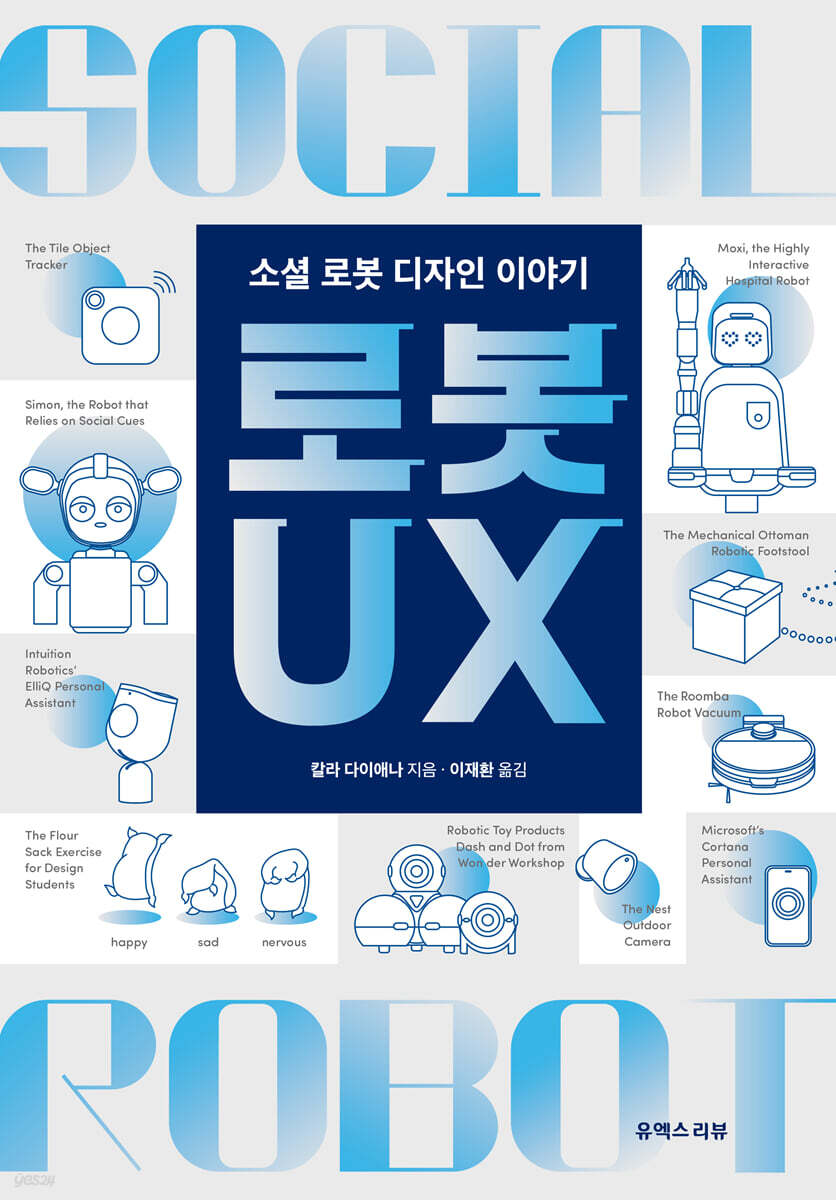 |
Description
Book Introduction
A new UX paradigm for human-robot interaction design!
“How are smart products designed to realize social value?”
Paro, a seal robot that helps with the psychological treatment of dementia patients; Airstar, a guide robot that roams Incheon Airport taking photos of travelers; Sophia, an AI robot that surprised us with its human-like appearance… Today, social robots are with us in various fields.
Social robots are robots that can recognize and learn from their users and environment, and perform 'social functions' that were originally considered to be the exclusive domain of humans. They are given the role of companions that communicate with humans, going beyond mere products.
When designing these, it is very important to consider UX that creates the optimal human-centered experience.
It is necessary to be able to interact with humans in the most delicate way possible by utilizing social intelligence.
Did you know that today's first-generation smart products, representing the robotic age, aren't all that smart? While AI products and robots have undoubtedly made human life much more valuable and enriching, we're still only seeing the tip of the iceberg when it comes to the societal roles they can play.
《Robot UX》 presents a method for designing smart products that goes beyond the simple functions of the first generation and leaps to a higher level of social role.
Author Carla Diana, a senior designer at Diligent Robotics, a leading medical robotics company, and a renowned robotics UX researcher, introduces 'social interaction,' one of the long-standing research fields of design convergence, as a key concept that the robotics field should pay the most attention to in the future.
Based on a five-step design framework of 'presence, expression, interaction, context, and ecosystem,' this book provides detailed guidance on how to deliver the UX of a smart product that truly "understands" humans.
This book introduces various social robot products that are actually in use and details the process of how they were planned and created.
We will discuss in detail the process of defining a product concept and designing it using various approaches such as vision imagery, scenario storyboarding, video prototyping, and behavior charting.
This is the bible of robot design, a much-needed tool for today's society, not only interpreting the robot business from the perspective of a design expert, but also providing sharp insights and knowledge on the social roles that only robot products can play, such as alleviating isolation and resolving labor shortages.
“How are smart products designed to realize social value?”
Paro, a seal robot that helps with the psychological treatment of dementia patients; Airstar, a guide robot that roams Incheon Airport taking photos of travelers; Sophia, an AI robot that surprised us with its human-like appearance… Today, social robots are with us in various fields.
Social robots are robots that can recognize and learn from their users and environment, and perform 'social functions' that were originally considered to be the exclusive domain of humans. They are given the role of companions that communicate with humans, going beyond mere products.
When designing these, it is very important to consider UX that creates the optimal human-centered experience.
It is necessary to be able to interact with humans in the most delicate way possible by utilizing social intelligence.
Did you know that today's first-generation smart products, representing the robotic age, aren't all that smart? While AI products and robots have undoubtedly made human life much more valuable and enriching, we're still only seeing the tip of the iceberg when it comes to the societal roles they can play.
《Robot UX》 presents a method for designing smart products that goes beyond the simple functions of the first generation and leaps to a higher level of social role.
Author Carla Diana, a senior designer at Diligent Robotics, a leading medical robotics company, and a renowned robotics UX researcher, introduces 'social interaction,' one of the long-standing research fields of design convergence, as a key concept that the robotics field should pay the most attention to in the future.
Based on a five-step design framework of 'presence, expression, interaction, context, and ecosystem,' this book provides detailed guidance on how to deliver the UX of a smart product that truly "understands" humans.
This book introduces various social robot products that are actually in use and details the process of how they were planned and created.
We will discuss in detail the process of defining a product concept and designing it using various approaches such as vision imagery, scenario storyboarding, video prototyping, and behavior charting.
This is the bible of robot design, a much-needed tool for today's society, not only interpreting the robot business from the perspective of a design expert, but also providing sharp insights and knowledge on the social roles that only robot products can play, such as alleviating isolation and resolving labor shortages.
- You can preview some of the book's contents.
Preview
index
Translator's Preface
Chapter 1: Social Design Beyond Smartness
Why Smart Products Aren't So Smart
What is missing from today's products?
Integrating Social Design into Your Products
How Social Design Works
Literacy of Social Products
Products at the intersection of physical and digital environments
Why I wrote this book
How to use and structure this book
Chapter 2 How Does Social Design Work?
social affordance
The ears of the social robot Simon
Interaction is intelligence
Interaction Modeling
Procedure approach
Chapter 3: The Importance of Product Reality
What is presence?
Product Semantics
Flip Mino in my pocket
Product Story and Character
Getting to the heart of things through social roles
Communication using social cues and physical structures
Chapter 4: Expressing Things Through Communication
Communication using abbreviations
What is an expression?
Product body language
Light, movement and sound
Combination of modes
Now all we have to do is interact
In the Lab: Using Sound
Chapter 5: Interaction between Products and People
Sensors and Actuators
Camera as an 'all-purpose sensor'
Multiple senses felt simultaneously
Prototyping using a microcontroller
social interaction
Interaction Design
Contextual questioning
Scale scenario
WOZ Design Methodology
Field experiment
Interview with Andrea Thomas
Chapter 6: Design the Context
Context-based mindset
In the lab: Moksi
Pros and Cons of Smartphones
In the Lab: Apron Alert
Case Study: Hammerhead One Bicycle Handlebar Navigation System
Context of conversation
Case Study: The Clever Coat Rack
Chapter 7: Ecosystem Design: Connecting Everything Together
The ecosystem is social
Cloud Robotics: A Technology That Demonstrates Social Intelligence
One experience, many devices
Social Internet of Things
Wearable Devices: The Internet of Your Body
Crowdsourcing and Aggregated Data
From the Lab: Smart News
Creating brand value through the ecosystem
Chapter 8: Various Levels of Intelligence, Including AI
AI-driven social intelligence
Rumors surrounding artificial intelligence
AI Tools for Social Intelligence
Learning through continuous exchange
Interview with Jonathan Foster
Chapter 9: The Future Is Here Now
The Age of Social Robots
Victory is bittersweet
Product designers hold the key
Let's take advantage of the opportunity
Acknowledgements
References
Chapter 1: Social Design Beyond Smartness
Why Smart Products Aren't So Smart
What is missing from today's products?
Integrating Social Design into Your Products
How Social Design Works
Literacy of Social Products
Products at the intersection of physical and digital environments
Why I wrote this book
How to use and structure this book
Chapter 2 How Does Social Design Work?
social affordance
The ears of the social robot Simon
Interaction is intelligence
Interaction Modeling
Procedure approach
Chapter 3: The Importance of Product Reality
What is presence?
Product Semantics
Flip Mino in my pocket
Product Story and Character
Getting to the heart of things through social roles
Communication using social cues and physical structures
Chapter 4: Expressing Things Through Communication
Communication using abbreviations
What is an expression?
Product body language
Light, movement and sound
Combination of modes
Now all we have to do is interact
In the Lab: Using Sound
Chapter 5: Interaction between Products and People
Sensors and Actuators
Camera as an 'all-purpose sensor'
Multiple senses felt simultaneously
Prototyping using a microcontroller
social interaction
Interaction Design
Contextual questioning
Scale scenario
WOZ Design Methodology
Field experiment
Interview with Andrea Thomas
Chapter 6: Design the Context
Context-based mindset
In the lab: Moksi
Pros and Cons of Smartphones
In the Lab: Apron Alert
Case Study: Hammerhead One Bicycle Handlebar Navigation System
Context of conversation
Case Study: The Clever Coat Rack
Chapter 7: Ecosystem Design: Connecting Everything Together
The ecosystem is social
Cloud Robotics: A Technology That Demonstrates Social Intelligence
One experience, many devices
Social Internet of Things
Wearable Devices: The Internet of Your Body
Crowdsourcing and Aggregated Data
From the Lab: Smart News
Creating brand value through the ecosystem
Chapter 8: Various Levels of Intelligence, Including AI
AI-driven social intelligence
Rumors surrounding artificial intelligence
AI Tools for Social Intelligence
Learning through continuous exchange
Interview with Jonathan Foster
Chapter 9: The Future Is Here Now
The Age of Social Robots
Victory is bittersweet
Product designers hold the key
Let's take advantage of the opportunity
Acknowledgements
References
Detailed image

Into the book
The best products come from working with people's preferences, inclinations, and limitations.
For a design to work well, it must be in harmony with human instincts.
Furthermore, rather than leaving social interactions to chance, we must be able to design these 'interactions' intentionally.
---From "Chapter 1 | Social Design Beyond Smartness"
Here, it is necessary to clearly distinguish between interaction intelligence and artificial intelligence.
Today's artificial intelligence enables rapid search, pattern recognition, complex planning, and large-scale data processing.
It is true that artificial intelligence helps create intelligent interactive systems.
However, artificial intelligence alone is not enough to create interaction.
The book's ideas focus on interaction intelligence, which will serve as the cornerstone for designing socially communicative products and establishing a paradigm for next-generation consumer product design.
---From "Chapter 2 | How Does Social Design Work?"
We decided to exaggerate Simon's ears to create a large characteristic element that could be used for expressive feedback.
This aligns with our goal of making 'curiosity' the cornerstone of our robot character, establishing its role as a social actor even before interaction takes place through its bold willingness to heed commands to perform new tasks.
Simon's ears, which occupy a prominent position on the upper hemisphere of his head, are shaped like two long half-capsules, similar to antennae.
Because part of the design goal was to set expectations for robots as machines (rather than living beings like humans), the ears are more helmet-like in shape than organic.
Each ear has two degrees of freedom, rotating up and down and forward and backward.
The result is a wide range of movements that enhance interactivity.
---From "Chapter 2 | How Does Social Design Work?"
Kiosks are generally designed to have a strong sense of presence, are recognizable from a distance, stand upright at shoulder height, and have screens facing upwards for comfortable viewing.
Kiosks are spaced appropriately apart from each other to ensure individual privacy.
Each aspect is carefully designed with sensitivity to how the product's presence impacts human interaction.
Because kiosks serve as a representation of the airline, they must be able to convey appropriate brand values, whether they are elegant, tall, thin, cute, muscular, round, or whatever shape they take.
It should also be able to provide a comfortable sense of presence in the context of an overwhelming airport environment that can lead to feelings of alienation and isolation.
---From "Chapter 3 | The Importance of a Product's Reality"
Intuition Robotics' Dore Scholar outlines their strategy for digital integrity.
He noted a focus on honesty, including features like filters applied to computer-generated voices to make them sound more robotic rather than trying to make the machine mimic human speech.
The design team, led by Yves Behar's company Fuseproject, relied heavily on multimodal body language through light, sound, and movement rather than simulated facial expressions.
“Being clear about what is and what isn’t, what you can and can’t do, always creates an honest relationship,” he said.
“It’s not trying to trick you,” he explained.
For a design to work well, it must be in harmony with human instincts.
Furthermore, rather than leaving social interactions to chance, we must be able to design these 'interactions' intentionally.
---From "Chapter 1 | Social Design Beyond Smartness"
Here, it is necessary to clearly distinguish between interaction intelligence and artificial intelligence.
Today's artificial intelligence enables rapid search, pattern recognition, complex planning, and large-scale data processing.
It is true that artificial intelligence helps create intelligent interactive systems.
However, artificial intelligence alone is not enough to create interaction.
The book's ideas focus on interaction intelligence, which will serve as the cornerstone for designing socially communicative products and establishing a paradigm for next-generation consumer product design.
---From "Chapter 2 | How Does Social Design Work?"
We decided to exaggerate Simon's ears to create a large characteristic element that could be used for expressive feedback.
This aligns with our goal of making 'curiosity' the cornerstone of our robot character, establishing its role as a social actor even before interaction takes place through its bold willingness to heed commands to perform new tasks.
Simon's ears, which occupy a prominent position on the upper hemisphere of his head, are shaped like two long half-capsules, similar to antennae.
Because part of the design goal was to set expectations for robots as machines (rather than living beings like humans), the ears are more helmet-like in shape than organic.
Each ear has two degrees of freedom, rotating up and down and forward and backward.
The result is a wide range of movements that enhance interactivity.
---From "Chapter 2 | How Does Social Design Work?"
Kiosks are generally designed to have a strong sense of presence, are recognizable from a distance, stand upright at shoulder height, and have screens facing upwards for comfortable viewing.
Kiosks are spaced appropriately apart from each other to ensure individual privacy.
Each aspect is carefully designed with sensitivity to how the product's presence impacts human interaction.
Because kiosks serve as a representation of the airline, they must be able to convey appropriate brand values, whether they are elegant, tall, thin, cute, muscular, round, or whatever shape they take.
It should also be able to provide a comfortable sense of presence in the context of an overwhelming airport environment that can lead to feelings of alienation and isolation.
---From "Chapter 3 | The Importance of a Product's Reality"
Intuition Robotics' Dore Scholar outlines their strategy for digital integrity.
He noted a focus on honesty, including features like filters applied to computer-generated voices to make them sound more robotic rather than trying to make the machine mimic human speech.
The design team, led by Yves Behar's company Fuseproject, relied heavily on multimodal body language through light, sound, and movement rather than simulated facial expressions.
“Being clear about what is and what isn’t, what you can and can’t do, always creates an honest relationship,” he said.
“It’s not trying to trick you,” he explained.
---From "Chapter 4 | Expressing Things Through Communication"
Publisher's Review
The new bible of smart product design!
Read about the design trends of products with “social intelligence” in one book!
Highly recommended by former Rhode Island School of Design President John Maeda, LG Electronics CX Center Director Lee Cheol-bae, and Hanyang University Robotics Engineering Professor Han Jae-kwon!
It has become a familiar sight for us to see serving robots bringing our food to restaurants or Roomba robot vacuums cleaning our floors.
The daily life with robots that we only saw in movies will become a more concrete reality before us.
As demand for contactless services increased, demand for robot products also increased rapidly.
The potential of robots is limitless, as a global market research firm predicted that the global robot market will grow by over 20% annually, reaching $140 billion (approximately 189 trillion won) by 2027.
Among them, social robots refer to autonomous robots that communicate and interact with people through social behaviors such as language and gestures.
They are expected to be utilized in various fields, improving the quality of life of each individual and contributing significantly to solving various social problems such as the aging population and labor shortage.
《Robot UX》 covers all aspects of social robot design, integrating cutting-edge technologies such as AI, big data, the Internet of Things, and the cloud.
We will understand the design principles for socializing smart products through a five-step robotics design framework and numerous product and research examples. We will also explore more specifically how to design highly advanced human interactions through the creative use of elements such as light, sound, and motion.
Furthermore, we envision the future and vision of social robots, and we delve into the mission and role of product designers who must keep pace with the future.
Applicable to all intelligent products including robots
Design with the “5-Step Social Design Framework”!
Author Carla Diana is a product designer and robotics researcher who has designed countless ingenious products over the years.
His interdisciplinary perspective, developed through his Bachelor of Science in Mechanical Engineering from Cooper Union and his MFA in 3D Design from Cranbrook Academy of Art, has allowed him to integrate both technical knowledge and design creativity into the field of robotics.
He was the head of design at Diligent Robotics, where he developed the medical robot Moxi, and is currently actively conducting research into the development of autonomous vehicle systems.
As an authority in the field of robotics, she considers 'social intelligence' to be the most important factor in designing the UX of social robots.
This is to maximize the value of the product as a companion by understanding and appropriately responding to complex human emotions.
The author's "Five Social Design Frameworks" help you incorporate the design perspectives necessary when planning products with social intelligence.
Users of products designed based on this will have an extremely high level of UX.
The social design framework consists of “presence, expression, interaction, context, and ecosystem.”
First, in the 'realism' stage, we examine why the physical properties of a product are important.
In the 'Expression' stage, we will learn about how products and users communicate externally.
In the 'Interaction' stage, we explore patterns for effective exchange between them, and in the 'Context' stage, we look at the overall situation in which the product is used (from the physical situation to the user's state of mind) and learn how to apply it to design.
Finally, the 'ecosystem' stage outlines how to connect all of this into a single ecosystem to provide a more expanded experience to users.
Building on this groundbreaking design framework, this book explores the process of planning and building products that enable seamless interaction between humans and robots, with engaging and insightful case studies.
Additionally, this book serves as a concrete guide for establishing product concepts and design by introducing various approaches such as vision imagery, scenario storyboarding, video prototyping, and behavior charting.
Through robot UX that connects cutting-edge technology and emotion
The first guide to present the ideal point of contact for coexistence between humans and robots!
One of the social robots featured in the book, ElliQ, interacts with socially isolated seniors in a variety of ways, providing them with attentive care services such as health, wellness, communication, and entertainment support.
The hospital robot 'Moksi', which was developed under the direct design supervision of the author, is currently performing relatively simple tasks such as collecting patient gowns and delivering medicine in hospitals, but through AI-based learning, it will soon be able to provide medical services on the level of human nurses, thereby solving the problem of a critical shortage of nursing personnel.
The role of Moksi substantially reduces the workload of nurses, freeing them from simple labor and allowing them to focus on caring for patients, thereby helping hospitals provide higher quality medical services.
Robot products equipped with social intelligence like this provide specific solutions to various social problems faced by humans.
There are still unresolved challenges in the robotics field, including job losses and privacy concerns related to the collected data.
However, the ever-accelerating development of artificial intelligence has made coexistence with robots unavoidable.
The author focuses on 'Human-Robot Interaction' in this book as an alternative to building trust between humans and robots while overcoming these barriers, and delves deeply into how robots can effectively perform their role as companions through interaction with humans.
《Robot UX》 is a clear companion that will help you design smart products that deliver the best user experience by utilizing various UX methodologies such as bodystorming, scenario storyboarding, video prototyping, and behavior charting.
It will serve as a solid guide for everyone involved in the rapidly growing AI and robotics fields, from product designers and product managers to entrepreneurs and developers planning successful robotics businesses.
Read about the design trends of products with “social intelligence” in one book!
Highly recommended by former Rhode Island School of Design President John Maeda, LG Electronics CX Center Director Lee Cheol-bae, and Hanyang University Robotics Engineering Professor Han Jae-kwon!
It has become a familiar sight for us to see serving robots bringing our food to restaurants or Roomba robot vacuums cleaning our floors.
The daily life with robots that we only saw in movies will become a more concrete reality before us.
As demand for contactless services increased, demand for robot products also increased rapidly.
The potential of robots is limitless, as a global market research firm predicted that the global robot market will grow by over 20% annually, reaching $140 billion (approximately 189 trillion won) by 2027.
Among them, social robots refer to autonomous robots that communicate and interact with people through social behaviors such as language and gestures.
They are expected to be utilized in various fields, improving the quality of life of each individual and contributing significantly to solving various social problems such as the aging population and labor shortage.
《Robot UX》 covers all aspects of social robot design, integrating cutting-edge technologies such as AI, big data, the Internet of Things, and the cloud.
We will understand the design principles for socializing smart products through a five-step robotics design framework and numerous product and research examples. We will also explore more specifically how to design highly advanced human interactions through the creative use of elements such as light, sound, and motion.
Furthermore, we envision the future and vision of social robots, and we delve into the mission and role of product designers who must keep pace with the future.
Applicable to all intelligent products including robots
Design with the “5-Step Social Design Framework”!
Author Carla Diana is a product designer and robotics researcher who has designed countless ingenious products over the years.
His interdisciplinary perspective, developed through his Bachelor of Science in Mechanical Engineering from Cooper Union and his MFA in 3D Design from Cranbrook Academy of Art, has allowed him to integrate both technical knowledge and design creativity into the field of robotics.
He was the head of design at Diligent Robotics, where he developed the medical robot Moxi, and is currently actively conducting research into the development of autonomous vehicle systems.
As an authority in the field of robotics, she considers 'social intelligence' to be the most important factor in designing the UX of social robots.
This is to maximize the value of the product as a companion by understanding and appropriately responding to complex human emotions.
The author's "Five Social Design Frameworks" help you incorporate the design perspectives necessary when planning products with social intelligence.
Users of products designed based on this will have an extremely high level of UX.
The social design framework consists of “presence, expression, interaction, context, and ecosystem.”
First, in the 'realism' stage, we examine why the physical properties of a product are important.
In the 'Expression' stage, we will learn about how products and users communicate externally.
In the 'Interaction' stage, we explore patterns for effective exchange between them, and in the 'Context' stage, we look at the overall situation in which the product is used (from the physical situation to the user's state of mind) and learn how to apply it to design.
Finally, the 'ecosystem' stage outlines how to connect all of this into a single ecosystem to provide a more expanded experience to users.
Building on this groundbreaking design framework, this book explores the process of planning and building products that enable seamless interaction between humans and robots, with engaging and insightful case studies.
Additionally, this book serves as a concrete guide for establishing product concepts and design by introducing various approaches such as vision imagery, scenario storyboarding, video prototyping, and behavior charting.
Through robot UX that connects cutting-edge technology and emotion
The first guide to present the ideal point of contact for coexistence between humans and robots!
One of the social robots featured in the book, ElliQ, interacts with socially isolated seniors in a variety of ways, providing them with attentive care services such as health, wellness, communication, and entertainment support.
The hospital robot 'Moksi', which was developed under the direct design supervision of the author, is currently performing relatively simple tasks such as collecting patient gowns and delivering medicine in hospitals, but through AI-based learning, it will soon be able to provide medical services on the level of human nurses, thereby solving the problem of a critical shortage of nursing personnel.
The role of Moksi substantially reduces the workload of nurses, freeing them from simple labor and allowing them to focus on caring for patients, thereby helping hospitals provide higher quality medical services.
Robot products equipped with social intelligence like this provide specific solutions to various social problems faced by humans.
There are still unresolved challenges in the robotics field, including job losses and privacy concerns related to the collected data.
However, the ever-accelerating development of artificial intelligence has made coexistence with robots unavoidable.
The author focuses on 'Human-Robot Interaction' in this book as an alternative to building trust between humans and robots while overcoming these barriers, and delves deeply into how robots can effectively perform their role as companions through interaction with humans.
《Robot UX》 is a clear companion that will help you design smart products that deliver the best user experience by utilizing various UX methodologies such as bodystorming, scenario storyboarding, video prototyping, and behavior charting.
It will serve as a solid guide for everyone involved in the rapidly growing AI and robotics fields, from product designers and product managers to entrepreneurs and developers planning successful robotics businesses.
GOODS SPECIFICS
- Date of issue: August 31, 2023
- Page count, weight, size: 272 pages | 588g | 180*250*22mm
- ISBN13: 9791192143859
- ISBN10: 119214385X
You may also like
카테고리
korean


korean

![GQ KOREA Mark (Monthly): December [2025]](http://librairie.coreenne.fr/cdn/shop/files/8ef265dbbfbf186523ed75ba7319009d.jpg?v=1765340328&width=3840)


