

Make a pop-up book from a discarded picture book.
 |
Description
Book Introduction
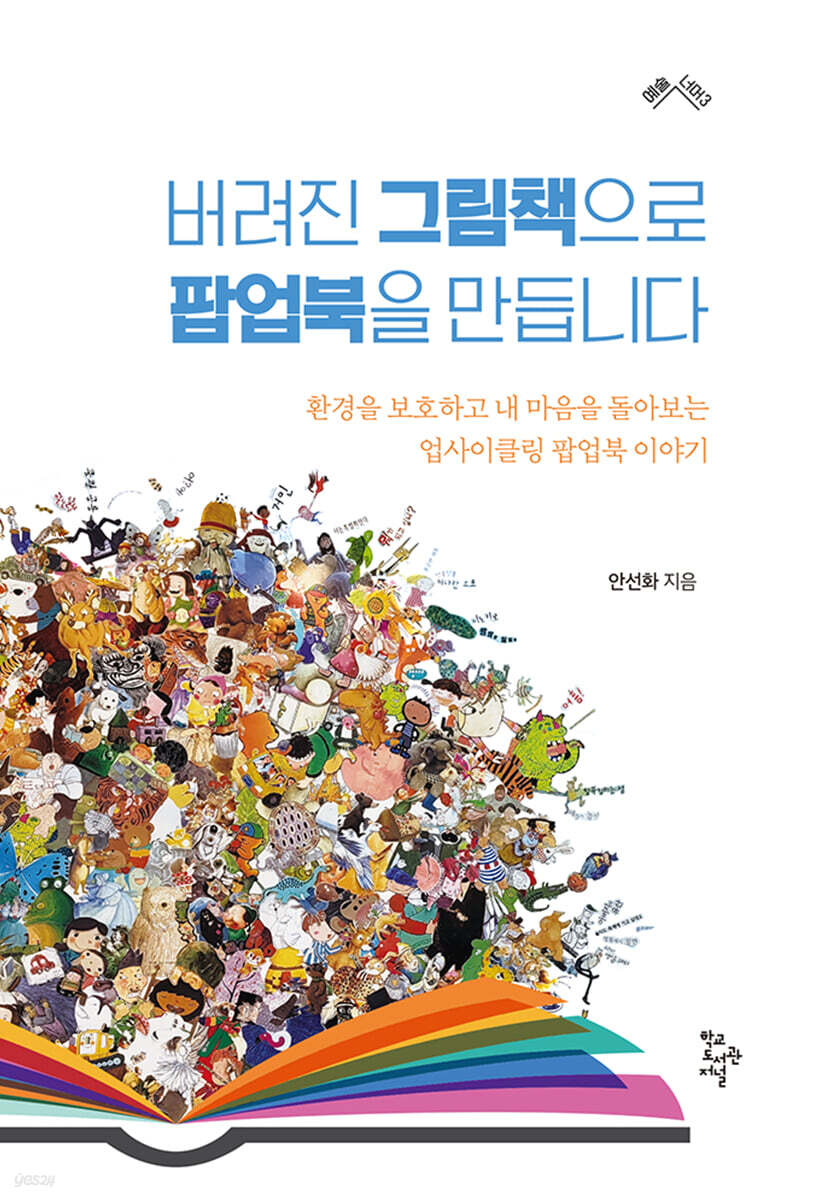
An essay and pop-up book production guidebook by junk artist Seonhwa Ahn, who creates pop-up books by upcycling old and discarded picture books.
The book is divided into three parts.
Part 1 is an autobiographical account of how the author became interested in picture books and created upcycled pop-up books.
Part 2 introduces how to make a pop-up book in earnest.
We introduce 12 different ways to make pop-up books, from beginner pop-up books made with scissors and glue to advanced pop-up books using various folding and origami methods.
Part 3 is a record of the author's pop-up exhibition, offering healing to readers as they share the joy of making unexpected connections across the country.
Making pop-up books is an artistic activity that fosters creativity and imagination because children choose pictures from existing picture books, cut them out, and paste them onto their own books to create their own stories.
Additionally, by reusing picture books that are no longer read or have been thrown away, it helps protect the environment and foster ecological awareness for coexistence with nature.
Above all, when reading the author's loving gaze toward abandoned picture books and the process of reviving them into pop-up books, you realize that even seemingly useless things each hold their own story and are precious in their own right.
The book is divided into three parts.
Part 1 is an autobiographical account of how the author became interested in picture books and created upcycled pop-up books.
Part 2 introduces how to make a pop-up book in earnest.
We introduce 12 different ways to make pop-up books, from beginner pop-up books made with scissors and glue to advanced pop-up books using various folding and origami methods.
Part 3 is a record of the author's pop-up exhibition, offering healing to readers as they share the joy of making unexpected connections across the country.
Making pop-up books is an artistic activity that fosters creativity and imagination because children choose pictures from existing picture books, cut them out, and paste them onto their own books to create their own stories.
Additionally, by reusing picture books that are no longer read or have been thrown away, it helps protect the environment and foster ecological awareness for coexistence with nature.
Above all, when reading the author's loving gaze toward abandoned picture books and the process of reviving them into pop-up books, you realize that even seemingly useless things each hold their own story and are precious in their own right.
- You can preview some of the book's contents.
Preview
index
· Prologue
Part 1: A Gift from a Discarded Picture Book
Treasure found in the trash
Have you ever torn a book?
Turning discarded books into ‘books to be revisited’
A story you can only hear if you listen closely
Books reborn as upcycled pop-up books
Tearing up a book is ridiculous!
I care about the environment
There's a White Wind Wall: Pop-up Playground in Hangdong
Relationships made through pop-up books
The fate of pop-ups, the challenge of homework
Part 2: Making an Upcycling Pop-Up Book in a Snap!
Beginner's Guide: Pop-up Books for Beginners
1.
Popcorn Book: A First Look at the Ever-Variable Pop-Up Book
2.
No plan: Today I am the main character
3.
Stick Figure: Tell me your story!
4.
Strategy: Create your own room easily
5.
Outline Book: Follow the Line, Follow the Story
6.
Line book: Origami as your hand leads
Advanced Edition: A Gorgeous Pop-Up Book
1.
Tunnel Book: Making Memories Shine Even Brighter
2.
Framed Book: A Gift to Myself
3.
180-degree pop-up book: colorful and free
4.
Box Book: A Look into My Unknown Heart
5.
Message Book: A book to express what you want to say to me
6.
Accordion Book: From a Book to be Seen to a Book to be Played with
Part 3: Traveling Picture Books: Pop-up Books That Became Artworks
· Epilogue
Part 1: A Gift from a Discarded Picture Book
Treasure found in the trash
Have you ever torn a book?
Turning discarded books into ‘books to be revisited’
A story you can only hear if you listen closely
Books reborn as upcycled pop-up books
Tearing up a book is ridiculous!
I care about the environment
There's a White Wind Wall: Pop-up Playground in Hangdong
Relationships made through pop-up books
The fate of pop-ups, the challenge of homework
Part 2: Making an Upcycling Pop-Up Book in a Snap!
Beginner's Guide: Pop-up Books for Beginners
1.
Popcorn Book: A First Look at the Ever-Variable Pop-Up Book
2.
No plan: Today I am the main character
3.
Stick Figure: Tell me your story!
4.
Strategy: Create your own room easily
5.
Outline Book: Follow the Line, Follow the Story
6.
Line book: Origami as your hand leads
Advanced Edition: A Gorgeous Pop-Up Book
1.
Tunnel Book: Making Memories Shine Even Brighter
2.
Framed Book: A Gift to Myself
3.
180-degree pop-up book: colorful and free
4.
Box Book: A Look into My Unknown Heart
5.
Message Book: A book to express what you want to say to me
6.
Accordion Book: From a Book to be Seen to a Book to be Played with
Part 3: Traveling Picture Books: Pop-up Books That Became Artworks
· Epilogue
Detailed image

Into the book
Everyone has probably had the desire to cut out a pretty circle.
However, we advise you not to draw a line in advance and cut with scissors.
This is because it allows us to create more diverse lines.
The activity of creating colorful lines, sometimes thick and sometimes thin, develops children's cognitive abilities.
--- p.87~88
While making the book, I learned the small things that make me think, "This is enough."
It is also the courage to reduce greed and leave room for space.
I call this mind the 'mind of moderation.'
--- p.90
But did you know that if you start creating a complete pop-up book and narrative in advance, the process of creating it can be arduous.
--- p.116
If you try to make a pop-up book according to a story you've decided on, it will become more difficult to make a pop-up book. I suggest that you just focus on cutting out the pieces of the picture you want to make with scissors.
--- p.117
It's clear why you don't just make a pop-up book and write the text.
This is because the narrative contained in a pop-up book can be interpreted differently by each person who reads it, and a different story can be read every day.
I want to preserve the infinite possibilities of the stories in pop-up books so that we don't just immediately dismiss them with, "Oh, that's the story."
--- p.137
What I remember from traveling to many places are the blue sky there and the eyes of the people I met there.
It's a light filled with endless possibilities, so it's always exciting to see it.
I think about this when I do exhibitions.
"I hope people who see my exhibition feel inspired to take on a challenge." I want to instill in people the thoughts, "I think I can make this too!" and "Should I try it? It'd be fun."
Couldn't this small thought awaken the artist's dream that lies dormant within someone?
However, we advise you not to draw a line in advance and cut with scissors.
This is because it allows us to create more diverse lines.
The activity of creating colorful lines, sometimes thick and sometimes thin, develops children's cognitive abilities.
--- p.87~88
While making the book, I learned the small things that make me think, "This is enough."
It is also the courage to reduce greed and leave room for space.
I call this mind the 'mind of moderation.'
--- p.90
But did you know that if you start creating a complete pop-up book and narrative in advance, the process of creating it can be arduous.
--- p.116
If you try to make a pop-up book according to a story you've decided on, it will become more difficult to make a pop-up book. I suggest that you just focus on cutting out the pieces of the picture you want to make with scissors.
--- p.117
It's clear why you don't just make a pop-up book and write the text.
This is because the narrative contained in a pop-up book can be interpreted differently by each person who reads it, and a different story can be read every day.
I want to preserve the infinite possibilities of the stories in pop-up books so that we don't just immediately dismiss them with, "Oh, that's the story."
--- p.137
What I remember from traveling to many places are the blue sky there and the eyes of the people I met there.
It's a light filled with endless possibilities, so it's always exciting to see it.
I think about this when I do exhibitions.
"I hope people who see my exhibition feel inspired to take on a challenge." I want to instill in people the thoughts, "I think I can make this too!" and "Should I try it? It'd be fun."
Couldn't this small thought awaken the artist's dream that lies dormant within someone?
--- p.152~153
Publisher's Review
Picture books that are discarded and cannot be recycled are reborn as various types of upcycled pop-up books!
According to statistics, 10 million books are thrown away every year.
Some books are only thrown away on their covers and the insides are recycled, but picture books are not recycled at all because both the covers and insides are coated.
This is also why the author of this book, Seonhwa Ahn, began to focus on abandoned picture books.
The author collects discarded picture books and makes pop-up books.
It is an ‘upcycling pop-up book’.
Pieces of pictures cut from different pages are put together to create a new story that is different from the original picture book.
The author introduces a total of 12 pop-up book creation methods, divided into beginner and advanced levels.
It doesn't matter what kind of picture book it is or how many pictures it contains.
I'm just creating the kind of pop-up book that best represents my current state of mind.
Let's create freely, either alone or with children, as our hearts desire, following the author's friendly guide.
Picture book 'Looking Again',
'Barobogi': Protecting the Environment and My Heart
The author does not recommend buying new books to create pop-up books.
I hope that you will find old picture books that have been read many times but are no longer read, picture books that someone is throwing away, and picture books that are up for sale as second-hand goods and turn them into picture books that can be 're-read'.
So, when creating a pop-up book, the author suggests looking for 'treasures' in discarded picture books.
It would be good to explain to children who read books that the process of creating books that can be 're-read' is upcycling, and how it helps solve the waste problem that is harming the Earth.
Recycling isn't just about protecting the environment.
As children create 'revisited' books, they discover a new understanding that everything discarded has a use and the potential to be transformed at any time.
This will serve as a driving force for children to reflect on their own hearts and get back up again when they experience setbacks one day.
A pop-up playground where you can play with books,
Creativity in children grows as they become familiar with books.
The author hopes that children will freely fold and paste the picture books and play with them.
Children choose pictures from existing picture books that fit the story they have imagined, cut them out, and paste them to complete their own story.
In this process, the imagination to come up with a story and the creativity to implement the story into a pop-up book are developed.
At first, children are confused by the author's suggestion to rip and cut out the book to their heart's content.
But once you start, you'll start making pop-up books more fun than anyone else.
This is because the sound of cutting a coated picture book has a calming effect on children, helping them focus, and the act of tearing and cutting the book at will gives them a sense of liberation, lowering their stress level.
The pop-up playground unfolds before children, transforming books, previously considered mere reading materials, into toys and introducing them in a more approachable way.
Even children who are not usually familiar with books will experience becoming intimate with books through the process of touching them and creating new stories.
According to statistics, 10 million books are thrown away every year.
Some books are only thrown away on their covers and the insides are recycled, but picture books are not recycled at all because both the covers and insides are coated.
This is also why the author of this book, Seonhwa Ahn, began to focus on abandoned picture books.
The author collects discarded picture books and makes pop-up books.
It is an ‘upcycling pop-up book’.
Pieces of pictures cut from different pages are put together to create a new story that is different from the original picture book.
The author introduces a total of 12 pop-up book creation methods, divided into beginner and advanced levels.
It doesn't matter what kind of picture book it is or how many pictures it contains.
I'm just creating the kind of pop-up book that best represents my current state of mind.
Let's create freely, either alone or with children, as our hearts desire, following the author's friendly guide.
Picture book 'Looking Again',
'Barobogi': Protecting the Environment and My Heart
The author does not recommend buying new books to create pop-up books.
I hope that you will find old picture books that have been read many times but are no longer read, picture books that someone is throwing away, and picture books that are up for sale as second-hand goods and turn them into picture books that can be 're-read'.
So, when creating a pop-up book, the author suggests looking for 'treasures' in discarded picture books.
It would be good to explain to children who read books that the process of creating books that can be 're-read' is upcycling, and how it helps solve the waste problem that is harming the Earth.
Recycling isn't just about protecting the environment.
As children create 'revisited' books, they discover a new understanding that everything discarded has a use and the potential to be transformed at any time.
This will serve as a driving force for children to reflect on their own hearts and get back up again when they experience setbacks one day.
A pop-up playground where you can play with books,
Creativity in children grows as they become familiar with books.
The author hopes that children will freely fold and paste the picture books and play with them.
Children choose pictures from existing picture books that fit the story they have imagined, cut them out, and paste them to complete their own story.
In this process, the imagination to come up with a story and the creativity to implement the story into a pop-up book are developed.
At first, children are confused by the author's suggestion to rip and cut out the book to their heart's content.
But once you start, you'll start making pop-up books more fun than anyone else.
This is because the sound of cutting a coated picture book has a calming effect on children, helping them focus, and the act of tearing and cutting the book at will gives them a sense of liberation, lowering their stress level.
The pop-up playground unfolds before children, transforming books, previously considered mere reading materials, into toys and introducing them in a more approachable way.
Even children who are not usually familiar with books will experience becoming intimate with books through the process of touching them and creating new stories.
GOODS SPECIFICS
- Date of issue: November 6, 2023
- Page count, weight, size: 168 pages | 230g | 130*190*10mm
- ISBN13: 9788969151568
- ISBN10: 8969151567
You may also like
카테고리
korean


korean

![GQ KOREA Mark (Monthly): December [2025]](http://librairie.coreenne.fr/cdn/shop/files/8ef265dbbfbf186523ed75ba7319009d.jpg?v=1765340328&width=3840)


