

Moneyly
 |
Description
Book Introduction
For you who is new to studying money and investing
A household account book that gets you closer to your money the more you use it in just 30 minutes a day!
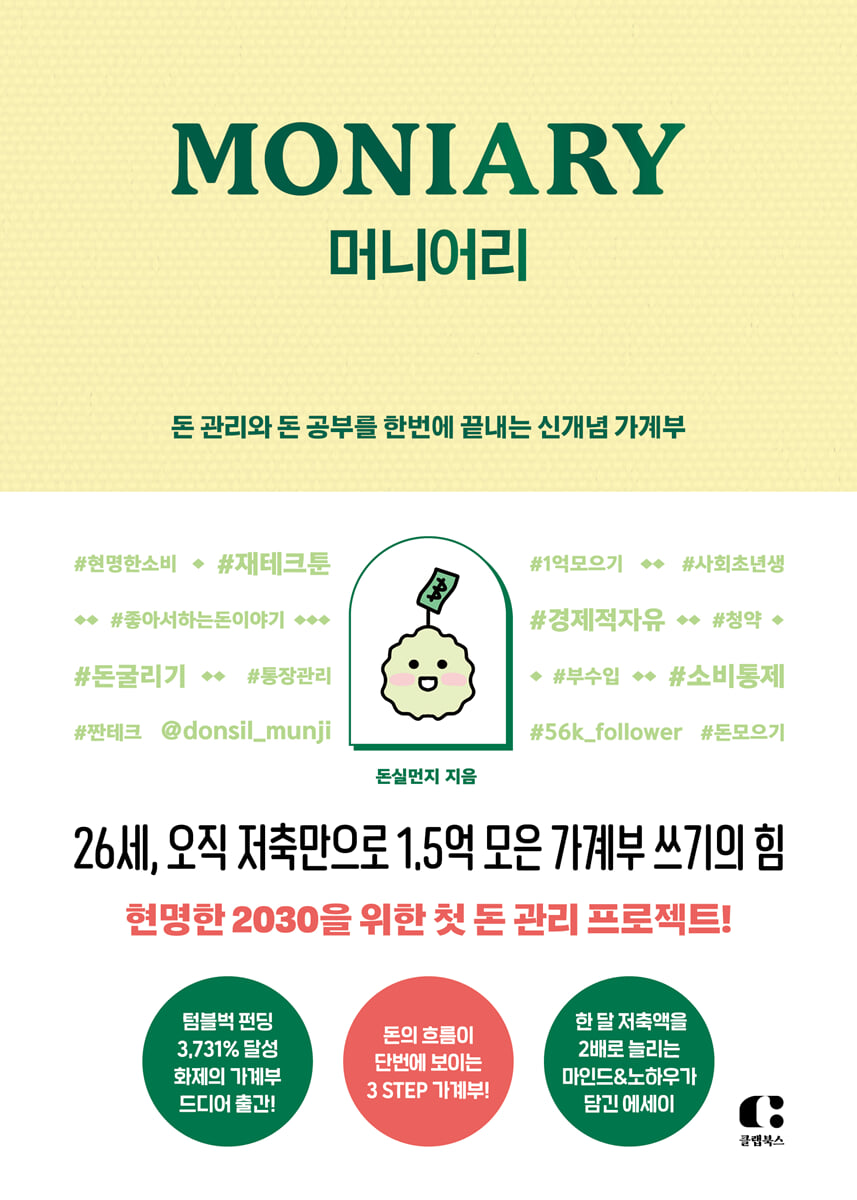
Tumblbug Funding Achieved 3,731%, the Hot Topic Household Account Book
Money management and money study all in one!
The protagonist of the household account book reels viewed by 1.17 million people,
Donsilmunji's steadily accumulated financial expertise in one book!
The first book of digital creator Donsilmunji, who is the main character of the household account book Reels, which was viewed by 1.17 million people, and is loved by 57,000 followers for his financial technology cartoon, has been published.
For young adults who are just starting out in society and have so many things they want to do, places they want to see, and things they want to eat, money seems close yet distant.
For those new to money management and social life, the author recommends starting money management by keeping a household account book, rather than resorting to extreme frugal tech or blind investing.
This is because, for those just starting out in society, whose salaries are bound to be low, it is most important to understand the flow of money and take the initiative in managing finances.
This book contains essays that help you study money, as well as a household account book that helps you manage your money.
The essay details the author's entire process of saving 150 million won through savings alone.
He honestly shared his experience of failing after rashly trying to invest in a business with the belief that he could make a return greater than the interest rate, and his story of experiencing a period of stagnation in his financial management after achieving his primary goal.
The author emphasizes that anyone can achieve their goals by consistently managing their finances by keeping a household ledger, as he, an ordinary office worker, achieved his goals by keeping a household ledger.
The household account book, developed by the author himself, is specialized in helping you see your monthly income, expenses, savings, and investments at a glance. Since its launch in 2022, it has been improved five times based on feedback from actual users.
With the 200% utilization method of the household account book, exclusively revealed to readers of 『Moneyary』, you will be able to start investing without any burden, even if it felt vague.
A household account book that gets you closer to your money the more you use it in just 30 minutes a day!
Tumblbug Funding Achieved 3,731%, the Hot Topic Household Account Book
Money management and money study all in one!
The protagonist of the household account book reels viewed by 1.17 million people,
Donsilmunji's steadily accumulated financial expertise in one book!
The first book of digital creator Donsilmunji, who is the main character of the household account book Reels, which was viewed by 1.17 million people, and is loved by 57,000 followers for his financial technology cartoon, has been published.
For young adults who are just starting out in society and have so many things they want to do, places they want to see, and things they want to eat, money seems close yet distant.
For those new to money management and social life, the author recommends starting money management by keeping a household account book, rather than resorting to extreme frugal tech or blind investing.
This is because, for those just starting out in society, whose salaries are bound to be low, it is most important to understand the flow of money and take the initiative in managing finances.
This book contains essays that help you study money, as well as a household account book that helps you manage your money.
The essay details the author's entire process of saving 150 million won through savings alone.
He honestly shared his experience of failing after rashly trying to invest in a business with the belief that he could make a return greater than the interest rate, and his story of experiencing a period of stagnation in his financial management after achieving his primary goal.
The author emphasizes that anyone can achieve their goals by consistently managing their finances by keeping a household ledger, as he, an ordinary office worker, achieved his goals by keeping a household ledger.
The household account book, developed by the author himself, is specialized in helping you see your monthly income, expenses, savings, and investments at a glance. Since its launch in 2022, it has been improved five times based on feedback from actual users.
With the 200% utilization method of the household account book, exclusively revealed to readers of 『Moneyary』, you will be able to start investing without any burden, even if it felt vague.
- You can preview some of the book's contents.
Preview
index
prolog
PART 1: This is my first time studying money and managing money, but it's okay.
Household Account Book: Why I Started Keeping a Household Account Book
Salary: Just because it's small doesn't mean it's not valuable.
Consumption: If you can't avoid it, be smart about it
Goal: It's not the speed that matters, it's the direction.
Savings: The Secret to Unfailing Success
Investing: If you are looking for a quick and easy way to make a lot of money
Mind: All you need is a heart that believes in me.
PART 2: How to stop money from leaking out and hold on to money that comes in
The Importance of Discipline: Why I Was Able to Keep a Consistent Household Ledger
Asset Summary: I Control My Money Flow
Income Flow Chart: A New Way to Control Consumption
Earning More: The Small Potential Shown by Zantech
No Spend: The Pitfalls of the No Spend Challenge
Saving: Our saving must continue.
Rolling: My Investment Journal
PART 3: Wise 2030's First Money Management Project
Household Account Book User Manual
Summarizing the current situation
Monthly household account book
Check annual changes
PART 1: This is my first time studying money and managing money, but it's okay.
Household Account Book: Why I Started Keeping a Household Account Book
Salary: Just because it's small doesn't mean it's not valuable.
Consumption: If you can't avoid it, be smart about it
Goal: It's not the speed that matters, it's the direction.
Savings: The Secret to Unfailing Success
Investing: If you are looking for a quick and easy way to make a lot of money
Mind: All you need is a heart that believes in me.
PART 2: How to stop money from leaking out and hold on to money that comes in
The Importance of Discipline: Why I Was Able to Keep a Consistent Household Ledger
Asset Summary: I Control My Money Flow
Income Flow Chart: A New Way to Control Consumption
Earning More: The Small Potential Shown by Zantech
No Spend: The Pitfalls of the No Spend Challenge
Saving: Our saving must continue.
Rolling: My Investment Journal
PART 3: Wise 2030's First Money Management Project
Household Account Book User Manual
Summarizing the current situation
Monthly household account book
Check annual changes
Detailed image

Into the book
I'm not a financial expert, and I'm just another ordinary office worker who commutes to work by subway every day. But even I, who am nothing special, was able to save the amount of money I set out to save at a young age just by consistently using my money.
I'm still steadily growing by setting new goals, so I believe you too can achieve your goals.
I hope this book will help you lead a healthy financial life.
---From the "Prologue"
When people think of 'keeping a household account book', they often think of it as simply organizing their daily income and expenses.
However, I wanted to inject a sense of 'flow' into the household account book, making it feel like money was being managed just by writing it down, rather than simply keeping a record.
And to take the lead in that flow, I plan the budget for the month at the beginning of each month (PLAN), and record my daily income and expenses, savings, and investments according to the planned budget (ACTION).
In addition, I focused on systematic money management by reviewing my spending, savings, and investments against my income at the end of each month.
---From "Part 1: It's my first time studying money and managing money, but it's okay"
If we compare our lives to a building, I think the role of our salary is like a solid framework.
With a steady income, like a salary that serves as a solid foundation for life, you can dream of a colorful life outside of work.
You can have peace of mind when starting any side job, and even if it doesn't work out, there won't be a major crisis that will shake up your life.
---From "Part 1: It's my first time studying money and managing money, but it's okay"
In fact, in just one year, I saw the benefits of maintaining a certain level of consumption over the long term, even if my income increases each year.
When I first started keeping a household account book, my savings rate was around 50%, but now I've reached 90%.
This is because, in addition to my salary, I increased my overall income through side jobs and other miscellaneous expenses, while my expenses remained the same as a year ago.
---From "Part 1: It's my first time studying money and managing money, but it's okay"
All expenses are divided into those I can control and those I cannot control.
Controllable spending here means spending that you can boldly give up if you feel that the consumption itself is unnecessary.
---From "Part 2: How to stop money from leaking out and hold on to money that comes in"
At the time, I was feeling so happy with the 10 or 20 won I earned through Jjantech that the first month's sales of 8,000 won felt like a lot of money.
8,000 won was the amount of money I would have to earn by doing dozens of app techs.
This gave me hope that I could earn extra income beyond my salary with just a little effort, and this has been a strong driving force that has allowed me to continue my side hustle to this day.
---From "Part 2: How to stop money from leaking out and hold on to money that comes in"
Solutions to your problems can sometimes come from unexpected places.
Until then, I think what we need to do is keep a household account book to build up the financial stamina to consistently save money.
From now on, I hope that by keeping a household account book together, you will become leaders in the flow of money, so that money follows you, rather than being led by it.
I'm still steadily growing by setting new goals, so I believe you too can achieve your goals.
I hope this book will help you lead a healthy financial life.
---From the "Prologue"
When people think of 'keeping a household account book', they often think of it as simply organizing their daily income and expenses.
However, I wanted to inject a sense of 'flow' into the household account book, making it feel like money was being managed just by writing it down, rather than simply keeping a record.
And to take the lead in that flow, I plan the budget for the month at the beginning of each month (PLAN), and record my daily income and expenses, savings, and investments according to the planned budget (ACTION).
In addition, I focused on systematic money management by reviewing my spending, savings, and investments against my income at the end of each month.
---From "Part 1: It's my first time studying money and managing money, but it's okay"
If we compare our lives to a building, I think the role of our salary is like a solid framework.
With a steady income, like a salary that serves as a solid foundation for life, you can dream of a colorful life outside of work.
You can have peace of mind when starting any side job, and even if it doesn't work out, there won't be a major crisis that will shake up your life.
---From "Part 1: It's my first time studying money and managing money, but it's okay"
In fact, in just one year, I saw the benefits of maintaining a certain level of consumption over the long term, even if my income increases each year.
When I first started keeping a household account book, my savings rate was around 50%, but now I've reached 90%.
This is because, in addition to my salary, I increased my overall income through side jobs and other miscellaneous expenses, while my expenses remained the same as a year ago.
---From "Part 1: It's my first time studying money and managing money, but it's okay"
All expenses are divided into those I can control and those I cannot control.
Controllable spending here means spending that you can boldly give up if you feel that the consumption itself is unnecessary.
---From "Part 2: How to stop money from leaking out and hold on to money that comes in"
At the time, I was feeling so happy with the 10 or 20 won I earned through Jjantech that the first month's sales of 8,000 won felt like a lot of money.
8,000 won was the amount of money I would have to earn by doing dozens of app techs.
This gave me hope that I could earn extra income beyond my salary with just a little effort, and this has been a strong driving force that has allowed me to continue my side hustle to this day.
---From "Part 2: How to stop money from leaking out and hold on to money that comes in"
Solutions to your problems can sometimes come from unexpected places.
Until then, I think what we need to do is keep a household account book to build up the financial stamina to consistently save money.
From now on, I hope that by keeping a household account book together, you will become leaders in the flow of money, so that money follows you, rather than being led by it.
---From "Part 2: How to stop money from leaking out and hold on to money that comes in"
Publisher's Review
At 26, the power of keeping a household account book: saving 150 million won through savings alone.
The first money management project for a smart 2030!
The joy of payday is short-lived, as various subscription fees, utility bills, and telecommunications charges are deducted from your bank account and credit card bills are paid, and your account balance quickly becomes zero.
Many people use a household account book application because it's easy to keep track of, but since they don't check it even once a week, they often don't know where their paychecks are going.
The author knows better than anyone the anxious feeling of searching for "financial management for new graduates" on YouTube to avoid falling behind others, and the panicked feeling of blindly setting a tight budget for living expenses because they are told to spend what's left after saving, only to end up overdue on their credit card bill.
Even if you're interested in investing, isn't it more difficult for office workers to disclose their salary than their college entrance exam scores?
There are many office workers who manage their finances alone, unable to even tell their closest friends.
Even for those with a certain level of experience, investing is difficult, but for those just starting out in the workforce, who are busy adjusting to their new job and have no one around to consult, investing is even more difficult.
The author wrote this book with the hope of helping young adults struggling with financial issues find and achieve their financial goals more quickly.
For you who is new to studying money and investing
A household account book that gets you closer to money the more you spend.
It is now widely known that the basic financial management strategy for new graduates is to set a target amount, identify fixed expenses, save first, and then live off the remaining amount.
However, many people start to get stuck when it comes to setting a goal and identifying fixed expenses.
"What should I do with the money I saved? I don't have any plans to become independent yet…." "Next month is my mother's birthday and my friend's wedding."
The moment you think, 'I've got some unexpected expenses,' investing becomes complicated and a headache.
When you feel like giving up and thinking, "Am I not good at managing money?" because you lack motivation due to lack of clear goals for saving money and are tired of repeatedly exceeding your budget due to unexpected expenses, 『Moneyary』 will help you lighten the burden of studying and managing money.
The author says that for young adults who have so many things they want to do, see, and go to, there is no need to sacrifice their current joys and engage in excessive financial planning.
However, it is clear that money is needed to protect the values that one considers important.
You should live a life that leads money, not a life that is led by money.
Through the author's story of how he finally set a goal after much trial and error, readers will also have time to think about what values they hold important and how to save enough money to protect them (Part 1 Goals - It's not speed that matters, but direction).
For those looking for a reason to save money, the author advises starting by simply recording all of your monthly income and expenses for three months.
To figure out your average monthly living expenses.
After figuring out how much you spend and how much you can save from your income, set a goal to save an amount that you can achieve with just a little more effort.
Even if it seems like a small goal, the sense of accomplishment you feel when you achieve it becomes the driving force that allows you to continue investing consistently (Part 1 Savings - The Secret to Guaranteed Success).
In 'Part 3 Annual Change Check Page', you can visualize your goals by drawing a pie chart of your monthly balance and check the specific progress toward achieving them.
A special income flow chart that shows the flow of money at a glance
How to Use Your Household Account Book 200%, Revealed Exclusively to Readers
The author believed that keeping a household account book should not simply be about organizing income and expenses, but should also be a process of understanding the flow of money.
That's how we developed our own household account book, and since its launch in 2022, we've gone through five rounds of improvements based on feedback from actual users.
As a result, I was able to create a household account book that specialized in checking monthly income, expenses, savings, and investment status at a glance.
How to establish rules for managing your household account book to sort out any ambiguous details, organize your spending categories, categorize controllable and uncontrollable expenses, and create an income flow chart... If you follow the detailed instructions provided by the developer of the household account book, you'll soon discover a household account book filled with useful information.
You can let go of the burden of having to write a household account book every day.
You can effectively control your spending by keeping a household account book every week or every two weeks and checking how much you have spent compared to your budget.
If you break down your one-year goal into quarterly goals, and then quarterly goals into monthly goals, and practice them every day, you will find yourself getting closer to your goal before you know it.
The author is a caring friend who shares his financial concerns and sometimes offers advice to young adults struggling to manage their finances effectively on a small salary.
With Donsilmunji, who believes that spending is not a mistake and that household budgets should not be a reflection, you can enjoy the process of accumulating money and practice healthy financial management.
The first money management project for a smart 2030!
The joy of payday is short-lived, as various subscription fees, utility bills, and telecommunications charges are deducted from your bank account and credit card bills are paid, and your account balance quickly becomes zero.
Many people use a household account book application because it's easy to keep track of, but since they don't check it even once a week, they often don't know where their paychecks are going.
The author knows better than anyone the anxious feeling of searching for "financial management for new graduates" on YouTube to avoid falling behind others, and the panicked feeling of blindly setting a tight budget for living expenses because they are told to spend what's left after saving, only to end up overdue on their credit card bill.
Even if you're interested in investing, isn't it more difficult for office workers to disclose their salary than their college entrance exam scores?
There are many office workers who manage their finances alone, unable to even tell their closest friends.
Even for those with a certain level of experience, investing is difficult, but for those just starting out in the workforce, who are busy adjusting to their new job and have no one around to consult, investing is even more difficult.
The author wrote this book with the hope of helping young adults struggling with financial issues find and achieve their financial goals more quickly.
For you who is new to studying money and investing
A household account book that gets you closer to money the more you spend.
It is now widely known that the basic financial management strategy for new graduates is to set a target amount, identify fixed expenses, save first, and then live off the remaining amount.
However, many people start to get stuck when it comes to setting a goal and identifying fixed expenses.
"What should I do with the money I saved? I don't have any plans to become independent yet…." "Next month is my mother's birthday and my friend's wedding."
The moment you think, 'I've got some unexpected expenses,' investing becomes complicated and a headache.
When you feel like giving up and thinking, "Am I not good at managing money?" because you lack motivation due to lack of clear goals for saving money and are tired of repeatedly exceeding your budget due to unexpected expenses, 『Moneyary』 will help you lighten the burden of studying and managing money.
The author says that for young adults who have so many things they want to do, see, and go to, there is no need to sacrifice their current joys and engage in excessive financial planning.
However, it is clear that money is needed to protect the values that one considers important.
You should live a life that leads money, not a life that is led by money.
Through the author's story of how he finally set a goal after much trial and error, readers will also have time to think about what values they hold important and how to save enough money to protect them (Part 1 Goals - It's not speed that matters, but direction).
For those looking for a reason to save money, the author advises starting by simply recording all of your monthly income and expenses for three months.
To figure out your average monthly living expenses.
After figuring out how much you spend and how much you can save from your income, set a goal to save an amount that you can achieve with just a little more effort.
Even if it seems like a small goal, the sense of accomplishment you feel when you achieve it becomes the driving force that allows you to continue investing consistently (Part 1 Savings - The Secret to Guaranteed Success).
In 'Part 3 Annual Change Check Page', you can visualize your goals by drawing a pie chart of your monthly balance and check the specific progress toward achieving them.
A special income flow chart that shows the flow of money at a glance
How to Use Your Household Account Book 200%, Revealed Exclusively to Readers
The author believed that keeping a household account book should not simply be about organizing income and expenses, but should also be a process of understanding the flow of money.
That's how we developed our own household account book, and since its launch in 2022, we've gone through five rounds of improvements based on feedback from actual users.
As a result, I was able to create a household account book that specialized in checking monthly income, expenses, savings, and investment status at a glance.
How to establish rules for managing your household account book to sort out any ambiguous details, organize your spending categories, categorize controllable and uncontrollable expenses, and create an income flow chart... If you follow the detailed instructions provided by the developer of the household account book, you'll soon discover a household account book filled with useful information.
You can let go of the burden of having to write a household account book every day.
You can effectively control your spending by keeping a household account book every week or every two weeks and checking how much you have spent compared to your budget.
If you break down your one-year goal into quarterly goals, and then quarterly goals into monthly goals, and practice them every day, you will find yourself getting closer to your goal before you know it.
The author is a caring friend who shares his financial concerns and sometimes offers advice to young adults struggling to manage their finances effectively on a small salary.
With Donsilmunji, who believes that spending is not a mistake and that household budgets should not be a reflection, you can enjoy the process of accumulating money and practice healthy financial management.
GOODS SPECIFICS
- Date of issue: September 20, 2023
- Format: Hardcover book binding method guide
- Page count, weight, size: 316 pages | 636g | 148*210*25mm
- ISBN13: 9791198428592
- ISBN10: 1198428597
You may also like
카테고리
korean


korean

![GQ KOREA Mark (Monthly): December [2025]](http://librairie.coreenne.fr/cdn/shop/files/8ef265dbbfbf186523ed75ba7319009d.jpg?v=1765340328&width=3840)


