

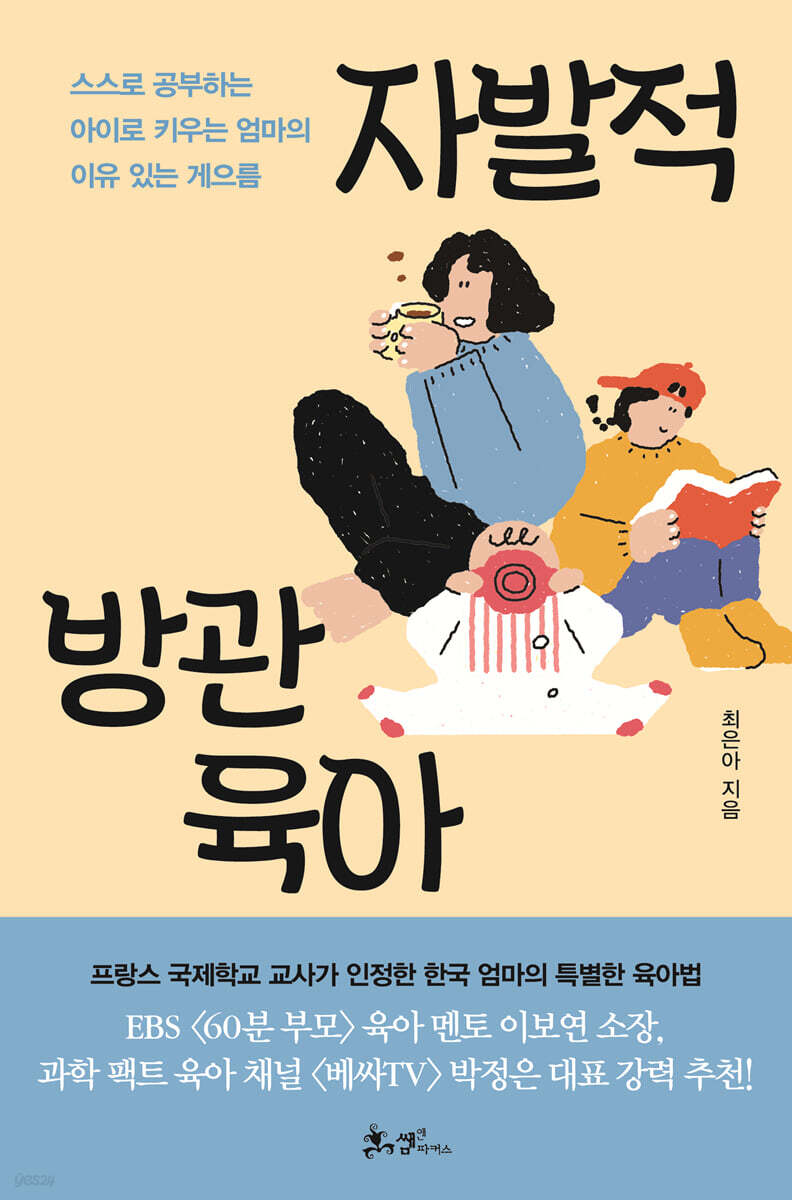
Voluntary neglect parenting
 |
Description
Book Introduction
“French first graders cut oranges with a knife and squeeze out the juice to eat?”
The 12-year veteran elementary school teacher who impressed 4.7 million parents
Lazy parenting techniques to raise children who study on their own are revealed!
★★★★★ EBS [60 Minute Parenting] Recommended Books by Parenting Mentor Lee Bo-yeon
★★★★★ Books recommended by [Bessa TV] Parenting Channel CEO Park Jeong-eun
★★★★★ Parenting solutions for each growth stage: 0-3 years old, 4-7 years old, and 8-10 years old.
★★★★★ Includes a checklist for elementary school admissions, as provided by teachers.
The author, an elementary school teacher, made sure to teach her two children jump rope and origami instead of Korean and English.
This is because he has seen through hundreds of students that a child who can't write his name but is good at origami, or a child who can jump rope but doesn't know the multiplication tables, will inevitably do well in school.
"Spontaneous Indifference Parenting" contains the surprising process and success stories of children becoming engrossed in their studies on their own when parents take a leisurely, yet strategic, approach to indifference.
For example, the author, who suddenly moved to France, experienced a type of wild parenting that Korean parents could not have imagined. The author's children adapted to the institution within ten days and showed this through their academic achievements.
Parents who want to raise their children to be independent in both life and studies, parents who want to wait patiently for their children, and parents who want to respect their children as they are will find emotional liberation from parenting through this book, while also witnessing the amazing transformation of their children as they carve out their own paths in life.
The 12-year veteran elementary school teacher who impressed 4.7 million parents
Lazy parenting techniques to raise children who study on their own are revealed!
★★★★★ EBS [60 Minute Parenting] Recommended Books by Parenting Mentor Lee Bo-yeon
★★★★★ Books recommended by [Bessa TV] Parenting Channel CEO Park Jeong-eun
★★★★★ Parenting solutions for each growth stage: 0-3 years old, 4-7 years old, and 8-10 years old.
★★★★★ Includes a checklist for elementary school admissions, as provided by teachers.
The author, an elementary school teacher, made sure to teach her two children jump rope and origami instead of Korean and English.
This is because he has seen through hundreds of students that a child who can't write his name but is good at origami, or a child who can jump rope but doesn't know the multiplication tables, will inevitably do well in school.
"Spontaneous Indifference Parenting" contains the surprising process and success stories of children becoming engrossed in their studies on their own when parents take a leisurely, yet strategic, approach to indifference.
For example, the author, who suddenly moved to France, experienced a type of wild parenting that Korean parents could not have imagined. The author's children adapted to the institution within ten days and showed this through their academic achievements.
Parents who want to raise their children to be independent in both life and studies, parents who want to wait patiently for their children, and parents who want to respect their children as they are will find emotional liberation from parenting through this book, while also witnessing the amazing transformation of their children as they carve out their own paths in life.
- You can preview some of the book's contents.
Preview
index
Prologue: The Secret to Creating a Top 2% Child That Only I Want to Know
Chapter 1: What Makes a Good Student Different?
Children who are good at studying don't go to 'this place' often - emotional stability
Try this and you'll know who's good at studying - self-control
Even if a child gets a 20 on a dictation test, he or she will eventually get a 100 - intrinsic motivation.
Children who are good at origami are also good at Korean - Literacy
Children who don't know the multiplication tables in first grade will be good at math later in life - Metacognition
[Super Simple Action Plan] Prep Station: Developing Successful Experiences
Chapter 2: Voluntary Parenting: Raising Children Aged 4-7 to Learn on Their Own
01 It's okay if you don't clean the house
02 Let them eat on their own
03 Will the mother be more upset? Will the child be more hurt?
04 It's okay to raise your child while saying 'nothing'
05 'This' alone will cut nagging in half.
06 Sometimes lying is necessary
07 If you're a bored child, just play along with them.
08 A child's aptitude is not something you can find at an academy.
09 Listening to English fluently, if you listen too much you won't be able to hear it.
10 You don't have to read a lot of books all night long
11 Be a selfish mom
12 If you speak well, you will sit down and study.
13 Go grocery shopping to develop planning skills
[Super Simple Action Plan] A Three-Day Family Planner That Makes Planning a Habit
Chapter 3: Voluntary Parenting: How Elementary School Studies Lead to Middle and High School Skills for 8-10 Year Olds
14 Don't pack all the supplies one by one.
15. You have to play a lot to sit well at school.
16 If you say you don't know, say, "I don't know."
Just leave the child adding with his fingers alone.
18 Please display it diligently and don't throw it away.
19 Move with the invisible hand
20 Don't buy me a good desk
21 When you have trouble writing, turn on the recorder.
22 If you hate books, read 'this' first.
23 You don't have to take the Chinese character proficiency test
24 Mom, don't go to school
25 The real golden spoon is the dirt spoon
[Super Easy Action Plan] A List of Recommended English Learning Tips for Play
[Super Simple Action Plan] Recommended List of Teaching Materials and Tools to Develop Mathematical Thinking Skills
Epilogue_Don't leave me alone.
Leave me alone
Appendix 1_Preparing for Elementary School Admission - Lifestyle
Appendix 2_Preparing for Elementary School Admission - Learning Section
Chapter 1: What Makes a Good Student Different?
Children who are good at studying don't go to 'this place' often - emotional stability
Try this and you'll know who's good at studying - self-control
Even if a child gets a 20 on a dictation test, he or she will eventually get a 100 - intrinsic motivation.
Children who are good at origami are also good at Korean - Literacy
Children who don't know the multiplication tables in first grade will be good at math later in life - Metacognition
[Super Simple Action Plan] Prep Station: Developing Successful Experiences
Chapter 2: Voluntary Parenting: Raising Children Aged 4-7 to Learn on Their Own
01 It's okay if you don't clean the house
02 Let them eat on their own
03 Will the mother be more upset? Will the child be more hurt?
04 It's okay to raise your child while saying 'nothing'
05 'This' alone will cut nagging in half.
06 Sometimes lying is necessary
07 If you're a bored child, just play along with them.
08 A child's aptitude is not something you can find at an academy.
09 Listening to English fluently, if you listen too much you won't be able to hear it.
10 You don't have to read a lot of books all night long
11 Be a selfish mom
12 If you speak well, you will sit down and study.
13 Go grocery shopping to develop planning skills
[Super Simple Action Plan] A Three-Day Family Planner That Makes Planning a Habit
Chapter 3: Voluntary Parenting: How Elementary School Studies Lead to Middle and High School Skills for 8-10 Year Olds
14 Don't pack all the supplies one by one.
15. You have to play a lot to sit well at school.
16 If you say you don't know, say, "I don't know."
Just leave the child adding with his fingers alone.
18 Please display it diligently and don't throw it away.
19 Move with the invisible hand
20 Don't buy me a good desk
21 When you have trouble writing, turn on the recorder.
22 If you hate books, read 'this' first.
23 You don't have to take the Chinese character proficiency test
24 Mom, don't go to school
25 The real golden spoon is the dirt spoon
[Super Easy Action Plan] A List of Recommended English Learning Tips for Play
[Super Simple Action Plan] Recommended List of Teaching Materials and Tools to Develop Mathematical Thinking Skills
Epilogue_Don't leave me alone.
Leave me alone
Appendix 1_Preparing for Elementary School Admission - Lifestyle
Appendix 2_Preparing for Elementary School Admission - Learning Section
Detailed image

Into the book
My first child went to France after finishing the first semester of the first year.
Her life in France began with her husband, who was dispatched overseas.
I can only imagine what school would be like for a child who couldn't speak French at all, but that too is a challenge the child must face and overcome.
It is my job to encourage, praise, embrace and hug.
However, in France, children's self-directedness was even more prominent.
In French elementary schools, mothers are strictly prohibited from entering from the school gate (in kindergartens, mothers are allowed to accompany their children all the way to the front of the classroom).
A few days later, I heard from someone else that he almost couldn't eat the lunch on the first day.
It was heartbreaking to hear the story of a Korean friend who took a child who was supposed to eat in the cafeteria to the cafeteria after seeing him standing still in the playground, but he managed to eat anyway, so it was okay.
School is a place where children go.
Said to the child.
“If you ate it, that’s fine, right?
“Now, go to the cafeteria.” I was worried that he might be flustered, but I was also impressed by his courage in overcoming the situation and solving it.
(…)
This kind of behavior in children was not just something they grew up with.
At the buffet, even when my husband and I moved to get food, the kids sat quietly and ate.
It was when the second child turned.
No YouTube, no toys, no cell phones or tablets.
Thanks to my children who have good table manners thanks to child-led weaning, I have been able to have a comfortable time in any restaurant or travel destination, and I still do.
---pp.65~67 From "Let them eat by themselves"
I wish I had studied more seriously.
I wish I could just sit down and do it for 30 minutes.
The children did it for 10 minutes and said, “We’re done.” They did it for 20 minutes and said, “We’re done.”
“How long do I have to do this?” he asks.
Mom is so upset.
There is something that can reduce nagging about 'time', even though it cannot reduce other nagging.
It's a timer.
It's not a ticking timer that keeps kids on their toes.
There is something called 'Google Timer'.
If you set the time for 30 minutes, the red area will gradually decrease by 30 minutes and an alarm will sound when the time is up.
Even in school, this timer has tremendous power.
Children find it extremely difficult to attend classes longer than 40 minutes.
If you set the timer for exactly 40 minutes, the children will focus during class without any complaints.
He suggested that we read a book in the morning.
When I asked how many minutes it would take to read a book without feeling pressured, he said 10 minutes was too short and 30 minutes was too long, so 20 minutes seemed like a good time. So I set the timer for 20 minutes and shouted, “Go!”
The children read books as quietly as mice.
It's amazing how no one does anything else for 20 minutes, as if they think they have to read for about 20 minutes.
(…)
The concept of time is very difficult and abstract for children.
When playing, an hour feels like 10 minutes, and when studying, 10 minutes feels like 1 hour.
When we show children time with their eyes, they learn the concept of time through their bodies and put it into practice by controlling it on their own.
The reason why mom nags is because only mom feels the passage of time.
Let's help children feel the passage of time.
Let's show you with your eyes the time that cannot be felt with your senses.
If you let them see for themselves, they will nag less and their ability to manage their time will grow.
---pp.84~86 From "This One Thing Cuts Nagging in Half"
Even if children are not able to develop self-direction well between the ages of 4 and 7, they will quickly learn it if they make good use of the early grades.
For first graders, the first and second semesters are different.
When children reach second and third grade, they change so much that it can be said to be a world of difference.
The child who crawled around the classroom and lay on the floor in the first semester, the child who got into fights with his friends every day and had friends come to him during recess, becomes a different child in the second semester.
A child who said studying wasn't fun will say, "I think I'm pretty good at studying."
When children learn the joy of studying on their own, they study harder.
If you are a mother of a child about to enter school or a mother of a child in the lower grades, you need to change your strategy from now on.
You should make good use of the school life, which ends around 1 o'clock at the latest.
At home, children should be given ample time to think, learn, and move their bodies.
You shouldn't be tempted to spend time solving workbooks or go to a cram school to improve your grades in a short period of time.
Lower grades are not grades that are checked.
You should think of it as a time to prepare to go to middle or high school and study.
(…) After six years of trial and error, the child advances to middle and high school and finally develops his or her own study method.
Teachers know.
I can see a child who won't last long studying even if he or she gets a perfect score on a dictation test, and a child who will last long studying even if he or she gets a zero on a dictation test.
---pp.142~143 From the preface to “Voluntary Parenting: How Elementary School Studies for 8-10 Year Olds Lead to Middle and High School Skills”
Perhaps fostering self-direction in children involves a mother practicing stepping away from her child and letting go of her own concerns. Why wouldn't I want to be there, supporting them in everything they do? However, what children need at school is an awareness of what they need to do now and an attitude of taking action on their own.
Self-directedness is not something that can be developed in school; it must be developed at home before school.
Self-direction is essential for knowing what I need to do at school right now.
(…)
There are children who enter school without knowing how to write their names.
One child doesn't know for the whole school year, and another child is like, 'Oh, I have to write my name.
I think, 'I should go home and find out the name.'
The former is a child whose mother solves everything for him, that is, a child who lacks self-initiative.
If your mother doesn't teach you how to write your name, you won't feel the need to know.
The latter is a child with self-direction.
Since he is a child who knows what is needed in school now, he tries to learn on his own by starting with writing his name.
A child who studies well even though he comes to school without knowing his own name.
“This child can’t do anything if I don’t do it for him.
“I have to take care of everything.”
Let's think about whether this isn't an excuse for a mother to want to be there for her child.
Because you do it, you don't feel the need to do it.
If there is a deficiency, we try to fill it.
You need to carefully decide whether to have your child study by finding a private academy for him or her until the third year of high school, or to be a passive mother who fosters self-directed learning and makes the child find the things to study on his or her own.
Her life in France began with her husband, who was dispatched overseas.
I can only imagine what school would be like for a child who couldn't speak French at all, but that too is a challenge the child must face and overcome.
It is my job to encourage, praise, embrace and hug.
However, in France, children's self-directedness was even more prominent.
In French elementary schools, mothers are strictly prohibited from entering from the school gate (in kindergartens, mothers are allowed to accompany their children all the way to the front of the classroom).
A few days later, I heard from someone else that he almost couldn't eat the lunch on the first day.
It was heartbreaking to hear the story of a Korean friend who took a child who was supposed to eat in the cafeteria to the cafeteria after seeing him standing still in the playground, but he managed to eat anyway, so it was okay.
School is a place where children go.
Said to the child.
“If you ate it, that’s fine, right?
“Now, go to the cafeteria.” I was worried that he might be flustered, but I was also impressed by his courage in overcoming the situation and solving it.
(…)
This kind of behavior in children was not just something they grew up with.
At the buffet, even when my husband and I moved to get food, the kids sat quietly and ate.
It was when the second child turned.
No YouTube, no toys, no cell phones or tablets.
Thanks to my children who have good table manners thanks to child-led weaning, I have been able to have a comfortable time in any restaurant or travel destination, and I still do.
---pp.65~67 From "Let them eat by themselves"
I wish I had studied more seriously.
I wish I could just sit down and do it for 30 minutes.
The children did it for 10 minutes and said, “We’re done.” They did it for 20 minutes and said, “We’re done.”
“How long do I have to do this?” he asks.
Mom is so upset.
There is something that can reduce nagging about 'time', even though it cannot reduce other nagging.
It's a timer.
It's not a ticking timer that keeps kids on their toes.
There is something called 'Google Timer'.
If you set the time for 30 minutes, the red area will gradually decrease by 30 minutes and an alarm will sound when the time is up.
Even in school, this timer has tremendous power.
Children find it extremely difficult to attend classes longer than 40 minutes.
If you set the timer for exactly 40 minutes, the children will focus during class without any complaints.
He suggested that we read a book in the morning.
When I asked how many minutes it would take to read a book without feeling pressured, he said 10 minutes was too short and 30 minutes was too long, so 20 minutes seemed like a good time. So I set the timer for 20 minutes and shouted, “Go!”
The children read books as quietly as mice.
It's amazing how no one does anything else for 20 minutes, as if they think they have to read for about 20 minutes.
(…)
The concept of time is very difficult and abstract for children.
When playing, an hour feels like 10 minutes, and when studying, 10 minutes feels like 1 hour.
When we show children time with their eyes, they learn the concept of time through their bodies and put it into practice by controlling it on their own.
The reason why mom nags is because only mom feels the passage of time.
Let's help children feel the passage of time.
Let's show you with your eyes the time that cannot be felt with your senses.
If you let them see for themselves, they will nag less and their ability to manage their time will grow.
---pp.84~86 From "This One Thing Cuts Nagging in Half"
Even if children are not able to develop self-direction well between the ages of 4 and 7, they will quickly learn it if they make good use of the early grades.
For first graders, the first and second semesters are different.
When children reach second and third grade, they change so much that it can be said to be a world of difference.
The child who crawled around the classroom and lay on the floor in the first semester, the child who got into fights with his friends every day and had friends come to him during recess, becomes a different child in the second semester.
A child who said studying wasn't fun will say, "I think I'm pretty good at studying."
When children learn the joy of studying on their own, they study harder.
If you are a mother of a child about to enter school or a mother of a child in the lower grades, you need to change your strategy from now on.
You should make good use of the school life, which ends around 1 o'clock at the latest.
At home, children should be given ample time to think, learn, and move their bodies.
You shouldn't be tempted to spend time solving workbooks or go to a cram school to improve your grades in a short period of time.
Lower grades are not grades that are checked.
You should think of it as a time to prepare to go to middle or high school and study.
(…) After six years of trial and error, the child advances to middle and high school and finally develops his or her own study method.
Teachers know.
I can see a child who won't last long studying even if he or she gets a perfect score on a dictation test, and a child who will last long studying even if he or she gets a zero on a dictation test.
---pp.142~143 From the preface to “Voluntary Parenting: How Elementary School Studies for 8-10 Year Olds Lead to Middle and High School Skills”
Perhaps fostering self-direction in children involves a mother practicing stepping away from her child and letting go of her own concerns. Why wouldn't I want to be there, supporting them in everything they do? However, what children need at school is an awareness of what they need to do now and an attitude of taking action on their own.
Self-directedness is not something that can be developed in school; it must be developed at home before school.
Self-direction is essential for knowing what I need to do at school right now.
(…)
There are children who enter school without knowing how to write their names.
One child doesn't know for the whole school year, and another child is like, 'Oh, I have to write my name.
I think, 'I should go home and find out the name.'
The former is a child whose mother solves everything for him, that is, a child who lacks self-initiative.
If your mother doesn't teach you how to write your name, you won't feel the need to know.
The latter is a child with self-direction.
Since he is a child who knows what is needed in school now, he tries to learn on his own by starting with writing his name.
A child who studies well even though he comes to school without knowing his own name.
“This child can’t do anything if I don’t do it for him.
“I have to take care of everything.”
Let's think about whether this isn't an excuse for a mother to want to be there for her child.
Because you do it, you don't feel the need to do it.
If there is a deficiency, we try to fill it.
You need to carefully decide whether to have your child study by finding a private academy for him or her until the third year of high school, or to be a passive mother who fosters self-directed learning and makes the child find the things to study on his or her own.
---pp.144~146 From "Please don't prepare everything one by one"
Publisher's Review
“Don’t force me to read the book.
“Please buy me an origami book.”
Which child will excel academically in the future? Will it be the one who masters Korean and English phonics early, is quick at math, and can recite multiplication tables? The author, an elementary school teacher, says that children who can jump rope for long periods, are good at origami, and are adept at opening beverage caps are sure to excel academically.
The principle is simple.
Self-control, which is essential for studying, is closely related to the ability to control the body.
In other words, children who know how to control their bodies appropriately through standing in line or jumping rope can also sit down and study earnestly.
Also, origami is closely related to literacy because it involves understanding a complex process in writing and expressing it through folding paper.
If you want to raise a child who is interested in studying and does well in school all the way up to high school, you should practice letting go of your child during the period when you need to be with them the most.
Mom, be a deliberate bystander.
The child grows into an independent individual!
The author is an ordinary working mom who is so busy feeding, washing, and putting her children to bed that she has never properly read a book to them before bed and has never been able to attend their school entrance ceremony.
But more than anyone else, I wanted my child to study well.
I realized this every day while meeting children who seemed to have considerable inner strength and who seemed different from the start at school, and counseling their parents.
I learned how to raise my children to study on their own, and I decided to push forward with my convictions.
I quit all my academies and stopped doing home tutoring.
I didn't tell you to do your homework or read a book.
The child gradually became able to do more things on his own.
- At age 4, he showers, dresses, and blow-dries his hair on his own.
- At the age of 5, he was able to clean up after himself in the toilet.
- Peel an apple with a vegetable peeler during snack time.
- Even if the TV is on, there is a book open next to me.
- I solve problems on my own to relieve my boredom.
- Win a prize in a math competition without private tutoring.
- Win first place in a writing contest without private tutoring.
- Converse in English with native speakers without private tutoring.
"Spontaneous Indifference Parenting" contains the surprising process and success stories of children becoming engrossed in their studies on their own when parents take a leisurely, yet strategic, approach to indifference.
For example, the author created a 'Prep Station' on a mobile shelf and stored spoons, cups, wet wipes, toilet paper, etc.
When it's mealtime, the children bring their own utensils and set the table.
This habit led to making and eating toast at age 4 and packing and going to school on her own at age 8.
Self-directedness, which began with ‘life’, led to ‘learning’.
The author has never taught Korean to children.
The children learned to read Korean on their own by asking what the letters on the sign meant.
The first one is said to have stopped taking 1:1 English video lessons because he was curious about English when he was 7 years old.
The effects of voluntary learning were amazing.
I was able to learn phonics on my own in six months, and I was able to converse in English in France in a year.
A child can handle being late for school, not doing his homework, or having a nosebleed on his own.
The author held back his feelings and spoke whenever he felt like helping as a parent.
“School is a place you go to.
“Mom is not a student in your class.”
Parenting Principles for Developing Study Habits in Early Elementary School Children
“Mom, don’t do it alone.
“Let the child do it alone!”
Some parents leave their children alone because they are told that they should be able to do it on their own.
The book introduces a method where parents should watch their children sharpen their pencils and organize their pencil cases themselves, rather than sharpening them and putting them in their pencil cases for them.
For example, if a child does not do his or her homework, remind him or her right before going to bed, but even if the child gets scolded by the teacher for not doing his or her homework, leave it to the child to solve.
It also contains very specific and practical parenting solutions, such as parenting items that cut parents' nagging in half and a schedule format that French mothers use to foster their children's planning skills.
The book contains the experience of an elementary school teacher and the heart of a mother, giving a break to mothers who have been working hard so far, and guiding the way to become a parenting expert who helps establish study habits in the early elementary grades.
“Please buy me an origami book.”
Which child will excel academically in the future? Will it be the one who masters Korean and English phonics early, is quick at math, and can recite multiplication tables? The author, an elementary school teacher, says that children who can jump rope for long periods, are good at origami, and are adept at opening beverage caps are sure to excel academically.
The principle is simple.
Self-control, which is essential for studying, is closely related to the ability to control the body.
In other words, children who know how to control their bodies appropriately through standing in line or jumping rope can also sit down and study earnestly.
Also, origami is closely related to literacy because it involves understanding a complex process in writing and expressing it through folding paper.
If you want to raise a child who is interested in studying and does well in school all the way up to high school, you should practice letting go of your child during the period when you need to be with them the most.
Mom, be a deliberate bystander.
The child grows into an independent individual!
The author is an ordinary working mom who is so busy feeding, washing, and putting her children to bed that she has never properly read a book to them before bed and has never been able to attend their school entrance ceremony.
But more than anyone else, I wanted my child to study well.
I realized this every day while meeting children who seemed to have considerable inner strength and who seemed different from the start at school, and counseling their parents.
I learned how to raise my children to study on their own, and I decided to push forward with my convictions.
I quit all my academies and stopped doing home tutoring.
I didn't tell you to do your homework or read a book.
The child gradually became able to do more things on his own.
- At age 4, he showers, dresses, and blow-dries his hair on his own.
- At the age of 5, he was able to clean up after himself in the toilet.
- Peel an apple with a vegetable peeler during snack time.
- Even if the TV is on, there is a book open next to me.
- I solve problems on my own to relieve my boredom.
- Win a prize in a math competition without private tutoring.
- Win first place in a writing contest without private tutoring.
- Converse in English with native speakers without private tutoring.
"Spontaneous Indifference Parenting" contains the surprising process and success stories of children becoming engrossed in their studies on their own when parents take a leisurely, yet strategic, approach to indifference.
For example, the author created a 'Prep Station' on a mobile shelf and stored spoons, cups, wet wipes, toilet paper, etc.
When it's mealtime, the children bring their own utensils and set the table.
This habit led to making and eating toast at age 4 and packing and going to school on her own at age 8.
Self-directedness, which began with ‘life’, led to ‘learning’.
The author has never taught Korean to children.
The children learned to read Korean on their own by asking what the letters on the sign meant.
The first one is said to have stopped taking 1:1 English video lessons because he was curious about English when he was 7 years old.
The effects of voluntary learning were amazing.
I was able to learn phonics on my own in six months, and I was able to converse in English in France in a year.
A child can handle being late for school, not doing his homework, or having a nosebleed on his own.
The author held back his feelings and spoke whenever he felt like helping as a parent.
“School is a place you go to.
“Mom is not a student in your class.”
Parenting Principles for Developing Study Habits in Early Elementary School Children
“Mom, don’t do it alone.
“Let the child do it alone!”
Some parents leave their children alone because they are told that they should be able to do it on their own.
The book introduces a method where parents should watch their children sharpen their pencils and organize their pencil cases themselves, rather than sharpening them and putting them in their pencil cases for them.
For example, if a child does not do his or her homework, remind him or her right before going to bed, but even if the child gets scolded by the teacher for not doing his or her homework, leave it to the child to solve.
It also contains very specific and practical parenting solutions, such as parenting items that cut parents' nagging in half and a schedule format that French mothers use to foster their children's planning skills.
The book contains the experience of an elementary school teacher and the heart of a mother, giving a break to mothers who have been working hard so far, and guiding the way to become a parenting expert who helps establish study habits in the early elementary grades.
GOODS SPECIFICS
- Date of issue: January 31, 2023
- Page count, weight, size: 256 pages | 456g | 147*224*16mm
- ISBN13: 9791165346805
- ISBN10: 116534680X
You may also like
카테고리
korean


korean

![GQ KOREA Mark (Monthly): December [2025]](http://librairie.coreenne.fr/cdn/shop/files/8ef265dbbfbf186523ed75ba7319009d.jpg?v=1765340328&width=3840)


