

Mom's first study
 |
Description
Book Introduction
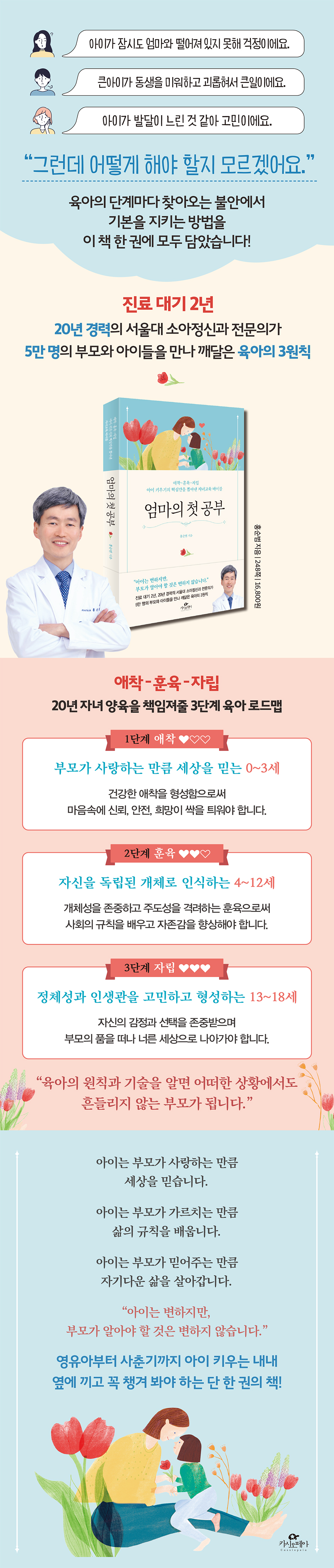
“Children change, but what parents need to know doesn’t.” A Seoul National University child psychiatrist with 20 years of experience and 2 years of waiting time for treatment Three Principles of Parenting I Learned from Meeting 50,000 Parents and Children We live in an age overflowing with parenting information. These days, if you have any questions about raising a child, you can get parenting information anytime, anywhere through various media such as mom cafes, social media, and TV programs. But too much information is also a problem. It is impossible to find all the information, and there are even many conflicting claims. Rather than solving parents' concerns, their confusion and anxiety only increase. In times like these, the ‘power of basics’ is essential. Professor Hong Soon-beom, a child psychiatrist at Seoul National University with 20 years of experience, says in “A Mother’s First Study” that if you know the principles of proper child-rearing and practice specific techniques accordingly, you can raise your child without obstacles in any situation. In order to raise children successfully, parents must understand the characteristics of the three stages of a child's mental development (infant, child, adolescent) and make appropriate changes to their parenting methods according to each stage. The parenting goals that parents should focus on change with each stage of a child's development. In the first stage, when a child is a baby (0-3 years old), the most important priority is to form a healthy 'attachment' with the child. Next, in the second stage, children (ages 4-12), the emphasis should be on 'discipline', which teaches the rules accepted in society, such as the distinction between what should and should not be done. For adolescents (ages 13-18), the final stage of 20 years of parenting, we must prepare to send our children out into the wider world with the goal of becoming 'independent'. The strength of this book is that after pinpointing the three core keywords of child education for each period of time, 'attachment-discipline-independence', the author explains in detail what obstacles hinder 'attachment-discipline-independence' and what specific techniques parents can practice in their daily lives for 'attachment-discipline-independence' based on his long experience in counseling and treatment. As with all learning, there is nothing more empowering than a book that teaches the fundamentals that are as solid and unchanging as a cornerstone. If you remember the core keywords of child-rearing in "Mom's First Study"—attachment, discipline, and independence—you will be able to draw the big picture of parenting by looking at the entire 20-year period of parenting with a broad perspective, without being overwhelmed by ups and downs. |
- You can preview some of the book's contents.
Preview
index
prolog
If you understand the principles of parenting, you can do it in any situation.
You can be an unwavering parent
Part 1: Parenting Education Determines Parenting Style
With the flood of parenting information out there, which one should you stick to?
Study how to avoid accidents, not how to deal with them.
Understanding developmental stages makes parenting much easier.
There are three times when the rules of parenting change.
Part 1 Summary
Part 2: Attachment (ages 0-3): Children who grow well as much as their parents love them.
[Stage 1 of Childhood Development] The Time When Trust in the World Begins to Sprout
[Parental Transformation Step 1] Develop a Healthy Attachment with Your Child
[Attachment Obstacles] Things that hinder stable attachment
- Mother's depression
- Parents who are sick
- A child receiving treatment
- Frequent changes in caregivers
[Attachment Skill 1] Sensitivity: Responding sensitively and being patient
[Attachment Skills 2] Relationships: A Harmonious Family and Affectionate Marital Relationships
Part 2 Summary
Part 3: Discipline (ages 4-12) Children grow up as well as their parents teach them.
[Stage 2 of Child Development] The Period When Individuality and Initiative Appear
- A time when I can separate myself from others
- Still a very self-centered time
- A time to find leadership and a role
[Parenting Transformation Step 2] Start Disciplining and Teach Rules
[Obstacles to Discipline] Things that Obstruct Principled Discipline
- It's a pity to discipline him.
- I miss grandma and grandpa.
- I hate my younger brother.
- Because there is nothing to discipline: Parents' wounds
- There is nothing to discipline: the child's wounds
- Eye level of discipline
- The trap of studying
- Discipline is not good.
[Discipline Skills 1] Success Experiences: Turn the Wheel of Success with Praise
- From a vicious cycle to a virtuous cycle
Why hasty praise is dangerous
- Parents who patiently wait for opportunities to praise
- Parents are the directors of their children's success.
- Praise that takes a child's breath away
- Let's focus praise on initiative.
- Tips for finding compliments
[Discipline Skills 2] Play: How to Study While Having Fun
- The magic called play
- Express your feelings through play
- Healing wounds through play
- Practice, overcome, mature
- Learn competition and cooperation through play.
- Build attachment through play
- Teaching through play
- Find play in studying
- Isn't it fun to achieve and communicate?
Part 3 Summary
Part 4: Independence (ages 13-18): Children who grow up as much as their parents believe in them.
[The 3 Stages of Childhood Development] A Time to Reflect on Identity and Life Outlook
[Parenting Transformation: Step 3] Become an Advisor to Help Your Child Become Self-Reliant
[Obstacles to Self-Reliance] Things that Obstruct Healthy Self-Reliance
- Loss of parents
- Parental anxiety
- Parents' misunderstanding
- Child's irritability and rebellion
- Parents' competitiveness
[Self-Reliance Skill 1] Empathy: The Best Defense is Empathy
- Let's realize the joy of imagination.
Empathy is both a skill and a personality trait.
- Distinguish between mind and action
- Tune in to the frequency of empathy.
[Self-Reliance Skills 2] Role Models: Happy Parents, Happy Children
- Put on your oxygen mask.
- Catch the happy character
[Self-Reliance Skills 3] Message: Parenting: The Countless Crossroads
- Various variables in parenting
- Children who receive their parents' messages differently
- A message delivered with all my heart and soul
Part 4 Summary
Epilogue
Creating a society where everyone lives well together
It is the greatest gift a parent can give their child.
main
If you understand the principles of parenting, you can do it in any situation.
You can be an unwavering parent
Part 1: Parenting Education Determines Parenting Style
With the flood of parenting information out there, which one should you stick to?
Study how to avoid accidents, not how to deal with them.
Understanding developmental stages makes parenting much easier.
There are three times when the rules of parenting change.
Part 1 Summary
Part 2: Attachment (ages 0-3): Children who grow well as much as their parents love them.
[Stage 1 of Childhood Development] The Time When Trust in the World Begins to Sprout
[Parental Transformation Step 1] Develop a Healthy Attachment with Your Child
[Attachment Obstacles] Things that hinder stable attachment
- Mother's depression
- Parents who are sick
- A child receiving treatment
- Frequent changes in caregivers
[Attachment Skill 1] Sensitivity: Responding sensitively and being patient
[Attachment Skills 2] Relationships: A Harmonious Family and Affectionate Marital Relationships
Part 2 Summary
Part 3: Discipline (ages 4-12) Children grow up as well as their parents teach them.
[Stage 2 of Child Development] The Period When Individuality and Initiative Appear
- A time when I can separate myself from others
- Still a very self-centered time
- A time to find leadership and a role
[Parenting Transformation Step 2] Start Disciplining and Teach Rules
[Obstacles to Discipline] Things that Obstruct Principled Discipline
- It's a pity to discipline him.
- I miss grandma and grandpa.
- I hate my younger brother.
- Because there is nothing to discipline: Parents' wounds
- There is nothing to discipline: the child's wounds
- Eye level of discipline
- The trap of studying
- Discipline is not good.
[Discipline Skills 1] Success Experiences: Turn the Wheel of Success with Praise
- From a vicious cycle to a virtuous cycle
Why hasty praise is dangerous
- Parents who patiently wait for opportunities to praise
- Parents are the directors of their children's success.
- Praise that takes a child's breath away
- Let's focus praise on initiative.
- Tips for finding compliments
[Discipline Skills 2] Play: How to Study While Having Fun
- The magic called play
- Express your feelings through play
- Healing wounds through play
- Practice, overcome, mature
- Learn competition and cooperation through play.
- Build attachment through play
- Teaching through play
- Find play in studying
- Isn't it fun to achieve and communicate?
Part 3 Summary
Part 4: Independence (ages 13-18): Children who grow up as much as their parents believe in them.
[The 3 Stages of Childhood Development] A Time to Reflect on Identity and Life Outlook
[Parenting Transformation: Step 3] Become an Advisor to Help Your Child Become Self-Reliant
[Obstacles to Self-Reliance] Things that Obstruct Healthy Self-Reliance
- Loss of parents
- Parental anxiety
- Parents' misunderstanding
- Child's irritability and rebellion
- Parents' competitiveness
[Self-Reliance Skill 1] Empathy: The Best Defense is Empathy
- Let's realize the joy of imagination.
Empathy is both a skill and a personality trait.
- Distinguish between mind and action
- Tune in to the frequency of empathy.
[Self-Reliance Skills 2] Role Models: Happy Parents, Happy Children
- Put on your oxygen mask.
- Catch the happy character
[Self-Reliance Skills 3] Message: Parenting: The Countless Crossroads
- Various variables in parenting
- Children who receive their parents' messages differently
- A message delivered with all my heart and soul
Part 4 Summary
Epilogue
Creating a society where everyone lives well together
It is the greatest gift a parent can give their child.
main
Detailed image
Into the book
There is one most important part when it comes to raising children properly.
The point is that even rivers and mountains change in 10 years.
The mountains and rivers change so much that it's hard to imagine what a child will be like in the meantime. A child born is a completely different person than a child at ten years old.
Moreover, raising a child requires planning for at least 10 years, usually around 20 years.
Twenty years is the time it takes for rivers and mountains to change twice, and the changes that occur in a child during this time are indescribable.
In the past, it was the time when the child would have given birth.
Rivers and mountains change, and children transform into completely different people, so the way parents treat their children must change.
---pp.35~36 From “Part 1 - There are three times when the rules of childcare change”
When you are a newborn, things happen automatically without you having to do them yourself.
Because my parents came and took care of it.
I unconditionally accept everything and respond to it.
Parents try to accommodate their baby's needs and feelings as much as possible.
From the baby's perspective, he or she may not even know how his or her needs were met.
I don't even know what parents are, and the distinction between myself and others is still blurry.
The world just took care of itself.
Thanks to this, a very important seed sprouts in the baby's mind.
It is the confidence that 'this world is a place worth living in.'
---p.46 From “Part 2 - Stage 1 of a Child’s Growth: The Time When Trust in the World Begins”
Through someone who cares for them in this way, the baby learns to trust the world.
Trust in that person soon leads to trust in the world.
Because to the baby, that person's arms will feel like the whole world.
If this trust takes root and takes firm root in your heart, it will be a great strength for you throughout your life.
Thanks to this, we can maintain a certain degree of peace and stability even in the harsh reality where we cannot see even an inch ahead and where chance reigns supreme.
Even amidst the endless cycle of failure and frustration, hope springs up again because the trust in the world formed in infancy is deeply rooted.
Because I have faith that if I burst into tears, the world will come and comfort me.
---p.50 From “Part 2 - Step 1 of Parental Transformation: Let’s Form a Healthy Attachment with Your Child”
What will a child who has realized their individuality look like? Just as there are things they want to do, there are also things they refuse to do.
For a while, I lived with the word “no” on my lips.
This means that since you are a different individual from others, you can reject it.
When a child tries to do something on his own and also actively refuses to do something, this is 'initiative'.
As initiative expands, the child tries to find his own role.
If there is only one entity called 'I', I can take the initiative as I please.
But it will take some skill and thought to figure out how to take the lead in a place where countless other entities coexist.
The role is to take initiative in this way, taking into account social relationships and context.
Also, as we become aware of the existence of others (other entities), we come to realize that rules are necessary for coexistence.
---pp.86~87 From “Part 3 - Stage 2 of Child Growth: The Period When Individuality and Initiative Appear”
The transformation of parents in stage 2 should not be misunderstood.
This does not mean that you should give up on attachment and only focus on discipline at this time.
I'm not saying that you should just cut off unconditional love.
This does not mean that you should force your child to do everything on his own.
Painters do not use only the three primary colors, but also mix various levels of colors appropriately.
The same goes for chameleon parents.
A gradual transformation is needed.
The difference between Stage 1 and Stage 2 is that the focus shifts from attachment to discipline.
And if the attachment is well formed in stage 1, discipline will be easier in stage 2.
---p.97 From “Part 3 - Parenting Transformation Stage 2: Let’s start disciplining and teaching rules”
During this period, abstract and conceptual thinking begins to emerge in earnest.
I also worry about who I am and how I should live my life.
In other words, it is a time to think about identity and outlook on life.
It is generally most evident in middle and high school, but there are significant differences between individuals.
(…omitted…) Based on this kind of abstract, conceptual thinking, young people try to understand who they are and find their own path.
But there is an important pitfall here that parents should be aware of and avoid.
When teenagers worry about 'I need to find my own way', this usually means 'my own way, not my parents' way'.
---pp.175~176 From “Part 4 - The 3 Stages of Child Growth: A Time to Reflect on Identity and Outlook on Life”
Most children challenge their parents verbally, but rarely with serious behavior.
They are simply trying to discover who they are and what their path is based on their new superpowers.
As part of this, they want to be recognized by their parents as people with supernatural powers, so they reject their parents' interference and sometimes try to surpass their parents.
But in reality, what I really want is to be recognized rather than to challenge or rebel.
Therefore, parents need to intentionally find the positive aspects of their adolescent children's trials and errors, acknowledge them, and empathize with them.
This is why recognition and empathy are more effective than hasty teaching.
The point is that even rivers and mountains change in 10 years.
The mountains and rivers change so much that it's hard to imagine what a child will be like in the meantime. A child born is a completely different person than a child at ten years old.
Moreover, raising a child requires planning for at least 10 years, usually around 20 years.
Twenty years is the time it takes for rivers and mountains to change twice, and the changes that occur in a child during this time are indescribable.
In the past, it was the time when the child would have given birth.
Rivers and mountains change, and children transform into completely different people, so the way parents treat their children must change.
---pp.35~36 From “Part 1 - There are three times when the rules of childcare change”
When you are a newborn, things happen automatically without you having to do them yourself.
Because my parents came and took care of it.
I unconditionally accept everything and respond to it.
Parents try to accommodate their baby's needs and feelings as much as possible.
From the baby's perspective, he or she may not even know how his or her needs were met.
I don't even know what parents are, and the distinction between myself and others is still blurry.
The world just took care of itself.
Thanks to this, a very important seed sprouts in the baby's mind.
It is the confidence that 'this world is a place worth living in.'
---p.46 From “Part 2 - Stage 1 of a Child’s Growth: The Time When Trust in the World Begins”
Through someone who cares for them in this way, the baby learns to trust the world.
Trust in that person soon leads to trust in the world.
Because to the baby, that person's arms will feel like the whole world.
If this trust takes root and takes firm root in your heart, it will be a great strength for you throughout your life.
Thanks to this, we can maintain a certain degree of peace and stability even in the harsh reality where we cannot see even an inch ahead and where chance reigns supreme.
Even amidst the endless cycle of failure and frustration, hope springs up again because the trust in the world formed in infancy is deeply rooted.
Because I have faith that if I burst into tears, the world will come and comfort me.
---p.50 From “Part 2 - Step 1 of Parental Transformation: Let’s Form a Healthy Attachment with Your Child”
What will a child who has realized their individuality look like? Just as there are things they want to do, there are also things they refuse to do.
For a while, I lived with the word “no” on my lips.
This means that since you are a different individual from others, you can reject it.
When a child tries to do something on his own and also actively refuses to do something, this is 'initiative'.
As initiative expands, the child tries to find his own role.
If there is only one entity called 'I', I can take the initiative as I please.
But it will take some skill and thought to figure out how to take the lead in a place where countless other entities coexist.
The role is to take initiative in this way, taking into account social relationships and context.
Also, as we become aware of the existence of others (other entities), we come to realize that rules are necessary for coexistence.
---pp.86~87 From “Part 3 - Stage 2 of Child Growth: The Period When Individuality and Initiative Appear”
The transformation of parents in stage 2 should not be misunderstood.
This does not mean that you should give up on attachment and only focus on discipline at this time.
I'm not saying that you should just cut off unconditional love.
This does not mean that you should force your child to do everything on his own.
Painters do not use only the three primary colors, but also mix various levels of colors appropriately.
The same goes for chameleon parents.
A gradual transformation is needed.
The difference between Stage 1 and Stage 2 is that the focus shifts from attachment to discipline.
And if the attachment is well formed in stage 1, discipline will be easier in stage 2.
---p.97 From “Part 3 - Parenting Transformation Stage 2: Let’s start disciplining and teaching rules”
During this period, abstract and conceptual thinking begins to emerge in earnest.
I also worry about who I am and how I should live my life.
In other words, it is a time to think about identity and outlook on life.
It is generally most evident in middle and high school, but there are significant differences between individuals.
(…omitted…) Based on this kind of abstract, conceptual thinking, young people try to understand who they are and find their own path.
But there is an important pitfall here that parents should be aware of and avoid.
When teenagers worry about 'I need to find my own way', this usually means 'my own way, not my parents' way'.
---pp.175~176 From “Part 4 - The 3 Stages of Child Growth: A Time to Reflect on Identity and Outlook on Life”
Most children challenge their parents verbally, but rarely with serious behavior.
They are simply trying to discover who they are and what their path is based on their new superpowers.
As part of this, they want to be recognized by their parents as people with supernatural powers, so they reject their parents' interference and sometimes try to surpass their parents.
But in reality, what I really want is to be recognized rather than to challenge or rebel.
Therefore, parents need to intentionally find the positive aspects of their adolescent children's trials and errors, acknowledge them, and empathize with them.
This is why recognition and empathy are more effective than hasty teaching.
---pp.185~186 From “Part 4 - Step 3 of Parental Transformation: Become an Advisor to Help Your Child Become Independent”
Publisher's Review
“There are more and more media outlets talking about childcare, but why aren’t the number of children with AIDS decreasing?”
The most reliable way to find peace of mind amidst the overflow of parenting information
These are times when it's easy to get parenting information anytime, anywhere, through mom cafes, various social media platforms, TV programs, etc.
But too much information is also a problem.
There's no way to know all that information, and there's a lot of conflicting advice out there.
In the flood of information, it is uncertain what kind of parenting information parents will encounter.
Parents try to apply the advice they've received to their child's parenting, but their child doesn't seem to be getting any better.
Rather, the more information they receive, the more confused and anxious new parents become.
What we need most in times like these is a book that teaches us the fundamentals that are as solid and unchanging as a cornerstone and can be applied to any situation.
Because the basics are always strong.
“Mom’s First Study” is the book that most clearly explains the basics of parenting.
Professor Hong Soon-beom, a child psychiatrist at Seoul National University with 20 years of experience, has met 50,000 parents and children in his clinic and felt sorry for the many parents who struggle without understanding the simple principles of parenting.
So, I wrote this book with the intention of sharing my expertise as a child psychiatrist with the practical experience I gained in clinical settings, along with the three principles of parenting: attachment, discipline, and self-reliance.
Attachment, Discipline, and Self-Reliance: A 3-Step Parenting Roadmap to Support Your Child's Care for 20 Years
The one book you must always keep by your side and read while raising your child, from infancy to adolescence!
According to the author, if parents understand the principles of proper parenting and consistently practice specific techniques in their daily lives, they can raise their children without obstacles in any situation.
Rather than simply looking for a one-size-fits-all solution to a specific problem that arises during parenting, we must understand the principles of proper parenting that can help us avoid creating such problematic situations.
The author advises that, for easy parenting, parents should understand the characteristics of the three stages of a child's mental development and make appropriate changes to their parenting methods according to each stage of development.
Ten years is a time when even rivers and mountains change.
But raising a child is a 20-year project.
It is not a choice but a necessity for parents to change the way they treat their children as their children grow and develop.
During the 20 years of parenting, there are three major periods when the rules of parenting change (baby-child-adolescence).
At each stage of development, the parenting goals (attachment-discipline-independence) that parents should focus on change.
At such times, parents must actively transform like a chameleon, freely changing its color to suit the environment.
Below is a summary of the specific characteristics of each stage and the parenting goals that parents should focus on at each stage.
[0-3 Years | Stage 1 of Childhood Mental Development | Goal: Attachment]
“A child believes in the world as much as his parents love him.”
Babies learn to trust the world through those who care for them.
If this trust sprouts well and takes firm root in your heart, it will serve as a great strength throughout your life.
For this to happen, one person must act as the world's agent, and that person is the parent.
During this period, parents give unconditional love to their babies, and as a result, the babies form a special relationship with their caregivers, which is called 'attachment'.
Between the ages of 0 and 3, it is important to foster healthy attachments and foster trust, stability, and hope in the child's heart.
[Ages 4-12 | Stage 2 of Childhood Mental Development | Goal: Discipline]
“A child learns the rules of life as much as his parents teach him.”
As children grow up and leave the baby stage, they begin to realize that they and their parents, whom they thought were one in the same body, are different.
As we begin to distinguish between 'me' and 'others' and recognize ourselves as independent entities, we begin to want to do things for ourselves.
Of course, there are also things that you decide not to do.
At this stage, when individuality and initiative are developing, it is important to give the child ample opportunity to try things on his own and provide positive feedback on his accomplishments, even if they are not perfect.
Through 'discipline' that respects a child's individuality and encourages initiative, the child learns the rules accepted in society and improves his or her self-esteem.
[Ages 13-18 | 3 Stages of Childhood Mental Development | Goal: Independence]
“Children live their lives as authentically as their parents believe in them.”
The final stage of 20 years of parenting is adolescence, which we commonly call 'puberty'.
During this period, children become capable of abstract, conceptual thinking and begin to think about who they are (identity) and how they will live in the future (outlook on life).
Since this is a kind of superpower, children in their teens want to fully exercise it and be recognized, so they try to argue with their parents and try to find their own path by moving according to their own will, even if it means going through trial and error.
Parents raising children at this age should acknowledge and empathize with their children's emotions and choices rather than teaching them hastily.
Remember that the ultimate goal of raising a child is 'independence', and you should be an advisor, companion, and collaborator, not a supervisor or disciplinarian, and help your child leave their parents' embrace and enter the wider world.
“If you know the principles and techniques of parenting,
“You can be a parent who is unwavering in any situation.”
How to maintain the basics while dealing with the anxiety that comes with each stage of parenting.
Even if you fully understand the basic principles of parenting, it is of no use if you don't put them into practice.
After pointing out the core keywords of child education for each stage of a child's development, which are 'attachment-discipline-independence', the author explains in detail what obstacles hinder 'attachment-discipline-independence' and what specific techniques parents can practice in their daily lives to achieve 'attachment-discipline-independence'.
[The Art of Attachment]
1.
Sensitivity: Recognizing and meeting the baby's needs.
2.
Relationship: Parents care for each other so that they can give their best affection to their child.
[The Art of Discipline]
1.
Success Experience: Be generous with praise that encourages your child's initiative.
2.
Play: Interact closely with your child by playing with him or her with your whole body and mind.
[The Art of Self-Reliance]
1.
Empathy: Tune in to your child's heart, empathize with them, and acknowledge them.
2.
Role models: Parents should first show their children how to live happy lives.
3.
Message: Parents themselves should have healthy beliefs and send good messages to their children.
There is a saying that 'well begun is half done'.
It means that it is important to make up your mind and take the first step well.
When you're stepping into an unfamiliar field with limited background knowledge, the most important thing you need is a reliable, introductory book that can lay a solid foundation in that field.
As the title, 'Mom's First Study' suggests, this book contains all the principles and techniques for raising children over the past 20 years that new and prospective parents must know.
Whenever you feel uneasy or anxious while raising a child, remember the core keywords of parenting contained in this book: “Attachment-Discipline-Self-Reliance.”
With "Mom's First Study," you will be able to wisely navigate the difficult, long-term project of raising a child for 20 years with a steady attitude and the right direction.
The most reliable way to find peace of mind amidst the overflow of parenting information
These are times when it's easy to get parenting information anytime, anywhere, through mom cafes, various social media platforms, TV programs, etc.
But too much information is also a problem.
There's no way to know all that information, and there's a lot of conflicting advice out there.
In the flood of information, it is uncertain what kind of parenting information parents will encounter.
Parents try to apply the advice they've received to their child's parenting, but their child doesn't seem to be getting any better.
Rather, the more information they receive, the more confused and anxious new parents become.
What we need most in times like these is a book that teaches us the fundamentals that are as solid and unchanging as a cornerstone and can be applied to any situation.
Because the basics are always strong.
“Mom’s First Study” is the book that most clearly explains the basics of parenting.
Professor Hong Soon-beom, a child psychiatrist at Seoul National University with 20 years of experience, has met 50,000 parents and children in his clinic and felt sorry for the many parents who struggle without understanding the simple principles of parenting.
So, I wrote this book with the intention of sharing my expertise as a child psychiatrist with the practical experience I gained in clinical settings, along with the three principles of parenting: attachment, discipline, and self-reliance.
Attachment, Discipline, and Self-Reliance: A 3-Step Parenting Roadmap to Support Your Child's Care for 20 Years
The one book you must always keep by your side and read while raising your child, from infancy to adolescence!
According to the author, if parents understand the principles of proper parenting and consistently practice specific techniques in their daily lives, they can raise their children without obstacles in any situation.
Rather than simply looking for a one-size-fits-all solution to a specific problem that arises during parenting, we must understand the principles of proper parenting that can help us avoid creating such problematic situations.
The author advises that, for easy parenting, parents should understand the characteristics of the three stages of a child's mental development and make appropriate changes to their parenting methods according to each stage of development.
Ten years is a time when even rivers and mountains change.
But raising a child is a 20-year project.
It is not a choice but a necessity for parents to change the way they treat their children as their children grow and develop.
During the 20 years of parenting, there are three major periods when the rules of parenting change (baby-child-adolescence).
At each stage of development, the parenting goals (attachment-discipline-independence) that parents should focus on change.
At such times, parents must actively transform like a chameleon, freely changing its color to suit the environment.
Below is a summary of the specific characteristics of each stage and the parenting goals that parents should focus on at each stage.
[0-3 Years | Stage 1 of Childhood Mental Development | Goal: Attachment]
“A child believes in the world as much as his parents love him.”
Babies learn to trust the world through those who care for them.
If this trust sprouts well and takes firm root in your heart, it will serve as a great strength throughout your life.
For this to happen, one person must act as the world's agent, and that person is the parent.
During this period, parents give unconditional love to their babies, and as a result, the babies form a special relationship with their caregivers, which is called 'attachment'.
Between the ages of 0 and 3, it is important to foster healthy attachments and foster trust, stability, and hope in the child's heart.
[Ages 4-12 | Stage 2 of Childhood Mental Development | Goal: Discipline]
“A child learns the rules of life as much as his parents teach him.”
As children grow up and leave the baby stage, they begin to realize that they and their parents, whom they thought were one in the same body, are different.
As we begin to distinguish between 'me' and 'others' and recognize ourselves as independent entities, we begin to want to do things for ourselves.
Of course, there are also things that you decide not to do.
At this stage, when individuality and initiative are developing, it is important to give the child ample opportunity to try things on his own and provide positive feedback on his accomplishments, even if they are not perfect.
Through 'discipline' that respects a child's individuality and encourages initiative, the child learns the rules accepted in society and improves his or her self-esteem.
[Ages 13-18 | 3 Stages of Childhood Mental Development | Goal: Independence]
“Children live their lives as authentically as their parents believe in them.”
The final stage of 20 years of parenting is adolescence, which we commonly call 'puberty'.
During this period, children become capable of abstract, conceptual thinking and begin to think about who they are (identity) and how they will live in the future (outlook on life).
Since this is a kind of superpower, children in their teens want to fully exercise it and be recognized, so they try to argue with their parents and try to find their own path by moving according to their own will, even if it means going through trial and error.
Parents raising children at this age should acknowledge and empathize with their children's emotions and choices rather than teaching them hastily.
Remember that the ultimate goal of raising a child is 'independence', and you should be an advisor, companion, and collaborator, not a supervisor or disciplinarian, and help your child leave their parents' embrace and enter the wider world.
“If you know the principles and techniques of parenting,
“You can be a parent who is unwavering in any situation.”
How to maintain the basics while dealing with the anxiety that comes with each stage of parenting.
Even if you fully understand the basic principles of parenting, it is of no use if you don't put them into practice.
After pointing out the core keywords of child education for each stage of a child's development, which are 'attachment-discipline-independence', the author explains in detail what obstacles hinder 'attachment-discipline-independence' and what specific techniques parents can practice in their daily lives to achieve 'attachment-discipline-independence'.
[The Art of Attachment]
1.
Sensitivity: Recognizing and meeting the baby's needs.
2.
Relationship: Parents care for each other so that they can give their best affection to their child.
[The Art of Discipline]
1.
Success Experience: Be generous with praise that encourages your child's initiative.
2.
Play: Interact closely with your child by playing with him or her with your whole body and mind.
[The Art of Self-Reliance]
1.
Empathy: Tune in to your child's heart, empathize with them, and acknowledge them.
2.
Role models: Parents should first show their children how to live happy lives.
3.
Message: Parents themselves should have healthy beliefs and send good messages to their children.
There is a saying that 'well begun is half done'.
It means that it is important to make up your mind and take the first step well.
When you're stepping into an unfamiliar field with limited background knowledge, the most important thing you need is a reliable, introductory book that can lay a solid foundation in that field.
As the title, 'Mom's First Study' suggests, this book contains all the principles and techniques for raising children over the past 20 years that new and prospective parents must know.
Whenever you feel uneasy or anxious while raising a child, remember the core keywords of parenting contained in this book: “Attachment-Discipline-Self-Reliance.”
With "Mom's First Study," you will be able to wisely navigate the difficult, long-term project of raising a child for 20 years with a steady attitude and the right direction.
GOODS SPECIFICS
- Date of issue: August 8, 2022
- Page count, weight, size: 248 pages | 348g | 145*210*16mm
- ISBN13: 9791168270626
- ISBN10: 1168270626
You may also like
카테고리
korean


korean

![GQ KOREA Mark (Monthly): December [2025]](http://librairie.coreenne.fr/cdn/shop/files/8ef265dbbfbf186523ed75ba7319009d.jpg?v=1765340328&width=3840)


