

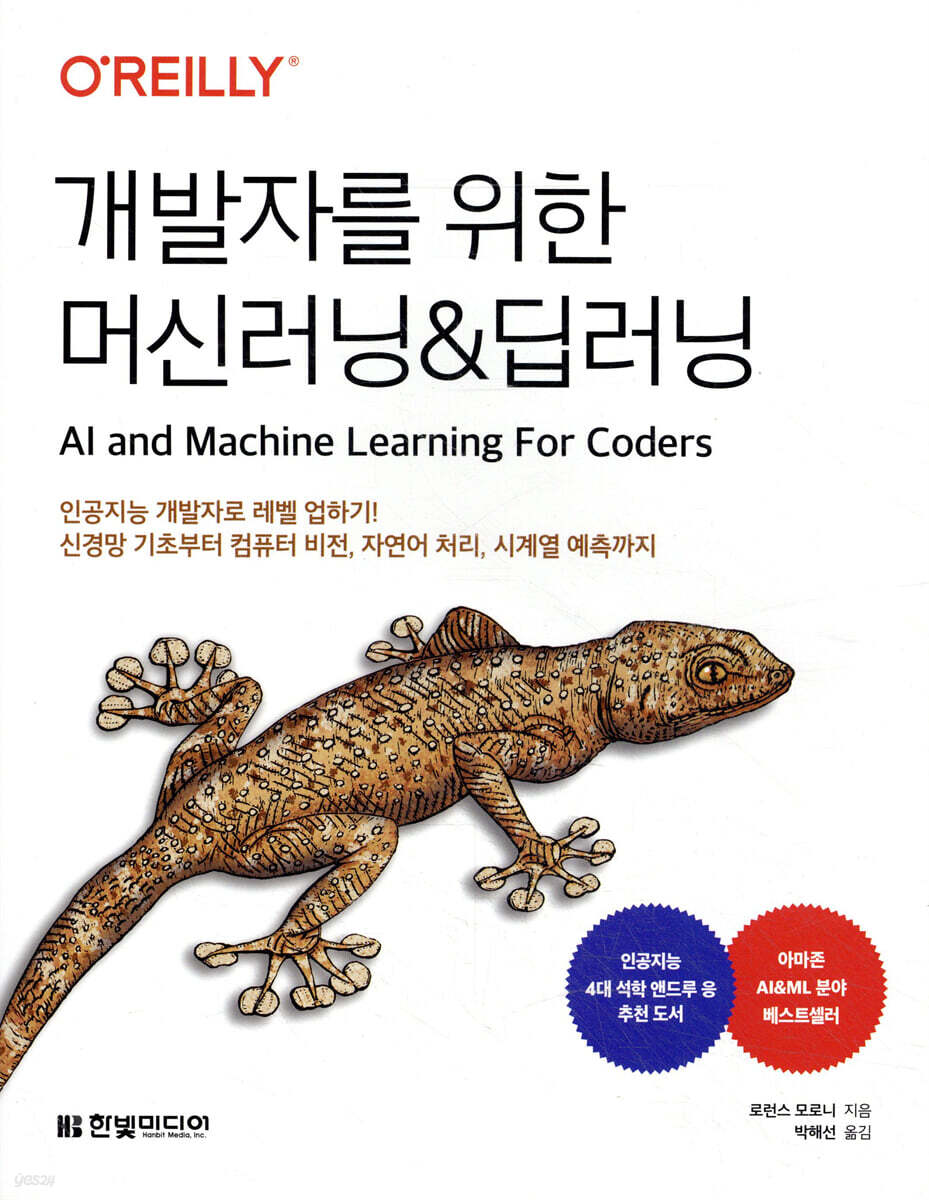
Machine Learning & Deep Learning for Developers
 |
Description
Book Introduction
Dedicated to developers who find math difficult
Hands-on Machine Learning Guidebook
As the adoption of artificial intelligence technology increases, the skills required of developers are also increasing.
Artificial intelligence is transforming industries. How can we master it wisely and effectively? This book aims to guide developers through solving various problems they face using machine learning and help them level up as machine learning and AI developers.
The content is based on online courses chosen by tens of thousands of people, and does not cover complex or difficult formulas. Instead, you learn key concepts by practicing various example codes.
We'll implement a variety of scenarios you'll encounter in the world of machine learning, and also introduce sequence modeling for computer vision, natural language processing, web, mobile, cloud, and embedded runtimes.
After reading this book, you will soon be upgraded to an AI developer who can freely navigate the world of machine learning and artificial intelligence with Python and TensorFlow.
Hands-on Machine Learning Guidebook
As the adoption of artificial intelligence technology increases, the skills required of developers are also increasing.
Artificial intelligence is transforming industries. How can we master it wisely and effectively? This book aims to guide developers through solving various problems they face using machine learning and help them level up as machine learning and AI developers.
The content is based on online courses chosen by tens of thousands of people, and does not cover complex or difficult formulas. Instead, you learn key concepts by practicing various example codes.
We'll implement a variety of scenarios you'll encounter in the world of machine learning, and also introduce sequence modeling for computer vision, natural language processing, web, mobile, cloud, and embedded runtimes.
After reading this book, you will soon be upgraded to an AI developer who can freely navigate the world of machine learning and artificial intelligence with Python and TensorFlow.
- You can preview some of the book's contents.
Preview
index
[PART I: Building the Model]
Chapter 1: Introduction to TensorFlow
1.1 What is machine learning?
1.2 Limitations of Traditional Programming
1.3 From Programming to Learning
1.4 TensorFlow
1.5 Using TensorFlow
1.6 Getting Started with Machine Learning
1.7 In conclusion
CHAPTER 2: INTRODUCTION TO COMPUTER VISION
2.1 Recognizing Clothing Items
2.2 Neurons for Computer Vision
2.3 Neural network design
2.4 Training the Neural Network
2.5 Examining the Model Output
2.6 Training longer: Overfitting
2.7 Early termination of training
2.8 In conclusion
CHAPTER 3 ADVANCED COMPUTER VISION: Detecting Features in Images
3.1 Convolution
3.2 Pooling
3.3 Creating a Convolutional Neural Network
3.4 Examining Convolutional Neural Networks
3.5 Building a CNN that Distinguishes Speech from People
3.6 Image multiplication
3.7 Transfer Learning
3.8 Multi-classification
3.9 Dropout Regulation
3.10 In conclusion
CHAPTER 4: Using Public Datasets with TensorFlow Datasets
4.1 Getting Started with TensorFlow Datasets
4.2 Using TensorFlow Datasets in Keras Models
4.3 Using mapping functions for data augmentation
4.4 Using Custom Splits
4.5 Understanding TFRecord
4.6 ETL Process for Data Management in TensorFlow
4.7 In conclusion
CHAPTER 5: INTRODUCTION TO NATURAL LANGUAGE PROCESSING
5.1 Encoding Language into Numbers
5.2 Stopword Removal and Text Cleansing
5.3 Handling Real Data
5.4 In conclusion
CHAPTER 6: Emotional Programming Using Embeddings
6.1 Constructing the meaning of words
6.2 Embedding in TensorFlow
6.3 Embedding Visualization
6.4 Using Pretrained Embeddings from TensorFlow Hub
6.5 In conclusion
CHAPTER 7 Recurrent Neural Networks for Natural Language Processing
7.1 Circular Structure
7.2 Extending the cycle to language
7.3 Building a Text Classifier with RNNs
7.4 Using Pretrained Embeddings in RNNs
7.5 In conclusion
CHAPTER 8: Generating Text with TensorFlow
8.1 Converting a sequence to an input sequence
8.2 Creating a Model
8.3 Creating Text
8.4 Expanding the Dataset
8.5 Changing the model structure
8.6 Improving Data
8.7 Character-based encoding
8.8 In conclusion
CHAPTER 9 Understanding Sequence and Time Series Data
9.1 Common Features of Time Series
9.2 Time series forecasting techniques
9.3 In conclusion
CHAPTER 10: Building a Machine Learning Model to Predict Sequences
10.1 Creating a Windows Dataset
10.2 Creating a DNN and Training It with Sequence Data
10.3 Evaluating DNN Results
10.4 Looking at the overall forecast
10.5 Tuning the Learning Rate
10.6 Tuning Hyperparameters with Keras Tuner
10.7 In conclusion
CHAPTER 11 Convolutional Neural Networks and Recurrent Neural Networks for Sequence Models
11.1 Convolution for Sequence Data
11.2 Using NASA Weather Data
11.3 Modeling Sequences with RNNs
11.4 Other circulation layers
11.5 Using Dropout
11.6 Using Bidirectional RNNs
11.7 In conclusion
[PART II Using the Model]
Chapter 12: Introducing TensorFlow Lite
12.1 What is TensorFlow Lite?
12.2 Converting a Trained Model to TensorFlow Lite
12.3 Converting an Image Classifier Built with Transfer Learning to TensorFlow Lite
12.4 In conclusion
CHAPTER 13 Using TensorFlow Lite in Android Apps
13.1 What is Android Studio?
13.2 Creating Your First TensorFlow Lite Android App
13.3 Creating an App that Processes Images
13.4 TensorFlow Lite Sample App (for Android)
13.5 In conclusion
CHAPTER 14 Using TensorFlow Lite in iOS Apps
14.1 Creating Your First TensorFlow Lite App with Xcode
14.2 One Step Further: Image Processing
14.3 TensorFlow Lite Sample App (for iOS)
14.4 In conclusion
CHAPTER 15: Introduction to TensorFlow.js
15.1 What is TensorFlow.js?
15.2 Installing and Running Brackets
15.3 Creating Your First TensorFlow.js Model
15.4 Building an Iris Classifier
15.5 In conclusion
CHAPTER 16: Training Computer Vision Models in TensorFlow.js
16.1 JavaScript Considerations for TensorFlow Developers
16.2 Building a CNN with JavaScript
16.3 Using Callbacks for Visualization
16.4 Training with the MNIST Dataset
16.5 Performing Inference on Images with TensorFlow.js
16.6 In conclusion
CHAPTER 17 Converting and Reusing Python Models
17.1 Converting Python-based models to JavaScript
17.2 Using a pre-transformed model
17.3 In conclusion
CHAPTER 18 Transfer Learning in JavaScript
18.1 Performing Transfer Learning with MobileNet
18.2 Transfer Learning with TensorFlow Hub
18.3 Transfer Learning with TensorFlow.org
18.4 In conclusion
CHAPTER 19 Deploying with TensorFlow Serving
19.1 What is TensorFlow Serving?
19.2 Installing TensorFlow Serving
19.3 Building and Deploying Models
19.4 In conclusion
CHAPTER 20 AI Ethics, Fairness, and Privacy
20.1 Fairness in Programming
20.2 Fairness in Machine Learning
20.3 Tools for Fairness
20.4 Federated Learning
20.5 Google's AI Principles
20.6 In conclusion
Chapter 1: Introduction to TensorFlow
1.1 What is machine learning?
1.2 Limitations of Traditional Programming
1.3 From Programming to Learning
1.4 TensorFlow
1.5 Using TensorFlow
1.6 Getting Started with Machine Learning
1.7 In conclusion
CHAPTER 2: INTRODUCTION TO COMPUTER VISION
2.1 Recognizing Clothing Items
2.2 Neurons for Computer Vision
2.3 Neural network design
2.4 Training the Neural Network
2.5 Examining the Model Output
2.6 Training longer: Overfitting
2.7 Early termination of training
2.8 In conclusion
CHAPTER 3 ADVANCED COMPUTER VISION: Detecting Features in Images
3.1 Convolution
3.2 Pooling
3.3 Creating a Convolutional Neural Network
3.4 Examining Convolutional Neural Networks
3.5 Building a CNN that Distinguishes Speech from People
3.6 Image multiplication
3.7 Transfer Learning
3.8 Multi-classification
3.9 Dropout Regulation
3.10 In conclusion
CHAPTER 4: Using Public Datasets with TensorFlow Datasets
4.1 Getting Started with TensorFlow Datasets
4.2 Using TensorFlow Datasets in Keras Models
4.3 Using mapping functions for data augmentation
4.4 Using Custom Splits
4.5 Understanding TFRecord
4.6 ETL Process for Data Management in TensorFlow
4.7 In conclusion
CHAPTER 5: INTRODUCTION TO NATURAL LANGUAGE PROCESSING
5.1 Encoding Language into Numbers
5.2 Stopword Removal and Text Cleansing
5.3 Handling Real Data
5.4 In conclusion
CHAPTER 6: Emotional Programming Using Embeddings
6.1 Constructing the meaning of words
6.2 Embedding in TensorFlow
6.3 Embedding Visualization
6.4 Using Pretrained Embeddings from TensorFlow Hub
6.5 In conclusion
CHAPTER 7 Recurrent Neural Networks for Natural Language Processing
7.1 Circular Structure
7.2 Extending the cycle to language
7.3 Building a Text Classifier with RNNs
7.4 Using Pretrained Embeddings in RNNs
7.5 In conclusion
CHAPTER 8: Generating Text with TensorFlow
8.1 Converting a sequence to an input sequence
8.2 Creating a Model
8.3 Creating Text
8.4 Expanding the Dataset
8.5 Changing the model structure
8.6 Improving Data
8.7 Character-based encoding
8.8 In conclusion
CHAPTER 9 Understanding Sequence and Time Series Data
9.1 Common Features of Time Series
9.2 Time series forecasting techniques
9.3 In conclusion
CHAPTER 10: Building a Machine Learning Model to Predict Sequences
10.1 Creating a Windows Dataset
10.2 Creating a DNN and Training It with Sequence Data
10.3 Evaluating DNN Results
10.4 Looking at the overall forecast
10.5 Tuning the Learning Rate
10.6 Tuning Hyperparameters with Keras Tuner
10.7 In conclusion
CHAPTER 11 Convolutional Neural Networks and Recurrent Neural Networks for Sequence Models
11.1 Convolution for Sequence Data
11.2 Using NASA Weather Data
11.3 Modeling Sequences with RNNs
11.4 Other circulation layers
11.5 Using Dropout
11.6 Using Bidirectional RNNs
11.7 In conclusion
[PART II Using the Model]
Chapter 12: Introducing TensorFlow Lite
12.1 What is TensorFlow Lite?
12.2 Converting a Trained Model to TensorFlow Lite
12.3 Converting an Image Classifier Built with Transfer Learning to TensorFlow Lite
12.4 In conclusion
CHAPTER 13 Using TensorFlow Lite in Android Apps
13.1 What is Android Studio?
13.2 Creating Your First TensorFlow Lite Android App
13.3 Creating an App that Processes Images
13.4 TensorFlow Lite Sample App (for Android)
13.5 In conclusion
CHAPTER 14 Using TensorFlow Lite in iOS Apps
14.1 Creating Your First TensorFlow Lite App with Xcode
14.2 One Step Further: Image Processing
14.3 TensorFlow Lite Sample App (for iOS)
14.4 In conclusion
CHAPTER 15: Introduction to TensorFlow.js
15.1 What is TensorFlow.js?
15.2 Installing and Running Brackets
15.3 Creating Your First TensorFlow.js Model
15.4 Building an Iris Classifier
15.5 In conclusion
CHAPTER 16: Training Computer Vision Models in TensorFlow.js
16.1 JavaScript Considerations for TensorFlow Developers
16.2 Building a CNN with JavaScript
16.3 Using Callbacks for Visualization
16.4 Training with the MNIST Dataset
16.5 Performing Inference on Images with TensorFlow.js
16.6 In conclusion
CHAPTER 17 Converting and Reusing Python Models
17.1 Converting Python-based models to JavaScript
17.2 Using a pre-transformed model
17.3 In conclusion
CHAPTER 18 Transfer Learning in JavaScript
18.1 Performing Transfer Learning with MobileNet
18.2 Transfer Learning with TensorFlow Hub
18.3 Transfer Learning with TensorFlow.org
18.4 In conclusion
CHAPTER 19 Deploying with TensorFlow Serving
19.1 What is TensorFlow Serving?
19.2 Installing TensorFlow Serving
19.3 Building and Deploying Models
19.4 In conclusion
CHAPTER 20 AI Ethics, Fairness, and Privacy
20.1 Fairness in Programming
20.2 Fairness in Machine Learning
20.3 Tools for Fairness
20.4 Federated Learning
20.5 Google's AI Principles
20.6 In conclusion
Detailed image

Publisher's Review
Recommended by Andrew Ng, one of the four leading experts in artificial intelligence
A Machine Learning Guidebook by, for, and of Developers
We've truly entered the era of artificial intelligence! AI technology has been growing rapidly, and various industries, including finance, education, distribution, and manufacturing, are rushing to adopt it.
In keeping with the times, AI-related education is diversifying and the age of participants is getting younger. However, many developers still find it difficult to take their first steps in machine learning and deep learning.
If you're a developer who wants to learn artificial intelligence properly but finds complex formulas burdensome, or if you want to start machine learning with Python code without difficult theories, this book is the perfect time to take your first step into the world of machine learning!
This book explains machine learning and TensorFlow from a developer's perspective and guides you through installing TensorFlow for practical use.
We'll implement simple models ourselves and build machine learning and deep learning models using various datasets, including Fashion MNIST, Horse-Person, Rock, Paper, Scissors, Sarcasm, and Dog-Cat datasets.
This book is a comprehensive machine learning gift set for developers, covering computer vision, convolutional neural networks, recurrent neural networks, as well as TensorFlow Lite, TensorFlow.js, and TensorFlow Serving.
Learn machine learning step by step with clear, practical explanations of concepts and example code.
We support you as you level up as AI developers.
Target audience
● Developers who want to get started with machine learning but don't know where to start
Anyone who wants to learn machine learning concepts by directly executing Python code without difficult math or theory
Key Contents
● Creating various model structures with TensorFlow
● Building a model with a neural network with one neuron
● Detecting image features using computer vision
● Tokenize and order words and sentences using natural language processing
● Using models on mobile devices with TensorFlow Lite
Deploying models to the web or cloud with TensorFlow Serving
A Machine Learning Guidebook by, for, and of Developers
We've truly entered the era of artificial intelligence! AI technology has been growing rapidly, and various industries, including finance, education, distribution, and manufacturing, are rushing to adopt it.
In keeping with the times, AI-related education is diversifying and the age of participants is getting younger. However, many developers still find it difficult to take their first steps in machine learning and deep learning.
If you're a developer who wants to learn artificial intelligence properly but finds complex formulas burdensome, or if you want to start machine learning with Python code without difficult theories, this book is the perfect time to take your first step into the world of machine learning!
This book explains machine learning and TensorFlow from a developer's perspective and guides you through installing TensorFlow for practical use.
We'll implement simple models ourselves and build machine learning and deep learning models using various datasets, including Fashion MNIST, Horse-Person, Rock, Paper, Scissors, Sarcasm, and Dog-Cat datasets.
This book is a comprehensive machine learning gift set for developers, covering computer vision, convolutional neural networks, recurrent neural networks, as well as TensorFlow Lite, TensorFlow.js, and TensorFlow Serving.
Learn machine learning step by step with clear, practical explanations of concepts and example code.
We support you as you level up as AI developers.
Target audience
● Developers who want to get started with machine learning but don't know where to start
Anyone who wants to learn machine learning concepts by directly executing Python code without difficult math or theory
Key Contents
● Creating various model structures with TensorFlow
● Building a model with a neural network with one neuron
● Detecting image features using computer vision
● Tokenize and order words and sentences using natural language processing
● Using models on mobile devices with TensorFlow Lite
Deploying models to the web or cloud with TensorFlow Serving
GOODS SPECIFICS
- Publication date: August 24, 2022
- Page count, weight, size: 464 pages | 922g | 183*235*30mm
- ISBN13: 9791169210126
- ISBN10: 1169210120
You may also like
카테고리
korean


korean

![GQ KOREA Mark (Monthly): December [2025]](http://librairie.coreenne.fr/cdn/shop/files/8ef265dbbfbf186523ed75ba7319009d.jpg?v=1765340328&width=3840)


