

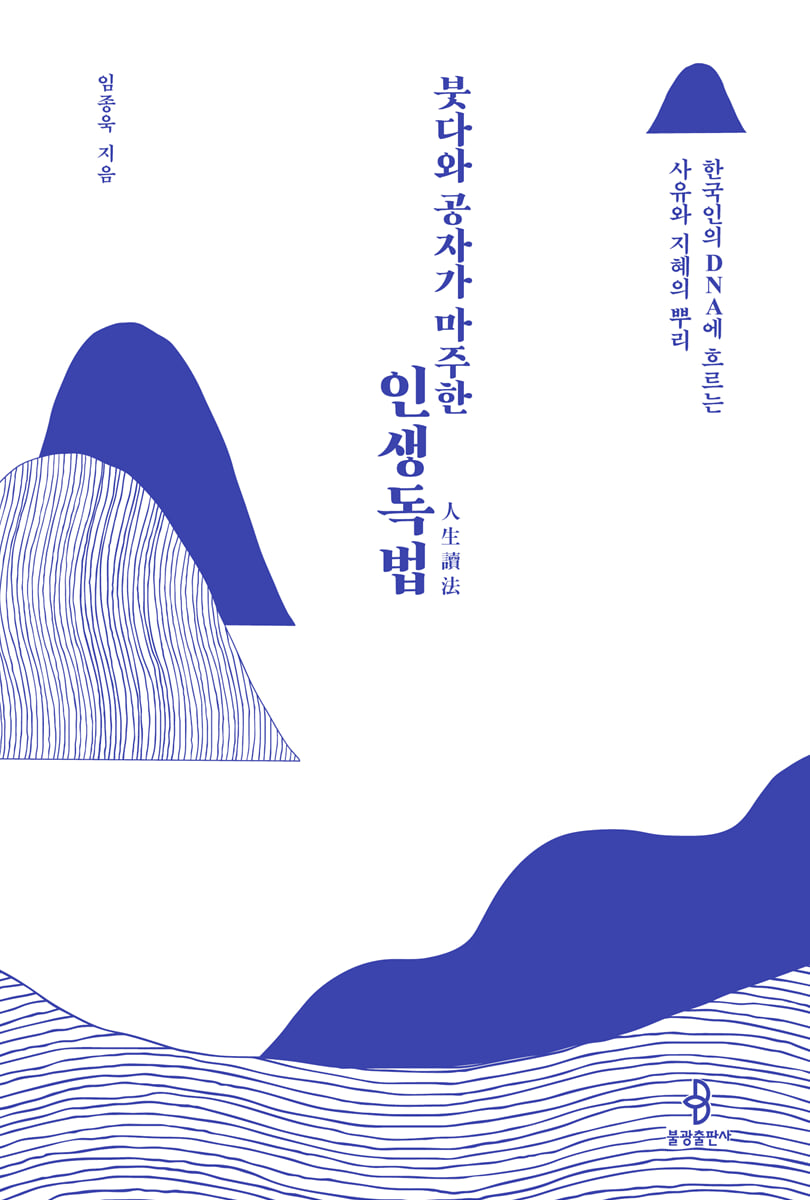
The Life Lessons of Buddha and Confucius
 |
Description
Book Introduction
In an Age of Uncertainty, Rereading the Words of Buddha and Confucius
When the thinking of the classics becomes the wisdom of reality,
Finally, the center of life is found!
In a world where anxiety and division have become the norm, the power of an unwavering mind has become an essential virtue for modern people.
Where will we cultivate that strength? "The Life Lessons of Buddha and Confucius" seeks the answer in the roots of thought and wisdom that flow in Korean DNA: Buddha and Confucius.
It finds common ground in the teachings of Buddha and Confucius and reveals the enduring wisdom of life contained within them.
This book is not a simple commentary on the classics that repeats the words of Buddha and Confucius, saying, "This word means this, and that word means that."
It is a ‘living grain of wisdom’ that the author has cultivated over the course of half a century of his life.
It tells the insights of Buddha and Confucius from 2,500 years ago in a new way for today: how to stand tall in front of the world, how to make friends rather than enemies, how to achieve your goals, and how to enjoy this precious life.
It guides you on the path of life where you go far and long rather than rushing, and follow your intentions without regrets.
When the thinking of the classics becomes the wisdom of reality,
Finally, the center of life is found!
In a world where anxiety and division have become the norm, the power of an unwavering mind has become an essential virtue for modern people.
Where will we cultivate that strength? "The Life Lessons of Buddha and Confucius" seeks the answer in the roots of thought and wisdom that flow in Korean DNA: Buddha and Confucius.
It finds common ground in the teachings of Buddha and Confucius and reveals the enduring wisdom of life contained within them.
This book is not a simple commentary on the classics that repeats the words of Buddha and Confucius, saying, "This word means this, and that word means that."
It is a ‘living grain of wisdom’ that the author has cultivated over the course of half a century of his life.
It tells the insights of Buddha and Confucius from 2,500 years ago in a new way for today: how to stand tall in front of the world, how to make friends rather than enemies, how to achieve your goals, and how to enjoy this precious life.
It guides you on the path of life where you go far and long rather than rushing, and follow your intentions without regrets.
- You can preview some of the book's contents.
Preview
index
introduction
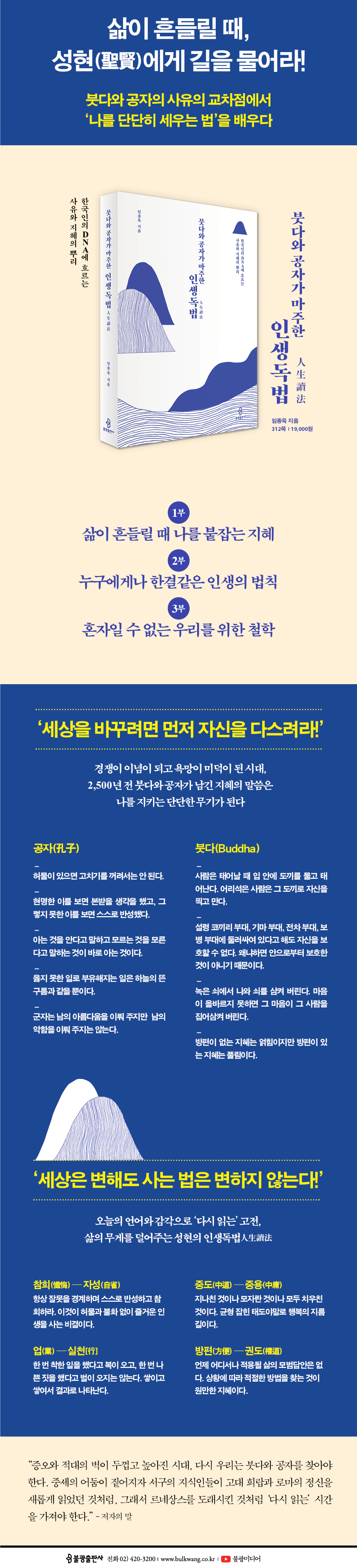
Part 1: Wisdom to Hold Me Together When Life Shakes
Know Me, and You Have Nothing to Fear - Repentance and Self-Reflection
If you want to be pure, you must live purely - Pure poverty and honest officials
The results of life are proportional to what I have created - karma and actions
The path taken in the middle goes the furthest - the Middle Way and the Doctrine of the Mean
Alone time is also a form of self-cultivation - An-geo (retreat) and Sin-dok (attention to solitude).
The Last Bastion the Mind Must Protect: Conscience and Impatience
Knowing the Roots Leads to the Center - The Genealogy of Zen and the Confucian Theory of Daoism
A person with a generous heart is truly rich - The poor have one light and the self-discipline is a virtue.
What Type of Person Am I? - Human Types in Buddhism and Confucianism
Let go of the past - love and obsession
Those who are not forgotten do not die - Cremation and funeral rites
A Man Becomes Stronger on the Road - The Journeys of Buddha and Confucius
For a life filled with lingering emotions - Leisure and a poetic heart
Part 2: The Laws of Life That Are the Same for Everyone
A person's character is revealed in his or her attitude - Buddha and the gentleman
When Flexibility Becomes Wisdom - Expedients and Power
A Dialogue That Begins When We Acknowledge Differences: Debates Between Buddhism and Confucianism
All that remains after a fight is scars - The Persecution of the Law and the Purge of Scholars
Tomorrow Doesn't Come on Itself - The Six Perfections and Their Practice
Now is the fastest time - the joy of learning
There is no set place for learning - Yadan and Haengdan
Where does learning end? - Self-illumination, Dharma-illumination, and the awakening of anger and forgetting about food.
Knowing is harder than doing - luck and village covenants
People live by teaching others - teaching the law in response to an opportunity and adapting to change.
A teacher illuminates his students, and students illuminate their teachers - The Ten Great Disciples and the Ten Philosophers of Confucius
Records Leave Wisdom - Tripitaka Koreana and Stone Scriptures
Truth is also conveyed through parables - the seven parables and allegories of the Lotus Sutra
Part 3: Philosophy for Those of Us Who Cannot Be Alone
Good friends deepen life - Seonwoo (善友) and Samikwoo (三益友)
Great people have great mothers - Mahapajapati and Anjingjae
The desire to save is love - releasing life and enjoying the mountains and waters
All Life is Precious - The Cat Slashed by Nanquan and the Horse That Doesn't Ask Questions
Illness hurts the mind more than the body - Bhaisajyaguru and Sainsajill
If you live as you please, you will be infamous - Gangsters and Idlers
There are evil people everywhere - the evil monk and the corrupt Confucian scholar.
The Meaning of Commemoration - The Birthdays of Buddha and Confucius
The Philosophy of a Cup of Tea and a Cup of Alcohol - Tea and Alcohol
Life is more enjoyable when we live together - the unity of monks and laypeople and the joy of sharing with the people.
Nature and humanity are not separate - we who live on the pale blue dot
Part 1: Wisdom to Hold Me Together When Life Shakes
Know Me, and You Have Nothing to Fear - Repentance and Self-Reflection
If you want to be pure, you must live purely - Pure poverty and honest officials
The results of life are proportional to what I have created - karma and actions
The path taken in the middle goes the furthest - the Middle Way and the Doctrine of the Mean
Alone time is also a form of self-cultivation - An-geo (retreat) and Sin-dok (attention to solitude).
The Last Bastion the Mind Must Protect: Conscience and Impatience
Knowing the Roots Leads to the Center - The Genealogy of Zen and the Confucian Theory of Daoism
A person with a generous heart is truly rich - The poor have one light and the self-discipline is a virtue.
What Type of Person Am I? - Human Types in Buddhism and Confucianism
Let go of the past - love and obsession
Those who are not forgotten do not die - Cremation and funeral rites
A Man Becomes Stronger on the Road - The Journeys of Buddha and Confucius
For a life filled with lingering emotions - Leisure and a poetic heart
Part 2: The Laws of Life That Are the Same for Everyone
A person's character is revealed in his or her attitude - Buddha and the gentleman
When Flexibility Becomes Wisdom - Expedients and Power
A Dialogue That Begins When We Acknowledge Differences: Debates Between Buddhism and Confucianism
All that remains after a fight is scars - The Persecution of the Law and the Purge of Scholars
Tomorrow Doesn't Come on Itself - The Six Perfections and Their Practice
Now is the fastest time - the joy of learning
There is no set place for learning - Yadan and Haengdan
Where does learning end? - Self-illumination, Dharma-illumination, and the awakening of anger and forgetting about food.
Knowing is harder than doing - luck and village covenants
People live by teaching others - teaching the law in response to an opportunity and adapting to change.
A teacher illuminates his students, and students illuminate their teachers - The Ten Great Disciples and the Ten Philosophers of Confucius
Records Leave Wisdom - Tripitaka Koreana and Stone Scriptures
Truth is also conveyed through parables - the seven parables and allegories of the Lotus Sutra
Part 3: Philosophy for Those of Us Who Cannot Be Alone
Good friends deepen life - Seonwoo (善友) and Samikwoo (三益友)
Great people have great mothers - Mahapajapati and Anjingjae
The desire to save is love - releasing life and enjoying the mountains and waters
All Life is Precious - The Cat Slashed by Nanquan and the Horse That Doesn't Ask Questions
Illness hurts the mind more than the body - Bhaisajyaguru and Sainsajill
If you live as you please, you will be infamous - Gangsters and Idlers
There are evil people everywhere - the evil monk and the corrupt Confucian scholar.
The Meaning of Commemoration - The Birthdays of Buddha and Confucius
The Philosophy of a Cup of Tea and a Cup of Alcohol - Tea and Alcohol
Life is more enjoyable when we live together - the unity of monks and laypeople and the joy of sharing with the people.
Nature and humanity are not separate - we who live on the pale blue dot
Detailed image
Into the book
Everyone makes mistakes.
If you know it and don't correct it, the fault will grow bigger and you will end up receiving a punishment that you can't handle.
In the 『Myeongsimbogam』, it is said, “If you commit a crime against heaven, there is no place to pray [獲罪於天 無所禱也]” and “If the crucible of evil is full, heaven will surely punish you [惡罐若滿 天必誅之]”.
So, we must always be aware of our mistakes, reflect on them, and repent.
This is the secret to reducing your own shortcomings and living a happy life without conflict with your family or neighbors.
--- p.25
A while ago, I reread the essay “Non-possession” written by monk Beopjeong (1932-2010).
This text, written over 50 years ago, surprisingly delivers a sharp rebuke to our current delusions and desires, and rescues us from our delusions with the weight of a billion dollars.
The monk even gave a kind explanation, saying that the meaning of non-possession is not 'having nothing' but 'not having unnecessary things.'
How can a life without possessions mean living like a homeless person? By living with only what we need, we can share what we have left over with others.
--- p.30
What does it mean to be non-extreme? In the following passage, Confucius asks, "Zilu, let me tell you what knowledge is.
“To say that you know what you know and to say that you don’t know what you don’t know is knowledge.”
Confucius taught that when we honestly acknowledge our true selves, without boasting about what we know or trying to hide what we don't know, we will not fall into wrong or distorted egoism.
Confucius expressed this attitude toward life with the word “Zhongyong” (meaning the middle way).
--- p.50
Scholars of old used to preach the virtue of contentment in poverty, and the Bible even says, “Blessed are the poor,” and “It is harder for a rich man to enter heaven than for a camel to pass through the eye of a needle.” However, in some ways, this sounds like the sophistry of those who are already well-fed.
However, it cannot be said that a life of poverty and contentment is only the work of a holy practitioner who is separated from ordinary people.
Human desires are endless, so no matter how wealthy you are, you will inevitably suffer from relative poverty.
It's not because they're truly poor, but because their hearts are poor.
--- p.77
If we are looking for a word in Confucianism that has a similar direction and meaning to expedient means, I think the most appropriate word would be gwondo (權道).
The word corresponding to the way of power is the way of the common people.
The engraving of the character '상' is usually interpreted as 'always sang', but this word also has an engraving as 'upright sang'.
It means that it is an honest and natural principle that applies to everyone at all times.
In that sense, the principle of balance is to appropriately balance the weight of an object as it increases, as represented by the word 'scales'.
So, we need to reconsider the negative implications of power.
--- p.136
If you think about it, enlightenment is also a result of learning.
The act of suddenly realizing a truth is called sudden enlightenment.
However, just as there is no water in the world without a source, I believe that there is no such thing as 'sudden' enlightenment.
Just as a swan appears to swim gracefully on the surface of the water but is constantly moving its feet beneath the water, so too, enlightenment may seem fleeting at first glance, and without the support of continuous practice and diligence, the pursuit of enlightenment will be no different from seeking fish through a tree.
--- p.166
The following words of Confucius are recorded in the Analects of Confucius, “The Book of Wine.”
(…) “Why didn’t you answer that once that person becomes interested in learning, he forgets to eat and worries in his joy, and doesn’t even know that old age is coming?”
The 'indignation' that Confucius spoke of is a state of breaking free from the dry and parrot-like information that is being passed around.
It refers to an exhilarating moment when one's body heats up and sweats because one voluntarily wants to know something.
Isn't it because we learned it that Confucius's knowledge still resonates with us even after so much time has passed?
--- p.185
As the saying goes, “a good teacher and a good student are not separate from each other”.
(…) Just like the saying, ‘You can lead a donkey to the river, but you can’t make it drink,’ no matter how passionately a teacher teaches, if the student lacks enthusiasm, it will all be for naught.
However, when a passionate teacher and an enthusiastic student meet properly, an amazing teaching-learning effect occurs, just like a chick breaking out of its shell and experiencing a new world.
The teacher creates the student, and the student creates the teacher.
--- p.204
In the 『Imje-rok』, there is a declaration by the monk Imje-ui-hyeon (臨濟義玄, ?~867) that would make one faint and fall into the wind.
“When you meet the Buddha, kill the Buddha. When you meet the patriarch, kill the patriarch [殺佛殺祖].” Surely this doesn’t mean that you should actually kill the Buddha and the patriarch.
There is no absolute authority, so don't confine yourself to a world of ignorance.
(…) How can we just sit by and watch as a mere ignorant monk, not even a Buddha or a patriarch, tries to mislead the masses and lead them down the path of delusion with his shallow knowledge and dusty power?
If you know it and don't correct it, the fault will grow bigger and you will end up receiving a punishment that you can't handle.
In the 『Myeongsimbogam』, it is said, “If you commit a crime against heaven, there is no place to pray [獲罪於天 無所禱也]” and “If the crucible of evil is full, heaven will surely punish you [惡罐若滿 天必誅之]”.
So, we must always be aware of our mistakes, reflect on them, and repent.
This is the secret to reducing your own shortcomings and living a happy life without conflict with your family or neighbors.
--- p.25
A while ago, I reread the essay “Non-possession” written by monk Beopjeong (1932-2010).
This text, written over 50 years ago, surprisingly delivers a sharp rebuke to our current delusions and desires, and rescues us from our delusions with the weight of a billion dollars.
The monk even gave a kind explanation, saying that the meaning of non-possession is not 'having nothing' but 'not having unnecessary things.'
How can a life without possessions mean living like a homeless person? By living with only what we need, we can share what we have left over with others.
--- p.30
What does it mean to be non-extreme? In the following passage, Confucius asks, "Zilu, let me tell you what knowledge is.
“To say that you know what you know and to say that you don’t know what you don’t know is knowledge.”
Confucius taught that when we honestly acknowledge our true selves, without boasting about what we know or trying to hide what we don't know, we will not fall into wrong or distorted egoism.
Confucius expressed this attitude toward life with the word “Zhongyong” (meaning the middle way).
--- p.50
Scholars of old used to preach the virtue of contentment in poverty, and the Bible even says, “Blessed are the poor,” and “It is harder for a rich man to enter heaven than for a camel to pass through the eye of a needle.” However, in some ways, this sounds like the sophistry of those who are already well-fed.
However, it cannot be said that a life of poverty and contentment is only the work of a holy practitioner who is separated from ordinary people.
Human desires are endless, so no matter how wealthy you are, you will inevitably suffer from relative poverty.
It's not because they're truly poor, but because their hearts are poor.
--- p.77
If we are looking for a word in Confucianism that has a similar direction and meaning to expedient means, I think the most appropriate word would be gwondo (權道).
The word corresponding to the way of power is the way of the common people.
The engraving of the character '상' is usually interpreted as 'always sang', but this word also has an engraving as 'upright sang'.
It means that it is an honest and natural principle that applies to everyone at all times.
In that sense, the principle of balance is to appropriately balance the weight of an object as it increases, as represented by the word 'scales'.
So, we need to reconsider the negative implications of power.
--- p.136
If you think about it, enlightenment is also a result of learning.
The act of suddenly realizing a truth is called sudden enlightenment.
However, just as there is no water in the world without a source, I believe that there is no such thing as 'sudden' enlightenment.
Just as a swan appears to swim gracefully on the surface of the water but is constantly moving its feet beneath the water, so too, enlightenment may seem fleeting at first glance, and without the support of continuous practice and diligence, the pursuit of enlightenment will be no different from seeking fish through a tree.
--- p.166
The following words of Confucius are recorded in the Analects of Confucius, “The Book of Wine.”
(…) “Why didn’t you answer that once that person becomes interested in learning, he forgets to eat and worries in his joy, and doesn’t even know that old age is coming?”
The 'indignation' that Confucius spoke of is a state of breaking free from the dry and parrot-like information that is being passed around.
It refers to an exhilarating moment when one's body heats up and sweats because one voluntarily wants to know something.
Isn't it because we learned it that Confucius's knowledge still resonates with us even after so much time has passed?
--- p.185
As the saying goes, “a good teacher and a good student are not separate from each other”.
(…) Just like the saying, ‘You can lead a donkey to the river, but you can’t make it drink,’ no matter how passionately a teacher teaches, if the student lacks enthusiasm, it will all be for naught.
However, when a passionate teacher and an enthusiastic student meet properly, an amazing teaching-learning effect occurs, just like a chick breaking out of its shell and experiencing a new world.
The teacher creates the student, and the student creates the teacher.
--- p.204
In the 『Imje-rok』, there is a declaration by the monk Imje-ui-hyeon (臨濟義玄, ?~867) that would make one faint and fall into the wind.
“When you meet the Buddha, kill the Buddha. When you meet the patriarch, kill the patriarch [殺佛殺祖].” Surely this doesn’t mean that you should actually kill the Buddha and the patriarch.
There is no absolute authority, so don't confine yourself to a world of ignorance.
(…) How can we just sit by and watch as a mere ignorant monk, not even a Buddha or a patriarch, tries to mislead the masses and lead them down the path of delusion with his shallow knowledge and dusty power?
--- p.281
Publisher's Review
“Rule yourself first.”
To lighten the burden of life and live my own way
The life lessons of a saint that should be engraved in your heart
Buddhism dreams of Buddha, and Confucianism aims for a gentleman.
Not only are the personalities of Buddha and the gentleman different, but the paths to achieving them are also quite different.
However, there is no significant difference in the cause of overcoming the painful and absurd reality and creating a better world.
The path of the Buddha and the gentleman is not one of compromise, but one of honesty, reflection, and self-cultivation.
This book juxtaposes core Buddhist keywords such as repentance, karma, the Middle Way, and expedient means with the Confucian virtues of self-reflection, practice, moderation, and the way of authority, thereby unfolding a ‘living thought’ that transcends the boundaries between academia and life.
Through this, it teaches us how to rule ourselves before ruling the world.
Even if you are surrounded by elephants, cavalry, chariots, and infantry, you cannot protect yourself.
Because it is not protected from within.
(…) protection from within is better than protection from without.
- Volume 3 of 『Byeolyeokjabahamgyeong』
Even if you eat coarse rice, drink plain water, and lie down with your arms bent, there is still joy in it.
To me, becoming rich or rising to a high position by doing wrong is like a passing cloud in the sky.
- The Analects, "On Wine"
The world may change, but life doesn't.
This is evidenced by the fact that even as time passes, the sense of helplessness contained in the phrase, “Life is hard,” and the earnestness contained in the phrase, “I want to live my own way,” do not diminish.
Where can we find happiness? What is the secret to letting go of the burdens of life and living authentically? Buddha and Confucius speak with one voice.
Refine and practice every moment, renewing yourself! It may not be glamorous, but it is the path that will take you the farthest, that will lead you to your goal, and that will last the longest.
This is the 'life reading method of a saint' that people in this era, who are only focused on hurrying and getting ahead, should keep in mind.
Correct beliefs, self-cultivation and reflection, good efforts…
This is the promise of salvation delivered by Buddha and Confucius.
Buddha, who showed the way to eliminate suffering and achieve complete happiness, and Confucius, who taught that benevolence is the highest virtue and should be beneficial to both oneself and others.
You two are the greatest intellects and personalities ever created by mankind.
As saints, the fact that they are loved and respected by many people across time and region means that the teachings they left behind are profound and precious.
People often thought of the teachings of Buddha and Confucius.
When trials, big or small, have come upon my personal life, when great hardships have arisen in my family and society, I have drawn courage and wisdom from the words of these two people.
The thoughts and reflections of Buddha and Confucius have been read for generations under the name of "classics," serving as a compass for countless people.
『The Life Readings of Buddha and Confucius』 is a book on life philosophy that interprets the lives and thoughts of Buddha and Confucius in a unique way.
Rather than a predictable textbook-style interpretation, it contains the wisdom of a Chinese literature major dedicated to the study of Buddhism and classics, filtered through the prism of reality.
This book vividly demonstrates how the teachings of these two sages can be applied in everyday life and in the fiercely competitive realms of life. It revives the teachings of Buddha and Confucius from 2,500 years ago with modern language and sensibilities, conveying core values for inner peace and harmony in the world.
'To survive in this muddy world, I have to get dirty.' More and more people believe, say, and act this way.
But can such self-justification alone truly lead to the life you desire? Life is difficult for everyone.
How we choose to accept reality is entirely up to each individual, but at that crossroads, Buddha and Confucius speak to us ceaselessly.
Live with the right beliefs and attitudes, strive for self-cultivation and reflection, and believe that good efforts will inevitably lead to good results.
This is the truth of the world and the promise of salvation that Buddha and Confucius taught.
The teachings of Buddha and Confucius, proven by conscience and conviction
A life philosophy of affirmation, written as I have learned and lived.
The author of this book has a somewhat unusual background.
He majored in Chinese literature, received a doctorate, and taught classics to students at a university for a long time.
If this was the first page of his life, he later turned to writing and became passionate about his work.
He has published numerous novels based on historical facts, and won the grand prize at the 3rd Kim Man-jung Literary Award in 2012 for his novel, The South Sea Never Sleeps.
He was born in the countryside, spent his youth in Seoul, and returned to live in Namhae as he got older.
The fact that your history is not coherent means that your life has been full of twists and turns.
Still, the author says he has no regrets about his life.
Because I did not betray my conscience, even though I suffered losses and got angry.
For example, during the professorial hiring process, I decided to reject a professor's offer of sweet temptation.
How many people would refuse a lifelong, secure, and respected position if they could simply close their eyes and shake hands? But as a teacher who instilled virtue and kindness in his students, he couldn't bring himself to compromise with corruption for the sake of his own greed.
"The Life Lessons of Buddha and Confucius" is a book written by an author who has lived his entire life adhering to his convictions in an age where people do not hesitate to flatter or subjugate others for the sake of success. It is based on his own life.
This is why each and every sentence touches the heart so deeply, and why it deals with classics without being abstract.
Because I speak of wisdom that I have personally practiced and acquired.
Only someone who has faced and overcome life's hardships with their whole body can write such a piece.
There is a sense of the unavoidable hardships of life, but there is also positivity, hope, and confidence in a life that transcends them.
That is why the teachings of the saints contained in this book come across more vividly and poignantly.
To lighten the burden of life and live my own way
The life lessons of a saint that should be engraved in your heart
Buddhism dreams of Buddha, and Confucianism aims for a gentleman.
Not only are the personalities of Buddha and the gentleman different, but the paths to achieving them are also quite different.
However, there is no significant difference in the cause of overcoming the painful and absurd reality and creating a better world.
The path of the Buddha and the gentleman is not one of compromise, but one of honesty, reflection, and self-cultivation.
This book juxtaposes core Buddhist keywords such as repentance, karma, the Middle Way, and expedient means with the Confucian virtues of self-reflection, practice, moderation, and the way of authority, thereby unfolding a ‘living thought’ that transcends the boundaries between academia and life.
Through this, it teaches us how to rule ourselves before ruling the world.
Even if you are surrounded by elephants, cavalry, chariots, and infantry, you cannot protect yourself.
Because it is not protected from within.
(…) protection from within is better than protection from without.
- Volume 3 of 『Byeolyeokjabahamgyeong』
Even if you eat coarse rice, drink plain water, and lie down with your arms bent, there is still joy in it.
To me, becoming rich or rising to a high position by doing wrong is like a passing cloud in the sky.
- The Analects, "On Wine"
The world may change, but life doesn't.
This is evidenced by the fact that even as time passes, the sense of helplessness contained in the phrase, “Life is hard,” and the earnestness contained in the phrase, “I want to live my own way,” do not diminish.
Where can we find happiness? What is the secret to letting go of the burdens of life and living authentically? Buddha and Confucius speak with one voice.
Refine and practice every moment, renewing yourself! It may not be glamorous, but it is the path that will take you the farthest, that will lead you to your goal, and that will last the longest.
This is the 'life reading method of a saint' that people in this era, who are only focused on hurrying and getting ahead, should keep in mind.
Correct beliefs, self-cultivation and reflection, good efforts…
This is the promise of salvation delivered by Buddha and Confucius.
Buddha, who showed the way to eliminate suffering and achieve complete happiness, and Confucius, who taught that benevolence is the highest virtue and should be beneficial to both oneself and others.
You two are the greatest intellects and personalities ever created by mankind.
As saints, the fact that they are loved and respected by many people across time and region means that the teachings they left behind are profound and precious.
People often thought of the teachings of Buddha and Confucius.
When trials, big or small, have come upon my personal life, when great hardships have arisen in my family and society, I have drawn courage and wisdom from the words of these two people.
The thoughts and reflections of Buddha and Confucius have been read for generations under the name of "classics," serving as a compass for countless people.
『The Life Readings of Buddha and Confucius』 is a book on life philosophy that interprets the lives and thoughts of Buddha and Confucius in a unique way.
Rather than a predictable textbook-style interpretation, it contains the wisdom of a Chinese literature major dedicated to the study of Buddhism and classics, filtered through the prism of reality.
This book vividly demonstrates how the teachings of these two sages can be applied in everyday life and in the fiercely competitive realms of life. It revives the teachings of Buddha and Confucius from 2,500 years ago with modern language and sensibilities, conveying core values for inner peace and harmony in the world.
'To survive in this muddy world, I have to get dirty.' More and more people believe, say, and act this way.
But can such self-justification alone truly lead to the life you desire? Life is difficult for everyone.
How we choose to accept reality is entirely up to each individual, but at that crossroads, Buddha and Confucius speak to us ceaselessly.
Live with the right beliefs and attitudes, strive for self-cultivation and reflection, and believe that good efforts will inevitably lead to good results.
This is the truth of the world and the promise of salvation that Buddha and Confucius taught.
The teachings of Buddha and Confucius, proven by conscience and conviction
A life philosophy of affirmation, written as I have learned and lived.
The author of this book has a somewhat unusual background.
He majored in Chinese literature, received a doctorate, and taught classics to students at a university for a long time.
If this was the first page of his life, he later turned to writing and became passionate about his work.
He has published numerous novels based on historical facts, and won the grand prize at the 3rd Kim Man-jung Literary Award in 2012 for his novel, The South Sea Never Sleeps.
He was born in the countryside, spent his youth in Seoul, and returned to live in Namhae as he got older.
The fact that your history is not coherent means that your life has been full of twists and turns.
Still, the author says he has no regrets about his life.
Because I did not betray my conscience, even though I suffered losses and got angry.
For example, during the professorial hiring process, I decided to reject a professor's offer of sweet temptation.
How many people would refuse a lifelong, secure, and respected position if they could simply close their eyes and shake hands? But as a teacher who instilled virtue and kindness in his students, he couldn't bring himself to compromise with corruption for the sake of his own greed.
"The Life Lessons of Buddha and Confucius" is a book written by an author who has lived his entire life adhering to his convictions in an age where people do not hesitate to flatter or subjugate others for the sake of success. It is based on his own life.
This is why each and every sentence touches the heart so deeply, and why it deals with classics without being abstract.
Because I speak of wisdom that I have personally practiced and acquired.
Only someone who has faced and overcome life's hardships with their whole body can write such a piece.
There is a sense of the unavoidable hardships of life, but there is also positivity, hope, and confidence in a life that transcends them.
That is why the teachings of the saints contained in this book come across more vividly and poignantly.
GOODS SPECIFICS
- Date of issue: November 11, 2025
- Page count, weight, size: 312 pages | 474g | 152*225*19mm
- ISBN13: 9791172612214
- ISBN10: 1172612218
You may also like
카테고리
korean


korean

![ELLE 엘르 스페셜 에디션 A형 : 12월 [2025]](http://librairie.coreenne.fr/cdn/shop/files/b8e27a3de6c9538896439686c6b0e8fb.jpg?v=1766436872&width=3840)


