

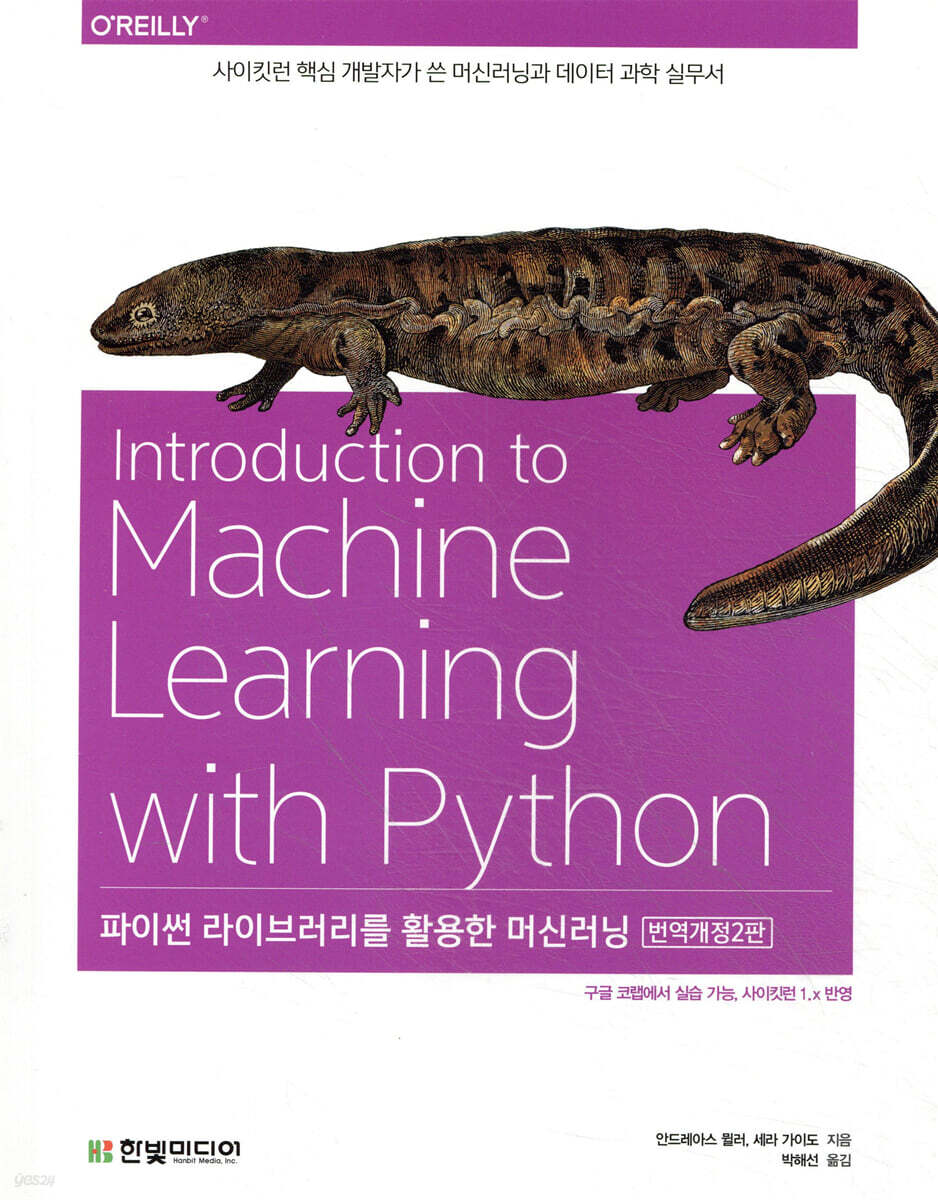
Machine learning using Python libraries
 |
Description
Book Introduction
Learn Machine Learning Theory and Implementation from a Scikit-Learn Core Developer
You don't necessarily need a degree to study machine learning and develop artificial intelligence services in the field.
This is thanks to excellent machine learning libraries like scikit-learn, which wrap complex and difficult tasks in an intuitive interface.
In this book, a core developer of scikit-learn explains every step of building practical machine learning without complex mathematics.
Even if you haven't studied calculus, linear algebra, or probability theory, you'll be able to utilize machine learning through this book.
※ This revised second edition of the translation is based on the fourth edition of the original book, which has been comprehensively updated in accordance with scikit-learn updates.
We corrected typos and printed in full color for visual convenience.
You don't necessarily need a degree to study machine learning and develop artificial intelligence services in the field.
This is thanks to excellent machine learning libraries like scikit-learn, which wrap complex and difficult tasks in an intuitive interface.
In this book, a core developer of scikit-learn explains every step of building practical machine learning without complex mathematics.
Even if you haven't studied calculus, linear algebra, or probability theory, you'll be able to utilize machine learning through this book.
※ This revised second edition of the translation is based on the fourth edition of the original book, which has been comprehensively updated in accordance with scikit-learn updates.
We corrected typos and printed in full color for visual convenience.
- You can preview some of the book's contents.
Preview
index
CHAPTER 1 Introduction
1.1 Why Machine Learning?
__1.1.1 Problems that can be solved with machine learning
__1.1.2 Understanding the Problem and Data
1.2 Why Python?
1.3 scikit-learn
__1.3.1 Installing scikit-learn
1.4 Required Libraries and Tools
__1.4.1 Jupyter Notebook
__1.4.2 NumPy
__1.4.3 SciPy
__1.4.4 matplotlib
__1.4.5 pandas
__1.4.6 mglearn
1.5 Python 2 vs.
Python 3
1.6 Software versions used in this book
1.7 First Application: Classification of Iris Varieties
__1.7.1 Loading data
__1.7.2 Performance Measurement: Training and Test Data
__1.7.3 First things first: Take a look at the data
__1.7.4 Our First Machine Learning Model: The k-Nearest Neighbor Algorithm
__1.7.5 Predicting
__1.7.6 Evaluating the Model
1.8 Summary and Summary
CHAPTER 2 Supervised Learning
2.1 Classification and Regression
2.2 Generalization, overfitting, and underfitting
__2.2.1 Relationship between model complexity and dataset size
2.3 Supervised Learning Algorithms
__2.3.1 Dataset to be used in the example
__2.3.2 k-nearest neighbors
__2.3.3 Linear Model
__2.3.4 Naive Bayes Classifier
__2.3.5 Decision Tree
__2.3.6 Ensemble of Decision Trees
__2.3.7 (Korean version appendix) Bagging, extra tree, Adaboost
__2.3.8 Kernel Support Vector Machine
__2.3.9 Neural Networks (Deep Learning)
2.4 Estimating uncertainty in classification predictions
__2.4.1 Decision function
__2.4.2 Predicted Probability
__2.4.3 Uncertainty in Multiclassification
2.5 Summary and Summary
CHAPTER 3 Unsupervised Learning and Data Preprocessing
3.1 Types of unsupervised learning
3.2 Challenges of Unsupervised Learning
3.3 Data preprocessing and scaling
__3.3.1 Various preprocessing methods
__3.3.2 Applying data transformation
__3.3.3 (Korean version appendix) QuantileTransformer and PowerTransformer
__3.3.4 Scale training and test data in the same way
__3.3.5 The Effect of Data Preprocessing in Supervised Learning
3.4 Dimensionality reduction, feature extraction, and manifold learning
__3.4.1 Principal Component Analysis (PCA)
__3.4.2 Nonnegative Matrix Factorization (NMF)
__3.4.3 Manifold Learning with t-SNE
3.5 Cluster
__3.5.1 k-means clustering
__3.5.2 Merge clusters
__3.5.3 DBSCAN
__3.5.4 Comparison and Evaluation of Clustering Algorithms
__3.5.5 Summary of Clustering Algorithms
3.6 Summary and Summary
CHAPTER 4 Data Representation and Feature Engineering
4.1 Categorical variables
__4.1.1 One-Hot Encoding (Variable)
__4.1.2 Categorical features expressed as numbers
4.2 OneHotEncoder and ColumnTransformer: Handling Categorical Variables with scikit-learn
4.3 Easily create a ColumnTransformer with make_column_transformer
4.4 Interval segmentation, discretization, and linear and tree models
4.5 Interactions and Polynomials
4.6 Univariate Nonlinear Transformation
4.7 Auto-selection of characteristics
__4.7.1 Univariate Statistics
__4.7.2 Model-Based Feature Selection
__4.7.3 Iterative feature selection
4.8 Leveraging Expert Knowledge
4.9 Summary and Summary
CHAPTER 5 MODEL EVALUATION AND PERFORMANCE IMPROVEMENT
5.1 Cross-validation
__5.1.1 Cross-validation in scikit-learn
__5.1.2 Advantages of Cross-Validation
__5.1.3 Hierarchical k-fold cross-validation and other strategies
__5.1.4 (Korean version appendix) Repeated cross-validation
5.2 Grid Search
__5.2.1 Simple Grid Search
__5.2.2 Parameter overfitting and validation set
__5.2.3 Grid search using cross-validation
5.3 Evaluation Indicators and Measurements
__5.3.1 Remember the ultimate goal
__5.3.2 Evaluation metrics for binary classification
__5.3.3 Evaluation metrics for multi-classification
__5.3.4 Regression Evaluation Indicators
__5.3.5 Using Evaluation Metrics in Model Selection
5.4 Summary and Summary
CHAPTER 6 Algorithm Chains and Pipelines
6.1 Data preprocessing and parameter selection
6.2 Building a Pipeline
6.3 Applying Pipelines to Grid Search
6.4 Pipeline Interface
__6.4.1 Creating a pipeline using make_pipleline
__6.4.2 Accessing step properties
__6.4.3 Accessing Pipeline Properties in Grid Search
6.5 Grid search for preprocessing and model parameters
6.6 Grid Search for Model Selection
__6.6.1 Avoiding Double Counting
6.7 Summary and Summary
CHAPTER 7 Handling Text Data
7.1 String Data Type
7.2 Example Application: Movie Review Sentiment Analysis
7.3 Representing text data as BOW
__7.3.1 Applying BOW to sample data
__7.3.2 BOW on movie reviews
7.4 Stop words
7.5 Rescaling data with tf-idf
7.6 Model Coefficient Investigation
7.7 BOW (n-gram) made of multiple words
7.8 Advanced Tokenization, Stemming, and Heading Extraction
__7.8.1 (Korean version appendix) Movie review analysis using KoNLPy
7.9 Topic Modeling and Document Clustering
__7.9.1 LDA
7.10 Summary and Summary
CHAPTER 8 CONCLUSION
8.1 Approaches to Machine Learning Problems
__8.1.1 Participation in decision-making
8.2 From Prototype to Product
8.3 Product System Testing
8.4 Creating Your Own Estimator
8.5 More to Learn
__8.5.1 Theory
__8.5.2 Other Machine Learning Frameworks and Packages
__8.5.3 Ranking, Recommendation Systems, and Other Algorithms
__8.5.4 Probabilistic Modeling, Inference, and Probabilistic Programming
__8.5.5 Neural Networks
__8.5.6 Scaling to large datasets
__8.5.7 Building Skills
8.6 In conclusion
1.1 Why Machine Learning?
__1.1.1 Problems that can be solved with machine learning
__1.1.2 Understanding the Problem and Data
1.2 Why Python?
1.3 scikit-learn
__1.3.1 Installing scikit-learn
1.4 Required Libraries and Tools
__1.4.1 Jupyter Notebook
__1.4.2 NumPy
__1.4.3 SciPy
__1.4.4 matplotlib
__1.4.5 pandas
__1.4.6 mglearn
1.5 Python 2 vs.
Python 3
1.6 Software versions used in this book
1.7 First Application: Classification of Iris Varieties
__1.7.1 Loading data
__1.7.2 Performance Measurement: Training and Test Data
__1.7.3 First things first: Take a look at the data
__1.7.4 Our First Machine Learning Model: The k-Nearest Neighbor Algorithm
__1.7.5 Predicting
__1.7.6 Evaluating the Model
1.8 Summary and Summary
CHAPTER 2 Supervised Learning
2.1 Classification and Regression
2.2 Generalization, overfitting, and underfitting
__2.2.1 Relationship between model complexity and dataset size
2.3 Supervised Learning Algorithms
__2.3.1 Dataset to be used in the example
__2.3.2 k-nearest neighbors
__2.3.3 Linear Model
__2.3.4 Naive Bayes Classifier
__2.3.5 Decision Tree
__2.3.6 Ensemble of Decision Trees
__2.3.7 (Korean version appendix) Bagging, extra tree, Adaboost
__2.3.8 Kernel Support Vector Machine
__2.3.9 Neural Networks (Deep Learning)
2.4 Estimating uncertainty in classification predictions
__2.4.1 Decision function
__2.4.2 Predicted Probability
__2.4.3 Uncertainty in Multiclassification
2.5 Summary and Summary
CHAPTER 3 Unsupervised Learning and Data Preprocessing
3.1 Types of unsupervised learning
3.2 Challenges of Unsupervised Learning
3.3 Data preprocessing and scaling
__3.3.1 Various preprocessing methods
__3.3.2 Applying data transformation
__3.3.3 (Korean version appendix) QuantileTransformer and PowerTransformer
__3.3.4 Scale training and test data in the same way
__3.3.5 The Effect of Data Preprocessing in Supervised Learning
3.4 Dimensionality reduction, feature extraction, and manifold learning
__3.4.1 Principal Component Analysis (PCA)
__3.4.2 Nonnegative Matrix Factorization (NMF)
__3.4.3 Manifold Learning with t-SNE
3.5 Cluster
__3.5.1 k-means clustering
__3.5.2 Merge clusters
__3.5.3 DBSCAN
__3.5.4 Comparison and Evaluation of Clustering Algorithms
__3.5.5 Summary of Clustering Algorithms
3.6 Summary and Summary
CHAPTER 4 Data Representation and Feature Engineering
4.1 Categorical variables
__4.1.1 One-Hot Encoding (Variable)
__4.1.2 Categorical features expressed as numbers
4.2 OneHotEncoder and ColumnTransformer: Handling Categorical Variables with scikit-learn
4.3 Easily create a ColumnTransformer with make_column_transformer
4.4 Interval segmentation, discretization, and linear and tree models
4.5 Interactions and Polynomials
4.6 Univariate Nonlinear Transformation
4.7 Auto-selection of characteristics
__4.7.1 Univariate Statistics
__4.7.2 Model-Based Feature Selection
__4.7.3 Iterative feature selection
4.8 Leveraging Expert Knowledge
4.9 Summary and Summary
CHAPTER 5 MODEL EVALUATION AND PERFORMANCE IMPROVEMENT
5.1 Cross-validation
__5.1.1 Cross-validation in scikit-learn
__5.1.2 Advantages of Cross-Validation
__5.1.3 Hierarchical k-fold cross-validation and other strategies
__5.1.4 (Korean version appendix) Repeated cross-validation
5.2 Grid Search
__5.2.1 Simple Grid Search
__5.2.2 Parameter overfitting and validation set
__5.2.3 Grid search using cross-validation
5.3 Evaluation Indicators and Measurements
__5.3.1 Remember the ultimate goal
__5.3.2 Evaluation metrics for binary classification
__5.3.3 Evaluation metrics for multi-classification
__5.3.4 Regression Evaluation Indicators
__5.3.5 Using Evaluation Metrics in Model Selection
5.4 Summary and Summary
CHAPTER 6 Algorithm Chains and Pipelines
6.1 Data preprocessing and parameter selection
6.2 Building a Pipeline
6.3 Applying Pipelines to Grid Search
6.4 Pipeline Interface
__6.4.1 Creating a pipeline using make_pipleline
__6.4.2 Accessing step properties
__6.4.3 Accessing Pipeline Properties in Grid Search
6.5 Grid search for preprocessing and model parameters
6.6 Grid Search for Model Selection
__6.6.1 Avoiding Double Counting
6.7 Summary and Summary
CHAPTER 7 Handling Text Data
7.1 String Data Type
7.2 Example Application: Movie Review Sentiment Analysis
7.3 Representing text data as BOW
__7.3.1 Applying BOW to sample data
__7.3.2 BOW on movie reviews
7.4 Stop words
7.5 Rescaling data with tf-idf
7.6 Model Coefficient Investigation
7.7 BOW (n-gram) made of multiple words
7.8 Advanced Tokenization, Stemming, and Heading Extraction
__7.8.1 (Korean version appendix) Movie review analysis using KoNLPy
7.9 Topic Modeling and Document Clustering
__7.9.1 LDA
7.10 Summary and Summary
CHAPTER 8 CONCLUSION
8.1 Approaches to Machine Learning Problems
__8.1.1 Participation in decision-making
8.2 From Prototype to Product
8.3 Product System Testing
8.4 Creating Your Own Estimator
8.5 More to Learn
__8.5.1 Theory
__8.5.2 Other Machine Learning Frameworks and Packages
__8.5.3 Ranking, Recommendation Systems, and Other Algorithms
__8.5.4 Probabilistic Modeling, Inference, and Probabilistic Programming
__8.5.5 Neural Networks
__8.5.6 Scaling to large datasets
__8.5.7 Building Skills
8.6 In conclusion
Detailed image

Publisher's Review
A comprehensive introduction to machine learning for machine learning practitioners seeking solutions to real-world problems.
A revised translation of the second edition, reflecting scikit-learn 1.x and available for practice on Google Colab.
This book doesn't cover how to build machine learning algorithms from scratch, but instead focuses on using the vast number of models already implemented in scikit-learn and other libraries.
This introductory book requires no prior knowledge of machine learning or artificial intelligence. It walks you through all the steps to successfully build machine learning applications, focusing on Python and scikit-learn.
The methods presented here will be helpful not only to data professionals building commercial applications, but also to researchers and scientists.
If you are familiar with Python and the NumPy and matplotlib libraries, you will understand most of this book.
★ Features of the 2nd revised translation edition
This revised translation is based on the fourth edition of the original book, and all typos discovered since the first edition have been corrected.
We've also updated the content overall to follow the scikit-learn 1.x releases.
Furthermore, we have made overall revisions to enable hands-on practice in Google Colab.
★ Main contents
● Basic concepts and applications of machine learning
● Advantages and disadvantages of widely used machine learning algorithms
● How to express data processed through machine learning
● Advanced methods for model evaluation and parameter tuning
● Pipeline for chain model and workflow encapsulation
● Technology for handling text data
Advice for improving your machine learning and data science skills
A revised translation of the second edition, reflecting scikit-learn 1.x and available for practice on Google Colab.
This book doesn't cover how to build machine learning algorithms from scratch, but instead focuses on using the vast number of models already implemented in scikit-learn and other libraries.
This introductory book requires no prior knowledge of machine learning or artificial intelligence. It walks you through all the steps to successfully build machine learning applications, focusing on Python and scikit-learn.
The methods presented here will be helpful not only to data professionals building commercial applications, but also to researchers and scientists.
If you are familiar with Python and the NumPy and matplotlib libraries, you will understand most of this book.
★ Features of the 2nd revised translation edition
This revised translation is based on the fourth edition of the original book, and all typos discovered since the first edition have been corrected.
We've also updated the content overall to follow the scikit-learn 1.x releases.
Furthermore, we have made overall revisions to enable hands-on practice in Google Colab.
★ Main contents
● Basic concepts and applications of machine learning
● Advantages and disadvantages of widely used machine learning algorithms
● How to express data processed through machine learning
● Advanced methods for model evaluation and parameter tuning
● Pipeline for chain model and workflow encapsulation
● Technology for handling text data
Advice for improving your machine learning and data science skills
GOODS SPECIFICS
- Publication date: February 25, 2022
- Page count, weight, size: 504 pages | 183*235*35mm
- ISBN13: 9791162245279
- ISBN10: 1162245271
You may also like
카테고리
korean


korean

![GQ KOREA Mark (Monthly): December [2025]](http://librairie.coreenne.fr/cdn/shop/files/8ef265dbbfbf186523ed75ba7319009d.jpg?v=1765340328&width=3840)


