

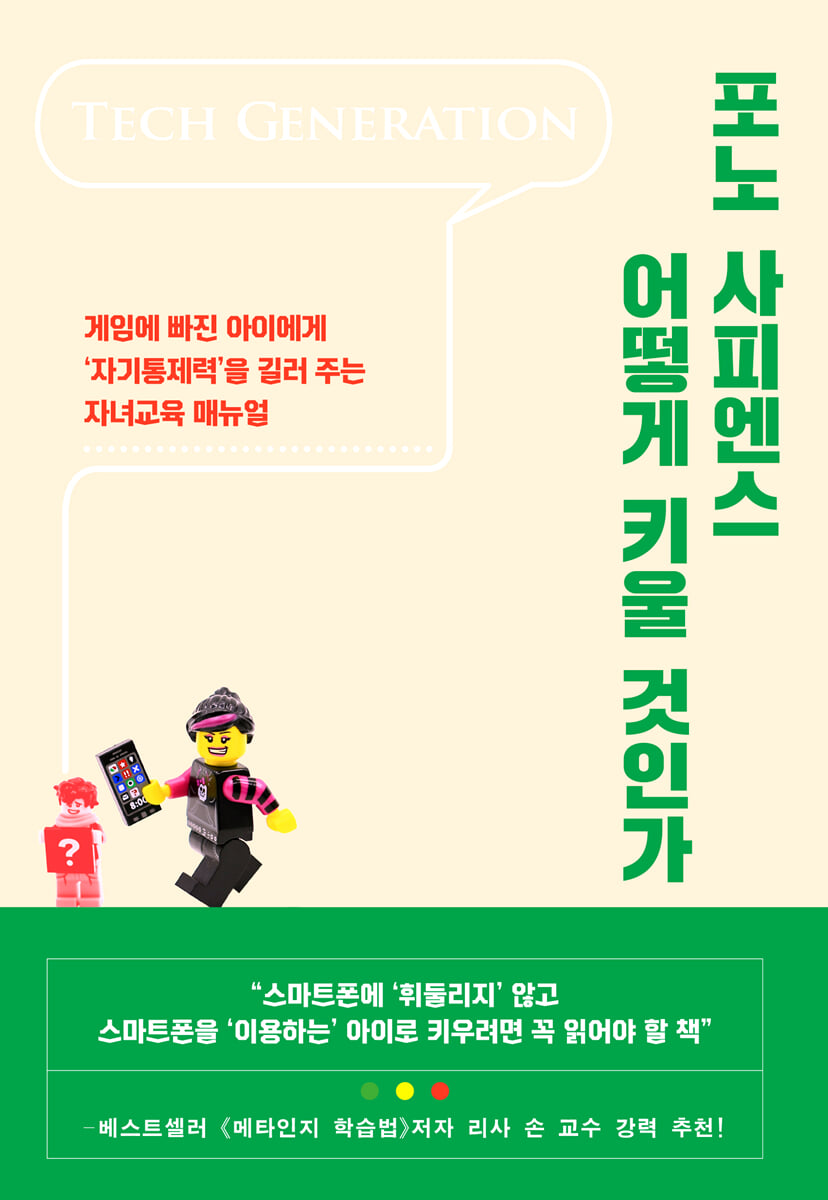
How to Raise Phono Sapiens
 |
Description
Book Introduction
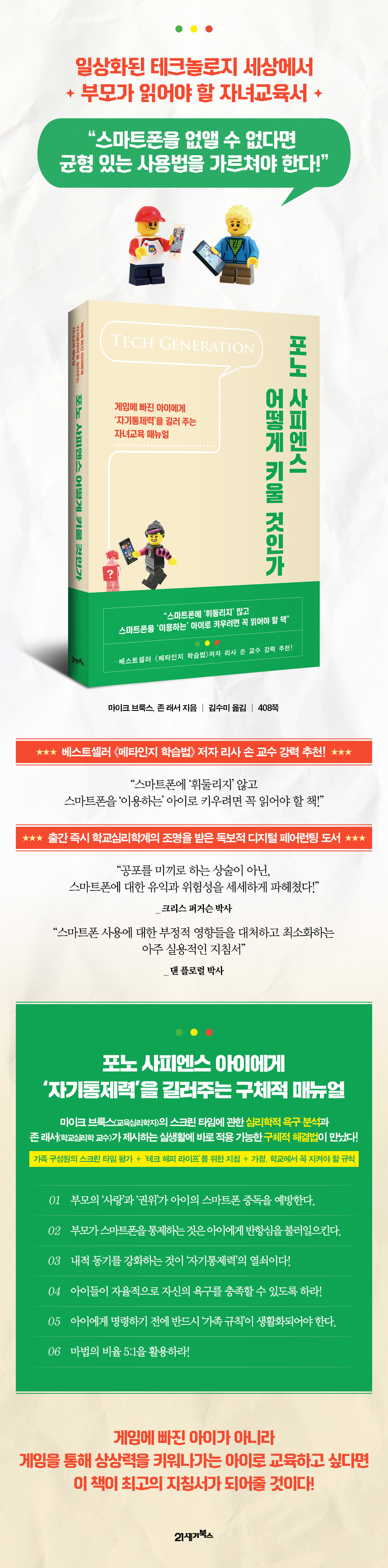
★★★Highly recommended by Professor Lisa Sohn, author of the best-selling book "Metacognitive Learning"!★★★
"A must-read if you want to raise children who 'use' their smartphones, not 'be swayed' by them!"
A must-read parenting book for parents in a world of everyday technology!
If you can't get rid of your smartphone, you need to teach your child how to use it in a balanced way.
These days, children have become 'Phono sapiens' who always hold their smartphones in their hands and use them as if they were a part of their bodies.
The term 'phono sapiens' is a portmanteau of 'smartphone' and 'Homo sapiens', and refers to a generation that grew up experiencing the use of digital devices as a part of their daily lives.
According to the British weekly magazine The Economist, 80% of people with smartphones check messages and social media on their smartphones within 15 minutes of waking up in the morning.
It is now impossible to imagine a world without smartphones.
As it has become such an essential part of our lives, its influence is absolute.
In particular, the problems caused by smartphone use by children and adolescents and the conflicts within families surrounding them have become serious social issues.
The smartphone penetration rate in Korea reached 75% at the end of 2013 after a transition period of about two years since its launch, rapidly becoming popular, and at the same time, reports of 'smartphone addiction' began to appear.
The problem is that it has been less than 10 years since smartphones began to exert a tremendous influence on our society, and parents have vague fears about their children's smartphone use, without a clear diagnosis and treatment for the various addiction symptoms and psychological phenomena that are believed to be caused by smartphones.
We haven't even been able to address basic questions like whether our children are spending too much time on their smartphones, how much time is appropriate, and what the criteria are for determining addiction.
Furthermore, there is no guidance on which concerns surrounding digital devices are valid and how to address them.
"How to Raise a Phono Sapiens" does not denounce the harmful effects of smartphones with unconfirmed logic, nor does it argue that smartphones should be unconditionally banned from children during their growing years.
Rather, we must acknowledge the unavoidable reality of using digital devices (even schools use digital devices for education), and focus on finding ways to use digital devices in a balanced manner.
The various guidelines presented by educational psychologist Mike Brooks and school psychology professor John Lasser are practical and specific implementation methods derived from consultation, analysis, and trial and error regarding various problems caused by smartphones in schools and homes.
The authors have been conducting a project for a long time, consulting on numerous cases in the field, to create a manual that can teach children 'self-control' regarding the use of digital devices.
The result of that project is this book, which has been spotlighted in the school psychology community since its publication, receiving praise as “a very practical guide to dealing with and minimizing the negative effects of smartphone use.”
Also, Professor Lisa Son, who is well-known as an expert on metacognitive learning methods through her EBS parenting lectures in Korea, strongly recommended this book as “a must-read if you want to raise a child who ‘uses’ smartphones rather than being ‘swayed’ by them!”
If you want to teach your child, a phono sapiens, how to use a smartphone in a balanced way and develop self-control over their digital device use, this book will be the best guide.
"A must-read if you want to raise children who 'use' their smartphones, not 'be swayed' by them!"
A must-read parenting book for parents in a world of everyday technology!
If you can't get rid of your smartphone, you need to teach your child how to use it in a balanced way.
These days, children have become 'Phono sapiens' who always hold their smartphones in their hands and use them as if they were a part of their bodies.
The term 'phono sapiens' is a portmanteau of 'smartphone' and 'Homo sapiens', and refers to a generation that grew up experiencing the use of digital devices as a part of their daily lives.
According to the British weekly magazine The Economist, 80% of people with smartphones check messages and social media on their smartphones within 15 minutes of waking up in the morning.
It is now impossible to imagine a world without smartphones.
As it has become such an essential part of our lives, its influence is absolute.
In particular, the problems caused by smartphone use by children and adolescents and the conflicts within families surrounding them have become serious social issues.
The smartphone penetration rate in Korea reached 75% at the end of 2013 after a transition period of about two years since its launch, rapidly becoming popular, and at the same time, reports of 'smartphone addiction' began to appear.
The problem is that it has been less than 10 years since smartphones began to exert a tremendous influence on our society, and parents have vague fears about their children's smartphone use, without a clear diagnosis and treatment for the various addiction symptoms and psychological phenomena that are believed to be caused by smartphones.
We haven't even been able to address basic questions like whether our children are spending too much time on their smartphones, how much time is appropriate, and what the criteria are for determining addiction.
Furthermore, there is no guidance on which concerns surrounding digital devices are valid and how to address them.
"How to Raise a Phono Sapiens" does not denounce the harmful effects of smartphones with unconfirmed logic, nor does it argue that smartphones should be unconditionally banned from children during their growing years.
Rather, we must acknowledge the unavoidable reality of using digital devices (even schools use digital devices for education), and focus on finding ways to use digital devices in a balanced manner.
The various guidelines presented by educational psychologist Mike Brooks and school psychology professor John Lasser are practical and specific implementation methods derived from consultation, analysis, and trial and error regarding various problems caused by smartphones in schools and homes.
The authors have been conducting a project for a long time, consulting on numerous cases in the field, to create a manual that can teach children 'self-control' regarding the use of digital devices.
The result of that project is this book, which has been spotlighted in the school psychology community since its publication, receiving praise as “a very practical guide to dealing with and minimizing the negative effects of smartphone use.”
Also, Professor Lisa Son, who is well-known as an expert on metacognitive learning methods through her EBS parenting lectures in Korea, strongly recommended this book as “a must-read if you want to raise a child who ‘uses’ smartphones rather than being ‘swayed’ by them!”
If you want to teach your child, a phono sapiens, how to use a smartphone in a balanced way and develop self-control over their digital device use, this book will be the best guide.
- You can preview some of the book's contents.
Preview
index
Chapter 1: How Does My Child Use Technology?
Technology Use: Excessive or Appropriate? / Technology, a Double-Edged Sword / Being Trapped by Technology / What if It Interferes with Happiness? / How to Approach Balance / Starting with a Family Discussion / The Tech Happy Life Model
Chapter 2: Screen Time Has Already Become a Part of Our Daily Life
How did we play in the old days? / Beware of techno-criticism / Digital immigrants vs. digital natives / The pros and cons of technology
Chapter 3: Will my child be happy on the screen?
Why Happiness Can't Be Guaranteed / We Need to Consider Return on Investment / What is Opportunity Cost? / The Battle Over the Pros and Cons of the Screen / Deviating from the Legacy of Evolution / Key Points
Chapter 4: Why Are We So Drawn to the Screen?
Psychological Needs / Lured Away from People by Screens / Why We're So Drawn to Screens / Superstimulation Is the Culprit / Variable Reinforcement Schedules and the 'Vegas Effect' / Classical Conditioning / Too Much of a Good Thing Can Be Bad / Bottom Line
Chapter 5: Screens Hinder Family Communication
Lessons from Baby Einstein / Things to think about regarding the impact of technology / Healthy relationships come first / Examining your mood / Is it good to multitask well? / Not knowing the influence of screens / Bottom line
Chapter 6: Parental Love and Authority Are the Starting Point of Child Education
Where to Start / Influence Through Relationships / Relationships Prevent Screen Problems / Bottom Line
Chapter 7: How to Build a Good Relationship with Your Child
Creating Quality Time Together / Using the "Magic 5:1 Ratio" / Why Strengthening Intrinsic Motivation Matters / Parents Should Be Role Models / Key Points
Chapter 8: Tech Happy Life Green Light Stage - Prevention is the Best Medicine
Connecting Children to Life / How to Prevent It / Building a United Front Instead of Dividing / With Greater Power Comes Greater Responsibility / The Problem of Setting Time Limits / Contracts Regarding Screen Use / Are 'Parental Controls' for Devices Necessary? / When Parents Should Supervise / Mindfulness as an Antidote to Digital Addiction / Stop Problems Before They Happen
Chapter 9: Tech Happy Life: Yellow Light Stage - Recognize the Problem
When the negative aspects of technology outweigh the positive ones / Use authoritative parenting and relationships.
Chapter 10: Tech Happy Life Red Light Stage - Intervene Strongly
How to Approach Serious Problems / Intervention at the Red Light Stage / From Intervention to Control and Beyond
Chapter 11: A World Where School Homework is Done on Digital Devices
Technology at School and Home / Does Technology Facilitate Learning? / Home-School Partnerships / How to Manage School Technology at Home / Facing Cyberbullying / Key Points
Chapter 12: Hyperconnected Society: How to Develop Balance in Children
How to avoid shipwreck / We are not fish out of water / Look inside yourself for answers / The battle for attention / The Tech Happy Life Model / Thinking about technology / A Tech Happy Life
Appendix: How to Develop Self-Control in Your Child
Appendix 1: Family Screen Time Assessment / Appendix 2: Guidelines for Tech Happy Life Strategies / Appendix 3: Tech Happy Life FAQs / Appendix 4: Tech Happy Life Resources
Technology Use: Excessive or Appropriate? / Technology, a Double-Edged Sword / Being Trapped by Technology / What if It Interferes with Happiness? / How to Approach Balance / Starting with a Family Discussion / The Tech Happy Life Model
Chapter 2: Screen Time Has Already Become a Part of Our Daily Life
How did we play in the old days? / Beware of techno-criticism / Digital immigrants vs. digital natives / The pros and cons of technology
Chapter 3: Will my child be happy on the screen?
Why Happiness Can't Be Guaranteed / We Need to Consider Return on Investment / What is Opportunity Cost? / The Battle Over the Pros and Cons of the Screen / Deviating from the Legacy of Evolution / Key Points
Chapter 4: Why Are We So Drawn to the Screen?
Psychological Needs / Lured Away from People by Screens / Why We're So Drawn to Screens / Superstimulation Is the Culprit / Variable Reinforcement Schedules and the 'Vegas Effect' / Classical Conditioning / Too Much of a Good Thing Can Be Bad / Bottom Line
Chapter 5: Screens Hinder Family Communication
Lessons from Baby Einstein / Things to think about regarding the impact of technology / Healthy relationships come first / Examining your mood / Is it good to multitask well? / Not knowing the influence of screens / Bottom line
Chapter 6: Parental Love and Authority Are the Starting Point of Child Education
Where to Start / Influence Through Relationships / Relationships Prevent Screen Problems / Bottom Line
Chapter 7: How to Build a Good Relationship with Your Child
Creating Quality Time Together / Using the "Magic 5:1 Ratio" / Why Strengthening Intrinsic Motivation Matters / Parents Should Be Role Models / Key Points
Chapter 8: Tech Happy Life Green Light Stage - Prevention is the Best Medicine
Connecting Children to Life / How to Prevent It / Building a United Front Instead of Dividing / With Greater Power Comes Greater Responsibility / The Problem of Setting Time Limits / Contracts Regarding Screen Use / Are 'Parental Controls' for Devices Necessary? / When Parents Should Supervise / Mindfulness as an Antidote to Digital Addiction / Stop Problems Before They Happen
Chapter 9: Tech Happy Life: Yellow Light Stage - Recognize the Problem
When the negative aspects of technology outweigh the positive ones / Use authoritative parenting and relationships.
Chapter 10: Tech Happy Life Red Light Stage - Intervene Strongly
How to Approach Serious Problems / Intervention at the Red Light Stage / From Intervention to Control and Beyond
Chapter 11: A World Where School Homework is Done on Digital Devices
Technology at School and Home / Does Technology Facilitate Learning? / Home-School Partnerships / How to Manage School Technology at Home / Facing Cyberbullying / Key Points
Chapter 12: Hyperconnected Society: How to Develop Balance in Children
How to avoid shipwreck / We are not fish out of water / Look inside yourself for answers / The battle for attention / The Tech Happy Life Model / Thinking about technology / A Tech Happy Life
Appendix: How to Develop Self-Control in Your Child
Appendix 1: Family Screen Time Assessment / Appendix 2: Guidelines for Tech Happy Life Strategies / Appendix 3: Tech Happy Life FAQs / Appendix 4: Tech Happy Life Resources
Detailed image
Into the book
One of the most important aspects of parenting is helping our children become self-regulated, and that includes technology.
While it is important for parents to guide, manage, and control their children's lives, it is also essential that children learn to make sound decisions on their own.
---p.29
Everyone talks about "technological progress," but what exactly does that mean? Does it simply mean that technology has become faster and more sophisticated, or that it has improved our lives and work productivity? If texting or social media increase communication, why is that a good thing? If technology use reduces sleep, why is that a bad thing? If parents have a family rule banning digital devices from the dinner table, why is that a bad thing?
---p.57
I assume it's not unhealthy because kids use screens to play games, check social media, and stream content, and most kids do that.
But given the amount of time we and our children spend on screens and the frequency with which we check them, we must be careful not to confuse the words "average" or "typical" with "healthy."
---p.120
If screen time takes too much time away from other important activities (such as outdoor play, family time, or educational activities), parents may be forced to confiscate the devices.
If you suddenly block the game system, there will be conflict.
If parents carefully control their children in the context of a warm and loving relationship, they are more likely to achieve the desired results while minimizing conflict.
---p.159
Our children's use of technology presents one of our greatest challenges.
But as parents, setting an example for screen time balance—supporting these family rules and values and following them ourselves—is an effective way to reduce our children's screen time.
---p.179
Talk to your child's teacher(s) about technology at home and school.
Are students allowed to bring their smartphones to school? If so, to what extent is their use permitted? What about other devices? Parents should be fully aware of the school's rules and expectations.
But remember that communication must be two-way, so be sure to talk to your child's teacher(s) about technology use at home and your own values and expectations.
---p.289
The way we raise our children affects them in many ways.
We all strive to have a positive impact on our children by raising them to be happy, successful, and emotionally stable adults.
There is no such thing as a single 'secret' to effective parenting.
However, it turns out that authoritarian parenting, characterized by warmth, participation, and limit setting, produces such desirable outcomes.
This effective parenting framework includes developmental considerations for children's intrinsic needs for relatedness, competence, and autonomy.
The Tech Happy Life Model utilizes an authoritative parenting style and presents a framework for addressing the challenges of screen time based on severity.
---p.318
It is essential to remember that in the process of achieving a balance between life and technology, we do not experience deprivation.
If we learn to strike a healthy balance, we can reap the benefits screens offer while minimizing the downsides.
There is no need to make a choice between the two.
If you approach it carefully, you can have both.
The essential and inescapable truth we must bear in mind is that our happiness ultimately lies in our deep and meaningful direct relationships with one another.
While it is important for parents to guide, manage, and control their children's lives, it is also essential that children learn to make sound decisions on their own.
---p.29
Everyone talks about "technological progress," but what exactly does that mean? Does it simply mean that technology has become faster and more sophisticated, or that it has improved our lives and work productivity? If texting or social media increase communication, why is that a good thing? If technology use reduces sleep, why is that a bad thing? If parents have a family rule banning digital devices from the dinner table, why is that a bad thing?
---p.57
I assume it's not unhealthy because kids use screens to play games, check social media, and stream content, and most kids do that.
But given the amount of time we and our children spend on screens and the frequency with which we check them, we must be careful not to confuse the words "average" or "typical" with "healthy."
---p.120
If screen time takes too much time away from other important activities (such as outdoor play, family time, or educational activities), parents may be forced to confiscate the devices.
If you suddenly block the game system, there will be conflict.
If parents carefully control their children in the context of a warm and loving relationship, they are more likely to achieve the desired results while minimizing conflict.
---p.159
Our children's use of technology presents one of our greatest challenges.
But as parents, setting an example for screen time balance—supporting these family rules and values and following them ourselves—is an effective way to reduce our children's screen time.
---p.179
Talk to your child's teacher(s) about technology at home and school.
Are students allowed to bring their smartphones to school? If so, to what extent is their use permitted? What about other devices? Parents should be fully aware of the school's rules and expectations.
But remember that communication must be two-way, so be sure to talk to your child's teacher(s) about technology use at home and your own values and expectations.
---p.289
The way we raise our children affects them in many ways.
We all strive to have a positive impact on our children by raising them to be happy, successful, and emotionally stable adults.
There is no such thing as a single 'secret' to effective parenting.
However, it turns out that authoritarian parenting, characterized by warmth, participation, and limit setting, produces such desirable outcomes.
This effective parenting framework includes developmental considerations for children's intrinsic needs for relatedness, competence, and autonomy.
The Tech Happy Life Model utilizes an authoritative parenting style and presents a framework for addressing the challenges of screen time based on severity.
---p.318
It is essential to remember that in the process of achieving a balance between life and technology, we do not experience deprivation.
If we learn to strike a healthy balance, we can reap the benefits screens offer while minimizing the downsides.
There is no need to make a choice between the two.
If you approach it carefully, you can have both.
The essential and inescapable truth we must bear in mind is that our happiness ultimately lies in our deep and meaningful direct relationships with one another.
---p.327
Publisher's Review
A Concrete Manual for Rebuilding Your Relationship with Your Phono Sapiens Child
Parents' love and authority prevent their children from becoming addicted to smartphones!
"How to Raise a Phono Sapiens" assumes that the most fundamental thing for children to use smartphones in a balanced way is to restore the relationship between parents and children.
The book divides the severity of the problem into three levels (green, yellow, and red) based on the amount of time spent on digital devices, and emphasizes that regardless of the severity, the solution to preventing a child's smartphone addiction lies in a trust-based relationship with your child.
As parents, our goal is to help our children grow up to be healthy individuals who experience happiness often.
The happiness we are talking about here is not a pleasure that stimulates the peripheral nerves, but a deep-rooted satisfaction with life.
Digital devices were originally used to increase happiness and enhance productivity (interconnectivity, work efficiency, collaboration, and creativity), but when used excessively for pleasure (entertainment), they actually become a hindrance to happiness.
This manifests as sleep disruption, decreased concentration, decreased in-person relationships due to social media use, and limited physical activity, meaning that the basic needs needed to feel happy are blocked.
The problem is that satisfying physical needs through movement and satisfying psychological needs through direct interaction with others are blocked by digital devices.
In particular, human relationships are directly linked to happiness.
When we have meaningful, positive, and reciprocal relationships that meet our needs, we feel happy, whereas when we feel alienated, isolated, and conflicted, we feel profoundly unhappy.
The author argues that it is the parents' 'love' and 'authority' that determines participation in human relationships.
Spending quality time with your children, whether it's cooking, taking walks, exercising, or reading, is essential for building relationships, and these activities with your children can help them say, "I love you."
I want to spend time with you.
He mentions that sending a message that says, “You are precious to me” is a sure proof.
John Gottman has spent decades studying romantic relationships, and his formula, called the "magic ratio," provides a valuable reference point when communicating with Phono Sapiens children.
A relationship is considered successful when the ratio of positive to negative interactions is 5:1.
With five strokes of love and one stroke of authority, the direction of the interaction is to focus on 'catching' and 'praising' children when they exhibit desirable behavior.
For example, even if you argue with your child about the amount of time they spend on their smartphone and get hurt, you still praise them when they behave.
“You’re amazing for quitting the game right on time!” This is an effective and positive strategy for increasing desired behavior and building trust in your relationship.
The authors call this strategy "catching kids when they're doing well."
This book presents in detail several effective strategies based on parental love and authority to manage children's screen time.
Parents controlling their children's smartphones can lead to rebellion.
Strengthening intrinsic motivation is the key to 'self-control'!
Psychologists Dr. Richard Ryan and Dr. Deci developed 'Self-Determination Theory' to explain the motivations behind human behavior.
According to this theory, creating experiences of autonomy fosters greater motivation, creativity, and perseverance.
The book, based on the theory of self-determination, emphasizes that the best way to raise Phono Sapiens children is to allow them to autonomously satisfy their own needs (the desire to obtain pleasure through games and social media).
We sometimes comfort our children, but sometimes we also command them.
There is a strong temptation to force children to do only what they are told to do.
Commanding children is a much quicker way to get them to act than coaxing or persuading them.
However, the author cautions against resorting to coercive means when managing a child's behavior.
Because control often backfires, contrary to its intention.
Psychologists have pointed out that parental control can be perceived as interference by adolescents, and even rules that would be beneficial to obey can be rejected outright.
Parents exert more control over their children to ensure they behave properly, but if they are unable to exercise control, the children become even more obsessed with their smartphones, as they do not know how to handle their freedom responsibly.
"Raising Homo Sapiens" emphasizes that parents should not make too many decisions for their children, thereby blocking the children's opportunity to learn how to develop autonomy on their own, and provides more specific suggestions in the appendix on "how to foster self-control in children."
Each family member evaluates their screen time, and the author develops guidelines for a "Tech Happy Life" (a happy life through balanced use of digital devices), breaking them down into rules to follow at home, at school, when traveling, and when playing games.
The section titled "General Strategies" sets out the essential principles that children and parents must adhere to, providing practical assistance in developing a child-rearing policy based on love and authority.
How to Teach Your Child to Balance Smartphone Use
Not a child addicted to games, but a child who develops his imagination through games!
Each stage mentioned in the 'Tech Happy Life Model' is divided into the green light stage (prevention), yellow light stage (problem recognition), and red light stage (active intervention).
In the green light stage, before problems arise, the goal is to prevent 'bad habits' related to screen use by empathizing with children's needs and maintaining strict controls.
Make it a habit to establish family rules, such as only allowing one screen at a time or banning screens during meal times.
However, if your children demand more screen time or have developed a habit of checking their devices, you are in the yellow light stage, which is also the stage where the parent-child relationship becomes more important because rules and limits need to be strengthened.
Strengthened controls are needed, such as designating areas in the home where device use is completely prohibited or completely separating devices for learning and entertainment, but children's consent and cooperative attitude are crucial for such controls.
If the screen's strong suction power has reached a point where it can be considered 'addictive', then this is a red light level.
Although professional help and strong intervention are necessary at this stage, the parent-child relationship is still crucial in implementing problem-solving strategies.
Today's children are raised and educated in a hyper-connected society created by digital devices from the moment they are born.
This book provides practical, real-life solutions based on a psychological need analysis of screen time, so that children can enjoy only the benefits of smartphones and avoid the negative effects.
If you want to raise your child to be someone who uses games to develop imagination and creativity, rather than someone who is addicted to games, this book will be the best guide.
21st Century Books Subscription Channel
* Facebook facebook.com/jiinpill21
* Post post.naver.com/21c_editors
* Instagram instagram.com/jiinpill21
* Homepage www.book21.com
* YouTube youtube.com/book21pub
Parents' love and authority prevent their children from becoming addicted to smartphones!
"How to Raise a Phono Sapiens" assumes that the most fundamental thing for children to use smartphones in a balanced way is to restore the relationship between parents and children.
The book divides the severity of the problem into three levels (green, yellow, and red) based on the amount of time spent on digital devices, and emphasizes that regardless of the severity, the solution to preventing a child's smartphone addiction lies in a trust-based relationship with your child.
As parents, our goal is to help our children grow up to be healthy individuals who experience happiness often.
The happiness we are talking about here is not a pleasure that stimulates the peripheral nerves, but a deep-rooted satisfaction with life.
Digital devices were originally used to increase happiness and enhance productivity (interconnectivity, work efficiency, collaboration, and creativity), but when used excessively for pleasure (entertainment), they actually become a hindrance to happiness.
This manifests as sleep disruption, decreased concentration, decreased in-person relationships due to social media use, and limited physical activity, meaning that the basic needs needed to feel happy are blocked.
The problem is that satisfying physical needs through movement and satisfying psychological needs through direct interaction with others are blocked by digital devices.
In particular, human relationships are directly linked to happiness.
When we have meaningful, positive, and reciprocal relationships that meet our needs, we feel happy, whereas when we feel alienated, isolated, and conflicted, we feel profoundly unhappy.
The author argues that it is the parents' 'love' and 'authority' that determines participation in human relationships.
Spending quality time with your children, whether it's cooking, taking walks, exercising, or reading, is essential for building relationships, and these activities with your children can help them say, "I love you."
I want to spend time with you.
He mentions that sending a message that says, “You are precious to me” is a sure proof.
John Gottman has spent decades studying romantic relationships, and his formula, called the "magic ratio," provides a valuable reference point when communicating with Phono Sapiens children.
A relationship is considered successful when the ratio of positive to negative interactions is 5:1.
With five strokes of love and one stroke of authority, the direction of the interaction is to focus on 'catching' and 'praising' children when they exhibit desirable behavior.
For example, even if you argue with your child about the amount of time they spend on their smartphone and get hurt, you still praise them when they behave.
“You’re amazing for quitting the game right on time!” This is an effective and positive strategy for increasing desired behavior and building trust in your relationship.
The authors call this strategy "catching kids when they're doing well."
This book presents in detail several effective strategies based on parental love and authority to manage children's screen time.
Parents controlling their children's smartphones can lead to rebellion.
Strengthening intrinsic motivation is the key to 'self-control'!
Psychologists Dr. Richard Ryan and Dr. Deci developed 'Self-Determination Theory' to explain the motivations behind human behavior.
According to this theory, creating experiences of autonomy fosters greater motivation, creativity, and perseverance.
The book, based on the theory of self-determination, emphasizes that the best way to raise Phono Sapiens children is to allow them to autonomously satisfy their own needs (the desire to obtain pleasure through games and social media).
We sometimes comfort our children, but sometimes we also command them.
There is a strong temptation to force children to do only what they are told to do.
Commanding children is a much quicker way to get them to act than coaxing or persuading them.
However, the author cautions against resorting to coercive means when managing a child's behavior.
Because control often backfires, contrary to its intention.
Psychologists have pointed out that parental control can be perceived as interference by adolescents, and even rules that would be beneficial to obey can be rejected outright.
Parents exert more control over their children to ensure they behave properly, but if they are unable to exercise control, the children become even more obsessed with their smartphones, as they do not know how to handle their freedom responsibly.
"Raising Homo Sapiens" emphasizes that parents should not make too many decisions for their children, thereby blocking the children's opportunity to learn how to develop autonomy on their own, and provides more specific suggestions in the appendix on "how to foster self-control in children."
Each family member evaluates their screen time, and the author develops guidelines for a "Tech Happy Life" (a happy life through balanced use of digital devices), breaking them down into rules to follow at home, at school, when traveling, and when playing games.
The section titled "General Strategies" sets out the essential principles that children and parents must adhere to, providing practical assistance in developing a child-rearing policy based on love and authority.
How to Teach Your Child to Balance Smartphone Use
Not a child addicted to games, but a child who develops his imagination through games!
Each stage mentioned in the 'Tech Happy Life Model' is divided into the green light stage (prevention), yellow light stage (problem recognition), and red light stage (active intervention).
In the green light stage, before problems arise, the goal is to prevent 'bad habits' related to screen use by empathizing with children's needs and maintaining strict controls.
Make it a habit to establish family rules, such as only allowing one screen at a time or banning screens during meal times.
However, if your children demand more screen time or have developed a habit of checking their devices, you are in the yellow light stage, which is also the stage where the parent-child relationship becomes more important because rules and limits need to be strengthened.
Strengthened controls are needed, such as designating areas in the home where device use is completely prohibited or completely separating devices for learning and entertainment, but children's consent and cooperative attitude are crucial for such controls.
If the screen's strong suction power has reached a point where it can be considered 'addictive', then this is a red light level.
Although professional help and strong intervention are necessary at this stage, the parent-child relationship is still crucial in implementing problem-solving strategies.
Today's children are raised and educated in a hyper-connected society created by digital devices from the moment they are born.
This book provides practical, real-life solutions based on a psychological need analysis of screen time, so that children can enjoy only the benefits of smartphones and avoid the negative effects.
If you want to raise your child to be someone who uses games to develop imagination and creativity, rather than someone who is addicted to games, this book will be the best guide.
21st Century Books Subscription Channel
* Facebook facebook.com/jiinpill21
* Post post.naver.com/21c_editors
* Instagram instagram.com/jiinpill21
* Homepage www.book21.com
* YouTube youtube.com/book21pub
GOODS SPECIFICS
- Date of issue: August 31, 2021
- Page count, weight, size: 408 pages | 564g | 148*210*26mm
- ISBN13: 9788950997069
- ISBN10: 8950997061
You may also like
카테고리
korean


korean

![GQ KOREA Mark (Monthly): December [2025]](http://librairie.coreenne.fr/cdn/shop/files/8ef265dbbfbf186523ed75ba7319009d.jpg?v=1765340328&width=3840)


