

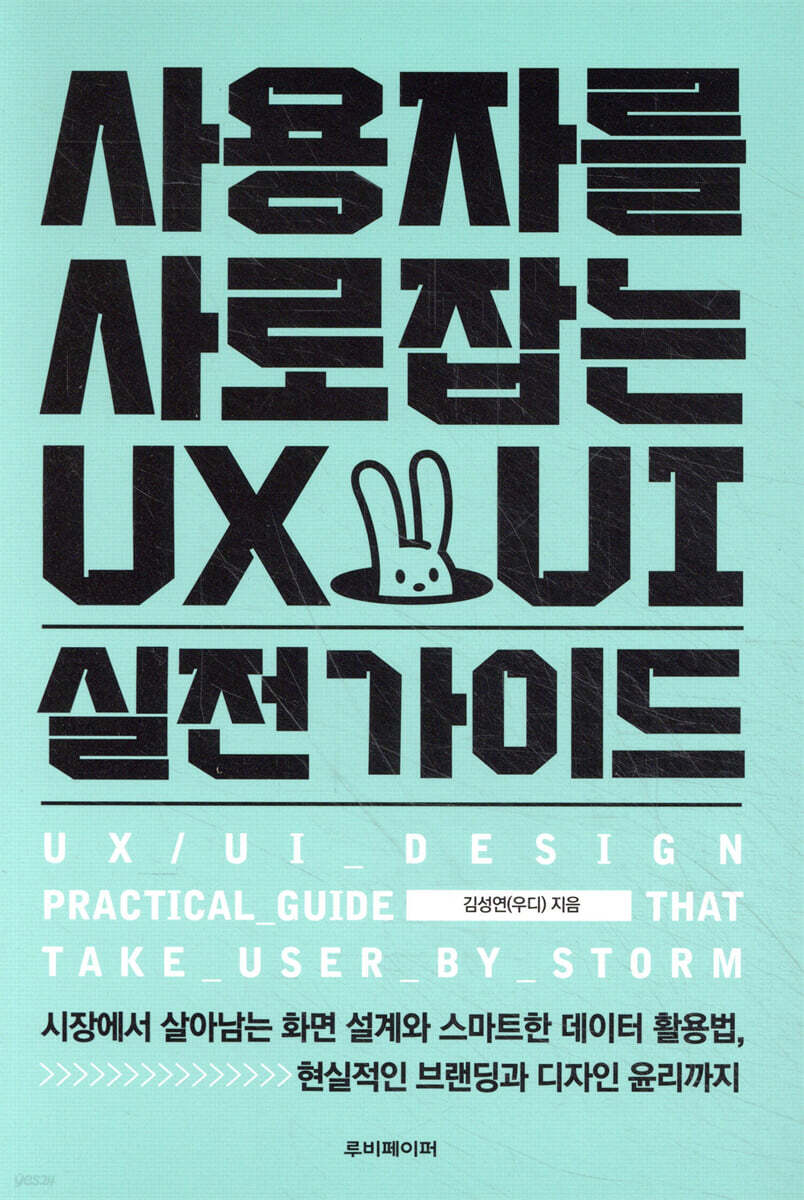
A Practical Guide to Captivating UX/UI Users
 |
Description
Book Introduction
It's not 'design' that captivates users, it's 'designers'!
If you dream of an attractive design, open this book
This book is for everyone who dreams of designs that captivate users, from juniors who are just beginning to think beyond design to seniors who are actively working as PMs.
Juniors will learn how to see the forest for the trees and gain basic knowledge of UX/UI, while seniors will gain insights gleaned from the whirlwind of rapidly changing trends.
If you dream of an attractive design, open this book
This book is for everyone who dreams of designs that captivate users, from juniors who are just beginning to think beyond design to seniors who are actively working as PMs.
Juniors will learn how to see the forest for the trees and gain basic knowledge of UX/UI, while seniors will gain insights gleaned from the whirlwind of rapidly changing trends.
- You can preview some of the book's contents.
Preview
index
Chapter 1: Understanding UX/UI
1.1 UX Design? UI Design?
__1.1.1 UI - User Interface
__1.1.2 UX - User Experience
__1.1.3 Product Designer - Designer in a product-centric organization
__1.1.4 UX/UI design process
__1.1.5 Designer's Note: Useful UX Terms to Know
1.2 UI Structure and Elements
__1.2.1 UI Structure
__1.2.2 UI elements
1.3 Changes in Mobile Design Trends
__1.3.1 Microsoft's Metro Design
__1.3.2 The Evolution of Apple Design
__1.3.3 An Apple designer and inertial scrolling
__1.3.4 Could Neumorphism Become a New UI Trend?
Chapter 2: Things You Must Know When Designing Web/Apps
2.1 Understanding Resolution
__2.1.1 Setting the resolution appropriate for the purpose
2.2 Correlation between pixel density and sharpness
__2.2.1 Pixel density differences according to screen size
__2.2.2 Various ways to express pixels
__2.2.3 Step 1.
Logical resolution
__2.2.4 Step 2.
Physical resolution
__2.2.5 Step 3.
downsampling
__2.2.6 Step 4.
Device expression
__2.2.7 PT on iOS and DP/SP on Android
2.3 Understanding the App Development Process for Mobile Services
__2.3.1 Native App
__2.3.2 Mobile Web App
__2.3.3 Hybrid App
2.4 Understanding Wireframes and Prototypes
__2.4.1 Wireframe
__2.4.2 Prototype
__2.4.3 Prototyping tool
__2.4.4 Designer's Note: How to Write Effective User Stories
Chapter 3 Survival is Well Designed
3.1 Strategies for Survival, MVP
__3.1.1 Minimum Viable Product and MVP Feedback Loop
__3.1.2 Dropbox and Airbnb Successfully Validated the Market with MVPs
3.2 Who are our real competitors?
__3.2.1 Why Conduct Competitor Analysis?
__3.2.2 Creating a Competitor List Table
__3.2.3 Creating a feature comparison table
3.3 What Designers See When They Are Interested in Data
__3.3.1 Data, a solid foundation for designers
__3.3.2 A/B testing to understand user preferences
__3.3.3 The process of tracking the user's path, funnel
__3.3.4 Key Indicator for Business Growth, AARRR
__3.3.5 Designer's Note: A Difference in Results: A UI Comparison of the Thickness of Hexagonal Meat
3.4 Finding the Real Problem, In-Depth Interviews and Affinity Diagrams
__3.4.1 In-depth Interview
__3.4.2 Affinity Diagram
__3.4.3 Designer's Note: Useful questioning method for brainstorming, HMW
3.5 UX Persona, a virtual character representing a user type
3.6 Finding the root cause of the problem, 5 Whys and the Golden Circle
__3.6.1 5 Whys in Case Studies
__3.6.2 Golden Circle Paired with 5 Whys
3.7 Some Tips for Better UX Writing
__3.7.1 UX Writing vs. Copywriting
__3.7.2 Four Rules for Creating Good UX Writing
__3.7.3 Applying UX Writing in Practice
Chapter 4 For Better Visual Design
4.1 Typography Basics, Web Fonts
__4.1.1 Understanding Web Fonts
__4.1.2 The process of calling web fonts
4.2 Seven Formulas for Good Digital Typography
__4.2.1 Formula 1.
Minimum font types
__4.2.2 Formula 2.
Line spacing to improve readability
__4.2.3 Formula 3.
Kerning according to font size
__4.2.4 Formula 4.
Appropriate number of characters per line
__4.2.5 Formula 5.
Text color sufficiently distinct from the background color
__4.2.6 Formula 6.
Typography using hierarchical structure
__4.2.7 Formula 7.
Choose a font that suits your personality
__4.2.8 Designer's Note: Building Brand Tone with Fonts & Images
4.3 Five Emphasis Methods for Creating Visual Hierarchy
__4.3.1 1.
Emphasis using size
__4.3.2 2.
Emphasis using color
__4.3.3 3.
Emphasis using texture
__4.3.4 4.
Emphasis using spatial sense
__4.3.5 5.
Emphasis using shape
__4.3.6 Button design using visual hierarchy
4.4 Color and UI Design
__4.4.1 Brand Color and Emotion
__4.4.2 'Color Image Space' that derives colors by keywording images
__4.4.3 Color matching using tone-on-tone
__4.4.4 Color Emphasis and Affordance
__4.4.5 System Color
4.5 Understanding Digital Grid Systems
__4.5.1 Understanding the Grid System
__4.5.2 Responsive Design and Breakpoints
4.6 Fibonacci Sequence and Visual Order
__4.6.1 Applying Fibonacci to Typography
__4.6.2 Creating an interval criterion using Fibonacci
4.7 Various icons in the interface
__4.7.1 App icons and system icons
__4.7.2 Icons and Visual Correction
__4.7.3 Designer's Note System icons for use according to purpose
Chapter 5: The Psychology of Goal Achievement
5.1 Persuading the Reptiles
__5.1.1 Automatic vs. Deliberative Systems
__5.1.2 Cognitive miser
__5.1.3 Designer's Note Design that leads to an automatic system
5.2 Web/App Evaluation Using Heuristics
__5.2.1 Representativeness Heuristic
__5.2.2 Availability Heuristic
__5.2.3 Jacob Nielsen's 10 Heuristic Evaluations
5.3 The brain loves the unpredictable
__5.3.1 Dopamine and Motivation
__5.3.2 Tinder Swipe
5.4 Psychology for Purchase Induction
__5.4.1 The Effect of Positive Messages - Loss Aversion Bias
__5.4.2 Comparative psychology in pursuit of gain - the anchoring effect
__5.4.3 A Foregone Conclusion - The Bait Effect
__5.4.4 The Power to Lead to the End - Granted Progress Effect
__5.4.5 Designer's Note Payment system tailored to the characteristics of target users
__5.4.6 Eight Psychological Laws Designers Should Know
5.5 Forming User Habits with the Hook Model
__5.5.1 Hook Model for Creating Habits
__5.5.2 Hook Model and Designer Ethics
__5.5.3 Designer's Note: Apps that lead life in a slightly better direction.
Chapter 6: The Most Realistic Branding
6.1 Finding Brand Identity: Core Values
__6.1.1 What you can strive for every day, core values
__6.1.2 Core Values of 'Wabi Parker'
6.2 Brand Dreams: Vision and Mission
__6.2.1 Dreams and visions that will not come true
__6.2.2 A mission to realize a dream that will never come true
__6.2.3 Airbnb's Vision and Mission
6.3 Eye Contact: Setting Specific Targets and Brand Personification
__6.3.1 Target and Lifestyle
__6.3.2 Designer's Note: On Good Branding
6.4 Creating the Surface: Brand Identity
__6.4.1 The face of the brand, the logo
__6.4.2 Brand sentiment and color
__6.4.3 Brand Identity, Photography
__6.4.4 Message texture, font
__6.4.5 Tools for Conveying Values: Taglines and Slogans
__6.4.6 Other visual elements
6.5 Branding: Triple Media Strategy and Channel Mix
__6.5.1 Designer's Note 'Wall' as a 'passageway' to meet customers
6.6 The Reality of Branding: A Look at the Hexagon
__6.6.1 Finding Brand Value
__6.6.2 The beginning of rebranding, removing the meat from the logo
__6.6.3 Brand Mission and Design Language
__6.6.4 Logo design that reflects core values and mission
Branding process after __6.6.5
__6.6.6 Designer's Note Useful Marketing Terms to Know
Chapter 7 Design and Ethics
7.1 Why Ethics Matter in Design Now
__7.1.1 A Brief History of Design Ethics
__7.1.2 Instagram's Illusory Metrics
__7.1.3 The illusion that interfaces are neutral
__7.1.4 How to escape the 'echo chamber' of social media
7.2 Dark Nudge and UX Patterns
__7.2.1 First, nudge
__7.2.2 What is a dark nudge?
__7.2.3 Designer's Note Can we set new goals for design?
7.3 Addictive interface
__7.3.1 Intermittent Compensation Psychology
__7.3.2 Absence of a stop signal
__7.3.3 FOMO
__7.3.4 Social Approval
__7.3.5 Designer's Note: Team activities considering design ethics, Judgment Call
Chapter 8 Appendix
8.1 Designer's Word Bowl
1.1 UX Design? UI Design?
__1.1.1 UI - User Interface
__1.1.2 UX - User Experience
__1.1.3 Product Designer - Designer in a product-centric organization
__1.1.4 UX/UI design process
__1.1.5 Designer's Note: Useful UX Terms to Know
1.2 UI Structure and Elements
__1.2.1 UI Structure
__1.2.2 UI elements
1.3 Changes in Mobile Design Trends
__1.3.1 Microsoft's Metro Design
__1.3.2 The Evolution of Apple Design
__1.3.3 An Apple designer and inertial scrolling
__1.3.4 Could Neumorphism Become a New UI Trend?
Chapter 2: Things You Must Know When Designing Web/Apps
2.1 Understanding Resolution
__2.1.1 Setting the resolution appropriate for the purpose
2.2 Correlation between pixel density and sharpness
__2.2.1 Pixel density differences according to screen size
__2.2.2 Various ways to express pixels
__2.2.3 Step 1.
Logical resolution
__2.2.4 Step 2.
Physical resolution
__2.2.5 Step 3.
downsampling
__2.2.6 Step 4.
Device expression
__2.2.7 PT on iOS and DP/SP on Android
2.3 Understanding the App Development Process for Mobile Services
__2.3.1 Native App
__2.3.2 Mobile Web App
__2.3.3 Hybrid App
2.4 Understanding Wireframes and Prototypes
__2.4.1 Wireframe
__2.4.2 Prototype
__2.4.3 Prototyping tool
__2.4.4 Designer's Note: How to Write Effective User Stories
Chapter 3 Survival is Well Designed
3.1 Strategies for Survival, MVP
__3.1.1 Minimum Viable Product and MVP Feedback Loop
__3.1.2 Dropbox and Airbnb Successfully Validated the Market with MVPs
3.2 Who are our real competitors?
__3.2.1 Why Conduct Competitor Analysis?
__3.2.2 Creating a Competitor List Table
__3.2.3 Creating a feature comparison table
3.3 What Designers See When They Are Interested in Data
__3.3.1 Data, a solid foundation for designers
__3.3.2 A/B testing to understand user preferences
__3.3.3 The process of tracking the user's path, funnel
__3.3.4 Key Indicator for Business Growth, AARRR
__3.3.5 Designer's Note: A Difference in Results: A UI Comparison of the Thickness of Hexagonal Meat
3.4 Finding the Real Problem, In-Depth Interviews and Affinity Diagrams
__3.4.1 In-depth Interview
__3.4.2 Affinity Diagram
__3.4.3 Designer's Note: Useful questioning method for brainstorming, HMW
3.5 UX Persona, a virtual character representing a user type
3.6 Finding the root cause of the problem, 5 Whys and the Golden Circle
__3.6.1 5 Whys in Case Studies
__3.6.2 Golden Circle Paired with 5 Whys
3.7 Some Tips for Better UX Writing
__3.7.1 UX Writing vs. Copywriting
__3.7.2 Four Rules for Creating Good UX Writing
__3.7.3 Applying UX Writing in Practice
Chapter 4 For Better Visual Design
4.1 Typography Basics, Web Fonts
__4.1.1 Understanding Web Fonts
__4.1.2 The process of calling web fonts
4.2 Seven Formulas for Good Digital Typography
__4.2.1 Formula 1.
Minimum font types
__4.2.2 Formula 2.
Line spacing to improve readability
__4.2.3 Formula 3.
Kerning according to font size
__4.2.4 Formula 4.
Appropriate number of characters per line
__4.2.5 Formula 5.
Text color sufficiently distinct from the background color
__4.2.6 Formula 6.
Typography using hierarchical structure
__4.2.7 Formula 7.
Choose a font that suits your personality
__4.2.8 Designer's Note: Building Brand Tone with Fonts & Images
4.3 Five Emphasis Methods for Creating Visual Hierarchy
__4.3.1 1.
Emphasis using size
__4.3.2 2.
Emphasis using color
__4.3.3 3.
Emphasis using texture
__4.3.4 4.
Emphasis using spatial sense
__4.3.5 5.
Emphasis using shape
__4.3.6 Button design using visual hierarchy
4.4 Color and UI Design
__4.4.1 Brand Color and Emotion
__4.4.2 'Color Image Space' that derives colors by keywording images
__4.4.3 Color matching using tone-on-tone
__4.4.4 Color Emphasis and Affordance
__4.4.5 System Color
4.5 Understanding Digital Grid Systems
__4.5.1 Understanding the Grid System
__4.5.2 Responsive Design and Breakpoints
4.6 Fibonacci Sequence and Visual Order
__4.6.1 Applying Fibonacci to Typography
__4.6.2 Creating an interval criterion using Fibonacci
4.7 Various icons in the interface
__4.7.1 App icons and system icons
__4.7.2 Icons and Visual Correction
__4.7.3 Designer's Note System icons for use according to purpose
Chapter 5: The Psychology of Goal Achievement
5.1 Persuading the Reptiles
__5.1.1 Automatic vs. Deliberative Systems
__5.1.2 Cognitive miser
__5.1.3 Designer's Note Design that leads to an automatic system
5.2 Web/App Evaluation Using Heuristics
__5.2.1 Representativeness Heuristic
__5.2.2 Availability Heuristic
__5.2.3 Jacob Nielsen's 10 Heuristic Evaluations
5.3 The brain loves the unpredictable
__5.3.1 Dopamine and Motivation
__5.3.2 Tinder Swipe
5.4 Psychology for Purchase Induction
__5.4.1 The Effect of Positive Messages - Loss Aversion Bias
__5.4.2 Comparative psychology in pursuit of gain - the anchoring effect
__5.4.3 A Foregone Conclusion - The Bait Effect
__5.4.4 The Power to Lead to the End - Granted Progress Effect
__5.4.5 Designer's Note Payment system tailored to the characteristics of target users
__5.4.6 Eight Psychological Laws Designers Should Know
5.5 Forming User Habits with the Hook Model
__5.5.1 Hook Model for Creating Habits
__5.5.2 Hook Model and Designer Ethics
__5.5.3 Designer's Note: Apps that lead life in a slightly better direction.
Chapter 6: The Most Realistic Branding
6.1 Finding Brand Identity: Core Values
__6.1.1 What you can strive for every day, core values
__6.1.2 Core Values of 'Wabi Parker'
6.2 Brand Dreams: Vision and Mission
__6.2.1 Dreams and visions that will not come true
__6.2.2 A mission to realize a dream that will never come true
__6.2.3 Airbnb's Vision and Mission
6.3 Eye Contact: Setting Specific Targets and Brand Personification
__6.3.1 Target and Lifestyle
__6.3.2 Designer's Note: On Good Branding
6.4 Creating the Surface: Brand Identity
__6.4.1 The face of the brand, the logo
__6.4.2 Brand sentiment and color
__6.4.3 Brand Identity, Photography
__6.4.4 Message texture, font
__6.4.5 Tools for Conveying Values: Taglines and Slogans
__6.4.6 Other visual elements
6.5 Branding: Triple Media Strategy and Channel Mix
__6.5.1 Designer's Note 'Wall' as a 'passageway' to meet customers
6.6 The Reality of Branding: A Look at the Hexagon
__6.6.1 Finding Brand Value
__6.6.2 The beginning of rebranding, removing the meat from the logo
__6.6.3 Brand Mission and Design Language
__6.6.4 Logo design that reflects core values and mission
Branding process after __6.6.5
__6.6.6 Designer's Note Useful Marketing Terms to Know
Chapter 7 Design and Ethics
7.1 Why Ethics Matter in Design Now
__7.1.1 A Brief History of Design Ethics
__7.1.2 Instagram's Illusory Metrics
__7.1.3 The illusion that interfaces are neutral
__7.1.4 How to escape the 'echo chamber' of social media
7.2 Dark Nudge and UX Patterns
__7.2.1 First, nudge
__7.2.2 What is a dark nudge?
__7.2.3 Designer's Note Can we set new goals for design?
7.3 Addictive interface
__7.3.1 Intermittent Compensation Psychology
__7.3.2 Absence of a stop signal
__7.3.3 FOMO
__7.3.4 Social Approval
__7.3.5 Designer's Note: Team activities considering design ethics, Judgment Call
Chapter 8 Appendix
8.1 Designer's Word Bowl
Detailed image

Publisher's Review
Brunch Views 400,000 Writer, 10-year Designer Seongyeon Kim (Woody)
UX/UI techniques that attract users
There are seven topics covered in this book.
First, we start with ‘properly understanding UX/UI,’ which even current designers have difficulty defining.
After understanding the role of a product designer, we will lay a solid foundation with 'Things to know before starting web/app design' such as pixels, resolution, and units.
To help you take your first steps as a full-fledged UX/UI designer, we'll explore research concepts, business strategies, UX writing, and even design elements that enhance the perfection of screens, all actively used in practice.
In the second half, we look at 'psychology' to understand users and achieve goals a little more easily.
Here, we've added the 'most realistic branding' that startups can start right now.
Going one step further, we've included 'Design and Ethics', which provides insight into the path you should take as a designer, and 'A Designer's Guide to Speaking' as an appendix.
As you follow the author's voice and turn the pages, you will soon find yourself facing the vast world of UX/UI.
Visual design? UX writing? Research? Branding!
About things that are long-lasting and feasible
From visual elements to branding.
Although it covers a wide range of topics, this book does not simply cover how to create beautiful designs or the fundamentals of branding.
This is because all of the author's experiences as a designer and writer with 10 years of experience are fully reflected in it.
Rather than having this book predict the direction you will take, you will gain the power to think about the direction you will take for yourself.
UX/UI techniques that attract users
There are seven topics covered in this book.
First, we start with ‘properly understanding UX/UI,’ which even current designers have difficulty defining.
After understanding the role of a product designer, we will lay a solid foundation with 'Things to know before starting web/app design' such as pixels, resolution, and units.
To help you take your first steps as a full-fledged UX/UI designer, we'll explore research concepts, business strategies, UX writing, and even design elements that enhance the perfection of screens, all actively used in practice.
In the second half, we look at 'psychology' to understand users and achieve goals a little more easily.
Here, we've added the 'most realistic branding' that startups can start right now.
Going one step further, we've included 'Design and Ethics', which provides insight into the path you should take as a designer, and 'A Designer's Guide to Speaking' as an appendix.
As you follow the author's voice and turn the pages, you will soon find yourself facing the vast world of UX/UI.
Visual design? UX writing? Research? Branding!
About things that are long-lasting and feasible
From visual elements to branding.
Although it covers a wide range of topics, this book does not simply cover how to create beautiful designs or the fundamentals of branding.
This is because all of the author's experiences as a designer and writer with 10 years of experience are fully reflected in it.
Rather than having this book predict the direction you will take, you will gain the power to think about the direction you will take for yourself.
GOODS SPECIFICS
- Publication date: December 15, 2021
- Page count, weight, size: 356 pages | 152*225*30mm
- ISBN13: 9791186710753
- ISBN10: 1186710756
You may also like
카테고리
korean


korean

![GQ KOREA Mark (Monthly): December [2025]](http://librairie.coreenne.fr/cdn/shop/files/8ef265dbbfbf186523ed75ba7319009d.jpg?v=1765340328&width=3840)


