

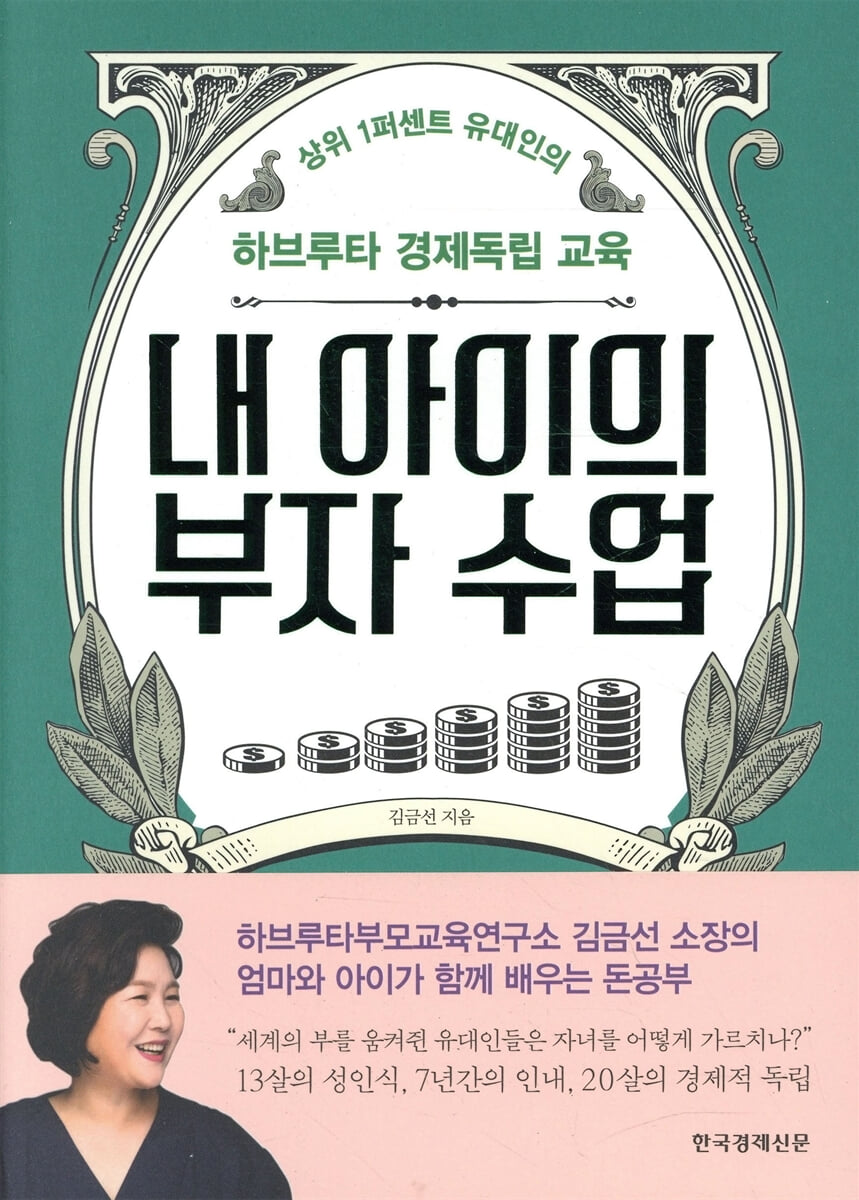
My Child's Rich Class
 |
Description
Book Introduction
A truly rich person who knows the value of money and the happiness it brings. If you want to raise your child to be truly rich, learn the principles of Jewish Havruta education! Learning about money through Talmud Havruta with mother and child John Lee highly recommended Kim Geum-seon, director of the Havruta Parent Education Research Institute, who sparked interest in 'Havruta education' among parents through her previous work, now discusses the importance of economic education through the Havruta education method. Now, in our country, there is a growing number of parents who agree with the need to teach their children about money. However, many parents are still unsure about how to provide financial education to their children. Director Kim Geum-seon finds the solution in the economic education of the Jews, who are said to be the smartest and richest people in the world. Havruta education, which involves discussing and debating various topics and finding solutions, serves as the foundation for awakening economic concepts, fostering sound consumption habits, and teaching the concept and importance of investment. Moreover, through the Talmud, which is the essence of Jewish thought and contains the core values of the Jewish people, the meaning and purpose of the Jewish people's thorough economic concept are interpreted in an interesting way. It contains economic education that allows mothers and children to learn and grow together through conversations with children, sparking their thoughts and developing their skills in areas such as preparing for the future, credit and promises, the value of labor, consumption habits, and how to read economic trends. |
- You can preview some of the book's contents.
Preview
index
Prologue: Learning about money at a young age creates wealthy people in the future.
Chapter 1: The First Step in Economic Education: Where to Start?
ㆍChildren's future lies in economic education.
The Meaning of Tzedakah for a 6-Month-Old Baby
The two balancing weights of 'donation' and 'honesty'
Qualifications of parents to become 'economics teachers'
Let's talk about money freely
Let's teach patience with money
Strict culture and system for 'economic independence'
Economic independence begins at age thirteen
Who Raised the Kangaroo Tribe?
The concept of making money through labor
What Samuel's father did
Are parents raising their children to be robbers?
Six verbal habits that ruin economic education for parents
We are rich in heart
Yeah, that's how I feel.
Let's eat chicken today
Mom will do everything, so you just study.
If you do well on the test, I'll give you a new phone.
Buy this, this is much better
If you can't finish it, don't even start.
Chapter 2: Change Your Parents' Thinking
Why do we need to earn money?
Braving the rain to the steamed bun shop!
Give me money instead of freedom
ㆍIs it absolutely necessary to save money?
Make them think about the value of money
Money makes money
Children who learn from failure also earn a lot of money.
The great history of the world is a history of failure.
A debate without a 'right answer'
ㆍLet them know the pain of poverty
How did I raise this child!
To raise a child who is the happiest for the longest time
The Real Reason Jews Encourage Entrepreneurship
Teach the challenge
A real opportunity to develop your money-making skills
Chapter 3: Creative Thinking to Develop Money-Making Abilities
Jewish 'commercialism'
The power of thinking that turns weaknesses into strengths
Creativity that blossoms from spontaneity and initiative
ㆍThinking method to turn the situation around
An old man's thoughts on his bed before he died
Different is better than the best
The best timing to foster creativity
The other side of complaints and discontent
How to turn your weaknesses into strengths
ㆍ7 Chutzpah Spirits that Make Children Wealthy
Spark a spark in your child's head
High Risk, High Return as Told by Parents
Four types of education that will help you develop your ability to make money
Money-making education that builds money-making skills
There is only one way to make money through education.
Chapter 4: Economic Habits You Must Develop
ㆍSkills of discussion and debate for collaboration
The dangers of unanimity
Money comes from discussion and debate.
ㆍThe trap of small happiness and YOLO
Children who are moving towards emotional consumption rather than necessary consumption
The pleasure of saving money is greater than the pleasure of spending money.
How to avoid landmines in economic activity
Investing in Chicken or Duck?
Critical thinking creates healthy spending habits.
ㆍSpecific principles and rules for making money
What global financiers emphasize
From 'emotional' empathy to 'economic' empathy
Jews who win through negotiation and networking
Negotiation training that teaches 'logic'
Chapter 5: Learning the Rich Mind through the Talmud
ㆍThe rich prepare and prepare.
Preparing for the future today
Develop your ability to predict the future
The rich value trust and promises above all else.
Bargaining and contracting are trust and promises.
The hardest promise to keep in the world
Consumption habits make the rich.
The difficulty of protecting the money you earn
Why I Should Be Grateful for My Money
The Dilemma Between Promotion and Hype
ㆍYou have to work efficiently to become rich.
Is working hard and long hours the best?
Between principle and old-fashionedness
ㆍYou need to know the economic trends to live a rich life.
Merchant's Profit vs.
Consumer interests
From producer to consumer
What the bank gives us
ㆍSmart interpersonal relationships bring money.
The importance of personal networks
How to feel when lending money
ㆍAttitude toward living as a rich person
To live as a truly rich person
An honest attitude of refusing special treatment
Sweet fruit that comes only to those who persevere
Build a 'good relationship' with money
Phone recovery, a magical life
Honest and upright ownership
ㆍMother Kim Geum-seon and daughter Eunice's father-son lessons
Economic education is an investment in future asset value.
Epilogue: Recommending Havruta in a World of Constant Change
Appendix_ To make your child rich, parents must first have a rich mindset.
References and Literature
Chapter 1: The First Step in Economic Education: Where to Start?
ㆍChildren's future lies in economic education.
The Meaning of Tzedakah for a 6-Month-Old Baby
The two balancing weights of 'donation' and 'honesty'
Qualifications of parents to become 'economics teachers'
Let's talk about money freely
Let's teach patience with money
Strict culture and system for 'economic independence'
Economic independence begins at age thirteen
Who Raised the Kangaroo Tribe?
The concept of making money through labor
What Samuel's father did
Are parents raising their children to be robbers?
Six verbal habits that ruin economic education for parents
We are rich in heart
Yeah, that's how I feel.
Let's eat chicken today
Mom will do everything, so you just study.
If you do well on the test, I'll give you a new phone.
Buy this, this is much better
If you can't finish it, don't even start.
Chapter 2: Change Your Parents' Thinking
Why do we need to earn money?
Braving the rain to the steamed bun shop!
Give me money instead of freedom
ㆍIs it absolutely necessary to save money?
Make them think about the value of money
Money makes money
Children who learn from failure also earn a lot of money.
The great history of the world is a history of failure.
A debate without a 'right answer'
ㆍLet them know the pain of poverty
How did I raise this child!
To raise a child who is the happiest for the longest time
The Real Reason Jews Encourage Entrepreneurship
Teach the challenge
A real opportunity to develop your money-making skills
Chapter 3: Creative Thinking to Develop Money-Making Abilities
Jewish 'commercialism'
The power of thinking that turns weaknesses into strengths
Creativity that blossoms from spontaneity and initiative
ㆍThinking method to turn the situation around
An old man's thoughts on his bed before he died
Different is better than the best
The best timing to foster creativity
The other side of complaints and discontent
How to turn your weaknesses into strengths
ㆍ7 Chutzpah Spirits that Make Children Wealthy
Spark a spark in your child's head
High Risk, High Return as Told by Parents
Four types of education that will help you develop your ability to make money
Money-making education that builds money-making skills
There is only one way to make money through education.
Chapter 4: Economic Habits You Must Develop
ㆍSkills of discussion and debate for collaboration
The dangers of unanimity
Money comes from discussion and debate.
ㆍThe trap of small happiness and YOLO
Children who are moving towards emotional consumption rather than necessary consumption
The pleasure of saving money is greater than the pleasure of spending money.
How to avoid landmines in economic activity
Investing in Chicken or Duck?
Critical thinking creates healthy spending habits.
ㆍSpecific principles and rules for making money
What global financiers emphasize
From 'emotional' empathy to 'economic' empathy
Jews who win through negotiation and networking
Negotiation training that teaches 'logic'
Chapter 5: Learning the Rich Mind through the Talmud
ㆍThe rich prepare and prepare.
Preparing for the future today
Develop your ability to predict the future
The rich value trust and promises above all else.
Bargaining and contracting are trust and promises.
The hardest promise to keep in the world
Consumption habits make the rich.
The difficulty of protecting the money you earn
Why I Should Be Grateful for My Money
The Dilemma Between Promotion and Hype
ㆍYou have to work efficiently to become rich.
Is working hard and long hours the best?
Between principle and old-fashionedness
ㆍYou need to know the economic trends to live a rich life.
Merchant's Profit vs.
Consumer interests
From producer to consumer
What the bank gives us
ㆍSmart interpersonal relationships bring money.
The importance of personal networks
How to feel when lending money
ㆍAttitude toward living as a rich person
To live as a truly rich person
An honest attitude of refusing special treatment
Sweet fruit that comes only to those who persevere
Build a 'good relationship' with money
Phone recovery, a magical life
Honest and upright ownership
ㆍMother Kim Geum-seon and daughter Eunice's father-son lessons
Economic education is an investment in future asset value.
Epilogue: Recommending Havruta in a World of Constant Change
Appendix_ To make your child rich, parents must first have a rich mindset.
References and Literature
Detailed image

Into the book
Financial education for children is not about raising them to be wealthy.
It's to teach children how to be happy with money.
If you introduce the concepts of 'giving and honesty' at the starting point of that education, you will have taken a very good first step in economic education.
--- p.20, from “Children’s Future Lies in Economic Education”
If you don't receive proper economic education from a young age, you won't be able to form a concept of money, and as a result, you will have difficulty protecting and managing money.
This is true no matter how much wealth you inherit.
They have no idea how much money they have, how to manage it efficiently, and how to make more money.
We live a life where we fit our lives around the money we have, spending it when we have it, and sometimes not spending it when we don't have it.
We often use the expression 'money-shy' in a derogatory tone.
But the money must be revealed.
If you educate your child to be aware of money and the family's financial situation from a young age, he or she will grow up to be someone who can protect, maintain, and grow his or her own money well.
--- p.24, from “Qualifications of Parents to Become ‘Economics Teachers’”
The Jewish Bar Mitzvah is the starting point for a child to prepare and plan for financial independence.
The purpose is to teach the importance of investing by investing wedding money rather than allowance money, and to allow children to manage money larger than their allowance.
During the seven years after coming of age until becoming financially independent, children learn that there is money that is "theirs but cannot be spent," and that through investments, they experience the fact that that money can grow.
And I also realize that I have to be patient until that money becomes my money.
--- p.30, from “Strict Culture and Systems for ‘Economic Independence’”
A 'goal' is a process that must be achieved one by one to achieve the ultimate goal.
On the other hand, 'purpose' is what you ultimately want to do by stepping on each goal.
If your goal is 'I want to live a worthwhile life!', then 'helping others' is your goal to achieve that goal.
Getting good test scores is just a goal.
The ultimate goal is to get good test scores, study what you want at the university you want, and grow into a great adult.
Jews see the ultimate goal of making money as 'freedom'.
The act of making money is just a goal in itself, and through it we aim to achieve the goal of 'freedom'.
--- p.49~50, from “Why Should We Earn Money?”
In a capitalist society, to make money healthily, you have no choice but to choose how money makes money.
It is not a denial of the value of sacred labor, but rather the wisdom of knowing how to 'make money efficiently.'
It's the same principle as having to study efficiently.
--- p.57, from “Should I always save money?”
Jews grow up in an environment of discussion and debate from an early age.
There is no 'right answer' in discussion and debate.
It's not about finding the right answer, it's about how creative the answer is.
There are many cases where we make mistakes when trying to find something that didn't exist before, and there are also many cases where we think something is right but it turns out to be wrong.
In the world of creativity, failure is a common occurrence.
Jewish parents also take this so for granted that they think failure is also natural.
This is where a whole new concept of failure arises.
'Failure is a new experience.'
--- p.62, from “Children who learn from failure also make a lot of money”
One of the core economic lessons of Jewish education is the experience of poverty and deprivation.
From a young age, we make them accustomed to poverty and deprivation, and we naturally accept it, so that when they come out into the world, they develop the strength to overcome any difficulties they may face.
Rather than ignoring poverty, we educate people to face it head on.
It teaches us how great a curse and suffering poverty is.
--- p.68, from “Let’s Know the Pain of Poverty”
This is the core of Jewish Havruta education.
This is a method that does not force any thoughts or judgments on the child, but only provides directions so that the child can find his or her own path.
The rest is left to the child to discover on his own through discussion, questions, and answers.
--- p.86, from “Jewish ‘Commercialism’”
You have to change your 'stereotypical thinking' to turn things around, and only then can you make money creatively.
Of course, the reversal of thinking isn't just useful for making money.
It is also the foundation for growing into an adult who can overcome countless crises and hardships that we encounter throughout life.
That kind of attitude toward life is the most valuable legacy we can give to our children as they go forth into the world.
--- p.92, from “Thinking Methods to Turn Things Around”
At the heart of Jewish spiritual culture lies the spirit of Chutzpah.
It contains the principles of Jewish education, business management, and social governance.
In a word, it is the core of the Jewish spirit.
The reason why Jews make a lot of money can also be found here.
Chutzpah means 'shameless courage, presumptuous arrogance'.
It consists of seven spirits.
▶Risk taking ▶Goal orientation ▶Breaking the mold ▶Learning from failure ▶Mixing and matching ▶Persistence ▶The right to ask questions.
If children can internalize the chutzpah spirit, they will have the opportunity to grow into great individuals in this society and even become wealthy.
--- p.100, from “The Seven Chutzpah Spirits that Make Children Rich”
The four educational methods that develop the ability to make money ultimately converge into one.
It is ‘fast, abundant, and high-quality information power.’
No one brings information.
It is discovered through abilities acquired through consistent habits and effort.
The ability to discover value in information hidden everywhere and to predict the future through that discovery.
That's the key to making money.
--- p.110, from “Four Educational Methods to Develop Money-Making Ability”
It would not be wrong to say that Jewish education is 'a discussion from beginning to end.'
Why do Jews value debate so much? In fact, the ultimate goal of debate isn't to confirm our differences, but to "cooperate based on our differences."
There is not only homogeneity but also heterogeneity between people.
If you cooperate only by looking at homogeneity, problems often arise later due to the heterogeneity that is revealed.
Discussion education is about recognizing and understanding each other's differences and cooperating on that basis.
--- p.116~117, from “Techniques of Discussion and Argument for Collaboration”
Many experts say that no matter how much the Fourth Industrial Revolution develops, one thing that artificial intelligence cannot keep up with is empathy.
The ability to deeply understand the human mind and thus develop economic empathy to address the discomfort and inadequacies felt by people is a very important skill that guarantees children's economic success.
--- p.139, from “Specific Principles and Laws of Making Money”
The first part of the story deals with unfair trade practices and disputes over the procedures of trade.
First, the person who negotiated first is the one who buys the land, but then another person suddenly appears and tells him that it is wrong to buy the land right away.
Above all, the teaching that 'you must thoroughly keep your promises' is important.
Bargaining itself is a promise not to sell to anyone else.
Therefore, it is not right to try to buy something first when someone is bargaining.
Another thing to note from this story is that we should be wary of accepting free gifts from people we don't know well.
--- p.159, from “Bargaining and Contracts are Faith and Promises”
This story concludes that there is nothing wrong with the economic practices of giving away prizes or selling things cheaply.
That is, it is sufficiently acknowledging ‘marketing’.
In modern economic activities, 'freebie marketing' and 'low-price marketing' are commonplace and do not cause any particular controversy, but thousands of years ago, in commercial transactions, such sales methods would have been controversial.
In this story, it is judged that such sales are not unfair trade, and the standard for judging this is said to be 'the interests of the consumer'.
--- p.189, “Merchant’s Profit vs.
From “Consumer Benefits”
Economics is a truly useful discipline that, once studied, can be used throughout one's life.
We can determine where we are in the economic cycle, anticipate what government policies will be implemented during this period, and determine how to manage our assets based on those policies.
Studying economics helped me realize that there are countless opportunities in the world and what I need to do to seize them.
Now, we can see where investors' money is flowing, which industries are on the rise, and which companies are driving those industries.
It's to teach children how to be happy with money.
If you introduce the concepts of 'giving and honesty' at the starting point of that education, you will have taken a very good first step in economic education.
--- p.20, from “Children’s Future Lies in Economic Education”
If you don't receive proper economic education from a young age, you won't be able to form a concept of money, and as a result, you will have difficulty protecting and managing money.
This is true no matter how much wealth you inherit.
They have no idea how much money they have, how to manage it efficiently, and how to make more money.
We live a life where we fit our lives around the money we have, spending it when we have it, and sometimes not spending it when we don't have it.
We often use the expression 'money-shy' in a derogatory tone.
But the money must be revealed.
If you educate your child to be aware of money and the family's financial situation from a young age, he or she will grow up to be someone who can protect, maintain, and grow his or her own money well.
--- p.24, from “Qualifications of Parents to Become ‘Economics Teachers’”
The Jewish Bar Mitzvah is the starting point for a child to prepare and plan for financial independence.
The purpose is to teach the importance of investing by investing wedding money rather than allowance money, and to allow children to manage money larger than their allowance.
During the seven years after coming of age until becoming financially independent, children learn that there is money that is "theirs but cannot be spent," and that through investments, they experience the fact that that money can grow.
And I also realize that I have to be patient until that money becomes my money.
--- p.30, from “Strict Culture and Systems for ‘Economic Independence’”
A 'goal' is a process that must be achieved one by one to achieve the ultimate goal.
On the other hand, 'purpose' is what you ultimately want to do by stepping on each goal.
If your goal is 'I want to live a worthwhile life!', then 'helping others' is your goal to achieve that goal.
Getting good test scores is just a goal.
The ultimate goal is to get good test scores, study what you want at the university you want, and grow into a great adult.
Jews see the ultimate goal of making money as 'freedom'.
The act of making money is just a goal in itself, and through it we aim to achieve the goal of 'freedom'.
--- p.49~50, from “Why Should We Earn Money?”
In a capitalist society, to make money healthily, you have no choice but to choose how money makes money.
It is not a denial of the value of sacred labor, but rather the wisdom of knowing how to 'make money efficiently.'
It's the same principle as having to study efficiently.
--- p.57, from “Should I always save money?”
Jews grow up in an environment of discussion and debate from an early age.
There is no 'right answer' in discussion and debate.
It's not about finding the right answer, it's about how creative the answer is.
There are many cases where we make mistakes when trying to find something that didn't exist before, and there are also many cases where we think something is right but it turns out to be wrong.
In the world of creativity, failure is a common occurrence.
Jewish parents also take this so for granted that they think failure is also natural.
This is where a whole new concept of failure arises.
'Failure is a new experience.'
--- p.62, from “Children who learn from failure also make a lot of money”
One of the core economic lessons of Jewish education is the experience of poverty and deprivation.
From a young age, we make them accustomed to poverty and deprivation, and we naturally accept it, so that when they come out into the world, they develop the strength to overcome any difficulties they may face.
Rather than ignoring poverty, we educate people to face it head on.
It teaches us how great a curse and suffering poverty is.
--- p.68, from “Let’s Know the Pain of Poverty”
This is the core of Jewish Havruta education.
This is a method that does not force any thoughts or judgments on the child, but only provides directions so that the child can find his or her own path.
The rest is left to the child to discover on his own through discussion, questions, and answers.
--- p.86, from “Jewish ‘Commercialism’”
You have to change your 'stereotypical thinking' to turn things around, and only then can you make money creatively.
Of course, the reversal of thinking isn't just useful for making money.
It is also the foundation for growing into an adult who can overcome countless crises and hardships that we encounter throughout life.
That kind of attitude toward life is the most valuable legacy we can give to our children as they go forth into the world.
--- p.92, from “Thinking Methods to Turn Things Around”
At the heart of Jewish spiritual culture lies the spirit of Chutzpah.
It contains the principles of Jewish education, business management, and social governance.
In a word, it is the core of the Jewish spirit.
The reason why Jews make a lot of money can also be found here.
Chutzpah means 'shameless courage, presumptuous arrogance'.
It consists of seven spirits.
▶Risk taking ▶Goal orientation ▶Breaking the mold ▶Learning from failure ▶Mixing and matching ▶Persistence ▶The right to ask questions.
If children can internalize the chutzpah spirit, they will have the opportunity to grow into great individuals in this society and even become wealthy.
--- p.100, from “The Seven Chutzpah Spirits that Make Children Rich”
The four educational methods that develop the ability to make money ultimately converge into one.
It is ‘fast, abundant, and high-quality information power.’
No one brings information.
It is discovered through abilities acquired through consistent habits and effort.
The ability to discover value in information hidden everywhere and to predict the future through that discovery.
That's the key to making money.
--- p.110, from “Four Educational Methods to Develop Money-Making Ability”
It would not be wrong to say that Jewish education is 'a discussion from beginning to end.'
Why do Jews value debate so much? In fact, the ultimate goal of debate isn't to confirm our differences, but to "cooperate based on our differences."
There is not only homogeneity but also heterogeneity between people.
If you cooperate only by looking at homogeneity, problems often arise later due to the heterogeneity that is revealed.
Discussion education is about recognizing and understanding each other's differences and cooperating on that basis.
--- p.116~117, from “Techniques of Discussion and Argument for Collaboration”
Many experts say that no matter how much the Fourth Industrial Revolution develops, one thing that artificial intelligence cannot keep up with is empathy.
The ability to deeply understand the human mind and thus develop economic empathy to address the discomfort and inadequacies felt by people is a very important skill that guarantees children's economic success.
--- p.139, from “Specific Principles and Laws of Making Money”
The first part of the story deals with unfair trade practices and disputes over the procedures of trade.
First, the person who negotiated first is the one who buys the land, but then another person suddenly appears and tells him that it is wrong to buy the land right away.
Above all, the teaching that 'you must thoroughly keep your promises' is important.
Bargaining itself is a promise not to sell to anyone else.
Therefore, it is not right to try to buy something first when someone is bargaining.
Another thing to note from this story is that we should be wary of accepting free gifts from people we don't know well.
--- p.159, from “Bargaining and Contracts are Faith and Promises”
This story concludes that there is nothing wrong with the economic practices of giving away prizes or selling things cheaply.
That is, it is sufficiently acknowledging ‘marketing’.
In modern economic activities, 'freebie marketing' and 'low-price marketing' are commonplace and do not cause any particular controversy, but thousands of years ago, in commercial transactions, such sales methods would have been controversial.
In this story, it is judged that such sales are not unfair trade, and the standard for judging this is said to be 'the interests of the consumer'.
--- p.189, “Merchant’s Profit vs.
From “Consumer Benefits”
Economics is a truly useful discipline that, once studied, can be used throughout one's life.
We can determine where we are in the economic cycle, anticipate what government policies will be implemented during this period, and determine how to manage our assets based on those policies.
Studying economics helped me realize that there are countless opportunities in the world and what I need to do to seize them.
Now, we can see where investors' money is flowing, which industries are on the rise, and which companies are driving those industries.
--- p.237, from “Mother Kim Geum-seon and Daughter Eunice’s Rich Lessons”
Publisher's Review
Jews are the most talented and wealthiest people in the world
Why did they become so special?
Although Jews make up only 0.2 percent of the world's population, they are known as one of the most creative and wealthiest people in the world.
The proportion of Jewish Nobel Prize winners is incomparably higher than in our country, and there are surprisingly many Jewish CEOs of global companies and billionaires around the world.
Is that all?
The geniuses and masters of the IT industry that young people admire, such as Mark Zuckerberg, Larry Page, and Steve Jobs, are all Jewish.
It is now widely known that Jews have a firm grip on the world's financial, political, legal, economic, media, artistic, and academic worlds.
How did a small minority of Jews, with a difficult history, become such a powerful people and attract the world's attention? The secret lies in their unique "education."
The educational method of discussion and debate, called 'Havruta', has remarkably fostered Jewish creativity and a spirit of challenge, and has fostered a strong mentality that is not afraid of failure.
The Jewish educational method, systematic and thorough in its freedom, was also applied to economic education.
Jews teach their children about money as soon as they are born.
It teaches you how to save and save money, the necessity of investment, an understanding of economic trends, and the joy of making money and sharing it.
It is important to properly teach children economic concepts from a young age so that they can grow into adults who understand the value and power of money.
Author Kim Geum-seon shows how Jews teach economics to children through the 'Havruta Education Method' and the Talmud.
It may be somewhat unfamiliar to us, but he emphasizes that the sooner we begin economic education, the better, and that education that illuminates money is absolutely necessary.
We need to get rid of our prejudices and bad habits about money.
Become a smart parent who teaches economics
The pandemic is gradually blurring the lines between home and school, and between parents and teachers.
Parents should also become teachers and provide economic education to their children starting at home.
But when I tell my parents to become 'economics teachers', I feel a vague sense of fear.
The author says there is no need for that.
Just knowing how important money studies are, why they are important, and what their purpose is is already a sign of having the qualities of a teacher.
And most importantly, he says, parents need to abandon any prejudices and timidity they have had about money and adopt a completely new economic mindset.
To provide children with a proper economic education, parents must abandon distorted perceptions and habits, big and small, such as an obsession with saving, a fear of challenges and failure, aversion to investing, excessive love for children to avoid passing on pain to them, and emotional spending.
In particular, the author says that economic education should not be limited to just 'money'.
Throughout the book, the author focuses on creative education through 'Havruta'.
Because creativity provides original ideas and gives us the strength to bounce back when we face hardship by changing our thinking.
To do that, you need to break free from the pressure of studying hard, going to a top university, getting a job at a large company, and living a life as a diligent salaryman or a safe civil servant, and not be afraid to take on challenges and try new things.
In other words, we must support children to live their own lives actively by raising them as free and independent children, not passive children.
At its foundation is the Havruta method of education and the spirit of chutzpah.
The author presents a variety of specific, unique Jewish economic education methods, and through engaging anecdotes and Talmud stories, he shows us what important values, sound consumption practices, and proper economic concepts are.
In particular, a lot of space is devoted to analyzing stories from the Talmud, and by presenting specific questions and answers to ask children within those stories, it is structured so that it can also be used as a guidebook for economic education.
Additionally, at the end of each chapter, an appendix titled 'Practical Economic Education with Parents' is included to provide hints on how to implement economic education in everyday life.
It can be said to be a practical economic education book for children.
So that my child can have a rich mindset
Start studying money right now
Everyone wants to live rich.
I want my life to be like that, but I desperately want my children to not live with the worries and pain caused by money.
And then he blames himself for not having an inheritance to leave to his children.
Some people ask how a child can live a rich life without being a building owner or having saved a lot of money.
We need to abandon the idea that parents are responsible for their children's future.
“Everyone wants their child to live a rich life.
I hope to live a leisurely life, enjoying the freedom and happiness that money brings, without suffering or struggling because of money.
I hope you grow into a truly rich person who knows the joy of living together, doesn't judge people by their money, and knows the joy of sharing.
“If that’s the case, then we should not hesitate to talk about money from a young age.” _From the prologue
Jews raise their children to be strong.
At the age of 13, you have a coming-of-age ceremony, and at the age of 20, you begin to become financially independent.
They don't give a lot of allowance for no reason, and they don't buy things right away even if the child needs them.
They are willing to make their children do difficult tasks and, no matter how unprepared they may be, they are unconditionally made independent when they turn twenty.
It's not because I don't love my child.
Because we know that experiencing money and understanding the nature of money at a young age is the greatest legacy a parent can give their child.
We need to get away from the idea that 'it is not good for children's education to reveal money.'
We also need to abandon the idea that 'children should grow up brightly under their parents' care without worrying about money.'
You have to be aware of money, study money, and know your parents' financial situation to understand the value of money.
The rich mindset for living a rich life is nothing special.
Knowing the value of money and grasping its power is the mindset of a rich person.
The rich mindset is knowing that you are happier when you share with others rather than living a luxurious life alone.
It is not easy, so you have to learn and get used to it as a habit.
This book shows that studying money is ultimately studying life.
You can live a proper life only if you know how to manage money properly.
This book, which introduces the unique Jewish economic education method and suggests ways to adapt and utilize it to the realities of our country, will provide both parents and children with a direction to reset their perception of money and, at the same time, reset their lives.
Why did they become so special?
Although Jews make up only 0.2 percent of the world's population, they are known as one of the most creative and wealthiest people in the world.
The proportion of Jewish Nobel Prize winners is incomparably higher than in our country, and there are surprisingly many Jewish CEOs of global companies and billionaires around the world.
Is that all?
The geniuses and masters of the IT industry that young people admire, such as Mark Zuckerberg, Larry Page, and Steve Jobs, are all Jewish.
It is now widely known that Jews have a firm grip on the world's financial, political, legal, economic, media, artistic, and academic worlds.
How did a small minority of Jews, with a difficult history, become such a powerful people and attract the world's attention? The secret lies in their unique "education."
The educational method of discussion and debate, called 'Havruta', has remarkably fostered Jewish creativity and a spirit of challenge, and has fostered a strong mentality that is not afraid of failure.
The Jewish educational method, systematic and thorough in its freedom, was also applied to economic education.
Jews teach their children about money as soon as they are born.
It teaches you how to save and save money, the necessity of investment, an understanding of economic trends, and the joy of making money and sharing it.
It is important to properly teach children economic concepts from a young age so that they can grow into adults who understand the value and power of money.
Author Kim Geum-seon shows how Jews teach economics to children through the 'Havruta Education Method' and the Talmud.
It may be somewhat unfamiliar to us, but he emphasizes that the sooner we begin economic education, the better, and that education that illuminates money is absolutely necessary.
We need to get rid of our prejudices and bad habits about money.
Become a smart parent who teaches economics
The pandemic is gradually blurring the lines between home and school, and between parents and teachers.
Parents should also become teachers and provide economic education to their children starting at home.
But when I tell my parents to become 'economics teachers', I feel a vague sense of fear.
The author says there is no need for that.
Just knowing how important money studies are, why they are important, and what their purpose is is already a sign of having the qualities of a teacher.
And most importantly, he says, parents need to abandon any prejudices and timidity they have had about money and adopt a completely new economic mindset.
To provide children with a proper economic education, parents must abandon distorted perceptions and habits, big and small, such as an obsession with saving, a fear of challenges and failure, aversion to investing, excessive love for children to avoid passing on pain to them, and emotional spending.
In particular, the author says that economic education should not be limited to just 'money'.
Throughout the book, the author focuses on creative education through 'Havruta'.
Because creativity provides original ideas and gives us the strength to bounce back when we face hardship by changing our thinking.
To do that, you need to break free from the pressure of studying hard, going to a top university, getting a job at a large company, and living a life as a diligent salaryman or a safe civil servant, and not be afraid to take on challenges and try new things.
In other words, we must support children to live their own lives actively by raising them as free and independent children, not passive children.
At its foundation is the Havruta method of education and the spirit of chutzpah.
The author presents a variety of specific, unique Jewish economic education methods, and through engaging anecdotes and Talmud stories, he shows us what important values, sound consumption practices, and proper economic concepts are.
In particular, a lot of space is devoted to analyzing stories from the Talmud, and by presenting specific questions and answers to ask children within those stories, it is structured so that it can also be used as a guidebook for economic education.
Additionally, at the end of each chapter, an appendix titled 'Practical Economic Education with Parents' is included to provide hints on how to implement economic education in everyday life.
It can be said to be a practical economic education book for children.
So that my child can have a rich mindset
Start studying money right now
Everyone wants to live rich.
I want my life to be like that, but I desperately want my children to not live with the worries and pain caused by money.
And then he blames himself for not having an inheritance to leave to his children.
Some people ask how a child can live a rich life without being a building owner or having saved a lot of money.
We need to abandon the idea that parents are responsible for their children's future.
“Everyone wants their child to live a rich life.
I hope to live a leisurely life, enjoying the freedom and happiness that money brings, without suffering or struggling because of money.
I hope you grow into a truly rich person who knows the joy of living together, doesn't judge people by their money, and knows the joy of sharing.
“If that’s the case, then we should not hesitate to talk about money from a young age.” _From the prologue
Jews raise their children to be strong.
At the age of 13, you have a coming-of-age ceremony, and at the age of 20, you begin to become financially independent.
They don't give a lot of allowance for no reason, and they don't buy things right away even if the child needs them.
They are willing to make their children do difficult tasks and, no matter how unprepared they may be, they are unconditionally made independent when they turn twenty.
It's not because I don't love my child.
Because we know that experiencing money and understanding the nature of money at a young age is the greatest legacy a parent can give their child.
We need to get away from the idea that 'it is not good for children's education to reveal money.'
We also need to abandon the idea that 'children should grow up brightly under their parents' care without worrying about money.'
You have to be aware of money, study money, and know your parents' financial situation to understand the value of money.
The rich mindset for living a rich life is nothing special.
Knowing the value of money and grasping its power is the mindset of a rich person.
The rich mindset is knowing that you are happier when you share with others rather than living a luxurious life alone.
It is not easy, so you have to learn and get used to it as a habit.
This book shows that studying money is ultimately studying life.
You can live a proper life only if you know how to manage money properly.
This book, which introduces the unique Jewish economic education method and suggests ways to adapt and utilize it to the realities of our country, will provide both parents and children with a direction to reset their perception of money and, at the same time, reset their lives.
GOODS SPECIFICS
- Publication date: February 19, 2021
- Page count, weight, size: 264 pages | 450g | 150*210*16mm
- ISBN13: 9788947546874
- ISBN10: 8947546879
You may also like
카테고리
korean


korean

![GQ KOREA Mark (Monthly): December [2025]](http://librairie.coreenne.fr/cdn/shop/files/8ef265dbbfbf186523ed75ba7319009d.jpg?v=1765340328&width=3840)


