

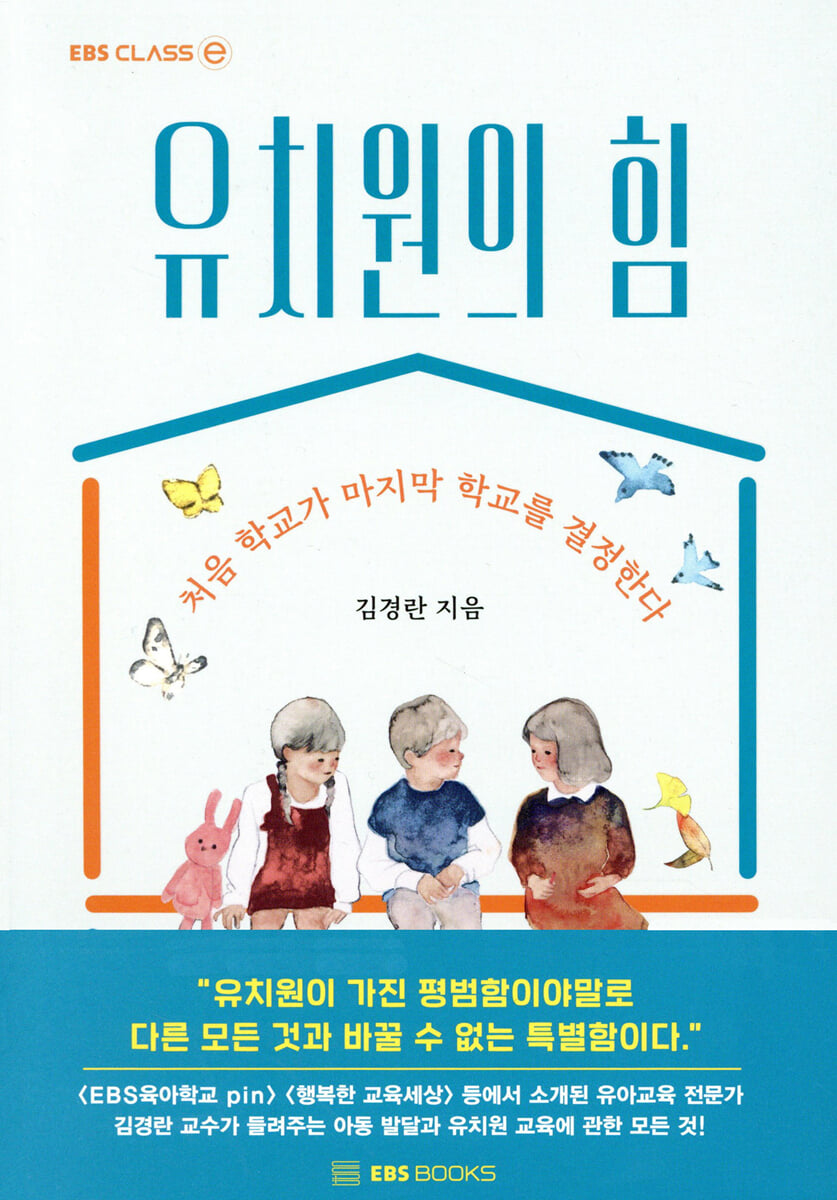
The Power of Kindergarten
 |
Description
Book Introduction
Professor Kim Kyung-ran, an early childhood education expert, tells us
All About Child Development and Preschool Education
Something that everyone seems to know, but in fact no one knew, is kindergarten education.
Because children are still young, they do not have the ability to concisely and coherently explain the content, and because adults view it quantitatively, they do not know the hidden content.
Also, there are things that are only available in kindergartens that you will never find in other educational institutions.
When their children turn 3 to 5 years old, parents begin to worry about sending them to kindergarten or other educational institutions.
Why do we send our children to kindergarten? What do kindergartens, which seem to be all about play, teach?
"The Power of Kindergarten" is a close-up exploration of time and space, the first society a child encounters and the foundation of self-esteem.
This book aims to address the curiosity about what a kindergarten is and what kind of education it provides by covering all the elements that occur in a kindergarten space from various angles, including the characteristics and specific processes of education in kindergarten, the communication process between the homeroom teacher and the child, the socialization and self-esteem of the child that occur in kindergarten, and the growth process, including the characteristics of the kindergarten curriculum.
By examining the characteristics of kindergartens and the specific events that occur there, "The Power of Kindergarten" not only rediscovers kindergartens as educational institutions, but also asks what kind of education should be provided to children aged 3 to 5.
Kindergarten is a fun place for children, with friends to play with and teachers who understand their feelings.
At one time, almost all children went to kindergarten.
However, the value of kindergartens is gradually being diminished by the emergence of English kindergartens (English academy kindergarten programs) that emphasize special features and play academies that teach children through play.
But a kindergarten must remain a kindergarten forever.
Because the time spent in kindergarten cannot be replaced by anything else.
At this point, it's time to consider whether you're squeezing your child into learning and whether you're missing out on what's truly necessary in the pursuit of specialness.
All About Child Development and Preschool Education
Something that everyone seems to know, but in fact no one knew, is kindergarten education.
Because children are still young, they do not have the ability to concisely and coherently explain the content, and because adults view it quantitatively, they do not know the hidden content.
Also, there are things that are only available in kindergartens that you will never find in other educational institutions.
When their children turn 3 to 5 years old, parents begin to worry about sending them to kindergarten or other educational institutions.
Why do we send our children to kindergarten? What do kindergartens, which seem to be all about play, teach?
"The Power of Kindergarten" is a close-up exploration of time and space, the first society a child encounters and the foundation of self-esteem.
This book aims to address the curiosity about what a kindergarten is and what kind of education it provides by covering all the elements that occur in a kindergarten space from various angles, including the characteristics and specific processes of education in kindergarten, the communication process between the homeroom teacher and the child, the socialization and self-esteem of the child that occur in kindergarten, and the growth process, including the characteristics of the kindergarten curriculum.
By examining the characteristics of kindergartens and the specific events that occur there, "The Power of Kindergarten" not only rediscovers kindergartens as educational institutions, but also asks what kind of education should be provided to children aged 3 to 5.
Kindergarten is a fun place for children, with friends to play with and teachers who understand their feelings.
At one time, almost all children went to kindergarten.
However, the value of kindergartens is gradually being diminished by the emergence of English kindergartens (English academy kindergarten programs) that emphasize special features and play academies that teach children through play.
But a kindergarten must remain a kindergarten forever.
Because the time spent in kindergarten cannot be replaced by anything else.
At this point, it's time to consider whether you're squeezing your child into learning and whether you're missing out on what's truly necessary in the pursuit of specialness.
- You can preview some of the book's contents.
Preview
index
Prologue and a water painting that dries and is redrawn_ 8
Part 1 Only in Kindergarten_ 12
ㆍ Ages 3 to 5: The age to spend time with the Little Prince_ 14
Tears of a Baby Elephant Tied to a Pole_ 19
There are no English kindergartens in Korea_ 24
ㆍ You can't teach any subject without understanding children_ 31
ㆍ A buffer zone that exists only in feeling_ 35
ㆍ A kindergarten teacher who becomes your own teacher at your discretion_ 39
ㆍ An open perspective that doesn't see them as problem children helps overcome problems_ 43
Part 2: My Smallest School in the World_ 48
ㆍ The starting point of self-esteem, “Mom, look at me because I’m talking!”_ 50
Rules created through interaction_ 54
ㆍ Cultivating the wisdom to overcome shortcomings_ 60
Why is it necessary to learn unchanging standards?_ 66
ㆍ The power of words that come from empathy: “It’s okay” and “I see”!_ 72
Integrated education through dialogue_ 75
ㆍ A broad perspective and balanced attitude gained through mixing_ 78
ㆍ The foundation of learning is concentration, developing concentration_ 84
ㆍ Innovation School is an elementary school that borrows the kindergarten system_ 89
Part 3: What Happened at Kindergarten That Mom Doesn't Know_ 94
Prince of the 'I Don't Know Anything But Me' Country, Who Had No Friends_ 96
"It's all your fault!" Tears from a child who never apologizes_ 100
What can I do if I haven't learned it? I can't do it!_ 105
ㆍ You can't become a king who has never been to the bathroom alone, right?_ 109
ㆍ A transparent copycat with no color or thought, with no ego_ 116
A child who ran into a wall because there was no book to teach him how to move his body_ 122
ㆍ A child who is always beaten cannot trust adults_ 130
ㆍ The fist master who made friends by keeping his promise to wait_ 136
ㆍ I'll say goodbye to the loner now_ 142
ㆍ The reason I chose the slow and effortful path over the fast path_ 146
Adaptation begins with letting things be_ 151
ㆍ The prince of the country of arbitrary deeds became the prince of the country of manners_ 156
ㆍ A six-year-old perfectionist who can't participate in games for fear of losing_ 160
ㆍ The reason why people vent their anger by yelling and sweating_ 169
Part 4: What will children learn in a kindergarten where they only play? _ 174
ㆍ Art class to create your own color through careful observation_ 176
ㆍ Learning Hangul through word play_ 179
ㆍLearning various ways to express thoughts and feelings_ 181
ㆍ Comprehensive language skills developed through continuous, frequent speaking_ 187
ㆍ Experiential learning to experience another world outside of kindergarten_ 196
ㆍ Can elementary school math concepts be studied in kindergarten?_ 200
ㆍ Understanding the concept of space through the stacking area_ 203
ㆍ Weighing the same amount while playing in the sand_ 206
ㆍ Draw a graph of your favorite foods to compare them at a glance_ 209
ㆍ Interactive class where students read and discuss books_ 212
ㆍ Seeing and internalizing the art of dance from a child's perspective_ 217
Safety education to develop safe living habits_ 220
Studying Social Studies While Writing Thank-You Letters_ 227
Part 5: Two Hours of Miracles_ 232
Outdoor play that opens up interest in the outside world and limitless possibilities for communication_ 234
ㆍ A game that fosters cooperation and fun for children with poor motor skills_ 240
ㆍ 10 Strategies for Tag_ 243
ㆍ Children who relieve stress from reality through play_ 246
Finding a Mentor Through Role Play_ 251
ㆍ Block play with infinite transformations_ 255
ㆍ Sand artists who can create anything with sand_ 259
ㆍ Make a flag and follow where the wind blows_ 265
ㆍ Infinite transformations of water painting, sand painting, and car wash play_ 268
Part 6: Studying to Become a Straight-Minded and Upright Person_ 272
ㆍ Knowing Me, Why You Call Me by My Name_ 274
ㆍ Learning basic living habits needed for living together_ 280
ㆍ Develop your sensitivity by looking at the sky_ 284
ㆍ Understanding the true meaning of celebrating a birthday party_ 287
ㆍ A subject you can never learn at school: making friends_ 294
Learning to Comfort and Be Comforted_ 299
ㆍ Saying I'm upset without saying it's your fault_ 302
ㆍGender sensitivity starts with eliminating feminine and masculine colors_ 305
ㆍBe able to say “no” and stop when you say “no”_ 312
ㆍ Children have a completely different sexual curiosity than adults_ 317
Part 1 Only in Kindergarten_ 12
ㆍ Ages 3 to 5: The age to spend time with the Little Prince_ 14
Tears of a Baby Elephant Tied to a Pole_ 19
There are no English kindergartens in Korea_ 24
ㆍ You can't teach any subject without understanding children_ 31
ㆍ A buffer zone that exists only in feeling_ 35
ㆍ A kindergarten teacher who becomes your own teacher at your discretion_ 39
ㆍ An open perspective that doesn't see them as problem children helps overcome problems_ 43
Part 2: My Smallest School in the World_ 48
ㆍ The starting point of self-esteem, “Mom, look at me because I’m talking!”_ 50
Rules created through interaction_ 54
ㆍ Cultivating the wisdom to overcome shortcomings_ 60
Why is it necessary to learn unchanging standards?_ 66
ㆍ The power of words that come from empathy: “It’s okay” and “I see”!_ 72
Integrated education through dialogue_ 75
ㆍ A broad perspective and balanced attitude gained through mixing_ 78
ㆍ The foundation of learning is concentration, developing concentration_ 84
ㆍ Innovation School is an elementary school that borrows the kindergarten system_ 89
Part 3: What Happened at Kindergarten That Mom Doesn't Know_ 94
Prince of the 'I Don't Know Anything But Me' Country, Who Had No Friends_ 96
"It's all your fault!" Tears from a child who never apologizes_ 100
What can I do if I haven't learned it? I can't do it!_ 105
ㆍ You can't become a king who has never been to the bathroom alone, right?_ 109
ㆍ A transparent copycat with no color or thought, with no ego_ 116
A child who ran into a wall because there was no book to teach him how to move his body_ 122
ㆍ A child who is always beaten cannot trust adults_ 130
ㆍ The fist master who made friends by keeping his promise to wait_ 136
ㆍ I'll say goodbye to the loner now_ 142
ㆍ The reason I chose the slow and effortful path over the fast path_ 146
Adaptation begins with letting things be_ 151
ㆍ The prince of the country of arbitrary deeds became the prince of the country of manners_ 156
ㆍ A six-year-old perfectionist who can't participate in games for fear of losing_ 160
ㆍ The reason why people vent their anger by yelling and sweating_ 169
Part 4: What will children learn in a kindergarten where they only play? _ 174
ㆍ Art class to create your own color through careful observation_ 176
ㆍ Learning Hangul through word play_ 179
ㆍLearning various ways to express thoughts and feelings_ 181
ㆍ Comprehensive language skills developed through continuous, frequent speaking_ 187
ㆍ Experiential learning to experience another world outside of kindergarten_ 196
ㆍ Can elementary school math concepts be studied in kindergarten?_ 200
ㆍ Understanding the concept of space through the stacking area_ 203
ㆍ Weighing the same amount while playing in the sand_ 206
ㆍ Draw a graph of your favorite foods to compare them at a glance_ 209
ㆍ Interactive class where students read and discuss books_ 212
ㆍ Seeing and internalizing the art of dance from a child's perspective_ 217
Safety education to develop safe living habits_ 220
Studying Social Studies While Writing Thank-You Letters_ 227
Part 5: Two Hours of Miracles_ 232
Outdoor play that opens up interest in the outside world and limitless possibilities for communication_ 234
ㆍ A game that fosters cooperation and fun for children with poor motor skills_ 240
ㆍ 10 Strategies for Tag_ 243
ㆍ Children who relieve stress from reality through play_ 246
Finding a Mentor Through Role Play_ 251
ㆍ Block play with infinite transformations_ 255
ㆍ Sand artists who can create anything with sand_ 259
ㆍ Make a flag and follow where the wind blows_ 265
ㆍ Infinite transformations of water painting, sand painting, and car wash play_ 268
Part 6: Studying to Become a Straight-Minded and Upright Person_ 272
ㆍ Knowing Me, Why You Call Me by My Name_ 274
ㆍ Learning basic living habits needed for living together_ 280
ㆍ Develop your sensitivity by looking at the sky_ 284
ㆍ Understanding the true meaning of celebrating a birthday party_ 287
ㆍ A subject you can never learn at school: making friends_ 294
Learning to Comfort and Be Comforted_ 299
ㆍ Saying I'm upset without saying it's your fault_ 302
ㆍGender sensitivity starts with eliminating feminine and masculine colors_ 305
ㆍBe able to say “no” and stop when you say “no”_ 312
ㆍ Children have a completely different sexual curiosity than adults_ 317
Detailed image

Into the book
The image that parents have of 'English kindergartens' is that the kindergarten curriculum is taught in English.
I think if the teacher speaks English, the children will respond in English too.
However, humans are creatures who speak as much as they think.
When there is a gap between words and thoughts, confusion naturally arises.
If a six-year-old soul has the language skills of a three-year-old.
Thinking has no choice but to be leveled down to fit the language.
The same goes for other abilities.
This is because human intellectual ability develops comprehensively through cooperation between each area.
To become good at a language, it is not enough to know a few more unfamiliar words, but rather to expand the vessel that can use the language itself.
--- p.19
When a child does something mischievous, parents often discipline him by saying, “Your friends won’t like it if you do that, so don’t do it!”
But children don't know that much.
You realize this yourself when you see your friend frowning and getting angry.
Children learn within themselves the moments when they need to put the brakes on their actions or emotions.
Some friends hate it when you push them lightly, but some friends laugh even when you accidentally push them a little too hard.
Through such experiences, children also learn how to treat friends.
In this way, children learn how to build good relationships through thousands and thousands of trials and errors.
Children aged 3 to 5 need a time and space to experience trial and error.
But that space cannot be provided by parents.
A good parent is one who gives their child a buffer zone and a chance to learn from their mistakes when they make them.
--- p.37
Even if you lie a little, even if you hit your children, even if you are stubborn, even if you are a little slow to speak, even if you are prone to tantrums, even if you can't read, it doesn't matter at all.
By working together with teachers and friends, we can naturally overcome any problems that may have been noticed.
If you don't tag it as 'abnormal', even if it looks a little different now, the difference will gradually fade over time.
--- p.44
For example, adults call Im Kkeok-jeong and Hong Gil-dong righteous bandits, but children think they are bad people because they stole.
Children between the ages of 3 and 5 do not understand that stealing from bad people is not always a bad thing.
During this period, the seeds of value formation are sown, so education that instills the right values is necessary.
Stories like Hong Gil-dong or Im Kkeok-jeong can actually be confusing to children at this age.
Only after some more time has passed and after experiencing various aspects of life will we be able to understand them.
During this period, we must clearly teach what must be done and what must not be done.
Based on that, children judge what they should and should not do.
--- p.67
“Teacher! Land.
“Shoes.” Children who do not know the word for dirt point to their shoes with their fingers and say,
They convey through facial expressions and gestures that dirt has gotten into their shoes and that their feet are uncomfortable.
“Oh, Jinsu is upset because his feet hurt right now.
Why did dirt get in your shoes? I'll brush the dirt off your shoes.
“Did the dirt get in and make your feet feel rough and uncomfortable?” By deliberately repeating the word “dirt,” you make it clear that it is not the ground but the dirt that is bothering your toes inside your shoes.
Even though Jinsoo didn't know the word "rough", he vaguely realized that it was a painful sensation felt on the soles of his feet.
The teacher deliberately translates the children's words into sentences accurately.
--- p.75
There are also moments when creativity shines brightly through mixing.
It's time to play.
When playing 'The Rose of Sharon Has Blossomed' or 'Hide and Seek,' children make dozens of decisions in an instant, whether they are the one being chased or not.
By understanding the unique characteristics of children, we can predict where they are hiding, focus on children who are slow to move, and focus on the sounds they make behind their backs to deduce where they are hiding.
Children develop dozens of strategies in their heads while playing.
--- p.81
A kindergarten class consists of about 15 to 20 students.
That size of population is an appropriate size for a society to handle for children aged 3 to 5.
Children must not be stubborn when playing with other children in this group and must follow the rules that all children must follow.
Socialization happens like this, mixing in an appropriately sized kindergarten classroom.
--- p.82
We need a place where we can close the door to parental interference by saying, “I’m sorry, but you have to go back.”
This means that for socialization, we need an institution that provides education through objective programs by experts.
--- p.90
When the child arrives at school, the teacher greets the child by calling his or her name.
Just calling someone by their name in a pleasant way can make them think positively about themselves.
When teachers talk to children, they first call the child's name in a bright and pleasant voice.
For shy or passive children, the teacher approaches them first, pats them on the shoulder, or observes their appearance.
Then, even children who are unable to join in on the play can confidently stride into the play area.
'I am loved anytime, anywhere!' Teachers help children feel this way.
This is because it becomes the starting point of presence or confidence for children.
--- p.274
Taking children to the woods or fields and asking them to experience nature for hours is difficult for them.
Saying, “Listen to the new sounds now!” is forcing children to feel.
Children should hear the sound of birds and the wind by chance.
Feelings come in a moment and cannot be prolonged.
The teacher and the children are just waiting quietly for that moment to come.
I think if the teacher speaks English, the children will respond in English too.
However, humans are creatures who speak as much as they think.
When there is a gap between words and thoughts, confusion naturally arises.
If a six-year-old soul has the language skills of a three-year-old.
Thinking has no choice but to be leveled down to fit the language.
The same goes for other abilities.
This is because human intellectual ability develops comprehensively through cooperation between each area.
To become good at a language, it is not enough to know a few more unfamiliar words, but rather to expand the vessel that can use the language itself.
--- p.19
When a child does something mischievous, parents often discipline him by saying, “Your friends won’t like it if you do that, so don’t do it!”
But children don't know that much.
You realize this yourself when you see your friend frowning and getting angry.
Children learn within themselves the moments when they need to put the brakes on their actions or emotions.
Some friends hate it when you push them lightly, but some friends laugh even when you accidentally push them a little too hard.
Through such experiences, children also learn how to treat friends.
In this way, children learn how to build good relationships through thousands and thousands of trials and errors.
Children aged 3 to 5 need a time and space to experience trial and error.
But that space cannot be provided by parents.
A good parent is one who gives their child a buffer zone and a chance to learn from their mistakes when they make them.
--- p.37
Even if you lie a little, even if you hit your children, even if you are stubborn, even if you are a little slow to speak, even if you are prone to tantrums, even if you can't read, it doesn't matter at all.
By working together with teachers and friends, we can naturally overcome any problems that may have been noticed.
If you don't tag it as 'abnormal', even if it looks a little different now, the difference will gradually fade over time.
--- p.44
For example, adults call Im Kkeok-jeong and Hong Gil-dong righteous bandits, but children think they are bad people because they stole.
Children between the ages of 3 and 5 do not understand that stealing from bad people is not always a bad thing.
During this period, the seeds of value formation are sown, so education that instills the right values is necessary.
Stories like Hong Gil-dong or Im Kkeok-jeong can actually be confusing to children at this age.
Only after some more time has passed and after experiencing various aspects of life will we be able to understand them.
During this period, we must clearly teach what must be done and what must not be done.
Based on that, children judge what they should and should not do.
--- p.67
“Teacher! Land.
“Shoes.” Children who do not know the word for dirt point to their shoes with their fingers and say,
They convey through facial expressions and gestures that dirt has gotten into their shoes and that their feet are uncomfortable.
“Oh, Jinsu is upset because his feet hurt right now.
Why did dirt get in your shoes? I'll brush the dirt off your shoes.
“Did the dirt get in and make your feet feel rough and uncomfortable?” By deliberately repeating the word “dirt,” you make it clear that it is not the ground but the dirt that is bothering your toes inside your shoes.
Even though Jinsoo didn't know the word "rough", he vaguely realized that it was a painful sensation felt on the soles of his feet.
The teacher deliberately translates the children's words into sentences accurately.
--- p.75
There are also moments when creativity shines brightly through mixing.
It's time to play.
When playing 'The Rose of Sharon Has Blossomed' or 'Hide and Seek,' children make dozens of decisions in an instant, whether they are the one being chased or not.
By understanding the unique characteristics of children, we can predict where they are hiding, focus on children who are slow to move, and focus on the sounds they make behind their backs to deduce where they are hiding.
Children develop dozens of strategies in their heads while playing.
--- p.81
A kindergarten class consists of about 15 to 20 students.
That size of population is an appropriate size for a society to handle for children aged 3 to 5.
Children must not be stubborn when playing with other children in this group and must follow the rules that all children must follow.
Socialization happens like this, mixing in an appropriately sized kindergarten classroom.
--- p.82
We need a place where we can close the door to parental interference by saying, “I’m sorry, but you have to go back.”
This means that for socialization, we need an institution that provides education through objective programs by experts.
--- p.90
When the child arrives at school, the teacher greets the child by calling his or her name.
Just calling someone by their name in a pleasant way can make them think positively about themselves.
When teachers talk to children, they first call the child's name in a bright and pleasant voice.
For shy or passive children, the teacher approaches them first, pats them on the shoulder, or observes their appearance.
Then, even children who are unable to join in on the play can confidently stride into the play area.
'I am loved anytime, anywhere!' Teachers help children feel this way.
This is because it becomes the starting point of presence or confidence for children.
--- p.274
Taking children to the woods or fields and asking them to experience nature for hours is difficult for them.
Saying, “Listen to the new sounds now!” is forcing children to feel.
Children should hear the sound of birds and the wind by chance.
Feelings come in a moment and cannot be prolonged.
The teacher and the children are just waiting quietly for that moment to come.
--- p.286
Publisher's Review
“Children grow happily one more day in kindergarten.
“Those days will become the blueprint for a child’s life.”
Questions about kindergarten: Is kindergarten just a place to play?
Kindergarten is the center of children aged 3 to 5, the starting point of self-esteem and socialization.
How is self-esteem developed in children? Children's character, social skills, and cognitive development all experience explosive growth between the ages of three and five.
The space that surrounds a child at this age is not just home.
The environment surrounding a child is divided into the home, where parents exert their influence, and the external environment.
Socialization is the result of the interaction between these two factors.
Therefore, it can be said that a child's self-esteem is created along with socialization.
This book began with curiosity about what kind of place kindergarten, the first starting point of a child's socialization, is.
Kindergarten is at the center of the 3-5 year old period when a person's characteristics such as personality, character, and cognitive ability are determined.
What role does kindergarten play in a child's life? To address this question, I began to investigate the nature of kindergarten education, its differences from private education, children's developmental processes, the spatial characteristics of kindergartens, and the specific educational formats implemented in kindergartens.
The most important school in life is the first school
What kind of education do children aged 3 to 5 need, and what format should it take? Professor Kim Kyung-ran explains that while intensive instruction in specific areas like reading, writing, and arithmetic can be postponed, there are certain things that should not be overlooked during kindergarten.
If we compare kindergarten education to a tree, there must be no empty space in the trunk for the nutrients in the trunk to flow to the branches.
Kindergarten is the first school where the first objective form of education takes place, comprehensively fulfilling all the elements necessary for a child's growth.
It is a place that satisfies quantitative factors such as cognitive growth while simultaneously filling in non-quantitative factors such as emotions, sociality, and morality.
Young children fill these elements by living with professional teachers and friends in a place with various facilities including an outdoor playground.
These are the most important factors that determine a person's life.
The absence of academies that teach fun, immersion, social skills, and character proves that there is no substitute for kindergarten.
In kindergarten, the first school, children learn to judge their own behavior, learn how to make friends, and learn what they should and should not do, and what others like and dislike.
While living in kindergarten, children grow by making their own decisions.
This is something you can never experience in a home where parental influence exists.
Therefore, children aged 3 to 5 need a buffer zone for socialization, away from their parents, not too large or too small, with about 20 people.
Self-esteem, morality, and character are naturally developed in children while they are in kindergarten.
This is what you must learn before anything else.
Why Your First School Determines Your Last School
If you expect your child to express himself or herself and accept others through various experiences, you must provide them with the opportunity to experience things to their heart's content every day at kindergarten.
Complex problem-solving skills and adaptation, not just simple knowledge and information, are formed over a long period of time, and these can never be helped from the outside.
This is because it is a power that is developed through children's own experiences, making judgments, and going on new adventures.
It is an ability that is developed by climbing the slide better than yesterday, observing friends to play well, and resolving conflicts with friends.
Even things that parents consider negative, such as conflicts between friends, competition for toys, and stress, can be considered positive factors within the kindergarten environment.
By solving problems with your teacher and friends, you will be able to solve similar situations on your own without being overwhelmed.
More important than learning English, math, or science is gaining experience through the daily routine of kindergarten.
That experience will become an inner strength that will permeate the child's life.
It is no exaggeration to say that whether a person will be passive, active, creative, or dependent is decided in kindergarten, the first school.
The competence of kindergarten teachers determines the quality of education.
In kindergarten, teachers have a completely different role from teachers in academies or elementary schools.
Kindergarten teachers individually guide the growth of children.
Unlike school teachers, kindergarten teachers are guides who make children think, realize, and make decisions.
They exert an absolute influence on children, but that influence is never outwardly apparent.
It plays a role in making people do things on their own without being told to do them, and in making them judge without being judged.
Above all, respect the child's thoughts.
Kindergarten teachers are professionals who understand young children and can provide them with the necessary elements.
These experts are trained in the necessary communication and behavioral skills when dealing with young children. While in charge of the kindergarten curriculum, they also go beyond the curriculum.
These teachers are in charge of the parts that cannot be judged quantitatively.
Fun and focus learned through play, essential elements in the age of artificial intelligence.
The education provided in kindergarten is completely different from the reading and workbook solving provided in elementary school.
Reading books, talking, and playing outside are all kindergarten subjects.
If you only look at the curriculum, you will likely hear people say that it is a kindergarten where children only play.
However, the core of the kindergarten curriculum is to think while playing and to realize while playing.
Kindergarten teachers have the power to capture the attention of children in less than 10 seconds while reading, allowing them to freely explore the world within the book, and to keep them focused for the entire day.
The ability of young children to find fun things to do and focus on them becomes the foundation for all their future education.
Concentration and problem-solving skills come from this foundation.
And these are unique tasks that only humans can do, and cannot be replaced by artificial intelligence.
Through reading books, talking, and playing outside, children develop the ability to explore and concentrate on interesting things.
Rediscovering the Ordinary Kindergarten
Kindergarten is a fun place for children, with friends to play with and teachers who understand their feelings.
At one time, almost all children went to kindergarten.
However, the value of kindergartens is gradually being diminished by the emergence of English kindergartens (English academy kindergarten programs) that emphasize special features and play academies that teach children through play.
But a kindergarten must remain a kindergarten forever.
Because the time spent in kindergarten cannot be replaced by anything else.
At this point, it's time to consider whether you're squeezing your child into learning and whether you're missing out on what's truly necessary in the pursuit of specialness.
Hillary Clinton, Bill Gates, and Steve Jobs also took time out of their busy schedules to send their children to kindergarten.
Unlike in Korea, in the US and Europe, the argument that we should “reawaken the empathy, creativity, and imagination of childhood” to prepare for the age of artificial intelligence is gaining traction.
MIT's Media Lab, which created the World Wide Web, GPS, and virtual reality, has created a program called Lifelong Kindergarten.
The rediscovery of Montessori education, which is synonymous with kindergarten education, is also taking place.
If you miss kindergarten, not only will everything be delayed, but it will also result in consequences that cannot be recovered.
This is because all the qualities that a human being should have, such as self-esteem, morality, character, and joy, sprout there.
Why send your child to a seemingly ordinary kindergarten? Why do we need an ordinary education, not a special one? Because everyone has childhood experiences, experiences they don't remember, that remain with them throughout their lives as habits, emotions, and educational qualities.
“Those days will become the blueprint for a child’s life.”
Questions about kindergarten: Is kindergarten just a place to play?
Kindergarten is the center of children aged 3 to 5, the starting point of self-esteem and socialization.
How is self-esteem developed in children? Children's character, social skills, and cognitive development all experience explosive growth between the ages of three and five.
The space that surrounds a child at this age is not just home.
The environment surrounding a child is divided into the home, where parents exert their influence, and the external environment.
Socialization is the result of the interaction between these two factors.
Therefore, it can be said that a child's self-esteem is created along with socialization.
This book began with curiosity about what kind of place kindergarten, the first starting point of a child's socialization, is.
Kindergarten is at the center of the 3-5 year old period when a person's characteristics such as personality, character, and cognitive ability are determined.
What role does kindergarten play in a child's life? To address this question, I began to investigate the nature of kindergarten education, its differences from private education, children's developmental processes, the spatial characteristics of kindergartens, and the specific educational formats implemented in kindergartens.
The most important school in life is the first school
What kind of education do children aged 3 to 5 need, and what format should it take? Professor Kim Kyung-ran explains that while intensive instruction in specific areas like reading, writing, and arithmetic can be postponed, there are certain things that should not be overlooked during kindergarten.
If we compare kindergarten education to a tree, there must be no empty space in the trunk for the nutrients in the trunk to flow to the branches.
Kindergarten is the first school where the first objective form of education takes place, comprehensively fulfilling all the elements necessary for a child's growth.
It is a place that satisfies quantitative factors such as cognitive growth while simultaneously filling in non-quantitative factors such as emotions, sociality, and morality.
Young children fill these elements by living with professional teachers and friends in a place with various facilities including an outdoor playground.
These are the most important factors that determine a person's life.
The absence of academies that teach fun, immersion, social skills, and character proves that there is no substitute for kindergarten.
In kindergarten, the first school, children learn to judge their own behavior, learn how to make friends, and learn what they should and should not do, and what others like and dislike.
While living in kindergarten, children grow by making their own decisions.
This is something you can never experience in a home where parental influence exists.
Therefore, children aged 3 to 5 need a buffer zone for socialization, away from their parents, not too large or too small, with about 20 people.
Self-esteem, morality, and character are naturally developed in children while they are in kindergarten.
This is what you must learn before anything else.
Why Your First School Determines Your Last School
If you expect your child to express himself or herself and accept others through various experiences, you must provide them with the opportunity to experience things to their heart's content every day at kindergarten.
Complex problem-solving skills and adaptation, not just simple knowledge and information, are formed over a long period of time, and these can never be helped from the outside.
This is because it is a power that is developed through children's own experiences, making judgments, and going on new adventures.
It is an ability that is developed by climbing the slide better than yesterday, observing friends to play well, and resolving conflicts with friends.
Even things that parents consider negative, such as conflicts between friends, competition for toys, and stress, can be considered positive factors within the kindergarten environment.
By solving problems with your teacher and friends, you will be able to solve similar situations on your own without being overwhelmed.
More important than learning English, math, or science is gaining experience through the daily routine of kindergarten.
That experience will become an inner strength that will permeate the child's life.
It is no exaggeration to say that whether a person will be passive, active, creative, or dependent is decided in kindergarten, the first school.
The competence of kindergarten teachers determines the quality of education.
In kindergarten, teachers have a completely different role from teachers in academies or elementary schools.
Kindergarten teachers individually guide the growth of children.
Unlike school teachers, kindergarten teachers are guides who make children think, realize, and make decisions.
They exert an absolute influence on children, but that influence is never outwardly apparent.
It plays a role in making people do things on their own without being told to do them, and in making them judge without being judged.
Above all, respect the child's thoughts.
Kindergarten teachers are professionals who understand young children and can provide them with the necessary elements.
These experts are trained in the necessary communication and behavioral skills when dealing with young children. While in charge of the kindergarten curriculum, they also go beyond the curriculum.
These teachers are in charge of the parts that cannot be judged quantitatively.
Fun and focus learned through play, essential elements in the age of artificial intelligence.
The education provided in kindergarten is completely different from the reading and workbook solving provided in elementary school.
Reading books, talking, and playing outside are all kindergarten subjects.
If you only look at the curriculum, you will likely hear people say that it is a kindergarten where children only play.
However, the core of the kindergarten curriculum is to think while playing and to realize while playing.
Kindergarten teachers have the power to capture the attention of children in less than 10 seconds while reading, allowing them to freely explore the world within the book, and to keep them focused for the entire day.
The ability of young children to find fun things to do and focus on them becomes the foundation for all their future education.
Concentration and problem-solving skills come from this foundation.
And these are unique tasks that only humans can do, and cannot be replaced by artificial intelligence.
Through reading books, talking, and playing outside, children develop the ability to explore and concentrate on interesting things.
Rediscovering the Ordinary Kindergarten
Kindergarten is a fun place for children, with friends to play with and teachers who understand their feelings.
At one time, almost all children went to kindergarten.
However, the value of kindergartens is gradually being diminished by the emergence of English kindergartens (English academy kindergarten programs) that emphasize special features and play academies that teach children through play.
But a kindergarten must remain a kindergarten forever.
Because the time spent in kindergarten cannot be replaced by anything else.
At this point, it's time to consider whether you're squeezing your child into learning and whether you're missing out on what's truly necessary in the pursuit of specialness.
Hillary Clinton, Bill Gates, and Steve Jobs also took time out of their busy schedules to send their children to kindergarten.
Unlike in Korea, in the US and Europe, the argument that we should “reawaken the empathy, creativity, and imagination of childhood” to prepare for the age of artificial intelligence is gaining traction.
MIT's Media Lab, which created the World Wide Web, GPS, and virtual reality, has created a program called Lifelong Kindergarten.
The rediscovery of Montessori education, which is synonymous with kindergarten education, is also taking place.
If you miss kindergarten, not only will everything be delayed, but it will also result in consequences that cannot be recovered.
This is because all the qualities that a human being should have, such as self-esteem, morality, character, and joy, sprout there.
Why send your child to a seemingly ordinary kindergarten? Why do we need an ordinary education, not a special one? Because everyone has childhood experiences, experiences they don't remember, that remain with them throughout their lives as habits, emotions, and educational qualities.
GOODS SPECIFICS
- Publication date: December 30, 2020
- Page count, weight, size: 320 pages | 498g | 145*210*18mm
- ISBN13: 9788954756129
- ISBN10: 8954756123
You may also like
카테고리
korean


korean

![GQ KOREA Mark (Monthly): December [2025]](http://librairie.coreenne.fr/cdn/shop/files/8ef265dbbfbf186523ed75ba7319009d.jpg?v=1765340328&width=3840)


