

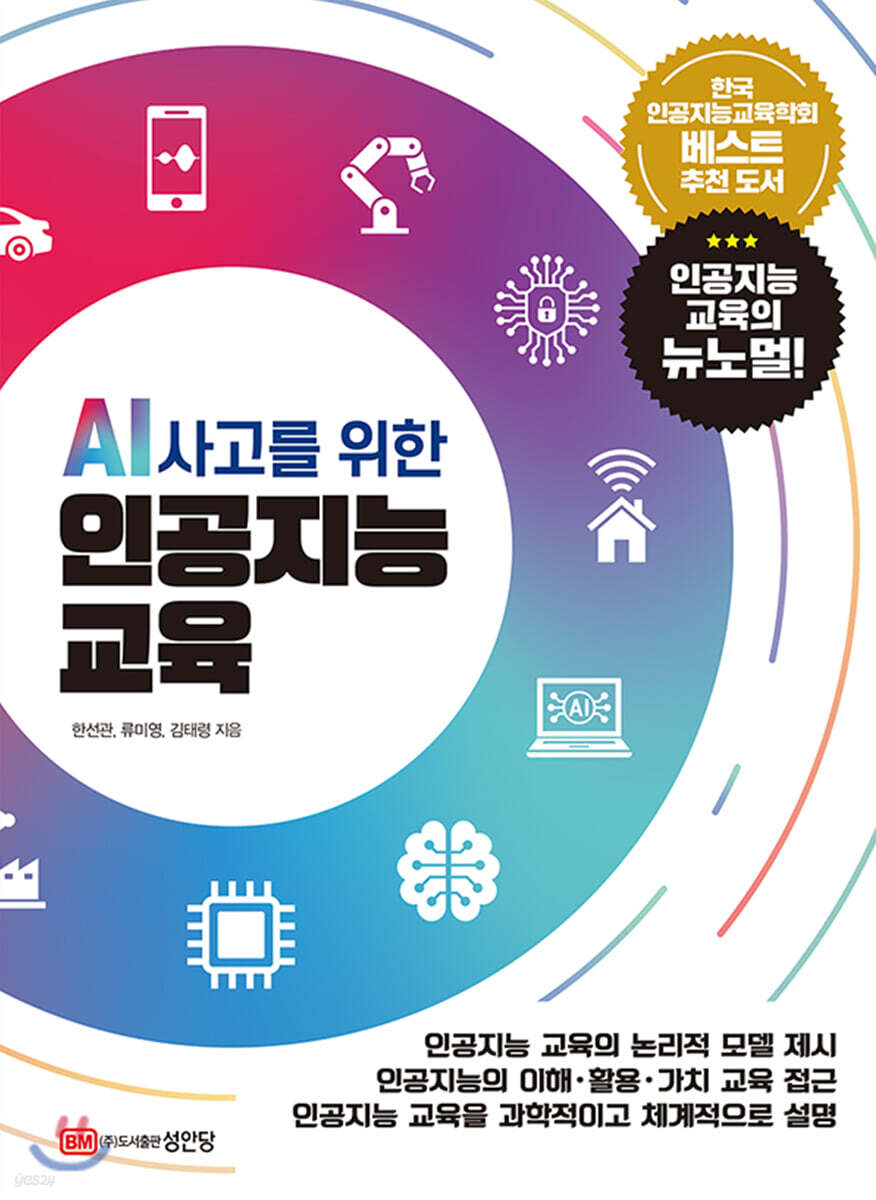
Artificial Intelligence Training for AI Thinking
 |
Description
Book Introduction
Presenting a blueprint for AI education, the core of future education!
Presenting a logical model for AI education, approaching AI education scientifically and systematically!
Artificial Intelligence Training for AI Thinking
The core code of future education is undoubtedly artificial intelligence.
The Ministry of Education has been busy establishing a Future Education Promotion Team in the first half of this year, and the promotion of AI education was recently included among the five policies necessary to lead future education announced by Minister of Education Yoo Eun-hye.
This book is a textbook written to establish a new standard for AI education, designed to train teachers with the right skills for schools, teachers, and graduate schools of education at all levels, for the urgent and critical AI education.
This book, which was completed with the participation of teachers from the Future Talent Research Institute and members of the Artificial Intelligence Education Research Institute, led by Han Seon-gwan, the president of the Korean Society for Artificial Intelligence Education (Professor of Computer Education, Gyeongin National University of Education), who is an authority on artificial intelligence education and has been actively developing an artificial intelligence education framework and signing an agreement for the development of artificial intelligence education with the Incheon Metropolitan Office of Education, is comprehensive in that it not only presents guidelines for artificial intelligence education but also presents a logical model for artificial intelligence education and basic data for the standardization of artificial intelligence education.
Additionally, based on the basic academic studies of artificial intelligence and computer science, it introduces the key concepts and technologies of artificial intelligence and presents various educational approaches to artificial intelligence, including understanding education, utilization education, and value education.
In particular, it presents educational methods and class examples for applying actual artificial intelligence to field education.
This book is expected to serve as a new milestone for educators, researchers, and interested students preparing for various AI education programs.
Presenting a logical model for AI education, approaching AI education scientifically and systematically!
Artificial Intelligence Training for AI Thinking
The core code of future education is undoubtedly artificial intelligence.
The Ministry of Education has been busy establishing a Future Education Promotion Team in the first half of this year, and the promotion of AI education was recently included among the five policies necessary to lead future education announced by Minister of Education Yoo Eun-hye.
This book is a textbook written to establish a new standard for AI education, designed to train teachers with the right skills for schools, teachers, and graduate schools of education at all levels, for the urgent and critical AI education.
This book, which was completed with the participation of teachers from the Future Talent Research Institute and members of the Artificial Intelligence Education Research Institute, led by Han Seon-gwan, the president of the Korean Society for Artificial Intelligence Education (Professor of Computer Education, Gyeongin National University of Education), who is an authority on artificial intelligence education and has been actively developing an artificial intelligence education framework and signing an agreement for the development of artificial intelligence education with the Incheon Metropolitan Office of Education, is comprehensive in that it not only presents guidelines for artificial intelligence education but also presents a logical model for artificial intelligence education and basic data for the standardization of artificial intelligence education.
Additionally, based on the basic academic studies of artificial intelligence and computer science, it introduces the key concepts and technologies of artificial intelligence and presents various educational approaches to artificial intelligence, including understanding education, utilization education, and value education.
In particular, it presents educational methods and class examples for applying actual artificial intelligence to field education.
This book is expected to serve as a new milestone for educators, researchers, and interested students preparing for various AI education programs.
- You can preview some of the book's contents.
Preview
index
Recommendation
Recommendation
Author's biography
preface
Guidelines for AI Education
Part 1: Artificial Intelligence Society
1.
The Age of Artificial Intelligence
2.
Artificial intelligence in everyday life
2.1 Artificial intelligence that challenges humans
2.2 Artificial Intelligence Judges
2.3 Artificial Intelligence that Demonstrates Creativity
3.
Artificial intelligence that changes the world
3.1 A Statistical Approach to Society Transformed by Artificial Intelligence
3.2 Artificial Intelligence and Jobs
4.
The impact of artificial intelligence
4.1 Humanity Preparing for the AI Era
4.2 The Future of Artificial Intelligence
4.3 Jobs and Job Replacement by AI
Part 2: Education and Artificial Intelligence
1.
National competitiveness, artificial intelligence
2.
Cultivating AI talent at the risk of life and death
3.
Overseas AI education cases
4.
Domestic artificial intelligence education policy
5.
The Need for Artificial Intelligence Education
6.
Basis for introducing artificial intelligence education
7.
Approaches to AI Education
8.
Various Perspectives on AI Education
9.
Types of AI Education
10.
AI Integrated Education Model
11.
The thinking skills pursued by artificial intelligence education
12.
The Need for Artificial Intelligence Thinking
13.
Computational thinking and artificial intelligence thinking
14.
Defining AI Thinking
15.
Expanding AI's Thinking Power
16.
Education for the Era of Artificial Intelligence
17.
AI Education for Everyone
Part 3: The Knowledge System of Artificial Intelligence
1.
The Basics of Artificial Intelligence
1.1 History of Artificial Intelligence
1.2 Artificial Intelligence and Human Intelligence
1.3 Agent Model
1.4 Artificial Intelligence and Software
1.5 Basic knowledge of artificial intelligence
1.6 Artificial Intelligence Algorithms and Applications
1.7 The Realm of Artificial Intelligence
1.7.1 Intrinsic function
1.7.2 External Functions
1.7.3 Interactions
1.8 Diagram of Artificial Intelligence and Academic Systems
2.
Machine Navigation: Problems and Navigation
2.1 Problems, Answers, and Status
2.2 Random search method
2.2.1 Breadth-first search
2.2.2 Depth-first search
2.2.3 Depth-limited search
2.2.4 Bidirectional Navigation
2.3 Exploration strategies using information
2.3.1 Greedy Algorithm
2.3.2 A* Algorithm
2.4 Optimization Search Strategy
2.4.1 Hill Climb Navigation
2.4.2 Genetic Algorithm
2.5 Game Exploration
2.5.1 Min-Max Algorithm
2.5.2 Monte Carlo Algorithm
2.6 Constraint Satisfaction Problem (Backtracking Search)
2.7 Other Exploration and Exploration Issues
3.
Machine Reasoning: Knowledge and Reasoning
3.1 Components of Knowledge-Based Artificial Intelligence
3.2 frames
3.3 Logic
3.3.1 Propositional logic
3.4 Semantic Network
3.5 Planning
3.5.1 Algorithm for Planning
3.5.2 Types of Planning Problems
3.5.3 Planning Graph
3.5.4 Other languages
3.6 Uncertainty
3.6.1 Basic probability of uncertainty
3.6.2 Bayes' theorem
3.7 Probabilistic Inference
3.8 Decision-making
4.
Machine Learning: Data and Learning
4.1 Overview of Machine Learning
4.2 Supervised learning
4.2.1 Regression
4.2.2 Linear regression
4.2.3 Logistic Regression
4.2.4 Decision Tree
4.2.5 SVM
4.2.6 Random Forest
4.2.7 Naive Bayes
4.3 Unsupervised learning
4.3.1 K-Means
4.3.2 Gaussian mixture model
4.3.3 Principal component analysis
4.3.4 Artificial Neural Networks
4.3.5 Deep Learning
4.3.6 Convolutional Neural Networks
4.4 Reinforcement Learning
4.4.1 MDP and MRP
4.4.2 A3C
4.5 Big Data
5.
Data Science: Data and Science
5.1 Fields of study in data science
5.2 Data Science Processes
5.3 Types of Data Science Professionals
5.4 Data Science Tools
5.5 Differences Between Data Science and Business Intelligence (BI)
5.5.1 Applications of Data Science
5.6 Key Differences Between Data Science and Machine Learning
6.
Machine Perception: Sensation and Cognition
6.1 Pattern Recognition
6.2 Image formation
6.2.1 Basic Image Detection
6.3 Image Processing
6.3.1 Corner Detection
6.3.2 Textures
6.3.3 Optical Flow
6.3.4 Image Segmentation
6.4 Object Recognition
6.4.1 HOG
6.4.2 R-CNN
6.4.3 YOLO & SSD
6.5 3D World
6.6 Voice Recognition
7.
Natural Language Processing: Language and Communication
7.1 Probabilistic Approaches to Language Analysis
7.2 Key Ideas of NLP - Text Classification
7.3 Characteristics of Natural Language and Natural Language Processing Components
7.3.1 Morphological and lexical analysis
7.3.2 Syntax Analysis
7.3.3 Semantic Analysis
7.3.4 Discourse Integration and Pragmatic Analysis
7.4 Deep Learning-Based Natural Language Processing
7.5 Speaker Recognition
8.
Robotics: Behavior and Action
8.1 Robot Hardware
8.1.1 Robot sensors
8.1.2 Robot actuators
8.2 Robot perception
8.2.1 Positioning
8.2.2 Map Creation
8.3 Robot Planning
8.4 Robot Software
9.
Artificial Intelligence Issues: Artificial Intelligence, Humans, and Social
influence
9.1 Weak AI and Strong AI
9.2 Consciousness and qualia
9.3 Ethical Issues of Artificial Intelligence
9.3.1 Responsibility: Who is responsible for checking?
9.3.2 Transparency: Explainable AI, its use
Transparency
9.3.3 Fairness: Data Bias, Fairness of Use
9.3.4 Other Ethical Issues
Part 4: Education for Understanding Artificial Intelligence
1. Overview of AI Understanding Education
2.
The Relationship Between Software Education and AI Understanding Education
2.1 The type of talent and learner competencies required for AI understanding education
2.2 Competencies Pursued in AI Understanding Education
2.3 Goals of AI Understanding Education
3. Types of AI Understanding Curriculum Design
4. Content structure of AI understanding education
4.1 Three Major Areas of AI Understanding Education
4.1.1 'Intelligence Expression' Area
4.1.2 'Interaction' area
4.1.3 'Social Influence' Area
4.2 Seven major topics for learning in the three areas
4.3 A Standard Framework for AI Understanding Education
5. Design of an AI Understanding Curriculum
6. Methods of AI Understanding Education
6.1 Teaching and Learning Models for Knowledge Expansion
6.2 Teaching and Learning Model for Functional Development
6.3 Teaching and Learning Model for Attitude
7. AI Understanding Education: Teaching and Learning Strategies for Each Level
8. Evaluation of AI Understanding Education
Part 5: Education Using Artificial Intelligence
1. Overview of AI-based education
2. Capacity Building through AI-Based Training
3.
Educational Subjects and AI-Used Education
4. Tools for AI-based education
5. Types of AI-based education
5.1 AI-based education
5.2 AI Convergence Education (STEAM Education)
5.3 AI-based education
5.4 Using AI in Education Policy Work
6. AI-based education
6.1 Examples of AI-powered education in music education
6.1.1 Nature of music curriculum
6.1.2 Goals of Music Education
6.2 AI Utilization Educational Cases for Each Subject
6.2.1 AI-based education in moral (ethical) education
6.2.2 AI-based education in Korean language classes
6.2.3 AI-based education in mathematics
6.2.4 Social Studies AI Education
6.2.5 AI-based education in science curriculum
6.2.6 AI-based education in physical education
6.2.7 AI-based education in art classes
6.2.8 AI-based education in practical arts (technology and home economics) subjects
6.2.9 AI-powered English education
7. AI Convergence Education
7.1 Procedures for industrial convergence projects utilizing AI services
7.2 Industry Convergence Problem-Solving Class Case: Automobile Driving Support
8. AI-based education (online education system, edutech)
8.1 AI and EdTech Meet
8.2 Areas of AI Application in Education
8.2.1 University Use Cases
9.
Using AI in Education Policy
9.1 Various variables and factors for utilizing AI in education policy
9.2 Case Studies of AI in Education Policy
10. Integrated Platform for AI-Based Education
Part 6: Education with a View on Artificial Intelligence
1. Overview of AI Value Education
2. Early Research on AI Ethics
3.
AI Ethics Issues by Industry
3.1 Manufacturing Sector: Autonomous Vehicles
3.2 Financial Sector: Robo-Advisors
3.3 Medical Field: Health Care
3.4 Military: Autonomous Weapon Systems
4. Domestic and International Cases of AI Ethics
5. Approach to AI Value Education
5.1 Current Status of AI Ethics Education at Home and Abroad
6. Topic composition of AI value education
6.1 Various Topics of AI Value Education
7. Model for AI Value Education
8.
Human-centered, benevolent AI
8.1 AI Project for Health
8.2 AI Project for the Earth's Environment
8.3 AI Projects for People with Disabilities
8.4 AI Project for Cultural Heritage
8.5 AI for Humanity
9.
Accountability, Responsible AI
10.
Transparency and explainable AI
10.1 Four modes of description techniques
10.2 How to develop explainable AI modes
11.
Privacy vs.
Data 3 Laws
11.1 Amendment to the Information and Communications Network Act
11.2 Amendment to the Credit Information Act
12.
Fairness and non-discrimination
12.1 Algorithmic Morality
13.
Stability and reliability
Part 7: The Reality of Artificial Intelligence Classes
◈ Types and approaches to AI classes
1. AI knowledge-centered classes
1.1 Knowledge-Centered Lesson 1: AI Cognitive Modeling Lesson
1.1.1 AI Cognitive Modeling Teaching Strategy - Connected Strategy
1.1.2 AI Cognitive Modeling Class Steps
1.2 Knowledge-Centered Lesson 2: AI Concept Formation Lesson
1.3 Knowledge-Centered Lesson 3: AI Discovery Exploration Lesson
1.4 Knowledge-Centered Class 4: AIT Thinking-Based Class (SW·AI Linked Class)
2. AI-focused classes
2.1 AI Function-Centered Class 1: AI Education Platform
Programming classes using
2.2 AI Function-Focused Class 2: Data Analysis Programming Class
2.3 AI Function-Centered Lesson 3: Programming Lesson Using AI Frameworks
2.4 AI Tensorable Computing Lesson 1: AI Edge Computing
2.5 AI Tensile Computing Lesson 2: AI Maker Activities
2.6 AI Tensorable Computing Lesson 3: Using AI Robots
3. AI Attitude-Centered Classes
3.1 AI Attitude-Centered Class 1; Technology-Centered Class
3.2 AI Attitude-Centered Class 2; Society-Centered Class
3.3 AI Attitude-Centered Class 3: Ethics-Centered Class
Support for Part 8 AI Education Practice
1. Types of Practical Resources for AI Education
2.
General-purpose AI commercial platform
2.1 Google AutoML
2.2 Superannotation
2.3 Apple CreateML
2.4 Fritz AI
2.5 RunwayML
2.6 Obviously AI
2.7 MakeML
2.8 Facebook
2.9 Amazon
2.10 Microsoft
2.11 IBM
2.12 Naver
3. AI Chatbot Platform
3.1 Types of AI Chatbot Platforms
3.1.1 Dialog Flow
3.1.2 ManyChat
3.1.3 Chatbot.com
3.1.4 Chatfuel
3.1.5 Mobile Monkey
3.1.6 Fresh Chat
4. Specialized platform for AI education
4.1 Types of Platforms
4.1.1 ML4Kids
4.1.2 Teachable Machine
4.1.3 Cognimate
4.2 AI Experience
4.2.1 TensorFlow Playground
4.2.2 With Google AI Labs
4.2.3 Autodraw
4.2.4 Quickdraw
4.2.5 Magenta
4.2.6 Computer Vision
4.2.7 Automatic Image Editing
4.2.8 Word Recognition Game
4.3 Educational Programming Language Tools
4.3.1 EPL
4.3.2 Scratch
4.3.3 Entry
4.3.4 M-Block
4.3.5 Deep AI
5. Programming Languages for AI Development
5.1 Types of Programming Languages
5.1.1 Python
5.1.2 R
5.1.3 LISP
5.1.4 Prolog
5.1.5 C/C++
5.1.6 Java
5.1.7 Javascript
5.1.8 Julia
5.1.9 Other Programming Languages
5.2 Representative AI Framework Libraries
5.2.1 Theano
5.2.2 Tensorflow
5.2.3 Keras
5.2.4 Lasagne
5.2.5 Caffe
5.2.6 Deep Learning 4j
5.2.7 MxNet
5.2.8 Torch
5.2.9 CNTK
5.3 Python Core Libraries and Tools
5.3.1 Numpy
5.3.2 Scipy
5.3.3 matapololib
5.3.4 pandas
5.3.5 Jupyter Notebook
5.4 Learning AI Programming Development
5.4.1 Code.org
5.4.2 Life Coding
5.4.3 Prologue Training
5.5 AI learning type
5.5.1 Al4School
5.5.2 Al4TEACHER
5.5.3 Technovation
5.5.4 Elements of AI
5.5.5 edX
5.5.6 SW-AI Education Portal
5.5.7 Creative Computing
5.5.8 Google's AI AZ
5.5.9 AI Crash Course
5.5.10 Microsoft's AI Learning Site
5.5.11 Open AI
References
Recommendation
Author's biography
preface
Guidelines for AI Education
Part 1: Artificial Intelligence Society
1.
The Age of Artificial Intelligence
2.
Artificial intelligence in everyday life
2.1 Artificial intelligence that challenges humans
2.2 Artificial Intelligence Judges
2.3 Artificial Intelligence that Demonstrates Creativity
3.
Artificial intelligence that changes the world
3.1 A Statistical Approach to Society Transformed by Artificial Intelligence
3.2 Artificial Intelligence and Jobs
4.
The impact of artificial intelligence
4.1 Humanity Preparing for the AI Era
4.2 The Future of Artificial Intelligence
4.3 Jobs and Job Replacement by AI
Part 2: Education and Artificial Intelligence
1.
National competitiveness, artificial intelligence
2.
Cultivating AI talent at the risk of life and death
3.
Overseas AI education cases
4.
Domestic artificial intelligence education policy
5.
The Need for Artificial Intelligence Education
6.
Basis for introducing artificial intelligence education
7.
Approaches to AI Education
8.
Various Perspectives on AI Education
9.
Types of AI Education
10.
AI Integrated Education Model
11.
The thinking skills pursued by artificial intelligence education
12.
The Need for Artificial Intelligence Thinking
13.
Computational thinking and artificial intelligence thinking
14.
Defining AI Thinking
15.
Expanding AI's Thinking Power
16.
Education for the Era of Artificial Intelligence
17.
AI Education for Everyone
Part 3: The Knowledge System of Artificial Intelligence
1.
The Basics of Artificial Intelligence
1.1 History of Artificial Intelligence
1.2 Artificial Intelligence and Human Intelligence
1.3 Agent Model
1.4 Artificial Intelligence and Software
1.5 Basic knowledge of artificial intelligence
1.6 Artificial Intelligence Algorithms and Applications
1.7 The Realm of Artificial Intelligence
1.7.1 Intrinsic function
1.7.2 External Functions
1.7.3 Interactions
1.8 Diagram of Artificial Intelligence and Academic Systems
2.
Machine Navigation: Problems and Navigation
2.1 Problems, Answers, and Status
2.2 Random search method
2.2.1 Breadth-first search
2.2.2 Depth-first search
2.2.3 Depth-limited search
2.2.4 Bidirectional Navigation
2.3 Exploration strategies using information
2.3.1 Greedy Algorithm
2.3.2 A* Algorithm
2.4 Optimization Search Strategy
2.4.1 Hill Climb Navigation
2.4.2 Genetic Algorithm
2.5 Game Exploration
2.5.1 Min-Max Algorithm
2.5.2 Monte Carlo Algorithm
2.6 Constraint Satisfaction Problem (Backtracking Search)
2.7 Other Exploration and Exploration Issues
3.
Machine Reasoning: Knowledge and Reasoning
3.1 Components of Knowledge-Based Artificial Intelligence
3.2 frames
3.3 Logic
3.3.1 Propositional logic
3.4 Semantic Network
3.5 Planning
3.5.1 Algorithm for Planning
3.5.2 Types of Planning Problems
3.5.3 Planning Graph
3.5.4 Other languages
3.6 Uncertainty
3.6.1 Basic probability of uncertainty
3.6.2 Bayes' theorem
3.7 Probabilistic Inference
3.8 Decision-making
4.
Machine Learning: Data and Learning
4.1 Overview of Machine Learning
4.2 Supervised learning
4.2.1 Regression
4.2.2 Linear regression
4.2.3 Logistic Regression
4.2.4 Decision Tree
4.2.5 SVM
4.2.6 Random Forest
4.2.7 Naive Bayes
4.3 Unsupervised learning
4.3.1 K-Means
4.3.2 Gaussian mixture model
4.3.3 Principal component analysis
4.3.4 Artificial Neural Networks
4.3.5 Deep Learning
4.3.6 Convolutional Neural Networks
4.4 Reinforcement Learning
4.4.1 MDP and MRP
4.4.2 A3C
4.5 Big Data
5.
Data Science: Data and Science
5.1 Fields of study in data science
5.2 Data Science Processes
5.3 Types of Data Science Professionals
5.4 Data Science Tools
5.5 Differences Between Data Science and Business Intelligence (BI)
5.5.1 Applications of Data Science
5.6 Key Differences Between Data Science and Machine Learning
6.
Machine Perception: Sensation and Cognition
6.1 Pattern Recognition
6.2 Image formation
6.2.1 Basic Image Detection
6.3 Image Processing
6.3.1 Corner Detection
6.3.2 Textures
6.3.3 Optical Flow
6.3.4 Image Segmentation
6.4 Object Recognition
6.4.1 HOG
6.4.2 R-CNN
6.4.3 YOLO & SSD
6.5 3D World
6.6 Voice Recognition
7.
Natural Language Processing: Language and Communication
7.1 Probabilistic Approaches to Language Analysis
7.2 Key Ideas of NLP - Text Classification
7.3 Characteristics of Natural Language and Natural Language Processing Components
7.3.1 Morphological and lexical analysis
7.3.2 Syntax Analysis
7.3.3 Semantic Analysis
7.3.4 Discourse Integration and Pragmatic Analysis
7.4 Deep Learning-Based Natural Language Processing
7.5 Speaker Recognition
8.
Robotics: Behavior and Action
8.1 Robot Hardware
8.1.1 Robot sensors
8.1.2 Robot actuators
8.2 Robot perception
8.2.1 Positioning
8.2.2 Map Creation
8.3 Robot Planning
8.4 Robot Software
9.
Artificial Intelligence Issues: Artificial Intelligence, Humans, and Social
influence
9.1 Weak AI and Strong AI
9.2 Consciousness and qualia
9.3 Ethical Issues of Artificial Intelligence
9.3.1 Responsibility: Who is responsible for checking?
9.3.2 Transparency: Explainable AI, its use
Transparency
9.3.3 Fairness: Data Bias, Fairness of Use
9.3.4 Other Ethical Issues
Part 4: Education for Understanding Artificial Intelligence
1. Overview of AI Understanding Education
2.
The Relationship Between Software Education and AI Understanding Education
2.1 The type of talent and learner competencies required for AI understanding education
2.2 Competencies Pursued in AI Understanding Education
2.3 Goals of AI Understanding Education
3. Types of AI Understanding Curriculum Design
4. Content structure of AI understanding education
4.1 Three Major Areas of AI Understanding Education
4.1.1 'Intelligence Expression' Area
4.1.2 'Interaction' area
4.1.3 'Social Influence' Area
4.2 Seven major topics for learning in the three areas
4.3 A Standard Framework for AI Understanding Education
5. Design of an AI Understanding Curriculum
6. Methods of AI Understanding Education
6.1 Teaching and Learning Models for Knowledge Expansion
6.2 Teaching and Learning Model for Functional Development
6.3 Teaching and Learning Model for Attitude
7. AI Understanding Education: Teaching and Learning Strategies for Each Level
8. Evaluation of AI Understanding Education
Part 5: Education Using Artificial Intelligence
1. Overview of AI-based education
2. Capacity Building through AI-Based Training
3.
Educational Subjects and AI-Used Education
4. Tools for AI-based education
5. Types of AI-based education
5.1 AI-based education
5.2 AI Convergence Education (STEAM Education)
5.3 AI-based education
5.4 Using AI in Education Policy Work
6. AI-based education
6.1 Examples of AI-powered education in music education
6.1.1 Nature of music curriculum
6.1.2 Goals of Music Education
6.2 AI Utilization Educational Cases for Each Subject
6.2.1 AI-based education in moral (ethical) education
6.2.2 AI-based education in Korean language classes
6.2.3 AI-based education in mathematics
6.2.4 Social Studies AI Education
6.2.5 AI-based education in science curriculum
6.2.6 AI-based education in physical education
6.2.7 AI-based education in art classes
6.2.8 AI-based education in practical arts (technology and home economics) subjects
6.2.9 AI-powered English education
7. AI Convergence Education
7.1 Procedures for industrial convergence projects utilizing AI services
7.2 Industry Convergence Problem-Solving Class Case: Automobile Driving Support
8. AI-based education (online education system, edutech)
8.1 AI and EdTech Meet
8.2 Areas of AI Application in Education
8.2.1 University Use Cases
9.
Using AI in Education Policy
9.1 Various variables and factors for utilizing AI in education policy
9.2 Case Studies of AI in Education Policy
10. Integrated Platform for AI-Based Education
Part 6: Education with a View on Artificial Intelligence
1. Overview of AI Value Education
2. Early Research on AI Ethics
3.
AI Ethics Issues by Industry
3.1 Manufacturing Sector: Autonomous Vehicles
3.2 Financial Sector: Robo-Advisors
3.3 Medical Field: Health Care
3.4 Military: Autonomous Weapon Systems
4. Domestic and International Cases of AI Ethics
5. Approach to AI Value Education
5.1 Current Status of AI Ethics Education at Home and Abroad
6. Topic composition of AI value education
6.1 Various Topics of AI Value Education
7. Model for AI Value Education
8.
Human-centered, benevolent AI
8.1 AI Project for Health
8.2 AI Project for the Earth's Environment
8.3 AI Projects for People with Disabilities
8.4 AI Project for Cultural Heritage
8.5 AI for Humanity
9.
Accountability, Responsible AI
10.
Transparency and explainable AI
10.1 Four modes of description techniques
10.2 How to develop explainable AI modes
11.
Privacy vs.
Data 3 Laws
11.1 Amendment to the Information and Communications Network Act
11.2 Amendment to the Credit Information Act
12.
Fairness and non-discrimination
12.1 Algorithmic Morality
13.
Stability and reliability
Part 7: The Reality of Artificial Intelligence Classes
◈ Types and approaches to AI classes
1. AI knowledge-centered classes
1.1 Knowledge-Centered Lesson 1: AI Cognitive Modeling Lesson
1.1.1 AI Cognitive Modeling Teaching Strategy - Connected Strategy
1.1.2 AI Cognitive Modeling Class Steps
1.2 Knowledge-Centered Lesson 2: AI Concept Formation Lesson
1.3 Knowledge-Centered Lesson 3: AI Discovery Exploration Lesson
1.4 Knowledge-Centered Class 4: AIT Thinking-Based Class (SW·AI Linked Class)
2. AI-focused classes
2.1 AI Function-Centered Class 1: AI Education Platform
Programming classes using
2.2 AI Function-Focused Class 2: Data Analysis Programming Class
2.3 AI Function-Centered Lesson 3: Programming Lesson Using AI Frameworks
2.4 AI Tensorable Computing Lesson 1: AI Edge Computing
2.5 AI Tensile Computing Lesson 2: AI Maker Activities
2.6 AI Tensorable Computing Lesson 3: Using AI Robots
3. AI Attitude-Centered Classes
3.1 AI Attitude-Centered Class 1; Technology-Centered Class
3.2 AI Attitude-Centered Class 2; Society-Centered Class
3.3 AI Attitude-Centered Class 3: Ethics-Centered Class
Support for Part 8 AI Education Practice
1. Types of Practical Resources for AI Education
2.
General-purpose AI commercial platform
2.1 Google AutoML
2.2 Superannotation
2.3 Apple CreateML
2.4 Fritz AI
2.5 RunwayML
2.6 Obviously AI
2.7 MakeML
2.8 Facebook
2.9 Amazon
2.10 Microsoft
2.11 IBM
2.12 Naver
3. AI Chatbot Platform
3.1 Types of AI Chatbot Platforms
3.1.1 Dialog Flow
3.1.2 ManyChat
3.1.3 Chatbot.com
3.1.4 Chatfuel
3.1.5 Mobile Monkey
3.1.6 Fresh Chat
4. Specialized platform for AI education
4.1 Types of Platforms
4.1.1 ML4Kids
4.1.2 Teachable Machine
4.1.3 Cognimate
4.2 AI Experience
4.2.1 TensorFlow Playground
4.2.2 With Google AI Labs
4.2.3 Autodraw
4.2.4 Quickdraw
4.2.5 Magenta
4.2.6 Computer Vision
4.2.7 Automatic Image Editing
4.2.8 Word Recognition Game
4.3 Educational Programming Language Tools
4.3.1 EPL
4.3.2 Scratch
4.3.3 Entry
4.3.4 M-Block
4.3.5 Deep AI
5. Programming Languages for AI Development
5.1 Types of Programming Languages
5.1.1 Python
5.1.2 R
5.1.3 LISP
5.1.4 Prolog
5.1.5 C/C++
5.1.6 Java
5.1.7 Javascript
5.1.8 Julia
5.1.9 Other Programming Languages
5.2 Representative AI Framework Libraries
5.2.1 Theano
5.2.2 Tensorflow
5.2.3 Keras
5.2.4 Lasagne
5.2.5 Caffe
5.2.6 Deep Learning 4j
5.2.7 MxNet
5.2.8 Torch
5.2.9 CNTK
5.3 Python Core Libraries and Tools
5.3.1 Numpy
5.3.2 Scipy
5.3.3 matapololib
5.3.4 pandas
5.3.5 Jupyter Notebook
5.4 Learning AI Programming Development
5.4.1 Code.org
5.4.2 Life Coding
5.4.3 Prologue Training
5.5 AI learning type
5.5.1 Al4School
5.5.2 Al4TEACHER
5.5.3 Technovation
5.5.4 Elements of AI
5.5.5 edX
5.5.6 SW-AI Education Portal
5.5.7 Creative Computing
5.5.8 Google's AI AZ
5.5.9 AI Crash Course
5.5.10 Microsoft's AI Learning Site
5.5.11 Open AI
References
Detailed image
.jpg)
Publisher's Review
Recommendation
At a time when artificial intelligence is at the core of education policy and the introduction of AI content elements into the curriculum is being discussed, accessing "Artificial Intelligence Education for AI Thinking" is truly a stroke of luck for those responsible for AI education.
I hope that readers of this book—researchers, teachers, and policymakers embarking on AI education—will gain new knowledge about AI education content, behavioral goals, teaching and learning models, and assessment, and apply this knowledge to their own practice.
Jang Si-jun (Director of the Digital Education Policy Division, Korea Education and Research Information Service)
The Ministry of Education is promoting educational policies to foster emotionally creative talent, a hyper-personalized learning environment, and warm intelligence to usher in an era of artificial intelligence for all, and is working to introduce artificial intelligence education into schools.
I am confident that this book will serve as a compass that will guide AI education in the right direction.
I recommend it to many people preparing for the future and to educators.
Kang Seong-hun (Researcher, Ministry of Education)
The Incheon Metropolitan Office of Education emphasizes the need for AI education to lead the future, and is working with the Korean Society for Artificial Intelligence Education, in which the authors of this book participated, to promote a sound AI education policy, reflecting the voices of the times and schools demanding changes in education that AI will bring.
I recommend this book as it provides a broad framework for AI education and suggests the right direction, not only in universities but also in primary and secondary education.
/ Yeon Su-hyeon (Scholarship Officer, Incheon Metropolitan Office of Education)
Artificial intelligence has become a subject that must be learned throughout one's life cycle and a required skill in all university departments.
For students majoring in science and engineering, this book is recommended as a required major course, and for students majoring in other fields, this book is recommended as a required general education course.
/ Lee Cheol-hyeon (Professor, Gyeongin National University of Education)
For college students, AI education is not an option, it is a necessity.
This book is a testament to the authors' dedication to providing a rich foundation of engineering education while maintaining a balanced approach and fostering a warm perspective on AI education.
I highly recommend it to anyone who wants to prepare for and get a glimpse into the future created by artificial intelligence.
Lee Se-hoon (Professor, Inha Technical College)
The authors, who always pioneer new paths and suggest specific directions, have once again taken on a new challenge.
The themes that permeate this book are change, the future, good technology, and human-centered education.
This book, written by authors with extensive educational experience, offers a detailed and in-depth look at the future of AI education.
A must-read for anyone interested in exploring the future of our education.
/ Jeon Su-jin (Professor, Hoseo University)
This book is a must-read for teachers, as it covers a variety of topics related to AI education to help students, who will lead the lives of the future, understand the basic concepts and principles of AI, develop specific methods for utilizing AI, and further, instill AI ethics and proper values.
Strongly recommended! / Hong Su-bin (President of the Software Teachers Research Association, elementary school teacher)
AI education is especially important for middle school students, whose values are just beginning to form.
This book explains creative and diverse educational content and methods for understanding and practicing artificial intelligence, and I believe every teacher in Korea should read it.
Kim Se-ho (Physical Computing Education Research Association Director, Middle School Teacher)
Starting in the second semester of 2021, "Fundamentals of Artificial Intelligence" and "Artificial Intelligence Mathematics" will be offered as elective courses in high schools, making artificial intelligence a pressing issue that all teachers and students must learn.
It is rich in diverse theories and practical examples of AI education, making it particularly helpful for teachers.
Shim Hyeon-bo (Principal of Incheon Science and Arts High School)
At a time when artificial intelligence is at the core of education policy and the introduction of AI content elements into the curriculum is being discussed, accessing "Artificial Intelligence Education for AI Thinking" is truly a stroke of luck for those responsible for AI education.
I hope that readers of this book—researchers, teachers, and policymakers embarking on AI education—will gain new knowledge about AI education content, behavioral goals, teaching and learning models, and assessment, and apply this knowledge to their own practice.
Jang Si-jun (Director of the Digital Education Policy Division, Korea Education and Research Information Service)
The Ministry of Education is promoting educational policies to foster emotionally creative talent, a hyper-personalized learning environment, and warm intelligence to usher in an era of artificial intelligence for all, and is working to introduce artificial intelligence education into schools.
I am confident that this book will serve as a compass that will guide AI education in the right direction.
I recommend it to many people preparing for the future and to educators.
Kang Seong-hun (Researcher, Ministry of Education)
The Incheon Metropolitan Office of Education emphasizes the need for AI education to lead the future, and is working with the Korean Society for Artificial Intelligence Education, in which the authors of this book participated, to promote a sound AI education policy, reflecting the voices of the times and schools demanding changes in education that AI will bring.
I recommend this book as it provides a broad framework for AI education and suggests the right direction, not only in universities but also in primary and secondary education.
/ Yeon Su-hyeon (Scholarship Officer, Incheon Metropolitan Office of Education)
Artificial intelligence has become a subject that must be learned throughout one's life cycle and a required skill in all university departments.
For students majoring in science and engineering, this book is recommended as a required major course, and for students majoring in other fields, this book is recommended as a required general education course.
/ Lee Cheol-hyeon (Professor, Gyeongin National University of Education)
For college students, AI education is not an option, it is a necessity.
This book is a testament to the authors' dedication to providing a rich foundation of engineering education while maintaining a balanced approach and fostering a warm perspective on AI education.
I highly recommend it to anyone who wants to prepare for and get a glimpse into the future created by artificial intelligence.
Lee Se-hoon (Professor, Inha Technical College)
The authors, who always pioneer new paths and suggest specific directions, have once again taken on a new challenge.
The themes that permeate this book are change, the future, good technology, and human-centered education.
This book, written by authors with extensive educational experience, offers a detailed and in-depth look at the future of AI education.
A must-read for anyone interested in exploring the future of our education.
/ Jeon Su-jin (Professor, Hoseo University)
This book is a must-read for teachers, as it covers a variety of topics related to AI education to help students, who will lead the lives of the future, understand the basic concepts and principles of AI, develop specific methods for utilizing AI, and further, instill AI ethics and proper values.
Strongly recommended! / Hong Su-bin (President of the Software Teachers Research Association, elementary school teacher)
AI education is especially important for middle school students, whose values are just beginning to form.
This book explains creative and diverse educational content and methods for understanding and practicing artificial intelligence, and I believe every teacher in Korea should read it.
Kim Se-ho (Physical Computing Education Research Association Director, Middle School Teacher)
Starting in the second semester of 2021, "Fundamentals of Artificial Intelligence" and "Artificial Intelligence Mathematics" will be offered as elective courses in high schools, making artificial intelligence a pressing issue that all teachers and students must learn.
It is rich in diverse theories and practical examples of AI education, making it particularly helpful for teachers.
Shim Hyeon-bo (Principal of Incheon Science and Arts High School)
GOODS SPECIFICS
- Publication date: January 26, 2021
- Page count, weight, size: 552 pages | 1,100g | 188*257*22mm
- ISBN13: 9788931556919
- ISBN10: 8931556918
You may also like
카테고리
korean


korean

![GQ KOREA Mark (Monthly): December [2025]](http://librairie.coreenne.fr/cdn/shop/files/8ef265dbbfbf186523ed75ba7319009d.jpg?v=1765340328&width=3840)


