

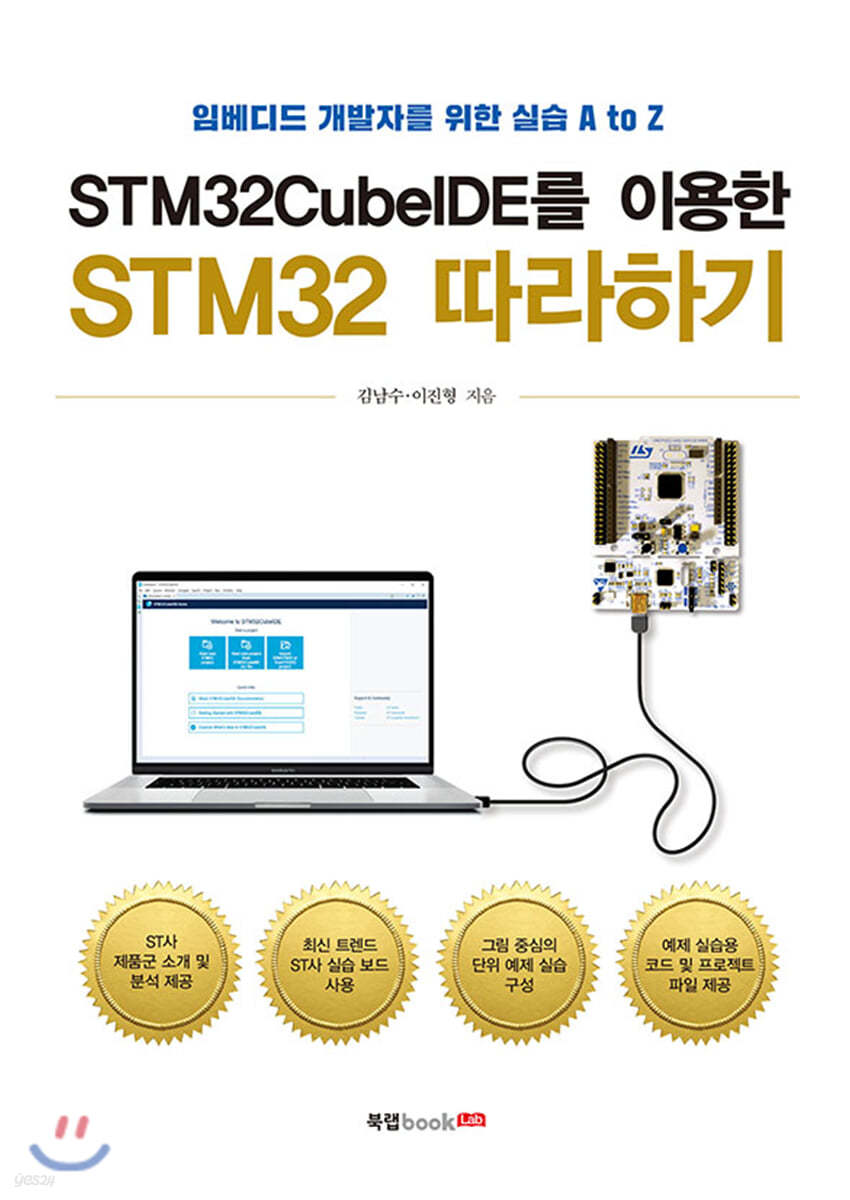
STM32 Tutorial with STM32CubeIDE
 |
Description
Book Introduction
From students to professionals, let's understand it all in one book!
Learn how to use STM32CubeIDE by following along.
A hands-on tutorial on the STM32 family of 32-bit microcontrollers for developers who are unfamiliar with embedded program development.
In an environment where user-centric embedded system design is being built, data is voluminous, but practical information is scattered.
『STM32 Tutorial with STM32CubeIDE』 contains practical examples that can be applied directly to real-world situations by utilizing the latest STM32CubeIDE development tool provided by ST.
Before the practical training, we will introduce the STM32 development board and go over the features of each.
First, we introduce how to analyze the system environment and select an MCU suitable for the design.
This textbook selects the STM32F103 series MCU, the most widely used in domestic designs, and provides detailed guidance on purchasing development boards for beginners unfamiliar with them. The relevant code and files needed for hands-on practice using the STM32CubeIDE program are provided free of charge.
You can follow along with step-by-step images of six peripheral examples and seven hands-on exercises using the NUCLEO board.
Additionally, we introduce methods for dealing with various exceptional situations that may arise during training.
This book will help students and practitioners alike become familiar with the latest development environments and gain confidence in embedded development.
Learn how to use STM32CubeIDE by following along.
A hands-on tutorial on the STM32 family of 32-bit microcontrollers for developers who are unfamiliar with embedded program development.
In an environment where user-centric embedded system design is being built, data is voluminous, but practical information is scattered.
『STM32 Tutorial with STM32CubeIDE』 contains practical examples that can be applied directly to real-world situations by utilizing the latest STM32CubeIDE development tool provided by ST.
Before the practical training, we will introduce the STM32 development board and go over the features of each.
First, we introduce how to analyze the system environment and select an MCU suitable for the design.
This textbook selects the STM32F103 series MCU, the most widely used in domestic designs, and provides detailed guidance on purchasing development boards for beginners unfamiliar with them. The relevant code and files needed for hands-on practice using the STM32CubeIDE program are provided free of charge.
You can follow along with step-by-step images of six peripheral examples and seven hands-on exercises using the NUCLEO board.
Additionally, we introduce methods for dealing with various exceptional situations that may arise during training.
This book will help students and practitioners alike become familiar with the latest development environments and gain confidence in embedded development.
- You can preview some of the book's contents.
Preview
index
Greeting 05
1. STM32 Summary
1.1. STMicroelectronics STM32 Status 12
1.2. Introduction to the STM32 32-bit MCU Family 14
1.3. STM32 Development Board Type 29
1.4. STM32 Ecosystem 31
2.
Setting up a development environment
2.1.
Introduction to the Practice Board 36
2.2. Installing STM32CubeIDE 45
2.3.
Installing a terminal communication program 66
3. Starting an STM32CubeIDE Project
3.1. LED Blink 76
3.2.
printf serial debugging 100
4.
Peripheral example
4.1. EXTI 120
4.2. TIM_TimeBase 138
4.3. ADC 153
4.4. WWDG 171
4.5. USART 180
4.6. TIM_PWM 195
5. Practice using the NUCLEOEVB board
5.1. GPIO 209
5.2. EXTI 226
5.3. ADC 249
5.4. TIM 279
5.5.
I2C 310
5.6. SPI 341
5.7. CLCD 353
5.8.
Application 370
1. STM32 Summary
1.1. STMicroelectronics STM32 Status 12
1.2. Introduction to the STM32 32-bit MCU Family 14
1.3. STM32 Development Board Type 29
1.4. STM32 Ecosystem 31
2.
Setting up a development environment
2.1.
Introduction to the Practice Board 36
2.2. Installing STM32CubeIDE 45
2.3.
Installing a terminal communication program 66
3. Starting an STM32CubeIDE Project
3.1. LED Blink 76
3.2.
printf serial debugging 100
4.
Peripheral example
4.1. EXTI 120
4.2. TIM_TimeBase 138
4.3. ADC 153
4.4. WWDG 171
4.5. USART 180
4.6. TIM_PWM 195
5. Practice using the NUCLEOEVB board
5.1. GPIO 209
5.2. EXTI 226
5.3. ADC 249
5.4. TIM 279
5.5.
I2C 310
5.6. SPI 341
5.7. CLCD 353
5.8.
Application 370
Into the book
Although it has not been five years since I first applied STM32 MCUs to my system design, the development environments provided by chip vendors have advanced at an incredible pace.
Of course, Arduino was the one that started this trend, but seeing major chip vendors quickly adapt to the times suggests that system design engineers don't need to be as fearful of new development environments as they once were.
This book was written with the hope that it would provide an easy guide to a microcontroller-based development environment for system engineers who want to advance from the existing ATMEL AVR MCU to Cortex MCU, and for majors who want to easily get started with microcontrollers like Arduino.
And I hope that the resulting opportunity cost can be focused on more innovative R&D areas and idea generation.
As a professor and developer, I felt the need for a practical textbook that would allow students to acquire knowledge they could immediately apply in the workplace.
This book is easy to follow with illustrations at the center, and the main functions are organized into unit projects so that when you need a function later, you can open the unit project and immediately apply it to your work.
Additionally, the repeated creation of projects allows users to become more familiar with the unfamiliar development environment. Simply purchasing the NUCLEO board allows users to immediately learn simple examples, and the author-designed educational kit allows users to control various external devices.
The final application does not directly release the source code, but provides design directions, allowing readers to design and implement their own projects using various external devices.
Of course, Arduino was the one that started this trend, but seeing major chip vendors quickly adapt to the times suggests that system design engineers don't need to be as fearful of new development environments as they once were.
This book was written with the hope that it would provide an easy guide to a microcontroller-based development environment for system engineers who want to advance from the existing ATMEL AVR MCU to Cortex MCU, and for majors who want to easily get started with microcontrollers like Arduino.
And I hope that the resulting opportunity cost can be focused on more innovative R&D areas and idea generation.
As a professor and developer, I felt the need for a practical textbook that would allow students to acquire knowledge they could immediately apply in the workplace.
This book is easy to follow with illustrations at the center, and the main functions are organized into unit projects so that when you need a function later, you can open the unit project and immediately apply it to your work.
Additionally, the repeated creation of projects allows users to become more familiar with the unfamiliar development environment. Simply purchasing the NUCLEO board allows users to immediately learn simple examples, and the author-designed educational kit allows users to control various external devices.
The final application does not directly release the source code, but provides design directions, allowing readers to design and implement their own projects using various external devices.
--- From "Greetings"
GOODS SPECIFICS
- Date of issue: June 17, 2020
- Page count, weight, size: 372 pages | 780g | 182*257*22mm
- ISBN13: 9791165392659
- ISBN10: 1165392658
You may also like
카테고리
korean


korean

![GQ KOREA Mark (Monthly): December [2025]](http://librairie.coreenne.fr/cdn/shop/files/8ef265dbbfbf186523ed75ba7319009d.jpg?v=1765340328&width=3840)


