

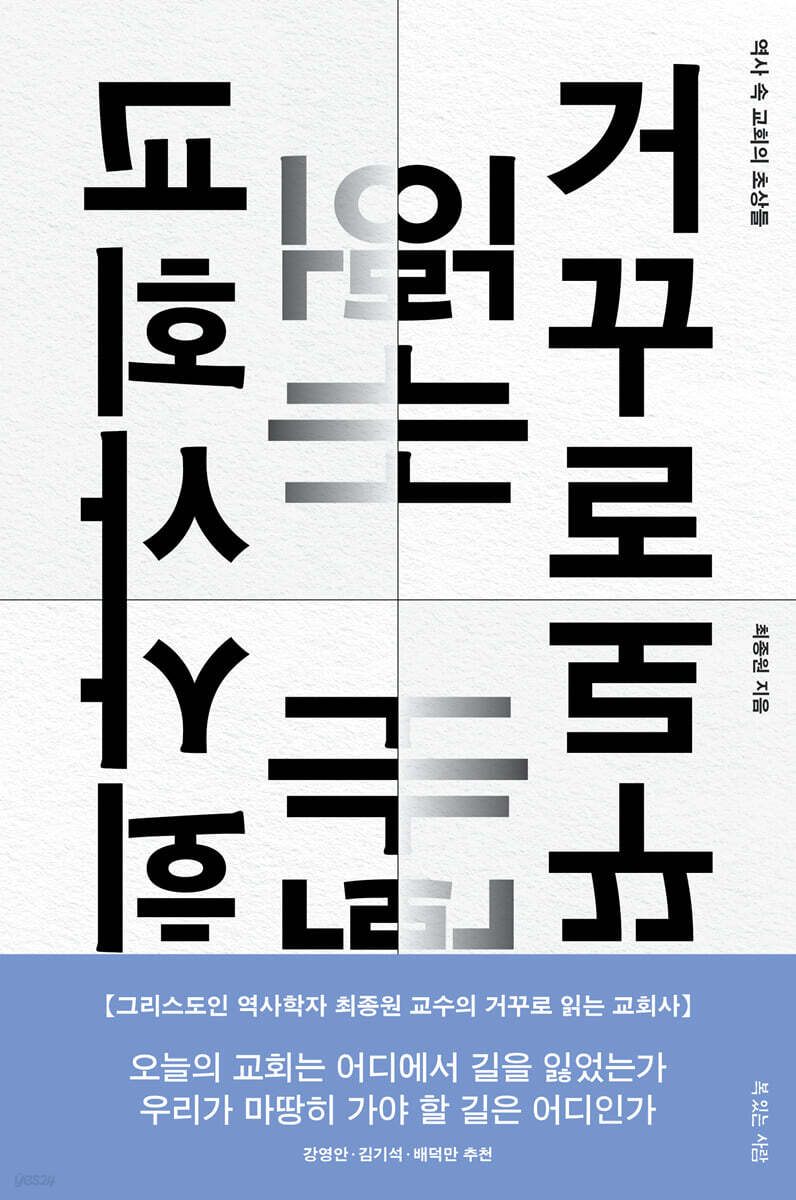
Church History Read Backwards
 |
Description
Book Introduction
Christian historian Professor Choi Jong-won's "Reading Church History Backwards"
“Where has today’s church lost its way?
“Where should we go?”
Recommended by Kang Young-an, Kim Ki-seok, and Bae Deok-man
This book, "Reading Church History Backwards," starts from the question of reading Christian history from a "backwards" perspective.
It presents a different approach from the traditional church history that focuses on doctrine and theological formation.
Previous studies of church history have failed to adequately capture the relationship the church has had with society throughout history.
This book argues that church history should be viewed as a record of the interaction between church and society, and that we should examine how the church exists and responds within society.
Through twenty themes selected from church history, the author shows how the church in each era responded to social changes and challenges.
Although the topics are a mixture of familiar and unfamiliar, each topic reveals new meaning when viewed through the mirror of society.
Standing in front of a mirror means reflection, and reflection is accompanied by discomfort and embarrassment.
As you examine the text, you may experience your existing beliefs being shattered or you may experience deep doubts.
“This book honestly confronts and records the truth of history and social reality.
“It serves as a milestone, pointing the way to deeper understanding and reflection for all who love the church.”
This book does not ignore the reality of the Korean church today.
It clearly reveals the deep gap between the institutional church, which has lost trust from society and is seen as anti-social, and the Christians living within it.
The church was never an ideal space and will never be perfect.
The church is a community of people who fall, struggle, and rise again, and their footsteps are the history of the church.
Now readers will enter into the unfamiliar and uncomfortable history of the church.
This journey is rough and unkind, but at the end of it, you will gain a new perspective on the church.
The past is not fixed, but is reinterpreted according to today's perspective, and all history is present history.
“Where has today’s church lost its way?
“Where should we go?”
Recommended by Kang Young-an, Kim Ki-seok, and Bae Deok-man
This book, "Reading Church History Backwards," starts from the question of reading Christian history from a "backwards" perspective.
It presents a different approach from the traditional church history that focuses on doctrine and theological formation.
Previous studies of church history have failed to adequately capture the relationship the church has had with society throughout history.
This book argues that church history should be viewed as a record of the interaction between church and society, and that we should examine how the church exists and responds within society.
Through twenty themes selected from church history, the author shows how the church in each era responded to social changes and challenges.
Although the topics are a mixture of familiar and unfamiliar, each topic reveals new meaning when viewed through the mirror of society.
Standing in front of a mirror means reflection, and reflection is accompanied by discomfort and embarrassment.
As you examine the text, you may experience your existing beliefs being shattered or you may experience deep doubts.
“This book honestly confronts and records the truth of history and social reality.
“It serves as a milestone, pointing the way to deeper understanding and reflection for all who love the church.”
This book does not ignore the reality of the Korean church today.
It clearly reveals the deep gap between the institutional church, which has lost trust from society and is seen as anti-social, and the Christians living within it.
The church was never an ideal space and will never be perfect.
The church is a community of people who fall, struggle, and rise again, and their footsteps are the history of the church.
Now readers will enter into the unfamiliar and uncomfortable history of the church.
This journey is rough and unkind, but at the end of it, you will gain a new perspective on the church.
The past is not fixed, but is reinterpreted according to today's perspective, and all history is present history.
- You can preview some of the book's contents.
Preview
index
index
Introduction: Portraits of the Church Reflected in the Mirror of History
Part 1: Seeing things from a different perspective
01 The Bible, a Book So Political | Why Did James I Translate the Bible?
02 Worship and the Mark of Christianity | Why Did the Puritans Leave for the New World?
03 "The Perfect Fisherman" and the Perfect Christian | Why Christians Should Learn to Fish
04 The Church in an Age of Revolution | Should Christianity Oppose Revolution?
05 Methodism and the Working Class | The Capitalist's Christ and the Worker's Christ
Part 2: Intelligence and Anti-Intellect
06 'Theology' and Academic Freedom | The Impeached Queen of Academics
07 The Magical and Disenchanted Nature of Religion | What is the Magical Nature that is Captivating Protestantism?
08 Luther and Hannah's "Reading" | Reading is the First Step Toward Liberation
09 Pseudoscience and Pseudoreligion | For a Strange, Strange, and Beautiful Life
10 Christian Anti-Intellectualism | The Opposite of Anti-Intellectualism Is Not Intellectualism
The Church's Place in the Mirror of Society
11. The Church and the Sect | Christianity is not a religion of self-perfection.
12 Peace and Violence | Did Christ's Peace Really Exist?
13 The Church Through the Eyes of a Loser | Celebrating the 500th Anniversary of the Reformation in 2025?
14 The State and the Church | Caesar's Kingdom, God's Kingdom
15 Rethinking the Secularization Thesis | The Decline of Christendom Is Not a Failure of Christianity
Part 4: Exploration and Breakthrough
16 A Common Heritage of Catholics and Protestants | Living Like Christ Instead of Saints
17 Bonhoeffer and the New Church | The Church as Peripheral, Stranger, and Foreigner
18 The Women's Suffrage Movement and Christianity | Are Women in the Church Equal?
19 Minorities and Religion | Is Anti-Discrimination Law a Crucial Issue for the Church?
20 Modernizing Tradition | Azornamento: Adapting to Modern Society
The Outgoing Word: Barbarism is the Substitute for Enlightenment
main
Search
Introduction: Portraits of the Church Reflected in the Mirror of History
Part 1: Seeing things from a different perspective
01 The Bible, a Book So Political | Why Did James I Translate the Bible?
02 Worship and the Mark of Christianity | Why Did the Puritans Leave for the New World?
03 "The Perfect Fisherman" and the Perfect Christian | Why Christians Should Learn to Fish
04 The Church in an Age of Revolution | Should Christianity Oppose Revolution?
05 Methodism and the Working Class | The Capitalist's Christ and the Worker's Christ
Part 2: Intelligence and Anti-Intellect
06 'Theology' and Academic Freedom | The Impeached Queen of Academics
07 The Magical and Disenchanted Nature of Religion | What is the Magical Nature that is Captivating Protestantism?
08 Luther and Hannah's "Reading" | Reading is the First Step Toward Liberation
09 Pseudoscience and Pseudoreligion | For a Strange, Strange, and Beautiful Life
10 Christian Anti-Intellectualism | The Opposite of Anti-Intellectualism Is Not Intellectualism
The Church's Place in the Mirror of Society
11. The Church and the Sect | Christianity is not a religion of self-perfection.
12 Peace and Violence | Did Christ's Peace Really Exist?
13 The Church Through the Eyes of a Loser | Celebrating the 500th Anniversary of the Reformation in 2025?
14 The State and the Church | Caesar's Kingdom, God's Kingdom
15 Rethinking the Secularization Thesis | The Decline of Christendom Is Not a Failure of Christianity
Part 4: Exploration and Breakthrough
16 A Common Heritage of Catholics and Protestants | Living Like Christ Instead of Saints
17 Bonhoeffer and the New Church | The Church as Peripheral, Stranger, and Foreigner
18 The Women's Suffrage Movement and Christianity | Are Women in the Church Equal?
19 Minorities and Religion | Is Anti-Discrimination Law a Crucial Issue for the Church?
20 Modernizing Tradition | Azornamento: Adapting to Modern Society
The Outgoing Word: Barbarism is the Substitute for Enlightenment
main
Search
Detailed image

Into the book
However, despite the popular acceptance and success of the King James Bible, James I failed to fully achieve religious and political unity.
A small group of separatist Puritans who opposed his religious policies eventually left for the New World on the Mayflower in 1620.
The Bible they took with them at that time was the Geneva Bible.
They shaped the social, political, and ecclesiastical culture of the New World based on the strict religiosity presented in the Geneva Bible.
Additionally, after the death of James I, England experienced a long civil war due to conflict between the Church of England and the Puritans.
Oliver Cromwell, a Puritan who fought in the English Civil War, published a pamphlet with excerpts from the Geneva Bible to encourage his troops and followers.
In this way, the Bible was a political book located at the center of national politics.
--- From "01 The Bible, a Very Political Book | Why Did James I Translate the Bible Again?"
Can theology be considered a subject of freedom? Does theology fall within the scope of academic freedom? Judging by the ideological scrutiny that takes place at the General Assembly of the Presbyterian Church every late fall, it becomes clear that theology does not fall within the scope of academic freedom.
If so, we cannot help but ask a more fundamental question.
Is theology an academic discipline? I once lamented why there was no academic freedom in seminaries.
But now I have to admit it frankly.
Theology is not an academic discipline.
Therefore, it is not possible to grant academic freedom to theologians in the Korean culture.
This is because the vast majority of the Korean theological world is based on denominational theology.
Theology as a discipline pursuing methodological secularism, even if it exists, is not very influential.
Loyalty to the Prophet and loyalty to the Church requires intellectual sacrifice.
It is an unavoidable reality that many people face before it becomes an attribute of theology.
Regardless of where and how those teaching in seminaries today received their education, the Korean theological world is not, strictly speaking, a temple of academia.
In this situation, it is meaningless to question whether theology is an academic discipline.
Today, theology is nothing more than the impeached and deposed queen of learning.
This is a sad result of the attempt to impeach the teaching authority that does not recognize the academic freedom guaranteed by the Constitution.
--- From "06 'Theology' and Academic Freedom | The Impeached Queen of Academics"
In the 21st century, no social group, including religion and the state, can lead a single culture like the church did in the 16th and 17th centuries.
Among them, religion is one of several competing cultural forces.
Even in the postmodern era, religion can still spread through symbols such as unique identities, value systems, and rituals.
In that sense, Christianity still has room to carve out its own destiny rather than being under uncontrollable forces.
The secular society that Christianity fears is a reality, and no one can escape its norms.
While most agree that traditional Christianity is nearing its end of life, it is difficult to agree that Christian traditions are worthless.
If so, in the postmodern era characterized by consumerism and nomadism, we must be able to create a new religiousness from diverse traditions and doctrines without experiencing cultural and cognitive dissonance.
Despite the undeniable trend of secularization, religion has long attempted to interact meaningfully with social, economic, and political structures through its reflexive approach to social change, and has achieved certain results.
--- From "Rethinking the 15 Secularization Theses | The Decline of Christendom Is Not a Failure of Christianity"
The Second Vatican Council demonstrates the wisdom with which the Catholic Church navigated the crisis.
Rather than excluding others through doctrine, labeling them heretics, or taking refuge behind heavenly mysteries, the Catholic Church has embraced the spirit of "Azornamento" in its attempt to adapt more humbly and positively to the modern society in which we live.
The path the church must take in times of crisis lies not in the scholastic obsession with judging and defining society through doctrine and biblical interpretation.
In a changing world, the church must look after marginalized women, minorities, immigrants, and the underprivileged and pursue the common good within society as a measure of its integrity.
Even under the neoliberal dominance of limitless competition, the church becomes a space of liberation and freedom where people can breathe.
From the very beginning of Christianity, the church was able to enter the masses because it practiced it.
A small group of separatist Puritans who opposed his religious policies eventually left for the New World on the Mayflower in 1620.
The Bible they took with them at that time was the Geneva Bible.
They shaped the social, political, and ecclesiastical culture of the New World based on the strict religiosity presented in the Geneva Bible.
Additionally, after the death of James I, England experienced a long civil war due to conflict between the Church of England and the Puritans.
Oliver Cromwell, a Puritan who fought in the English Civil War, published a pamphlet with excerpts from the Geneva Bible to encourage his troops and followers.
In this way, the Bible was a political book located at the center of national politics.
--- From "01 The Bible, a Very Political Book | Why Did James I Translate the Bible Again?"
Can theology be considered a subject of freedom? Does theology fall within the scope of academic freedom? Judging by the ideological scrutiny that takes place at the General Assembly of the Presbyterian Church every late fall, it becomes clear that theology does not fall within the scope of academic freedom.
If so, we cannot help but ask a more fundamental question.
Is theology an academic discipline? I once lamented why there was no academic freedom in seminaries.
But now I have to admit it frankly.
Theology is not an academic discipline.
Therefore, it is not possible to grant academic freedom to theologians in the Korean culture.
This is because the vast majority of the Korean theological world is based on denominational theology.
Theology as a discipline pursuing methodological secularism, even if it exists, is not very influential.
Loyalty to the Prophet and loyalty to the Church requires intellectual sacrifice.
It is an unavoidable reality that many people face before it becomes an attribute of theology.
Regardless of where and how those teaching in seminaries today received their education, the Korean theological world is not, strictly speaking, a temple of academia.
In this situation, it is meaningless to question whether theology is an academic discipline.
Today, theology is nothing more than the impeached and deposed queen of learning.
This is a sad result of the attempt to impeach the teaching authority that does not recognize the academic freedom guaranteed by the Constitution.
--- From "06 'Theology' and Academic Freedom | The Impeached Queen of Academics"
In the 21st century, no social group, including religion and the state, can lead a single culture like the church did in the 16th and 17th centuries.
Among them, religion is one of several competing cultural forces.
Even in the postmodern era, religion can still spread through symbols such as unique identities, value systems, and rituals.
In that sense, Christianity still has room to carve out its own destiny rather than being under uncontrollable forces.
The secular society that Christianity fears is a reality, and no one can escape its norms.
While most agree that traditional Christianity is nearing its end of life, it is difficult to agree that Christian traditions are worthless.
If so, in the postmodern era characterized by consumerism and nomadism, we must be able to create a new religiousness from diverse traditions and doctrines without experiencing cultural and cognitive dissonance.
Despite the undeniable trend of secularization, religion has long attempted to interact meaningfully with social, economic, and political structures through its reflexive approach to social change, and has achieved certain results.
--- From "Rethinking the 15 Secularization Theses | The Decline of Christendom Is Not a Failure of Christianity"
The Second Vatican Council demonstrates the wisdom with which the Catholic Church navigated the crisis.
Rather than excluding others through doctrine, labeling them heretics, or taking refuge behind heavenly mysteries, the Catholic Church has embraced the spirit of "Azornamento" in its attempt to adapt more humbly and positively to the modern society in which we live.
The path the church must take in times of crisis lies not in the scholastic obsession with judging and defining society through doctrine and biblical interpretation.
In a changing world, the church must look after marginalized women, minorities, immigrants, and the underprivileged and pursue the common good within society as a measure of its integrity.
Even under the neoliberal dominance of limitless competition, the church becomes a space of liberation and freedom where people can breathe.
From the very beginning of Christianity, the church was able to enter the masses because it practiced it.
--- From "20 Modernizations of Tradition | Azornamento, Adaptation to Modern Society"
GOODS SPECIFICS
- Date of issue: May 19, 2025
- Page count, weight, size: 364 pages | 473g | 142*214*30mm
- ISBN13: 9791170832638
You may also like
카테고리
korean


korean

![GQ KOREA Mark (Monthly): December [2025]](http://librairie.coreenne.fr/cdn/shop/files/8ef265dbbfbf186523ed75ba7319009d.jpg?v=1765340328&width=3840)


