

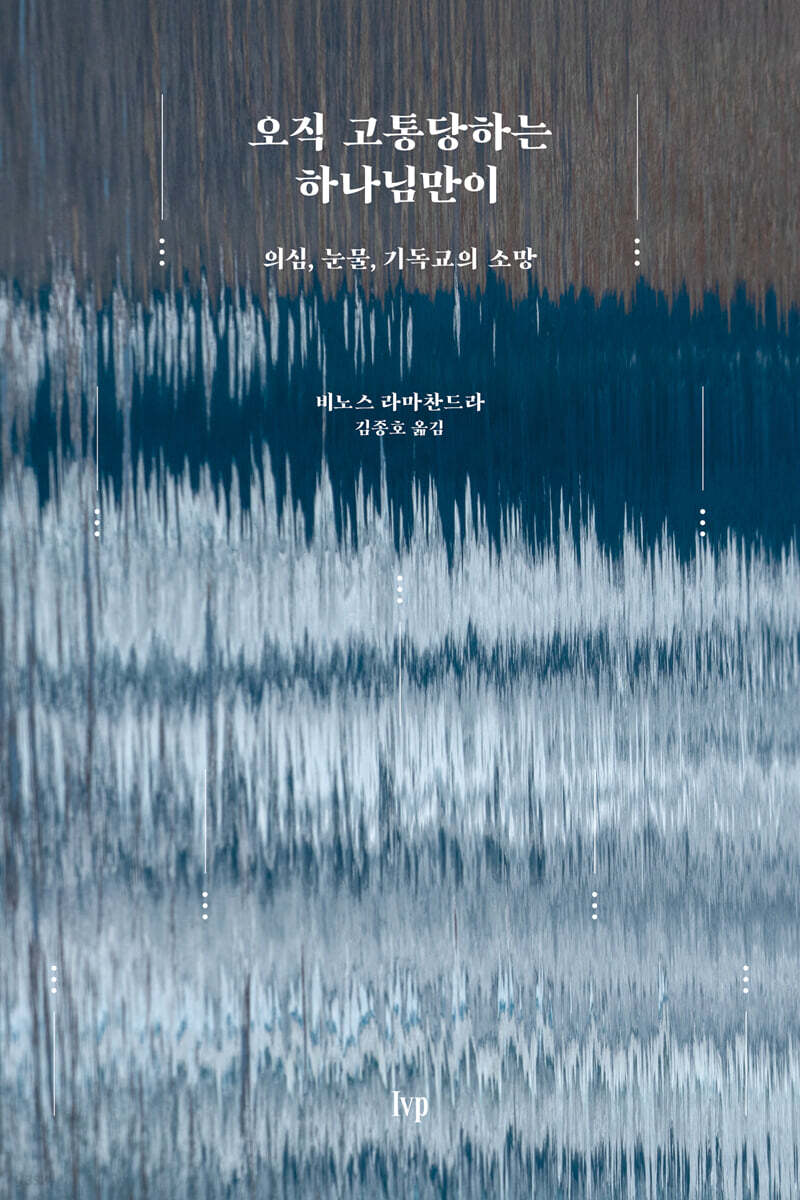
Only the suffering God
 |
Description
Book Introduction
“It provides clear and honest answers to the age-old question of pain and suffering.”
Kim Jin-hyeok (author of "Pure Christian"), Kim Hye-ryeong (author of "Cheerfully Until Death")
Recommended by Christopher Wright (author of "God's Mission") and others
This book is about suffering, a long-standing problem in Christianity.
This book, based on the personal experience of losing his wife, who had cancer, and the communal experience of the civil war in his home country, Sri Lanka, does not trivialize the issue of suffering.
The author draws attention to the biblical tradition of the Psalms of Lament and the Book of Job, and to Dietrich Bonhoeffer, C.
S. Lewis, Kitamori Kazo, and other scholars and literature explore suffering from a multifaceted Christian perspective.
This book, painstakingly written by “one of Asia’s foremost Christian thinkers,” will serve as a balanced and educational resource in today’s world, where misunderstandings and distortions about suffering are rampant.
Kim Jin-hyeok (author of "Pure Christian"), Kim Hye-ryeong (author of "Cheerfully Until Death")
Recommended by Christopher Wright (author of "God's Mission") and others
This book is about suffering, a long-standing problem in Christianity.
This book, based on the personal experience of losing his wife, who had cancer, and the communal experience of the civil war in his home country, Sri Lanka, does not trivialize the issue of suffering.
The author draws attention to the biblical tradition of the Psalms of Lament and the Book of Job, and to Dietrich Bonhoeffer, C.
S. Lewis, Kitamori Kazo, and other scholars and literature explore suffering from a multifaceted Christian perspective.
This book, painstakingly written by “one of Asia’s foremost Christian thinkers,” will serve as a balanced and educational resource in today’s world, where misunderstandings and distortions about suffering are rampant.
- You can preview some of the book's contents.
Preview
index
Translator's Preface
Chapter 1 O Lord, why do you hide your face?
Lament, Silence, and Selective Amnesia / Questions about Grief / Lament in Modern Times / A Church Without Lament
Chapter 2: Job and theological confusion
Job's Suffering / Job's Justification / Humble Empathy
Chapter 3 God's Tears
The Prophets and the Suffering of God / Jesus and the Suffering of God / Living with Suffering
Chapter 4 God and Natural Evil
Animal Predation / Selection, Waste, and Extinction / Evolution and Eschatology / Natural Disasters / Epilogue
Chapter 5 Future Tense
The Hope of Struggle / The Practice of Hope and the Weak / A Prophetic Way of Life, Hope
/ Hope of Waiting / Hope in the Darkness
Chapter 6 Review
References
Chapter 1 O Lord, why do you hide your face?
Lament, Silence, and Selective Amnesia / Questions about Grief / Lament in Modern Times / A Church Without Lament
Chapter 2: Job and theological confusion
Job's Suffering / Job's Justification / Humble Empathy
Chapter 3 God's Tears
The Prophets and the Suffering of God / Jesus and the Suffering of God / Living with Suffering
Chapter 4 God and Natural Evil
Animal Predation / Selection, Waste, and Extinction / Evolution and Eschatology / Natural Disasters / Epilogue
Chapter 5 Future Tense
The Hope of Struggle / The Practice of Hope and the Weak / A Prophetic Way of Life, Hope
/ Hope of Waiting / Hope in the Darkness
Chapter 6 Review
References
Detailed image
Into the book
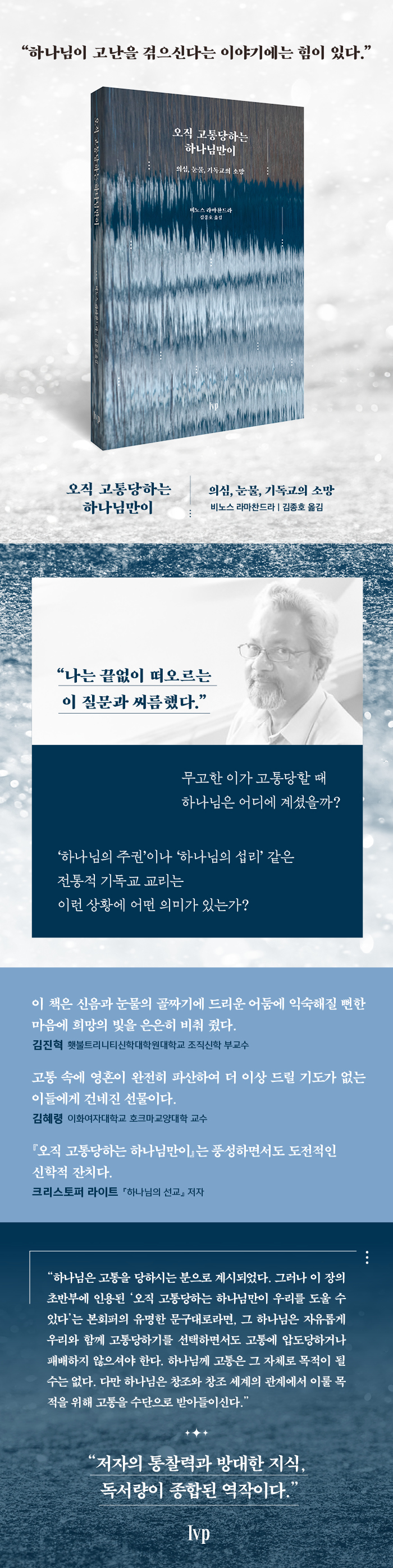
This is a masterpiece that combines the author's insight, extensive knowledge, and extensive reading.
Life cannot be properly understood without the theme of suffering and death.
This book delves into this very topic from a variety of angles, including theology, science, history, and philosophy.
In this respect, this book can be said to be a must-read for those who are serious about studying life.
In our suffering, we doubt, become discouraged, frustrated, angry, argue with God, and even cling desperately to Him.
When we meet God in the midst of that confusion and realize His will, we will find our laughter again.
This book is not simply a theological discussion; it offers practical comfort and direction to those seeking God in their suffering.
Through this book, readers will be able to reflect on their own suffering and find new hope in God's presence.
--- From the Translator's Preface
I wrestled with this question that kept coming up.
Where was God when the innocent suffered? And why did vaccines and antibiotics arrive so late in human history? What relevance do traditional Christian doctrines like "God's sovereignty" and "God's providence" have in this situation?
Even in times of pain and confusion, if we know that we are loved unconditionally by God, we can freely question Him, challenge Him, and even express anger.
The security of being loved allows us to sigh and gives us the courage to sigh.
--- From “Chapter 1, O Lord, Why Do You Hide Your Face?”
The Book of Job does not ask us to be patient.
Job is a rebellious believer.
He shouts to the heavens his honesty and innocence.
His righteous anger is directed not only at his own suffering but also at a God who appears indifferent to the suffering of all innocent victims.
He accuses God of being arbitrary in his treatment of humans.
Job's friends did not understand (and modern readers do not realize) that Job's questions were not intellectual inquiries.
The question Job faces is one of existential and relational crisis, not a theological one (the "problem of evil").
The moral order within the created world that he had taken for granted had collapsed.
Why had God, his lifelong protector, now become his enemy? Job saw that the trustworthiness of God, upon whom he could rely, was now in jeopardy.
And Job, troubled by these questions, which his friends consider utterly blasphemous, demands a personal answer from God.
--- From "Chapter 2: Job and the Confusion of Theology"
God is revealed not as one who inflicts suffering or avoids suffering, but as one who suffers.
But if Bonhoeffer's famous phrase, quoted earlier in this chapter, "Only a suffering God can help us," is true, then that God must freely choose to suffer with us, yet not be overwhelmed or defeated by suffering.
For God, suffering cannot be an end in itself.
However, God accepts suffering as a means to achieve a purpose in the relationship between creation and the created world.
Therefore, the resurrection of Christ and the 'new creation' that it initiated are inextricably linked to the crucifixion.
There is power in the story of God suffering.
Even if our suffering seems meaningless, we can juxtapose our stories of loss with God's story and see if they might have some meaning.
We can wait to see how the dire situation will be resolved and how God will bring good out of tragedy.
--- From "Chapter 3 God's Tears"
Theologians and philosophers have traditionally used the term "natural evil" to refer to (1) in biology, the presence of suffering, death, and extinction in the animal kingdom, and (2) in geophysics, climatic events such as earthquakes, tsunamis, volcanic eruptions, and hurricanes that cause large-scale destruction to humans and animals.
This chapter will attempt to argue that this use of the term is seriously misleading.
--- From “Chapter 4 God and Natural Evil”
It has been said that the opposite of faith is not doubt, but the desire for certainty.
That's right.
He chose to be God for us.
This means that God allows us to be influenced and allows suffering and evil to come upon Him.
But God is not overwhelmed by them.
This also means that God's existence has a true future enriched by the responses it receives from His creation.
Life cannot be properly understood without the theme of suffering and death.
This book delves into this very topic from a variety of angles, including theology, science, history, and philosophy.
In this respect, this book can be said to be a must-read for those who are serious about studying life.
In our suffering, we doubt, become discouraged, frustrated, angry, argue with God, and even cling desperately to Him.
When we meet God in the midst of that confusion and realize His will, we will find our laughter again.
This book is not simply a theological discussion; it offers practical comfort and direction to those seeking God in their suffering.
Through this book, readers will be able to reflect on their own suffering and find new hope in God's presence.
--- From the Translator's Preface
I wrestled with this question that kept coming up.
Where was God when the innocent suffered? And why did vaccines and antibiotics arrive so late in human history? What relevance do traditional Christian doctrines like "God's sovereignty" and "God's providence" have in this situation?
Even in times of pain and confusion, if we know that we are loved unconditionally by God, we can freely question Him, challenge Him, and even express anger.
The security of being loved allows us to sigh and gives us the courage to sigh.
--- From “Chapter 1, O Lord, Why Do You Hide Your Face?”
The Book of Job does not ask us to be patient.
Job is a rebellious believer.
He shouts to the heavens his honesty and innocence.
His righteous anger is directed not only at his own suffering but also at a God who appears indifferent to the suffering of all innocent victims.
He accuses God of being arbitrary in his treatment of humans.
Job's friends did not understand (and modern readers do not realize) that Job's questions were not intellectual inquiries.
The question Job faces is one of existential and relational crisis, not a theological one (the "problem of evil").
The moral order within the created world that he had taken for granted had collapsed.
Why had God, his lifelong protector, now become his enemy? Job saw that the trustworthiness of God, upon whom he could rely, was now in jeopardy.
And Job, troubled by these questions, which his friends consider utterly blasphemous, demands a personal answer from God.
--- From "Chapter 2: Job and the Confusion of Theology"
God is revealed not as one who inflicts suffering or avoids suffering, but as one who suffers.
But if Bonhoeffer's famous phrase, quoted earlier in this chapter, "Only a suffering God can help us," is true, then that God must freely choose to suffer with us, yet not be overwhelmed or defeated by suffering.
For God, suffering cannot be an end in itself.
However, God accepts suffering as a means to achieve a purpose in the relationship between creation and the created world.
Therefore, the resurrection of Christ and the 'new creation' that it initiated are inextricably linked to the crucifixion.
There is power in the story of God suffering.
Even if our suffering seems meaningless, we can juxtapose our stories of loss with God's story and see if they might have some meaning.
We can wait to see how the dire situation will be resolved and how God will bring good out of tragedy.
--- From "Chapter 3 God's Tears"
Theologians and philosophers have traditionally used the term "natural evil" to refer to (1) in biology, the presence of suffering, death, and extinction in the animal kingdom, and (2) in geophysics, climatic events such as earthquakes, tsunamis, volcanic eruptions, and hurricanes that cause large-scale destruction to humans and animals.
This chapter will attempt to argue that this use of the term is seriously misleading.
--- From “Chapter 4 God and Natural Evil”
It has been said that the opposite of faith is not doubt, but the desire for certainty.
That's right.
He chose to be God for us.
This means that God allows us to be influenced and allows suffering and evil to come upon Him.
But God is not overwhelmed by them.
This also means that God's existence has a true future enriched by the responses it receives from His creation.
--- From "Chapter 5 Future Tense"
Publisher's Review
“The author, one of Asia’s greatest Christian thinkers,
To the age-old question of human pain and suffering,
“Provides clear and honest answers”
A comprehensive book covering a wide range of topics related to pain.
“Only the Suffering God” explores suffering through theology, philosophy, and science.
Although the book is not very long, each chapter covers an important topic faithfully.
The translator's preface clearly outlines the book's structure.
“In Chapter 1, the author demonstrates that human lament can be honestly expressed within a relationship with God, and that the Bible recognizes lament as a form of faith.
Chapter 2 analyzes the Book of Job and addresses the theological confusion that those who suffer inevitably experience, showing that a truly religious attitude means not giving up on one's relationship with God even in suffering, but rather approaching God even through complaints.
Chapter 3 emphasizes that God is not indifferent to human suffering, but that He experienced suffering directly through Jesus Christ.
Through this, we discover God who shares our suffering and learn that we can gain the strength to endure it even if we do not fully understand its meaning.
Chapter 4 examines various perspectives from faith and science to understand “natural evils” such as natural disasters.
This is a chapter that reflects on God's providence by culminating the author's extensive knowledge and incredible reading volume.
Chapter 5 reveals that Christian hope is not simply optimism, but rather a practice of facing reality while waiting for and practicing the kingdom of God.
Finally, Chapter 6 concludes the book, reaffirming our faith-based approach to suffering and the hope we have in God.”
-From the translator's preface
“Only a suffering God can help us.”
This is what Dietrich Bonhoeffer, the theologian who was executed for his involvement in the assassination of Hitler, said.
A god separated from the world, a god uninfluenced by the world, cannot help us or love us.
However, “God is revealed not as one who inflicts pain or avoids pain, but as one who suffers.” The God recorded in the Bible suffered alongside humanity throughout history and, crucially, suffered on the cross.
The author explores these issues in depth in Chapter 3, “God’s Tears.”
Of course, this book does not only deal with God's suffering.
Christians talk about what attitude they should have in times of suffering, and they also discuss natural disasters, animal predation, and extinction, which seem far removed from human violence or evil.
But in the midst of it all lies the “mystery of suffering love.”
Can we still hope?
There are many things in the life of faith for which there are no clear answers.
“Mourning and joy, faith and doubt, clarity and ambiguity are interwoven in the Christian life.” Therefore, it is dangerous to hastily conclude or be optimistic about suffering by asserting God’s omnipotence.
Nevertheless, hope is possible because of God.
God “allows us to influence him, to allow suffering and evil to come upon him,” but he is not overwhelmed by them.
This means that he has a real future.
“Only the Suffering God” talks about what kind of hope Christians should have and how they should live.
As the translator says, “Through this book, readers will reflect on their own suffering and find new hope in God’s presence.”
Main Readers
ㆍReaders interested in theology and the problem of suffering
ㆍMinisters who must preach and counsel about suffering
ㆍParty in pain
To the age-old question of human pain and suffering,
“Provides clear and honest answers”
A comprehensive book covering a wide range of topics related to pain.
“Only the Suffering God” explores suffering through theology, philosophy, and science.
Although the book is not very long, each chapter covers an important topic faithfully.
The translator's preface clearly outlines the book's structure.
“In Chapter 1, the author demonstrates that human lament can be honestly expressed within a relationship with God, and that the Bible recognizes lament as a form of faith.
Chapter 2 analyzes the Book of Job and addresses the theological confusion that those who suffer inevitably experience, showing that a truly religious attitude means not giving up on one's relationship with God even in suffering, but rather approaching God even through complaints.
Chapter 3 emphasizes that God is not indifferent to human suffering, but that He experienced suffering directly through Jesus Christ.
Through this, we discover God who shares our suffering and learn that we can gain the strength to endure it even if we do not fully understand its meaning.
Chapter 4 examines various perspectives from faith and science to understand “natural evils” such as natural disasters.
This is a chapter that reflects on God's providence by culminating the author's extensive knowledge and incredible reading volume.
Chapter 5 reveals that Christian hope is not simply optimism, but rather a practice of facing reality while waiting for and practicing the kingdom of God.
Finally, Chapter 6 concludes the book, reaffirming our faith-based approach to suffering and the hope we have in God.”
-From the translator's preface
“Only a suffering God can help us.”
This is what Dietrich Bonhoeffer, the theologian who was executed for his involvement in the assassination of Hitler, said.
A god separated from the world, a god uninfluenced by the world, cannot help us or love us.
However, “God is revealed not as one who inflicts pain or avoids pain, but as one who suffers.” The God recorded in the Bible suffered alongside humanity throughout history and, crucially, suffered on the cross.
The author explores these issues in depth in Chapter 3, “God’s Tears.”
Of course, this book does not only deal with God's suffering.
Christians talk about what attitude they should have in times of suffering, and they also discuss natural disasters, animal predation, and extinction, which seem far removed from human violence or evil.
But in the midst of it all lies the “mystery of suffering love.”
Can we still hope?
There are many things in the life of faith for which there are no clear answers.
“Mourning and joy, faith and doubt, clarity and ambiguity are interwoven in the Christian life.” Therefore, it is dangerous to hastily conclude or be optimistic about suffering by asserting God’s omnipotence.
Nevertheless, hope is possible because of God.
God “allows us to influence him, to allow suffering and evil to come upon him,” but he is not overwhelmed by them.
This means that he has a real future.
“Only the Suffering God” talks about what kind of hope Christians should have and how they should live.
As the translator says, “Through this book, readers will reflect on their own suffering and find new hope in God’s presence.”
Main Readers
ㆍReaders interested in theology and the problem of suffering
ㆍMinisters who must preach and counsel about suffering
ㆍParty in pain
GOODS SPECIFICS
- Date of issue: April 7, 2025
- Page count, weight, size: 256 pages | 272g | 140*210*15mm
- ISBN13: 9788932823447
- ISBN10: 8932823448
You may also like
카테고리
korean


korean

![GQ KOREA Mark (Monthly): December [2025]](http://librairie.coreenne.fr/cdn/shop/files/8ef265dbbfbf186523ed75ba7319009d.jpg?v=1765340328&width=3840)


