

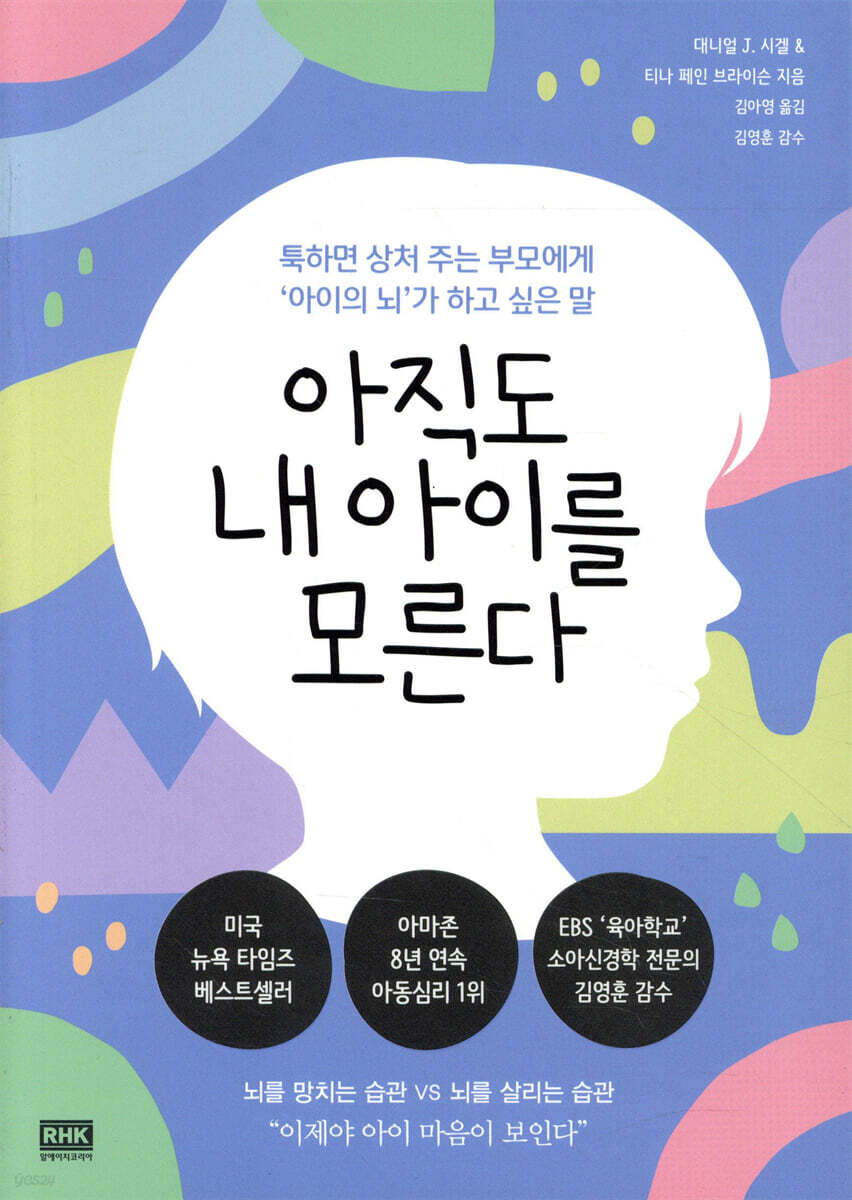
I still don't know my child
 |
Description
Book Introduction
- A word from MD
- The irritating moments of parenting, the sudden outbursts of emotion, can inflict damage on a child's brain! This book uses neuroscience knowledge to easily unravel the countless signals and nonverbal cues that a child's immature brain cannot yet verbalize. It also suggests 12 habits that can revitalize a child's brain.
Amazon's #1 children's psychology book for eight consecutive years, a masterpiece by America's leading authority on children's brains.
- Kim Hyun-joo, MD of Home Living
Amazon and New York Times bestseller!
A masterpiece from America's leading authority on children's brains!
Parents who often injure their children's brains
“Even now, a child’s brain is still growing.”
Have you ever pretended not to hear, ignored, or avoided your child's words? Have you ever blamed your child for mistakes or misleading results? Have you scolded or ordered your child out of control? Have you buried difficult experiences in your child's memory rather than sharing them? If so, your child's brain is being damaged without you even knowing it!
The brain plays a key role in all aspects of life, including self-balance, decision-making, and interpersonal relationships.
And surprisingly, what shapes the brain is ‘experience.’
New experiences cause brain cells to fire and change the physical structure of the brain.
This means that parents have a great influence on the growth of a resilient and flexible brain.
Parents have a responsibility to listen and understand what their child's brain is telling them.
This book uses brain science knowledge to easily explain the numerous signals and nonverbal clues that the child's brain, which is not yet fully developed, cannot express in words.
UCLA neuropsychiatrist Daniel J., a leading authority on children's brains in the United States, said:
Siegel and psychotherapist Tina Payne Bryson provide specific information on the core theories and practices of whole-brain parenting based on brain science research and parenting counseling.
In particular, the author's "12 Habits to Save Your Child's Brain" will provide an amazing miracle that will turn moments of parenting stress into opportunities for success.
A masterpiece from America's leading authority on children's brains!
Parents who often injure their children's brains
“Even now, a child’s brain is still growing.”
Have you ever pretended not to hear, ignored, or avoided your child's words? Have you ever blamed your child for mistakes or misleading results? Have you scolded or ordered your child out of control? Have you buried difficult experiences in your child's memory rather than sharing them? If so, your child's brain is being damaged without you even knowing it!
The brain plays a key role in all aspects of life, including self-balance, decision-making, and interpersonal relationships.
And surprisingly, what shapes the brain is ‘experience.’
New experiences cause brain cells to fire and change the physical structure of the brain.
This means that parents have a great influence on the growth of a resilient and flexible brain.
Parents have a responsibility to listen and understand what their child's brain is telling them.
This book uses brain science knowledge to easily explain the numerous signals and nonverbal clues that the child's brain, which is not yet fully developed, cannot express in words.
UCLA neuropsychiatrist Daniel J., a leading authority on children's brains in the United States, said:
Siegel and psychotherapist Tina Payne Bryson provide specific information on the core theories and practices of whole-brain parenting based on brain science research and parenting counseling.
In particular, the author's "12 Habits to Save Your Child's Brain" will provide an amazing miracle that will turn moments of parenting stress into opportunities for success.
- You can preview some of the book's contents.
Preview
index
Preface: The goal of parenting is to persevere and succeed.
If you want to know a child's heart, you must understand the brain.
Chapter 1: Parents Who Know Their Body But Not Their Brain
A whole-brain perspective on reading a child's mind
All difficulties are just one of the experiences a child will go through.
The key to successful parenting lies in brain integration.
Experience changes the structure of the brain.
To escape from confusion and tension and flow into the river of happiness
Chapter 2: Why Children Are True to the Present
The left brain focuses on words, while the right brain focuses on context.
To avoid both the desert and the flood of emotions
Habit 01.
Reset direction after empathy
Habit 02.
Calm down your heavy emotions with stories
[Practice] How to Read Your Child's Emotions and Needs: Whole-Brain Parenting
[Tell Me] Why is it important to express your emotions?
Chapter 3: Why are children different every day?
Instinctive lower brain, evolved upper brain
Set appropriate expectations for your child.
Why Action Comes Before Thought
Irritation from the upper and lower brains is different.
Habit 03.
Give your child a chance to think.
Habit 04.
Train your upper brain effectively
Habit 05.
Move your body and change your mind
[Practice] 3 Steps to Control Out-of-Control Emotions
[Tell Me] Useful Knowledge to Calm Down Your Anger
Chapter 4: Memories that Control a Child's Emotions
Unfounded beliefs about memory
The Truth About Memory: Implicit and Explicit Memory
Putting the puzzle together in a child's head
Habit 06.
Replay memories as if using a remote control.
Habit 07.
Memory also improves with practice.
[Practice] Transferring Implicit Memories to Explicit Memories
[Tell me] What are the benefits of talking about the past?
Chapter 5: How to Look Inside Yourself
The power of MindSight to understand a wide range of emotions
The error of defining oneself as a temporary emotion
The power of concentration to change the shape of the brain
Habit 08.
Let them know that emotions are temporary.
Habit 09: Explore Your Mind with SIFT Play
Habit 10.
Return to the center of your emotions
[Practice] Practice asking questions in your mind
[Tell me] How to avoid getting into an unpleasant mood?
Chapter 6: No Child is Happy Alone
Do you want to enjoy meaningful human relationships?
A brain tailored to us, not to ourselves
A source of empathy that reflects like a mirror
The quality of relationships changes a child's brain.
To enable us to live as ourselves
The answer that opens the door to your heart is 'YES'
Habit 11.
Make sure you have plenty of time to enjoy your family.
Habit 12.
Turn conflict into opportunity
[Practice] Children Live with Their Parents' Experiences
[Tell me] Do you want to think about how other people might feel?
Conclusion: A Whole-Brain Approach That Changes Everything
Thanks to
If you want to know a child's heart, you must understand the brain.
Chapter 1: Parents Who Know Their Body But Not Their Brain
A whole-brain perspective on reading a child's mind
All difficulties are just one of the experiences a child will go through.
The key to successful parenting lies in brain integration.
Experience changes the structure of the brain.
To escape from confusion and tension and flow into the river of happiness
Chapter 2: Why Children Are True to the Present
The left brain focuses on words, while the right brain focuses on context.
To avoid both the desert and the flood of emotions
Habit 01.
Reset direction after empathy
Habit 02.
Calm down your heavy emotions with stories
[Practice] How to Read Your Child's Emotions and Needs: Whole-Brain Parenting
[Tell Me] Why is it important to express your emotions?
Chapter 3: Why are children different every day?
Instinctive lower brain, evolved upper brain
Set appropriate expectations for your child.
Why Action Comes Before Thought
Irritation from the upper and lower brains is different.
Habit 03.
Give your child a chance to think.
Habit 04.
Train your upper brain effectively
Habit 05.
Move your body and change your mind
[Practice] 3 Steps to Control Out-of-Control Emotions
[Tell Me] Useful Knowledge to Calm Down Your Anger
Chapter 4: Memories that Control a Child's Emotions
Unfounded beliefs about memory
The Truth About Memory: Implicit and Explicit Memory
Putting the puzzle together in a child's head
Habit 06.
Replay memories as if using a remote control.
Habit 07.
Memory also improves with practice.
[Practice] Transferring Implicit Memories to Explicit Memories
[Tell me] What are the benefits of talking about the past?
Chapter 5: How to Look Inside Yourself
The power of MindSight to understand a wide range of emotions
The error of defining oneself as a temporary emotion
The power of concentration to change the shape of the brain
Habit 08.
Let them know that emotions are temporary.
Habit 09: Explore Your Mind with SIFT Play
Habit 10.
Return to the center of your emotions
[Practice] Practice asking questions in your mind
[Tell me] How to avoid getting into an unpleasant mood?
Chapter 6: No Child is Happy Alone
Do you want to enjoy meaningful human relationships?
A brain tailored to us, not to ourselves
A source of empathy that reflects like a mirror
The quality of relationships changes a child's brain.
To enable us to live as ourselves
The answer that opens the door to your heart is 'YES'
Habit 11.
Make sure you have plenty of time to enjoy your family.
Habit 12.
Turn conflict into opportunity
[Practice] Children Live with Their Parents' Experiences
[Tell me] Do you want to think about how other people might feel?
Conclusion: A Whole-Brain Approach That Changes Everything
Thanks to
Detailed image

Into the book
Parents are usually the experts when it comes to their children's bodies.
They know that their child has a fever even if the temperature goes over 37 degrees Celsius, and they also know how to disinfect their child's wounds to prevent infection.
You also know what foods make your child nervous before bedtime.
But even the most well-educated and loving parents often lack even basic knowledge about their child's brain.
Isn't it amazing? The brain plays a key role in nearly every aspect of a child's life that concerns parents: discipline, decision-making, self-awareness, school performance, relationships, and more.
--- From "A Whole Brain Perspective on Reading a Child's Mind"
Some parts of the brain deal exclusively with memory, while others make moral and ethical decisions.
It seems like there are multiple personalities in the brain.
When you look at it this way, it's no wonder that we sometimes act like completely different people.
The key to success is getting these different parts of the brain to work together, or integrate.
Integration is the process by which distinct parts of the brain work together to function as a single whole.
This process is similar to what happens in the body, which is made up of many different parts with different functions, such as the lungs that breathe, the heart that pumps blood, and the stomach that digests food.
--- From "The key to successful parenting lies in integrating the brain"
Let's think about the structure of the brain as an analogy to a house.
The downstairs is fully furnished, but the upstairs has little furniture and the extensions are a mess.
Moreover, the roof is not yet finished, so the sky is visible.
This is the child's upper brain, where development is in progress.
This is very important information for parents to understand.
This means that the areas of the brain that control the behaviors and skills we expect and desire from our children, such as the abilities listed above—making good decisions and planning, controlling emotions and bodies, understanding themselves, empathy, and morality—have not yet fully developed.
Because the upper brain is still developing, it does not always function fully.
--- From "Set Appropriate Expectations for Your Child"
"Tell me about your day. Tell me one good thing, one bad thing, and one time you were kind to someone."
Again, these actions and questions not only encourage children to recall memories, but also encourage them to think more deeply about their own feelings and actions, the person they shared their day with, and how they can help others.
If you want your child to think more about a particular event, it may be helpful to look at photo albums or old videotapes together.
A great way to help your child focus deeply is to design and draw a "memory book" with them.
For example, when your daughter returns from her first sleepover away from home, you can create a memory book with her, collecting letters, souvenirs, and photos she sent you.
It's also a good idea to write short phrases in the margins, like "Our Log Cabin" or "After the Shaving Cream Fight."
Bookmaking evokes these memories in detail and provides children with an opportunity to share important life events with their parents.
--- From "Memory improves with practice"
Children confuse the difference between 'state' and 'existence'.
When children experience certain emotional states, such as loneliness or frustration, they are more likely to define themselves based on that temporary experience rather than understanding that it is just a temporary emotion.
In these cases, instead of saying, “I feel lonely” or “I feel sad right now,” you say, “I am lonely” or “I am sad.”
The danger here is that children may accept temporary states of mind as immutable traits of their own.
In other words, we come to regard 'state' as a 'trait' that tells us who we are.
They know that their child has a fever even if the temperature goes over 37 degrees Celsius, and they also know how to disinfect their child's wounds to prevent infection.
You also know what foods make your child nervous before bedtime.
But even the most well-educated and loving parents often lack even basic knowledge about their child's brain.
Isn't it amazing? The brain plays a key role in nearly every aspect of a child's life that concerns parents: discipline, decision-making, self-awareness, school performance, relationships, and more.
--- From "A Whole Brain Perspective on Reading a Child's Mind"
Some parts of the brain deal exclusively with memory, while others make moral and ethical decisions.
It seems like there are multiple personalities in the brain.
When you look at it this way, it's no wonder that we sometimes act like completely different people.
The key to success is getting these different parts of the brain to work together, or integrate.
Integration is the process by which distinct parts of the brain work together to function as a single whole.
This process is similar to what happens in the body, which is made up of many different parts with different functions, such as the lungs that breathe, the heart that pumps blood, and the stomach that digests food.
--- From "The key to successful parenting lies in integrating the brain"
Let's think about the structure of the brain as an analogy to a house.
The downstairs is fully furnished, but the upstairs has little furniture and the extensions are a mess.
Moreover, the roof is not yet finished, so the sky is visible.
This is the child's upper brain, where development is in progress.
This is very important information for parents to understand.
This means that the areas of the brain that control the behaviors and skills we expect and desire from our children, such as the abilities listed above—making good decisions and planning, controlling emotions and bodies, understanding themselves, empathy, and morality—have not yet fully developed.
Because the upper brain is still developing, it does not always function fully.
--- From "Set Appropriate Expectations for Your Child"
"Tell me about your day. Tell me one good thing, one bad thing, and one time you were kind to someone."
Again, these actions and questions not only encourage children to recall memories, but also encourage them to think more deeply about their own feelings and actions, the person they shared their day with, and how they can help others.
If you want your child to think more about a particular event, it may be helpful to look at photo albums or old videotapes together.
A great way to help your child focus deeply is to design and draw a "memory book" with them.
For example, when your daughter returns from her first sleepover away from home, you can create a memory book with her, collecting letters, souvenirs, and photos she sent you.
It's also a good idea to write short phrases in the margins, like "Our Log Cabin" or "After the Shaving Cream Fight."
Bookmaking evokes these memories in detail and provides children with an opportunity to share important life events with their parents.
--- From "Memory improves with practice"
Children confuse the difference between 'state' and 'existence'.
When children experience certain emotional states, such as loneliness or frustration, they are more likely to define themselves based on that temporary experience rather than understanding that it is just a temporary emotion.
In these cases, instead of saying, “I feel lonely” or “I feel sad right now,” you say, “I am lonely” or “I am sad.”
The danger here is that children may accept temporary states of mind as immutable traits of their own.
In other words, we come to regard 'state' as a 'trait' that tells us who we are.
--- From "The Error of Defining Temporary Emotions as Oneself"
Publisher's Review
★★★#1 in Child Psychology on Amazon US for 8 Consecutive Years★★★
★★★New York Times Bestseller★★★
★★★EBS 'Childcare School' supervised by pediatric neurologist Kim Young-hoon★★★
Why are children different every day? Why do they only know themselves?
The Child's Brain Answers Your Parenting Questions
Why does my child, late for class, get distracted by a ladybug on the sidewalk? Why do some days seem like geniuses, and others act so poorly? Why do they fail to consider others' perspectives, instead focusing solely on their own feelings? Parents who fail to understand their children often face frustrating moments in parenting.
And the emotions that burst out 'suddenly' end up hurting the child.
The problem is that it hurts not only the heart but also the brain.
In fact, it is no exaggeration to say that the answer to reading a child's mind lies in the brain.
The reason why only the 'present' is important to a child is because the development of the right brain is dominant until the age of three.
The concepts of logic, responsibility, and time do not yet exist for children.
The left brain only begins to develop when the child asks “Why?”
The reason why it is difficult for a child's mind and behavior to remain consistent is also due to the characteristics of the brain.
The brain is not a single mass, but a combination of organs with different functions.
Problems arise when the different areas of the brain do not integrate harmoniously.
Parents must help their children work together harmoniously as a whole.
Habits that Destroy Your Brain vs. Habits that Save Your Brain
"Now I can see the child's heart."
This book provides specific parenting tips from a "whole-brain perspective" that allows you to use your entire brain.
When emotions explode, it is not the right time for parents to discipline their children because they are thinking in a 'right brain'-centric way.
As time passes and the 'left brain' returns to normal condition, it becomes much more receptive.
Also, when the 'lower brain' that processes emotions senses danger, it completely dominates the 'higher brain' that is logical.
At this time, the child becomes swayed by emotions and acts before thinking.
This is why horizontal integration between the left and right brain and vertical integration between the upper and lower brain are essential.
Parenting attitudes are completely different when you know this kind of brain science knowledge and when you don't.
The book's "12 Habits to Save Your Child's Brain" helps parents and children put whole-brain parenting into practice in their daily lives through conversations.
Common mistakes made by parents are marked with 'NG!', and correct examples are marked with 'OK!', providing answers to parenting goals.
Additionally, we have organized 'step-by-step coaching' tailored to the child's developmental stage from 0 to 12 years old.
We introduce brain-rearing methods for each age group: infants and toddlers (ages 0-3), preschoolers (ages 3-6), lower elementary school students (ages 6-9), and upper elementary school students (ages 9-12).
In fact, it is extremely difficult to set aside time for ‘whole-brain parenting.’
However, if you start practicing the small brain habits suggested by the author, you can turn even ordinary daily life into valuable opportunities for your child's brain to grow.
★★★New York Times Bestseller★★★
★★★EBS 'Childcare School' supervised by pediatric neurologist Kim Young-hoon★★★
Why are children different every day? Why do they only know themselves?
The Child's Brain Answers Your Parenting Questions
Why does my child, late for class, get distracted by a ladybug on the sidewalk? Why do some days seem like geniuses, and others act so poorly? Why do they fail to consider others' perspectives, instead focusing solely on their own feelings? Parents who fail to understand their children often face frustrating moments in parenting.
And the emotions that burst out 'suddenly' end up hurting the child.
The problem is that it hurts not only the heart but also the brain.
In fact, it is no exaggeration to say that the answer to reading a child's mind lies in the brain.
The reason why only the 'present' is important to a child is because the development of the right brain is dominant until the age of three.
The concepts of logic, responsibility, and time do not yet exist for children.
The left brain only begins to develop when the child asks “Why?”
The reason why it is difficult for a child's mind and behavior to remain consistent is also due to the characteristics of the brain.
The brain is not a single mass, but a combination of organs with different functions.
Problems arise when the different areas of the brain do not integrate harmoniously.
Parents must help their children work together harmoniously as a whole.
Habits that Destroy Your Brain vs. Habits that Save Your Brain
"Now I can see the child's heart."
This book provides specific parenting tips from a "whole-brain perspective" that allows you to use your entire brain.
When emotions explode, it is not the right time for parents to discipline their children because they are thinking in a 'right brain'-centric way.
As time passes and the 'left brain' returns to normal condition, it becomes much more receptive.
Also, when the 'lower brain' that processes emotions senses danger, it completely dominates the 'higher brain' that is logical.
At this time, the child becomes swayed by emotions and acts before thinking.
This is why horizontal integration between the left and right brain and vertical integration between the upper and lower brain are essential.
Parenting attitudes are completely different when you know this kind of brain science knowledge and when you don't.
The book's "12 Habits to Save Your Child's Brain" helps parents and children put whole-brain parenting into practice in their daily lives through conversations.
Common mistakes made by parents are marked with 'NG!', and correct examples are marked with 'OK!', providing answers to parenting goals.
Additionally, we have organized 'step-by-step coaching' tailored to the child's developmental stage from 0 to 12 years old.
We introduce brain-rearing methods for each age group: infants and toddlers (ages 0-3), preschoolers (ages 3-6), lower elementary school students (ages 6-9), and upper elementary school students (ages 9-12).
In fact, it is extremely difficult to set aside time for ‘whole-brain parenting.’
However, if you start practicing the small brain habits suggested by the author, you can turn even ordinary daily life into valuable opportunities for your child's brain to grow.
GOODS SPECIFICS
- Publication date: April 13, 2020
- Page count, weight, size: 312 pages | 496g | 148*210*20mm
- ISBN13: 9788925569222
- ISBN10: 8925569221
You may also like
카테고리
korean


korean

![GQ KOREA Mark (Monthly): December [2025]](http://librairie.coreenne.fr/cdn/shop/files/8ef265dbbfbf186523ed75ba7319009d.jpg?v=1765340328&width=3840)


