

The power of a picture book
 |
Description
Book Introduction
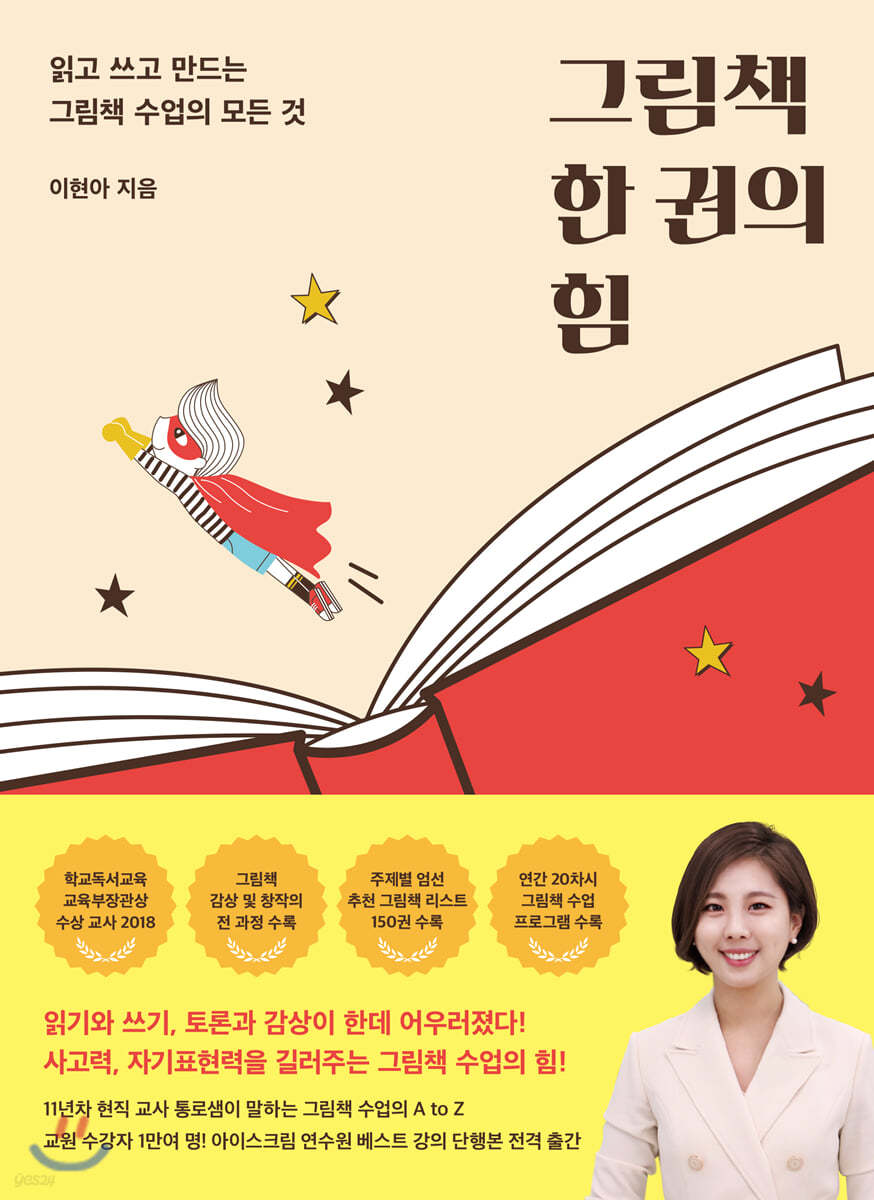
The A to Z of Picture Book Classes from a Teacher with 11 Years of Experience A picture book lesson manual for specific reference in the classroom and at home. "The Power of a Picture Book" is a book written by a current teacher who has been consistently communicating with children and teaching picture book creation classes in public education for the past six years, and contains the entire process of picture book classes, from appreciation to creation, as well as his own teaching know-how. The author has created over 200 original picture books with children. Children who take the author's picture book class go beyond simply reading and appreciating picture books. They become full-fledged 'children's authors' through the process of honestly and boldly expressing their inner voice and creating a picture book. The book contains everything about reading, writing, and creating picture books, including how to open up honest conversations with children through picture books, effective methods for teaching children how to write and draw for picture book creation, methods for producing and publishing actual picture books based on completed original drawings, and methods for reading and appreciating created picture books together. In addition to a list of 150 recommended picture books carefully selected by topic, a list of books that will be helpful when preparing for picture book classes, and a 20-lesson annual picture book class program created by the author based on many years of experience in picture book classes, the book also provides a detailed and practical guide for teachers and parents who wish to conduct picture book classes with children. |
- You can preview some of the book's contents.
Preview
index
Recommendation
Prologue: "The Breath of the Heart" breathes through "expression."
PART 1: Why Picture Book Classes? _Understanding the Beginning of the "Classroom Picture Book Creation Project"
I am a sentence collector
The voice of the third person
A feeling I wouldn't have known if it weren't for the picture book
From 'appreciator' to 'creator'
Can a nine-year-old make a picture book?
A passage through which children's writers' dreams flow
Children who need their own room
* Heart poured into picture books 01 _ Can picture books comfort us?
PART 2: Connecting with Children through Picture Books - "Asking Questions"
Everyone has a little bit of a weird side to them
What color are you today?
I think that's poetry
The biggest question in the world
You know what? You're not the only one!
* Heart poured into picture books 02 _ Raising self-esteem in your own way
PART 3 Connecting with Picture Books _ “Reading”
Picture books that connect with me _What is a Tong (通) picture book?
Hidden Hearts, Coming Out _ One Scene Post-it Activity
A debate that started with a single Post-it note _ A scene-by-scene discussion
A duet of text and pictures: Reading picture books and expressing them through poetry and pictures
Picture books and educational plays meet - A scene from Tablo's activities
* Hearts Poured into Picture Books 03 _ In an era of endless competition, children are afraid of falling behind.
PART 4 Expressing Myself through Picture Books _ “Writing”
Finding the One Thing That Reflects Me _ Self-Expression Through the 'Metaphor Mirror'
Expressing myself with numbers, scales, colors, etc.
Prescription for children who struggle with writing
Storytelling through 'Inner Voice Activities'
Three common story structures used by children
* Heart poured into picture books 04 _ Becoming the complete master of my life
PART 5: Creating Art with Picture Books _ “Making”
Pointing out the unique characteristics of picture books
Drawing a storyboard
Drawing original paintings using various materials and methods - expanding the range of artistic choices
Bringing out expressiveness with limitations
A prescription for children who are afraid of drawing
* Heart poured into picture books 05 _Freedom to dream freely
PART 6 Flowing Through Picture Books _ “Sharing”
Appreciation and creation form a virtuous cycle.
To further, to wider places
Independent Publishing Project "Cover and Start Again Picture Book"
Picture book lovers, gather here!
Epilogue If someone says school is a rotten pumpkin
Appendix 1: Picture Book Production A to Z
Appendix 2: A list of 150 recommended picture books, carefully selected by topic.
Appendix 3: List of Recommended Books for Preparing for Picture Book Creation Classes
Appendix 4 : Example of a 20-Hour Classroom Picture Book Creation Program
Prologue: "The Breath of the Heart" breathes through "expression."
PART 1: Why Picture Book Classes? _Understanding the Beginning of the "Classroom Picture Book Creation Project"
I am a sentence collector
The voice of the third person
A feeling I wouldn't have known if it weren't for the picture book
From 'appreciator' to 'creator'
Can a nine-year-old make a picture book?
A passage through which children's writers' dreams flow
Children who need their own room
* Heart poured into picture books 01 _ Can picture books comfort us?
PART 2: Connecting with Children through Picture Books - "Asking Questions"
Everyone has a little bit of a weird side to them
What color are you today?
I think that's poetry
The biggest question in the world
You know what? You're not the only one!
* Heart poured into picture books 02 _ Raising self-esteem in your own way
PART 3 Connecting with Picture Books _ “Reading”
Picture books that connect with me _What is a Tong (通) picture book?
Hidden Hearts, Coming Out _ One Scene Post-it Activity
A debate that started with a single Post-it note _ A scene-by-scene discussion
A duet of text and pictures: Reading picture books and expressing them through poetry and pictures
Picture books and educational plays meet - A scene from Tablo's activities
* Hearts Poured into Picture Books 03 _ In an era of endless competition, children are afraid of falling behind.
PART 4 Expressing Myself through Picture Books _ “Writing”
Finding the One Thing That Reflects Me _ Self-Expression Through the 'Metaphor Mirror'
Expressing myself with numbers, scales, colors, etc.
Prescription for children who struggle with writing
Storytelling through 'Inner Voice Activities'
Three common story structures used by children
* Heart poured into picture books 04 _ Becoming the complete master of my life
PART 5: Creating Art with Picture Books _ “Making”
Pointing out the unique characteristics of picture books
Drawing a storyboard
Drawing original paintings using various materials and methods - expanding the range of artistic choices
Bringing out expressiveness with limitations
A prescription for children who are afraid of drawing
* Heart poured into picture books 05 _Freedom to dream freely
PART 6 Flowing Through Picture Books _ “Sharing”
Appreciation and creation form a virtuous cycle.
To further, to wider places
Independent Publishing Project "Cover and Start Again Picture Book"
Picture book lovers, gather here!
Epilogue If someone says school is a rotten pumpkin
Appendix 1: Picture Book Production A to Z
Appendix 2: A list of 150 recommended picture books, carefully selected by topic.
Appendix 3: List of Recommended Books for Preparing for Picture Book Creation Classes
Appendix 4 : Example of a 20-Hour Classroom Picture Book Creation Program
Detailed image
Into the book
It was great to read picture books with my children, but it was even better to hear their thoughts after reading the books.
Belgian children's book author Kitty Crowder said in an interview, "My mission is to make everything visible: life, love, loneliness, friendship."
As I read picture books with my children and shared my thoughts, emotions that had not been visible before began to appear little by little in the stories.
Especially when a child like Dongwon, who rarely showed his feelings, started talking about himself, my ears perked up.
--- p.41, from “A Heart I Wouldn’t Have Known If It Were Not a Picture Book”
Although it is difficult to completely create a new picture book, anyone can easily change a part of a picture book they like and write their own version.
Find characters, events, and settings from a scene in your favorite picture book, and change one of them to create a new story.
Seoyoung began writing a story with soap as the main character instead of her mother.
By making soap the main character, a new narrative was discovered in that the soap gets smaller each time the moon is washed.
--- p.57, from “Can a Nine-Year-Old Make a Picture Book?”
One way I use in class to elicit story ideas from children is to ask them questions using existing picture books as a medium.
Picture books that touch on issues that children these days are concerned about are good for eliciting empathy from children.
Creativity begins with opening the door to communication with children.
Even if your goal isn't necessarily to create picture books, using picture books as a medium to talk with children can help you create creative reading classes and manage your classroom to foster their character and critical thinking skills.
p.88, from “Everyone has a little bit of a weird side”
One day, as I was immersed in the joy of discovering myself through picture books, a question suddenly arose.
What scenes resonate with children, not just me? I thought picture book creation classes should begin with, "Would you like to tell me about a book you like?" rather than, "This is a good book."
Because what I wanted to share with children through the creative process was conversation, not teaching, and communication, not advice.
p.148, from “Picture Books That Connect with Me_What is a Tong (通) Picture Book?”
Everyone has their own unique feelings and personality.
What if there were a mirror that reflected me as an object? I named the mirror that reflected me as an object a "metaphor mirror."
By projecting myself into the metaphorical mirror, I could express myself with one concise visual image instead of a lengthy explanation.
Because the most important process in the picture book creation class was looking into my inner self.
p.194, from “Finding an Object That Reflects Me_Self-Expression Through the ‘Metaphor Mirror’”
While working on a classroom picture book creation project, I have written and illustrated over 200 picture books with children.
Each of the picture books created by children had its own meaning, but when viewed as a whole, they also had a larger contextual meaning.
As I accumulated quite a few creative picture books, I was able to naturally understand the tendencies of what materials children mainly use when creating stories and how they develop their stories.
When we analyzed the picture books created by children, we found that they created narratives using three main story structures.
These are the ‘structure that poses a mystery’, the ‘structure that questions stereotypes’, and lastly, the ‘structure of repeated frustration and challenge’.
--- pp.229~230, from “Three Story Structures Frequently Used by Children”
When creating picture books, children face limitations at every moment.
When children feel frustrated because they have so much to say in their hearts but don't know where to start or how to express it, or when they feel vague because they can't quite put their desired feelings onto paper, they begin to worry like this.
'How can I solve this?' 'How should I tell my story?' At this point, it is important to try various methods to overcome that limitation.
If you can't draw, you can try cutting and pasting, and if you can't express it in detail, you can try drawing it roughly by scribbling.
By trying different methods to make the impossible possible, you can discover new joys you never knew existed.
In the process, you will learn how to tell a story and develop your own way and attitude toward problem solving.
--- p.303, from “Prescription for Children Afraid of Drawing”
Completing a picture book is not a destination, but a new starting point.
Once the picture book is completed, it is time to fully engage in appreciation activities in the classroom based on the 'Creative Virtuous Cycle Reading Activity'.
Children who complete picture books become independent creators and create a new appreciation culture in the classroom through the process of giving and receiving feedback.
When appreciation becomes sufficiently heated in the classroom, appreciation activities expand and flow out of the school like boiling water overflowing.
Picture books can be placed in the school library so that all students can read them together, and children's original picture books can be shared with parents and other members of the local community through local libraries.
Additionally, sharing picture books with children from other schools can open the door to another creative endeavor.
Finally, by creating an English-translated picture book, we can share children's stories with a wider world through cultural exchanges with overseas educational institutions.
Belgian children's book author Kitty Crowder said in an interview, "My mission is to make everything visible: life, love, loneliness, friendship."
As I read picture books with my children and shared my thoughts, emotions that had not been visible before began to appear little by little in the stories.
Especially when a child like Dongwon, who rarely showed his feelings, started talking about himself, my ears perked up.
--- p.41, from “A Heart I Wouldn’t Have Known If It Were Not a Picture Book”
Although it is difficult to completely create a new picture book, anyone can easily change a part of a picture book they like and write their own version.
Find characters, events, and settings from a scene in your favorite picture book, and change one of them to create a new story.
Seoyoung began writing a story with soap as the main character instead of her mother.
By making soap the main character, a new narrative was discovered in that the soap gets smaller each time the moon is washed.
--- p.57, from “Can a Nine-Year-Old Make a Picture Book?”
One way I use in class to elicit story ideas from children is to ask them questions using existing picture books as a medium.
Picture books that touch on issues that children these days are concerned about are good for eliciting empathy from children.
Creativity begins with opening the door to communication with children.
Even if your goal isn't necessarily to create picture books, using picture books as a medium to talk with children can help you create creative reading classes and manage your classroom to foster their character and critical thinking skills.
p.88, from “Everyone has a little bit of a weird side”
One day, as I was immersed in the joy of discovering myself through picture books, a question suddenly arose.
What scenes resonate with children, not just me? I thought picture book creation classes should begin with, "Would you like to tell me about a book you like?" rather than, "This is a good book."
Because what I wanted to share with children through the creative process was conversation, not teaching, and communication, not advice.
p.148, from “Picture Books That Connect with Me_What is a Tong (通) Picture Book?”
Everyone has their own unique feelings and personality.
What if there were a mirror that reflected me as an object? I named the mirror that reflected me as an object a "metaphor mirror."
By projecting myself into the metaphorical mirror, I could express myself with one concise visual image instead of a lengthy explanation.
Because the most important process in the picture book creation class was looking into my inner self.
p.194, from “Finding an Object That Reflects Me_Self-Expression Through the ‘Metaphor Mirror’”
While working on a classroom picture book creation project, I have written and illustrated over 200 picture books with children.
Each of the picture books created by children had its own meaning, but when viewed as a whole, they also had a larger contextual meaning.
As I accumulated quite a few creative picture books, I was able to naturally understand the tendencies of what materials children mainly use when creating stories and how they develop their stories.
When we analyzed the picture books created by children, we found that they created narratives using three main story structures.
These are the ‘structure that poses a mystery’, the ‘structure that questions stereotypes’, and lastly, the ‘structure of repeated frustration and challenge’.
--- pp.229~230, from “Three Story Structures Frequently Used by Children”
When creating picture books, children face limitations at every moment.
When children feel frustrated because they have so much to say in their hearts but don't know where to start or how to express it, or when they feel vague because they can't quite put their desired feelings onto paper, they begin to worry like this.
'How can I solve this?' 'How should I tell my story?' At this point, it is important to try various methods to overcome that limitation.
If you can't draw, you can try cutting and pasting, and if you can't express it in detail, you can try drawing it roughly by scribbling.
By trying different methods to make the impossible possible, you can discover new joys you never knew existed.
In the process, you will learn how to tell a story and develop your own way and attitude toward problem solving.
--- p.303, from “Prescription for Children Afraid of Drawing”
Completing a picture book is not a destination, but a new starting point.
Once the picture book is completed, it is time to fully engage in appreciation activities in the classroom based on the 'Creative Virtuous Cycle Reading Activity'.
Children who complete picture books become independent creators and create a new appreciation culture in the classroom through the process of giving and receiving feedback.
When appreciation becomes sufficiently heated in the classroom, appreciation activities expand and flow out of the school like boiling water overflowing.
Picture books can be placed in the school library so that all students can read them together, and children's original picture books can be shared with parents and other members of the local community through local libraries.
Additionally, sharing picture books with children from other schools can open the door to another creative endeavor.
Finally, by creating an English-translated picture book, we can share children's stories with a wider world through cultural exchanges with overseas educational institutions.
--- pp.319~320, from “Appreciation and Creation Form a Virtuous Cycle”
Publisher's Review
Think for yourself, express yourself creatively,
A story about a picture book class that grows one step further
Dozens of children's books are published every day, but most of them are written in adult voices.
Bookstores and libraries are filled with stories that adults want to tell children, stories that adults believe children need.
But do these books truly adequately convey the voices of children living in the "here and now"? Are there any works in which children become full creative agents, freely and honestly expressing their stories?
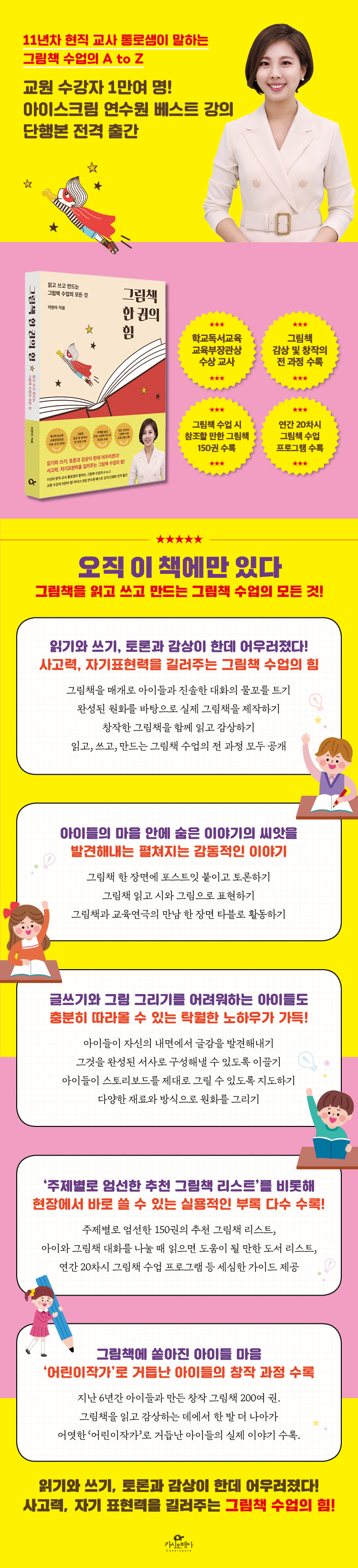
"The Power of a Picture Book" is a book written by a current teacher who has been consistently communicating with children and teaching picture book creation classes in public education for the past six years, and contains the entire process of picture book classes, from appreciation to creation, as well as his own teaching know-how.
The author has created over 200 original picture books with children.
Children who take the author's picture book class go beyond simply reading and appreciating picture books. They become full-fledged 'children's authors' through the process of honestly and boldly expressing their inner voice and creating a picture book.
Children are not beings who simply accept the world created by adults.
A creative being who feels alive when he reveals and radiates himself.
Instead of hearing the voices of adults, I wanted to hear the vivid voices of children.
In my classroom, at least, I wanted to empty out a single space on the crowded bookshelf and fill it with the children's voices.
I wanted to give the children the opportunity to express themselves and be themselves, at least once in their 12 years of school life.
(…) Children put their hearts into picture books as independent creators.
Children's works are filled with a world different from what adults imagine, a world seen through children's eyes, and a unique perspective that offers surprising insights.
I thought about it while listening to children's stories through picture book classes.
"Children are beings with their own language in their hearts." (From the Prologue)
Reading and writing, discussion and appreciation all come together!
The power of picture book classes that foster thinking and self-expression skills!
The author's picture book class is a little special.
This is because we aim to create a ‘picture book class where appreciation and creation form a virtuous cycle.’
For example, it is like this.
This involves sticking a post-it note on a scene from a picture book that resonates with you, writing down what you want to say or questions that come to mind, and then discussing the content or expressing your feelings through your body.
Or, after reading a picture book, you can try expressing your feelings through poetry and drawings.
In the process, children discover the seeds of story hidden within themselves and learn to speak and express their thoughts and feelings honestly.
It is not passive appreciation, but active and creative appreciation.
This kind of appreciation activity becomes a solid foundation for creating picture books.
If reading is inhaling, then expression is exhaling.
Just as I want to exhale after taking a deep breath, reading a picture book makes me want to express the stories that bloom within me.
Rather than a class that focuses solely on reading, I wanted to create a picture book class where reading and writing flow together in a healthy, virtuous cycle, like breathing in and out.
With that in mind, I studied a virtuous cycle reading class where appreciation and creation follow each other.
When reading and writing, discussion and appreciation lead to a virtuous cycle of creation, new things come in and accumulated things flow out.
Children's growth happened somewhere in between.
(From the 'Prologue')
When moving on to the full-fledged writing and drawing stages of picture book creation, the author's background and skills, having majored in Korean language education and art education, shine even brighter.
The book is filled with excellent picture book teaching know-how that even children who struggle with writing and drawing can easily follow, such as how to guide children to discover the writing material within themselves and compose it into a complete narrative, how to guide children to properly draw storyboards, and how to draw original pictures using various materials and methods other than paint.
Including a list of recommended picture books carefully selected by topic
Includes many practical appendices that can be used right away in the field!
In addition, the book contains a thorough explanation of the entire process of reading, writing, and creating picture books, including how to open up honest conversations with children through picture books, how to create and publish actual picture books based on completed original drawings, and how to read and appreciate the picture books created together.
And, by organizing all of this process through vivid conversations between the author and children in the classroom, we have organized the entire picture book class process to make it easier and more concrete to understand.
Additionally, QR codes for the children's creative picture books were included so that readers could view and refer to the actual results created through picture book classes.
We have also included a comprehensive appendix for teachers and parents who wish to conduct picture book classes with their children.
The book includes detailed and practical appendices at the end, including a list of 150 recommended picture books carefully selected by topic, a list of books that would be helpful to read before preparing for picture book classes, and a 20-lesson annual picture book class program created by the author based on his many years of experience teaching picture books.
Through "The Power of a Picture Book," let's take a step into the world of picture book classes that enhance children's thinking skills, self-expression skills, problem-solving skills, and self-esteem.
A story about a picture book class that grows one step further
Dozens of children's books are published every day, but most of them are written in adult voices.
Bookstores and libraries are filled with stories that adults want to tell children, stories that adults believe children need.
But do these books truly adequately convey the voices of children living in the "here and now"? Are there any works in which children become full creative agents, freely and honestly expressing their stories?
"The Power of a Picture Book" is a book written by a current teacher who has been consistently communicating with children and teaching picture book creation classes in public education for the past six years, and contains the entire process of picture book classes, from appreciation to creation, as well as his own teaching know-how.
The author has created over 200 original picture books with children.
Children who take the author's picture book class go beyond simply reading and appreciating picture books. They become full-fledged 'children's authors' through the process of honestly and boldly expressing their inner voice and creating a picture book.
Children are not beings who simply accept the world created by adults.
A creative being who feels alive when he reveals and radiates himself.
Instead of hearing the voices of adults, I wanted to hear the vivid voices of children.
In my classroom, at least, I wanted to empty out a single space on the crowded bookshelf and fill it with the children's voices.
I wanted to give the children the opportunity to express themselves and be themselves, at least once in their 12 years of school life.
(…) Children put their hearts into picture books as independent creators.
Children's works are filled with a world different from what adults imagine, a world seen through children's eyes, and a unique perspective that offers surprising insights.
I thought about it while listening to children's stories through picture book classes.
"Children are beings with their own language in their hearts." (From the Prologue)
Reading and writing, discussion and appreciation all come together!
The power of picture book classes that foster thinking and self-expression skills!
The author's picture book class is a little special.
This is because we aim to create a ‘picture book class where appreciation and creation form a virtuous cycle.’
For example, it is like this.
This involves sticking a post-it note on a scene from a picture book that resonates with you, writing down what you want to say or questions that come to mind, and then discussing the content or expressing your feelings through your body.
Or, after reading a picture book, you can try expressing your feelings through poetry and drawings.
In the process, children discover the seeds of story hidden within themselves and learn to speak and express their thoughts and feelings honestly.
It is not passive appreciation, but active and creative appreciation.
This kind of appreciation activity becomes a solid foundation for creating picture books.
If reading is inhaling, then expression is exhaling.
Just as I want to exhale after taking a deep breath, reading a picture book makes me want to express the stories that bloom within me.
Rather than a class that focuses solely on reading, I wanted to create a picture book class where reading and writing flow together in a healthy, virtuous cycle, like breathing in and out.
With that in mind, I studied a virtuous cycle reading class where appreciation and creation follow each other.
When reading and writing, discussion and appreciation lead to a virtuous cycle of creation, new things come in and accumulated things flow out.
Children's growth happened somewhere in between.
(From the 'Prologue')
When moving on to the full-fledged writing and drawing stages of picture book creation, the author's background and skills, having majored in Korean language education and art education, shine even brighter.
The book is filled with excellent picture book teaching know-how that even children who struggle with writing and drawing can easily follow, such as how to guide children to discover the writing material within themselves and compose it into a complete narrative, how to guide children to properly draw storyboards, and how to draw original pictures using various materials and methods other than paint.
Including a list of recommended picture books carefully selected by topic
Includes many practical appendices that can be used right away in the field!
In addition, the book contains a thorough explanation of the entire process of reading, writing, and creating picture books, including how to open up honest conversations with children through picture books, how to create and publish actual picture books based on completed original drawings, and how to read and appreciate the picture books created together.
And, by organizing all of this process through vivid conversations between the author and children in the classroom, we have organized the entire picture book class process to make it easier and more concrete to understand.
Additionally, QR codes for the children's creative picture books were included so that readers could view and refer to the actual results created through picture book classes.
We have also included a comprehensive appendix for teachers and parents who wish to conduct picture book classes with their children.
The book includes detailed and practical appendices at the end, including a list of 150 recommended picture books carefully selected by topic, a list of books that would be helpful to read before preparing for picture book classes, and a 20-lesson annual picture book class program created by the author based on his many years of experience teaching picture books.
Through "The Power of a Picture Book," let's take a step into the world of picture book classes that enhance children's thinking skills, self-expression skills, problem-solving skills, and self-esteem.
GOODS SPECIFICS
- Date of issue: April 9, 2020
- Page count, weight, size: 388 pages | 530g | 153*210*20mm
- ISBN13: 9791190776011
- ISBN10: 1190776014
You may also like
카테고리
korean


korean

![GQ KOREA Mark (Monthly): December [2025]](http://librairie.coreenne.fr/cdn/shop/files/8ef265dbbfbf186523ed75ba7319009d.jpg?v=1765340328&width=3840)


