

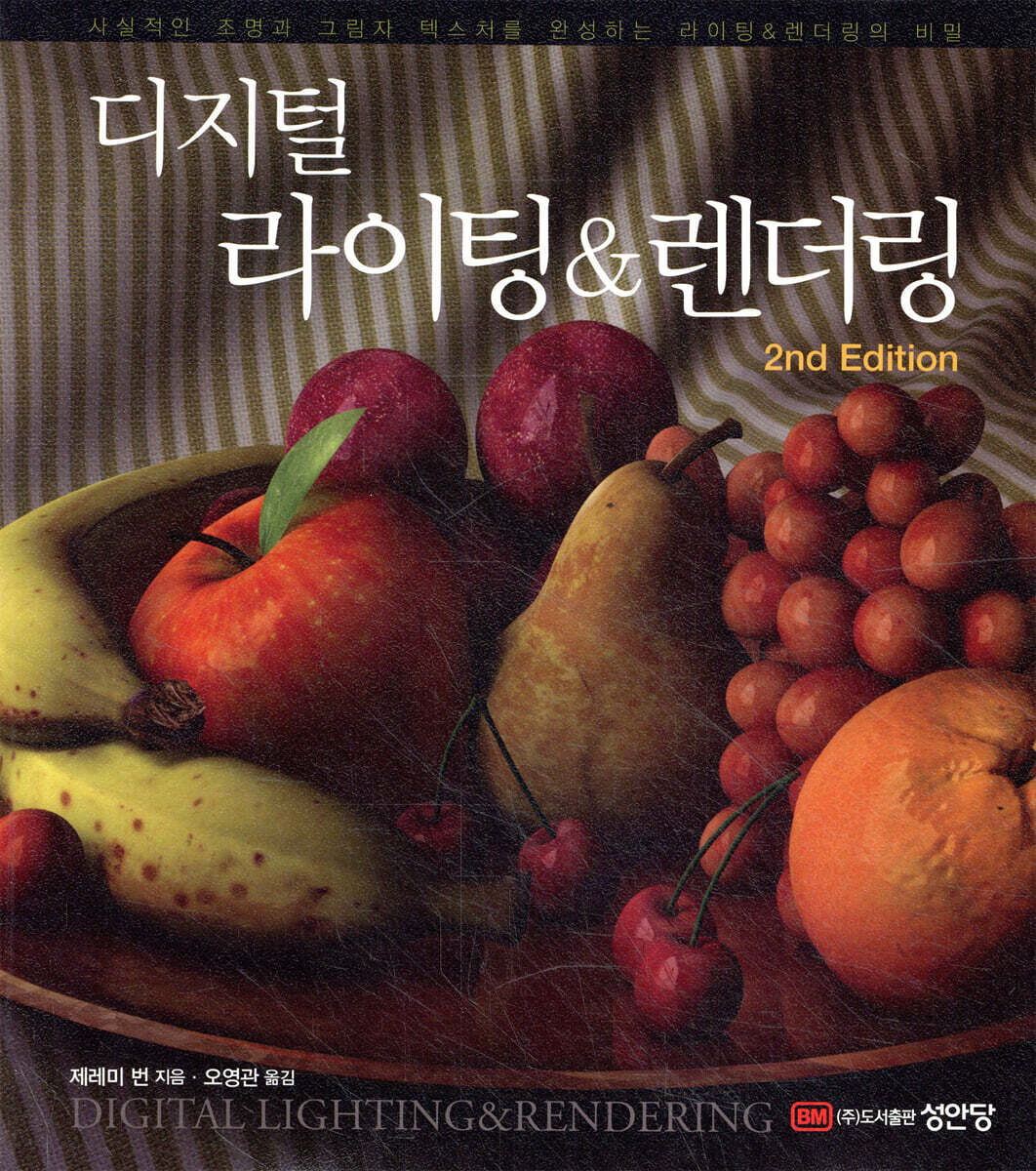
Digital Lighting & Rendering
 |
Description
Book Introduction
Meet the bible that sets the standard for 3D lighting and rendering techniques!
If you work in the CG field, you've probably heard of this book at least once.
This book covers lighting and rendering techniques for achieving professional, realistic lighting, shadows, and textures, regardless of software.
It is known as a standard textbook and bible in the relevant field, and its contents have been cited by many practitioners, knowingly or unknowingly.
This book, which explains the understanding of the surroundings and objects in relation to CG, is closer to a theory book than a technique book that focuses on programs.
However, it broadens your perspective on the work by explaining all elements of 3D graphics in a practical way, including sophisticated compositing, advanced rendering techniques, how to express camera properties, color implementation principles, structure, cinematography, and even the studio's production pipeline.
It's packed with fascinating topics that you won't want to skip a single page, and it's packed with the author's incredible insights and foresight, gleaned from his experience at Pixar Animation Studios.
This book will help beginners who are just starting out in CG build a solid foundation in digital lighting and rendering, while practical lighting workers will be able to keep it close by and fill in any gaps.
Between the ever-evolving state-of-the-art 3D techniques and the ever-changing principles that remain essential, this book will serve as a valuable guide.
If you work in the CG field, you've probably heard of this book at least once.
This book covers lighting and rendering techniques for achieving professional, realistic lighting, shadows, and textures, regardless of software.
It is known as a standard textbook and bible in the relevant field, and its contents have been cited by many practitioners, knowingly or unknowingly.
This book, which explains the understanding of the surroundings and objects in relation to CG, is closer to a theory book than a technique book that focuses on programs.
However, it broadens your perspective on the work by explaining all elements of 3D graphics in a practical way, including sophisticated compositing, advanced rendering techniques, how to express camera properties, color implementation principles, structure, cinematography, and even the studio's production pipeline.
It's packed with fascinating topics that you won't want to skip a single page, and it's packed with the author's incredible insights and foresight, gleaned from his experience at Pixar Animation Studios.
This book will help beginners who are just starting out in CG build a solid foundation in digital lighting and rendering, while practical lighting workers will be able to keep it close by and fill in any gaps.
Between the ever-evolving state-of-the-art 3D techniques and the ever-changing principles that remain essential, this book will serve as a valuable guide.
index
Chapter 01: The Basics of Lighting Design
motive
trickery
Visual Goals of Lighting Design
Lighting Challenge
Workspace
creativity
Chapter 02 The Basics of Writing and Proper Practice
starting point
Types of lights
Controllers and Options
Production Practice Lighting
Exercises
Chapter 03 Shadows and Occlusion
Visual functions of shadows
What kind of light needs shadow?
Color of shadow
Shadow size and perspective
Shadow Algorithm
Hard shadows and soft shadows
Occlusion
fake shadow
conclusion
Exercises
Chapter 04 Lighting of the Environment and Buildings
Daylight
night scene
Practical Light
Lighting through windows
Mimicking indirect light
Global Illumination
Ambient occlusion
Exercises
Chapter 05 Lighting and Animation of Creatures and Characters
Modeling with light
Three-point lighting
Light-specific features
Various issues in character animation lighting
Exercises
Chapter 06 Camera and Exposure
Understanding f-stops and depth of field
Frame rate
Realistic motion blur
Film speed
Exposure of the photo
Matching the imperfections of the lens
Exercises
Chapter 07 Composition and Direction
Types of shots
camera angle
Improved composition
Framing in Film and Video
Exercises
Chapter 08 The Art and Science of Color
Color mixing
color scheme
Color balance
Understanding RGB Color
digital color
Exercises
Chapter 09 Shaders and Rendering Algorithms
Surface shading
Antialiasing
Ray tracing
Raise algorithm
Z-buffer rendering
Scanline rendering
GPU acceleration and hardware rendering
Exercises
Chapter 10 Texture Design and Specification
Types of texture mapping
Textures using photos
Stylized textures
Resolution of texture maps
How to align texture maps
Procedural textures
Improved look
Exercises
Chapter 11 Rendering Passes and Compositing
Layer-by-layer rendering
Alpha Channel Issues
Pass-by-pass rendering
Lighting during the compositing stage
Matching live-action backgrounds
Exercises
Chapter 12: Production Pipeline and What Professionals Need
production pipeline
Get work approved
Working in the lighting field
motive
trickery
Visual Goals of Lighting Design
Lighting Challenge
Workspace
creativity
Chapter 02 The Basics of Writing and Proper Practice
starting point
Types of lights
Controllers and Options
Production Practice Lighting
Exercises
Chapter 03 Shadows and Occlusion
Visual functions of shadows
What kind of light needs shadow?
Color of shadow
Shadow size and perspective
Shadow Algorithm
Hard shadows and soft shadows
Occlusion
fake shadow
conclusion
Exercises
Chapter 04 Lighting of the Environment and Buildings
Daylight
night scene
Practical Light
Lighting through windows
Mimicking indirect light
Global Illumination
Ambient occlusion
Exercises
Chapter 05 Lighting and Animation of Creatures and Characters
Modeling with light
Three-point lighting
Light-specific features
Various issues in character animation lighting
Exercises
Chapter 06 Camera and Exposure
Understanding f-stops and depth of field
Frame rate
Realistic motion blur
Film speed
Exposure of the photo
Matching the imperfections of the lens
Exercises
Chapter 07 Composition and Direction
Types of shots
camera angle
Improved composition
Framing in Film and Video
Exercises
Chapter 08 The Art and Science of Color
Color mixing
color scheme
Color balance
Understanding RGB Color
digital color
Exercises
Chapter 09 Shaders and Rendering Algorithms
Surface shading
Antialiasing
Ray tracing
Raise algorithm
Z-buffer rendering
Scanline rendering
GPU acceleration and hardware rendering
Exercises
Chapter 10 Texture Design and Specification
Types of texture mapping
Textures using photos
Stylized textures
Resolution of texture maps
How to align texture maps
Procedural textures
Improved look
Exercises
Chapter 11 Rendering Passes and Compositing
Layer-by-layer rendering
Alpha Channel Issues
Pass-by-pass rendering
Lighting during the compositing stage
Matching live-action backgrounds
Exercises
Chapter 12: Production Pipeline and What Professionals Need
production pipeline
Get work approved
Working in the lighting field
Publisher's Review
Main contents of this book
* The best cinematic techniques to create results that can be used in any 3D program.
* Sophisticated synthesis between real-world environments and 3D models
* Advanced rendering techniques using subsurface scattering, global illumination, caustics, occlusion, and HDRI
*Creating realistic materials and painting elaborate texture maps
* A technique that mimics real camera properties such as f-stop, exposure time, depth of field, and natural color temperature for photorealistic rendering.
* Multi-pass rendering for maximum efficiency
* Understanding the production pipeline of visual effects studios and animation studios
* How to improve your lighting reel to get a job in the industry
Reviewer's note
If you work in CG, you've probably heard of this book at least once.
This book is a revised and expanded edition of 'Digital Lighting and Rendering' published in 2000.
The first book has already become the standard textbook and bible for 3D lighting and rendering techniques.
This revised edition reflects technological advances over time, with each chapter updated and many new techniques and concepts added.
Every page covers fascinating topics that you won't want to skip, and it's packed with the author's incredible insights and foresight, gleaned from his experience working at Pixar Animation Studios.
As this book is so famous and contains a wealth of information in various fields, it will be an opportunity for beginners who are just starting out with CG to build a solid foundation in digital lighting and rendering, and for practical lighting workers, it will be a good guidebook to keep by their side and fill in any gaps.
- Lee Hyuk (Raon4 director)
* The best cinematic techniques to create results that can be used in any 3D program.
* Sophisticated synthesis between real-world environments and 3D models
* Advanced rendering techniques using subsurface scattering, global illumination, caustics, occlusion, and HDRI
*Creating realistic materials and painting elaborate texture maps
* A technique that mimics real camera properties such as f-stop, exposure time, depth of field, and natural color temperature for photorealistic rendering.
* Multi-pass rendering for maximum efficiency
* Understanding the production pipeline of visual effects studios and animation studios
* How to improve your lighting reel to get a job in the industry
Reviewer's note
If you work in CG, you've probably heard of this book at least once.
This book is a revised and expanded edition of 'Digital Lighting and Rendering' published in 2000.
The first book has already become the standard textbook and bible for 3D lighting and rendering techniques.
This revised edition reflects technological advances over time, with each chapter updated and many new techniques and concepts added.
Every page covers fascinating topics that you won't want to skip, and it's packed with the author's incredible insights and foresight, gleaned from his experience working at Pixar Animation Studios.
As this book is so famous and contains a wealth of information in various fields, it will be an opportunity for beginners who are just starting out with CG to build a solid foundation in digital lighting and rendering, and for practical lighting workers, it will be a good guidebook to keep by their side and fill in any gaps.
- Lee Hyuk (Raon4 director)
GOODS SPECIFICS
- Date of publication: August 23, 2019
- Page count, weight, size: 440 pages | 1,174g | 210*235*30mm
- ISBN13: 9788931556193
- ISBN10: 8931556195
You may also like
카테고리
korean


korean

![GQ KOREA Mark (Monthly): December [2025]](http://librairie.coreenne.fr/cdn/shop/files/8ef265dbbfbf186523ed75ba7319009d.jpg?v=1765340328&width=3840)


