

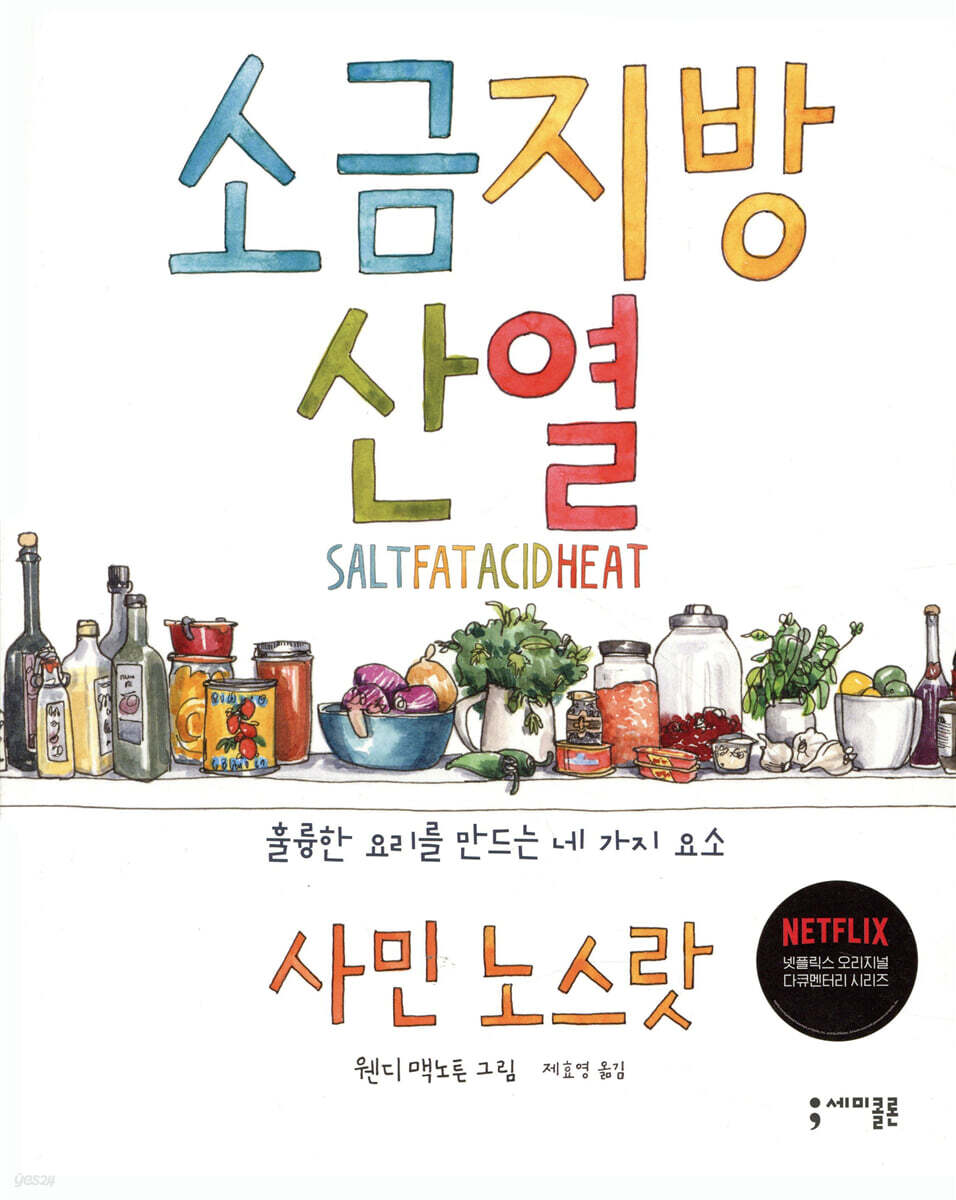
Salt Fat Acid Heat
 |
Description
Book Introduction
My own little checklist that I shout out every time I enter the kitchen
Here, there are people whose eyes grow as big as the universe when they find something delicious, and who laugh breathlessly as the food goes down their throats. Although he has not completed a formal cooking course, he is someone who cooks food with all his heart and eats it with all his heart. A person who can use not only their tongue and nose when approaching food, but also their ears. A person who is not afraid of new challenges and adventures, but rather loves them. His name is Samin Nosrat. As a student at the University of California, Berkeley, after seven months of saving money and learning the complex reservation system, he secured a table at the legendary restaurant Chez Panisse. Finally, on the day I go to Chez Panisse, I take the coins and notes I've been saving to the bank, exchange them for crisp bills, put on my best outfit, and head out. After a wonderful meal, I took a bite of the chocolate soufflé for dessert and was overcome with a powerful feeling. After that, I returned home, took the letter and resume, and went to the Chez Panisse restaurant again without any plan. Please let me participate in even the smallest thing here. The very next day, I was able to receive training by cleaning the floor and clearing the dishes, and a few weeks later, I was starting to get into the culinary world by nagging the chefs to help with kitchen work and attending menu meetings. After working at several prestigious restaurants, including 'Eccolo', he now spends his time tasting and exploring various flavors and ingredients from around the world. Salt, Fat, Acid, Heat is a new concept cookbook that distills decades of professional experience into just four elements. Since its publication in 2017, it has become a mega-bestseller, currently ranked #1 in the Amazon Books Overall Top 100 and Cooking Category, and its copyright has been sold to 15 countries around the world. In 2019, author Samin Nosrat was selected as one of Time magazine's "100 Most Influential People in the World," and a four-part documentary series of the same name was launched on Netflix, introducing the book to Korea. Semicolon, which has published major cookbooks such as "Silver Spoon," is publishing the Korean version of "Salt, Fat, Acid, Heat." |
- You can preview some of the book's contents.
Preview
index
Introducing this book
As we begin
How to use this book
Part 1.
The Four Elements of Great Cooking
salt
province
mountain
heat
What to make
Part 2.
Recipes and Advice
Basic kitchen knowledge
recipe
salad
dressing
vegetable
Broths and soups
Bean, grain, and pasta dishes
egg
fish
Thirteen Ways to Enjoy Chicken
meat
sauce
Food made with butter and flour
snack
Cooking practice
Recommended menu
Further Reading
Acknowledgements
References
Search
Note
About the Author & Illustrator
As we begin
How to use this book
Part 1.
The Four Elements of Great Cooking
salt
province
mountain
heat
What to make
Part 2.
Recipes and Advice
Basic kitchen knowledge
recipe
salad
dressing
vegetable
Broths and soups
Bean, grain, and pasta dishes
egg
fish
Thirteen Ways to Enjoy Chicken
meat
sauce
Food made with butter and flour
snack
Cooking practice
Recommended menu
Further Reading
Acknowledgements
References
Search
Note
About the Author & Illustrator
Detailed image

Into the book
Once you've mastered the secrets of salt, fat, acid, and heat, you too can experiment with improvisation in the kitchen.
Free from the pressure of having to prepare ingredients according to a set recipe or grocery list, you'll be able to leisurely select the best ingredients from farmers markets or butcher shops, and gain the confidence to create a balanced meal with them.
You'll also learn to trust your own taste buds, learn to adapt recipes, and cook with whatever ingredients you have on hand.
This book will change your overall "thoughts" about cooking and eating.
And no matter what kitchen you're in, what ingredients you're using, and what you're cooking, you'll find your own approach to cooking.
First, you can use the various recipes included in this book as a starting point.
In fact, even professional chefs consult recipes, not to follow every word, but to gain new inspiration and see the background and overall flow of the dish.
I promise you that you can not only cook well, but become a very good cook.
The reason I can say this with confidence is because it happened to me.
--- p.
5, from “Getting Started”
After developing a passion for cooking, I became an apprentice to Chef Christopher Lee of Chez Panisse.
He advised paying more attention to what goes on in the kitchen than to the tastings before the sale.
The story was that by looking at what chefs say and how they decide if a dish is good enough, you can find clues to becoming a skilled chef.
After actually doing that, I found that I could often revive a dish that seemed completely ruined by adjusting the amount of salt.
Salt control involves not only adding salt crystals, but also grating cheese or adding a little anchovy, olives, or capers.
It was then that I realized that the most important thing in cooking a good meal is to taste the food carefully in the kitchen, and especially to check the seasoning meticulously.
--- p.
18, from "Salt"
In four-legged animals that are fattened by eating a lot of calories, the central part of the body is the most delicious.
Fat accumulates in layers between muscle mass or just beneath the skin, such as the fat that forms on the outside of pork loin or beef ribs.
On the other hand, fat is sometimes mixed between the muscles, and this fat is valued more highly.
This is the fat called marbling in steak.
When a well-marbled steak is cooked, the fat melts and the meat becomes juicy, making it rich from the inside.
Because fat plays a role in transmitting flavor, most of the chemicals that make meat taste like beef (beef tastes like beef, pork tastes like pork, and chicken tastes like chicken) are more concentrated in the fat layer than in the lean meat, which is made up of muscle.
This is also why you can taste the chicken better when you eat thigh meat rather than breast meat, which has less fat.
--- p.
71, from "Local"
Vinegar? Have you ever heard of vinegar in soup? Was he crazy? Did I hear correctly? Not wanting to ruin a potful of soup, I scooped up a spoonful of my delicious soup and added a drop of red wine vinegar.
And the moment I tasted it, I was dumbfounded.
I thought it would taste terrible with the sweet and sour mixed together, but the vinegar seemed to reveal all the delicate flavors of the soup like a prism.
I could taste the butter, oil, onion, and broth, and even the sweetness and minerality of the carrots.
If you were blindfolded and asked to taste this soup and then guess the ingredients, I don't think you would ever realize that it contained vinegar, even if it took you a million years.
When I feel like something is missing from the food I've made, I can now pinpoint exactly what flavor is missing.
--- p.
103, from "Mountain"
I also learned that great cooks focus on the signals their senses give them rather than timers or thermometers.
Listen to the difference in the sound of the sausage sizzling, see the bubbling liquid begin to boil, feel the change in the tender pork shoulder over the course of several hours, and taste the noodles as they cook in the boiling water to determine if they are al dente.
I realized that for intuitive cooking, I had to learn to pay attention to these signals.
And I realized that I had to learn how food reacts to the fourth element of great cooking: heat.
--- p.
133, from "Heat"
Once you master one source, countless variations become possible.
This means that each person can change it spontaneously in any way they want.
Remember that every ingredient in a dish must have a clear purpose.
Pasta made with random ingredients gathered from around the kitchen usually ends up being a mess.
Even if you have to use ingredients you have available right now, the general rule is to limit the ingredients to six or fewer, excluding pasta, olive oil, and salt.
Before you finish cooking, don't forget to check that the salt, fat, and acid are in good balance.
Free from the pressure of having to prepare ingredients according to a set recipe or grocery list, you'll be able to leisurely select the best ingredients from farmers markets or butcher shops, and gain the confidence to create a balanced meal with them.
You'll also learn to trust your own taste buds, learn to adapt recipes, and cook with whatever ingredients you have on hand.
This book will change your overall "thoughts" about cooking and eating.
And no matter what kitchen you're in, what ingredients you're using, and what you're cooking, you'll find your own approach to cooking.
First, you can use the various recipes included in this book as a starting point.
In fact, even professional chefs consult recipes, not to follow every word, but to gain new inspiration and see the background and overall flow of the dish.
I promise you that you can not only cook well, but become a very good cook.
The reason I can say this with confidence is because it happened to me.
--- p.
5, from “Getting Started”
After developing a passion for cooking, I became an apprentice to Chef Christopher Lee of Chez Panisse.
He advised paying more attention to what goes on in the kitchen than to the tastings before the sale.
The story was that by looking at what chefs say and how they decide if a dish is good enough, you can find clues to becoming a skilled chef.
After actually doing that, I found that I could often revive a dish that seemed completely ruined by adjusting the amount of salt.
Salt control involves not only adding salt crystals, but also grating cheese or adding a little anchovy, olives, or capers.
It was then that I realized that the most important thing in cooking a good meal is to taste the food carefully in the kitchen, and especially to check the seasoning meticulously.
--- p.
18, from "Salt"
In four-legged animals that are fattened by eating a lot of calories, the central part of the body is the most delicious.
Fat accumulates in layers between muscle mass or just beneath the skin, such as the fat that forms on the outside of pork loin or beef ribs.
On the other hand, fat is sometimes mixed between the muscles, and this fat is valued more highly.
This is the fat called marbling in steak.
When a well-marbled steak is cooked, the fat melts and the meat becomes juicy, making it rich from the inside.
Because fat plays a role in transmitting flavor, most of the chemicals that make meat taste like beef (beef tastes like beef, pork tastes like pork, and chicken tastes like chicken) are more concentrated in the fat layer than in the lean meat, which is made up of muscle.
This is also why you can taste the chicken better when you eat thigh meat rather than breast meat, which has less fat.
--- p.
71, from "Local"
Vinegar? Have you ever heard of vinegar in soup? Was he crazy? Did I hear correctly? Not wanting to ruin a potful of soup, I scooped up a spoonful of my delicious soup and added a drop of red wine vinegar.
And the moment I tasted it, I was dumbfounded.
I thought it would taste terrible with the sweet and sour mixed together, but the vinegar seemed to reveal all the delicate flavors of the soup like a prism.
I could taste the butter, oil, onion, and broth, and even the sweetness and minerality of the carrots.
If you were blindfolded and asked to taste this soup and then guess the ingredients, I don't think you would ever realize that it contained vinegar, even if it took you a million years.
When I feel like something is missing from the food I've made, I can now pinpoint exactly what flavor is missing.
--- p.
103, from "Mountain"
I also learned that great cooks focus on the signals their senses give them rather than timers or thermometers.
Listen to the difference in the sound of the sausage sizzling, see the bubbling liquid begin to boil, feel the change in the tender pork shoulder over the course of several hours, and taste the noodles as they cook in the boiling water to determine if they are al dente.
I realized that for intuitive cooking, I had to learn to pay attention to these signals.
And I realized that I had to learn how food reacts to the fourth element of great cooking: heat.
--- p.
133, from "Heat"
Once you master one source, countless variations become possible.
This means that each person can change it spontaneously in any way they want.
Remember that every ingredient in a dish must have a clear purpose.
Pasta made with random ingredients gathered from around the kitchen usually ends up being a mess.
Even if you have to use ingredients you have available right now, the general rule is to limit the ingredients to six or fewer, excluding pasta, olive oil, and salt.
Before you finish cooking, don't forget to check that the salt, fat, and acid are in good balance.
--- p.
288, from "Recipe"
288, from "Recipe"
Publisher's Review
If you only know 'salt, fat, acid, and heat'
Anyone can make any food without a recipe,
You can even make it delicious
You're just starting out in the kitchen, and not everyone is an expert from the start.
Samin Nosrat speaks with a friendly and warm smile to us who are feeling lost.
“Anyone can make delicious food by mastering just four elements: salt, fat, acid, and heat.” Salt, which minimizes bitterness and balances sweetness; fat, which enhances flavor and creates texture; acid, which balances food; and heat, which creates variations in flavor and texture.
Samin Nosrat guides you through the fundamentals of cooking, delving into the four elements that make food taste better.
This book is largely divided into Part 1 and Part 2.
Part 1 introduces the individual properties of salt, fat, acid, and heat in detail.
Rather than a boring explanation based on simple theory, the author explains it in an easy-to-understand way by adding anecdotes from his own experiences, including what he saw, heard, and experienced in the kitchen or while attending classes.
It is full of interesting stories about the four elements that were learned from or influenced by world-famous culinary figures such as Alice Waters, the founder of Chez Panisse and an American chef, and Michael Pollan, who was a journalism teacher and also taught cooking.
If you read it more like an essay than a cookbook, you will be able to understand the four elements a little more clearly.
Salt is a type of mineral called sodium chloride, and is one of dozens of essential nutrients without which we cannot survive.
The human body cannot store much salt, so we need to consume salt.
The main function of salt in food is to enhance flavor.
It affects the texture of food and changes other tastes besides saltiness, but adding salt has the effect of strengthening and deepening the taste.
It is important to add salt ‘well’ rather than ‘a lot’.
Salt should be added in the right amount, in the right form, at the right time.
When used properly, salt minimizes bitterness, balances sweetness, adds flavor, and enhances our experience when eating food.
Depending on the purpose of use, you should choose the type of salt, whether it is sea salt or table salt, and the level of saltiness and the speed at which it dissolves in water vary between different manufacturers.
Fat is one of the four basic elements of good cooking and is the most basic element of all food, along with water, protein, and carbohydrates.
Fat acts as a reserve store of energy for later use and absorbs nutrients.
I can't imagine a food without fat.
Fat is an essential ingredient in achieving the full range of flavors and textures that a delicious food should have.
Understanding how fat is used in cooking will help you make smart decisions about which fat to use and how to prepare your food.
Commonly used fats in the kitchen include olive oil, butter, seed or nut oils, and animal fats such as pork or beef.
An acid is generally an acidic substance if its pH is lower than 7.
However, in cooking, anything that tastes sour when eaten is considered acidic.
Sour tastes produce the most saliva in our mouths.
The expression 'mouthwatering' is used in the same context to mean 'delicious'.
Sourness is generally more satisfying in food when used in contrast to other tastes rather than on its own.
It plays a role in balancing the food.
Even a small amount of this savory flavor can be enough to have a significant effect.
Lemon juice, vinegar, wine, cheese, fermented foods, coffee, chocolate, and tomatoes are all ingredients that add a pleasant sour taste to food.
Heat creates change.
Raw food becomes cooked food, and flowing ingredients take shape.
What was spread out becomes hard, what was flat becomes puffy, and what was pale becomes a golden brown.
It is an intangible element that is odorless and tasteless, but its influence is clear.
Chemical reactions initiated by heat affect the taste and texture of food.
There are various cooking methods available, including boiling, stewing, bain-marie, steaming, braising, frying, and broiling.
Part 2 contains practical recipes and various recommendations that will serve as a guide for applying what was explained in Part 1 to real-world situations.
Unlike the typical cookbook recipe presentation, it is organized in a sequential order that reflects the principles and lessons revealed while explaining salt, fat, acid, and heat.
"Thirteen Ways to Enjoy Chicken", "How to Easily Finish the Troublesome Chicken Preparation in Just a Few Steps", etc., help you understand the characteristics of basic ingredients and start cooking, starting with selecting ingredients and simple preparation tips.
It includes detailed descriptions and recipes for salads, vegetable dishes, soups, pasta, egg dishes, fish dishes, chicken dishes, meat dishes, and desserts, as well as base ingredients such as sauces and stocks.
You can also find exotic dishes such as Persian rice and Adas Polo, which are characteristic of the Iranian-American author, along with his extensive knowledge that covers almost all of the world, including the United States, Europe, Asia, and Africa.
What Samin Nosrat emphasizes in this book is that the suggested recipes should be considered recommendations only, and the cook's taste buds should be the final judge.
A thorough understanding of the four elements outlined above can inspire new cooking and help us make better decisions in the kitchen.
The ultimate goal is to teach you how to improvise and create creative dishes without a recipe, but until you develop that intuition, we've provided over 100 essential recipes, along with dozens of variations to help you along the way.
Here, Wendy McNaughton's quirky and humorous illustrations and infographics, over 150 of them, provide a comprehensive guide.
In particular, the diagrams that make it easy to understand ingredients used in each country around the world at a glance, such as 'Fats of the World' (page 72), 'Sour Flavors of the World' (page 110), and 'Tastes of the World' (page 194), as well as the illustrations placed throughout the book, such as 'Salt Calendar' (page 40), 'Caesar Salad' (page 48), 'Making Mayonnaise' (page 86), 'Vongole Pasta' (page 120), and 'Steamed Dishes' (page 166), are easy to understand and explain at a glance, while also adding to the visual enjoyment.
Furthermore, considerable effort was put into reproducing all of the English calligraphy that occupies the entire original book's illustrations in Korean handwriting rather than replacing it with computer fonts.
Through this process, we aimed to convey the feeling of the original book to Korean readers as much as possible and faithfully reproduce the author's intentions.
This work was actually undertaken by artist Hwang Ui-jeong, who had been studying painting and calligraphy through Wendy McNaughton's numerous works.
This book is a cookbook, but there are no pictures of food.
Samin Nosrat's message is that we should not limit our imagination when it comes to cooking, but rather try and fail enough.
We are confident that we will naturally come to understand 'why' and 'how' to make great food.
Anyone can make any food without a recipe,
You can even make it delicious
You're just starting out in the kitchen, and not everyone is an expert from the start.
Samin Nosrat speaks with a friendly and warm smile to us who are feeling lost.
“Anyone can make delicious food by mastering just four elements: salt, fat, acid, and heat.” Salt, which minimizes bitterness and balances sweetness; fat, which enhances flavor and creates texture; acid, which balances food; and heat, which creates variations in flavor and texture.
Samin Nosrat guides you through the fundamentals of cooking, delving into the four elements that make food taste better.
This book is largely divided into Part 1 and Part 2.
Part 1 introduces the individual properties of salt, fat, acid, and heat in detail.
Rather than a boring explanation based on simple theory, the author explains it in an easy-to-understand way by adding anecdotes from his own experiences, including what he saw, heard, and experienced in the kitchen or while attending classes.
It is full of interesting stories about the four elements that were learned from or influenced by world-famous culinary figures such as Alice Waters, the founder of Chez Panisse and an American chef, and Michael Pollan, who was a journalism teacher and also taught cooking.
If you read it more like an essay than a cookbook, you will be able to understand the four elements a little more clearly.
Salt is a type of mineral called sodium chloride, and is one of dozens of essential nutrients without which we cannot survive.
The human body cannot store much salt, so we need to consume salt.
The main function of salt in food is to enhance flavor.
It affects the texture of food and changes other tastes besides saltiness, but adding salt has the effect of strengthening and deepening the taste.
It is important to add salt ‘well’ rather than ‘a lot’.
Salt should be added in the right amount, in the right form, at the right time.
When used properly, salt minimizes bitterness, balances sweetness, adds flavor, and enhances our experience when eating food.
Depending on the purpose of use, you should choose the type of salt, whether it is sea salt or table salt, and the level of saltiness and the speed at which it dissolves in water vary between different manufacturers.
Fat is one of the four basic elements of good cooking and is the most basic element of all food, along with water, protein, and carbohydrates.
Fat acts as a reserve store of energy for later use and absorbs nutrients.
I can't imagine a food without fat.
Fat is an essential ingredient in achieving the full range of flavors and textures that a delicious food should have.
Understanding how fat is used in cooking will help you make smart decisions about which fat to use and how to prepare your food.
Commonly used fats in the kitchen include olive oil, butter, seed or nut oils, and animal fats such as pork or beef.
An acid is generally an acidic substance if its pH is lower than 7.
However, in cooking, anything that tastes sour when eaten is considered acidic.
Sour tastes produce the most saliva in our mouths.
The expression 'mouthwatering' is used in the same context to mean 'delicious'.
Sourness is generally more satisfying in food when used in contrast to other tastes rather than on its own.
It plays a role in balancing the food.
Even a small amount of this savory flavor can be enough to have a significant effect.
Lemon juice, vinegar, wine, cheese, fermented foods, coffee, chocolate, and tomatoes are all ingredients that add a pleasant sour taste to food.
Heat creates change.
Raw food becomes cooked food, and flowing ingredients take shape.
What was spread out becomes hard, what was flat becomes puffy, and what was pale becomes a golden brown.
It is an intangible element that is odorless and tasteless, but its influence is clear.
Chemical reactions initiated by heat affect the taste and texture of food.
There are various cooking methods available, including boiling, stewing, bain-marie, steaming, braising, frying, and broiling.
Part 2 contains practical recipes and various recommendations that will serve as a guide for applying what was explained in Part 1 to real-world situations.
Unlike the typical cookbook recipe presentation, it is organized in a sequential order that reflects the principles and lessons revealed while explaining salt, fat, acid, and heat.
"Thirteen Ways to Enjoy Chicken", "How to Easily Finish the Troublesome Chicken Preparation in Just a Few Steps", etc., help you understand the characteristics of basic ingredients and start cooking, starting with selecting ingredients and simple preparation tips.
It includes detailed descriptions and recipes for salads, vegetable dishes, soups, pasta, egg dishes, fish dishes, chicken dishes, meat dishes, and desserts, as well as base ingredients such as sauces and stocks.
You can also find exotic dishes such as Persian rice and Adas Polo, which are characteristic of the Iranian-American author, along with his extensive knowledge that covers almost all of the world, including the United States, Europe, Asia, and Africa.
What Samin Nosrat emphasizes in this book is that the suggested recipes should be considered recommendations only, and the cook's taste buds should be the final judge.
A thorough understanding of the four elements outlined above can inspire new cooking and help us make better decisions in the kitchen.
The ultimate goal is to teach you how to improvise and create creative dishes without a recipe, but until you develop that intuition, we've provided over 100 essential recipes, along with dozens of variations to help you along the way.
Here, Wendy McNaughton's quirky and humorous illustrations and infographics, over 150 of them, provide a comprehensive guide.
In particular, the diagrams that make it easy to understand ingredients used in each country around the world at a glance, such as 'Fats of the World' (page 72), 'Sour Flavors of the World' (page 110), and 'Tastes of the World' (page 194), as well as the illustrations placed throughout the book, such as 'Salt Calendar' (page 40), 'Caesar Salad' (page 48), 'Making Mayonnaise' (page 86), 'Vongole Pasta' (page 120), and 'Steamed Dishes' (page 166), are easy to understand and explain at a glance, while also adding to the visual enjoyment.
Furthermore, considerable effort was put into reproducing all of the English calligraphy that occupies the entire original book's illustrations in Korean handwriting rather than replacing it with computer fonts.
Through this process, we aimed to convey the feeling of the original book to Korean readers as much as possible and faithfully reproduce the author's intentions.
This work was actually undertaken by artist Hwang Ui-jeong, who had been studying painting and calligraphy through Wendy McNaughton's numerous works.
This book is a cookbook, but there are no pictures of food.
Samin Nosrat's message is that we should not limit our imagination when it comes to cooking, but rather try and fail enough.
We are confident that we will naturally come to understand 'why' and 'how' to make great food.
GOODS SPECIFICS
- Date of issue: January 28, 2020
- Format: Hardcover book binding method guide
- Page count, weight, size: 470 pages | 1,272g | 188*232*30mm
- ISBN13: 9791190403528
- ISBN10: 1190403528
You may also like
카테고리
korean


korean

![GQ KOREA Mark (Monthly): December [2025]](http://librairie.coreenne.fr/cdn/shop/files/8ef265dbbfbf186523ed75ba7319009d.jpg?v=1765340328&width=3840)


